12–37
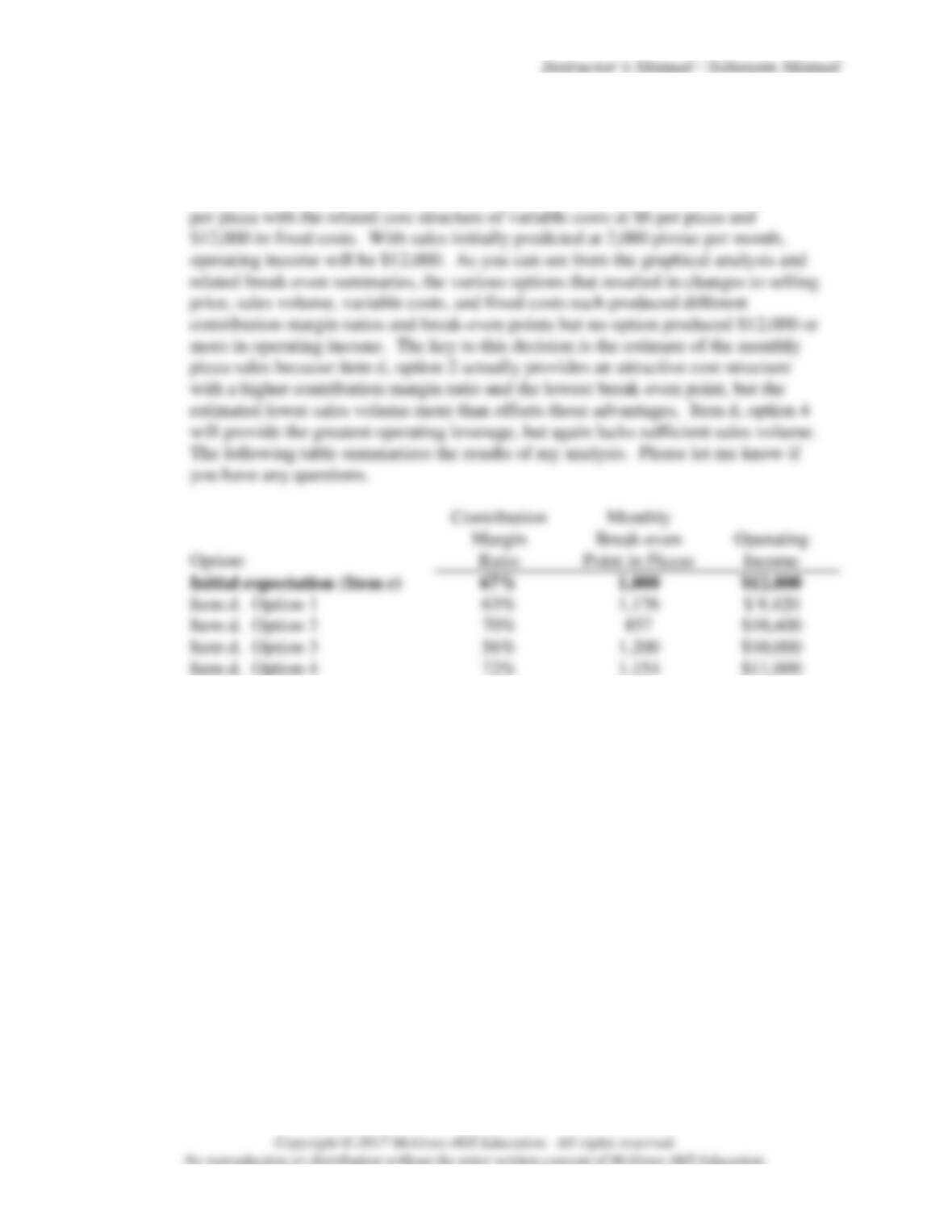
C12.33.
(continued)
e.
To: Dominic
From: Your Cost-Volume-Profit Analysis Person
Subject: Analysis Results
Option:
Point in Pizzas
Item d. Option 1
Item d. Option 2
Item d. Option 3
Item d. Option 4
It is recommended that you keep the selling price for the gourmet pizza line at $18
Chapter 12 Managerial Accounting and Cost-Volume-Profit Relationships
12–38
TAKE-HOME QUIZ: CHAPTER 12 NAME______________________
1. A university’s meal plan for students provides that 40% of a student’s meal fee is made
available to the student to purchase food at “cost.” At the end of the term, the student
receives a refund for any of this amount that has not been spent. The other 60% of the meal
fee is retained by the food service operation.
a. What is the cost behavior pattern assumed for the food consumed by the student?
b. What is the cost behavior pattern assumed for the 60% of the meal fee retained by the
food service operation?
c. Give an example of three costs that are probably included in the cost behavior
classification you identified in part b.
d. Is this meal plan more equitable to students than one in which all of the meal fee is
retained by the food service operation, and students can eat as much as they want?
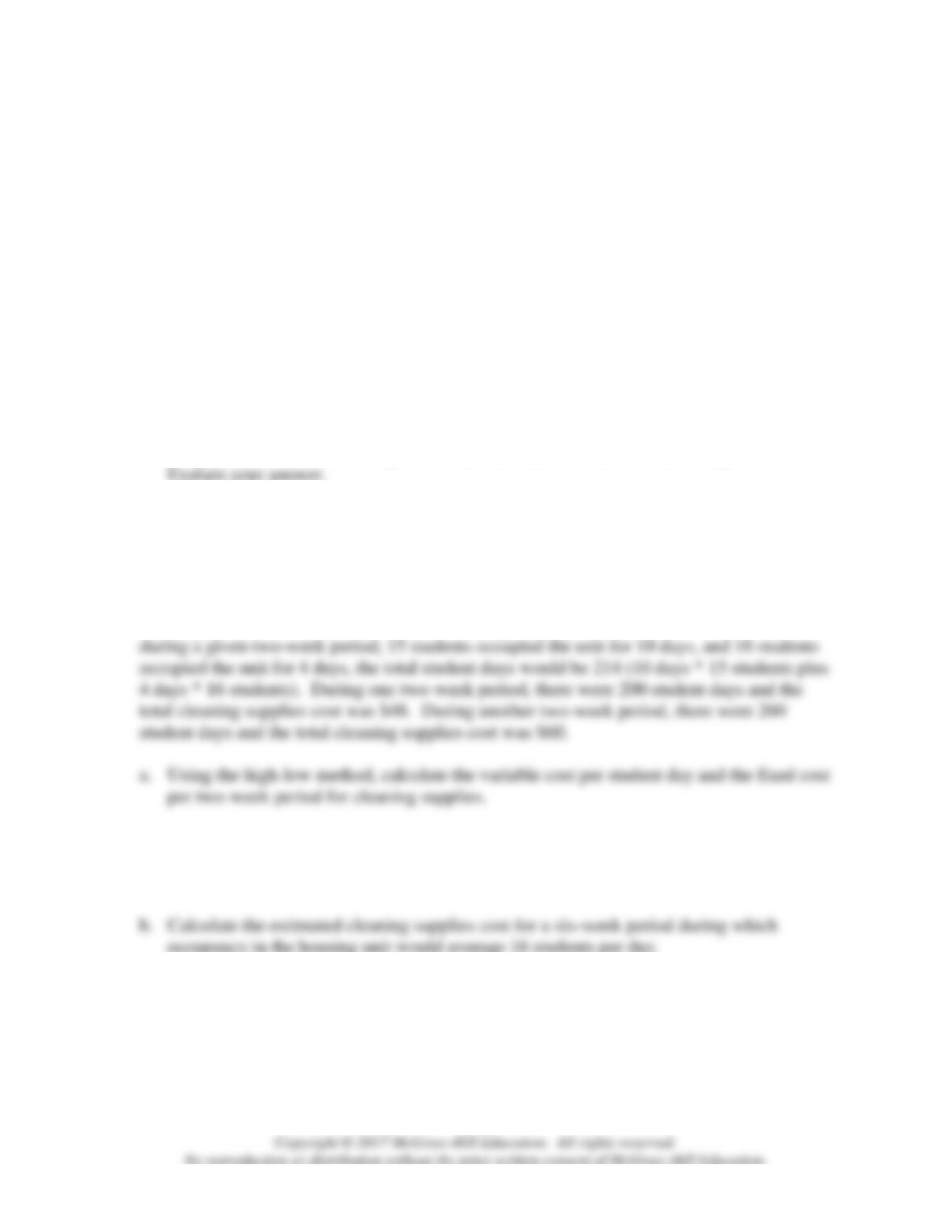
2. The cost of cleaning supplies used in a student-housing unit is believed to have a mixed cost
behavior pattern that is a function of the number of student days the unit is occupied. For
this purpose, a student day is defined as the occupancy by one student for one day. Thus, if
Instructor’s Manual / Solutions Manual
12–39
TAKE-HOME QUIZ: CHAPTER 12 (Continued)
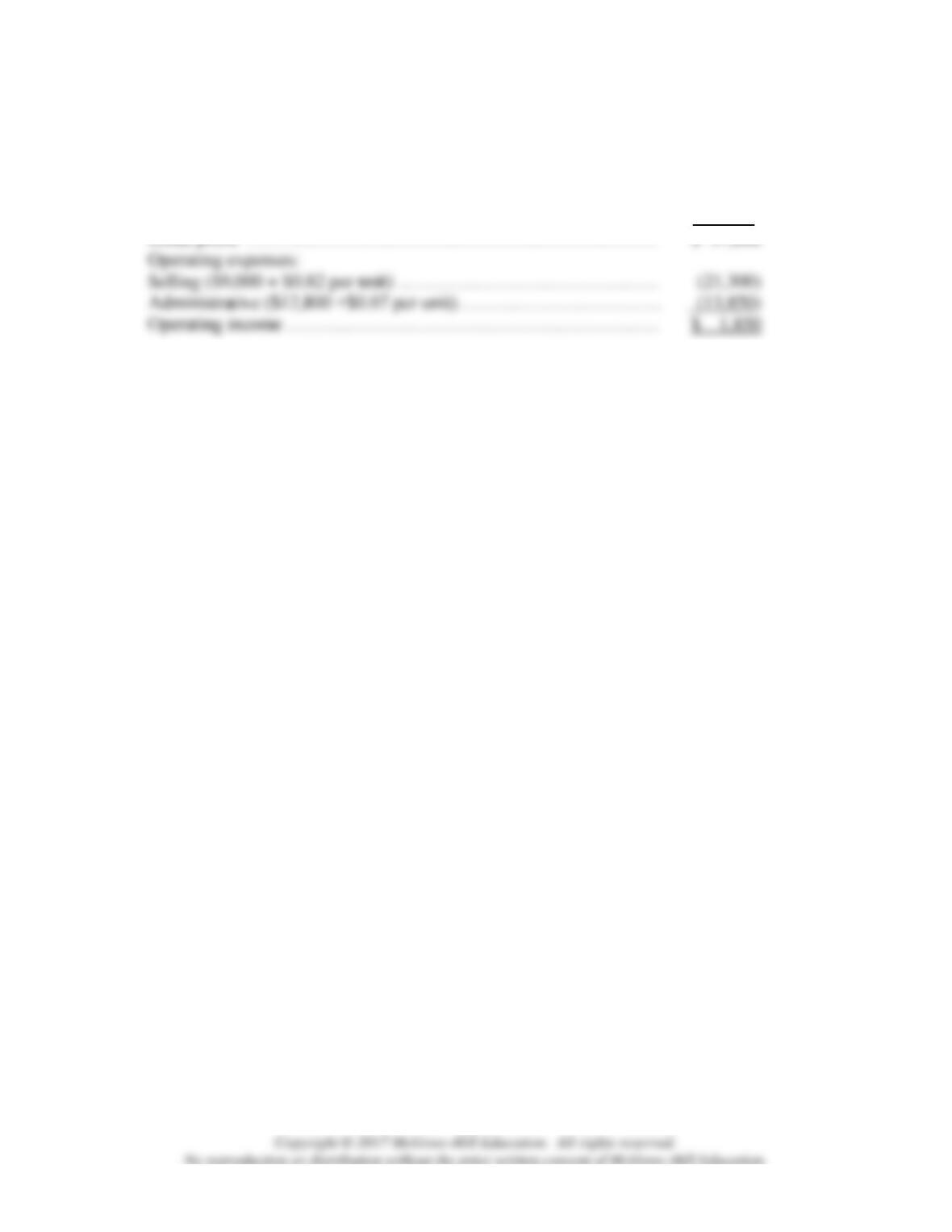
3. Shown below is an income statement in the traditional format for a firm that sells a single
product having a sales volume of 15,000 units. Cost formulas are also shown:
Sales …………………………………………………………………
$108,000
Cost of goods sold ($23,000 + $3.20 per unit) ………………………
(71,000)
Gross profit …………………………………………………………
$ 37,000
Administrative ($12,800 +$0.07 per unit)……………………………
Operating income ……………………………………………………
$ 1,850
a. Prepare an income statement in the contribution margin format.
b. Calculate the contribution margin per unit, and the increase in operating income if sales
volume increases by 3,000 units.
c. Calculate the firm’s break-even point in units.
Chapter 12 Managerial Accounting and Cost-Volume-Profit Relationships
12–40
TAKE-HOME QUIZ: CHAPTER 12 (Continued)
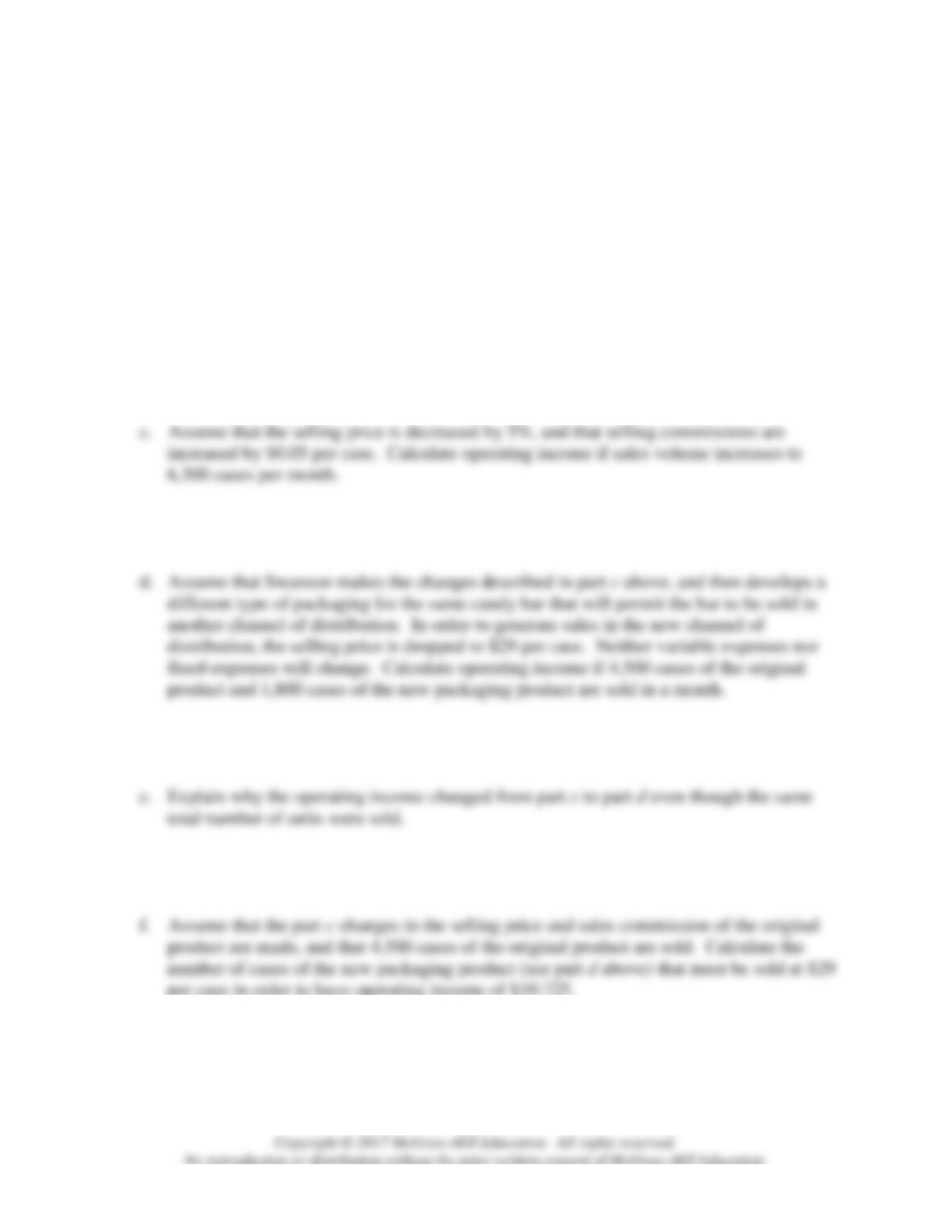
4. Swanson Candy Co. makes a candy bar that sells for $32 per case. Variable costs are
$19.20 per case, and fixed costs total $59,520 per month.
a. Calculate the number of cases of candy that must be sold each month for Swanson Candy
Co. to break even.
b. Calculate operating income if 5,300 cases are sold in a month.
Instructor’s Manual / Solutions Manual
12–41
TAKE-HOME QUIZ KEY: CHAPTER 12
1.
a.
Food consumed has a variable cost behavior pattern.
b.
The 60% charge would be for fixed costs.
c.
Fixed costs include the manager’s salary, depreciation, and some of the utility costs.
food service operation’s costs.
2.
a.
Variable rate = (High $ ─ Low $) / (High Activity ─ Low Activity)
= ($60 ─ $48) / (260 student days ─ 200 student days)
= $0.20 / student day
3.
a.
Sales ……………………………………………………………
$108,000
Variable expenses:
Cost of goods sold (15,000 units * $3.20 per unit)……………
$48,000
Selling expenses (15,000 units * $0.82 per unit) ……………
12,300
Fixed expenses:
Operating income ………………………………………………
4.
a.
Per Unit
*
Volume
=
Total
Revenue
$32.00
Variable Expense
19.20
Contribution Margin
$12.80
*
?
=
$ 59,520
Fixed Expense
(59,520)
Operating income
$ 0
? = 4,650 cases
c.
Per Unit
*
Volume
=
Total
Revenue
$30.40
Variable Expense
19.25
Contribution Margin
$11.15
*
6,300
=
$70,245
Fixed Expense
(59,520)
Operating income
d.
CM from New Packaging:
Per Unit
*
Volume
=
Total
Revenue
$29.00
Variable Expense
19.25
Contribution Margin
$ 9.75
*
1,800
=
$17,550
CM from Original
Packaging:
$11.15
*
4,500
=
50,175
Total contribution margin
Fixed Expense
(59,520)
Operating income
e.
Operating income dropped because the contribution margin on the new packaging product
is less than the contribution margin on the original packaging product.
f.
The difference in operating income (under part d as compared to the original packaging
only in part c) = $2,520 ($10,725 ─ $8,205). To make up for this difference and thus