VII. Your Turn: The Role of Labor Costs in Retail Electronics
Summary of Case
The case discusses Circuit City’s decision in 1997, to replace some of its highest-paid
employees with lower-paid workers. Some commentators attributed the loss it suffered in the
Learning Objective
Understand the impact of the change in Circuit City and Best Buy’s compensation strategy on
the companies’ performance.
Discussion of Case Issues
Evaluate whether the replacement of highly paid workers with lower-paid workers did or did
not cause Circuit City to perform so poorly. Will Best Buy face the same fate as Circuit City
because of its cost cutting measures and low sales of expensive items? How confident are you
in your evaluation? Why? What other data or information would be helpful in assessing
Circuit City change in compensation strategy.
Teaching Guidelines
Use this case to stimulate a discussion on restructuring and analyze the impact of replacement
of highly paid workers with lower-paid workers on the performance of Circuit City and the
effect the cost cutting measures taken by Best Buy on its sales and competitive edge.
Student opinion on this topic may vary. While some students may favor the argument that the
replacement of workers resulted in poor performance of the company, some may take a
neutral stand and believe that the cause and effect relationship between the two variables can
be proved only if additional data is provided. The following inputs can be considered to guide
the discussion.
Exhibit 1.4: Pay Rates at Retail Stores, Customer Satisfaction, Employee Turnover, and Sales
per Square Foot
high in the same year.
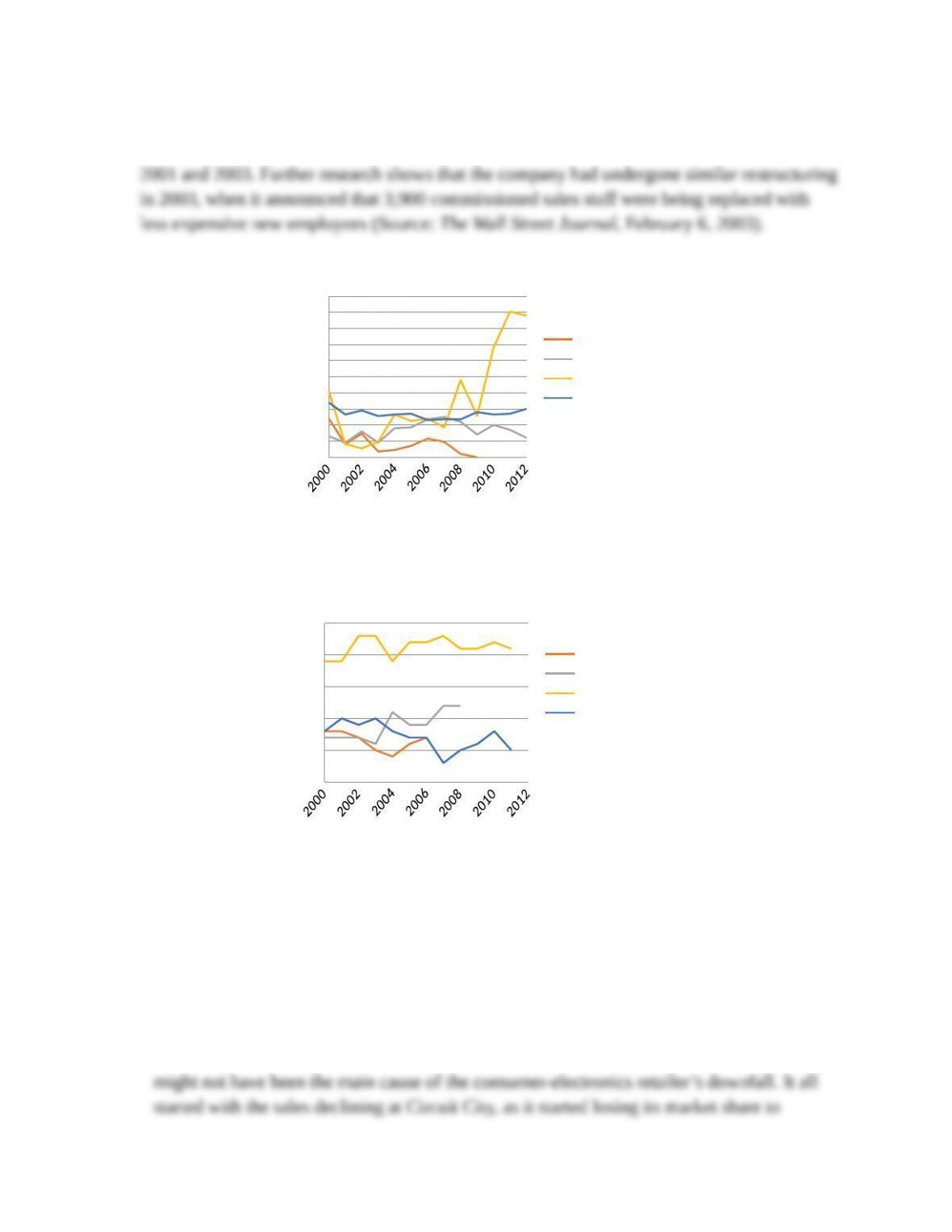
If you plot a graph, it will show a dip in the stock price of Circuit City during the periods of
0
20
40
60
80
100
120
140
160
180
200
Comparison of Circuit City, Best Buy, Amazon and Walmart- Stock Prices
Circuit City
Best Buy
Amazon
Wal-Mart
U.S. Dollars
65
70
75
80
85
90
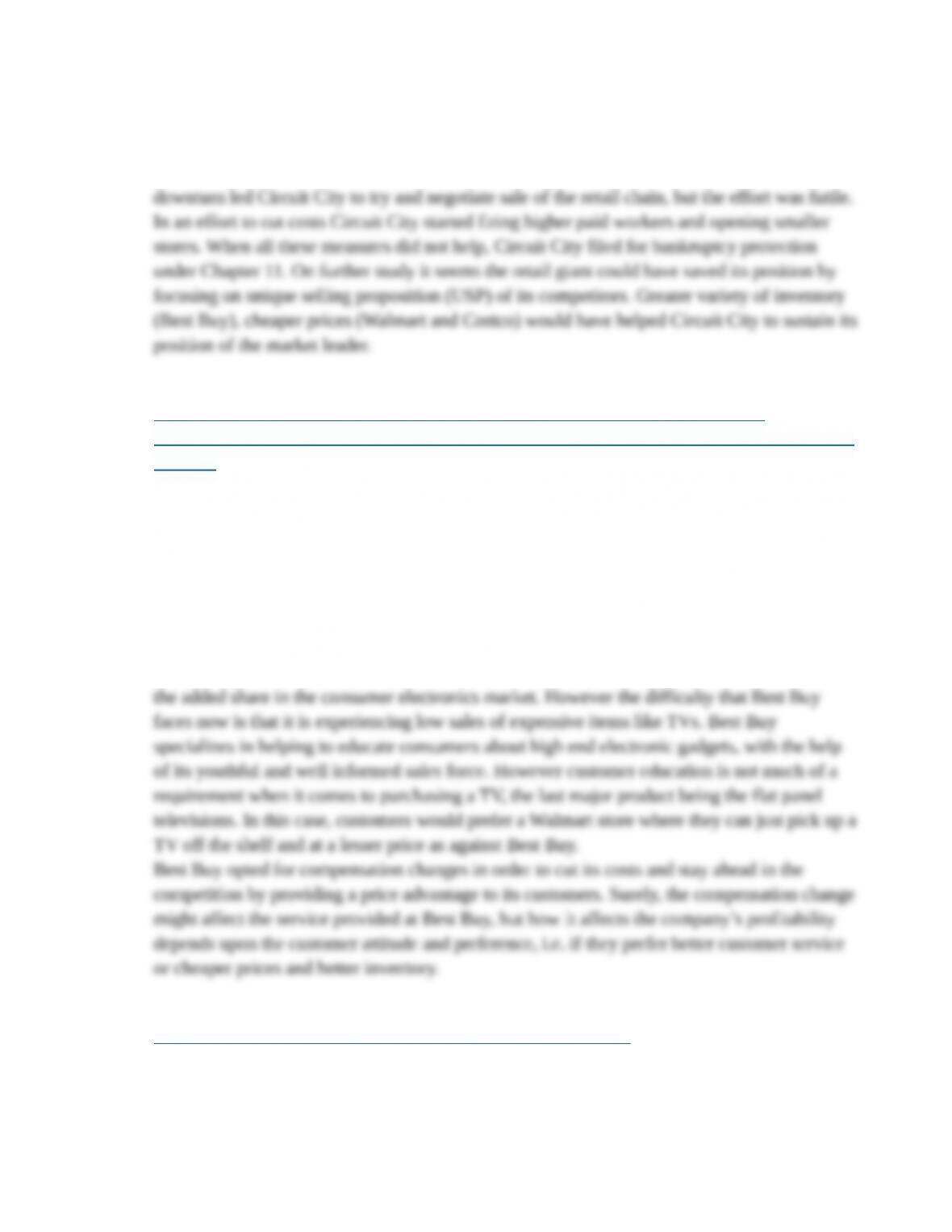
Comparison of Circuit City, Best Buy, Amazon and Walmart- ASCI Index
Circuit City
Best Buy
Amazon
Wal-Mart
ASC I Index
Discussion of Case Questions
1. Thinking back to our discussion in the chapter section, Caveat Emptor—Be An
Informed Consumer, evaluate whether the replacement of highly paid workers with
lower-paid workers did or did not cause Circuit City to perform so poorly. How
confident are you in your evaluation? Why?
Student answers will vary. There are several reasons why Circuit City went bankrupt. Though
the replacement of highly paid workers with lower paid workers was one of the reasons, it
Minnesota based specialty electronics retailer Best Buy, the world’s largest retailer Walmart,
discount club stores like Costco and online retailers. Slow sales led to suppliers who cut off
credit and demanded cash up front for supplies. This situation coupled with the economic
Sources:
http://www.bloomberg.com/apps/news?pid=newsarchive&sid=aMuM9XCHkNeo
http://www.cbsnews.com/8301-505125_162-28241493/eight-reasons-why-circuit-city-went-b
ankrupt/
2. Do you believe that the compensation changes at Best Buy are a major reason for its
current difficulties?
Best Buy is the nation’s largest specialty electronics retailer and positioning itself as a sales
and quality service provider, who assists consumers in making informed purchases. Walmart,
world’s largest retailer, on the other hand boasts of a large customer base and is positioning
itself as a low-cost option in consumer electronics. Ever since the electronics retail giant
Circuit City, went bankrupt Best Buy and Walmart have been fighting tooth and nail to capture
Source:
http://knowledge.wharton.upenn.edu/article.cfm?articleid=2191
3. Why are Walmart, Sam’s Club, and Costco doing better than Best Buy (and Circuit
City)? Do they have high pay?
Each of the three competitors of Best Buy has their own Unique Selling Propositions (USP).
Walmart has a large customer base and the scale gives it the ability to negotiate sharp prices
service.
Costco has little to offer in the way of support services but it offers customers to book cheap
Best Buy has a youthful and well informed sales force, which can help customers make
informed purchase decisions. The reason the other three are giving stiff competition to Best
Sources:
http://www.cheapism.com/sams-or-costco
http://knowledge.wharton.upenn.edu/article.cfm?articleid=2191
4. Are there larger problems in the competitive landscape for Best Buy that cannot be
solved by compensation strategy changes alone? When customers look to buy
electronics, what options do they have other than Best Buy and why would they
choose these options over Best Buy? Where do customers “test drive” the product and
where do they buy it? Can compensation changes address these challenges? Explain.
Best Buy faces very strong competition from Walmart, as the latter has a large customer base
and it sells everything from groceries, to apparels and electronics. Also Walmart offers a wide
range of products at lower prices. This is possible for Walmart to achieve because of its scale
Source:
http://knowledge.wharton.upenn.edu/article.cfm?articleid=2191
5. Is Best Buy focusing too much or too little on cost reduction? Explain.
Answers to Review Questions
1. How do differing perspectives affect our views of compensation?
From a societal perspective, compensation may be viewed as:
a measure of the inherent equity and justice in a society (examine the wages of similarly
situated men versus women, blacks versus whites, etc.).
From a stockholder perspective, compensation may be viewed as:
From a managerial perspective, compensation may be viewed as:
From an employee perspective, compensation may be viewed as:
a return for services rendered.
a reward for meritorious performance.
From a global perspective, compensation may be used to convey more contemporary
meanings:
2. What is your definition of compensation? Which meaning of compensation seems most
appropriate from an employee’s view: return, reward, or entitlement? Compare your
ideas with someone with more experience, someone from another country, someone from
another field of study.
likely to differ based on a combination of various factors such as age, occupation, family
status, etc.
3. What is the “network of returns” that your college offers your instructor? What returns
do you believe make a difference in teaching effectiveness? What “returns” would you
change or add to increase the teaching effectiveness?
The “network of returns” an instructor receives will depend on the type of college or
upon.
If an instructor attends a research university, the most appropriate network is the probability to
explore the chosen field of academics in detail, along with the ability to receive appropriate
colleges), the most appropriate network would probably include extensive facilities that allow
the instructor to access the latest studies, so as to be able to correlate the knowledge with the
Student recommendations will vary depending on the type of college or university attended.
4. What are the four policy issues in the pay model? What purposes do the objectives in the
pay model serve?
regulations. Efficiency can be correlated to improving performance, increasing quality,
delighting customers, and stockholders, and also to controlling labor costs. Fairness is a
fundamental objective that ensures fair treatment of all the employees by recognizing both
5. List all the forms of pay you receive from work. Compare your list to someone else’s list.
Explain any differences.
The different forms of pay will definitely depend on the types of jobs a student has held and
psychological, non-financial returns (e.g. recognition and status, employment security,
challenging work, opportunities to learn, personal satisfaction from successfully facing new
challenges, and teaming with great co-workers).
6. Answer the three questions in the Caveat Emptor—Be An Informed Consumer section for
any study or business article that tells you how to pay people.
Note: Student responses will vary depending on the type of compensation article the student
(1) Is the research useful?
Many studies use managers’ opinions as measures of success. For example, Rynes, Colbert,
and Brown (2002; see footnote #54) conducted a study that surveyed 5000 HR managers and
compared their beliefs to the research evidence in several areas and identifies seven common
The types of variables used in research studies and how they are measured significantly
measures (customer satisfaction), and opinions of managers (i.e. how effective is your
gain-sharing plan?).
Thus, answering the question, “is the research useful?” requires separating opinions from facts
(2) Does the study separate correlation from causation?
Empirical research studies typically employ statistical analysis techniques to analyze the
variables of interest. The correlation coefficient is a common measure of association and
On the other hand, even if the results had indicated a relationship existed between increased
levels of employee participation and satisfaction with pay, this relationship (measured by the
Research on compensation often attempts to answer questions that do not involve causality.
(3) Are there alternative explanations?
Research studies focused on compensation often examine the impact of a certain type of pay
(i.e. change in leadership, use of new supplier vendors, and change in operating procedures)?
The best way to establish causation is to explore competing explanations for the improved
performance results, either statistically or through the use of control variables. Research
methodology emphasizes or “requires” that alternative explanations need to be accounted for