44
CHAPTER 9
Triads in Second Inversion
Today’s students often have a difficult time accepting the notion that a triad is dissonant (unstable) simply because it
occurs in second inversion. We have found it useful at this point to emphasize that we are studying a restricted
style—an important style, but restricted nonetheless—and that this style depended to a large extent upon historical
precedents (see the Introduction to Chapter 9 in the text).
Our analytical symbols for six–four chords are not standard and attempt to reflect the embellishing nature of this
sonority. Those who find our symbols too fussy (the parentheses and so forth) may simply ignore them. To the usual
list of six–four types we have added those six–fours created by bass arpeggiations and by the melodic bass, both
frequent sources of confusion in analysis.
Answers to Selected Exercises
Exercise 9-1
A. 1. There are two cadential six–four chords and one pedal six–four chord (in m. 5).
5
2. Both six–four chords are passing six–fours.
45
3. The IVw is a pedal six–four. The first Iw is a passing six–four, and the second one is a cadential six–four.
38
4. The IVw is a pedal six–four.
112 116 121
Chapter 9
45
5. The Vw is a passing six–four. Notice that the first 8 measures take the melody line from ¡ through ™ to £ over a ¡
– ∞ – ¡ bass, while the next 8 measures of the melody consist essentially of a descent from § to ¡.
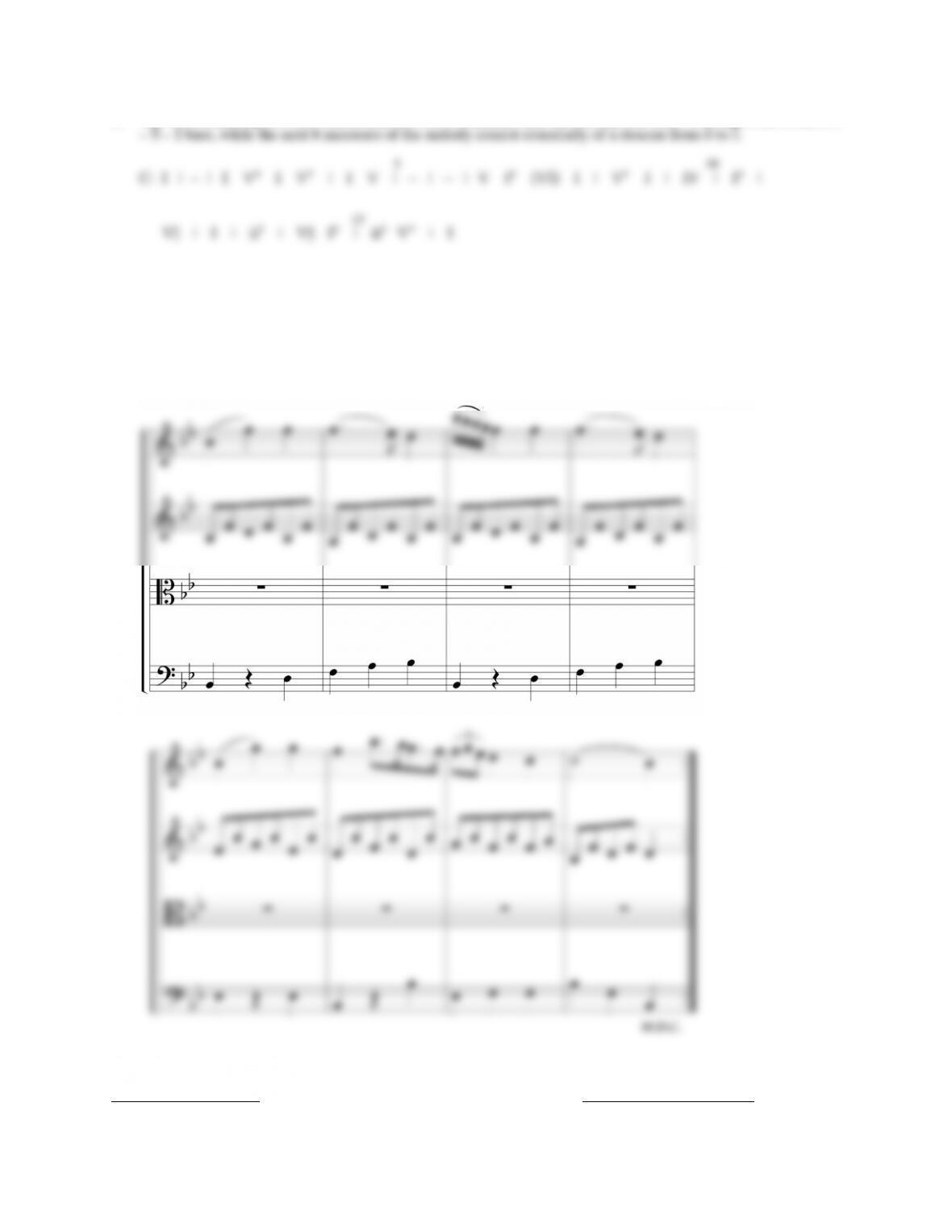
F. This exercise is drawn from music literature. Haydn’s original makes use of arpeggiated and cadential six–four
chords. The cadential six–four appears on the normally weak second beat, as is common in triple meter in this
style. (The “M.D.C.” at the bottom stands for “Menuetto da capo” and directs the musicians back to the
beginning of the movement.
Haydn: String Quartet, Op. 3 No. 5, III, mm. 37–44.
___________________ ______________________
(section) (name)
Chapter 9
46
Chapter 9 Quiz
A. Besides six–four chords that arise through bass arpeggiation or melodic bass lines, list three other types of six–
four chords discussed in Chapter 9.
1.
2.
3.
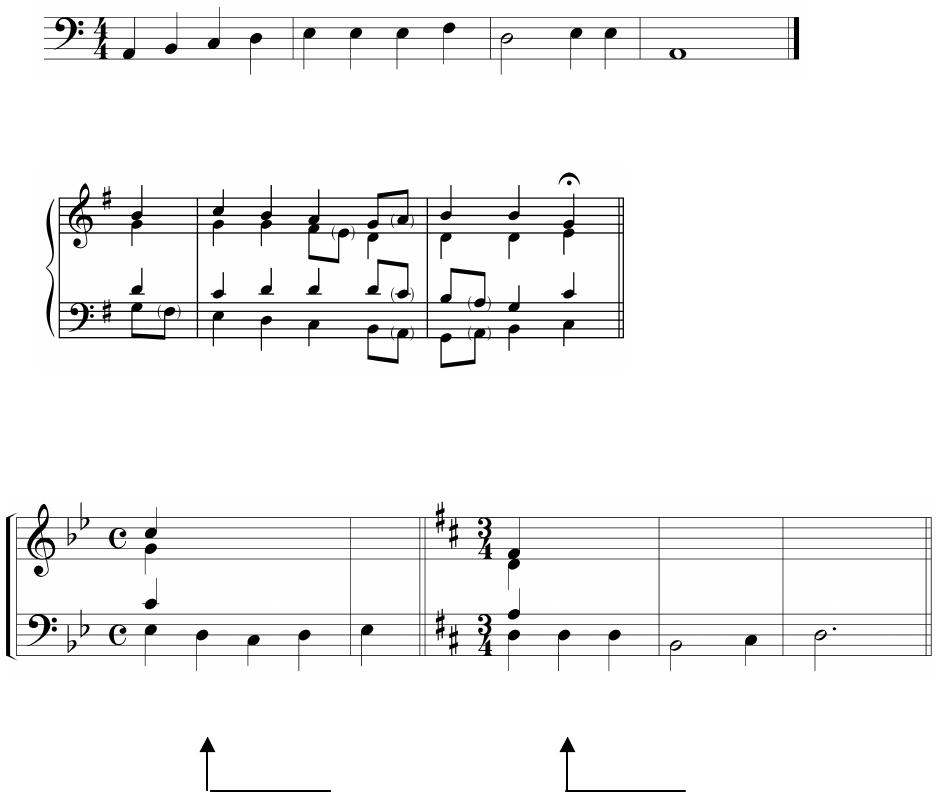
B. Show with roman numerals a good harmonization of the bass line below, being sure to include a good example
of one of each of the six–four chord types that you listed above, and show where each one occurs.
a:
C. Analyze this excerpt with roman numerals, and identify the types of any six–four chords that are used.
D. Add three upper parts to each example to create a good four–part texture, and identify the types of six–four
chords that are used.
g: 4q (1w) 20q % ^ D: ! ($w) ! $q %q !
Chapter 9
Key for Chapter 9 Quiz
A. Besides six–four chords that arise through bass arpeggiation or melodic bass lines, list three other types of six–
four chords discussed in Chapter 9.
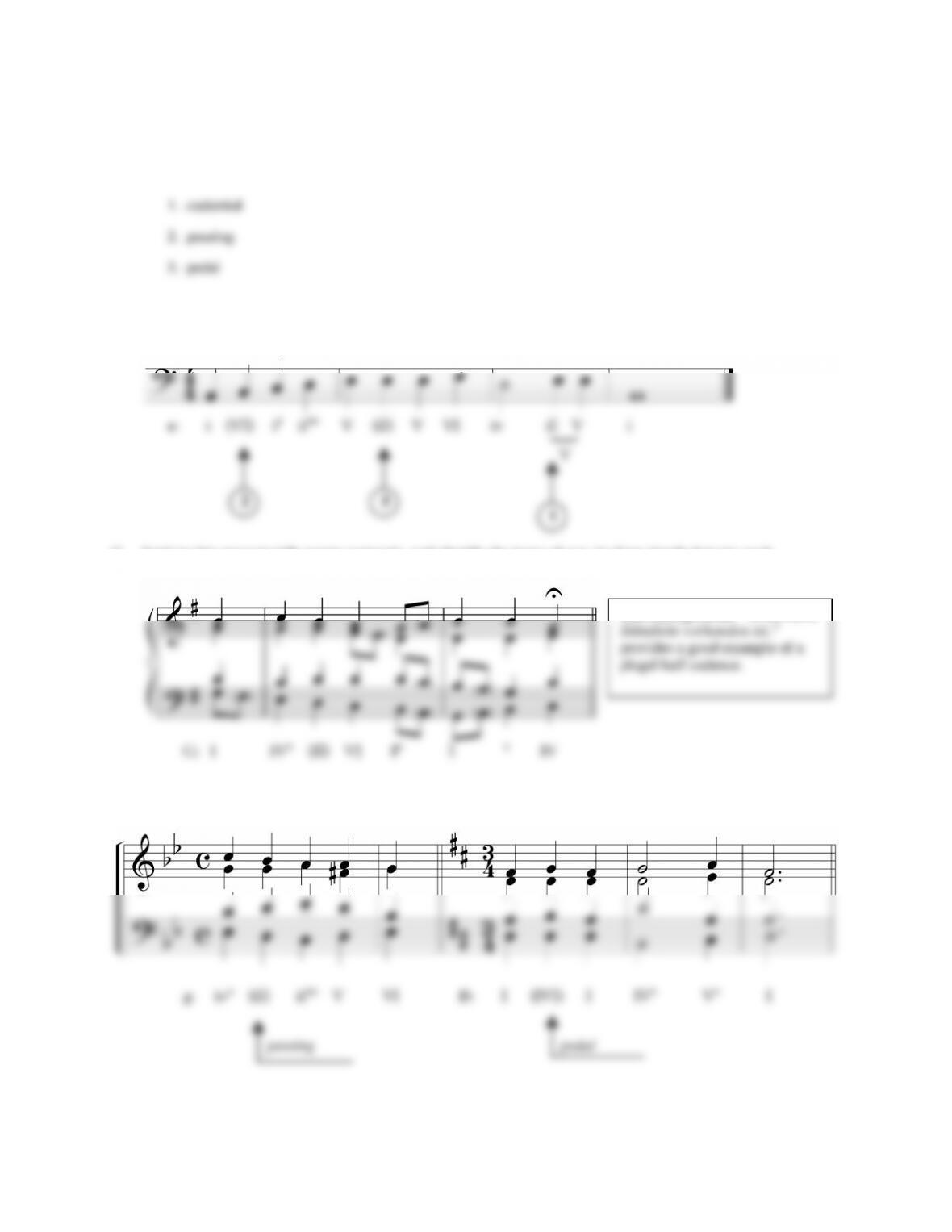
B. Show with roman numerals a good harmonization of the bass line below, being sure to include a good example
of one of each of the six–four chord types that you listed above, and show where each one occurs.
a: 1 (%w) 1q 20q % (1w) % ^ 4 1w % 1
G: ! $q (!w) %y !q a q $
D. Add three upper parts to each example to create a good four–part texture, and identify the types of six–four
chords that are used.
This excerpt, from “Wenn mein
Stündlein vorhanden ist,”
provides a good example of a
plagal half cadence.