24
CHAPTER 4
Diatonic Chords in Major and Minor Keys
This chapter begins by attempting to dispel the notion, so often held by students, that a tonal composer chooses from
a menu of three scales before beginning a piece in the minor mode. The fact is, of course, that diatonic minor mode
music is more complicated than diatonic music in the major mode because of the variability of § and ¶. It is fair to
say that in minor most melodic pitches conform to the melodic minor scale and most harmonic pitches belong to the
harmonic minor scale, but exceptions are so common as to render such a “rule” useless.
These complications are encountered when triads and seventh chords in minor are presented. Instead of following
the simpler but misleading system of forcing chords to conform to the harmonic minor scale, we include as norms
three chords from outside of that scale: III, i7, and IIIM7.
Class activities should include a great deal of drill, especially involving triads. Brain twisters like “F is the 5th of a
vi chord in what major key?” and “F# is the bass note of a Vt in what minor key?” will challenge even the best
students and help to develop skills essential for analysis.
Answers to Selected Exercises
Exercise 4-1
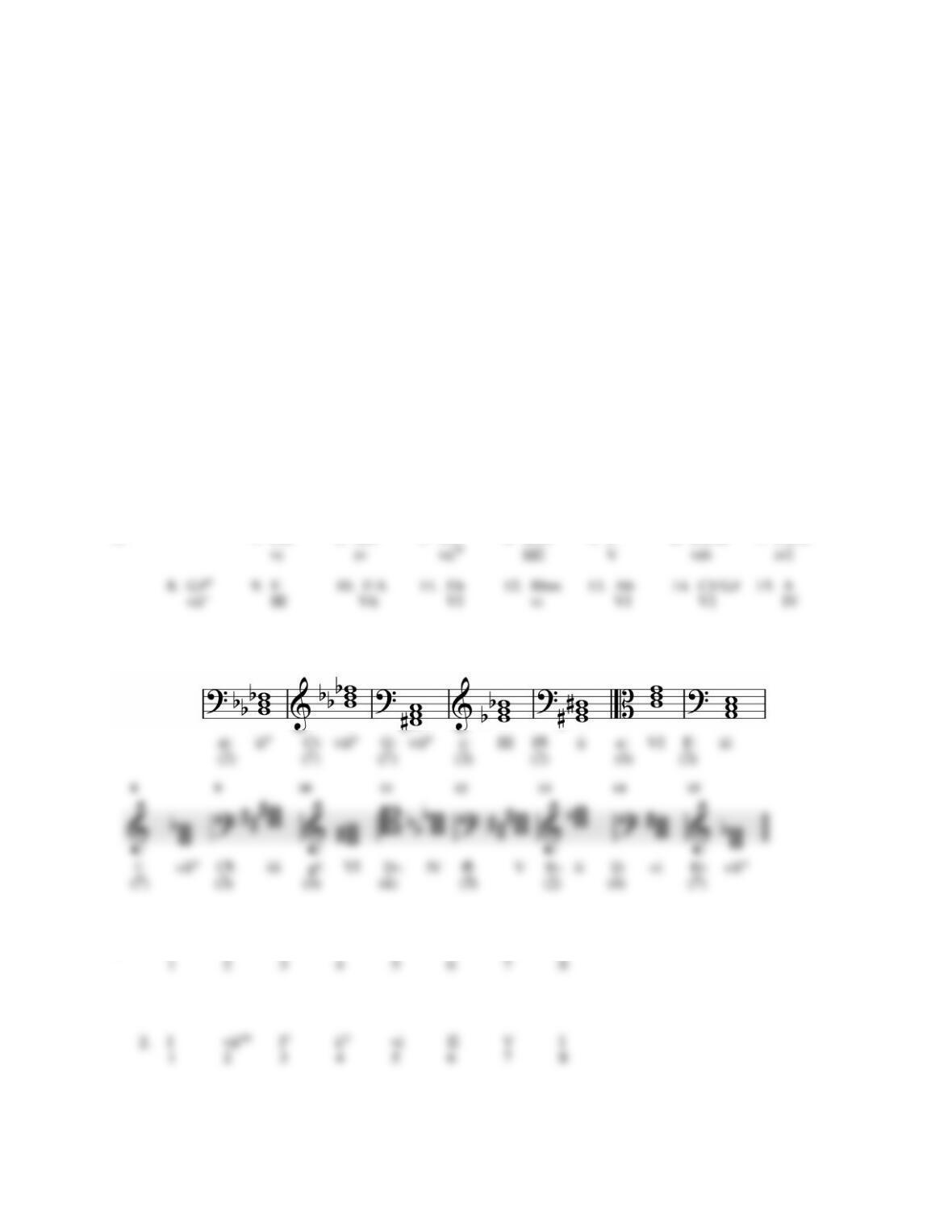
A. 1. Cm 2. Bm 3. D#0 4. Bb/F 5. C 6. Em/G 7. Fm/C
vi iv vii0 IIIw V vi6 ivw
B. 1 2 3 4 5 6 7
ab: 20 Cb: 70 G: 70 c: III Fm: ii e: VI F: iii
C. 1. I Vq IVq V Iq vii0q I IV
1 2 3 4 5 6 7 8
Chapter 4
25
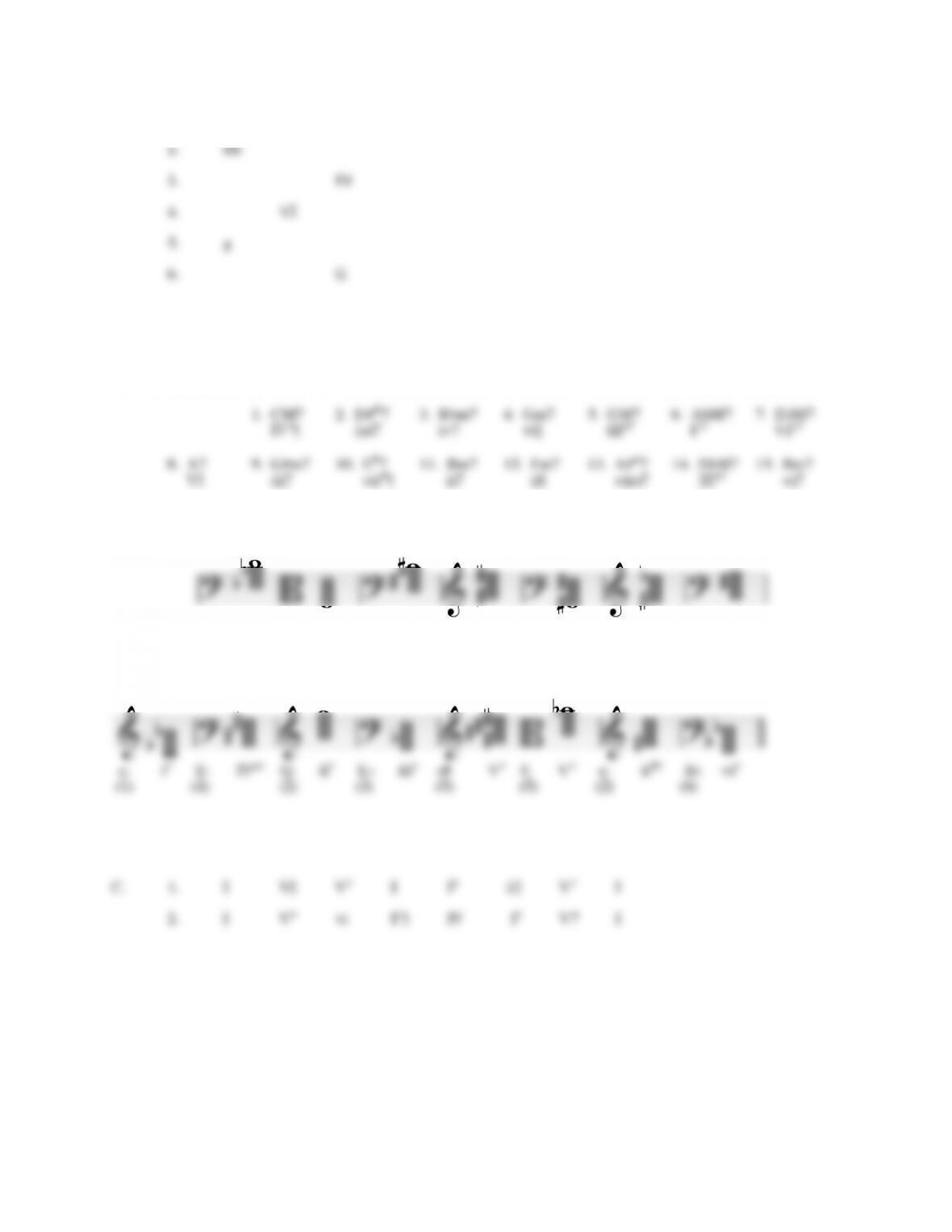
D. 1. G#
2. Eb
Exercise 4-2
A. The instructions did not call for slash chord notation, but it would not be incorrect if the student included them.
B. 1 2 3 4 5 6 7
Bb: $9e F: !9e b: #9e fm: 2-e A: 7-e g: 70e D: vie
(¢) (¡) (£) (™) (¶) (¶) (§)
8 9 10 11 12 13 14 15
c: ie E: $9e G: 2e Eb: 3e cm: Ve f: Ve e: 2-e Ab: 6e
Chapter 4
26
______________________ ________________________
(section) (name)
Chapter 4 Quiz
A. Name the triad type (M, m, o, or +) that is usually found on each scale degree in major and minor modes.
Major: ____ ____ ____ ____ ____ ____ ____
Minor: ____ ____ ____ ____ ____ ____ ____
Degree: 1 2 3 4 5 6 7
B. Name the seventh chord type (M7, m7, Mm7, ø7, or o7) that is usually found on each scale degree in major and
minor modes.
Major: ____ ____ ____ ____ ____ ____ ____
Minor: ____ ____ ____ ____ ____ ____ ____
Degree: 1 2 3 4 5 6 7
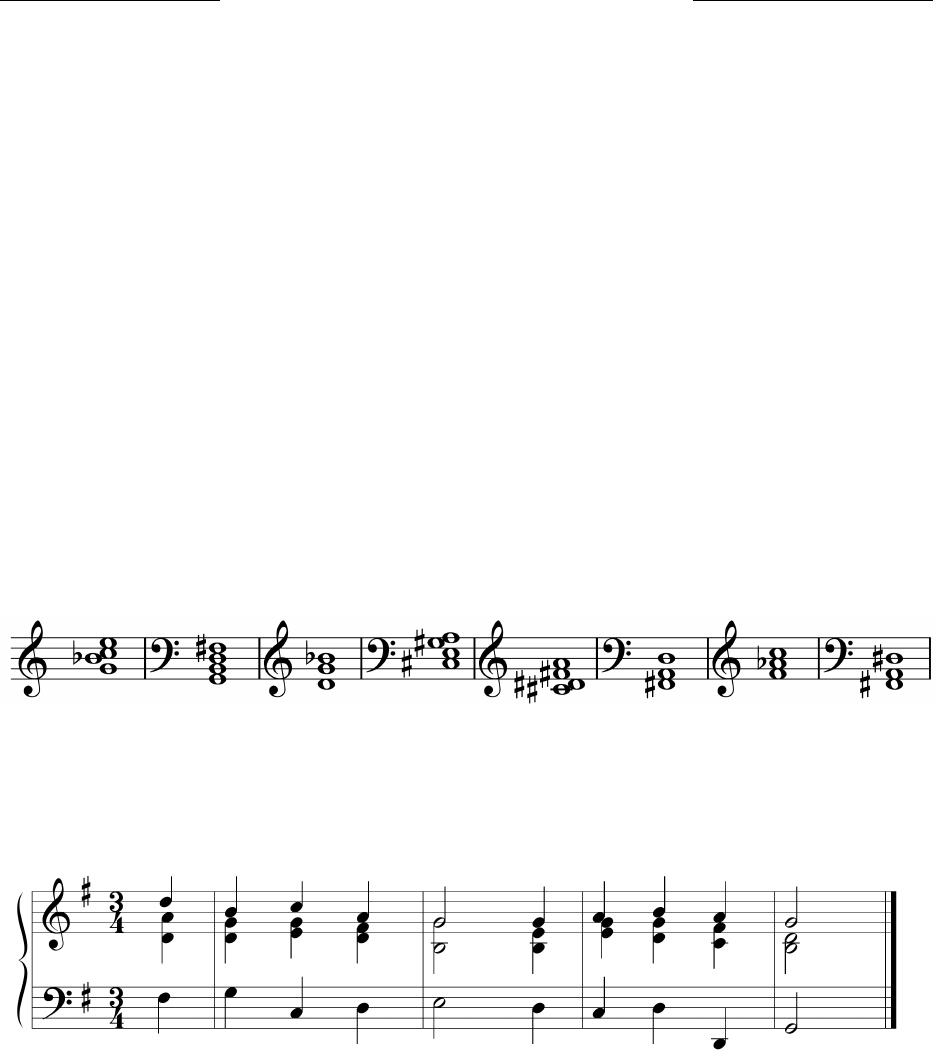
C. Given the key and a chord, supply the roman numeral below the staff. Be sure that your roman numeral is the
correct type and includes a bass position symbol if necessary. Finally, provide an appropriate lead sheet symbol
above the staff (you do not need to use slash chord notation).
1. _____ 2. _____ 3. _____ 4. _____ 5. _____ 6. _____ 7. _____ 8. _____
F: ____ b: _____ d: _____ A: _____ c#: _____ g: ____ Db: _____ E: _____
D. Analysis. Put roman numerals in the spaces provided, making sure each roman numeral is of the correct type
and includes a bass position symbol, if needed.
___ ___ ___ ___ ___ ___ ___ ___ ___ ___
1 2 3 4 5 6 7 8 9 10
Chapter 4
27
Key for Chapter 4 Quiz
A. Name the triad type (M, m, o, or +) that is usually found on each scale degree in major and minor modes.
B. Name the seventh chord type (M7, m7, Mm7, ø7, or o7) that is usually found on each scale degree in major and
minor modes.
Major: M7 m7 m7 M7 Mm7 m7 ø7
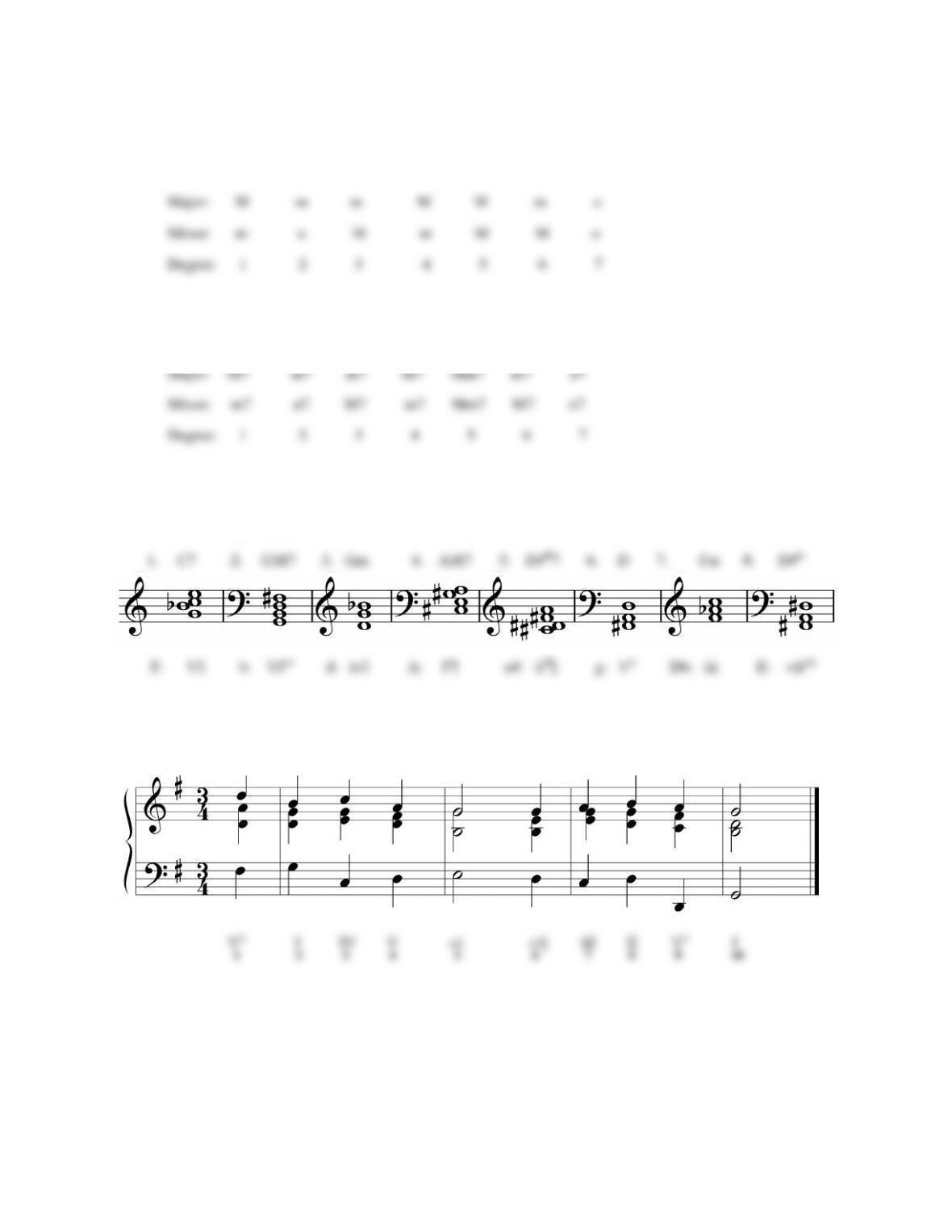
C. Given the key and a chord, supply the roman numeral below the staff. Be sure that your roman numeral is the
correct type and includes a bass position symbol if necessary. Finally, provide an appropriate lead sheet symbol
above the staff (you do not need to use slash chord notation).
D. Analysis. Put roman numerals in the spaces provided, making sure each roman numeral is of the correct type
and includes a bass position symbol, if needed.