119
CHAPTER 20
Larger Forms
This chapter continues the study of musical forms that was begun in Chapter 10, where phases, periods, and the
sentence were introduced. Here we discuss binary and ternary forms, sonata form, and the rondo.
Binary and ternary forms may be found in formal units as small as individual themes and as large as complete
movements. It is well known that the terminology regarding binary and ternary forms is not standardized, as a
comparison of treatments of the subject in various popular textbooks will confirm. Our approach regards the terms
as referring to a two–part or three–part structure, without regard to tonal design, degree of contrast, or other
considerations, although we do include “sectional” and “continuous” as modifiers. Those who wish to follow another
approach instead are, of course, free to do so.
We take the position that repetition, unlike return, has no bearing on formal classification. If a performer omits the
repeats in a movement in sonata form, for example, the formal classification is unaffected—it is still in sonata form.
Likewise, if we insert repeats into a ternary structure, it does not suddenly become a binary structure. That is, a
ternary A B A that becomes |: A :||: B A :| is still ternary, even if some of the repeats are written out. The effect
of the repeats (when they are taken) should not be ignored, however, and we attach the term “two–reprise” to such
patterns.
Students should be given practice in identifying and diagramming binary and ternary forms aurally. Minuets from
Classical symphonies provide a good source for aural examples.
Sonata form should be distinguished from multi–movement sonatas, such as symphonies, string quartets, and solo
sonatas. The first movement of a multi–movement sonata is almost always in sonata form, and one or more of the
other movements may be as well. Rondos are usually found in the last movement of a multi–movement sonata,
although slow movements may also be in rondo form. Both rondos and sonatas are found in other contexts as well,
such as in single–movement works and overtures.
Answers to Selected Exercises
Exercise 20-1
A. Two–reprise sectional rounded binary.
A B ½ A
a a1 b a1
: HC PAC : : HC PAC :
Chapter 20
120
B. Sectional ternary (with the first A repeated).
C. 1. It would also be correct to label the “cadence” in m. 20 as F: V/vi, which would still be a half cadence.
a a1 a a1 b a codetta
F: PAC F: HC F: PAC F: HC : d: HC F: PAC : F: PAC
D. Two–reprise continuous binary.
E. 1. Minuet
a a1 b c d
: Eb: HC PAC : : Bb: HC PAC Eb: HC
(m.4) (m.8) (m.12) (m.16) (m.20)
Chapter 20
121
2. Minuet: Two–reprise sectional ternary
Trio: Two–reprise continuous ternary
F. Example 1
Secondary Theme. This passage begins and ends in the secondary key of F major (as determined by the Bb–
Example 2
Transition. This passage destabilizes the primary key by modulating from Bb major to F major and ending
Example 3
Example 4
Chapter 20
122
________________ ____________________________
(section) (name)
Chapter 20 Quiz
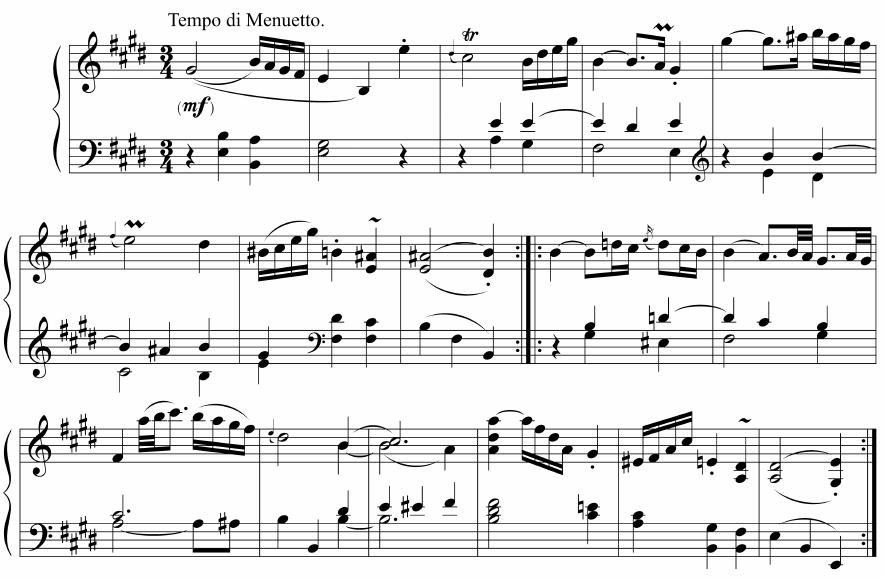
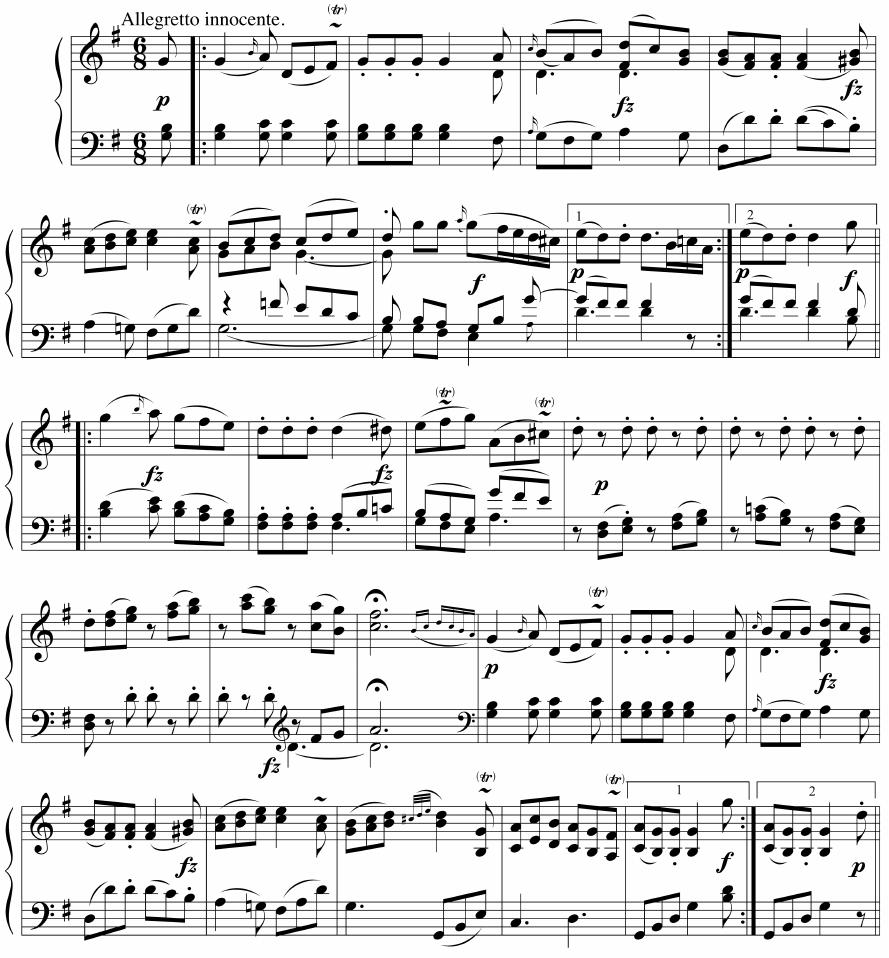
A. Diagram the excerpts below and on the next page at the phrase level, including phrase labels (a, b, etc.),
cadences, and measure numbers, and name the form of each example. Put your diagrams below the excerpts or
on a separate page.
1.
Chapter 20
123
2.
Chapter 20
124
B. Describe the characteristic features of the following parts of a sonata form:
1. recapitulation
2. secondary theme
3. development
4. transition
C. Describe the features that the following pairs of forms have in common.
1. Sonata and sonata–rondo
2. Seven–part rondo and sonata–rondo
Chapter 20
125
Key for Chapter 20 Quiz
A. 1. [Haydn, Piano Sonata No. 22, III]
a a1 b c
2. [Haydn, Piano Sonata No. 40, I]
a b c d a b1
: HC HC : : HC HC HC PAC :
B. 1. recapitulation: This section replays the movement’s important themes (from the exposition), usually in the
same order, with the modulating material adjusted so that the themes appear in the home key.
2. secondary theme: In the exposition, this theme establishes the secondary key by beginning and cadencing
C. 1. Both feature a development section (the C section in the rondo) followed by the return of earlier thematic
material (from the exposition in the sonata and the A and B sections in the rondo) adjusted to remain in the