Chapter 09 – Foreign Currency Transactions and Hedging Foreign Exchange Risk – Hoyle, Schaefer, Doupnik, 13e
CHAPTER 9
FOREIGN CURRENCY TRANSACTIONS AND
HEDGING FOREIGN EXCHANGE RISK
Chapter Outline
I. In today’s global economy, a great many companies deal in currencies other than their
reporting currencies.
A. Merchandise may be imported or exported with prices stated in a foreign currency.
B. For reporting purposes, foreign currency balances must be stated in terms of the
company’s reporting currency by multiplying it by an exchange rate.
C. Accountants face two questions in restating foreign currency balances.
1. What is the appropriate exchange rate for restating foreign currency balances?
2. How are changes in the exchange rate accounted for?
D. Companies often engage in foreign currency hedging activities to avoid the adverse
impact of exchange rate changes.
1. The spot rate is the price at which a foreign currency can be purchased or sold
today.
2. The forward rate is the price today at which foreign currency can be purchased or
sold sometime in the future.
3. Forward exchange contracts provide companies with the ability to “lock in” a price
today for purchasing or selling currency at a specific future date.
C. Foreign currency options provide the right but not the obligation to buy or sell foreign
currency in the future, and therefore are more flexible than forward contracts.
9-2
Copyright © 2017 McGraw-Hill Education. All rights reserved. No reproduction or distribution without the prior written consent of McGraw-Hill
Education.
instruments and hedging activities including the use of foreign currency forward contracts
and foreign currency options.
A. The fundamental requirement is that all derivatives must be carried on the balance
sheet at their fair value. Derivatives are reported on the balance sheet as assets when
1. foreign currency denominated assets and liabilities.
2. unrecognized foreign currency firm commitments.
3. forecasted foreign denominated currency transactions.
4. net investments in foreign operations (covered in Chapter 10).
C. Companies prefer to account for hedges in such a way that the gain or loss from the
1. the derivative is used to hedge either a cash flow exposure or fair value exposure to
foreign exchange risk,
2. the derivative is highly effective in offsetting changes in the cash flows or fair value
related to the hedged item, and
3. the derivative is properly documented as a hedge.
D. Hedge accounting is allowed for hedges of two different types of exposure: cash flow
exposure and fair value exposure. Hedges of (1) foreign currency denominated assets
1. The hedged asset or liability is adjusted to fair value based on changes in the spot
exchange rate, and a foreign exchange gain or loss is recognized in net income.
2. The derivative hedging instrument is adjusted to fair value (resulting in an asset or
3. An amount equal to the foreign exchange gain or loss on the hedged asset or
4. An additional amount is removed from AOCI and recognized in net income to reflect
(a) the current period’s amortization of the original discount or premium on the
1. The hedged asset or liability is adjusted to fair value based on changes in the spot
exchange rate, and a foreign exchange gain or loss is recognized in net income.
2. The derivative hedging instrument is adjusted to fair value (resulting in an asset or
liability reported on the balance sheet), with the counterpart recognized as a gain or
9-3
Education.
1. the gain or loss on the hedging instrument is recognized currently in net income,
and
2. the change in fair value of the firm commitment is also recognized currently in net
income.
This accounting treatment requires (1) measuring the fair value of the firm commitment,
1. Unlike the accounting for a firm commitment, there is no recognition of the
forecasted transaction or gains and losses on the forecasted transaction.
2. The hedging instrument (forward contract or option) is reported at fair value, but
because there is no gain or loss on the forecasted transaction to offset against,
changes in the fair value of the hedging instrument are not reported as gains and
losses in net income. Instead they are reported in other comprehensive income.
On the projected date of the forecasted transaction, the cumulative change in the
fair value of the hedging instrument is transferred from other comprehensive income
(balance sheet) to net income (income statement).
V. IFRS is very similar to U.S. GAAP with respect to the accounting for foreign currency
transactions and hedging of foreign exchange risk.
A. IAS 21 requires the use of a two-transaction perspective in accounting for foreign
currency transactions with unrealized foreign exchange gains and losses accrued in net
income in the period of exchange rate change.
B. IAS 39 allows hedge accounting for foreign currency hedges of recognized assets and
liabilities, firm commitments, and forecasted transactions when documentation
requirements and effectiveness tests are met. Hedges are designated as cash flow or
fair value hedges.
C. One difference between IFRS and U.S. GAAP relates to the type of financial instrument
that can be designated as a foreign currency cash flow hedge. Under U.S. GAAP, only
derivative financial instruments can be used as a cash flow hedge, whereas IFRS also
allows non-derivative financial instruments, such as foreign currency loans, to be
designated as hedging instruments in a foreign currency cash flow hedge.
D. Another difference relates to the accounting for the time value of a foreign currency
option used to hedge foreign exchange risk. Under IFRS, the time value of the option
when acquired is amortized to expense on a systematic and rationale basis. This is
accomplished by recognizing the change in time value of an option initially in AOCI, and
then immediately reclassifying a portion of the amount deferred in AOCI as option
expense.
Chapter 09 – Foreign Currency Transactions and Hedging Foreign Exchange Risk – Hoyle, Schaefer, Doupnik, 13e
9-4
Education.
Answer to Discussion Question
Do we have a gain or what? This case demonstrates the differing kinds of information provided
through application of current accounting rules for foreign currency transactions and derivative
financial instruments.
The Ahnuld Corporation could have received $200,000 [$2.00 x 100,000 tchecks] from its export
sale to Tcheckia if it had required immediate payment. Instead, Ahnuld allows its customer six
months to pay. Given the future exchange rate of $1.70, Ahnuld would have received only
contract (from zero initially to $10,000 at maturity) is recognized as a gain on the forward
contract of $10,000. This gain reflects the cash flow benefit from having entered into the forward
contract, and is the appropriate basis for evaluating the performance of the foreign exchange
risk manager. (Students should be reminded that the forward contract will not always improve
cash inflow. For example, if the future spot rate were $1.85, the forward contract would result in
$5,000 less cash inflow than if the transaction were left unhedged.)
The net impact on income resulting from the fluctuation in the value of the tcheck is a loss of
$20,000. Clearly, Ahnuld forgoes $20,000 in cash inflow by allowing the customer time to pay
for the purchase, and the net loss reported in income correctly measures this. The $20,000 loss
Chapter 09 – Foreign Currency Transactions and Hedging Foreign Exchange Risk – Hoyle, Schaefer, Doupnik, 13e
Answers to Questions
1. Under the two-transaction perspective, an export sale (import purchase) and the
subsequent collection (payment) of cash are treated as two separate transactions to be
2. Foreign currency receivables resulting from export sales are revalued at the end of
accounting periods using the current spot rate. An increase in the value of a receivable will
3. Foreign exchange gains and losses are created by two factors: having foreign currency
exposures (foreign currency receivables and payables) and changes in exchange rates.
4. The accounting for a foreign currency borrowing involves keeping track of two foreign
5. Hedging is the process of eliminating exposure to foreign exchange risk so as to avoid
potential losses from fluctuations in exchange rates. In addition to avoiding possible
6. A party to a foreign currency forward contract is obligated to deliver one currency in
7. Hedges of foreign currency denominated assets and liabilities are not entered into until a
foreign currency transaction (import purchase or export sale) has taken place. Hedges of
8. Foreign currency options have an advantage over forward contracts in that the holder of the
option can choose not to exercise if the future spot rate turns out to be more advantageous.
Forward contracts, on the other hand, can lock a company into an unnecessary loss (or a
9-6
Copyright © 2017 McGraw-Hill Education. All rights reserved. No reproduction or distribution without the prior written consent of McGraw-Hill
Education.
9. An enterprise is required to recognize all derivative financial instruments as assets or
liabilities on the balance sheet and measure them at fair value.
10. The fair value of a foreign currency forward contract is determined by reference to changes
in the forward rate over the life of the contract, discounted to the present value. Three
pieces of information are needed to determine the fair value of a forward contract at any
point in time during its life: (a) the contracted forward rate when the forward contract is
11. Hedge accounting is defined as recognition of gains and losses on the hedging instrument
12. For hedge accounting to apply, the forecasted transaction must be probable (likely to
13. In both cases, (1) sales revenue (or the cost of the item purchased) is determined using the
spot rate at the date of sale (or purchase), and (2) the hedged asset or liability is adjusted
to fair value based on changes in the spot exchange rate with a foreign exchange gain or
loss recognized in net income.
9-7
Education.
14. For a fair value hedge of a foreign currency asset or liability (1) sales revenue (cost of
purchases) is recognized at the spot rate at the date of sale (purchase) and (2) the hedged
asset or liability is adjusted to fair value based on changes in the spot exchange rate with a
foreign exchange gain or loss recognized in net income. The forward contract is adjusted
15. For a cash flow hedge of a foreign currency asset or liability (1) sales revenue (cost of
purchases) is recognized at the spot rate at the date of sale (purchase) and (2) the hedged
asset or liability is adjusted to fair value based on changes in the spot exchange rate with a
foreign exchange gain or loss recognized in net income. The forward contract is adjusted
anticipated to occur.
16. In accounting for a fair value hedge, the change in the fair value of the foreign currency
option is reported as a gain or loss in net income. In accounting for a cash flow hedge, the
Chapter 09 – Foreign Currency Transactions and Hedging Foreign Exchange Risk – Hoyle, Schaefer, Doupnik, 13e
9-8
Education.
Answers to Problems
1. C (Foreign exchange gain/loss on foreign currency transaction)
An import purchase causes a foreign currency payable to be carried on
The dollar value of the LCU receivable has increased from $110,000 at
December 31, 2017 to $120,000 at February 15, 2018. This increase of
$10,000 should be reported as a foreign exchange gain in 2018.
5. C (Calculate foreign exchange gain/loss on foreign currency borrowing)
The decrease in the dollar value of the euro note payable represents a
9-9
Copyright © 2017 McGraw-Hill Education. All rights reserved. No reproduction or distribution without the prior written consent of McGraw-Hill
Education.
The net foreign exchange loss is $10,000 ($10,000 gain – $20,000 loss).
8. A (Forward contract cash flow hedge of foreign currency denominated
asset/liability)
The Thai baht is selling at a discount (spot rate exceeds forward rate). The
exporter will receive fewer dollars as a result of selling the baht forward
asset. The forward contract must be reported at its fair value discounted
for two months at 12%, which is $1,960.60 [($.047 – $.049) x 1,000,000 x
.9803].
11. C (Calculate foreign exchange gain/loss on foreign currency transaction)
The 10 million won receivable has changed in dollar value from $35,000 at
Chapter 09 – Foreign Currency Transactions and Hedging Foreign Exchange Risk – Hoyle, Schaefer, Doupnik, 13e
9-10
Education.
December 31, 2017 that matures on March 31, 2018, $32,000 ($.0032 x 10
12. (continued)
Million). The fair value of the forward contract is the present value of
13. A (Forward contract cash flow hedge of forecasted foreign currency
transaction)
The krona is selling at a premium in the forward market, causing Pimlico
to pay more dollars to acquire kroner than if the kroner were purchased at
9-11
Education.
15–17. (Option fair value hedge of a foreign currency firm commitment)
Firm Commitment 980.30
[($.79 – $.80) x 100,000 = $1,000 x .9803 = $980.30]
Net impact on 2017 net income:
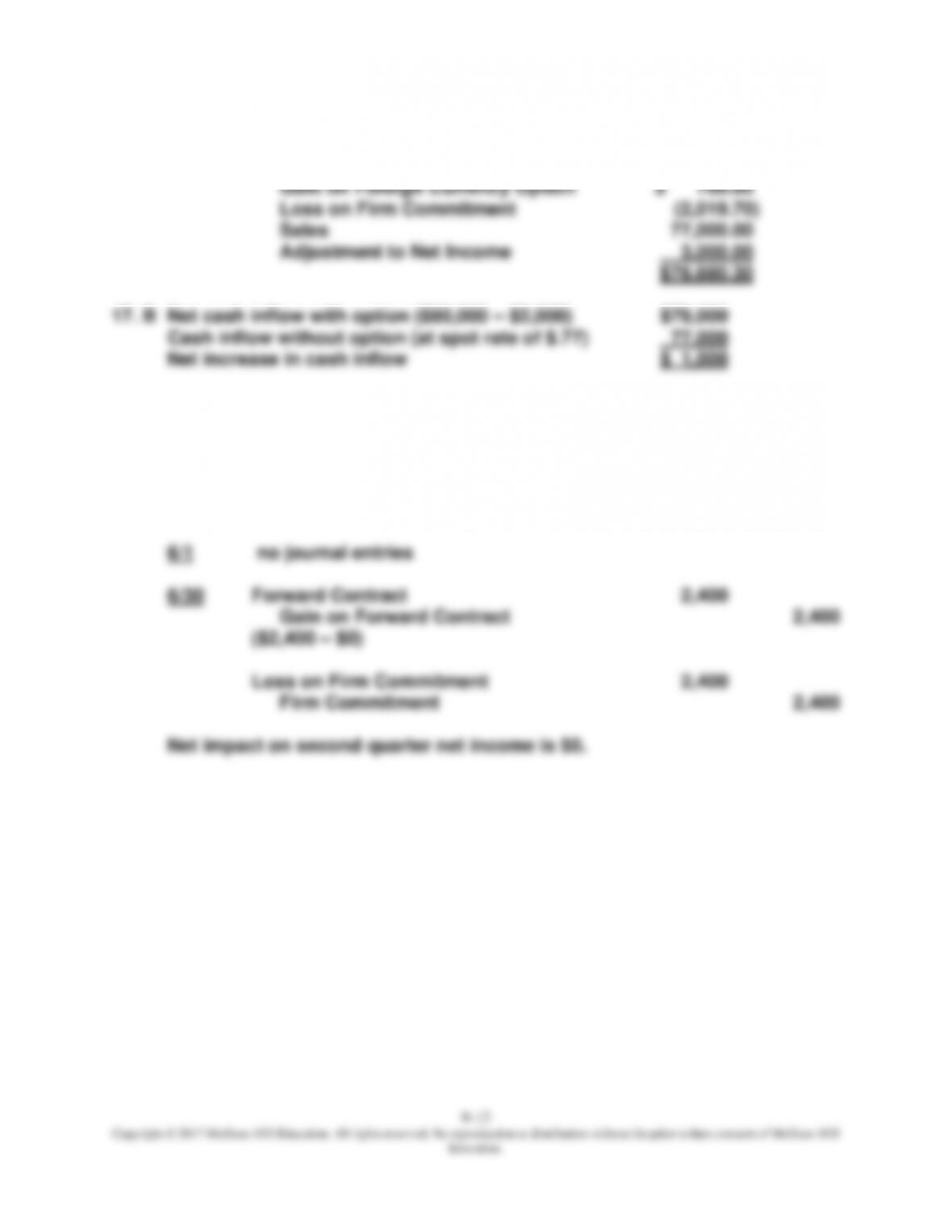
Gain on Foreign Currency Option $300.00
Loss on Firm Commitment (980.30)
$(680.30)
3/1/18
Foreign Currency Option 700.00
Foreign Currency (C$) 77,000.00
Sales 77,000.00
Chapter 09 – Foreign Currency Transactions and Hedging Foreign Exchange Risk – Hoyle, Schaefer, Doupnik, 13e
15-17. (continued)
Net impact on 2018 net income:
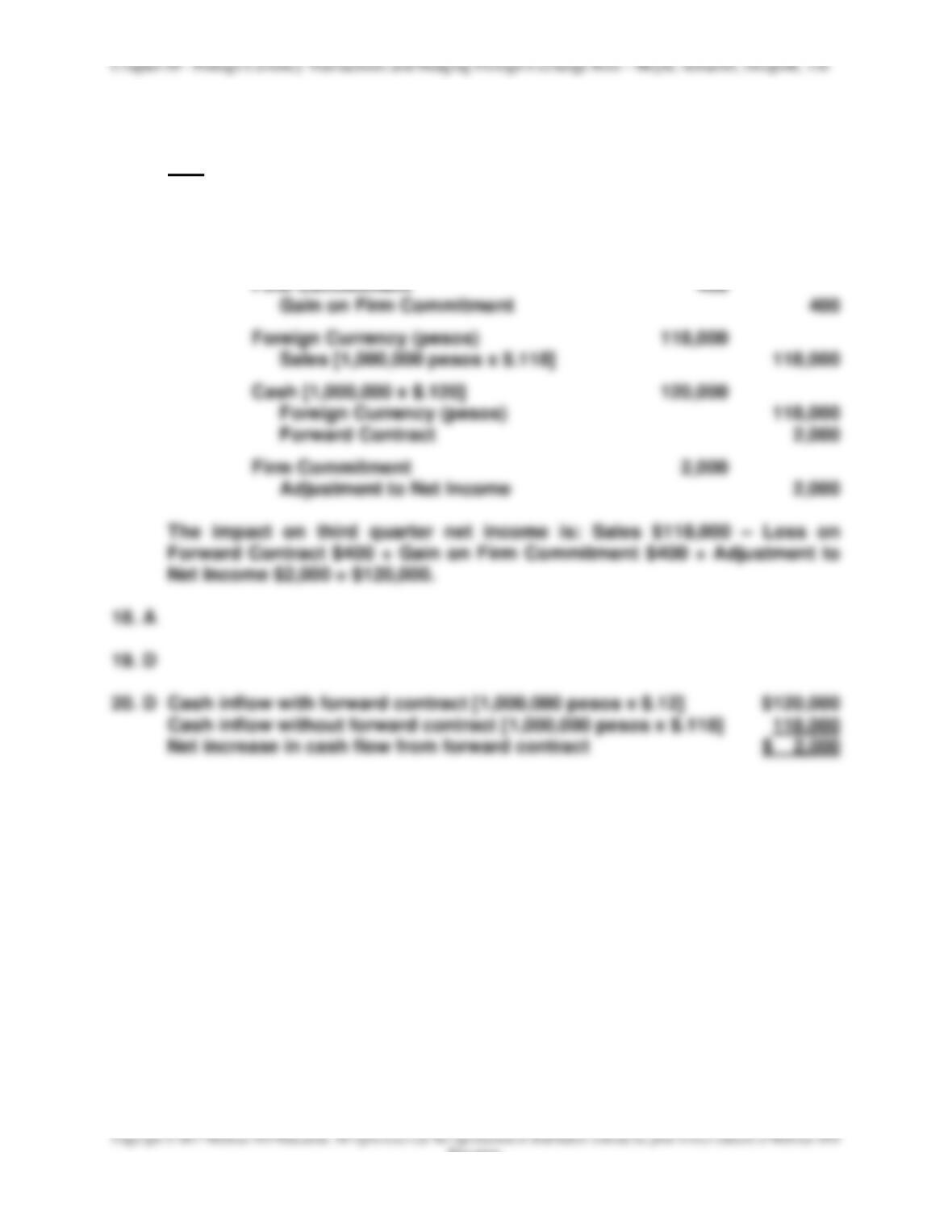
18–20. (Forward contract fair value hedge of a foreign currency firm commitment)
The easiest way to solve problems 18 and 19 is to prepare journal entries
for the forward contract fair value hedge of a firm commitment. The journal
entries are as follows:
9-13
Education.
18–20. (continued)
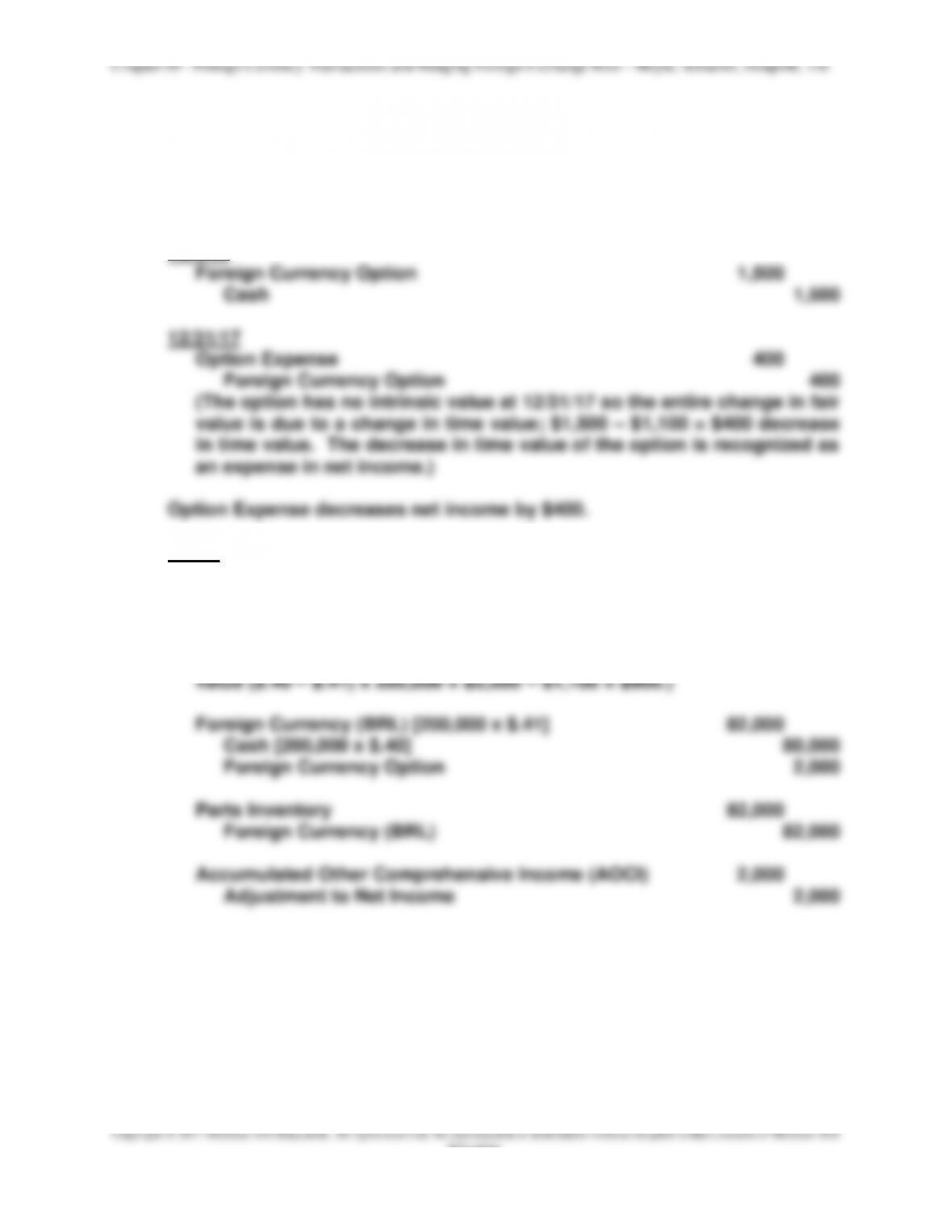
7/31 Loss on Forward Contract 400
Forward Contract 400
[Fair value of Forward Contract is
(($.120 – $.118) x 1,000,000) = $2,000;
$2,000 – $2,400 = $400]
9-14
Education.
21–22. (Option cash flow hedge of a forecasted foreign currency transaction)
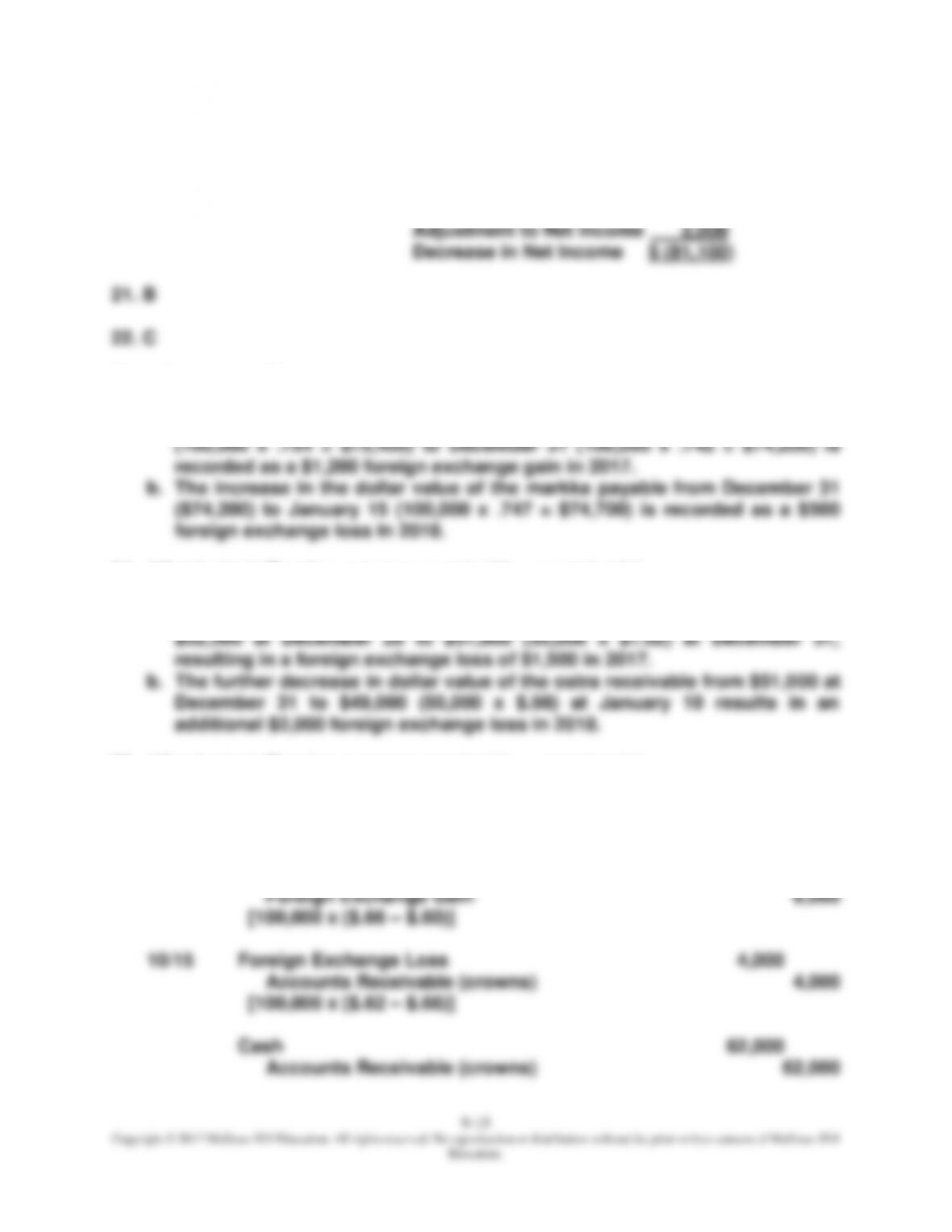
The easiest way to solve problems 21 and 22 is to prepare journal entries
for the option cash flow hedge of a forecasted transaction. The journal
entries are as follows:
11/1/17
2/1/18
Option Expense 1,100
Foreign Currency Option 900
Accumulated Other Comprehensive Income (AOCI) 2,000
(Record expense for the decrease in time value of the
option; $1,100 – $0 = $1,100; and write-up option to fair
Chapter 09 – Foreign Currency Transactions and Hedging Foreign Exchange Risk – Hoyle, Schaefer, Doupnik, 13e
21-22. (continued)
Net impact on 2018 net income:
Option Expense $ (1,100)
Cost-of-Goods-Sold (82,000)
23. (10 minutes) (Foreign currency payable – import purchase)
a. The decrease in the dollar value of the markka payable from November 1
24. (10 minutes) (Foreign currency receivable – export sale)
a. The ostra receivable decreases in dollar value from (50,000 x $1.05)
25. (10 minutes) (Foreign currency receivable – export sale)
9/15 Accounts Receivable (crowns) [100,000 x $.60] 60,000
Sales 60,000
9/30 Accounts Receivable (crowns) 6,000