Chapter 8 – Segment and Interim Reporting – Hoyle, Schaefer, Doupnik, 13e
CHAPTER 8
SEGMENT AND INTERIM REPORTING
Chapter Outline
I. FASB Accounting Standards Codification Topic 280, Segment Reporting (FASB ASC 280),
provides current guidance on segment reporting.
A. ASC 280 follows a management approach in which segments are based on the way
that management disaggregates the enterprise for making operating decisions; these
are referred to as operating segments.
B. Operating segments are components of an enterprise which meet three criteria.
1. Engage in business activities and earn revenues and incur expenses.
2. Operating results are regularly reviewed by the chief operating decision-maker to
assess performance and make resource allocation decisions.
3. Discrete financial information is available from the internal reporting system.
1. Revenue test—segment revenues, both external and intersegment, are 10 percent
2. Profit or loss test—segment profit or loss is 10 percent or more of the greater (in
3. Asset test—segment assets are 10 percent or more of the combined assets of all
1. Separately reported operating segments must generate at least 75 percent of total
(consolidated) sales made by the company to outside parties.
2. Ten is suggested as the maximum number of operating segments that should be
1. General information about the operating segment including factors used to identify
2. Segment profit or loss and the following components of profit or loss.
a. Revenues from external customers.
3. Total segment assets and the following related items.
a. Investment in equity method affiliates.
Chapter 8 – Segment and Interim Reporting – Hoyle, Schaefer, Doupnik, 13e
8-2
II. Enterprise-wide disclosures.
A. Information about products and services.
1. Additional information must be provided if operating segments have not been
2. In those situations, revenues derived from transactions with external customers
1. Revenues from external customers and long-lived assets must be reported for (a)
2. U.S. GAAP does not provide any specific guidance with regard to determining
1. The volume of sales to a single customer must be disclosed if it constitutes 10
percent or more of total sales to unaffiliated customers.
2. The identity of the major customer need not be disclosed.
III. International Financial Reporting Standards (IFRS) also provide guidance with respect to
1. IFRS 8 requires disclosure of total assets and total liabilities by operating segment if
2. IFRS 8 specifically includes intangibles in the scope of “non–current assets” to be
3. U.S. GAAP requires an entity with a matrix form of organization to determine
operating segments based on products and services. IFRS 8 allows such an entity
to determine operating segments based on either products and services or
geographic areas.
IV. To provide investors and creditors with more timely information than is provided by an
annual report, the U.S. Securities and Exchange Commission (SEC) requires publicly
traded companies to provide financial statements on an interim (quarterly) basis.
A. Quarterly statements need not be audited.
V. FASB Accounting Standards Codification Topic 270, Interim Reporting (FASB ASC 270)
requires companies to treat interim periods as integral parts of an annual period rather than
as discrete accounting periods in their own right.
A. Generally, interim statements should be prepared following the same accounting
principles and practices used in the annual statements.
B. However, several items require special treatment for the interim statements to better
reflect the expected annual amounts.
1. Revenues are recognized for interim periods in the same way as they are on an
annual basis.
8-3
Education.
2. Interim statements should not reflect the effect of a LIFO liquidation if the units of
beginning inventory sold are expected to be replaced by year-end; inventory
3. Costs incurred in one interim period but associated with activities or benefits of
4. Income tax related to ordinary income should be computed at an estimated annual
effective tax rate.
VI. FASB ASC 270 provides guidance for reporting changes in accounting principles made in
interim periods.
A. Unless impracticable to do so, an accounting change is applied retrospectively, that is,
prior period financial statements are restated as if the new accounting principle had
always been used.
B. When an accounting change is made in other than the first interim period, information
year.
VII. Many companies provide summary financial statements and notes in their interim reports.
A. U.S. GAAP imposes minimum disclosure requirements for interim reports.
1. Sales, income tax, cumulative effect of accounting change, and net income.
2. Earnings per share.
8. Significant changes in financial position.
1. Cash and cash equivalents.
2. Net working capital.
3. Long-term liabilities.
4. Stockholders’ equity.
VIII. Four items of information must also be disclosed by operating segments in interim financial

Chapter 8 – Segment and Interim Reporting – Hoyle, Schaefer, Doupnik, 13e
8-4
Education.
statements: revenues from external customers, intersegment revenues, segment profit or
loss, and, if there has been a material change since the annual report, total assets.
IX. IAS 34, “Interim Financial Reporting,” provides guidance in IFRS with respect to interim
financial statements.
A. Unlike U.S. GAAP, IAS 34 requires each interim period to be treated as a discrete
accounting period in terms of the amounts to be recognized. As a result, expenses
that are incurred in one quarter are expensed in that quarter even though the
expenditure benefits the entire year. And there is no accrual in earlier quarters for
expenses expected to be incurred later in the year.
Answer to Discussion Question: How Does a Company Determine Whether a
Foreign Country is Material?
In his well-publicized “The Numbers Game” speech delivered in September 1998, former SEC
chairman Arthur Levitt cited “materiality” as one of five gimmicks used by companies to manage
earnings. Although his remarks were not specifically directed toward the issue of geographic
segment reporting, the intent was to warn corporate America that materiality should not be used
as an excuse for inappropriate accounting.
To make the point even more salient, ASC 250-10-S99 (SAB Topic 1.M, Assessing Materiality,
originally issued by the SEC as Staff Accounting Bulletin (SAB) 99, “Materiality”), warns financial
statement preparers that reliance on a simple numerical rule of thumb, such as 5% of net
income, is not sufficient. And in paragraph QC 11 of Statement of Financial Accounting
Concepts (SFAC) 8, the FASB stated the essence of the materiality aspect of relevance as
follows:
“Information is material if omitting it or misstating it could influence decisions that users
make on the basis of the financial information of a specific reporting entity….Consequently,
the Board cannot specify a uniform quantitative threshold for materiality or predetermine
what could be material in a particular situation.”
Further, ASC 250-10-S99 reminds companies that both quantitative and qualitative factors
should be considered in determining materiality. With respect to segment reporting, ASC 250-
10-S99 states:
“The materiality of a misstatement may turn on where it appears in the financial statements.
For example, a misstatement may involve a segment of the registrant’s operations. In that
instance, in assessing materiality of a misstatement to the financial statements taken as a
whole, registrants and their auditors should consider not only the size of the misstatement
but also the significance of the segment information to the financial statements taken as a
whole. “A misstatement of the revenue and operating profit of a relatively small segment
that is represented by management to be important to the future profitability of the entity” is
more likely to be material to investors than a misstatement in a segment that management
has not identified as especially important. In assessing the materiality of misstatements in
segment information – as with materiality generally – situations may arise in practice where
the auditor will conclude that a matter relating to segment information is qualitatively
material even though, in his or her judgment, it is quantitatively immaterial to the financial
statements taken as a whole.
Thus, in addition to quantitative factors, such as the relative percentage of total revenues

Chapter 8 – Segment and Interim Reporting – Hoyle, Schaefer, Doupnik, 13e
8-5
Education.
generated in an individual foreign country, companies should consider qualitative factors as
well. Qualitative factors that might be relevant in assessing the materiality of a specific foreign
country include: the growth prospects in that country and the level of risk associated with doing
business in that country.
There are competing arguments for the FASB establishing a significance test for determining
material foreign countries. On one hand, such a quantitative materiality test flies in the face of
the warning provided in ASC 250-10-S99 and SFAC 8. For example, a “10% of total revenue or
long-lived asset test” might give companies an excuse to avoid reporting individual countries
that would be material for qualitative reasons. Assume that from one year to the next a
company increases its revenues in China from 2% of total revenues to 6% of total revenues.
Although 6% of total revenues would not meet a 10% test, the relatively large increase in total
revenues generated in China could be material in that it could affect an investor’s assessment of
the company’s future prospects. This company might be reluctant to disclose information about
its revenues in China because of potential competitive harm.
On the other hand, one could argue that if the FASB were to establish a relatively low disclosure
threshold of, say, “5% of total revenues,” that many countries that financial statement users
would deem to be of significance would be disclosed regardless of whether they are deemed
material for quantitative or for qualitative reasons. However, it could also result in disclosures
being provided that are not material, i.e., capable of influencing decisions made by financial
statement users.
In any event, establishing a materiality threshold would be inconsistent with the FASB’s
conclusion in SFAC 8 that it “cannot predetermine what could be material in a particular
situation.”
Chapter 8 – Segment and Interim Reporting – Hoyle, Schaefer, Doupnik, 13e
8-6
Education.
Answers to Questions
1. Consolidation presents the account balances of a business combination without regard for
the individual component units that comprise the organization. Thus, no distinction can be
2. The word disaggregated refers to a whole that has been broken apart. Thus,
3. According to the FASB, the objective of segment reporting is to provide information to help
users of financial statements:
4. Defining segments on the basis of a company’s organizational structure removes much of
the flexibility and subjectivity associated with defining industry segments under prior
5. An operating segment is defined as a component of an enterprise:
a. that engages in business activities from which it earns revenues and incurs expenses,
6. Two criteria must be considered in this situation to determine an enterprise’s operating
segment. If more than one set of organizational units exists, but there is only one set for
7. The Revenue Test. An operating segment is separately reportable if its total revenues
amount to 10 percent or more of the combined total revenues of all operating segments.
8. For reportable operating segments, the following information must be disclosed:
a. General information about the operating segment:
Chapter 8 – Segment and Interim Reporting – Hoyle, Schaefer, Doupnik, 13e
b. Segment profit or loss and each of the following if it is included in the measure of
segment profit or loss reviewed by, or it is otherwise regularly provided to, the chief
operating decision maker:
• Revenues from external customers.
• Equity in the net income of investees accounted for by the equity method.
c. Total segment assets and the following related items:
9. If operating segments are not based upon products or services, or a company has only one
10. Information must be provided for the domestic country, for all foreign countries in which the
11. Two items of information must be reported for the domestic country, for all foreign countries
12. The minimum number of countries to be reported separately is one: the domestic country.
If no single foreign country is material, then all foreign countries would be combined and
13. The existence of a major customer and the related amount of revenues must be disclosed
when sales to a single customer are 10 percent or more of consolidated sales.
14. U.S. GAAP requires disclosure of a measure of segment assets, but does not require
15. U.S. publicly traded companies are required to prepare quarterly financial reports to provide
16. Companies are required to follow an “integral” approach in which each interim period is
considered to be an integral part of an annual accounting period, rather than a “discrete”
8-8
Education.
17. Cost of goods sold should be adjusted in the interim period to reflect the cost at which the
18. Income tax expense related to interim period income is determined by estimating the
effective tax rate for the entire year. That rate is then applied to the cumulative pre-tax
19. When an accounting change occurs in other than the first interim period, information for the
pre-change interim periods should be reported based on retrospective application of the
20. The following minimum information must be disclosed in an interim report:
a. Sales or gross revenues, provision for income taxes, net income, and comprehensive
income.
b. Earnings per share.
21. Four items of segment information are required to be included in interim reports: revenues
22. Under IAS 34, an annual bonus paid in the fourth quarter of the year would be recognized
fully in that quarter. There would be no accrual of an estimated bonus expense in the first
Chapter 8 – Segment and Interim Reporting – Hoyle, Schaefer, Doupnik, 13e
8-9
Education.
Answers to Problems
1. D
9. B
10. B
18. D
8-10
Education.
20. B Under U.S. GAAP, the company should report property tax expense of
$25,000 in each quarter of the year. Under IFRS, the company should
report the entire property tax expense of $100,000 in the second quarter of
the year.
Minimum $ 42,200
23. B (Determine reportable segments under the profit or loss test)
Total operating losses of $580,000 (B and D) are larger than total operating
profits of $400,000 (A, C, E and F). Thus, based on the 10 percent
criterion, any segment with a profit or loss of $58,000 or more must be
8-11
Education.
24. (continued)
Profit or Loss Test
Total segment profits of $4,500,000 (U, V, X, Y, Z) is larger than the total
segment loss of $1,000,000 (W). This test is applied based on total
25. D
75 percent criterion established by U.S. GAAP has been met.
27. D (Determine expense amounts to be recognized in interim period)
Depreciation $120,000 x 1/4 = $30,000
Bonus $200,000 x 1/4 = 50,000
8-13
Education.
35. (25 minutes) (Apply the Three Tests Necessary to Determine Reportable
Operating Segments)
Revenue Test (numbers in thousands)
Segment Revenues Percentage
Plastics $ 6,842 61.7% (reportable)
Profit or Loss Test (numbers in thousands)
Segment Revenues Expenses Profit Loss
Plastics $ 6,842 $ 4,290 $2,552 $ (reportable)
Metals 2,561 1,793 768 (reportable)
Lumber 870 1,132 262
$3,430).
Asset Test (numbers in thousands)
Segment Assets Percentage
Plastics $1,588 21.4% (reportable)
Metals 3,599 48.4% (reportable)
three tests and therefore are reportable.
Chapter 8 – Segment and Interim Reporting – Hoyle, Schaefer, Doupnik, 13e
8-14
Education.
36. (20 minutes) (A Variety of Computational Questions about Operating Segment
and Major Customer Testing)
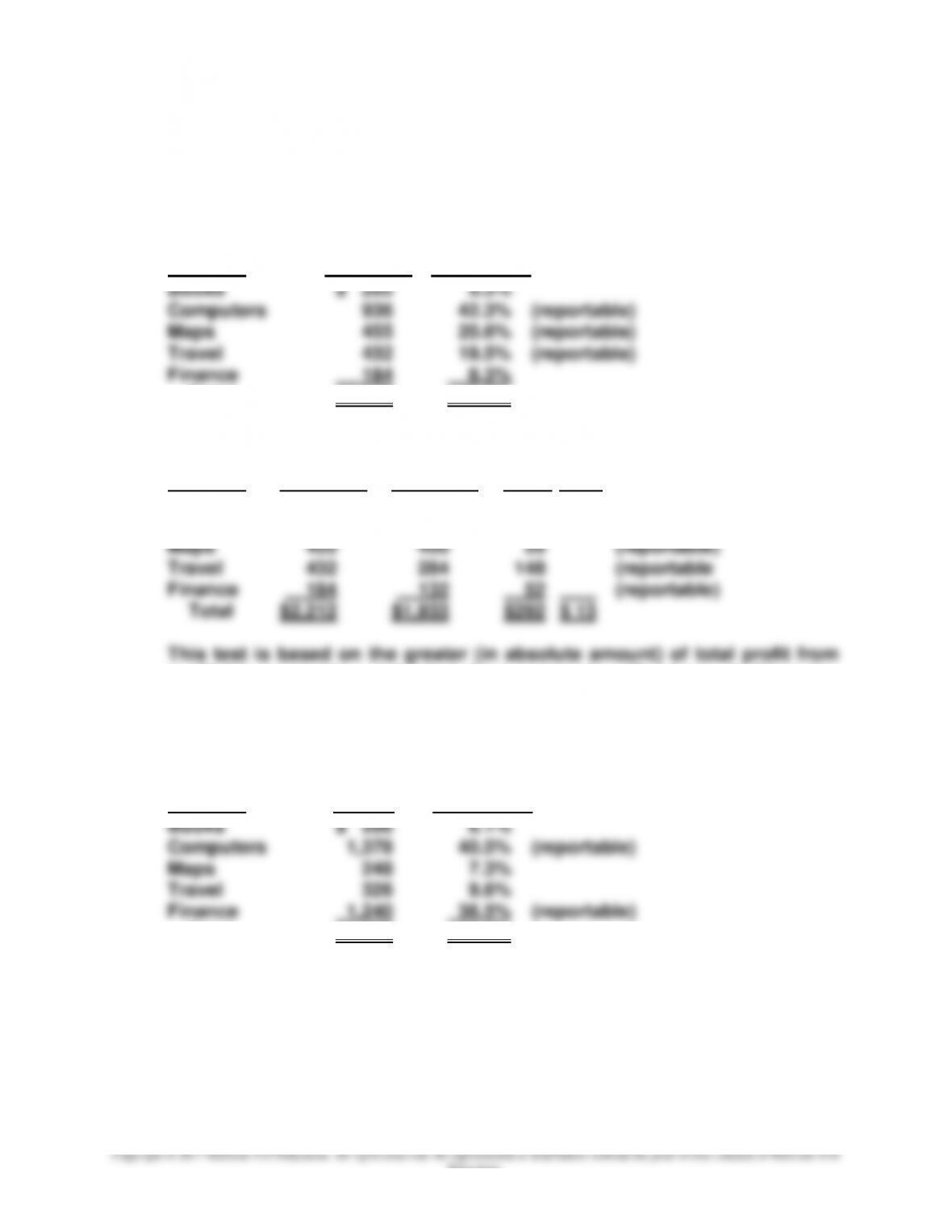
a. Total revenues for Fairfield (including intersegment revenues) amount to
b. Disclosure of operating segments is considered adequate only if the
separately reported segments have sales to unaffiliated customers that
c. Major customer disclosure is based on a level of sales to unaffiliated
d. This test is based on the greater (in absolute terms) of profits or losses. In
Chapter 8 – Segment and Interim Reporting – Hoyle, Schaefer, Doupnik, 13e
8-15
Education.
37. (25 minutes) (Apply the three tests necessary to determine reportable
operating segments and determine whether a sufficient number of segments
is reported)
Revenue Test (numbers in thousands)
Segment Revenues Percentage
Total $2,212 100.0%
Profit or Loss Test (numbers in thousands)
Segment Revenues Expenses Profit Loss
Books $ 205 $ 218 $ 13
Computers 936 899 $ 37 (reportable)
profitable segments or total loss from segments with a loss. In this case,
any segment with profit or loss greater than or equal to $29,200 (10% x
$292,000) is separately reportable.
Asset Test (numbers in thousands)
Segment Assets Percentage
Total $3,398 100.0%
Chapter 8 – Segment and Interim Reporting – Hoyle, Schaefer, Doupnik, 13e
Education.
37. (continued)
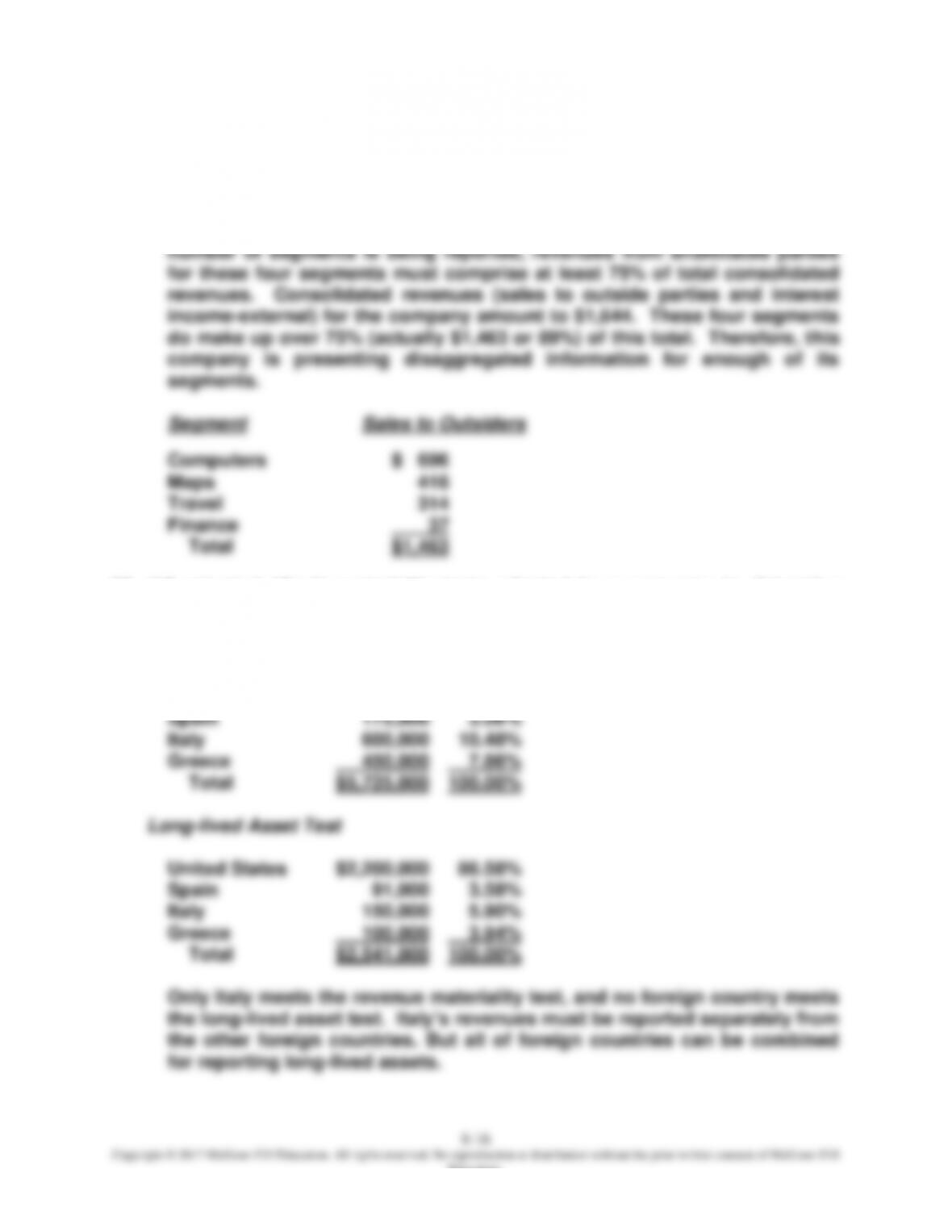
Test for Sufficient Number of Segments Being Reported
Four of Mason’s segments (computers, maps, travel, and finance) meet at
least one of the tests carried out above. To determine whether a sufficient
38. (15 minutes) (Apply materiality tests adopted by a company to determine
countries to be reported separately)
Revenue Test (sales to unaffiliated parties)
United States $4,500,000 78.60%