Chapter 07 – Consolidated Financial Statements—Ownership Patterns and Income Taxes – Hoyle, Schaefer,
Doupnik, 13e
7-1
Education.
CHAPTER 7
CONSOLIDATED FINANCIAL STATEMENTS—OWNERSHIP
PATTERNS AND INCOME TAXES
Chapter Outline
I. Indirect subsidiary control
A. Control of subsidiary companies within a business combination is often of an indirect
nature; one subsidiary possesses the stock of another rather than the parent having
direct ownership.
1. These ownership patterns may be developed specifically to enhance control or for
organizational purposes.
2. Such ownership patterns may also result from the parent company’s acquisition of a
company that already possesses subsidiaries.
1. The worksheet entries are effectively doubled by each corporate ownership layer but
the concepts underlying the consolidation process are not changed.
2. Calculation of the accrual-based income of a subsidiary recognizing the consolidated
relationships is an important step in an indirect ownership structure.
a. The determination of accrual-based income figures is needed for equity income
accruals as well as for the computation of noncontrolling interest balances.
1. The cost paid to acquire the parent’s stock is reclassified within the consolidation
process to a treasury stock account and no income is accrued.
2. The treasury stock approach is popular in practice because of its simplicity and is now
required by the FASB Codification.
7-2
Education.
1. Intra-entity profits are not taxed until goods are sold to outsiders or consumed within
the consolidated group.
2. Intra-entity dividends are not taxed (although these distributions are nontaxable for all
3. Losses of one affiliate can be used to reduce the taxable income earned by other
1. If a consolidated tax return is filed, an allocation of the total expense must be made to
2. Income tax expense is frequently assigned to each subsidiary based on the amounts
that would have been paid on separate returns.
V. Income tax accounting for a business combination—separate tax returns
A. Members of a business combination that are foreign companies or that do not meet the 80
percent ownership rule (as described above) must file separate income tax returns.
B. Companies in an affiliated group can elect to file separate tax returns. Deferred income
taxes are often recognized when separate returns are filed due to temporary differences
stemming from intra-entity gains and losses as well as intra-entity dividends.
VI. Temporary tax differences can stem from the creation of a business combination
A. The tax basis of a subsidiary’s assets and liabilities may differ from their consolidated
values (which is based on the fair value on the date the combination is created).
B. If additional taxes will result in future years (for example, if the tax basis of an asset is
lower than its consolidated value so that future depreciation expense for tax purposes will
be less), a deferred tax liability is created by a combination.
C. The deferred tax liability is then written off (creating a reduction in tax expense) in future
years so that the net expense recognized (a lower number) matches the combination’s
book income (a lower number due to the extra depreciation of the consolidated value).
Vll. Operating loss carryforwards
A. Net operating losses recognized by a company can be used to reduce taxable income
from the previous two years (a carryback) or for the future 20 years (a carryforward).
B. If one company in a newly created combination has a tax carryforward, the future tax
benefits are recognized as a deferred income tax asset.
C. However, a valuation allowance must also be recorded to reduce the deferred tax asset to
the amount that is more likely than not to be realized.
Chapter 07 – Consolidated Financial Statements—Ownership Patterns and Income Taxes – Hoyle, Schaefer,
Doupnik, 13e
7-3
Education.
Answers to Questions
1. A father-son-grandson relationship is a specific type of ownership configuration often
encountered in business combinations. The parent possesses the stock of one or more
2. In a business combination having an indirect ownership pattern, at least one company is in
both a parent and a subsidiary position. To calculate the accrual-based income earned by that
3. Able—100% of income accrues to the consolidated entity (as parent company).
Baker—70% (percentage of stock owned by Able).
4. When an indirect ownership is present, the quantity of consolidation entries will increase,
perhaps significantly. An additional set of entries is included on the worksheet for each
5. In a connecting affiliation, two (or more) companies within a business combination own shares
6. In accounting for a mutual ownership, U.S. GAAP requires the treasury stock approach. The
treasury stock approach presumes that the cost of the parent shares should be reclassified as
7. According to present tax laws, an affiliated group can be comprised of all domestic
8. Several basic advantages are available to combinations that file a consolidated tax return.
First, intra-entity profits are not taxed until the goods are sold to outside customers or
7-4
Copyright © 2017 McGraw-Hill Education. All rights reserved. No reproduction or distribution without the prior written consent of McGraw-Hill
Education.
9. The allocation of income tax expense among the component companies of a business
combination has a direct bearing on adjusted income totals and, therefore, noncontrolling
10. In filing a separate tax return (assuming that the two companies do not qualify as members of
an affiliated group), the parent must include as income the dividends received from the
subsidiary. For financial reporting purposes, however, income is accrued based on the
11. If the consolidated value of a subsidiary’s assets exceeds their tax basis, depreciation
expense in the future will be less on the tax return than is shown for external reporting
purposes. The reduced expense creates higher taxable income and, thus, increases taxes.
Therefore, the difference in values dictates an anticipated increase in future tax payments.
7-5
Education.
12. A net operating loss carryforward allows the company to reduce taxable income for up to 20
years into the future. Thus, a benefit may possibly be derived from the carryforward but that
13. At the date of acquisition, the valuation allowance was $150,000. As a contra asset account,
recognition of this amount reduced the net assets attributed to the subsidiary and, hence,
Chapter 07 – Consolidated Financial Statements—Ownership Patterns and Income Taxes – Hoyle, Schaefer,
Doupnik, 13e
7-6
Education.
Answers to Problems
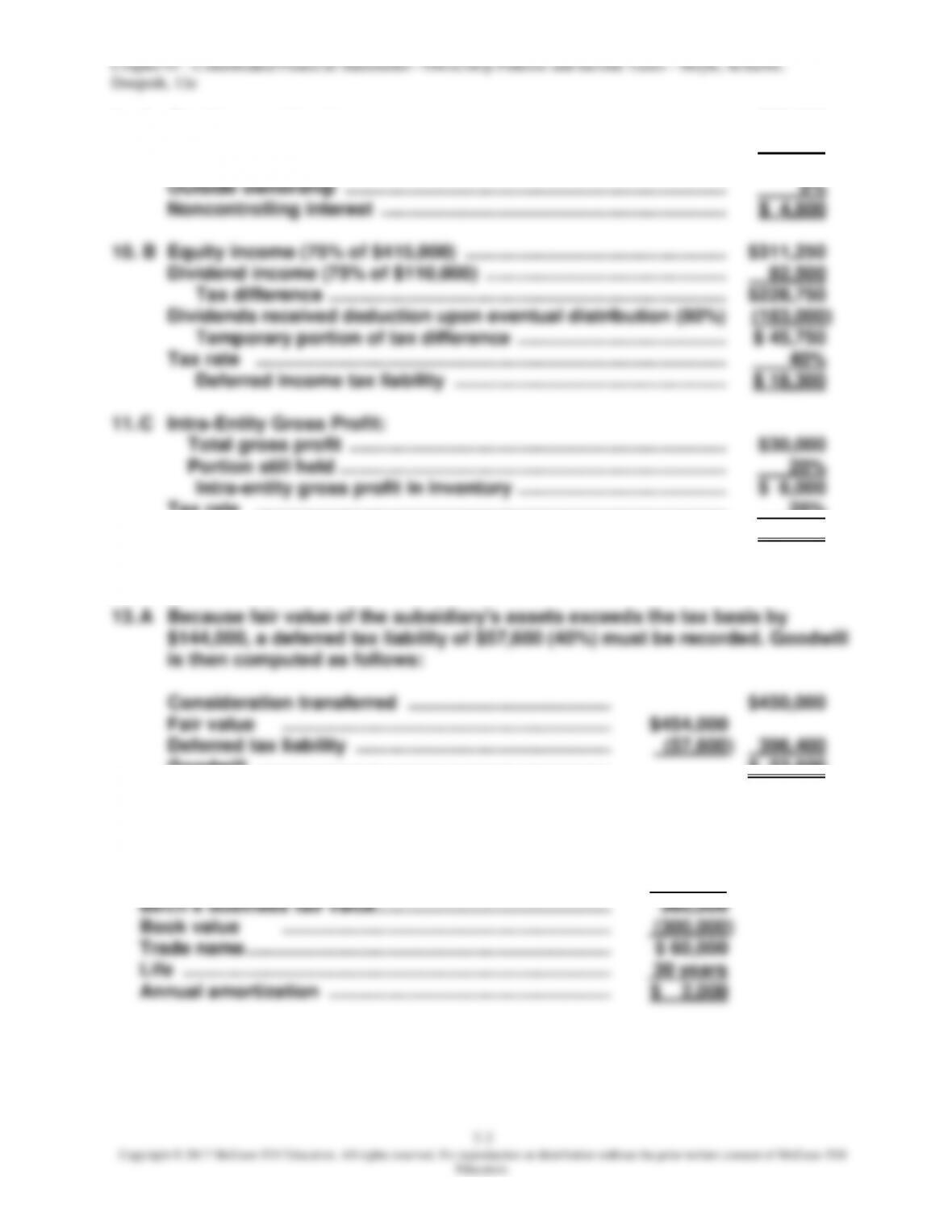
1. D
Operating income ……………………………………………………………. $210,000
Defer intra-entity gain ……………………………………………………… (50,000)
8. C Stang’s accrual-based income:
Operating income ……………………………………………………………. $240,000
Defer intra-entity gain ……………………………………………………… (50,000)
Stang‘s accrual-based income ……………………………………. $190,000
Outside ownership ……………………………………………………….…. 30%
Net income attributable to noncontrolling interest ………… $ 57,000
7-8
14. (continued)
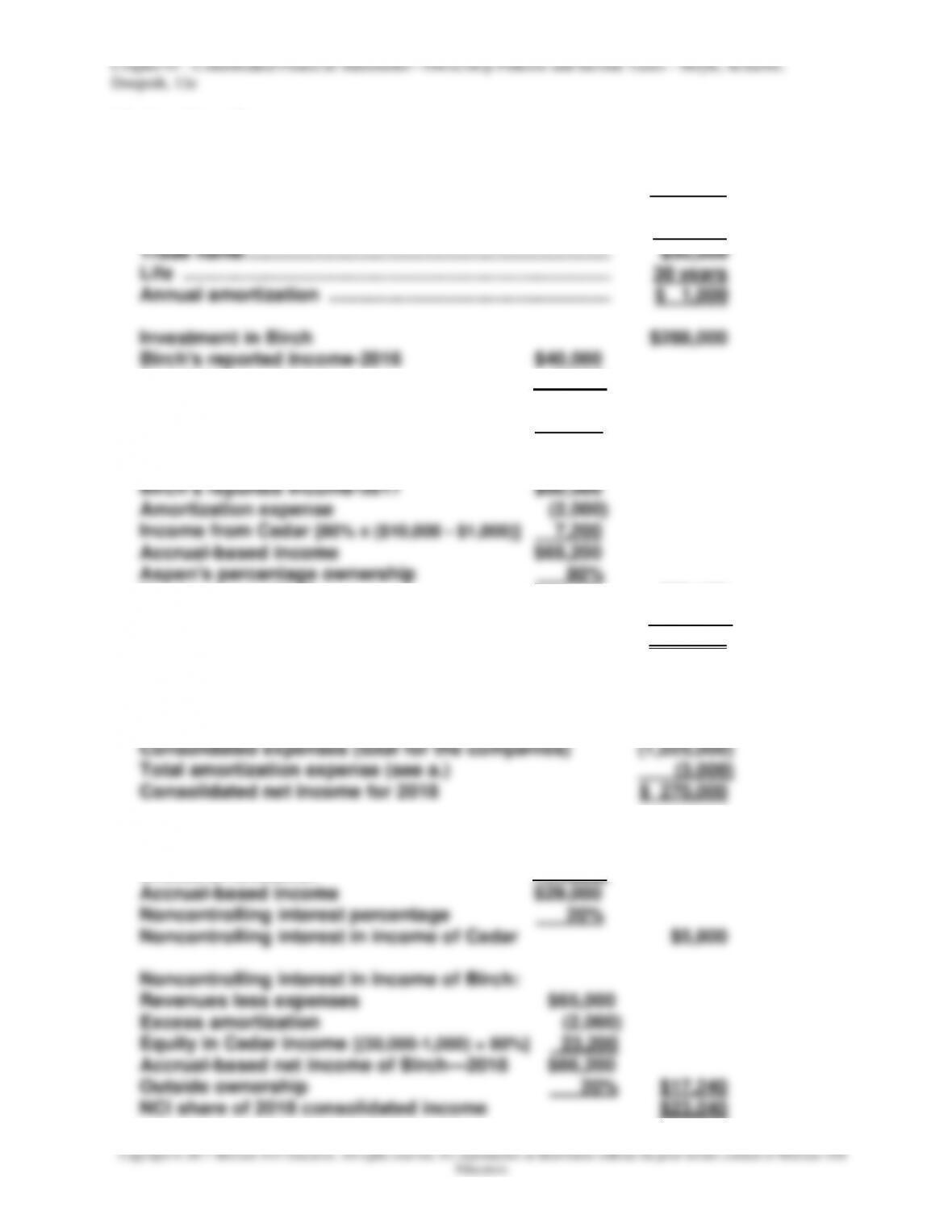
Consideration transferred for Cedar (by Birch) ………. $104,000
Noncontrolling interest fair value …………………………... 26,000
Cedar’s business fair value ……………………………………. $130,000
Book value ……………………………………………………… (100,000)
Amortization expense (2,000)
Accrual-based income $38,000
Aspen’s percentage ownership 80%
Equity accrual-2016 $30,400
Dividends received 2016 (8,000)
Equity accrual-2017 $52,160
Dividends received from Birch 2017 (16,000)
Investment in Birch, December 31, 2017 $346,560
Note: Dividends declared by Cedar (payable to Birch) do not affect Aspen’s
Investment account.
b. Consolidated sales (total for the companies) $1,298,000
c. Noncontrolling interest in income of Cedar
Revenues less expenses $30,000
Excess amortization (1,000)
7-9
Education.
14. (continued)
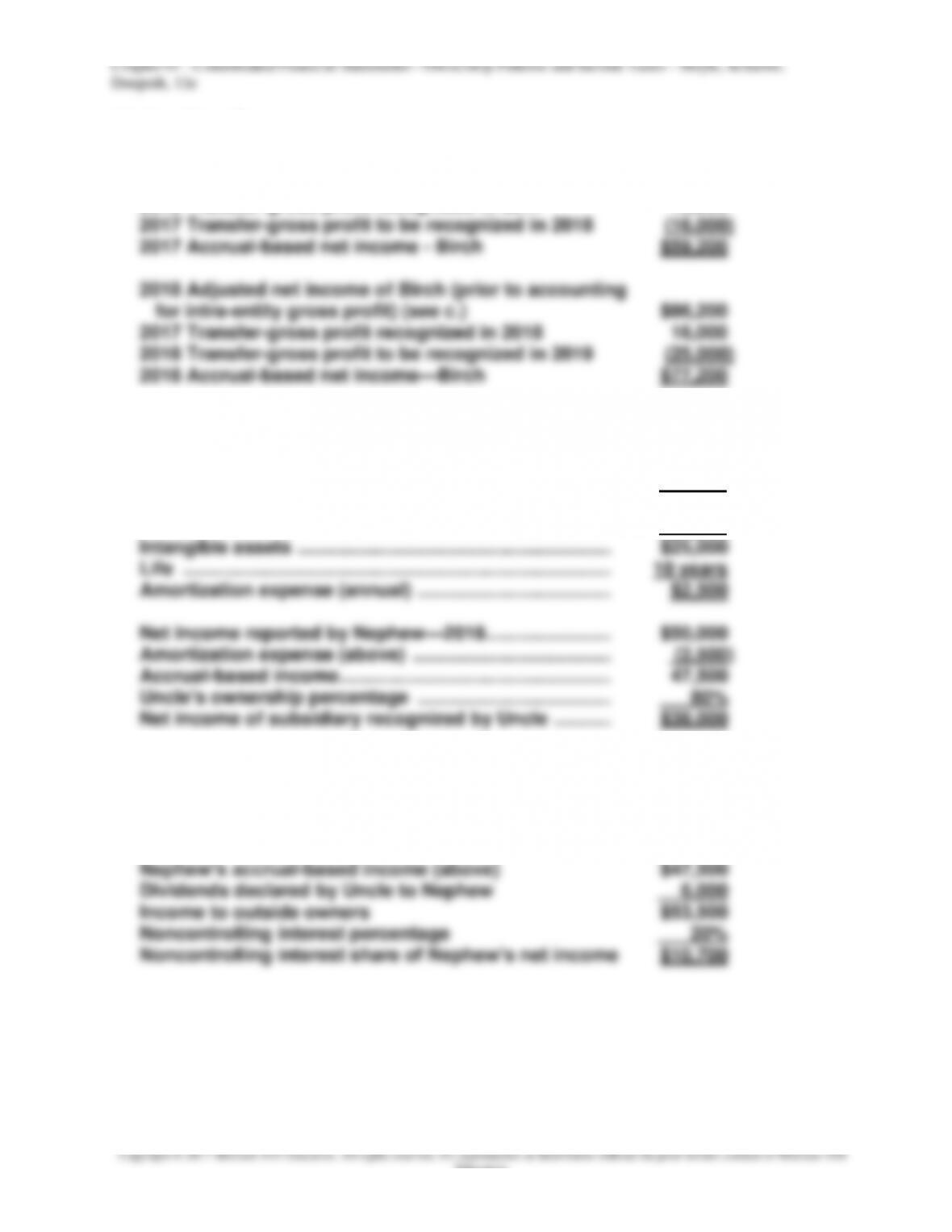
d. 2017 Adjusted net income of Birch (prior to accounting
for intra-entity gross profit) (see a) $65,200
2016 Transfer-gross profit recognized in 2017 10,000
15. (15 minutes) (Income and noncontrolling interest with mutual ownership.)
a. Consideration transferred by Uncle ……………………….. $500,000
Noncontrolling interest fair value …………………………... 125,000
Nephew’s business fair value ………………………………… $625,000
Book value ……………………………………………………………. 600,000
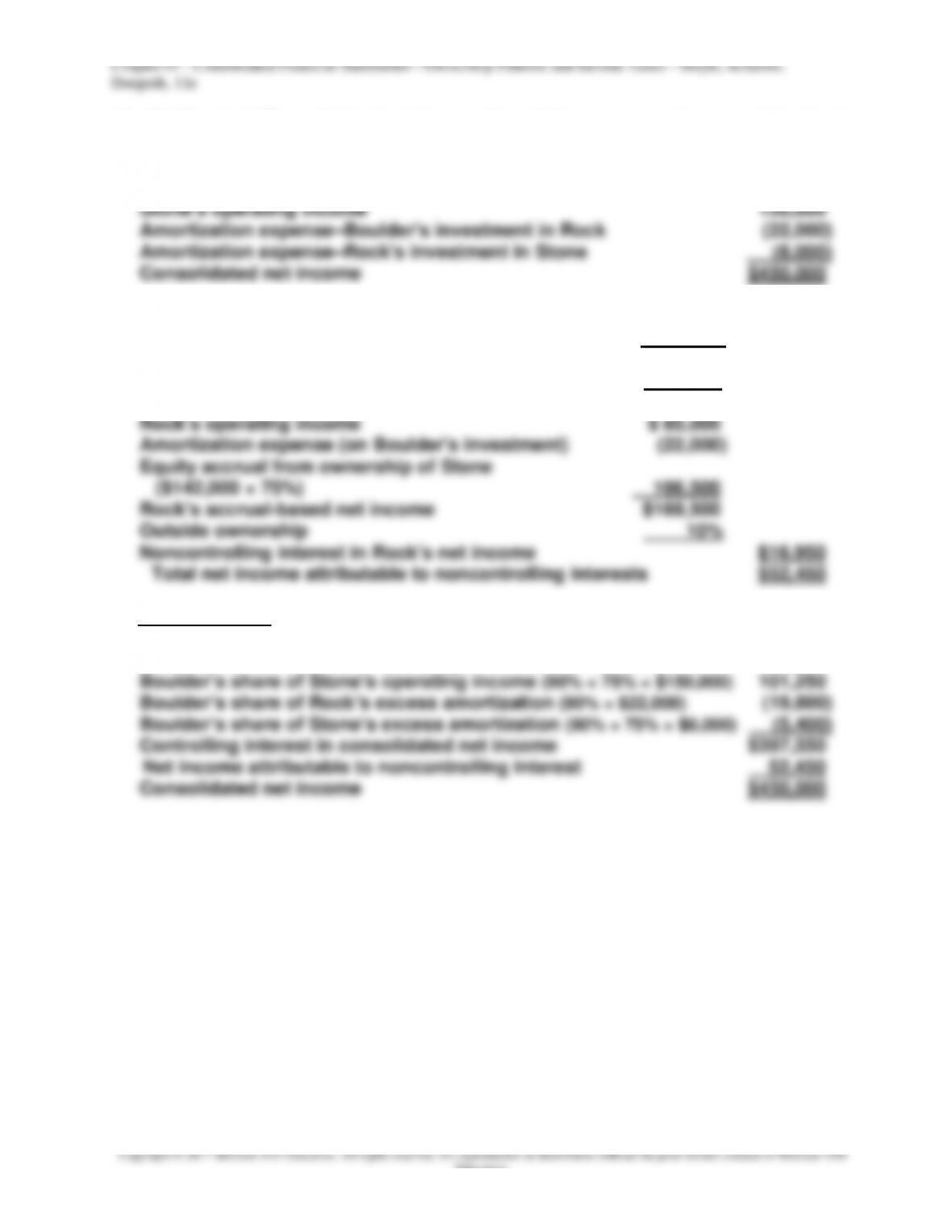
b. To the outside owners, the $6,000 intra-entity dividends ($20,000 × 30%)
declared by Uncle are viewed as income because the book value of Nephew
increases. Thus, the noncontrolling interest’s share of income is computed as
follows:
7-10
Education.
16. (35 Minutes) (Consolidated net income for a father-son-grandson combination.)
a. Boulder’s operating income $245,000
Rock’s operating income 85,000
b. Stone‘s operating income $150,000
Amortization expense (on Rock’s investment) (8,000)
Stone‘s accrual-based net income $142,000
Outside ownership 25%
Noncontrolling interest in Stone’s income $35,500
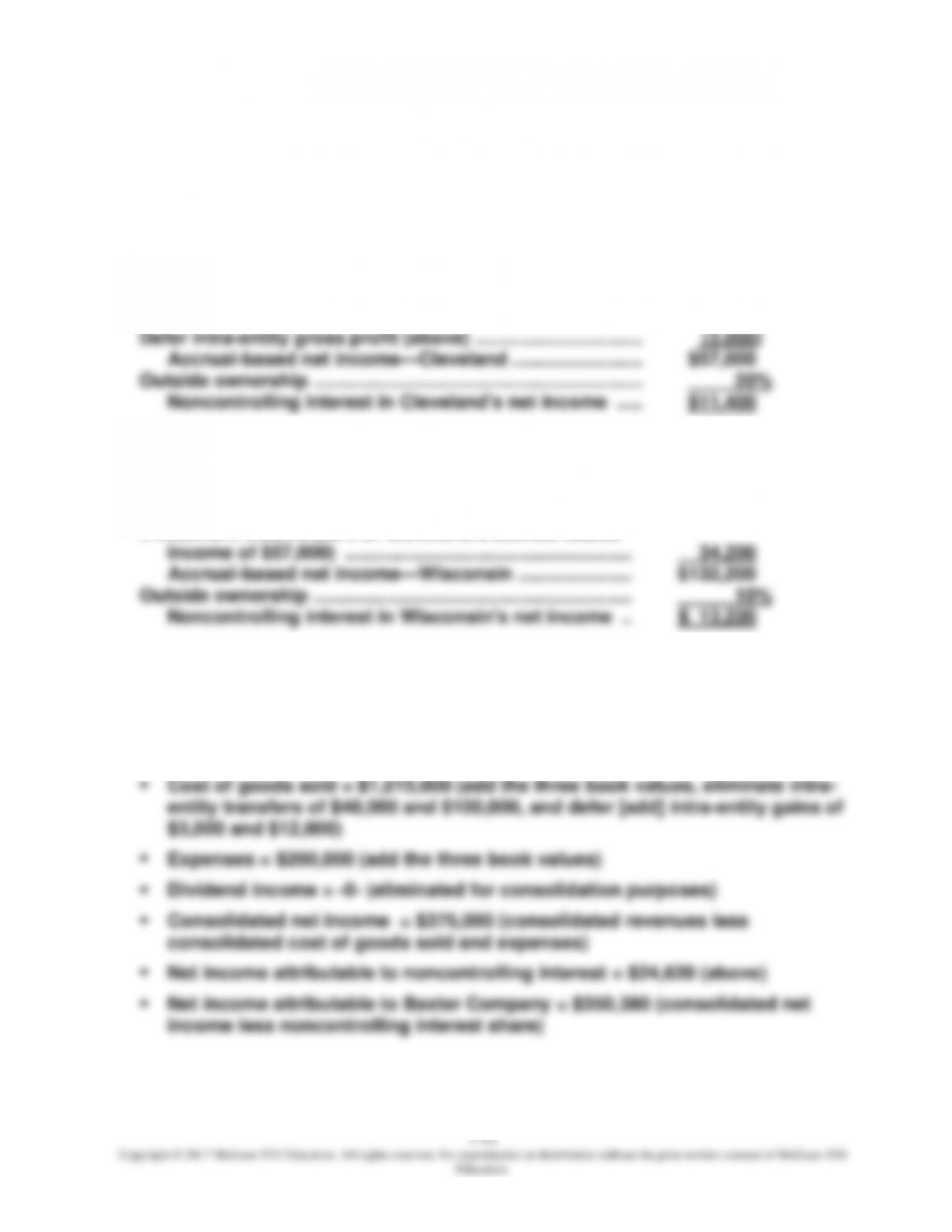
Reconciliation:
Boulder’s operating income $245,000
Boulder’s share of Rock’s operating income (90% × $85,000) 76,500
Chapter 07 – Consolidated Financial Statements—Ownership Patterns and Income Taxes – Hoyle, Schaefer,
Doupnik, 13e
17. (30 Minutes) (Consolidated net income figures for a connecting affiliation)
INTRA-ENTITY GROSS PROFIT:
Cleveland ($12,000 remaining inventory × 25% markup) = $3,000
Wisconsin ($40,000 remaining inventory × 30% markup) = $12,000
NONCONTROLLING INTERESTS:
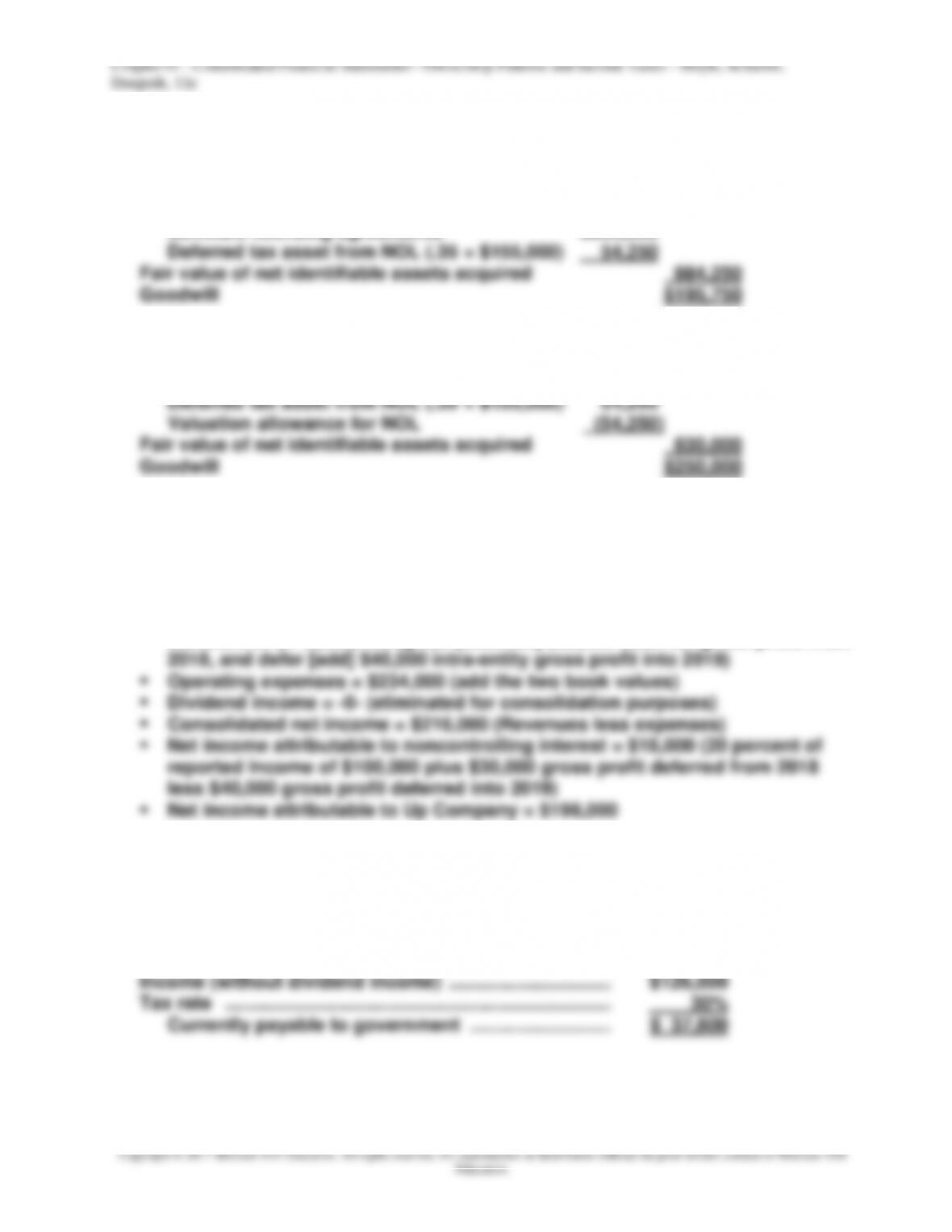
CLEVELAND:
Operating income (sales minus cost of goods sold and
expenses) ……………………………………………………………… $60,000
WISCONSIN:
Operating income (sales minus cost of goods sold and
expenses) ……………………………………………………………. $110,000
Defer intra-entity gross profit (above) ………………………… (12,000)
Investment income (60% of Cleveland’s accrual-based
TOTAL NONCONTROLLING INTERESTS: $24,620 ($11,400 + $13,220)
CONSOLIDATION TOTALS
▪ Sales = $1,590,000 (add the three book values and eliminate intra-entity
transfers of $40,000 and $100,000)
7-12
18. (12 Minutes) (Acquisition accounting for a subsidiary’s operating loss
carryforward)
a. Consideration transferred 1/1/18 $1,080,000
Fair value of identifiable assets acquired:
Software licensing agreements $830,000
b. Consideration transferred 1/1/18 $1,080,000
Fair value of identifiable assets acquired:
Software licensing agreements $830,000
19. (25 Minutes) (Tax expense with separate tax returns for a combination.)
a. CONSOLIDATED TOTALS
▪ Sales = $790,000 (add the two book values and eliminate the $110,000 intra-
entity transfer)
▪ Cost of goods sold = $340,000 (add the book values, eliminate intra-entity
transfers of $110,000, recognize [subtract] $30,000 deferred gross profit from
b. On separate returns, the intra-entity gross profits in inventories are reported as
taxable income. Because Up owns 80 percent of Down’s stock, the dividends are
tax- free and no deferred tax liability is necessary on the undistributed income.
DUE TO GOVERNMENT: (separate returns)
UP:
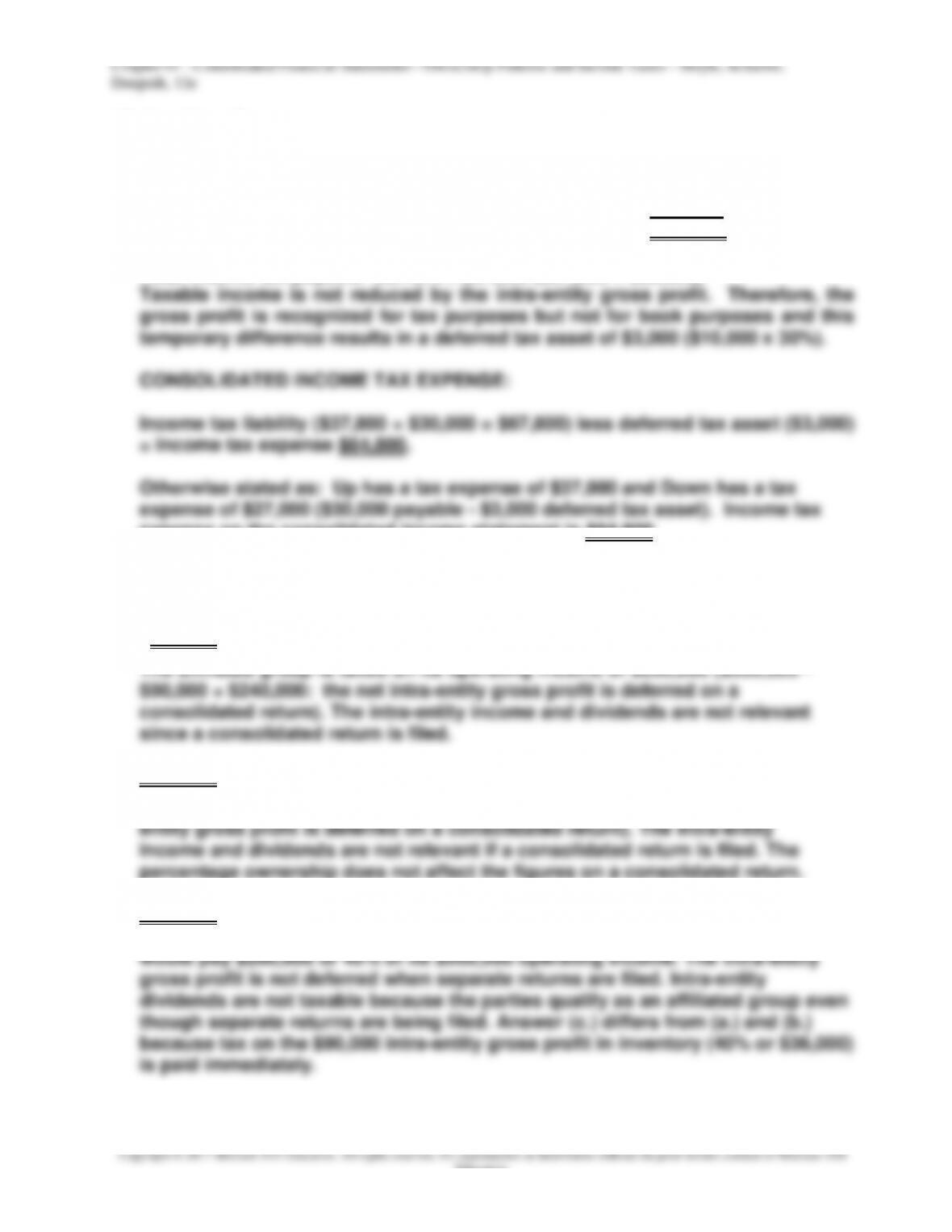
7-13
Education.
19. (continued)
DOWN:
Reported income …………………………………………………… $100,000
Tax rate …………………………..…………………………………… 30%
Currently payable to government ……………………… $ 30,000
Total income tax payable: Current = $67,800 ($37,800 + $30,000)
expense on the consolidated income statement is $64,800.
20. (45 Minutes) (Computation of income tax expense and the related payable
balances)
a. $260,000 ($650,000 × 40%)
b. $260,000 ($650,000 × 40%)
The affiliated group is taxed on its operating income of $650,000 (the net intra-
c. $296,000 ($96,000 + $200,000)
Rogers would pay $96,000 or 40% of its $240,000 operating income. Clarke
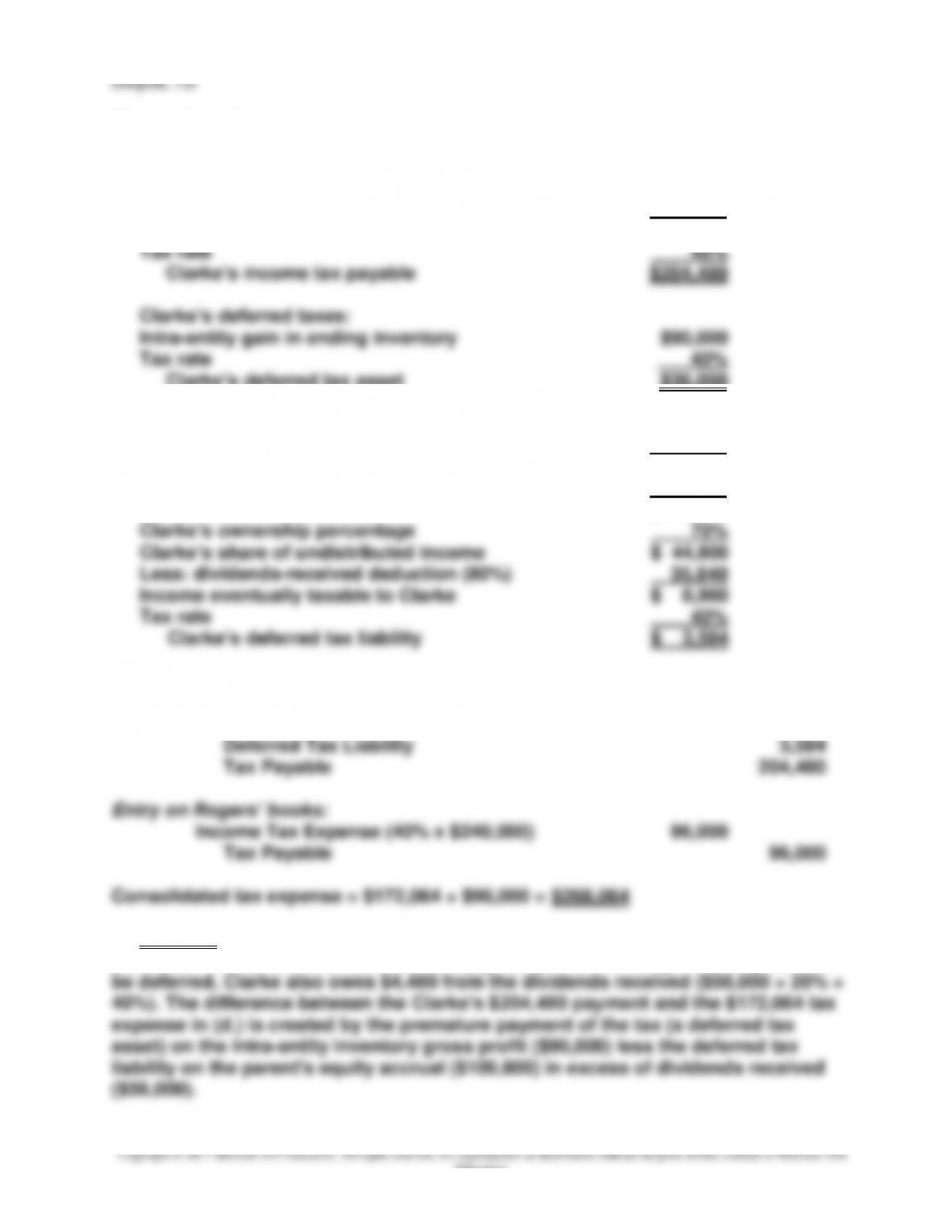
Chapter 07 – Consolidated Financial Statements—Ownership Patterns and Income Taxes – Hoyle, Schaefer,
7-14
Education.
20. (continued)
d. Clarke’s operating income $500,000
Dividends received net of 80% deduction
($80,000 x 70% x 20%) 11,200
Taxable income $511,200
Clarke’s deferred tax asset $36,000
Rogers’ income before income tax $240,000
Less: income tax (40%) 96,000
Rogers net income $144,000
Less: dividends paid 80,000
Undistributed income $ 64,000
Entry on Clarke’s books:
Deferred Tax Asset 36,000
Income Tax Expense 172,064
e. $204,480 (see part d. above) Clarke owes $200,000 on its operating income
($500,000 × 40%) because the intra-entity gross profit in ending inventory cannot
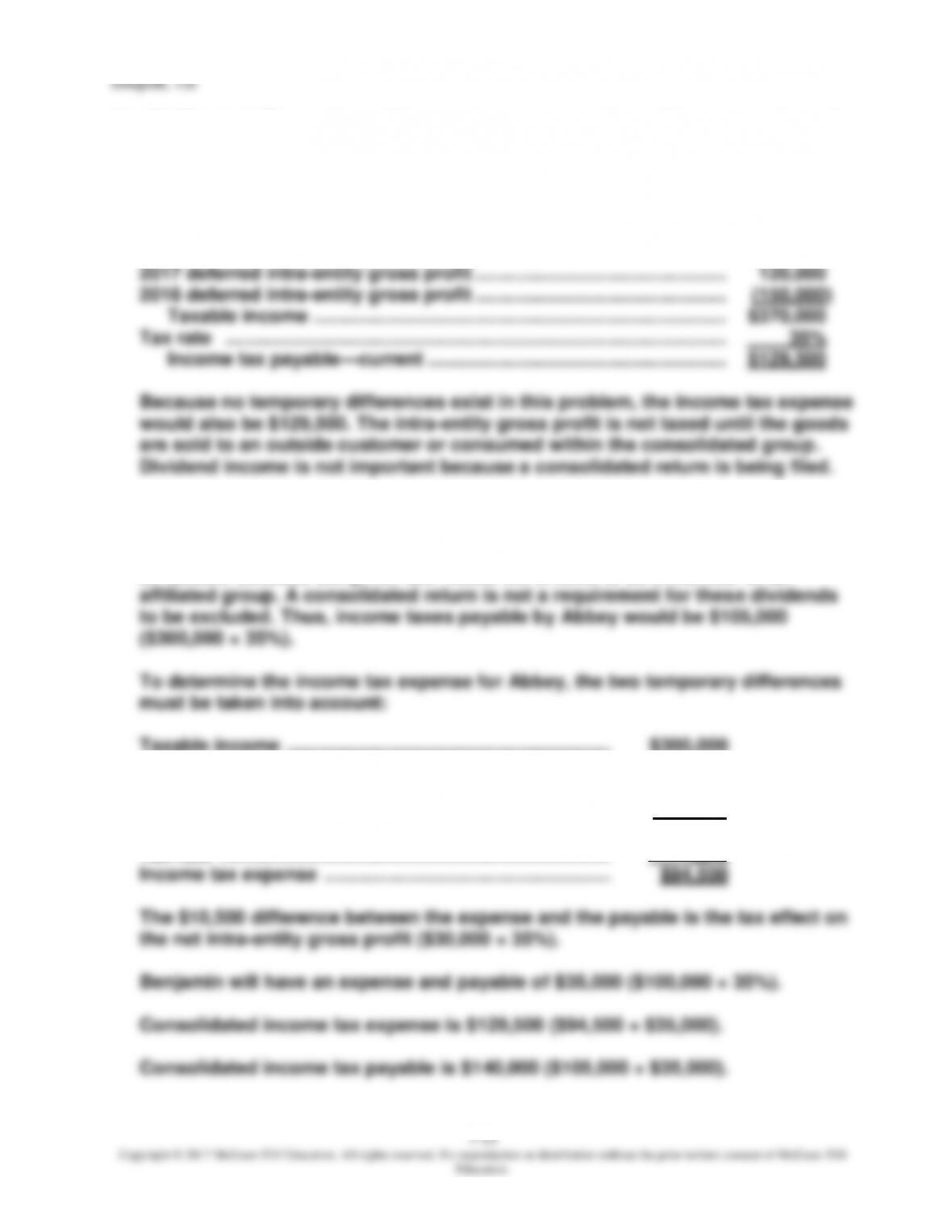
Chapter 07 – Consolidated Financial Statements—Ownership Patterns and Income Taxes – Hoyle, Schaefer,
7-16
Education.
22. (45 Minutes) (Comparison of income tax expense and payable on separate and
consolidated tax returns. Includes question on mutual ownership and the
conventional approach.)
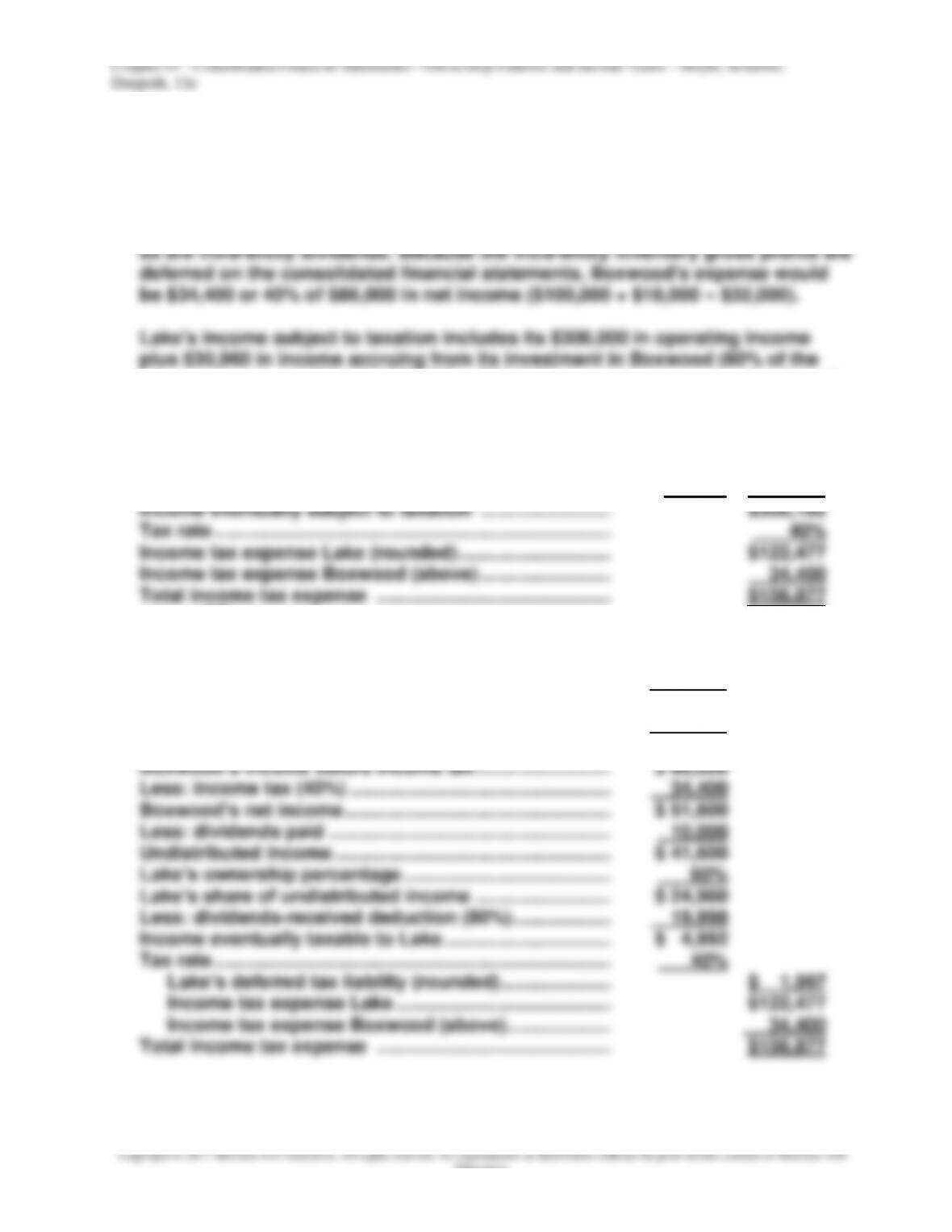
a. Total income tax expense is $156,877. Because of the level of ownership,
separate returns must be filed. Intra-entity gross profits are taxed immediately
after-tax income of $51,600 [$86,000 – $34,400]). Income tax expense for Lake is
computed as follows:
Operating income …………………………………………………. $300,000
Equity income ………………………………………………………. $30,960
Taxable portion …………………………………………………….. 20% 6,192
–OR–
Lake’s operating income ………………………………………… $300,000
Dividends received net of 80% deduction
($10,000 x 60% x 20%) ………………………………………….. 1,200
Taxable income ……………………………………………………… $301,200
Tax rate 40%
Lake’s income tax payable …………………………………. $120,480
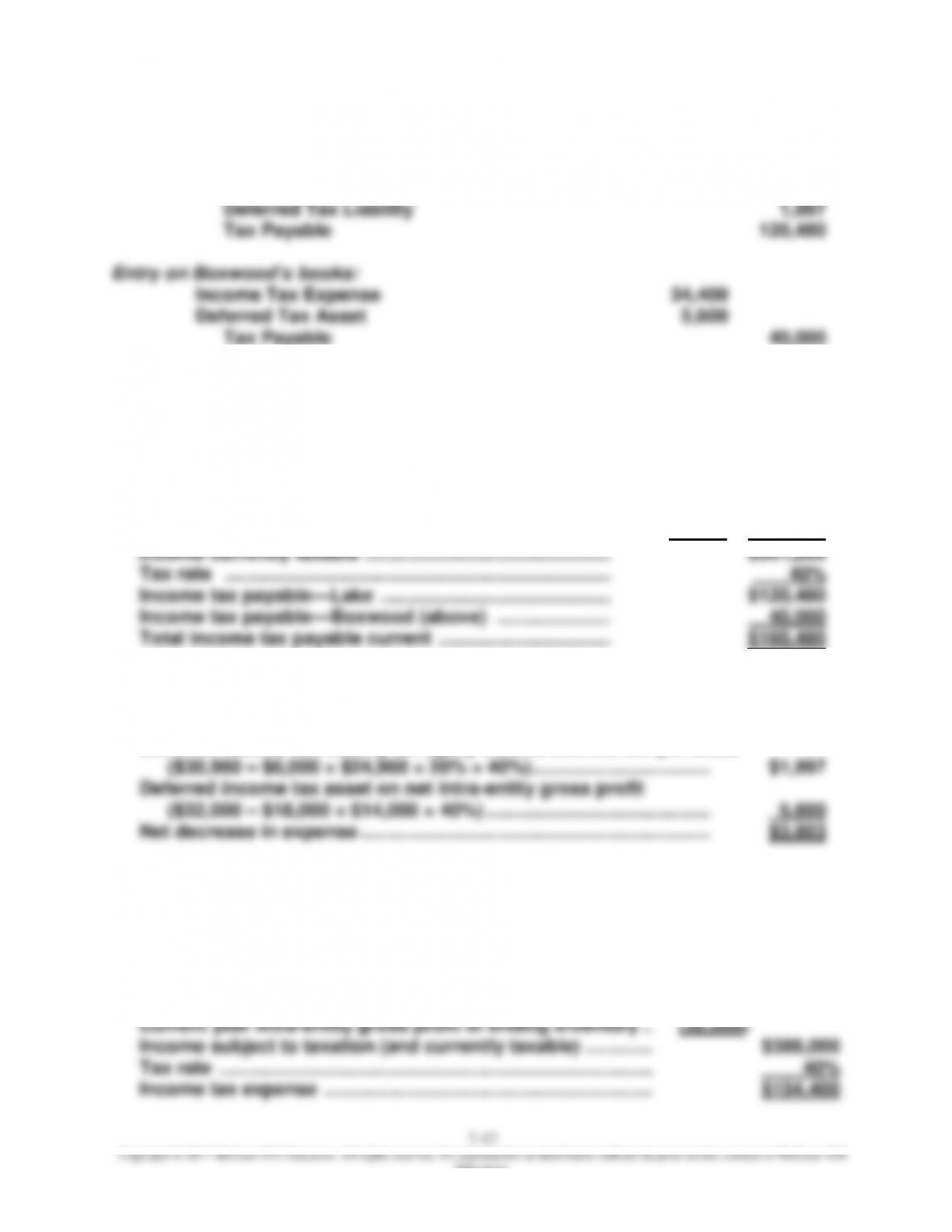
Chapter 07 – Consolidated Financial Statements—Ownership Patterns and Income Taxes – Hoyle, Schaefer,
Doupnik, 13e
Education.
22. (continued)
Entry on Lake’s books:
Income Tax Expense 122,477
b. Boxwood will pay $40,000 ($100,000 × 40%) because separate returns are filed.
Lake, however, will pay its taxes based on dividends received rather than on the
equity accrual. A deferred income tax liability would be established for the
difference. Lake’s payment for the current year is computed as follows:
Operating income …………………………..……………………… $300,000
Dividend income (60% × $10,000) …………………………... $6,000
Taxable portion (net of 80% dividends received deduction) 20% 1,200
The $3,603 difference between the expense in a. and the payable in b. is created
by the following two effects:
Deferred income tax liability on equity income accrual not yet taxed
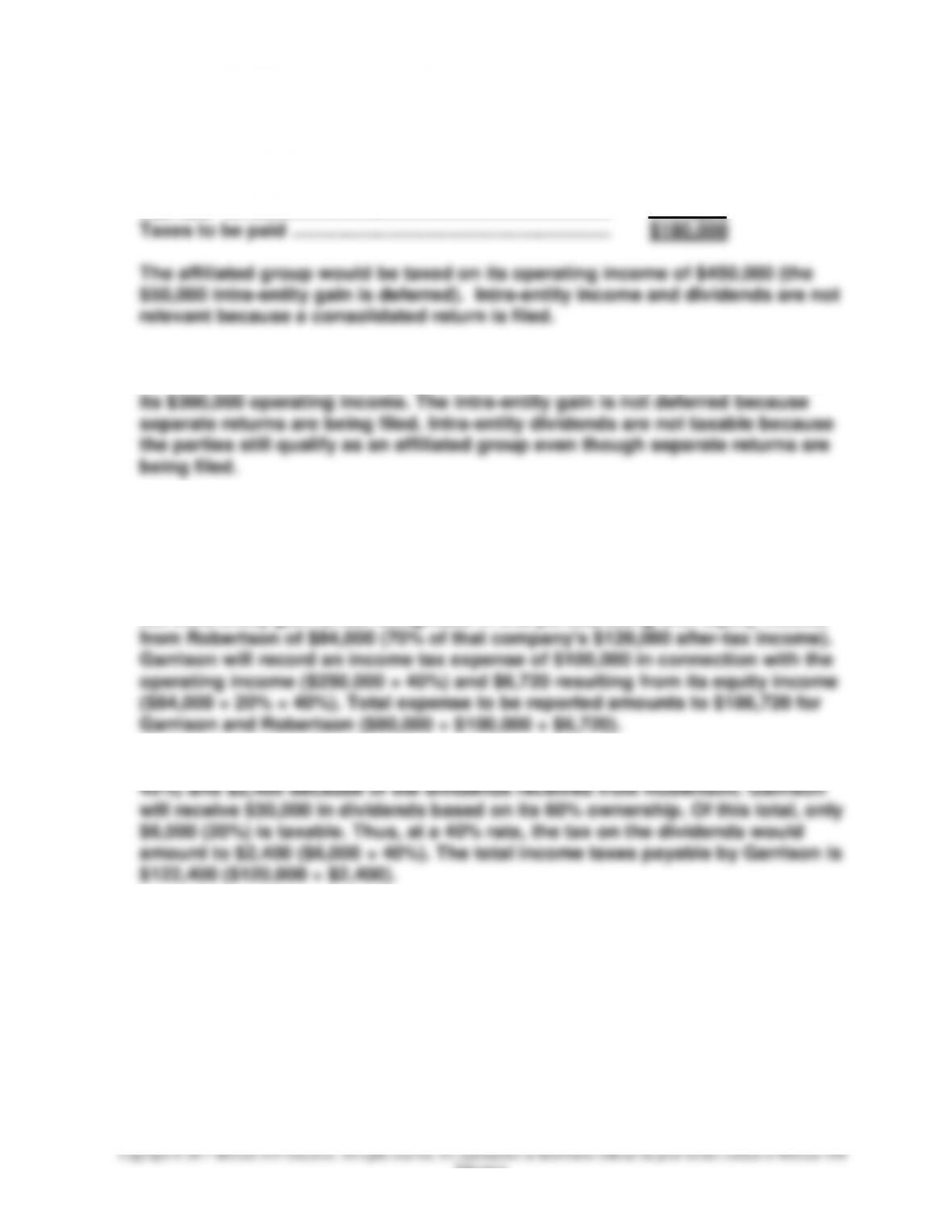
c. Because a consolidated tax return is filed, intra-entity gross profits in ending
inventory are deferred as for external reporting purposes. Dividend income is
not taxable.
Lake’s operating income ………………………………………………. $300,000
Boxwood’s operating income ……………………………………….. 100,000
Prior year intra-entity gross profit in ending inventory ……. 18,000
Chapter 07 – Consolidated Financial Statements—Ownership Patterns and Income Taxes – Hoyle, Schaefer,
Doupnik, 13e
7-18
Education.
23. (30 Minutes) (Computation of income tax expense and income tax payable on
consolidated and separate tax returns.)
a. Operating income …………………………..…………………….. $450,000
Tax rate …………………………..…………………………………… 40%
b. Total taxes to be paid are $200,000. Robertson would have to pay $80,000 or
40% of its $200,000 operating income. Garrison would pay $120,000 or 40% of
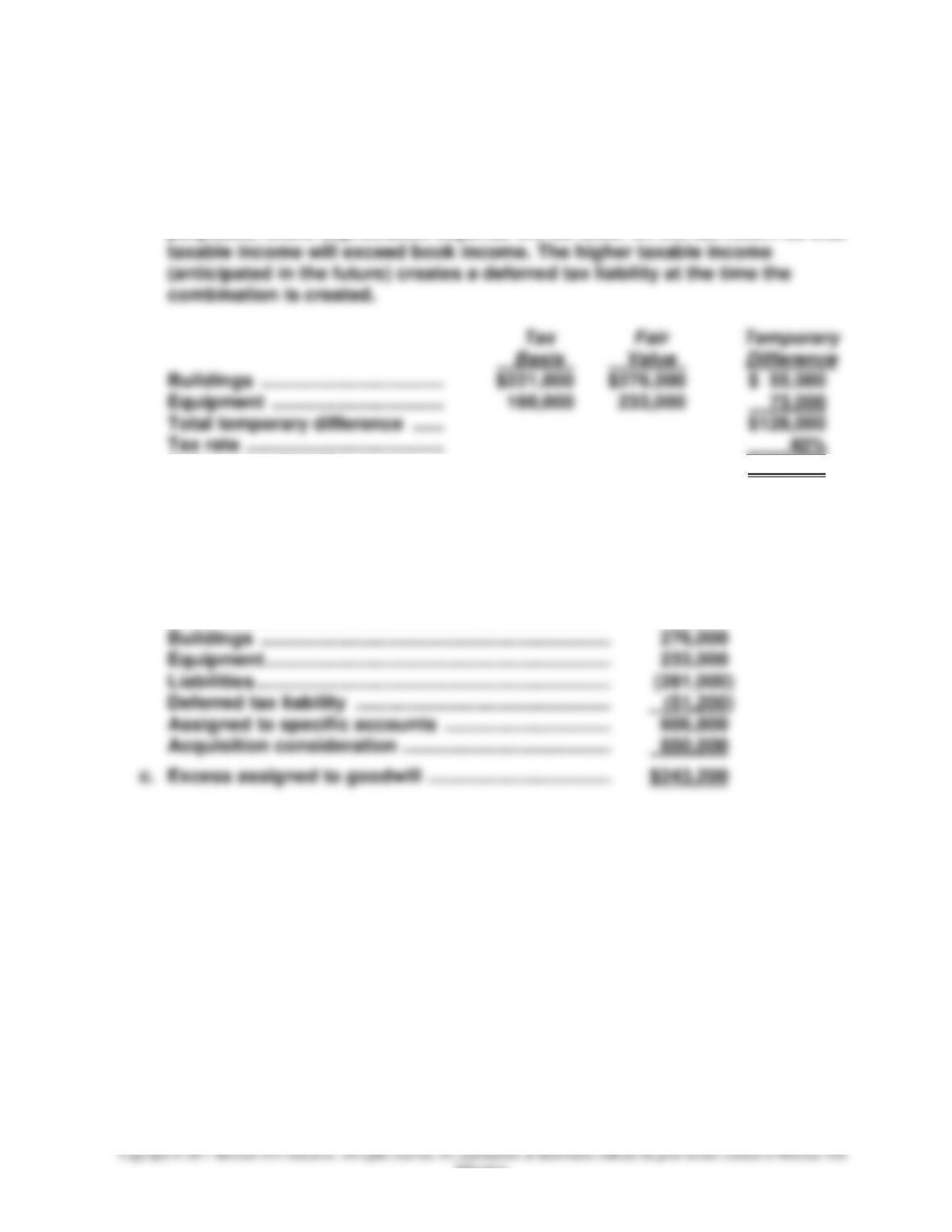
c. Robertson must report an income tax expense of $80,000 or 40% of its $200,000
operating income.
Garrison records its expense based on the revenue recognized during the
period. Thus, the expense is computed on an operating income of $250,000 (the
net intra-entity gain is not recognized in this period) along with equity income
d. Garrison will pay $120,000 in connection with its operating income ($300,000 ×
Chapter 07 – Consolidated Financial Statements—Ownership Patterns and Income Taxes – Hoyle, Schaefer,
Doupnik, 13e
7-19
Education.
24. (10 Minutes) (Impact on goodwill of assets with a different tax vs. book value.)
a. The assets and liabilities of Oxford (the subsidiary) will be consolidated at
their individual net fair values ($658,000). However, both the buildings and
equipment have a tax basis that is lower than fair value. Thus, for tax
purposes, future depreciation expense will be lower on the tax return so that
Deferred tax liability …………….. $ 51,200
b. Consequently, Oxford’s accounts will be consolidated as follows:
(parentheses indicate a credit balance)
Accounts receivable …………………………………………. $153,000
Inventory …………………………………………………………. 141,000
Land ………………………………………………………………… 136,000