Chapter 05 – Consolidated Financial Statements – Intra-Entity Asset Transactions – Hoyle, Schaefer, Doupnik, 13e
5-1
CHAPTER 5
CONSOLIDATED FINANCIAL STATEMENTS—
INTRA-ENTITY ASSET TRANSACTIONS
Chapter Outline
I. The transfer of assets between the companies within a consolidated entity is a common practice.
The opportunity for such direct acquisition (especially of inventory) is often the underlying motive
for the creation of the combination.
II. Intra–entity inventory transfers
A. The individual accounting systems of the two companies will record the transfer as a sale by
one party and as a purchase by the other
B. Because the transaction was not made with an outside, unrelated party, the sales and
purchases balances created by the transfer are eliminated in consolidation (Entry Tl)
C. Any transferred inventory retained at the end of the year is recorded at its transfer price
which in (many cases) will include an intra-entity gross profit
1. For consolidation purposes, this intra-entity gross profit must be deferred by eliminating
2. Because transfer effects carry over to the subsequent fiscal period, the intra-entity gross
profit must also be removed a second time: from the beginning inventory component of
3. The consolidation process is designed to shift the profit from the period of transfer into
1. Official accounting pronouncements permit but do not require deferral of intra-entity
profits on the valuation of noncontrolling interest balances
2. This textbook adjusts the noncontrolling interest balances but only if the sale was made
upstream from subsidiary to parent. Downstream sales are made by the parent and, thus,
are viewed as having no effect on the outside interest.
1. In the year of transfer, an actual gain account exists within the accounting records of the
seller and must be removed.
2. In all later time periods, since the intra-entity gain has become an element of the seller’s
beginning retained earnings balance, the reduction is made to this equity account.
3. If the land is ever sold to an outside party, the intra-entity gain must be recognized within
that time period.
Chapter 05 – Consolidated Financial Statements – Intra-Entity Asset Transactions – Hoyle, Schaefer, Doupnik, 13e
5-2
IV. Intra–entity transfer of depreciable assets
A. As with other intra-entity transfers, any intra-entity gross profit in depreciable assets must be
deferred and subsequently recognized (via depreciation expense adjustments) for
consolidation purposes to establish appropriate historical cost balances.
B. However, the difference between the transfer-based accounting carrying amount and the
historical-based carrying amount of the asset will change each year because of the effects of
depreciation. The amount of intra-entity gain within retained earnings will also be reduced
annually since excess depreciation expense is recognized (and closed into retained
earnings) based on the inflated transfer price.
C. Consequently, elimination of the intra-entity gain (within retained earnings) and the reduction
of the asset value to historical cost will differ from year to year.
D. Also within the consolidation process, the recorded depreciation expense must be decreased
every period to an amount appropriately based on the asset‘s original acquisition price.
Answers to Discussion Questions
Earnings Management: By selling goods to special purpose entities that it controlled but did not
consolidate, did Enron overstate its earnings?
According to the Power’s Report (Report of Investigation by the Special Investigative Committee of the
Board of Directors of Enron Corp.—February 1, 2004)
These partnerships—Chewco, LJM1, and LJM2—were used by Enron Management to
enter into transactions that it could not, or would not, do with unrelated commercial
entities. Many of the most significant transactions apparently were designed to
accomplish favorable financial statement results,
not to achieve bona fide economic objectives or to transfer risk. (page 4)
Assuming Enron controlled LJM2, the activities that produced the $67 million gain and the $20.3 million
agency fee were not arm’s length and thus did not provide a proper basis for recognizing income.
What effect does consolidation have on the financial reporting for transactions with controlled entities?
In consolidation, all intra-entity profit would have been deferred until the goods were sold to an outside
FASB Activity on Variable Interest Entities (VIEs)
Fortunately the FASB’s ASC Topic 810 explains how to identify an SPE (a type of entity that is often a
VIE) that is not subject to control through voting ownership interests, but is nonetheless controlled by
another enterprise and therefore subject to consolidation. The entity that controls the SPE is then
required to include the assets, liabilities, and results of the activities of the SPE in its consolidated
financial statements.
Chapter 05 – Consolidated Financial Statements – Intra-Entity Asset Transactions – Hoyle, Schaefer, Doupnik, 13e
5-3
What Price Should We Charge Ourselves?
Transfer pricing is actually a topic for a managerial accounting discussion. Students, though, need to be
aware that managerial and financial accounting do overlap at times. In this illustration, the price set by
company officials for this component will affect the specific consolidation procedures needed in the
preparation of financial statements for external reporting purposes.
Since Slagle owns 100 percent of Harrison’s common stock, consolidated net income will not be altered
by the transfer pricing decision. All intra-entity transactions as well as intra-entity profits will be removed
Chapter 05 – Consolidated Financial Statements – Intra-Entity Asset Transactions – Hoyle, Schaefer, Doupnik, 13e
5-4
Answers to Questions
1. One reason for the significant volume and frequency of intra-entity transfers is that many
consolidated entitiess are specifically organized so that the companies can provide products for
2. The sales between Barker and Walden totaled $100,000. Regardless of the ownership
3. Sales price per unit ($900,000 ÷ 3,000 units) $ 300
Number of units in Safeco’s ending inventory × 500
4. In intra-entity transactions, a transfer price is often established that exceeds the cost of the
inventory. Hence, the seller is recording a gross profit on its books that, from the perspective of
the consolidated entity as a whole, must be deferred until the asset is consumed or sold to an
outside party. Any intra-entity gross profit on merchandise still held by the buyer must be
5. On the individual financial records of James, Inc., a gross profit is recorded in the year of
transfer. From the viewpoint of the consolidated entity, this gross profit should be recognized in
6. Currently accounting pronouncement allow discretion regarding the effect of intra-entity profits in
inventory and noncontrolling interest values. This textbook reasons that intra-entity profits relate
7. Consolidated financial statements are largely unchanged across downstream versus upstream
transfers. Sales and purchases (Inventory) balances created by the transactions are eliminated
5-5
Copyright © 2017 McGraw-Hill Education. All rights reserved. No reproduction or distribution without the prior written consent of McGraw-Hill Education.
8. The computation of this noncontrolling interest balance depends on the direction of the intra–
entity transfers which is not indicated in the question. If the intra-entity gross profits were created
by downstream sales from King to Pawn, they relate only to King. The net income attributable to
the noncontrolling interest is not affected and would be $11,000 ($110,000 × 10%). In contrast, if
9. The deferral and subsequent recognition of intra-entity profits are allocated to the noncontrolling
interest in the same periods as the parent. When one affiliate sells to another affiliate, ownership
10. Several differences can be cited that exist between the consolidated process applicable to
inventory transfers and that which is appropriate for land transfers. The total intra-entity Sales
balance is offset against Purchases (Inventory) when inventory is transferred but no
11. As long as the land is held by the parent, its recorded value must be reduced to historical cost
within each consolidated set of financial statements. In the year of the original transfer, the asset
reduction is offset against the subsidiary’s recorded gain. For all subsequent years in which the
property is held, the credit to the Land account is made against the beginning retained earnings
5-6
12. Depreciable assets are often transferred between the members of a consolidated entity at
amounts in excess of book value. The buyer will then compute depreciation expense based on
13. From the viewpoint of the consolidated entity, an intra-entity gain has been created by the
transfer and must be deferred in the preparation of consolidated financial statements. This intra–
entity gain is closed by the seller into retained earnings necessitating subsequent reductions to
Chapter 05 – Consolidated Financial Statements – Intra-Entity Asset Transactions – Hoyle, Schaefer, Doupnik, 13e
Answers to Problems
1. D
Defer 2018 intra-entity gross profit ………………………………….. 15,750
Cost of goods sold ………………………………………………………………. $716,050
5. A Intra-entity sales and purchases of $100,000 must be eliminated. Additionally, an
intra-entity gross profit of $10,000 must be removed from ending inventory based
6. C The only change here from Problem 5 is the gross profit rate which would now be
40 percent ($120,000 gross profit $300,000 sales). Thus, the intra-entity gross
Chapter 05 – Consolidated Financial Statements – Intra-Entity Asset Transactions – Hoyle, Schaefer, Doupnik, 13e
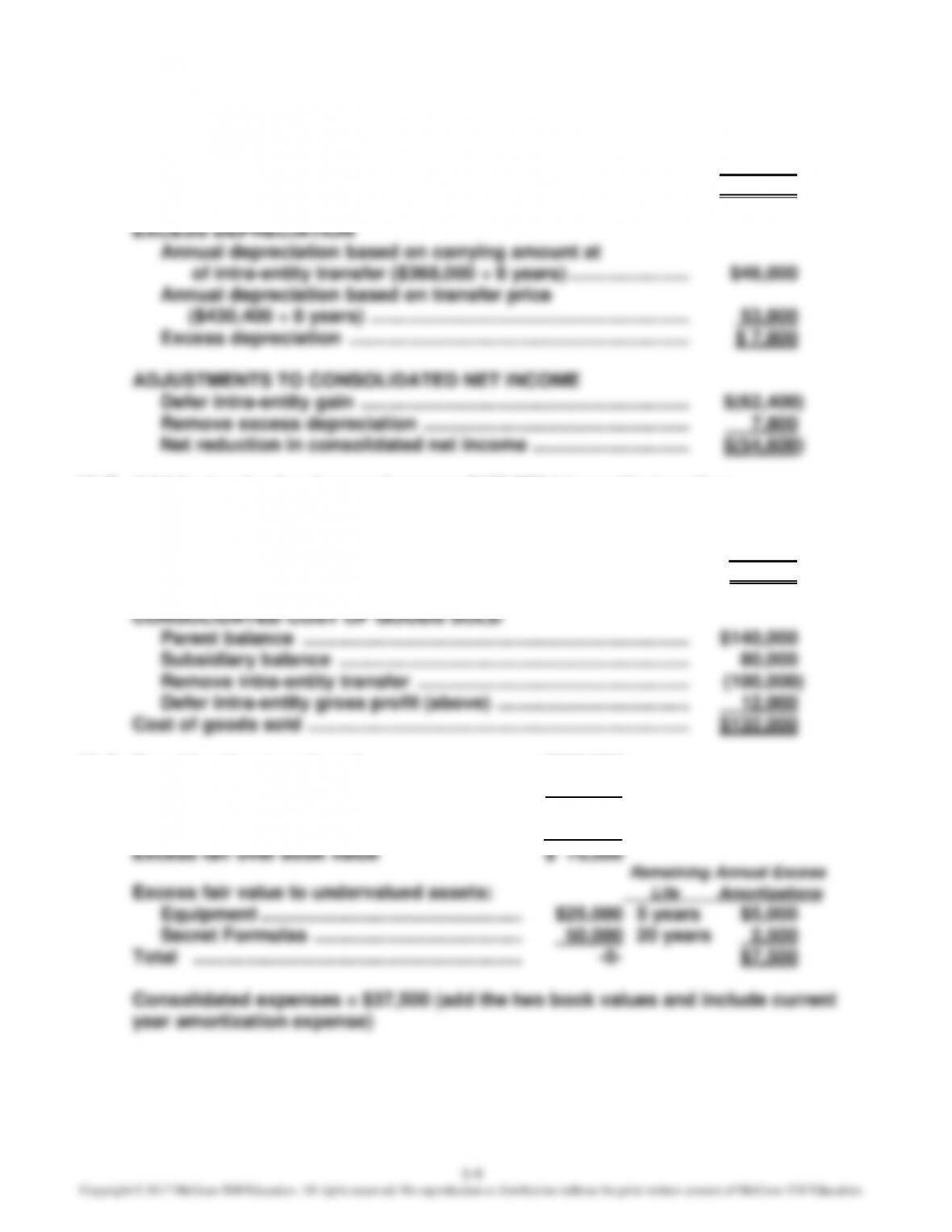
9. D INTRA-ENTITY GAIN
Transfer price …………………………..…………………………………….. $430,400
Book value (original cost less two years depreciation) ……… 368,000
Intra-entity gain ……………………………………………………………….. $ 62,400
10. D Add the two book values and remove $100,000 intra-entity transfers.
11. C Intra-entity gross profit ($100,000 – $80,000) …………………………. $20,000
Inventory remaining at year’s end ………………………………………… 60%
Intra-entity gross profit in ending inventory …………………………... $12,000
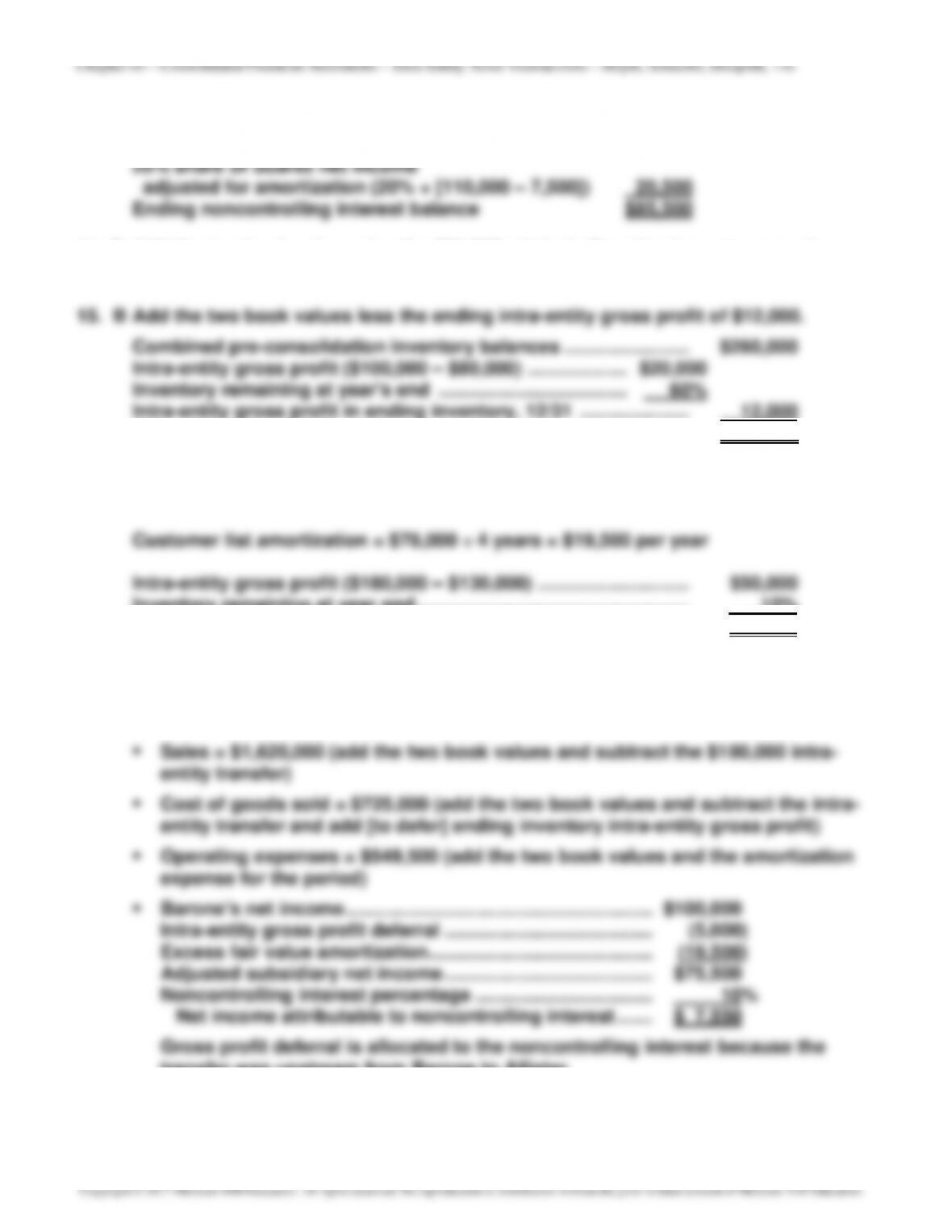
12. C Consideration transferred ………………………. $260,000
Noncontrolling interest fair value ……………… 65,000
Suarez total fair value ………………………………. $325,000
Book value of net assets ………………………….. (250,000)
5-10
13. A 20% of the beginning book value $50,000
Excess fair value allocation (20%× $75,000) 15,000
14. C Add the two book values plus the $25,000 original allocation less one year of
excess amortization expense ($5,000).
Consolidated total for inventory ……………………………………………. $248,000
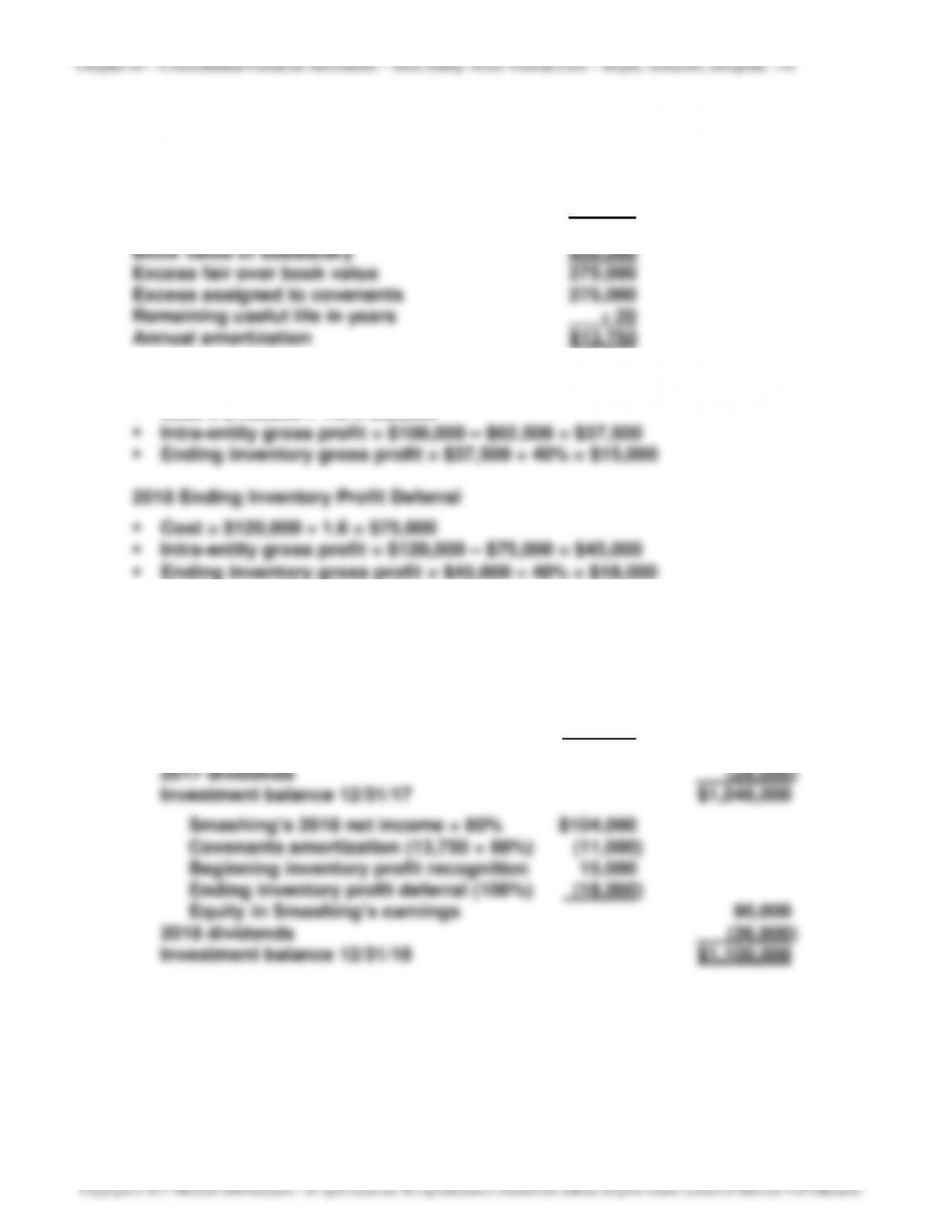
16. (15 Minutes) (Determine selected consolidated balances; includes inventory
transfers and an outside ownership.)
Inventory remaining at year end ……………………………………………. 10%
Intra-entity gross profit in ending inventory, 12/31 ………………… $ 5,000
CONSOLIDATED TOTALS
▪ Inventory = $795,000 (add the two book values and subtract the ending intra-
entity gross profit of $5,000)
transfer was upstream from Barone to Allister.
5-11
17. (60 minutes) (Downstream intra-entity profit adjustments when parent uses equity
method and a noncontrolling interest is present)
Consideration transferred by Corgan $980,000
Noncontrolling interest fair value 245,000
Smashing’s acquisition–date fair value 1,225,000
2017 Ending Inventory Profit Deferral
▪ Cost = $100,000 ÷ 1.6 = $62,500
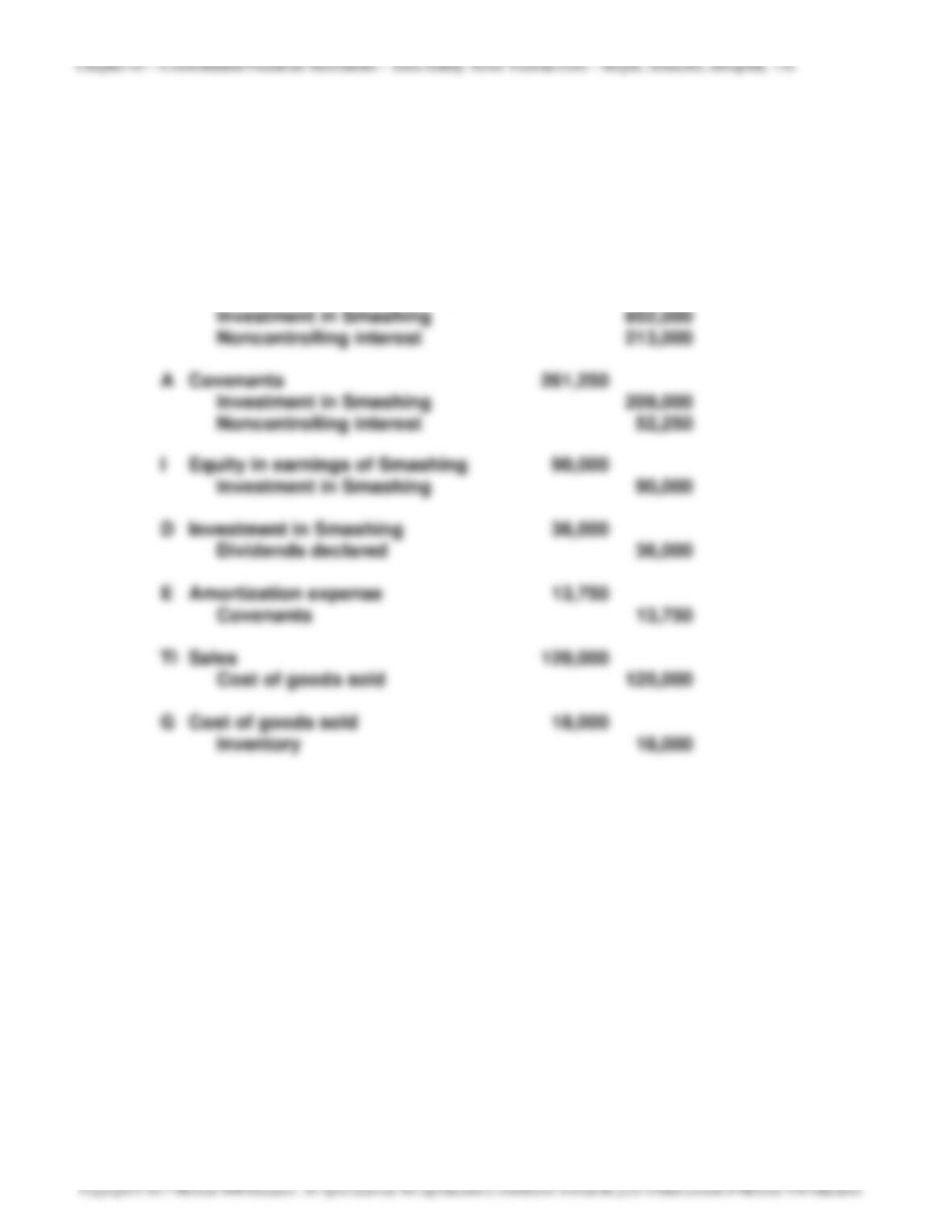
a. Investment account:
Consideration transferred, January 1, 2017 $980,000
Smashing’s 2017 net income × 80% $120,000
Covenant amortization (13,750 × 80%) (11,000)
Ending inventory profit deferral (100%) (15,000)
Equity in Smashing’s earnings 94,000
5-12
17. (continued)
b. 12/31/18 Worksheet Adjustments
*G Investment in Smashing 15,000
Cost of goods sold 15,000
S Common stock—Smashing 700,000
Retained earnings—Smashing 365,000
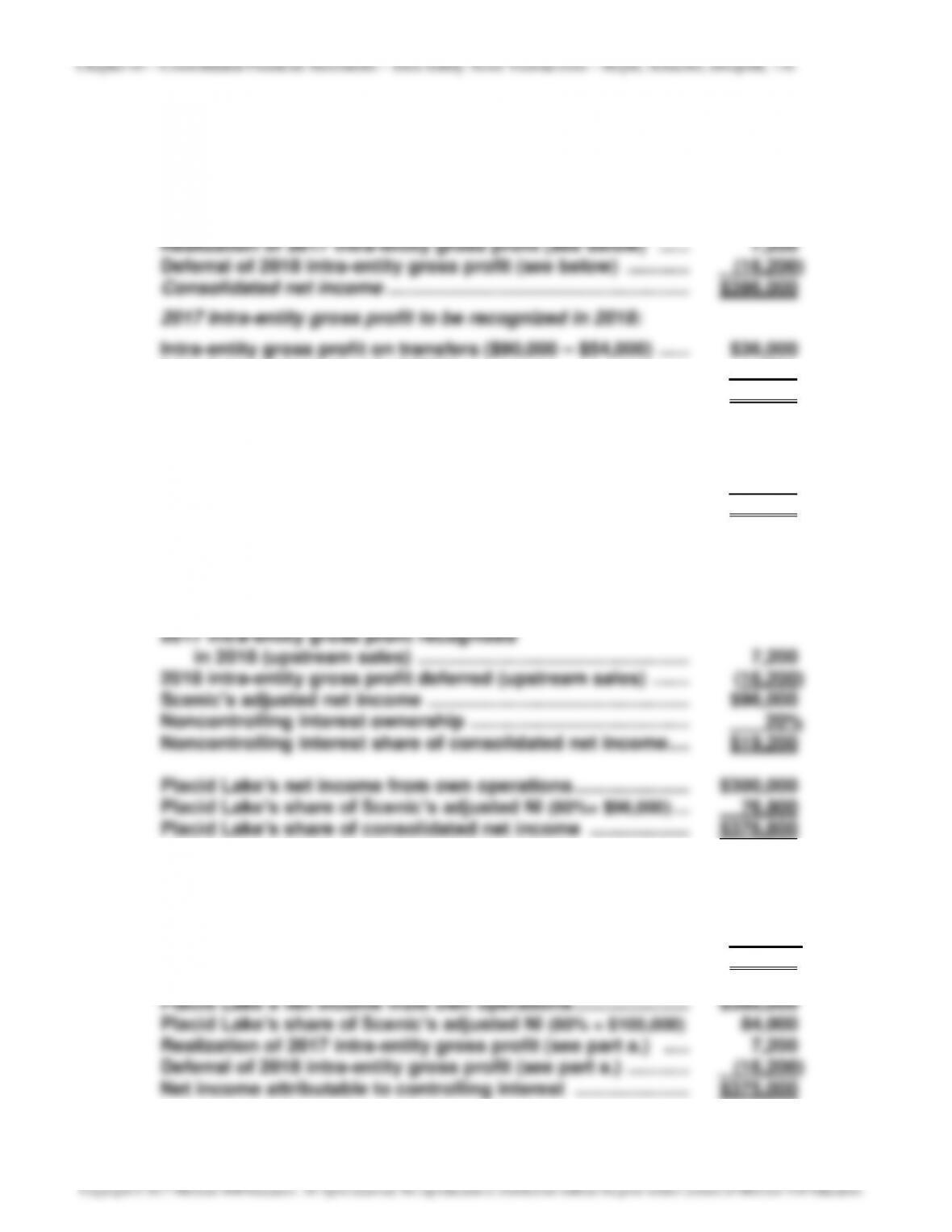
5-13
18. (40 Minutes) (Series of independent questions concerning various aspects of the
consolidation process when intra-entity transfers have occurred)
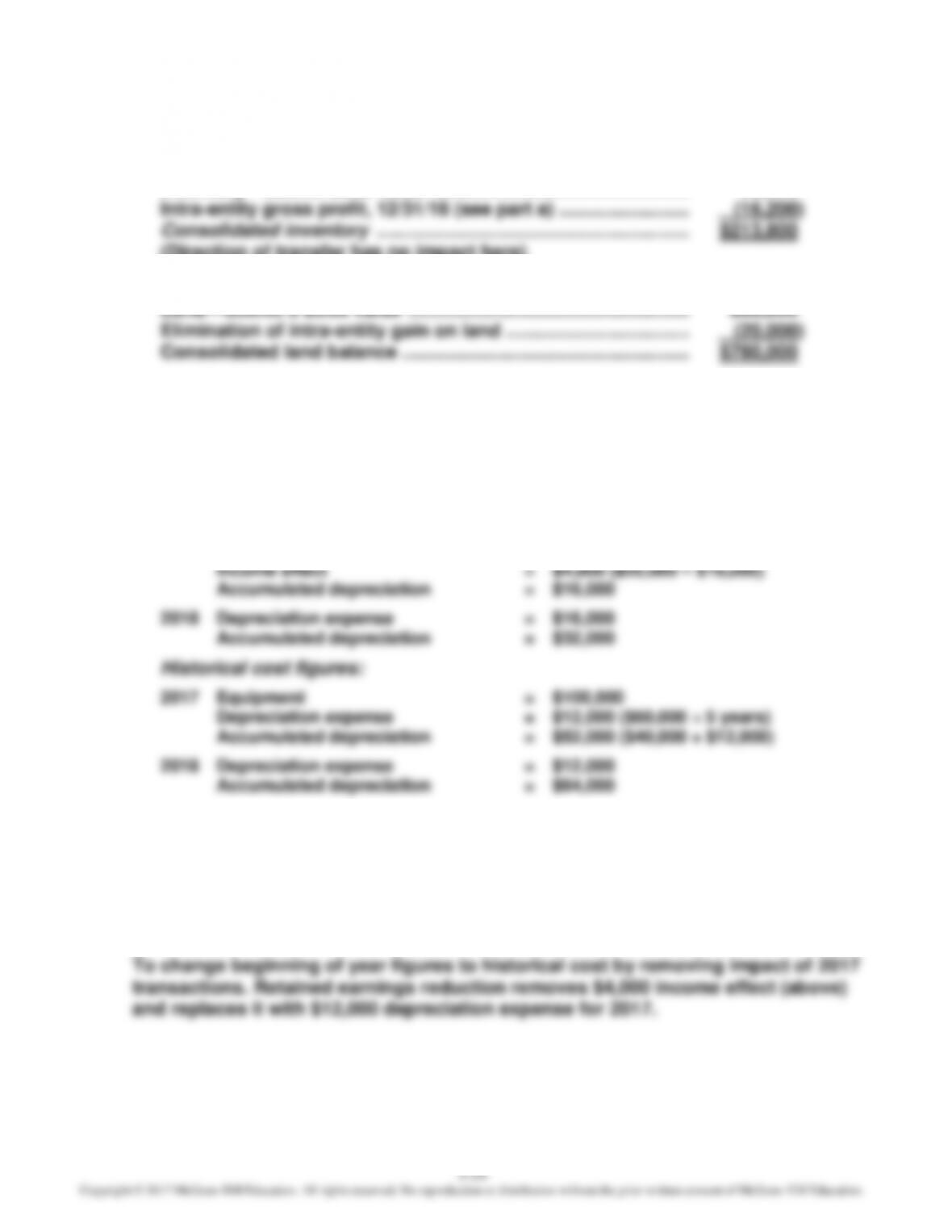
a. Placid Lake’s 2018 net income before effect from Scenic …… $300,000
Scenic’s reported net income 2018 ………………………………….. 110,000
Amortization expense (given) …………………………………………. (5,000)
Inventory retained at end of 2017 …………………………………….. 20%
Intra-entity gross profit in ending inventory—12/31/17 …. $ 7,200
2018 Intra-entity gross profit deferred:
Intra-entity gross profit on transfers ($120,000 – $66,000) …. $54,000
Inventory retained at end of 2018 …………………………………….. 30%
Intra-entity gross profit in ending inventory—12/31/18 ….. $16,200
b. Noncontrolling interest’s share of consolidated net income
(upstream sales):
Scenic’s reported net income 2018 …………………………………… $110,000
Amortization of excess fair value to intangibles ………………… (5,000)
c. Noncontrolling interest’s share of consolidated net income (downstream
sales): Downstream transfers do not affect the noncontrolling interest.
Scenic’s reported net income 2018 after amortization ……….. $105,000
Noncontrolling interest ownership …………………………………… 20%
Net income attributable to noncontrolling interest ……………. $21,000
Chapter 05 – Consolidated Financial Statements – Intra-Entity Asset Transactions – Hoyle, Schaefer, Doupnik, 13e
18. (continued)
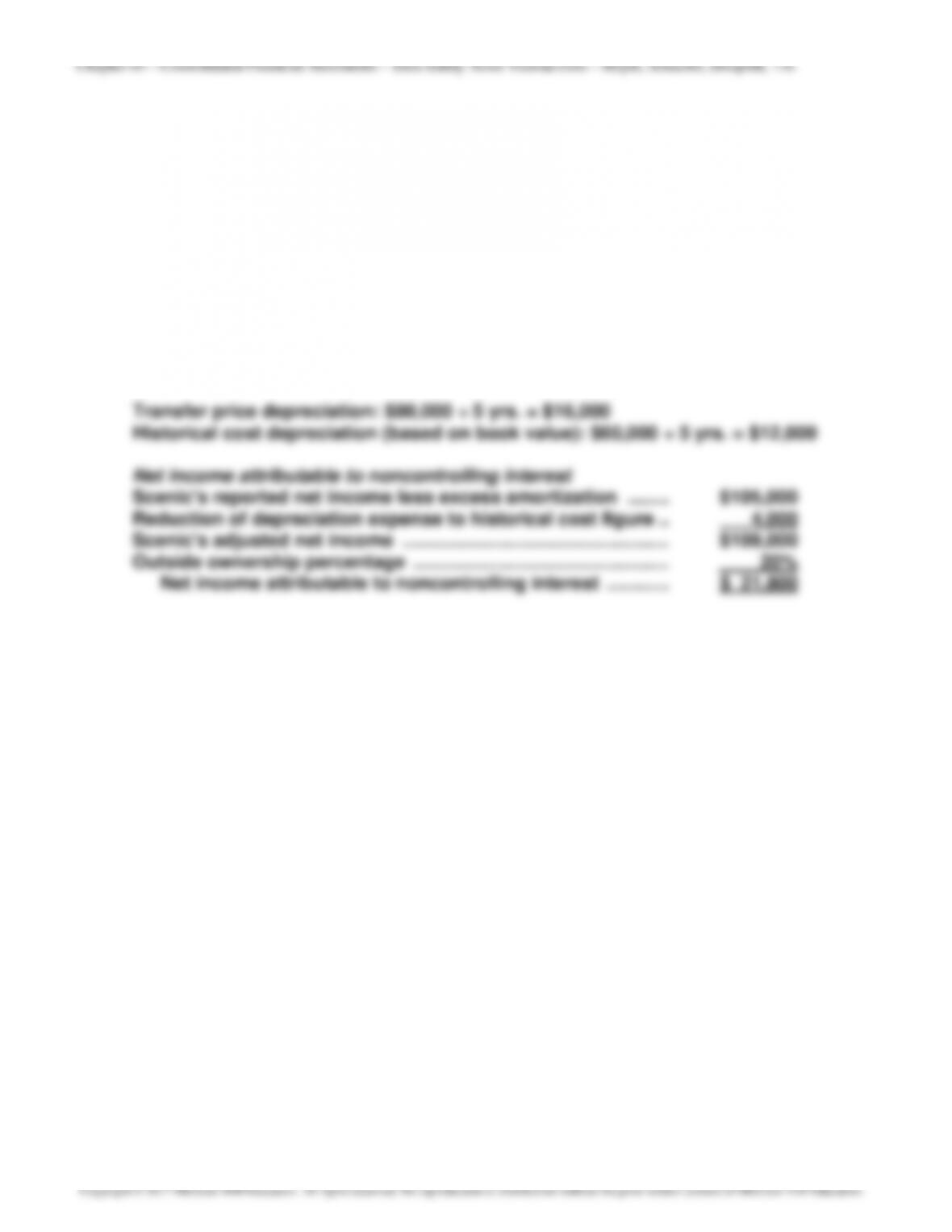
d. Inventory—Placid Lake book value ………………………………….. $140,000
Inventory—Scenic book value …………………………………………. 90,000
(Direction of transfer has no impact here)
e. Land—Placid Lake’s book value ……………………………………… $600,000
f. The intra-entity transfer was upstream from Scenic to Placid Lake. Because the
transfer occurred in 2017, beginning retained earnings of the seller for 2018
contains the remaining portion of the intra-entity gain.
Transfer pricing figures:
2017 Equipment = $80,000
Gain = $20,000 ($80,000 – $60,000)
Depreciation expense = $16,000 ($80,000 ÷ 5)
CONSOLIDATION ENTRIES FOR TRANSFERRED EQUIPMENT
ENTRY *TA
Retained earnings, 1/1/18 (Scenic) …………………….. 16,000
Equipment ($100,000 – $80,000) …………………………. 20,000
Accumulated depreciation ($52,000 – $16,000) .. 36,000
5-15
18. (continued)
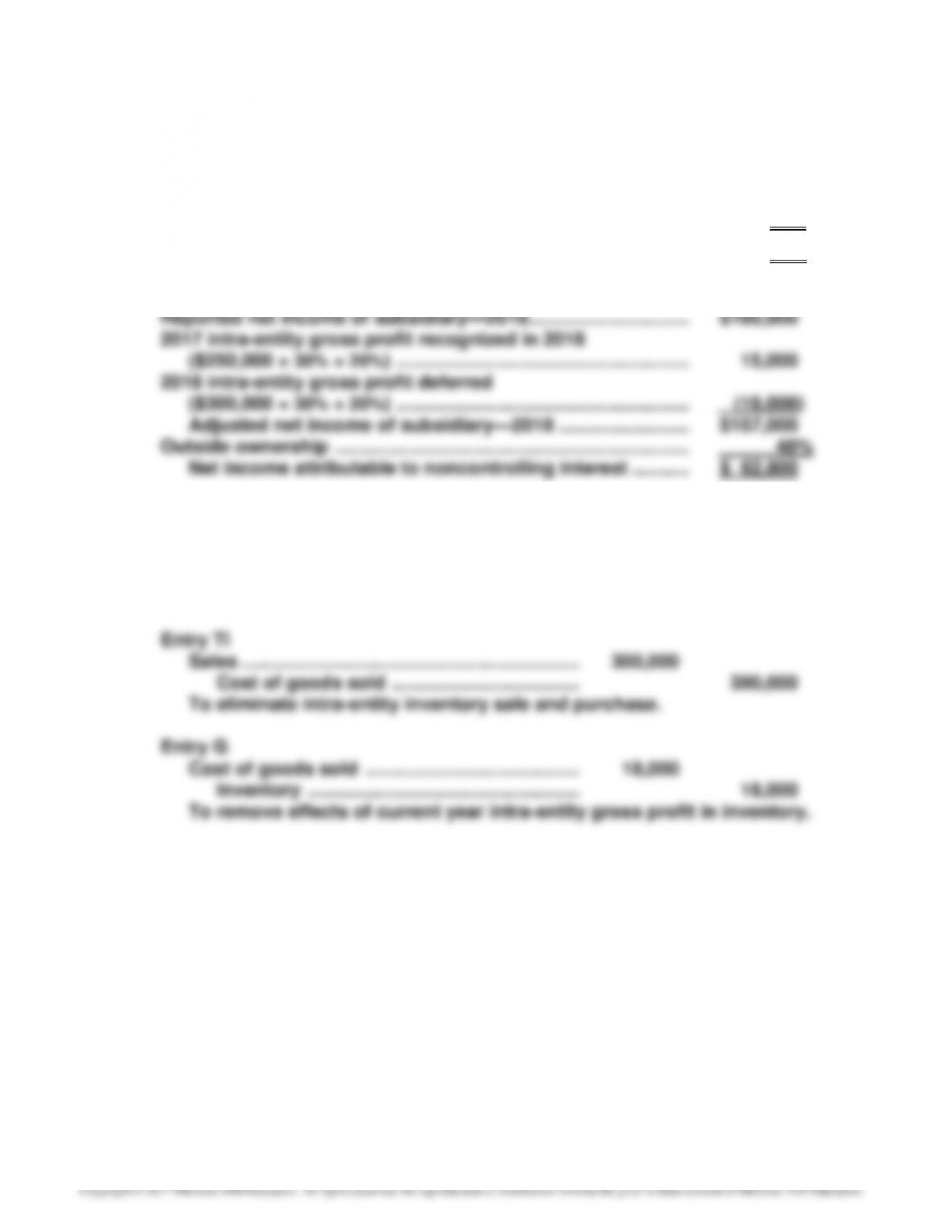
ENTRY ED
Accumulated depreciation ………………………………… 4,000
Depreciation expense …………………………………… 4,000
To reduce depreciation from transfer price ($16,000) to historical cost of $12,000.
This intra-entity transfer was upstream from Scenic to Placid Lake. Thus, income
effects are assumed to relate to the original seller (Scenic). Because the sale
occurred in 2017, the only effect in 2018 relates to depreciation expense. The
expense based on the transfer price is $4,000 higher than the amount based on
the historical cost. As an upstream transfer, this adjustment affects Scenic and
the noncontrolling interest computations.
Chapter 05 – Consolidated Financial Statements – Intra-Entity Asset Transactions – Hoyle, Schaefer, Doupnik, 13e
5-16
19. (20 Minutes) (Consolidation entries and noncontrolling interest balances affected
by inventory transfers.)
a. Conversion from Markup on Cost to Gross Profit Rate
Markup (given as a percentage of cost) ……………………………. 25%
Convert to gross profit rate [.25 (1.00 + 0.25)] …………………. 20%
Noncontrolling Interest’s Share of Consolidated Net Income
b. Entry *G
Retained earnings, Jan. 1 (subsidiary) ……… 15,000
Cost of goods sold …………………………..…. 15,000
To remove intra-entity gross profit from previous year so that it can be
recognized in current year.
5-17
20. (30 Minutes) (Compute selected balances based on three different intra-entity
asset transfer scenarios)
a. Consolidated Cost of Goods Sold
Protrade’s cost of goods sold …………………………………………. $410,000
Seacraft’s cost of goods sold ………………………………………….. 317,000
Elimination of 2018 intra-entity transfers …………………………. (134,000)
Recognized gross profit deferred in 2017
Net income attributable to noncontrolling interest:
Because all intra-entity sales were downstream, the deferrals do not affect
$30,800.
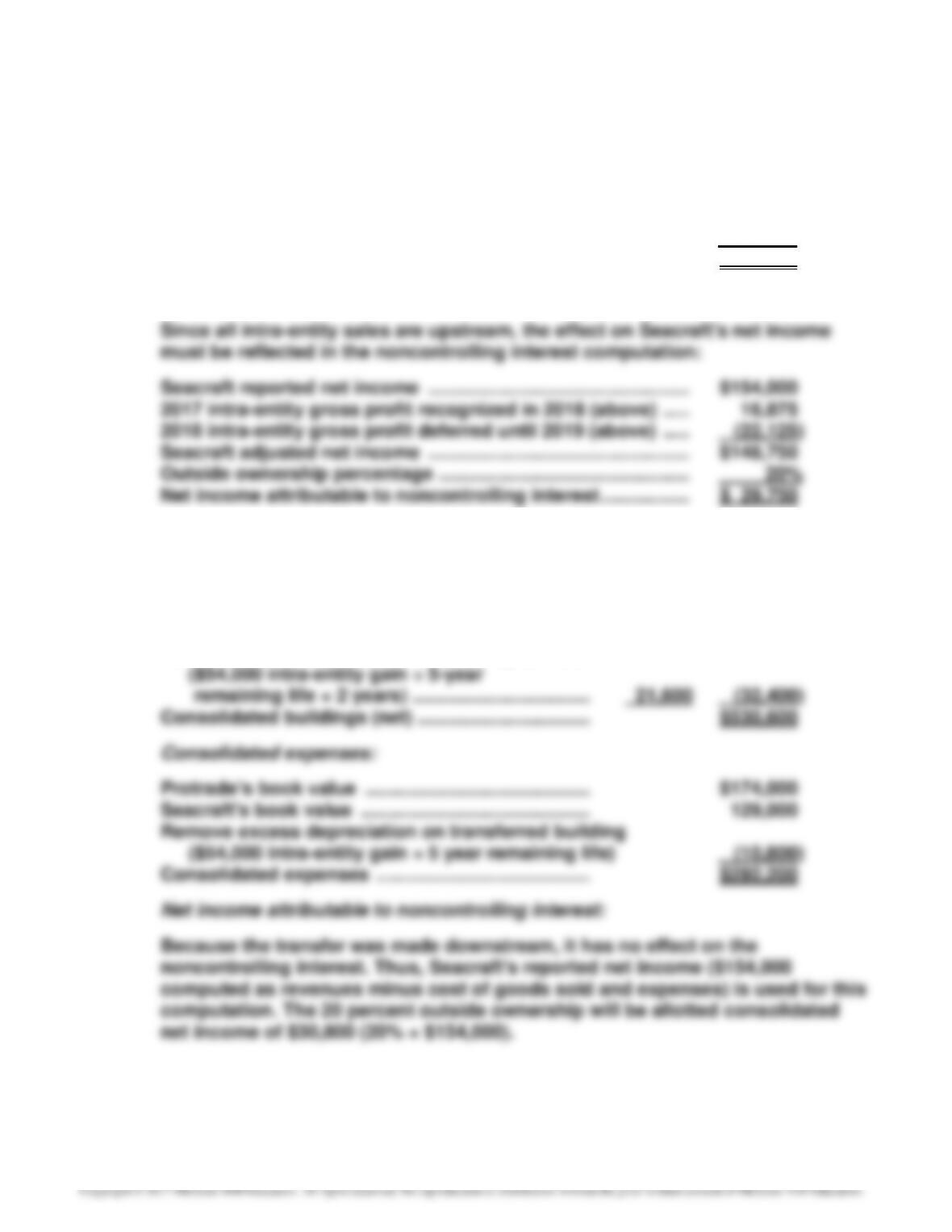
b. Consolidated Cost of Goods Sold
Protrade book value ……………………………………………………….. $410,000
Seacraft book value ………………………………………………………… 317,000
Elimination of 2018 intra-entity transfers …………………………. (104,000)
Recognized gross profit deferred in 2017
(2018 beginning inventory)
Chapter 05 – Consolidated Financial Statements – Intra-Entity Asset Transactions – Hoyle, Schaefer, Doupnik, 13e
5-18
20. b. (continued)
Consolidated inventory
Protrade book value ……………………………………………………….. $370,000
Seacraft book value ………………………………………………………… 144,000
Defer ending intra-entity gross profit (see above) …………….. (22,125)
Consolidated inventory …………………………………………………… $491,875
Net income attributable to noncontrolling interest
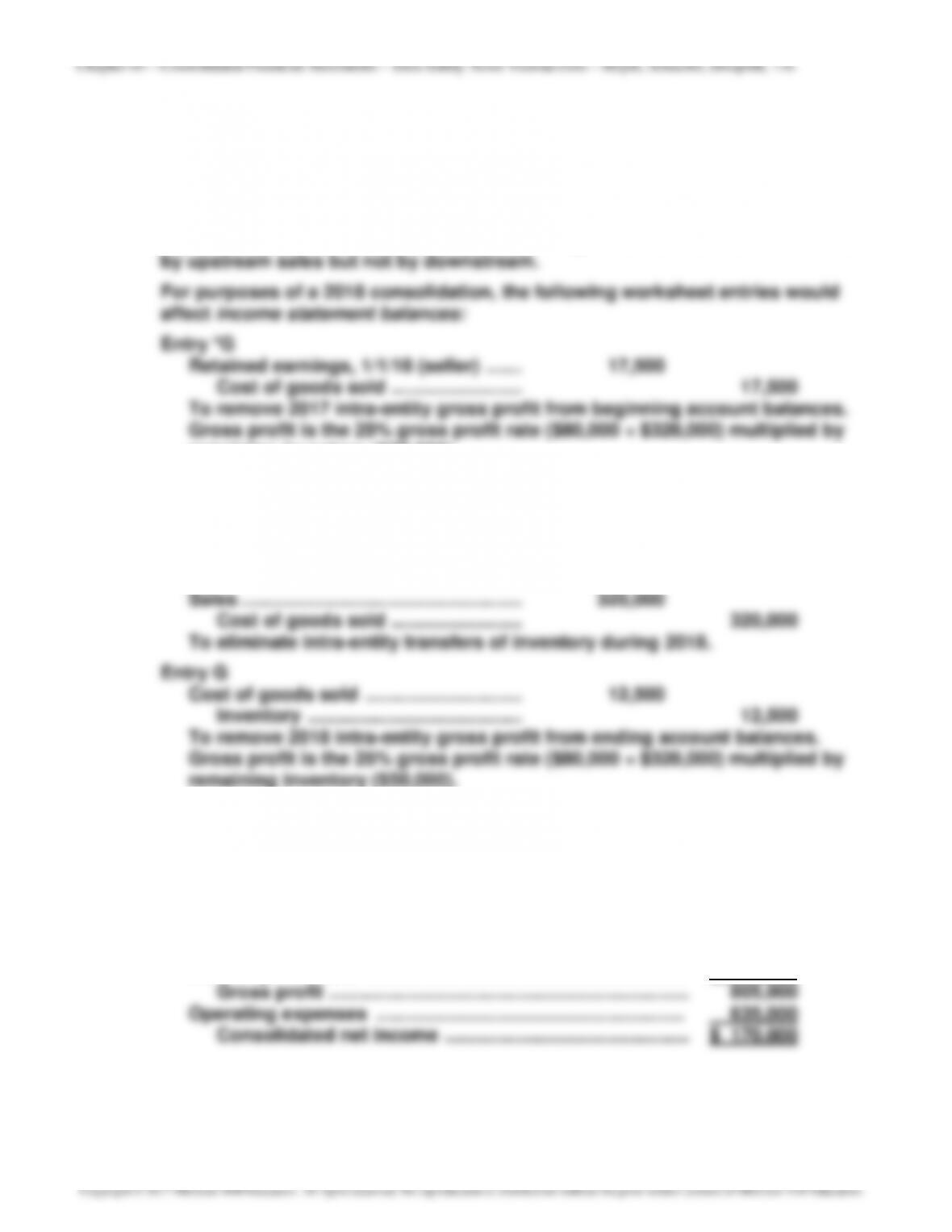
c. Consolidated buildings (net):
Protrade’s buildings ………………………………………. $382,000
Seacraft’s buildings ……………………………………….. 181,000
Remove write–up created by transfer
($128,000 – $74,000) ………………………………….. $(54,000)
Remove excess depreciation created by transfer
5-19
21. (15 Minutes) (Prepare consolidated income statement with a wholly-owned
subsidiary, includes transfers)
a. In this consolidated entity, the direction of the intra-entity transfers (either
upstream or downstream) is not important to the consolidated totals. Because
Akron controls all of Toledo’s outstanding stock, no noncontrolling interest
figures are computed. If present, noncontrolling interest balances are affected
remaining inventory ($70,000).
Entry E
Amortization expense …………………….. 15,000
Patented technology …………………. 15,000
To recognize excess amortization expense for the current period.
Entry Tl
b. By including the impact of each of these four consolidation entries, the
following income statement can be created from the individual account
balances:
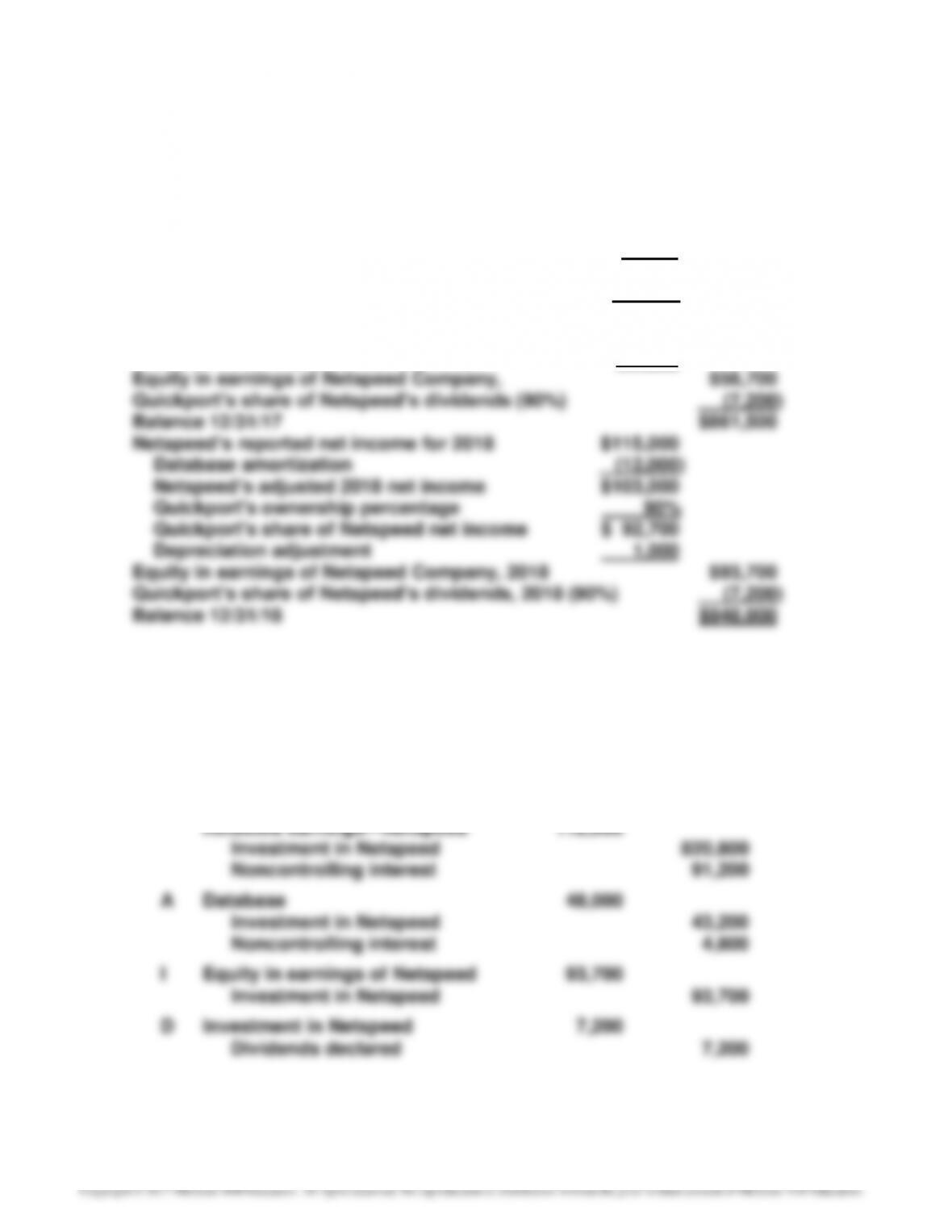
AKRON, INC. AND CONSOLIDATED SUBSIDIARY
Income Statement
Year Ending December 31, 2018
Sales …………………………………………………………………………. $1,380,000
Cost of goods sold …………………………………………………….. 575,000
Chapter 05 – Consolidated Financial Statements – Intra-Entity Asset Transactions – Hoyle, Schaefer, Doupnik, 13e
5-20
22. (60 minutes) (Downstream intra-entity asset transfer when parent uses equity
method and when a noncontrolling interest is present)
a. Investment account:
Consideration paid (fair value) 1/1/17 $810,000
Netspeed’s reported net income for 2017 $80,000
Database amortization (12,000)
Netspeed’s adjusted net income $68,000
Quickport’s ownership percentage 90%
Quickport’s share of Netspeed’s net income $61,200
Gain on equipment transfer deferral (3,000)
Depreciation adjustment (6 months) 500
b. 12/31/18 Worksheet Adjustments
*TA Equipment 6,000
Investment in Netspeed 2,500
Accumulated depreciation 8,500
To transfer the intra-entity equipment reduction (as of Jan. 1, 2018) from the
Investment account to the equipment and A.D. accounts.
S Common stock—Netspeed 800,000