Chapter 04 – Consolidated Financial Statements and Outside Ownership – Hoyle, Schaefer,
Doupnik, 13e
4-36
Education.
40. (55 Minutes) (Consolidated worksheet)
a. Consideration transferred by Adams $603,000
Noncontrolling interest fair value 67,000
Acquisition-date total fair value $670,000
Book value of Barstow (CS + RE 12/31/16) (460,000)
b. Because investment income is exactly 90 percent of Barstow’s reported
earnings, Adams apparently is applying the partial equity method.
c. d. Explanation of Consolidation Entries Found on Worksheet
Entry *C—Converts Adams’s financial records from the partial equity method
to the equity method by recognizing amortization for 2017. Total expense
was $15,000 but only 90 percent (or $13,500) applied to the parent.
Entry S—Eliminates subsidiary‘s stockholders’ equity while recording
Chapter 04 – Consolidated Financial Statements and Outside Ownership – Hoyle, Schaefer, Doupnik, 13e
40. c. and d. (continued) ADAMS CORPORATION AND BARSTOW, INC.
Consolidation Worksheet-Acquisition Method
For Year Ending December 31, 2018 Noncontrolling Consolidated
Adams Corp. Barstow Inc. Debit Credit Interest Totals
Revenues (940,000) (280,000) (1,220,000)
Cost of goods sold 480,000 90,000 570,000
Depreciation expense 100,000 55,000 (E) 6,000 161,000
Amortization expense (E) 5,000 5,000
Interest expense 40,000 15,000 (E) 4,000 59,000
Investment income (108,000) -0- (I) 108,000 -0-
Separate company net income (428,000) (120,000)
Consolidated net income (425,000)
Investment in Barstow 702,000 (D) 63,000 (*C) 13,500 -0-
(S) 468,000
(A) 175,500
(I) 108,000
Total assets 3,055,000 800,000 3,321,000
Notes payable (860,000) (230,000) (A) 16,000 (E) 4,000 (1,078,000)
Common stock (510,000) (180,000) (S) 180,000 (510,000)
Retained earnings, 12/31 (1,685,000) (390,000) (1,658,000)
(S) 52,000
4-38
Education.
41. (25 minutes) (Consolidated balances after a mid-year acquisition)
a. Investment account balance indicates the initial value method.
Consideration transferred by Gibson ……. $528,000
Noncontrolling interest fair value ………… 352,000
Davis acquisition-date fair value …………. 880,000
Goodwill …………………………………… $145,000 indefinite -0-
Total ……………………………………………… $(6,000)
Amortization for 9 months ……………… $(4,500)
Acquisition-date subsidiary book value:
Book value of Davis, 1/1/18 (CS + 1/1 RE) …………… $740,000
Revenues (1) $825,000
Cost of goods sold (2) $405,000
Operating expenses (3) 214,500 619,500
Consolidated net income 205,500
Net income attributable to noncontrolling interest (4) 31,800
subsidiary operating expenses) less nine month excess overvalued
equipment depreciation reduction of $4,500
(4) 40% of post-acquisition subsidiary net income less excess amortization
b. Goodwill = $145,000 (original allocation)
Equipment = $774,500 (add the two book values less $30,000
Chapter 04 – Consolidated Financial Statements and Outside Ownership – Hoyle, Schaefer, Doupnik, 13e
4-39
42. (45 minutes) Determine consolidated balance for a mid-year acquisition.
a. Consideration transferred by Truman ………. $720,000
Noncontrolling interest fair value …………….. 290,000
Atlanta’s acquisition-date total fair value …… $1,010,000
Book value of Atlanta …………………………..…… (840,000)
Fair value in excess of book value …………….. $ 170,000
b. Goodwill allocation with control premium Controlling Noncontrolling
Interest Interest
Fair values at acquisition date $720,000 $290,000
Relative fair values of identifiable net assets
c. Initial value at acquisition date $720,000
4-40
Education.
42. (continued)
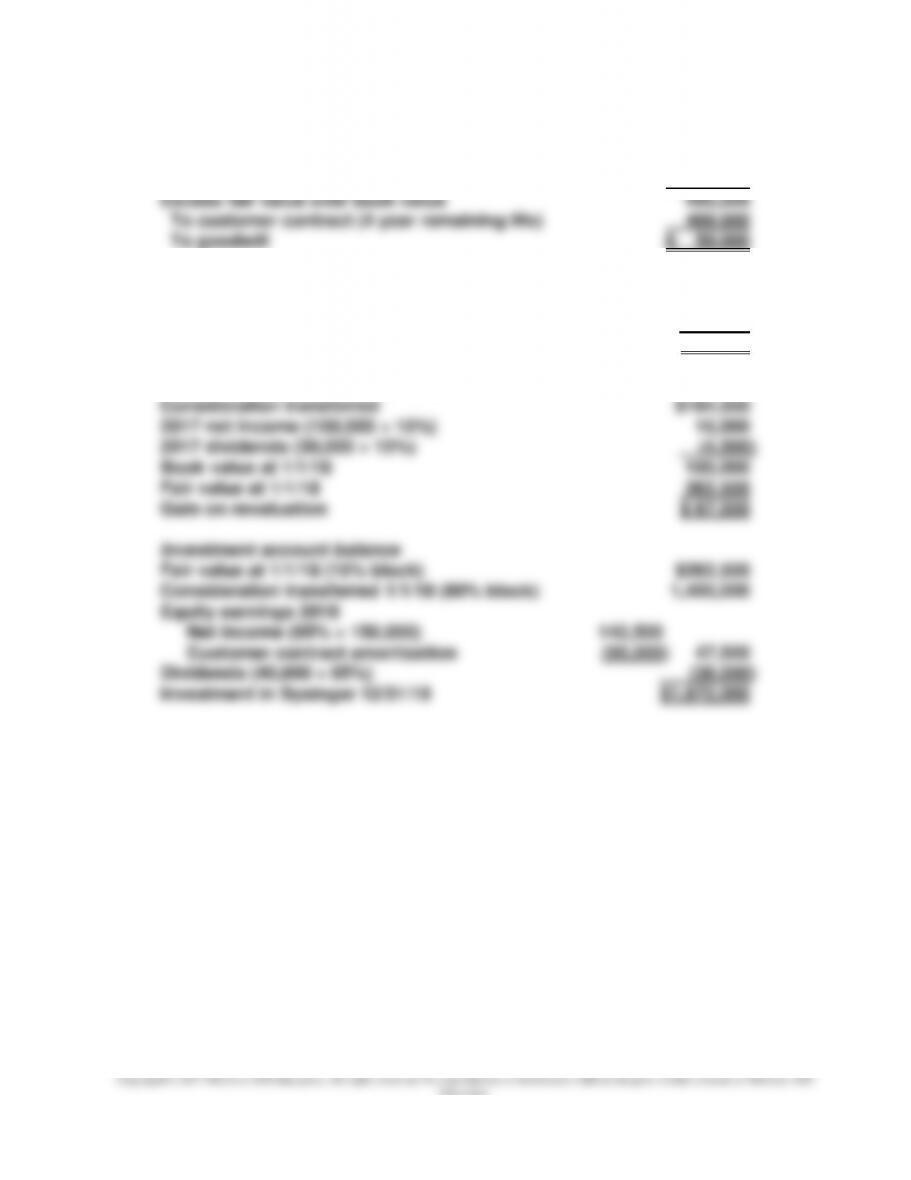
d. Consolidated Worksheet
TRUMAN COMPANY AND SUBSIDIARY ATLANTA COMPANY
Consolidation Worksheet
For Year Ending December 31, 2018
Truman
Atlanta
Adjustments & Eliminations
NCI
Cons.
Revenues
(670,000)
(400,000)
(S) 200,000
(870,000)
Operating Expenses
402,000
280,000
(E) 10,000
(S) 140,000
552,000
Net income of subsidiary
(35,000)
(I) 35,000
-0-
Separate company net income
(303,000)
(120,000)
Consolidated net income
(318,000)
Net income attributable to NCI
(15,000)
15,000
Net income attributable to Truman
(303,000)
Retained earnings, 1/1
(823,000)
(500,000)
(S) 500,000
(823,000)
Net income (above)
(303,000)
(120,000)
(303,000)
Dividends declared
145,000
80,000
(S) 40,000
12,000
(D) 28,000
145,000
Retained earnings 12/31
(981,000)
(540,000)
(981,000)
Current assets
481,000
390,000
871,000
Investment in Atlanta
727,000
(D) 28,000
(S) 588,000
-0-
(I) 35,000
(A1) 70,000
(A2) 62,000
Land
388,000
200,000
588,000
Buildings
701,000
630,000
1,331,000
Patent
(A1)100,000
(E) 10,000
90,000
Goodwill
(A2) 70,000
70,000
Total assets
2,297,000
1,220,000
2,950,000
Liabilities
(816,000)
(360,000)
(1,176,000)
Common stock
(95,000)
(300,000)
(S) 300,000
(95,000)
Additional paid-in capital
(405,000)
(20,000)
(S) 20,000
(405,000)
Retained earnings 12/31
(981,000)
(540,000)
(981,000)
Noncontrolling interest 7/1
(A1) 30,000
(A2) 8,000
(S) 252,000
(290,000)
Noncontrolling interest 12/31
(293,000)
(293,000)
Total liab. and equity
(2,297,000)
(1,220,000)
1,263,000
1,263,000
(2,950,000)
Chapter 04 – Consolidated Financial Statements and Outside Ownership – Hoyle, Schaefer, Doupnik, 13e
4-41
Education.
43. (60 minutes) (Consolidated statements for a step acquisition)
a. Fair value of Sysinger 1/1/18 (given) $1,750,000
Book value of Sysinger 1/1/18 (CS + APIC + RE) 1,300,000
b. Equity in earnings of Sysinger
2018 net income (150,000 × 95%) $142,500
Amortization (100,000 × 95%) (95,000)
Equity in earnings of Sysinger $ 47,500
Revaluation of 15% block to fair value
4-42
43. (Continued) c. Allan and Sysinger
Consolidation Worksheet
For Year Ending December 31, 2018
Allan Sysinger Consolidation Entries Noncontrolling Consolidated
Accounts Company Company Debit Credit Interest Totals
Revenues (931,000) (380,000) (1,311,000)
Operating expenses 615,000 230,000 (E)100,000 945,000
Equity earnings of Sysinger (47,500) -0- (I) 47,500 -0-
Gain on revaluation (67,500) -0- (67,500)
Separate company net income (431,000) (150,000)
Consolidated net income (433,500)
NI attributable to noncontrolling interest (2,500) 2,500
NI attributable to Allan Company (431,000)
Retained earnings, 1/1 (965,000) (600,000) (S) 600,000 (965,000)
Net income (431,000) (150,000) (431,000)
Dividends declared 140,000 40,000 (D) 38,000 2,000 140,000
4-43
44. (60 minutes) (Step acquisition—control previously acquired.)
a. According to the acquisition method, the valuation basis for a subsidiary is
established on the date control is obtained, in this case January 1, 2017.
Subsequent acquisitions are valued consistent with this initial value after
adjusting the investment for subsidiary net income and other changes.
Because subsequent acquisitions are considered as transactions in the parent’s
own equity, no gains or losses are recorded. Differences in cash paid and the
1/1/18 Investment in Keane 301,500
Cash 300,000
APIC from step acquisition 1,500
b. Investment in Keane Company 1/1/17 $573,000
2017 Equity earnings [60% × (150,000 – 20,000)] 78,000
2017 Dividends from Keane (60% × $80,000) (48,000)
Chapter 04 – Consolidated Financial Statements and Outside Ownership – Hoyle, Schaefer, Doupnik, 13e
4-45
Education.
ACCOUNTING THEORY RESEARCH CASE: NONCONTROLLING INTEREST
In deliberations prior to the issuance of SFAS 160, “Noncontrolling Interests in
Consolidated Financial Statements,” the FASB considered three alternatives for
displaying the noncontrolling interest in the consolidated balance sheet
What were these three alternatives?
1. As a liability
2. As equity
3. In the “mezzanine” area between liabilities and owners’ equity
What criteria did the FASB use to evaluate the desirability of each alternative?
The FASB evaluated whether the classifications conformed to current definitions
of financial statement elements (assets, liabilities, or equity) as articulated in
FASB Concept Statement No. 6.
In what specific ways did FASB Concept Statement 6 affect the FASB’s evaluation
of these alternatives?
From SFAS 160 paragraphs 32–34
If it required that the noncontrolling interest be reported in the
mezzanine, the Board would have had to create a new element—
noncontrolling interest in subsidiaries—specifically for consolidated
financial statements. The Board concluded that no compelling reason
exists to create a new element specifically for consolidated financial
statements to report the interests in a subsidiary held by owners other
Chapter 04 – Consolidated Financial Statements and Outside Ownership – Hoyle, Schaefer,
Doupnik, 13e
4-46
Education.
RESEARCH CASE: STARBUCKS’ STEP ACQUISITIONS OF STARBUCKS JAPAN
1. What amount did Starbucks use for the October 31, 2014 acquistion-date fair value of
Starbucks Japan?
2. Note 2 (Acquisitions and Divestitures) of Starbucks’s 2015 10-K shows the following
allocation for the Starbucks Japan acquisition (in millions):
Total acquisition-date fair value (above) $1,496.8
Cash and cash equivalents $ 224.4
Accounts receivable, net 37.4
Inventories 26.4
Prepaid expenses and other current assets 35.7
Goodwill $ 815.6
3. How does Starbucks explain the three different valuation bases for the following
items?
Amount paid to Sazaby for 39.5 percent share purchase.
The fair value of Starbucks’ pre-existing 39.5 equity interest.
The fair value of the 21 percent noncontrolling interest?
valuation techniques for its previously owned 39.5% ownership.
Starucks (2015 10-K, p. 63) explains that
4-47
Copyright © 2017 McGraw-Hill Education. All rights reserved. No reproduction or distribution without the prior written consent of McGraw-Hill
Education.
assumptions used in estimating future cash flows included projected revenue
growth and operating expenses, as well as the selection of an appropriate
discount rate. Estimates of revenue growth and operating expenses were based
on internal projections and considered the historical performance of stores, local
market economics and the business environment impacting the stores‘
interest.
Regarding the $411.1 million valuation for the noncontrolling interest, Starbucks notes
The fair value of the noncontrolling interest in Starbucks Japan was estimated
by applying the market approach. Specifically, the fair value was determined
based on the purchase price we expected to pay for the remaining 21%
4. How did Starbucks account for its 39.5 percent ownership interest in Starbucks Japan
prior to the acquisition from Sazaby of the additional 39.5 percent shares?
5. Upon acquisition of its controlling interest on October 31, 2014, how did Starbucks
account for the change in fair value of its original 39.5 percent ownership interest?
As a result of this acquisition, we remeasured the carrying value of our preexisting
6. Upon acquisition of the 21 percent noncontrolling interest, how did Starbucks account
for the difference in between the amount paid and the underlying carrying amount of
Starbucks Japan?
Because the 21 percent share purchase represented a post-control acquisition, the
Chapter 04 – Consolidated Financial Statements and Outside Ownership – Hoyle, Schaefer,
Doupnik, 13e
4-48
RESEARCH CASE: COSTCO’S NONCONTROLLING INTERESTS
1. How does Costco present the noncontrolling interest in its consolidated
financial statements?
• Consolidated Income Statement: Noncontrolling interests are listed at $226
million as of August 30, 2015 in the Owners’ Equity section of the
2. Explain how Costco’s presentation of the noncontrolling interest reflects the
acquisition method for consolidated entity reporting.
The acquisition method emphazises the inclusion of each entity controlled by
the parent as a whole for financial reporting purposes consistent with the
economic unit concept. Any outside ownership interests of subsidiaries is then
reported as the noncontrolling interest.
• The balance sheet combines all of Costco’s assets and liabilities for the
Chapter 04 – Consolidated Financial Statements and Outside Ownership – Hoyle, Schaefer, Doupnik, 13e
BARDEEN ELECTRIC: FASB ASC AND IFRS RESEARCH CASE
1. What is the total consideration transferred by Armstrong to acquire its 80 percent
controlling interest in Bardeen?
Cash $40,000,000
Shares of Armstrong stock 24,000,000
2. What values should Armstrong assign to identifiable assets and liabilities as part of
the acquisition accounting?
Cash $ 425,000
Accounts receivable 788,000
3. What is the acquisition-date value assigned to the 20 percent noncontrolling interest?
What are the noncontrolling interest valuation alternatives available under IFRS?
Under U.S. GAAP, the acquisition-date noncontrolling interest is measured at its fair
4. Under U.S. GAAP, what amount should Armstrong recognize as goodwill from the
acquisition? What alternative valuations are available for goodwill under IFRS?
Goodwill under U.S. GAAP (ASC 805–30–30-1) and IFRS alternative 1 (IFRS 3 IN 8):
Consideration transferred (above) $ 72,000,000