Chapter 04 – Consolidated Financial Statements and Outside Ownership – Hoyle, Schaefer, Doupnik, 13e
4-1
Education.
CHAPTER 4
CONSOLIDATED FINANCIAL STATEMENTS
AND OUTSIDE OWNERSHIP
Chapter Outline
I. Outside ownership may be present within any consolidated entity.
A. Complete ownership of a subsidiary is not a prerequisite for consolidation—only enough
voting shares need be owned so that the acquiring company has the ability to control the
decision-making process of the acquired company.
B. Any ownership interest in a subsidiary company by a party unrelated to the acquiring
company is termed a noncontrolling interest.
II. Valuation of subsidiary assets and liabilities poses a challenge when a noncontrolling interest
is present.
A. The accounting emphasis (economic unit concept) is placed on the entire entity that
results from the business combination when control has been obtained. The parent
company that controls its subsidiary must consolidate 100% of subsidiary assets,
liabilities, revenues, and expense are consolidated even when its ownership is less than
100%.
B. The consolidated valuation basis for a newly acquired subsidiary is the acquisition-date
fair value of the company (most frequently determined by the consideration transferred
and the fair value of the noncontrolling interest); specific subsidiary assets and liabilities
are measured at their acquisition-date fair values.
C. The noncontrolling interest balance is reported in the parent’s consolidated financial
statements as a component of stockholders’ equity.
1. Beginning of year balance sheet amount
2. Net income attributable to noncontrolling interest
3. Dividends declared by subsidiary during the period attributable to the noncontrolling
interest
4. End of year balance sheet amount
1. The beginning of year figure is entered on the worksheet as a component of Entries S
and A
2. The net income attributable to the noncontrolling interest is established by a columnar
3. Dividends declared to these outside owners are reflected by extending the subsidiary’s
4. The end of year noncontrolling interest total is the summation of the three items above
and is reported in stockholders’ equity.
Chapter 04 – Consolidated Financial Statements and Outside Ownership – Hoyle, Schaefer, Doupnik,
13e
4-2
Education.
IV. Step acquisitions
A. An acquiring company may make several different purchases of a subsidiary’s stock in
order to gain control
B. Upon attaining control, all of the parent’s previous investments in the subsidiary are
adjusted to fair value and a gain or loss recognized as appropriate
C. Upon attaining control, the valuation basis for the subsidiary is established at its total fair
value (the sum of the fair values of the controlling and noncontrolling interests)
D. Post-control subsidiary stock acquisitions by the parent are considered transactions with
current owners of the consolidated entity. Thus such post-control stock acquisitions neither
result in gains or losses nor provide a basis for subsidiary asset remeasurement to fair
value. The difference between the sale proceeds and the carrying value of the shares sold
(equity method) is recorded as an adjustment to the parent’s additional paid in capital.
V. Sales of subsidiary stock
A. The proper book value must be established within the parent’s Investment account so that
the sales transaction can be correctly recorded
B. The investment balance is adjusted as if the equity method had been applied during the
entire period of ownership
C. If only a portion of the shares are being sold, the book value of the investment account is
reduced using either a FIFO or a weighted-average cost flow assumption
D. If the parent maintains control, any difference between the proceeds of the sale and the
equity-adjusted book value of the share sold is recognized as an adjustment to additional
paid-in capital.
E. If the parent loses control with the sale of the subsidiary shares, the difference between
the proceeds of the sale and the equity-adjusted book value of the share sold is
recognized as a gain or loss.
F. Any interest retained by the parent company should be accounted for by either
consolidation, the equity method, or the fair value method depending on the influence
remaining after the sale.
Answer to Discussion Question:
Do you think the FASB made the correct decision in requiring consolidated financial
statements to recognize all subsidiary’s assets and liabilities at fair value regardless
of the percentage ownership acquired by the parent?
As the quotes from the five accounting professionals illustrate, the decision to require the revaluation
Chapter 04 – Consolidated Financial Statements and Outside Ownership – Hoyle, Schaefer, Doupnik, 13e
4-3
Education.
Answer to Discussion Question:
DOES GAAP UNDERVALUE POST-CONTROL STOCK ACQUISITIONS?
From the Berkshire Hathaway 2012 annual 10–K report:
We have owned a controlling interest in Marmon Holdings, Inc. (“Marmon”) since 2008. In the fourth
quarter of 2012, pursuant to the terms of the 2008 Marmon acquisition agreement, we acquired an
additional 10% of the outstanding shares of Marmon held by noncontrolling interests for aggregate
consideration of approximately $1.4 billion. Approximately $800 million of the consideration was paid in
Marmon’s proportionate carrying amounts. Because these transactions were with owners (not
outside parties), no gain or loss is recorded. Berkshire reduces its paid-in capital the for excess of the
purchase price over the carrying amount. The accounting is similar to retirement of stock for a
payment in excess of the company’s proportionate carrying amount.
Mr.Buffett may be correct that the current market value of Marmon is $4.6 bilion more that its carrying
amount. However, GAAP does not, in general, record unrealized increases in a firm’s market value
as increases in reported asset amounts.
Chapter 04 – Consolidated Financial Statements and Outside Ownership – Hoyle, Schaefer, Doupnik,
13e
4-4
Education.
Answers to Questions
1. “Noncontrolling interest” refers to an equity interest that is held in a member of a consolidated
entity by an unrelated (outside) party.
2. Acquisition method = $220,000 (fair value)
3. A control premium is the portion of an acquisition price (above currently traded market values)
4. Current accounting standards require the noncontrolling interest to appear in the stockholders’
5. The ending noncontrolling interest is determined on a consolidation worksheet by adding the
four components found in the noncontrolling interest column: (1) the beginning balance of the
6. Allsports should remove the pre-acquisition revenues and expenses from the consolidated
7. Following the second acquisition, consolidation is appropriate. Once Tree gains control, the
8. When a company sells a portion of an investment, it must remove the carrying value of that
portion from its investment account. The carrying value is based upon application of the equity
9. Unless control is surrendered, the acquisition method views the sale of subsidiary’s stock as a
10. The accounting method choice for the remaining shares depends upon the current
relationship between the two firms. If Duke retains control, consolidation is still required.
Chapter 04 – Consolidated Financial Statements and Outside Ownership – Hoyle, Schaefer, Doupnik, 13e
Answers to Problems
1. C
2. A At the date control is obtained, the parent consolidates subsidiary assets at fair
value ($549,000 in this case) regardless of the parent’s percentage ownership.
Combined expenses ……………………………………………………………… (700,000)
7. C Consideration transferred by Pride ……………………………………….. $540,000
Noncontrolling interest fair value …………………………..……………… 60,000
Star acquisition-date fair value ……………………………………………… $600,000
Star book value …………………………………………………………………….. 420,000
8. A Under the equity method, consolidated RE = parent’s RE.
4-6
Education.
10. A Amie, Inc. fair value at July 1, 2018:
30% previously owned fair value (30,000 shares × $5) ……………. $150,000
11. C
Control is maintained so excess proceeds go to APIC.
14. B Combined revenues ……………………………………………………………… $1,300,000
Combined expenses ……………………………………………………………… (800,000)
Acquisition-date fair value of noncontrolling interest……………… $200,000
40% change in previous year Solar book value ……………………….
($430,000 – $400,000) × 40% …………………………………………….. 12,000
40% of excess fair value amortization—year one ……………………. (5,600)
Net income attributable to noncontrolling interest (above) ……… 34,400
Noncontrolling interest at end of year …………………………..……….. $240,800
4-7
Education.
the loan taken out by Park to acquire Strand.
21. C Park stockholders‘ equity ……………………………………………………… $80,000
22. (15 minutes) (Compute consolidated net income and noncontrolling
interest)
2017 2018
a. Harrison net income ……………………………………………… $220,000 $260,000
Starr net income …………………………………………………… 70,000 90,000
Acquisition-date excess fair value amortization ……… (8,000) (8,000)
Chapter 04 – Consolidated Financial Statements and Outside Ownership – Hoyle, Schaefer, Doupnik,
13e
23. (30 minutes) (Consolidated balances, allocation of consolidated net income to
controlling and noncontrolling interest, calculation of noncontrolling interest).
a. Stayer’s building:
Carrying amount on Stayer’s books $175,500
Building, net $310,500
b. Stayer’s technology processes:
Acquisition-date fair value (20 year remaining life) $1,000,000
2018 amortization (50,000)
Technology processes 12/31/18 $ 950,000
c. Net income attributable to noncontrolling interest:
Stayer’s reported net income 350,000
Excess fair value amortization:
Net income attributable to noncontrolling interest $57,000
d. Controlling interest in consolidated net income:
Net income–Johnsonville $650,000
Net income–Stayer adjusted for excess fair value
amortization (see part d below) 285,000
Consolidated net income 935,000
Less: net income attributable to noncontrolling
Excess fair value amortization:
Technology processes (50,000)
Building ($345,000 – $195,000) ÷ 10 years (15,000)
Stayer’s adjusted net income 285,000
Johnsonville’s ownership percentage 80% 228,000
4-9
Education.
23. (continued)
e. Noncontrolling interest in Stayer:
Acquisition-date balance 1/1/18
24. (40 minutes) (Several valuation and income determination questions for a
consolidated entity involving a noncontrolling interest.)
a. Business combinations generally are measured at the fair value of the
consideration transferred by the acquiring firm plus the acquisition–date fair value
b. Each identifiable asset acquired and liability assumed in a business combination is
initially reported at its acquisition-date fair value.
c. In periods subsequent to acquisition, the subsidiary’s assets and liabilities are
reported at their book values adjusted for acquisition-date fair value allocations and
Trademarks …………………………..…………………………. 200,000
Patented technology …………………………..……………. 1,060,000
Unpatented technology …………………………………….. 600,000 1,610,000
Goodwill ……………………………………………………………………………… $ 200,000
e. Combined revenues ……………………………………………………….………….. $4,400,000
Consolidated net income …………………………………………………………… $1,615,000
Chapter 04 – Consolidated Financial Statements and Outside Ownership – Hoyle, Schaefer, Doupnik,
13e
4-10
24. (continued)
To noncontrolling interest:
Soriano’s revenues ………………………………………………………………. $1,400,000
Soriano’s expenses ………………………………………………………………. (600,000)
Total excess amortization expenses (above) ………………………….. (435,000)
Net income attributable to noncontrolling interest …………………. (73,000)
Net income attributable to Patterson ……………………………………… $1,542,000
–OR–
Patterson’s revenues ……………………………………………………….…… $3,000,000
f. Fair value of noncontrolling interest January 1 …………………………... $ 600,000
Net income attributable to noncontrolling interest ………………………. 73,000
Dividends (20% × $30,000) …………………………………………………………. (6,000)
Noncontrolling interest December 31 …………………………………………. $ 667,000
g. If Soriano’s acquisition-date total fair value was $2,250,000, then a bargain
purchase has occurred.
Collective fair values of Soriano’s net assets ……………………………… $2,900,000
4-11
25. (30 minutes) Step acquisition.
a. Investment in Sellinger 445,000
Cash 415,000
Additional paid-in capital 30,000
Acquisition-date fair value ($1,141,000 ÷ .7) $1,630,000
Sellinger net income 2017 340,000
b. Initial value for 70% acquisition $1,141,000
70% of adjusted 2017 subsidiary net income
($340,000 – $40,000) 210,000
70% of subsidiary dividends 2017 (105,000)
4-12
Education.
26. (20 Minutes) (Determine consolidated income balances, includes a mid-year
acquisition)
a. Acquisition-date total fair value …………………….. $594,000
Book value of net assets ……………………………….. (400,000)
Fair value in excess of book value ………………… $194,000
Goodwill …………………………………………………. 14,000
Total …………………………………………………. –0- $31,000
Consolidated figures following January 1 acquisition date:
Combined revenues ………………………………………………………………….. $1,500,000
b. Consolidated figures following April 1 acquisition date:
Combined revenues (1) ………………………………………………………………. $1,350,000
Combined expenses (2) ……………………………………………………………… (923,250)
Chapter 04 – Consolidated Financial Statements and Outside Ownership – Hoyle, Schaefer, Doupnik, 13e
4-13
Education.
27. (15 minutes) Consolidated figures with noncontrolling interest
Fair value of company (given) $60,000
Book value (10,000)
Fair value in excess of book value 50,000
to machine ($50,000 – $10,000) 40,000 ÷ 10 = $4,000 per year
to process trade secret $10,000 ÷ 4 = 2,500 per year
$6,500 per year
Consolidated figures:
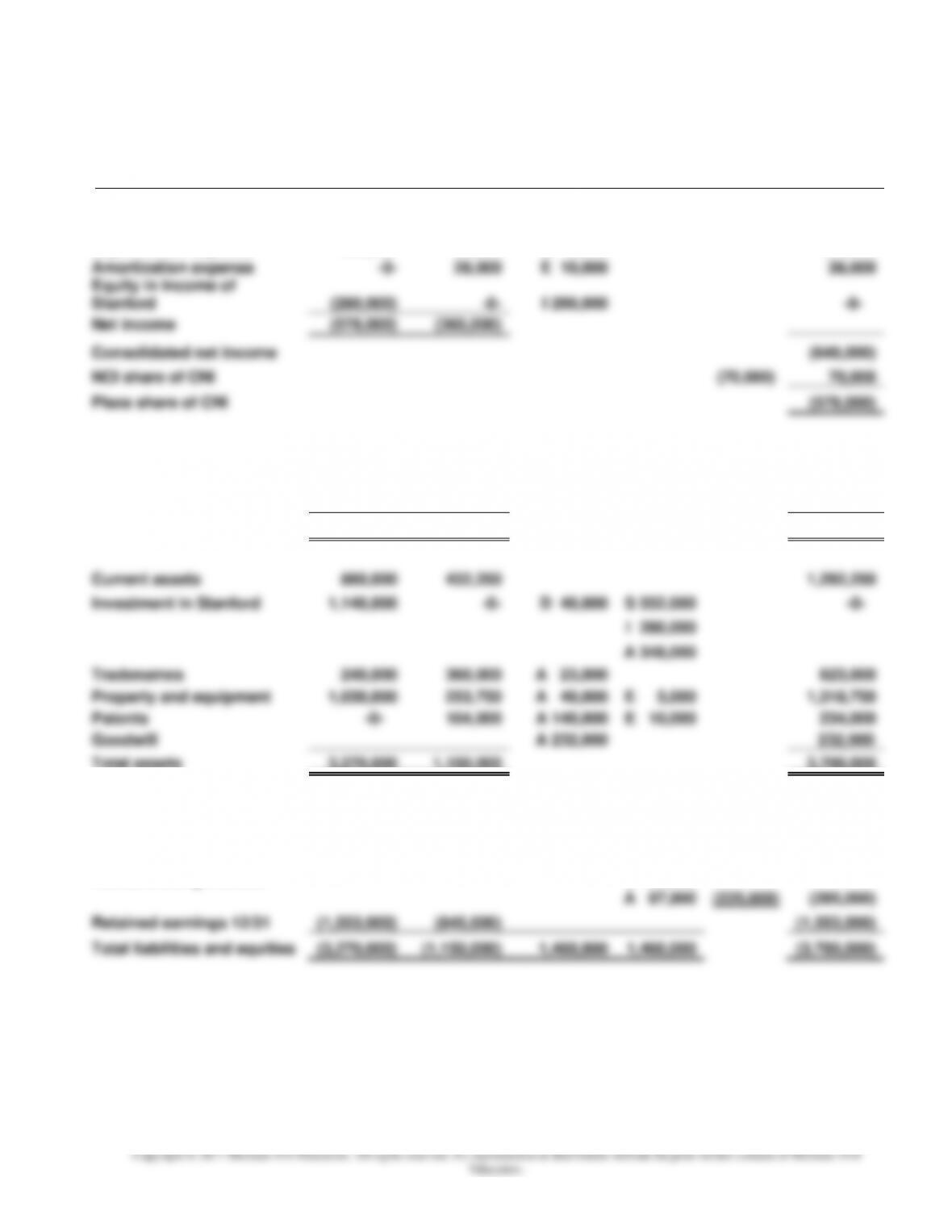
• Net income attributable to noncontrolling interest
Chapter 04 – Consolidated Financial Statements and Outside Ownership – Hoyle, Schaefer, Doupnik,
13e
4-14
28. (40 minutes) (Worksheet preparation, parent uses equity method, 20% noncontrolling
interest, no control premium, first year subsequent to acquisition).
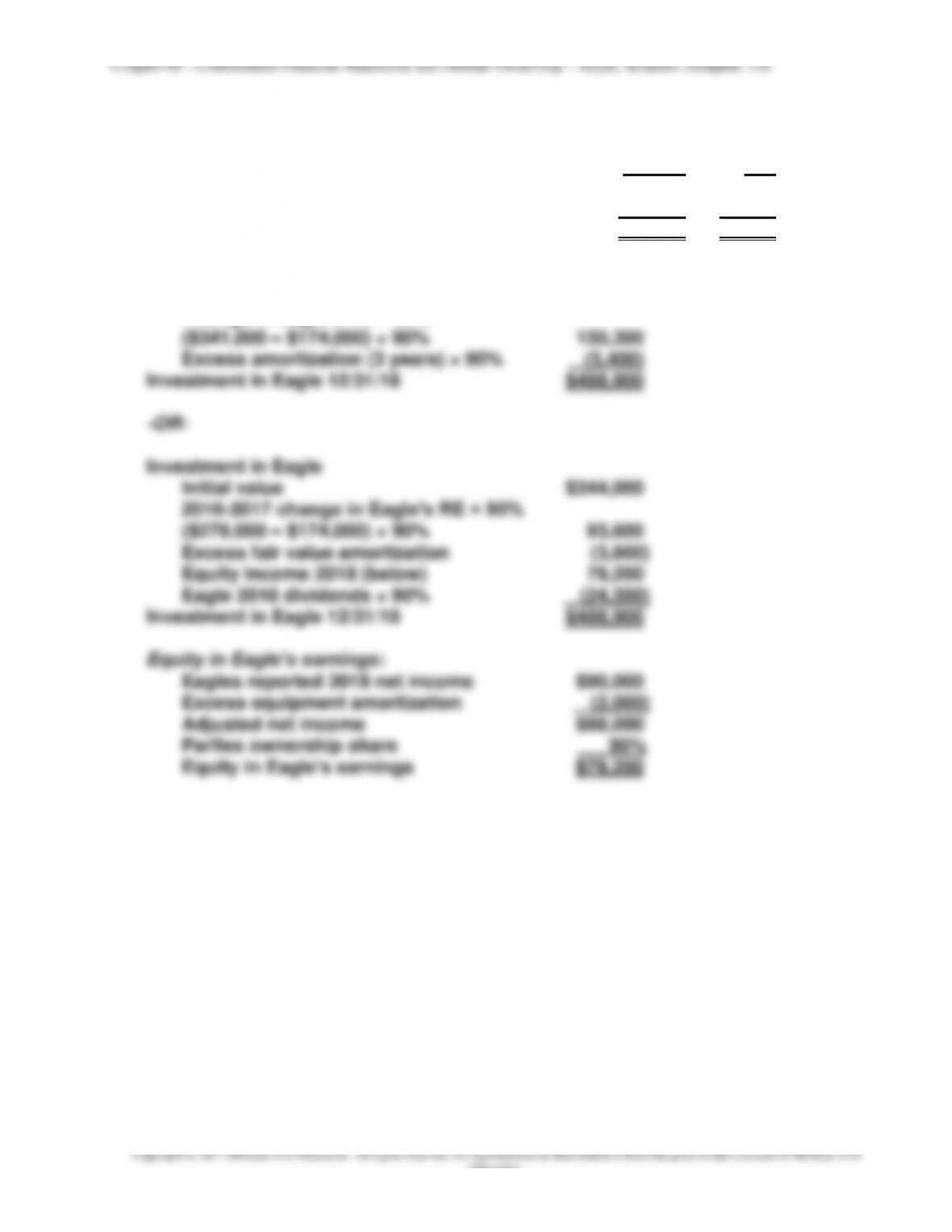
Plaza Stanford Consolidation Entries NCI Consolidated
Revenues
(1,400,000)
(825,000)
(2,225,000)
Cost of goods sold
774,000
395,750
1,169,750
Depreciation expense
328,000
36,250
E 5,000
369,250
Amortization expense
-0-
28,000
E 10,000
38,000
Equity in income of
Stanford
(280,000)
-0-
I 280,000
-0-
Net income
(578,000)
(365,000)
Consolidated net income
(648,000)
NCI share of CNI
(70,000)
70,000
Plaza share of CNI
(578,000)
Retained earnings 1/1
(1,275,000)
(530,000)
S 530,000
(1,275,000)
Net income
(578,000)
(365,000)
(578,000)
Dividends declared
300,000
50,000
D 40,000
10,000
300,000
Retained earnings 12/31
(1,553,000)
(845,000)
(1,553,000)
Current assets
860,000
432,250
1,292,250
Investment in Stanford
1,140,000
-0-
D 40,000
S 552,000
-0-
I 280,000
A 348,000
Tradenames
240,000
360,000
A 23,000
623,000
Property and equipment
1,030,000
253,750
A 40,000
E 5,000
1,318,750
Patents
-0-
104,000
A 140,000
E 10,000
234,000
Goodwill
A 232,000
232,000
Total assets
3,270,000
1,150,000
3,700,000
Accounts payable
(142,000)
(145,000)
(287,000)
Common stock
(300,000)
(120,000)
S 120,000
(300,000)
Additional paid-in capital
(1,275,000)
(40,000)
S 40,000
(1,275,000)
Noncontrolling interest
S 138,000
A 87,000
(225,000)
(285,000)
Retained earnings 12/31
(1,553,000)
(845,000)
(1,553,000)
Total liabilities and equities
(3,270,000)
(1,150,000)
1,460,000
1,460,000
(3,700,000)
4-15
Education.
29. (45 minutes) Noncontrolling interest in the presence of a control premium.
a. Goodwill allocation: Parflex NCI
Acquisition-date fair value $344,000 $36,000
Share of identifiable net assets ($324,000 + $18,000) 307,800 34,200
Goodwill allocation $36,200 $1,800
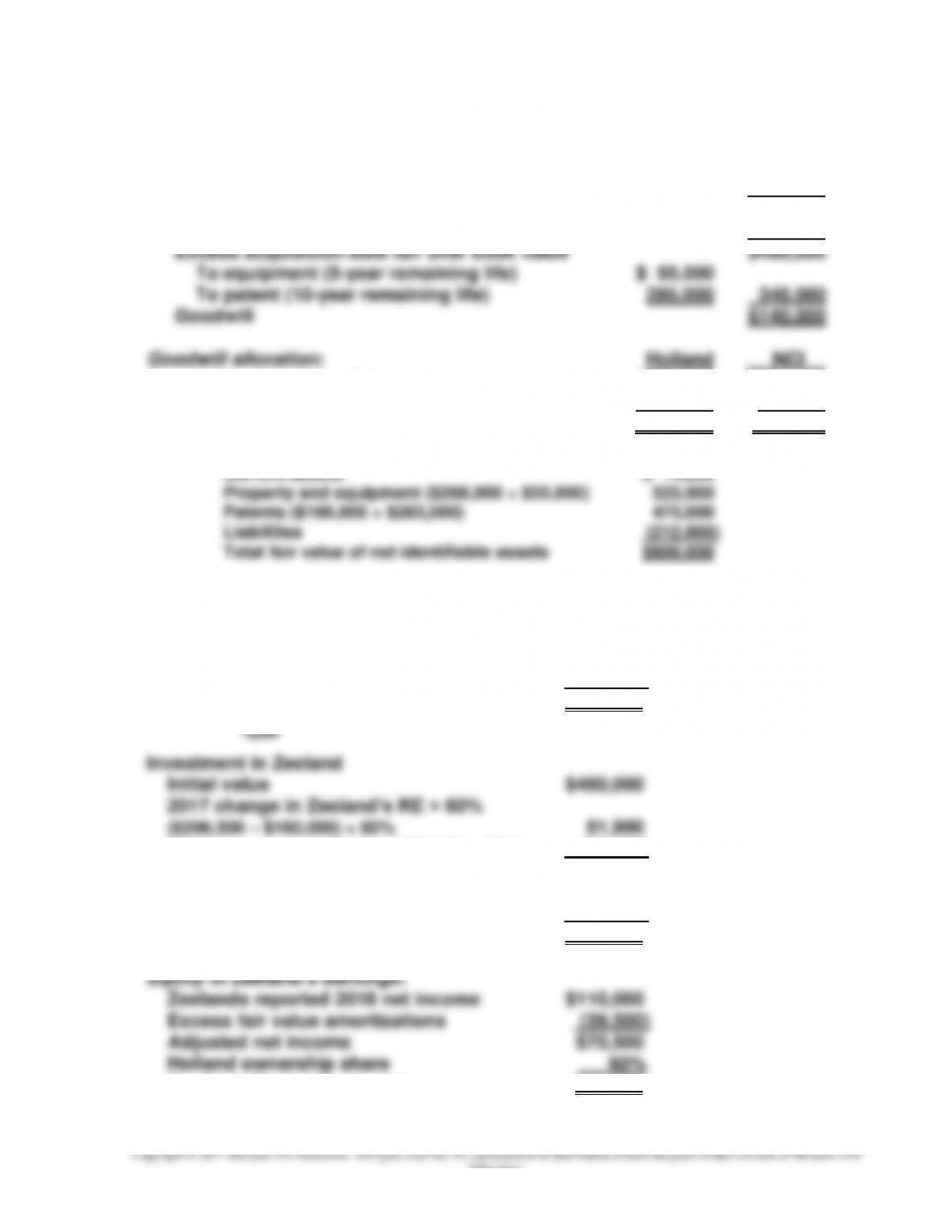
b. Investment in Eagle
Initial value $344,000
Change in Eagle’s RE × 90%
13e
4-16
Education.
29. continued
c. December 31, 2018
Parflex
Eagle
Adjustments
NCI
Consolidated
Sales
(862,000)
(366,000)
(1,228,000)
Cost of goods sold
515,000
209,000
724,000
Depreciation expense
191,200
67,000
E
2,000
260,200
Equity in Eagle’s earnings
(79,200)
0
I
79,200
0
Separate company net
income
(235,000)
(90,000)
Consolidated net income
(243,800)
to noncontrolling interest
(8,800)
8,800
to Parflex Corporation
(235,000)
Retained earnings, 1/1
(500,000)
(278,000)
S
278,000
(500,000)
Net income (above)
(235,000)
(90,000)
(235,000)
Dividends declared
130,000
27,000
24,300
D
2,700
130,000
Retained earnings, 12/31
(605,000)
(341,000)
(605,000)
Cash and receivables
135,000
82,000
217,000
Inventory
255,000
136,000
391,000
Investment in Eagle
488,900
0
D
24,300
385,200
S
-0-
12,600
A1
36,200
A2
79,200
I
Property & equipment (net)
964,000
328,000
A1
14,000
2,000
E
1,304,000
Goodwill
A2
38,000
38,000
Total assets
1,842,900
546,000
1,950,000
Liabilities
(722,900)
(55,000)
(777,900)
Common stock
(515,000)
(150,000)
S
150,000
(515,000)
NCI 1/1
42,800
S
1,400
A1
1,800
A2
(46,000)
NCI 12/31
(52,100)
(52,100)
Retained earnings, 12/31
(605,000)
(341,000)
(605,000)
Total liabilities and equities
(1,842,900)
(546,000)
585,500
585,500
(1,950,000)
Chapter 04 – Consolidated Financial Statements and Outside Ownership – Hoyle, Schaefer, Doupnik, 13e
4-17
Education.
30. (45 minutes) Noncontrolling interest in the presence of a control premium.
a. Consideration transferred by Holland ($8.00 × 60,000 shares) $480,000
Fair value of the noncontrolling interest ($6.50 × 40,000 shares) 260,000
Total Zeeland fair value at January 1, 2017 $740,000
Zeeland book value at January 1, 2017 260,000
Acquisition-date fair value $480,000 $260,000
Share (60% and 40%) of identifiable net assets* 360,000 240,000
Goodwill allocation $120,000 $ 20,000
*Zeeland identifiable net assets at acquisition-date fair value:
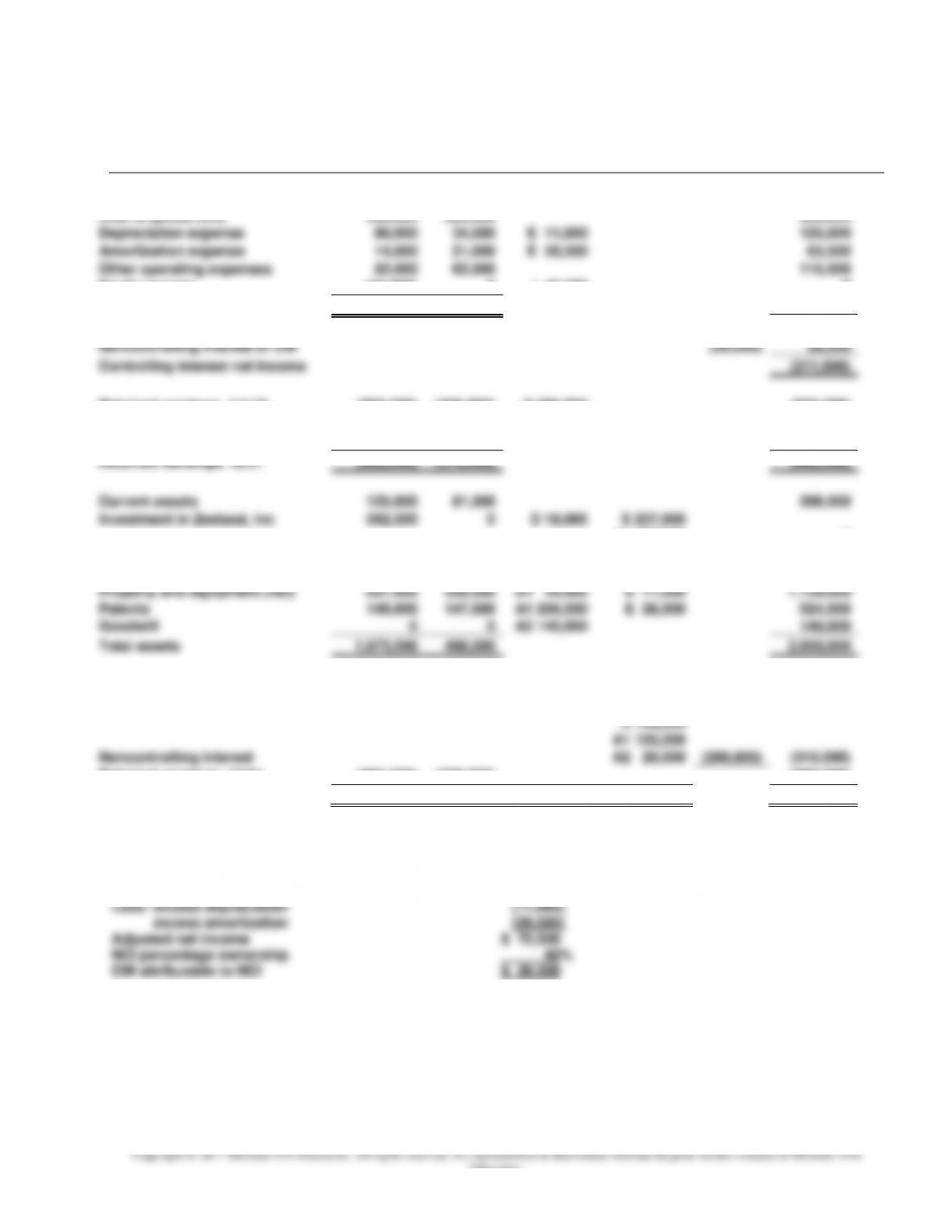
b. Investment in Zeeland
Initial value $480,000
Change in Zeeland’s RE × 60%
($376,500 – $160,000) × 60% 129,900
Excess amortization ($39,500 × 60% × 2 yrs.) (47,400)
Investment in Zeeland 12/31/18 $562,500
2017 excess amortization ($39,500 × 60%) (23,700)
Investment in Zeeland 12/31/17 $538,200
Equity income 2018 (below) 42,300
Zeeland 2018 dividends × 60% (18,000)
Investment in Zeeland 12/31/18 $562,500
Equity in Zeeland’s earnings $42,300
Chapter 04 – Consolidated Financial Statements and Outside Ownership – Hoyle, Schaefer, Doupnik,
13e
4-18
Education.
30. continued
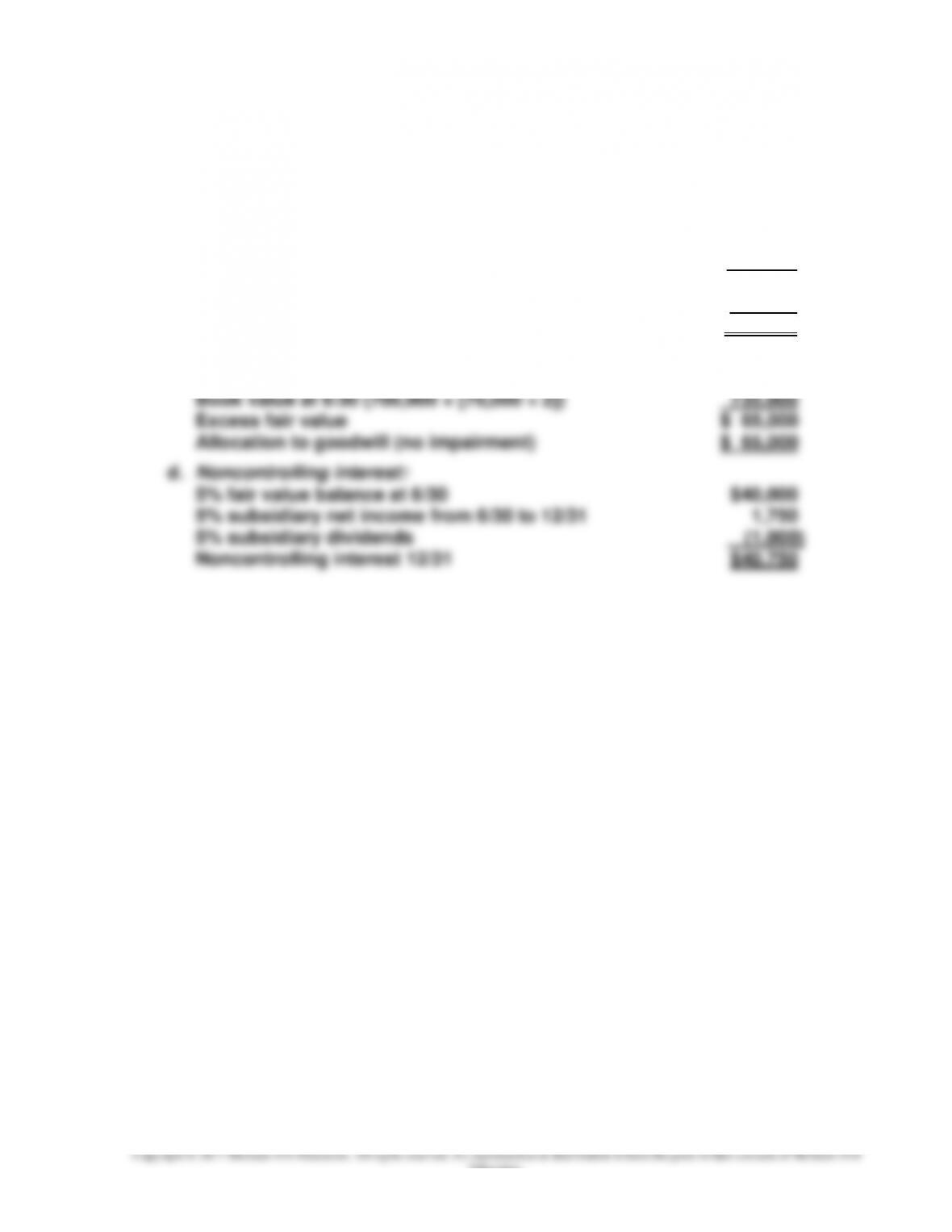
c. December 31, 2018 Holland Zeeland Adjustments NCI Consolidated
Sales
(640,500)
(428,500)
(1,069,000)
Cost of goods sold
325,000
200,000
525,000
Depreciation expense
80,000
34,000
E 11,000
125,000
Amortization expense
14,000
21,000
E 28,500
63,500
Other operating expenses
52,000
63,500
115,500
Equity income
(42,300)
0
I 42,300
0
Separate company net income
(211,800)
(110,000)
Consolidated net income
(240,000)
Noncontrolling interest in CNI
(28,200)
28,200
Controlling interest net income
(211,800)
Retained earnings, 1/1/18
(820,200)
(296,500)
S 296,500
(820,200)
Net income (above)
(211,800)
(110,000)
(211,800)
Dividends declared
50,000
30,000
D 18,000
12,000
50,000
Retained earnings, 12/31
(982,000)
(376,500)
(982,000)
Current assets
125,000
81,500
206,500
Investment in Zeeland, Inc
562,500
0
D 18,000
S 237,900
A1 180,300
0
A2 120,000
I 42,300
Property and equipment (net)
837,000
259,000
A1 44,000
E 11,000
1,129,000
Patents
149,000
147,500
A1 256,500
E 28,500
524,500
Goodwill
0
0
A2 140,000
140,000
Total assets
1,673,500
488,000
2,000,000
Liabilities
(371,500)
(11,500)
(383,000)
Common stock
(320,000)
(100,000)
S 100,000
(320,000)
S 158,600
A1 120,200
Noncontrolling interest
A2 20,000
(298,800)
(315,000)
Retained earnings, 12/31
(982,000)
(376,500)
(982,000)
Total liabilities and equities
(1,673,500)
(488,000)
936,800
936,800
(2,000,000)
Consolidated net income attributable to noncontrolling interest:
2018 Zeeland net income $110,000
Chapter 04 – Consolidated Financial Statements and Outside Ownership – Hoyle, Schaefer, Doupnik, 13e
4-19
Education.
31. (25 Minutes) (Determine consolidated balances for a step acquisition).
a. Amsterdam fair value implied by price paid by Morey
$560,000 ÷ 70% = $800,000
b. Revaluation gain:
1/1 equity investment in Amsterdam (book value) $178,000
25% net income for 1st 6 months 8,750
Investment book value at 6/30 186,750
Fair value of investment at 6/30 (25% × $800,000) 200,000
Gain on revaluation to fair value $ 13,250
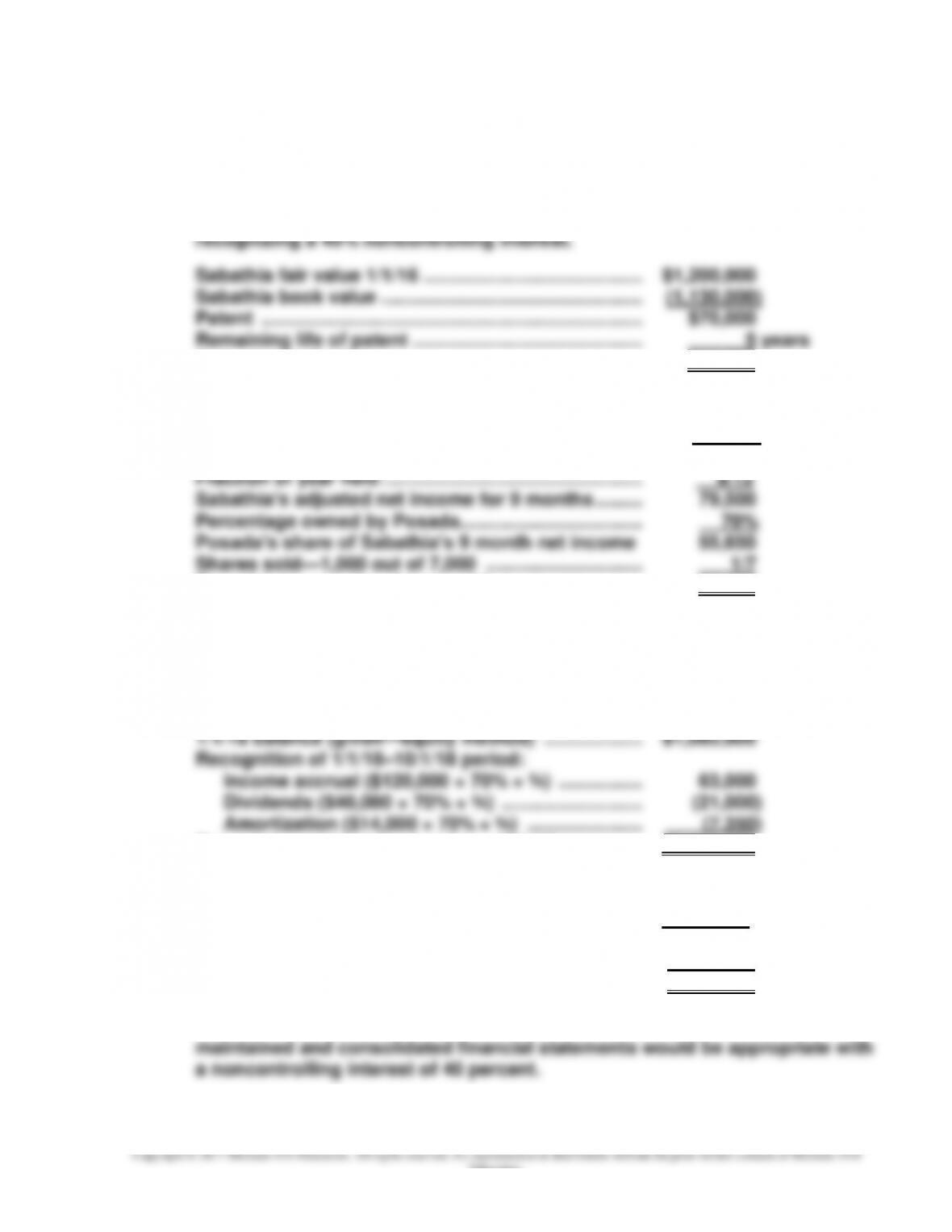
c. Goodwill at 12/31:
Fair value of Amsterdam at 6/30 $800,000
Chapter 04 – Consolidated Financial Statements and Outside Ownership – Hoyle, Schaefer, Doupnik,
13e
4-20
Education.
32. (30 Minutes) (Reporting the sale of a portion of an investment in a subsidiary.)
a. Posada records an accrual of $7,950 (see computation below) as “Equity
Income from Sold Shares of Sabathia” for the January 1, 2018 to October 1,
2018 period which will appear in the 2018 consolidated income statement.
The consolidation will continue to include all of Sabathia’s accounts but now
Annual amortization ………………………………………….. $14,000
Posada’s share of Sabathia’s net income accruing to shares sold:
Sabathia’s net income ……………………………………….. $120,000
Excess patent fair value amortization …………………. (14,000)
Sabathia’s adjusted net income ………………………….. 106,000
Posada’s income for shares sold ………………………. $7,950
b. As long as control is maintained, the acquisition method considers
transactions in the stock of a subsidiary, whether purchases or sales, as
transactions in the equity of the consolidated entity.
Posada’s investment book value 10/1/18
Pre-sale investment book value—10/1/18 ……………. $1,119,650
Computation of income effect—sale transaction
10/1/18 book value (above) ………………………………… $1,119,650
Portion of investment sold (1,000/7,000 shares) …. 1/7
Book value of investment sold ………………………….. $ 159,950
Proceeds ………………………………………………………….. 191,000
Credit to Posada’s additional paid-in capital ………. $ 31,050
c. Because Posada continues to hold 6,000 shares of Sabathia, control is still