Chapter 03 – Consolidations—Subsequent to the Date of Acquisition
Education.
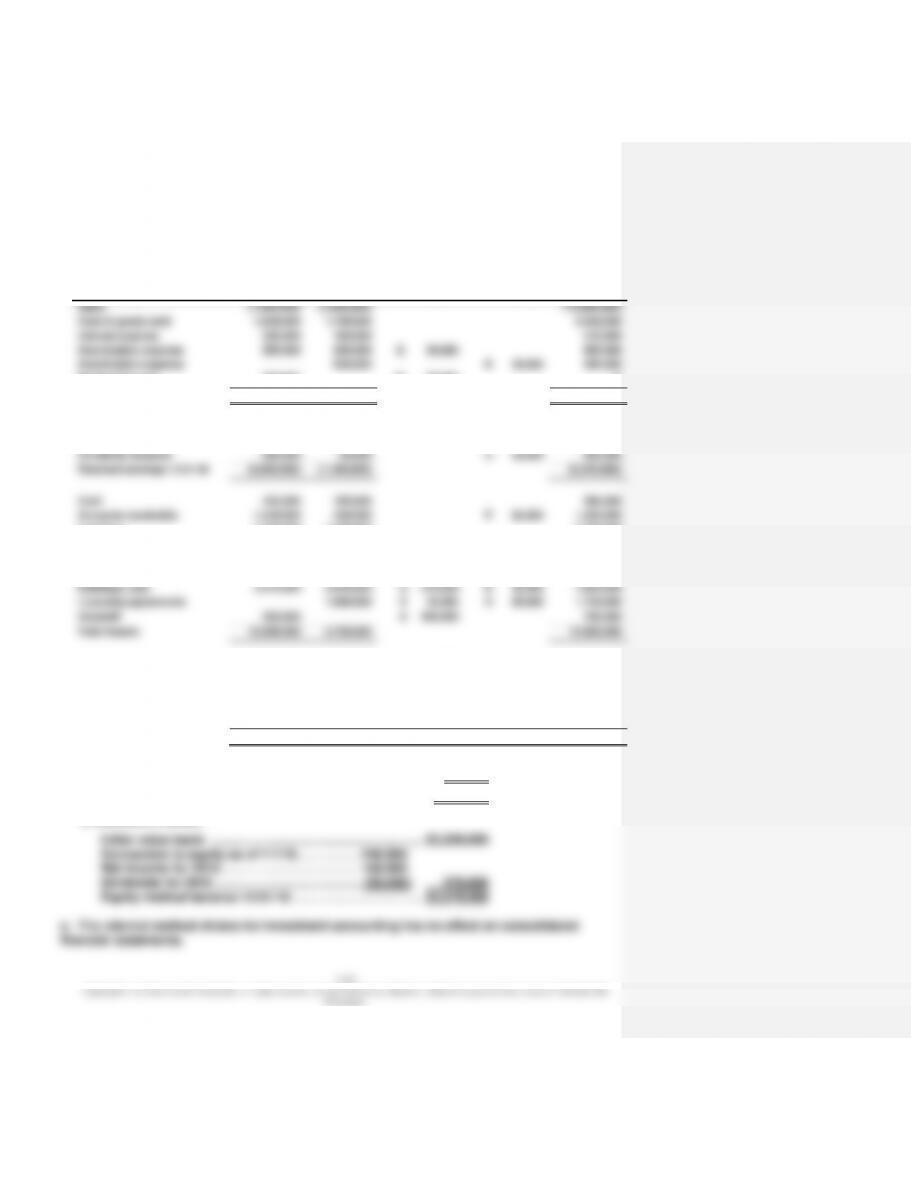
31. (45 Minutes) (Consolidated totals and worksheet two years after acquisition.
Parent uses initial value method. Includes question comparing initial value
and equity methods).
Consolidation Entries
a. 12/31/2018
Pinnacle
Strata
Debit Credit
Consolidated
Sales
(7,000,000)
(3,000,000)
(10,000,000)
Cost of goods sold
4,650,000
1,700,000
6,350,000
Interest expense
255,000
160,000
415,000
Depreciation expense
585,000
350,000
E 30,000
965,000
Amortization expense
600,000
E 20,000
580,000
Dividend income
(50,000)
D 50,000
0
Net Income
(1,560,000)
(190,000)
(1,690,000)
Retained earnings 1/1/18
(5,000,000)
(1,350,000)
S 1,350,000
*C 240,000
(5,240,000)
Net income
(1,560,000)
(190,000)
(1,690,000)
Dividends declared
560,000
50,000
D 50,000
560,000
Retained earnings 12/31/18
(6,000,000)
(1,490,000)
(6,370,000)
Cash
433,000
165,000
598,000
Accounts receivable
1,210,000
200,000
P 85,000
1,325,000
Inventory
1,235,000
1,500,000
2,735,000
Investment in Strata
3,200,000
*C 240,000
S 2,850,000
0
A 590,000
Buildings (net)
5,572,000
2,040,000
A 270,000
E 30,000
7,852,000
Licensing agreements
1,800,000
E 20,000
A 80,000
1,740,000
Goodwill
350,000
A 400,000
750,000
Total Assets
12,000,000
5,705,000
15,000,000
Accounts payable
(300,000)
(715,000)
P 85,000
(930,000)
Long-term debt
(2,700,000)
(2,000,000)
(4,700,000)
Common stock – Pinnacle
(3,000,000)
(3,000,000)
Common stock – Strata
(1,500,000)
S 1,500,000
0
Retained earnings 12/31/18
(6,000,000)
(1,490,000)
(6,370,000)
Total Liabilities and OE
(12,000,000)
(5,705,000)
3,945,000
3,945,000
(15,000,000)
b. Subsidiary income (190,000 – 10,000) ……………………………….. $180,000
1/1/18 retained earnings (5,000,000 + 240,000)………………… $5,240,000
Investment in Strata:
Chapter 03 – Consolidations—Subsequent to the Date of Acquisition
3-42
Education.
32. (30 Minutes) (Determine consolidated accounts and consolidation entries five
years after acquisition. Parent applies equity method.)
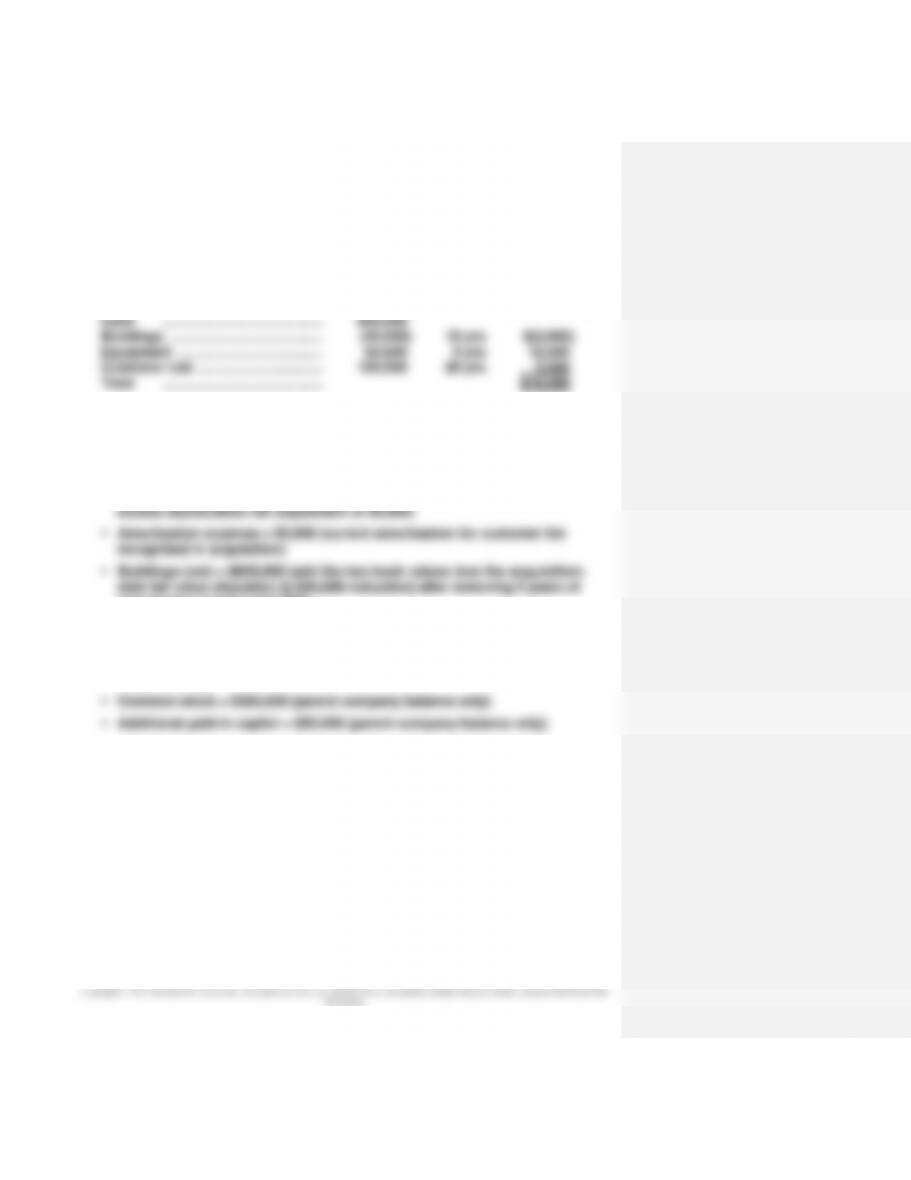
a. Fair value allocation and annual amortization
Remaining Annual excess
Allocation life amortizations
CONSOLIDATED TOTALS
▪ Revenues = $850,000 (add the two book values)
▪ Cost of goods sold = $380,000 (the accounts of both companies are added
together)
▪ Depreciation expense = $179,000 (the accounts are added and include the
amortization totaling $15,000)
▪ Equipment (net) = $450,000 (add the two book values. The acquisition-date
fair value allocation is completely amortized at end of current year)
▪ Customer list = $75,000 ($100,000 original allocation less $25,000 [5 years of
amortization])
b. The method used by the parent is only important in determining the parent’s
separate account balances (which are given here or are not needed) or
consolidation worksheet entries (which are not required in a.)
Chapter 03 – Consolidations—Subsequent to the Date of Acquisition
3-43
32. (continued)
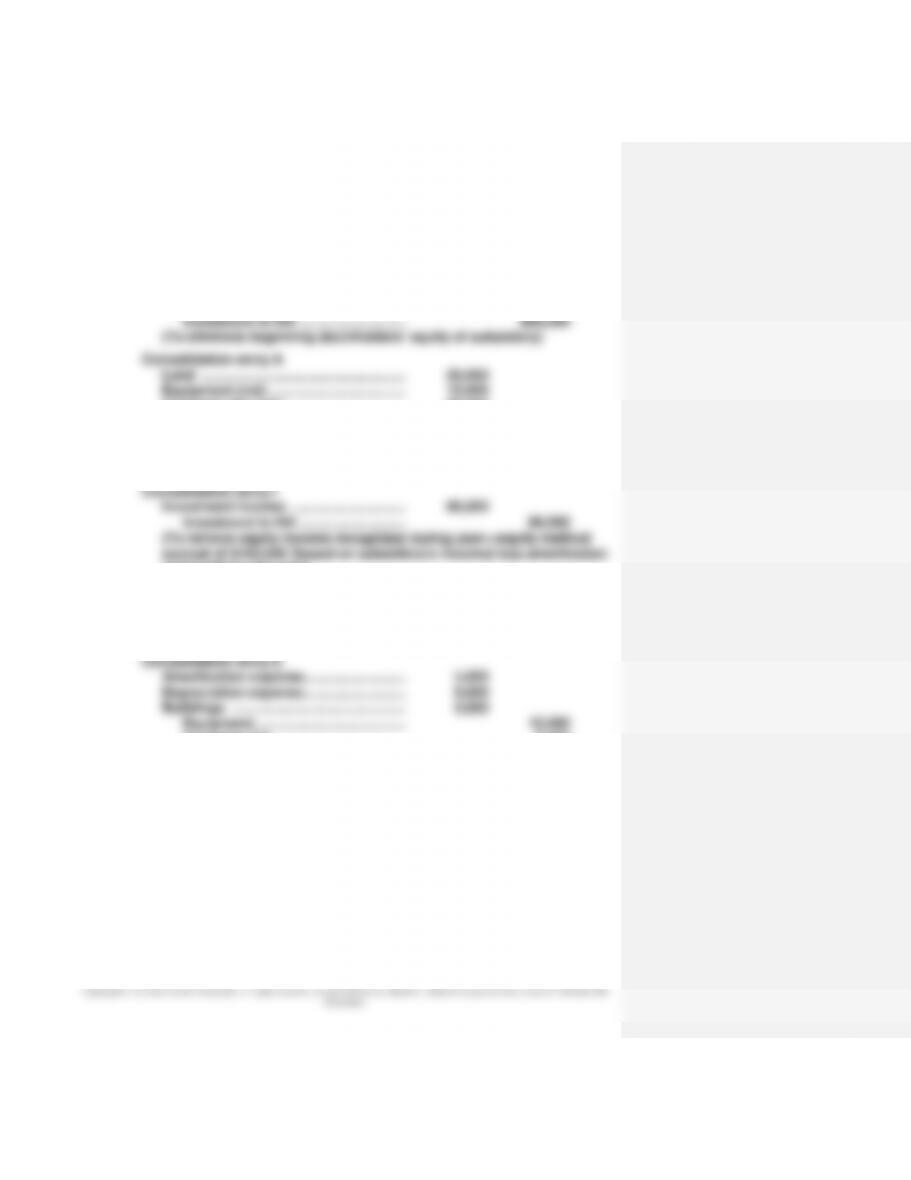
c. Consolidation entry S
Common stock (Hill) ………………………. 40,000
Additional paid-in capital (Hill) ……….. 160,000
Retained earnings 1/1 …………………….. 600,000
Customer list (net) …………………………. 80,000
Buildings (net) ………………………….. 18,000
Investment in Hill ………………………. 94,000
(To recognize unamortized allocation balances as of beginning of
current year)
of $14,000 for the year)
Consolidation entry D
Investment in Hill …………………………... 40,000
Dividends declared ……………………. 40,000
(To remove Intra-entity dividend declarations)
Customer list……………………………… 5,000
(To recognize excess acquisition-date fair-value amortizations for
the period)
3-44
Education.
33. (30 Minutes) (Determine parent company and consolidated account
balances for a bargain purchase combination. Parent applies equity
method)
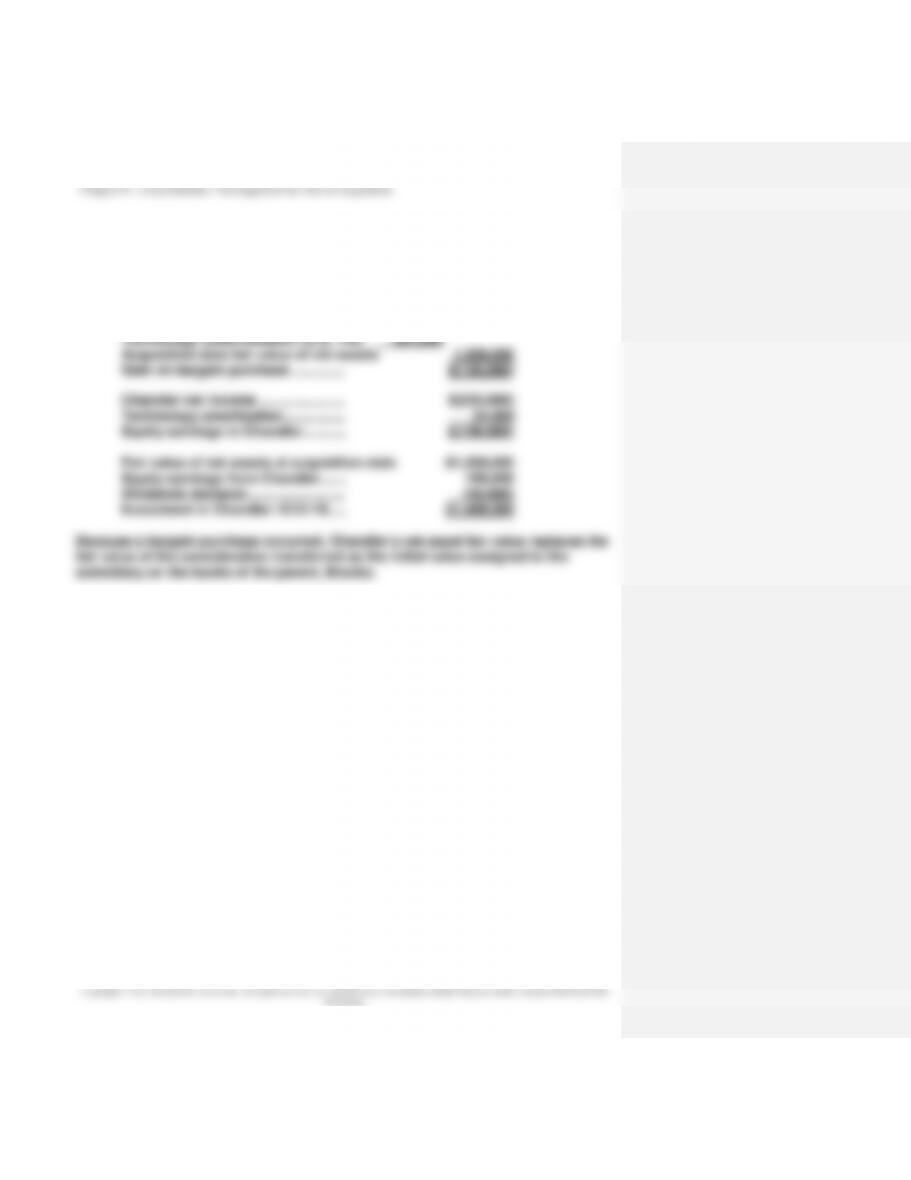
a. Acquisition-date fair value allocation and annual excess amortization
Consideration transferred …………. $1,183,000
Chandler book value (given) ………. $1,105,000

Chapter 03 – Consolidations—Subsequent to the Date of Acquisition
3-45
33. continued (part b.)
Income Statement
Brooks
Chandler
Consolidation Entries
Debit Credit
Consolidated
Revenues
(640,000)
(587,000)
(1,227,000)
Cost of goods sold
255,000
203,000
458,000
Gain on bargain purchase
(126,000)
-0-
(126,000)
Depreciation and
amortization expenses
150,000
151,000
(E) 34,000
335,000
Equity earnings in
Chandler
(199,000)
-0-
(I) 199,000
-0-
Net income
(560,000)
(233,000)
(560,000)
Statement of Retained
Earnings
Retained earnings, 1/1
(1,835,000)
(805,000)
(S) 805,000
(1,835,000)
Net income (above)
(560,000)
(233,000)
(560,000)
Dividends declared
100,000
40,000
(D) 40,000
100,000
Retained earnings, 12/31
(2,295,000)
(998,000)
(2,295,000)
Balance Sheet
Current assets
343,000
432,000
775,000
Investment in Chandler
1,468,000
-0-
(D) 40,000
(I) 199,000
(S)1,105,000
-0-
(A) 204,000
Trademarks
134,000
221,000
355,000
Patented technology
395,000
410,000
(A) 204,000
(E) 34,000
975,000
Equipment
693,000
341,000
1,034,000
Total assets
3,033,000
1,404,000
3,139,000
Liabilities
(203,000)
(106,000)
(309,000)
Common stock
(535,000)
(300,000)
(S) 300,000
(535,000)
Retained earnings, 12/31
(2,295,000)
(998,000)
(2,295,000)
Total liabilities and equity
(3,033,000)
(1,404,000)
1,582,000
1,582,000
(3,139,000)
3-46
Education.
34. (35 minutes) (Contingent performance obligation and worksheet adjustments
for equity and initial value methods.)
a. Investment in Wolfpack, Inc. 500,000
Contingent performance obligation 35,000
Cash 465,000
b.
Cash 50,000
c. Equity Method
Common stock- Wolfpack 200,000
Retained earnings-Wolfpack 180,000
Investment in Wolfpack 380,000
Investment in Wolfpack 35,000
Dividends declared 35,000
Amortization expense 10,000
Royalty agreements 10,000
d. Initial Value Method
Chapter 03 – Consolidations—Subsequent to the Date of Acquisition
Education.
34. (continued)
Royalty agreements 90,000
35. (45 Minutes) (Prepare consolidation worksheet five years after acquisition.
Parent applies equity method).
a. Allocation of Acquisition-Date Fair Value and Determination of
Amortization:
Bradford’s acquisition-date fair value …………… $140,000
Equipment …………………………... 5,000 5 yrs. $1,000
Formula …………………………..…… 20,000 20 yrs. 1,000
Total …………………………………………. $35,000 $2,000
The equity in subsidiary earnings reflects the equity method. The initial
b. Explanation of Consolidation Entries Found on Worksheet
Entry S—Eliminates stockholders’ equity accounts of the subsidiary as
of the beginning of the current year.
Entry A—Recognizes remaining unamortized allocation from
acquisition-date fair value adjustments. As of the beginning of the
current year, equipment and formula have undergone four years of
Chapter 03 – Consolidations—Subsequent to the Date of Acquisition
3-48
35. (continued) Allen and Subsidiary Consolidated Worksheet for year ended December 31, 2018
Consolidation Entries Consolidated
Accounts Allen Co. Bradford Co. Debit Credit Totals
Income Statement
Revenues …………………………..…………………….. (485,000) (190,000) (675,000)
Statement of Retained Earnings
Retained earnings 1/1 …………………………..…… (659,000) (98,000) (S) 98,000 (659,000)
Net income (above) …………………………..………. (261,000) (68,000) (261,000)
Dividends declared …………………………..………. 175,500 40,000 (D) 40,000 175,500
Retained earnings 12/31 ………………………. (744,500) (126,000) (744,500)
Land …………………………..…………………………. 427,500 58,000 (A) 10,000 495,500
Buildings and equipment (net) …………………… 713,000 161,000 (A) 1,000 (E) 1,000 874,000
Formula……………………………………………………. -0- -0- (A) 16,000 (E) 1,000 15,000
Total assets …………………………..……………. 1,624,500 294,000 1,727,500
Current liabilities ………………………………………. (190,000) (103,000) (293,000)
Chapter 03 – Consolidations—Subsequent to the Date of Acquisition
36. (20 Minutes) (Consolidated balances three years after acquisition. Parent
has applied the equity method.)
a. Schedule 1—Acquisition-Date Fair Value Allocation and Amortization
Jasmine’s acquisition-date fair value $206,000
Book value of Jasmine ……………… (140,000)
Buildings (overvalued) ………. (10,000) 20 yrs. (500)
Goodwill ………………………….... $21,600 indefinite -0-
Total …………………………..……….. $66,000 $6,300
Investment in Jasmine Company—12/31/18:
Jasmine’s acquisition-date fair value ………………………. $206,000
2018 Excess amortizations (Schedule 1) ………………… (6,300)
Investment in Jasmine Company 12/31/18 ………….. $257,100
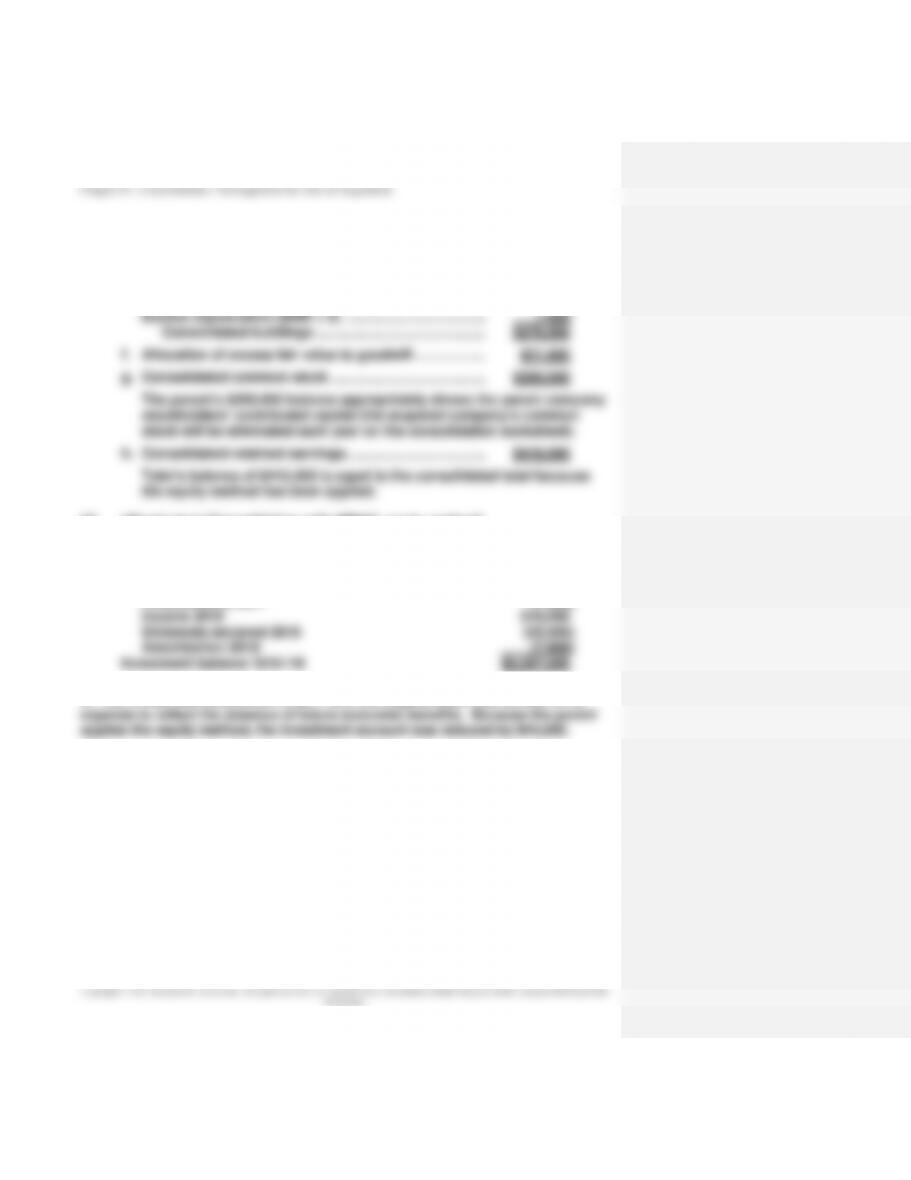
b. Equity in subsidiary earnings:
Income accrual …………………………..………………………….. $30,000
Excess amortizations (Schedule 1) ………………………… (6,300)
Consolidated net income …………………………..…………… $135,700
d. Consolidated equipment:
Book values added together …………………………..……… $370,000
Acquisition-date fair value allocation ……………………… 54,400
Excess depreciation ($6,800 × 3) ………………………….... (20,400)
3-50
Education.
36. (continued)
e. Consolidated buildings:
Book values added together …………………………..……… $288,000
Acquisition-date fair value allocation ………………………. (10,000)
37. (35 minutes) (Consolidation with IPR&D, equity method)
a. Consideration transferred 1/1/17 $1,980,000
Increase in GaugeRite’s retained earnings to 1/1/18 150,000
In-process R&D write-off in 2017 (44,000)
Amortizations 2017 (7,000)
b. The IPR&D was abandoned in 2017 and the original asset was written off to

Education.
Chapter 03 – Consolidations—Subsequent to the Date of Acquisition
3-52
Education.
38. (55 minutes) (Goodwill impairment, consolidated balances, and worksheet)
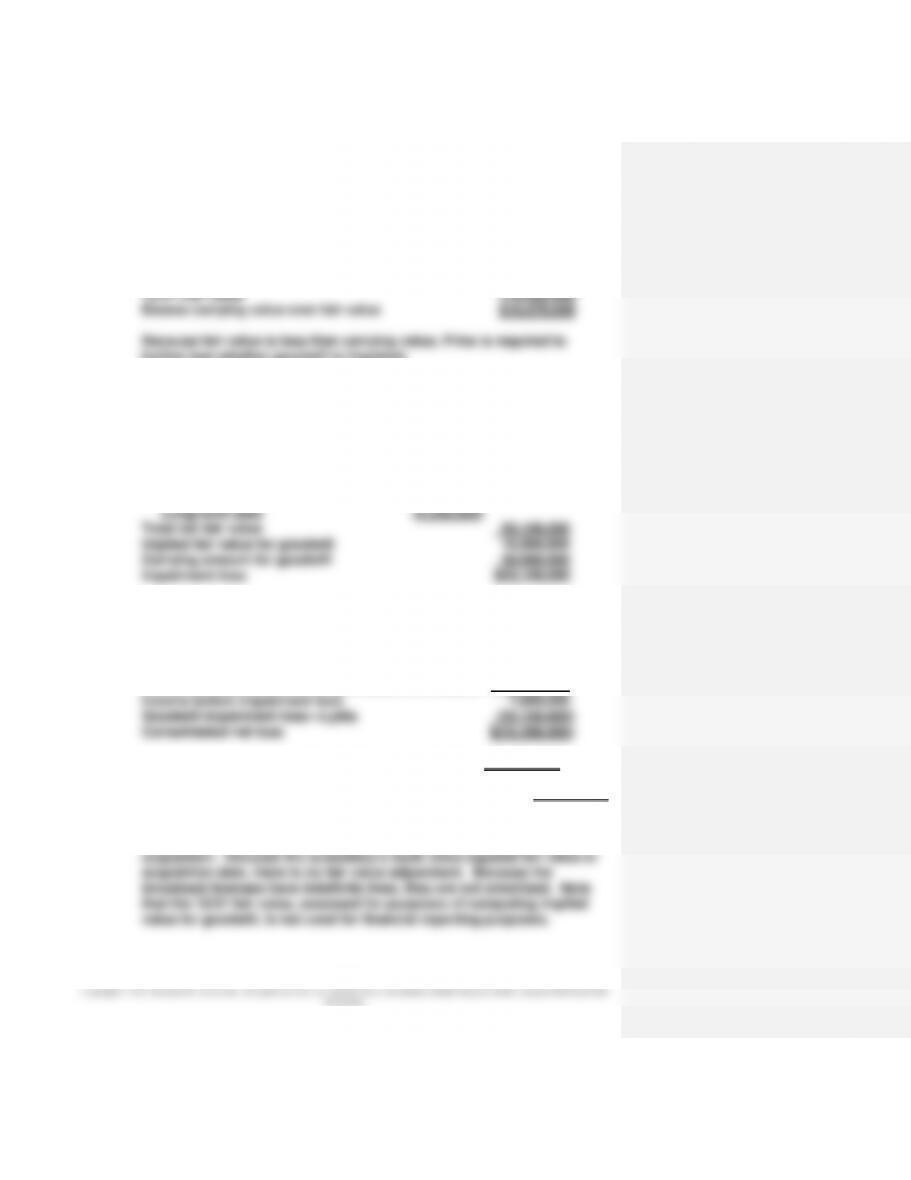
a. Prine compares Lydia’s total fair value to its carrying value, as follows:
12/31 Carrying value (equity method balance) $120,070,000
further test whether goodwill is impaired.
b. 12/31 Fair value for Lydia $110,000,000
Fair values of assets and liabilities
Cash $109,000
Receivables (net) 897,000
Movie library 60,000,000
Broadcast licenses 20,000,000
Equipment 19,000,000
Current liabilities (650,000)
Journal Entry by Prine:
Goodwill impairment loss 33,106,000
Investment in Lydia Co. 33,106,000
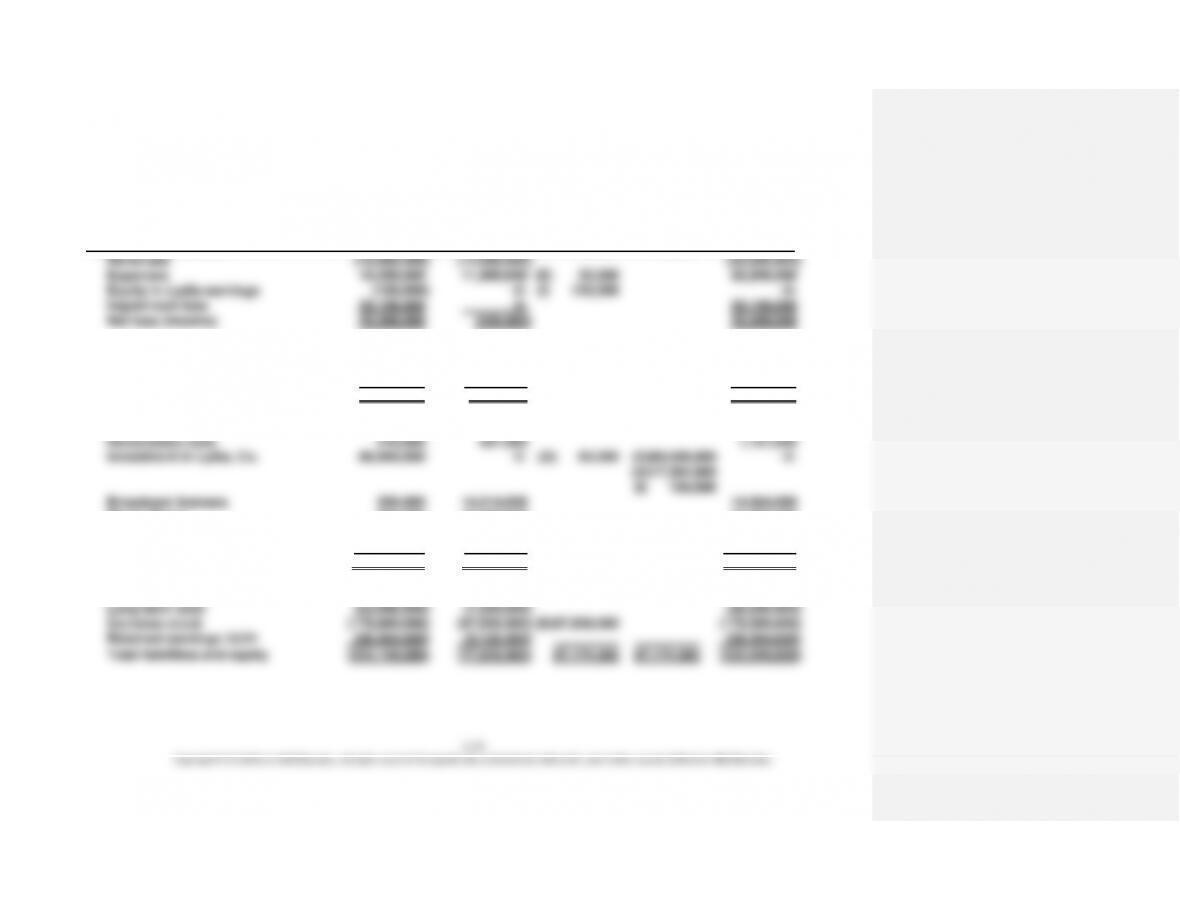
c. Combined revenues $ 30,000,000
Combined expenses (including excess amortization) 22,200,000
d. Consolidated goodwill = $50,000,000 – $33,106,000 = $16,894,000
e. Consolidated broadcast licenses = $350,000 + $14,014,000 = $14,364,000
The consolidated balance is the parent’s book value plus the fair value
of the subsidiary acquisition-date value adjusted for changes since
Chapter 03 – Consolidations—Subsequent to the Date of Acquisition
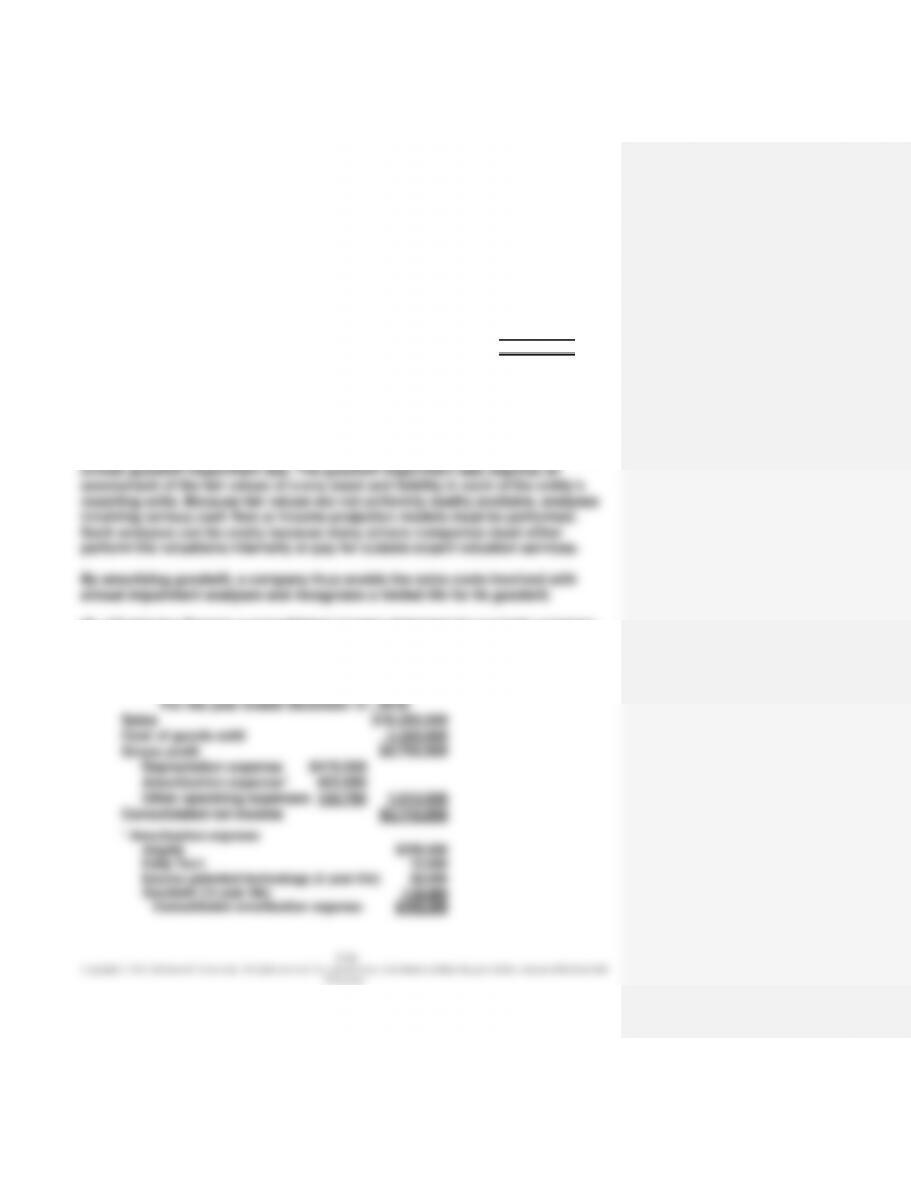
38. f. (continued) Prine and Lydia
Consolidated Worksheet
December 31
Consolidation Entries Consolidated
Accounts Prine, Inc. Lydia Co. Debit Credit Totals
Retained earnings 1/1 (52,000,000) (2,000,000) (S) 2,000,000 (52,000,000)
Dividends declared 300,000 80,000 (D) 80,000 300,000
Net loss (income) 25,306,000 (200,000) 25,306,000
Retained earnings 12/31 (26,394,000) (2,120,000) (26,394,000)
Cash 260,000 109,000 369,000
Movie library 365,000 45,000,000 45,365,000
Equipment (net) 136,000,000 17,500,000 (A) 500,000 (E) 50,000 153,950,000
Goodwill -0- -0- (A)16,894,000 16,894,000
Total assets 224,149,000 77,520,000 232,049,000
Current liabilities (755,000) (650,000) (1,405,000)
Chapter 03 – Consolidations—Subsequent to the Date of Acquisition
Education.
38. (continued):
Note: Applying the 2017 FASB ASU on simplifying goodwill impairment (effective in 2020
for SEC registered public companies, with early adoption permitted), the answer to part
b. is as follows:
12/31 Carrying amount (equity method balance) $120,070,000
12/31 Fair value 110,000,000
Goodwill impairment loss* $ 10,070,000
*Must be less than $50,000,000 (carrying amount of goodwill).
39. (10 minutes) (Discuss cost savings from alternative goodwill model available
to private companies).
The primary cost saving from electing to amortize goodwill is the avoidance of an
40. (15 minutes Prepare a consolidated income statement for a private company
electing goodwill amortization).
Angela Company and Subsidiary
Consolidated Income Statement
Chapter 03 – Consolidations—Subsequent to the Date of Acquisition
RESEARCH CASE SOLUTION
Jonas recognized several identifiable intangibles from its acquisition of
1. Advise Jonas on the acceptability of its suggested immediate write-off.
An intangible asset should not be written down or off in the period of
2. The accounting for recognized intangible assets is based on its useful life to the
reporting entity. An intangible asset with a finite useful life is amortized; an
3. The price paid by Jonas for Innovation Plus indicates a large amount was paid
for goodwill. However, Jonas worries that any goodwill impairment may send
the wrong signal to its investors about the wisdom of the acquisition. Jonas
4. Per the FASB ASC (350-20-35-41):
For the purpose of testing goodwill for impairment, all goodwill acquired in a
business combination shall be assigned to one or more reporting units as of
the acquisition date. Goodwill shall be assigned to reporting units of the
Chapter 03 – Consolidations—Subsequent to the Date of Acquisition
3-56
Education.
MICROSOFT IMPAIRMENT ANALYSIS CASE SOLUTION
1. Microsoft’s segments serve as its reporting units for assessing goodwill for
potential impairments. Which segment suffered a 2015 impairment? Describe
the revenue model for this segment.
From Microsoft’s 2015 10–K…
2. What were the underlying business reasons that required Microsoft to record
a goodwill impairment in 2015?
Microsoft acquired Nokia’s phone unit in April 2014 for $9.5 billion, including
$1.5 billion in acquired cash. The addition of the unit — a deal struck under
services that run on multiple software platforms and devices, regardless of
3-57
Education.
3. How did Microsoft reflect the 2015 goodwill impairment in its income
statement and cash flow statement?
4. Describe in your own words the goodwill impairment testing steps performed
by Microsoft in 2015.
a. Fair value of reporting unit estimates using a discounted cash flow
methodology
• Estimation of useful life
• Determination of weighted average cost of capital
b. Step 2, the fair value of all Phone Hardware assets and liabilities were
of the goodwill was then compared to the recorded goodwill to determine the
amount of the impairment.