Chapter 03 – Consolidations—Subsequent to the Date of Acquisition
21. (continued)
(To eliminate beginning of year stockholders’ equity accounts of
subsidiary—the retained earnings balance has been adjusted for 2017
income and dividends.)
Entry A
Goodwill …………………………..…………………………. 120,000
Investment in Abernethy ……………………………… 30,000
Dividends declared …………………………..…….. 30,000
(To eliminate Intra-entity dividend transfers.)
Equity E—not needed
22. (45 Minutes) (Variety of questions about the three methods of recording an
Investment in a subsidiary for internal reporting purposes.)
a. Acquisition-Date Fair-Value Allocation and Annual Amortization:
Clay’s acquisition-date fair value …… $510,000
Chapter 03 – Consolidations—Subsequent to the Date of Acquisition
Education.
22. (continued)
Investment in Clay—December 31, 2018:
Consideration transferred for Clay …………………………. $510,000
2017:
Equity accrual (based on Clay’s net Income) ……… 55,000
Dividends ……………………………………………………….… (8,000)
Total …………………………..…………………………..……………. $592,000
INITIAL VALUE METHOD
Investment Income—2018:
Dividend income …………………………..……………………… $8,000
Investment in Clay—December 31, 2018:
Consideration transferred for Clay …………………………. $510,000
b. The reported consolidated balances are not affected by the parent’s
the initial value method is applied by Adams.
c. The reported consolidated balances are not affected by the parent’s
investment accounting method. Thus, consolidated equipment
Adams income 2017 ……………………………………………………. 125,000
2017 equity accrual for Clay income ……………………………. 55,000
2017 excess amortization ……………………………………………. (10,000)
Adams retained earnings—1/1/18 …………………………..……. $1,030,000
Adams retained earnings—Initial value method
Chapter 03 – Consolidations—Subsequent to the Date of Acquisition
3-23
Education.
22. (continued)
e. EQUITY METHOD—Entry *C is not utilized since parent’s retained
earnings balance is correct.
Investment in Clay …………………………..………….. 40,000
Retained earnings, 1/1/18 (parent) ……………. 40,000
f. Consolidated worksheet entry S for 2018:
Common stock (Clay) …………………………..…. 150,000
Retained earnings, 1/1/18 (Clay) ……………….. 350,000
Investment in Clay …………………………..…. 500,000
g. Consolidated revenues (combined) ………………. $640,000
23. (15 Minutes) (Consolidated accounts one year after acquisition)
Stanza acquisition fair value ($10,000 in
Excess fair value allocated to copyrights life Amortization
based on fair value ………………………… 120,000 6 yrs. $20,000
Goodwill …………………………..………………… $ 80,000 indefinite -0-
Total …………………………..…………………. $20,000
a. Consolidated copyrights
Penske (book value) …………………………..…… $900,000
Chapter 03 – Consolidations—Subsequent to the Date of Acquisition
3-24
Education.
23. (continued)
b. Consolidated net income, 2018
Revenues (add book values) …………………… $1,100,000
Expenses:
Add book values …………………………..……. $700,000
Excess amortizations …………………………. 20,000 720,000
Consolidated net income …………………………. $380,000
c. Consolidated retained earnings, 12/31/18
excluded because they are intra-entity in nature.
d. Consolidated goodwill, 12/31/18
Allocation (above) …………………………..………. $80,000
24. (30 Minutes) (Consolidated balances three years after the date of
acquisition. Includes questions about parent’s method of recording
investment for internal reporting purposes.)
a. Acquisition-Date Fair Value Allocation and Amortization:
Consideration transferred 1/1/16 …………. $600,000
Book value (given) …………………………..…. (470,000)
Fair value in excess of book value ….. 130,000
Annual
Remaining excess
Allocation to equipment based on Life amortizations
fair and book value difference 90,000 10 yrs. $9,000
3-25
Education.
24. (continued)
▪ Buildings = $1,200,000 (add book values)
▪ Goodwill = $40,000 (original residual allocation)
▪ Common Stock = $900,000 (parent balance only)
b. The parent’s choice of an investment method has no impact on the
consolidated totals. The choice of an investment method only affects
the internal reporting of the parent.
Foxx’s 1/1/18 balance (initial value method) …………………. $1,100,000
2016 net equity accrual for Greenburg ($90,000 – $20,000) 70,000
2017 net equity accrual for Greenburg ($100,000 – $20,000) 80,000
Foxx’s 1/1/18 retained earnings …………………………..………. $1,250,000
Equity method—Foxx’s retained earnings—1/1/18
Foxx’s 1/1/18 balance (initial value method) …………………. $1,100,000
Chapter 03 – Consolidations—Subsequent to the Date of Acquisition
25. (50 Minutes) (Consolidated totals for an acquisition where parent employs
the equity method. Acquisition-date fair value allocation includes long-term
debt. Worksheet preparation is a separate requirement.)
a. Investment in Mathias:
3-27
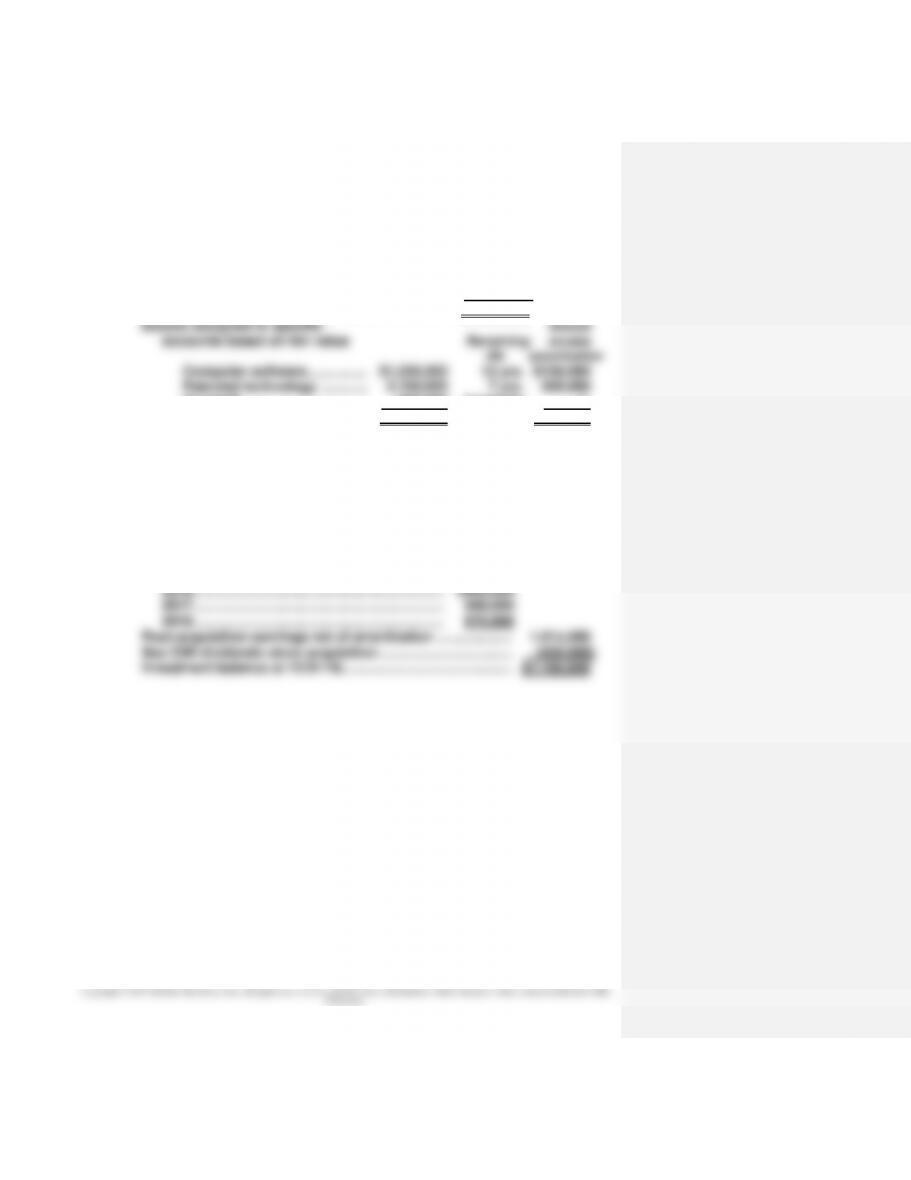
25. continued (part b.) ALLISON CORPORATION AND CONSOLIDATED SUBSIDIARY
Consolidation Worksheet
For Year Ending December 31, 2018
Consolidation Entries
Income Statement
Allison
Mathias
Debit Credit
Consolidated
Revenues
(6,400,000)
(3,900,000)
(10,300,000)
Cost of goods sold
4,500,000
2,500,000
7,000,000
Depreciation expense
875,000
277,000
1,152,000
Amortization expense
430,000
103,000
E 350,000
883,000
Interest expense
55,000
60,000
E 20,000
95,000
Equity earnings in Mathias
(630,000)
I 630,000
Net income
(1,170,000)
(960,000)
(1,170,000)
Statement of Retained Earnings
Retained earnings 1/1
(5,340,000)
(1,955,000)
S 1,955,000
(5,340,000)
Net income (above)
(1,170,000)
(960,000)
(1,170,000)
Dividends declared
560,000
50,000
D 50,000
560,000
Retained earnings 12/31
(5,950,000)
(2,865,000)
(5,950,000)
Balance Sheet
Cash
75,000
143,000
218,000
Accounts receivable
950,000
225,000
1,175,000
Inventories
1,700,000
785,000
2,485,000
Investment in Mathias
6,580,000
D 50,000
S 2,455,000
-0-
A 3,545,000
I 630,000
Equipment (net)
3,700,000
2,052,000
5,752,000
Patents
95,000
A 2,250,000
E 250,000
2,095,000
Unpatented technology
2,125,000
1,450,000
A 700,000
E 100,000
4,175,000
Goodwill
425,000
A 675,000
1,100,000
Total assets
15,650,000
4,655,000
17,000,000
Accounts payable
(500,000)
(90,000)
(590,000)
Long-term debt
(1,000,000)
(1,200,000)
E 20,000
A 80,000
(2,260,000)
Common stock
(8,200,000)
(500,000)
S 500,000
(8,200,000)
Retained earnings 12/31
(5,950,000)
(2,865,000)
(5,950,000)
Total liabilities and equity
(15,650,000)
(4,655,000)
7,130,000
7,130,000
(17,000,000)
Chapter 03 – Consolidations—Subsequent to the Date of Acquisition
3-28
Education.
26. (50 Minutes) (Consolidated totals for an acquisition where parent employs
the equity method. Worksheet is produced as a separate requirement.)
a. Sea Cliff acquisition-date fair value ………………. $6,000,000
Sea Cliff book value …………………………..………… (2,500,000)
Fair value in excess of book value ……………….. $3,500,000
Goodwill ………………………….. 200,000 indefinite -0-
Total …………………………..……. $3,500,000 $400,000
b. Equity earnings in Sea Cliff:
Because Persoff uses the equity method, the $575,000 “Equity earnings
in Sea Cliff” reflects a $975,000 equity accrual (100% of Sea Cliff’s
reported earnings) less $400,000 in excess amortization expense
computed above.
c. Investment in Sea Cliff:
Fair value at 1/3/16 …………………………..…………………………... $6,000,000
Persoff’s equity in Sea Cliff earnings (net of amortization):
Chapter 03 – Consolidations—Subsequent to the Date of Acquisition
3-30
Education.
27. (50 Minutes) (Consolidated totals for an acquisition where parent employs
the equity method. Worksheet is produced as a separate requirement.)
a. Stylene acquisition-date fair value ………………… $2,030,000
Stylene book value …………………………..………….. (1,550,000)
Fair value in excess of book value ………………… $480,000
Total ………………………………… $480,000 $55,000
b. Investment in Stylene:
Fair value at 1/1/17 …………………………..…………………………... $2,030,000
Prestige’s equity in Stylene earnings:
Chapter 03 – Consolidations—Subsequent to the Date of Acquisition
Education.
28. (50 Minutes) (Consolidated totals for an acquisition. Worksheet is
produced as a separate requirement.)
a. O’Brien acquisition-date fair value ……………….. $550,000
O’Brien book value …………………………..………….. (350,000)
Fair value in excess of book value ……………….. $200,000
Equipment ………………………….. (30,000) 10 yrs. (3,000)
Goodwill …………………………..… 55,000 indefinite -0-
Total …………………………..………. $200,000 $12,000
If the partial equity method were in use, the Income of O’Brien account would
have had a balance of $222,000 (100% of O’Brien‘s reported income for the
b. Students can develop consolidated figures conceptually, without relying on a
worksheet or consolidation entries. Thus, part b. asks students to determine
independently each balance to be reported by the business combination.
▪ Revenues = $1,645,000 (the accounts of both companies combined)
▪ Cost of goods sold = 528,000 (the accounts of both companies combined)
and replaced with the subsidiary’s individual revenue and expense
accounts)
▪ Net Income = 935,000 (consolidated revenues less expenses)
▪ Retained earnings, 1/1 = $700,000 (only the parent’s retained earnings
figure is included)
Chapter 03 – Consolidations—Subsequent to the Date of Acquisition
Education.
28. (continued)
▪ Cash = $290,000 (the accounts of both companies are added together)
▪ Receivables = $281,000 (the accounts of both companies are combined)
▪ Inventory = $310,000 (the accounts of both companies are combined)
Chapter 03 – Consolidations—Subsequent to the Date of Acquisition
3-34
28. (Continued)
c. PATRICK CORPORATION AND CONSOLIDATED SUBSIDIARY
Consolidation Worksheet
For Year Ending December 31
Consolidation Entries Consolidated
Income from O’Brien (210,000) -0- (I) 210,000 -0-
Net income (935,000) (222,000) (935,000)
Retained earnings, 1/1 (700,000) (250,000) (S)250,000 (700,000)
Net income (above) (935,000) (222,000) (935,000)
Dividends declared 142,000 80,000 (D) 80,000 142,000
(A) 200,000 -0-
(I) 210,000
Trademarks 474,000 60,000 (A) 100,000 634,000
Customer relationships -0- -0- (A) 75,000 (E) 15,000 60,000
Equipment (net) 925,000 272,000 (E) 3,000 (A) 30,000 1,170,000
Total liabilities and equity (2,664,000) (628,000) 888,000 888,000 (2,800,000)
Chapter 03 – Consolidations—Subsequent to the Date of Acquisition
29. (60 Minutes) (Consolidation worksheet five years after acquisition with
parent using initial value method. Effects of using equity method also
included)
Acquisition-date fair value allocation and annual amortization:
a. Aaron fair value (stock exchanged
life amortizations
Royalty agreements $ 60,000 6 yrs. $10,000
Trademark 50,000 10 yrs. 5,000
Total $110,000 $15,000
The parent company is apparently applying the initial value method:
Aaron’s retained earnings January 1, 2018 ………………….. $490,000
Retained earnings at acquisition-date …………………………. (230,000)
Increase since acquisition-date ………………………………….. $260,000
Excess amortization expenses ($15,000 x 4 years) ………. (60,000)
Conversion to equity method for years prior to 2018
the beginning of current year.
Entry A: Recognizes allocations to royalty agreements and trademark.
This entry establishes unamortized balances as of the
beginning of the current year.
Entry I: Eliminates intra-entity dividends.
Chapter 03 – Consolidations—Subsequent to the Date of Acquisition
3-36
29. a. (continued)
MICHAEL COMPANY AND CONSOLIDATED SUBSIDIARY
Consolidation Worksheet
For Year Ending December 31, 2018
Consolidation Entries Consolidated
Net income (230,000) (150,000) (360,000)
Retained earnings 1/1 (880,000) (*C) 200,000 (1,080,000)
(490,000) (S) 490,000 –0–
Net income (above) (230,000) (150,000) (360,000)
Dividends declared 90,000 5,000 (I) 5,000 90,000
(A) 50,000
Royalty agreements 920,000 380,000 (A) 20,000 (E) 10,000 1,310,000
Trademark –0– –0– (A) 30,000 (E) 5,000 25,000
Total assets 2,900,000 1,235,000 3,700,000
Total liabilities and equity (2,900,000) (1,235,000) 890,000 890,000 (3,700,000)
Parentheses indicate a credit balance.
Chapter 03 – Consolidations—Subsequent to the Date of Acquisition
29. (continued)
b. If the equity method had been applied by Michael, four figures on that
company’s financial records would be different: Equity in Earnings of
Aaron, Retained Earnings (both 1/1/18 and 12/31/18), and Investment in
Aaron Co.
subsidiary’s book value during previous years as well as $60,000 in
excess amortization expenses for these same four years [see Part a.])
Retained earning, 12/31/18 would be computed as follows:
Retained earnings 1/1/18 $1,080,000
Net income ($230,000 – 5,000 + 135,000) 360,000
expenses for these same four years [see Part a.]. In the current year,
net income of $135,000 would have been recognized [see above] along
with a reduction of $5,000 for subsidiary dividends declared).
c. No Entry *C is needed on the worksheet if the equity method is applied.
Both the investment account as well as beginning retained earnings
Declared and the Investment in Aaron account balances.
d. Consolidated figures are not affected by the investment method used by
the parent. The parent company balances would differ and changes
would be required in the worksheet entries. However, the figures to be
reported for the consolidated entity do not depend on the parent’s
Education.
30. (65 Minutes) (Consolidated totals and worksheet five years after
acquisition. Parent uses equity method. Includes goodwill impairment.)
a. Acquisition-date fair value allocations (given) Remaining Annual excess
life amortizations
Land $90,000 — —
earnings) less $5,000 in amortization expense computed above.
b.
▪ Revenues = $1,535,000 (both balances are added together)
▪ Cost of goods sold = $640,000 (both balances are added)
▪ Depreciation expense = $307,000 (both balances are added along with
consolidated revenues)
▪ Retained earnings, 1/1/18 = $1,417,000 (the parent’s balance)
▪ Dividends declared = $310,000 (the parent number alone because the
subsidiary’s dividends are intra-entity)
▪ Retained earnings, 12/31/18 = $1,695,000 (the parent’s balance at
individual asset and liability accounts can be brought into the
consolidation)
▪ Land = $695,000 (both book balances are added together along with the
acquisition-date fair value allocation of $90,000)
▪ Buildings = $723,000 (both book balances are added together)
Chapter 03 – Consolidations—Subsequent to the Date of Acquisition
3-39
Education.
30. b. (continued)
▪ Goodwill = $60,000 (represents the original acquisition-date
allocation)
▪ Total assets = $3,143,000 (summation of all consolidated assets)
Chapter 03 – Consolidations—Subsequent to the Date of Acquisition
30. c. (continued)
GIANT COMPANY AND SMALL COMPANY
Consolidation Worksheet
For Year Ending December 31, 2018
Consolidation Entries Consolidated
Net income …………………………..………………… (588,000) (140,000) (588,000)
Retained earnings 1/1 …………………………..……… (1,417,000) (620,000) (S) 620,000 (1,417,000)
Net income (above) …………………………..…………. (588,000) (140,000) (588,000)
Dividends declared …………………………..…………. 310,000 110,000 (D) 110,000 310,000
Retained earnings 12/31 …………………………. (1,695,000) (650,000) (1,695,000)
Buildings (net) …………………………..………………… 304,000 419,000 723,000
Equipment (net) …………………………..………………. 648,000 286,000 (A) 30,000 (E) 5,000 959,000
Goodwill …………………………..…………………………. -0- -0- (A) 60,000 60,000
Total assets …………………………..………………. 2,785,000 1,188,000 3,143,000
Liabilities …………………………..……………………….. (840,000) (368,000) (P) 10,000 (1,198,000)