Chapter 03 – Consolidations—Subsequent to the Date of Acquisition
3-1
CHAPTER 3
CONSOLIDATIONS—SUBSEQUENT TO
THE DATE OF ACQUISITION
I. Several factors serve to complicate the consolidation process when it occurs subsequent
to the date of acquisition. In all combinations within its own internal records the acquiring
company will utilize a specific method to account for the investment in the acquired
company.
1. Three alternatives are available
2. Depending upon the method applied, the acquiring company will record earnings
3. Under each of these three methods, the balance in the Investment account will
also vary. It too must be removed in producing consolidated statements and be
1. The parent adjusts its own Investment account to reflect the subsidiary’s income
2. Worksheet entries are then used to establish consolidated figures for reporting
purposes.
a. Entry S offsets the subsidiary’s stockholders’ equity accounts against the book
1. Most of the consolidation entries described above remain applicable regardless of
the time that has elapsed since the combination was formed.
2. The amount of the subsidiary’s stockholders’ equity to be removed in Entry S will
differ each period to reflect the balance as of the beginning of the current year
3-3
Education.
2. Goodwill is tested for impairment through an optional assessment process followed
by a two-step approach (if necessary).
a. Entities are allowed the option of conducting a qualitative assessment of
goodwill to assess whether the two-step testing procedure is required. Under
the qualitative assessment, management evaluates relevant events or
necessary.
d. The second step is a comparison of goodwill to its carrying amount. If the
implied value of a reporting unit’s goodwill is less than its carrying value,
goodwill is considered impaired and a loss is recognized. The loss is equal
to the amount by which goodwill exceeds its implied value.
3. The implied value of goodwill is calculated in the same manner that goodwill is
calculated in a business combination. That is, an entity allocates the fair value of
the reporting unit to all of the assets and liabilities of that unit (including any
unrecognized intangible assets) as if the reporting unit had been acquired in a
1. The aggregate amount of goodwill impairment losses should be presented as
2. A goodwill impairment loss associated with a discontinued operation should be
included (on a net-of-tax basis) within the results of discontinued operations.
VI. Amortization and Impairment of Other Intangibles
A. Subsequent to a business combination, any newly recognized subsidiary identifiable
intangible assets (i.e., other than goodwill) considered to possess indefinite lives are
not amortized but instead are assessed for impairment on an annual basis.
B. Similar to goodwill impairment assessment, an entity has the option to first perform
qualitative assessments for its indefinite-lived intangibles to see if further quantitative
tests are necessary.
Chapter 03 – Consolidations—Subsequent to the Date of Acquisition
3-4
Education.
C. For intangible assets with finite lives, amortization expense is recognized over the
intangible asset’s useful life. The amortization method should reflect the pattern of
decline in the economic usefulness of the asset. If no such pattern is apparent, the
straight-line method of amortization should be used.
VII. Contingent consideration
A. The fair value of any contingent consideration is included as part of the consideration
transferred.
B. If the contingency results in a liability (typically a cash payment), changes in the fair
value of the contingency are recognized in income as they occur.
C. If the contingency calls for an additional equity issue at a later date, the acquisition-
date fair value of the contingency is not adjusted over time. Any subsequent shares
issued as a consequence of the contingency are simply recorded at the original
acquisition-date fair value. This treatment is similar to other equity issues (e.g.,
common stock, preferred stock, etc.) in the parent’s owners’ equity section.
Answers to Discussion Questions
In consolidation worksheet entry *C, we adjust the parent’s beginning of the year retained
earnings to a full accrual basis. Why don’t we adjust to the parent’s end of the year retained
earnings balance on the consolidated worksheet?
This first part of the discussion question is addressed immediately below the above question.
How does the consolidation worksheet entry *C differ when the parent uses the initial value
method versus the partial equity method? Why is no *C adjustment needed when consolidated
statements are prepared for the first fiscal year-end after the business combination?
Under the initial value method, the parent recognizes no subsidiary income and therefore needs
to adjust the investment account in worksheet entry *C for the full change in subsidiary income
over time (less acquisition-date excess fair over book value amortization). In contrast, under the
partial equity method, the parent has not recognized on its books only the acquisition-date excess
fair over book value amortization—thus worksheet entry *C include only this excess amortization.
Finally, because the parent include all subsidiary earnings and excess amortization in applying
the equity method, no worksheet entry *C is needed. The parent’s retained earning already
provide a full-accrual measure of consolidated retained earnings.
How Does a Company Really Decide which Investment Method to Apply?
Students can come up with dozens of factors that Pilgrim should consider in choosing its internal
method of accounting for its subsidiary, Crestwood Corporation. The following is only a partial list
of possible points to consider.
▪ Use of the information. If Pilgrim does not monitor its subsidiary’s income levels closely,
enough to warrant the extra effort.
Chapter 03 – Consolidations—Subsequent to the Date of Acquisition
3-5
Education.
▪ Size of dividend declarations. If Crestwood distributes most of its income as dividends, that
figure will approximate equity income. Little additional information would be accrued by
applying the equity method. In contrast, if dividends are small or not declared on a regular
basis, a Dividend Income balance might vastly understate the profits to be recognized by the
business combination.
▪ Amount of excess amortizations. If Pilgrim has paid a significant amount in excess of book
outweigh any potential benefits.
▪ The timeliness and accuracy of income figures generated by Crestwood. If the subsidiary
reports operating results on a regular basis (such as weekly or monthly) and these figures
prove to be reliable, equity totals recorded by Pilgrim may serve as valuable information to
the parent. However, if Crestwood’s reports are slow and often require later adjustment,
Pilgrim’s use of the equity method will provide only questionable results.
Answers to Questions
1. a. CCES Corp., for its own recordkeeping, may apply the equity method to its Investment
in Schmaling. Under this approach, the parent’s records parallel the activities of the
subsidiary. The parent accrues income as it is earned by the subsidiary. Dividends
rather difficult to apply and a time consuming process.
b. The initial value method. The initial value method can also be utilized by CCES
c. The partial equity method combines the advantages of the previous two techniques.
Income is accrued as earned by the subsidiary as under the equity method. Similarly,
dividends reduce the investment account. However, no other entries are recorded;
Chapter 03 – Consolidations—Subsequent to the Date of Acquisition
2. a. The consolidated total for equipment is made up of the sum of Maguire’s book value,
Williams’ book value, and any unamortized excess acquisition-date fair value over
book value attributable to Williams’ equipment.
b. Although an Investment in Williams account is appropriately maintained by the parent,
from a consolidation perspective the balance is intra-entity in nature. Thus, the entire
amount is eliminated in arriving at consolidated financial statements.
c. Only dividends declared to outside parties are included in consolidated statements.
h. The net income for a business combination is calculated as the difference between
consolidated revenues and consolidated expenses.
3. Under the equity method, the parent accrues subsidiary earnings and amortization
4. In the consolidation process, excess amortizations must be recognized annually for any
portion of the acquisition-date fair value allocations to specific assets or liabilities (other
5. When a parent applies the initial value method, no accrual is recorded to reflect the
subsidiary’s change in book value subsequent to acquisition. Recognition of excess
amortizations relating to the acquisition is also omitted by the parent. The partial equity
method, in contrast, records the subsidiary’s book value increases and decreases but not
3-7
Education.
6. Lambert’s loan payable and the receivable held by Jenkins are intra-entity accounts. The
consolidation process offsets these reciprocal balances. The $100,000 is neither a debt
7. Because Benns applies the equity method, the $920,000 is composed of four balances:
a. The original consideration transferred by the parent;
8. The $100,000 attributed to goodwill is reported at its original amount unless a portion of
goodwill is impaired or a unit of the business where goodwill resides is sold.
9. A parent should consider recognizing an impairment loss for goodwill associated with an
acquired subsidiary when, at the reporting unit level, the fair value is less than its carrying
amount. Goodwill is reduced when its carrying value is less than its fair value. To compute
10. The acquisition-date fair value of the contingent payment is part of the consideration
transferred by Reimers to acquire Rollins and thus is part of the overall fair value assigned
Chapter 03 – Consolidations—Subsequent to the Date of Acquisition
3-8
Education.
Answers to Problems
1. A
2. B
6. A
7. B. Applying the 2017 FASB ASU on simplifying goodwill impairment (effective in
8. D
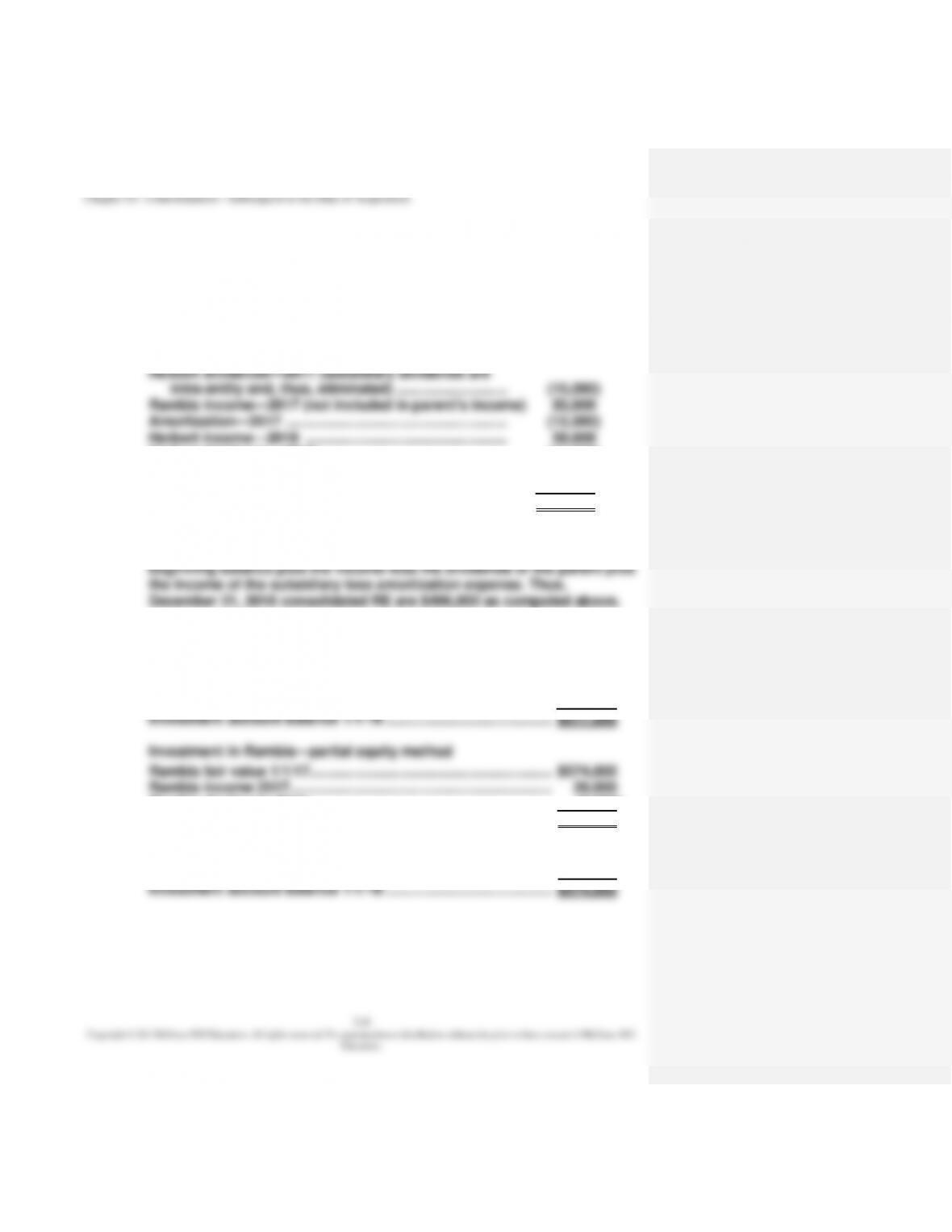
Net income before Sedona effect 148,000
11. A (same because Phoenix uses the equity method).
3-10
Education.
14. (continued)
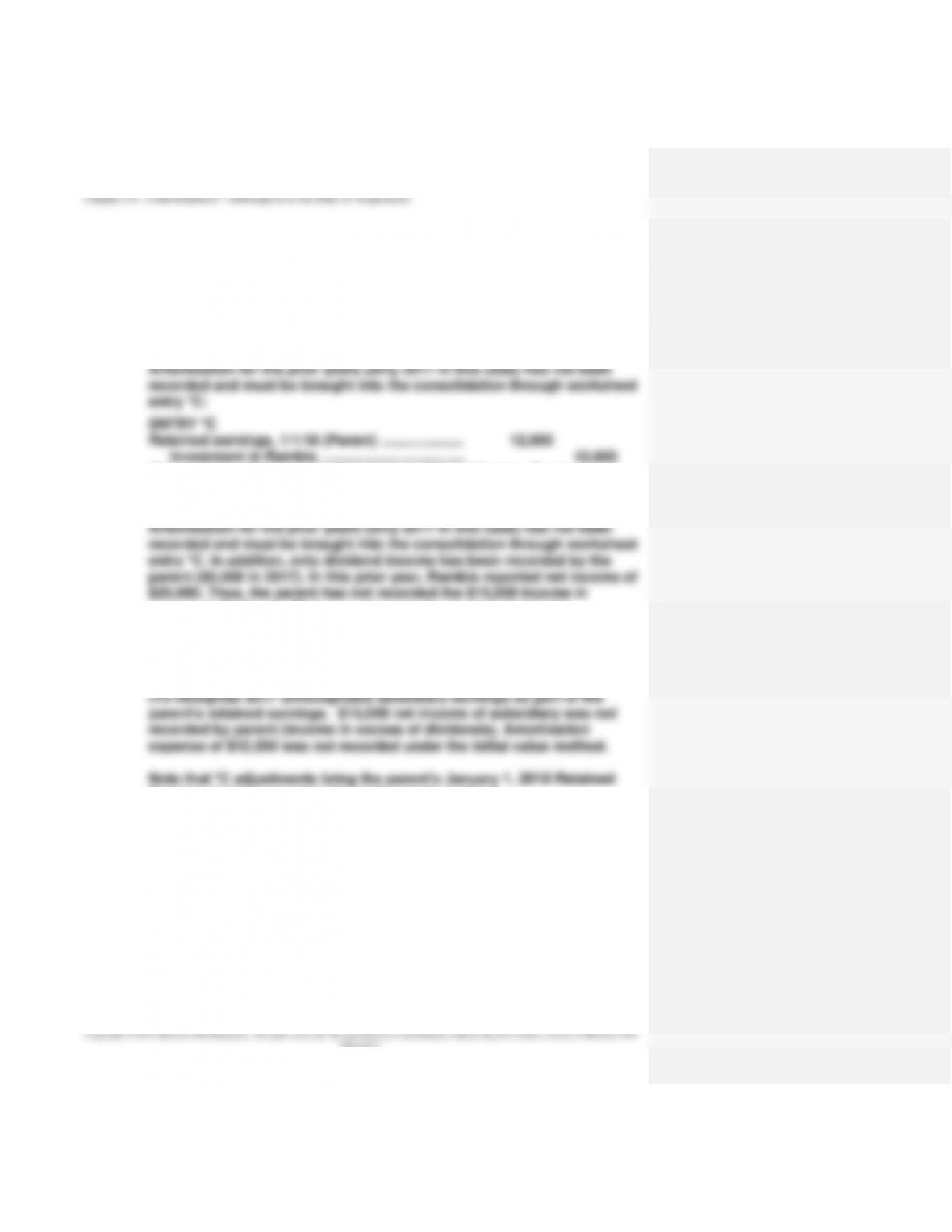
c. ENTRY *C
▪ EQUITY METHOD
No entry is needed to convert the past figures to the equity method
since that method has already been applied.
▪ PARTIAL EQUITY METHOD
(To recognize 2017 amortization in consolidated figures. Expense was
omitted because of application of partial equity method.)
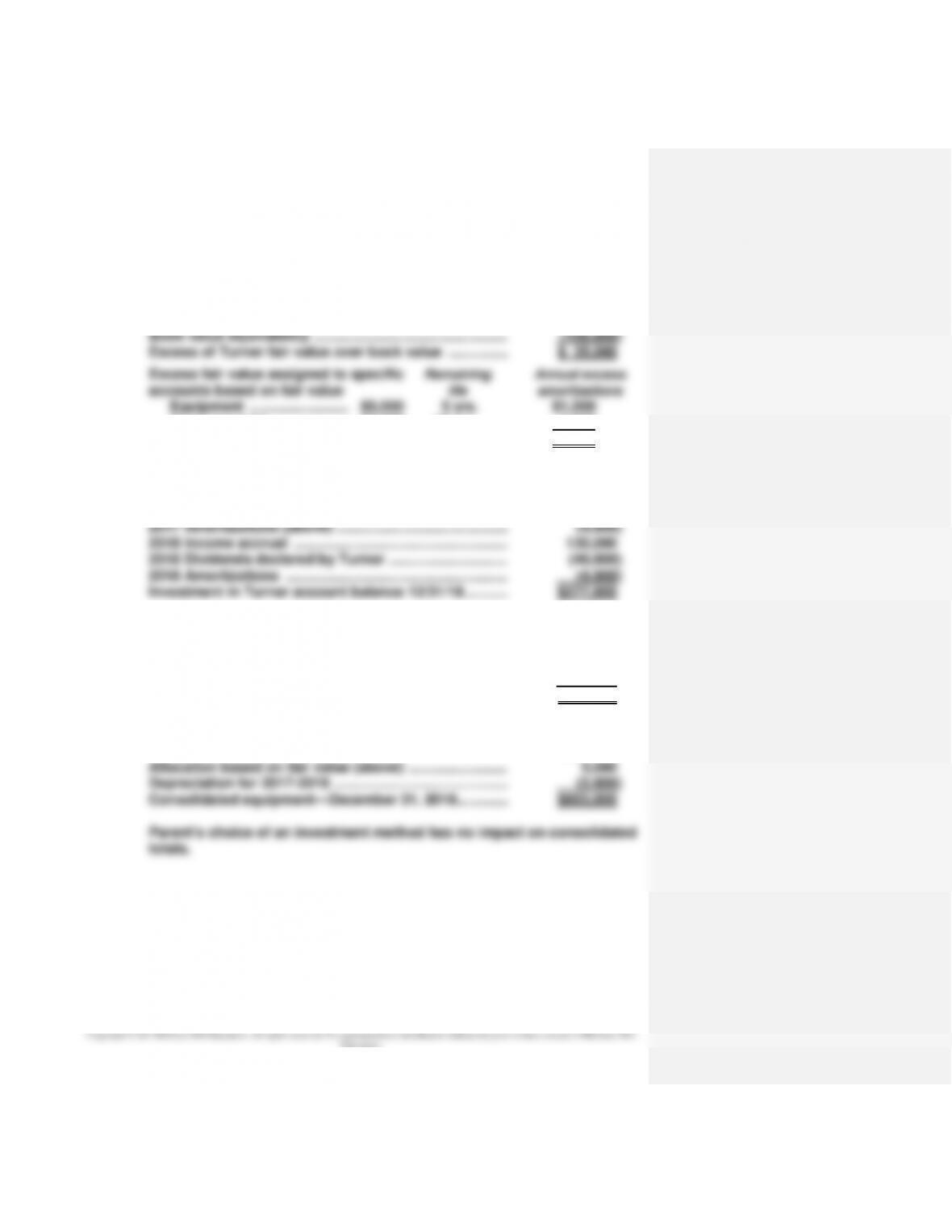
▪ INITIAL VALUE METHOD
excess of dividends. That amount must also be included in the
consolidation through entry *C:
ENTRY *C
Investment in Rambis …………………………..……… 3,000
Retained earnings, 1/1/18 (Parent) …………… 3,000
Earnings balance equal to that of the equity method.
Chapter 03 – Consolidations—Subsequent to the Date of Acquisition
3-11
Education.
15. (30 Minutes) (A variety of questions on equity method, initial value method,
and partial equity method.)
a. An allocation of the acquisition price (based on the fair value of the
shares issued) must be made first.
Acquisition fair value (consideration paid by Haynes) $135,000
Customer List …………………. 30,000 10 yrs. 3,000
$4,000
Acquisition-date fair value ……………………………………… $135,000
2017 Income accrual ……………………………………………… 110,000
2017 Dividends declared by Turner ………………………… (50,000)
b. Net income of Haynes …………………………..……………….. $240,000
Net Income of Turner …………………………..………………… 130,000
Depreciation expense …………………………..………………… (1,000)
Amortization expense …………………………..………………… (3,000)
Consolidated net income 2018 ………………………….. $366,000
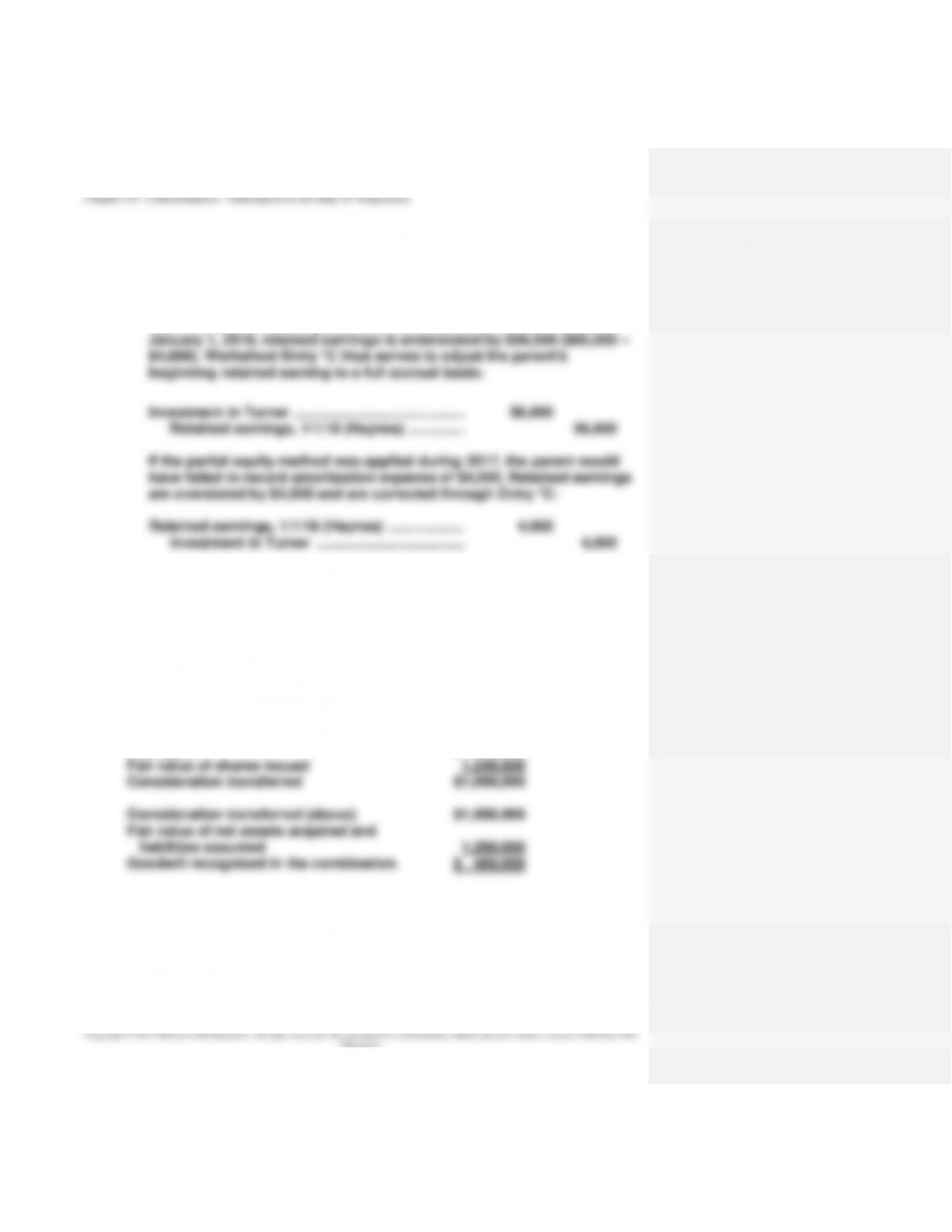
c. Equipment balance Haynes ……………………………………. $500,000
Equipment balance Turner …………………………..………… 300,000
3-12
Education.
15. (continued)
d. If the initial value method was applied during 2017, the parent would
have recorded dividend income of $50,000 rather than $110,000 (as
equity income). Income is, therefore, understated by $60,000. In
addition, amortization expense of $4,000 was not recorded. Thus, the
If the equity method had been applied, consolidated retained earnings
would equal the parent’s retained earnings. Thus, no adjustment would
be necessary.
16. (20 minutes) (Record a merger combination with subsequent testing for
goodwill impairment).
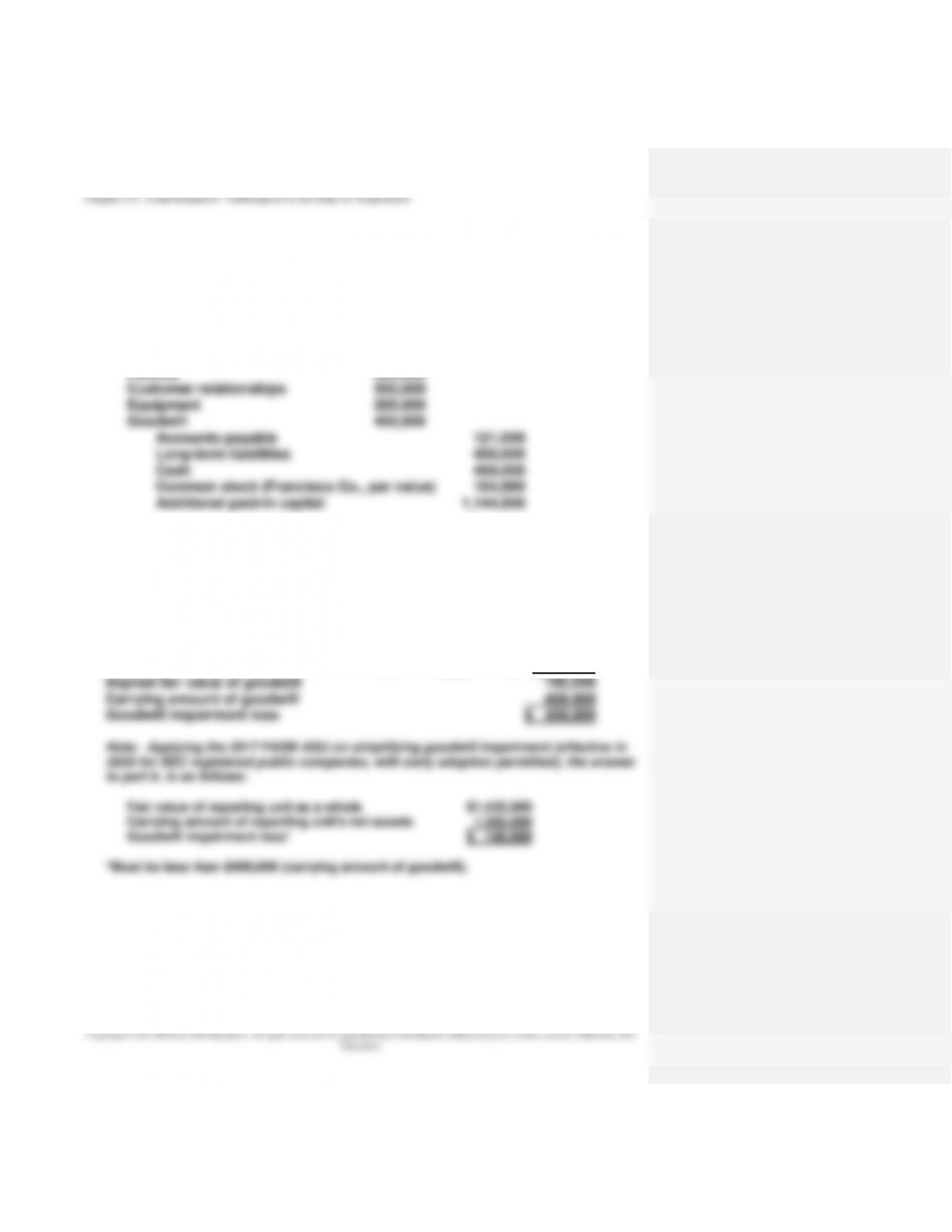
a. In accounting for the combination, the total fair value of Beltran (consideration
transferred) is allocated to each identifiable asset acquired and liability
assumed with any remaining excess as goodwill.
Cash paid $ 450,000
3-13
16. (continued):
Entry by Francisco to record assets acquired and liabilities assumed in the
combination with Beltran:
Cash 75,000
Receivables 193,000
Inventory 281,000
Patents 525,000
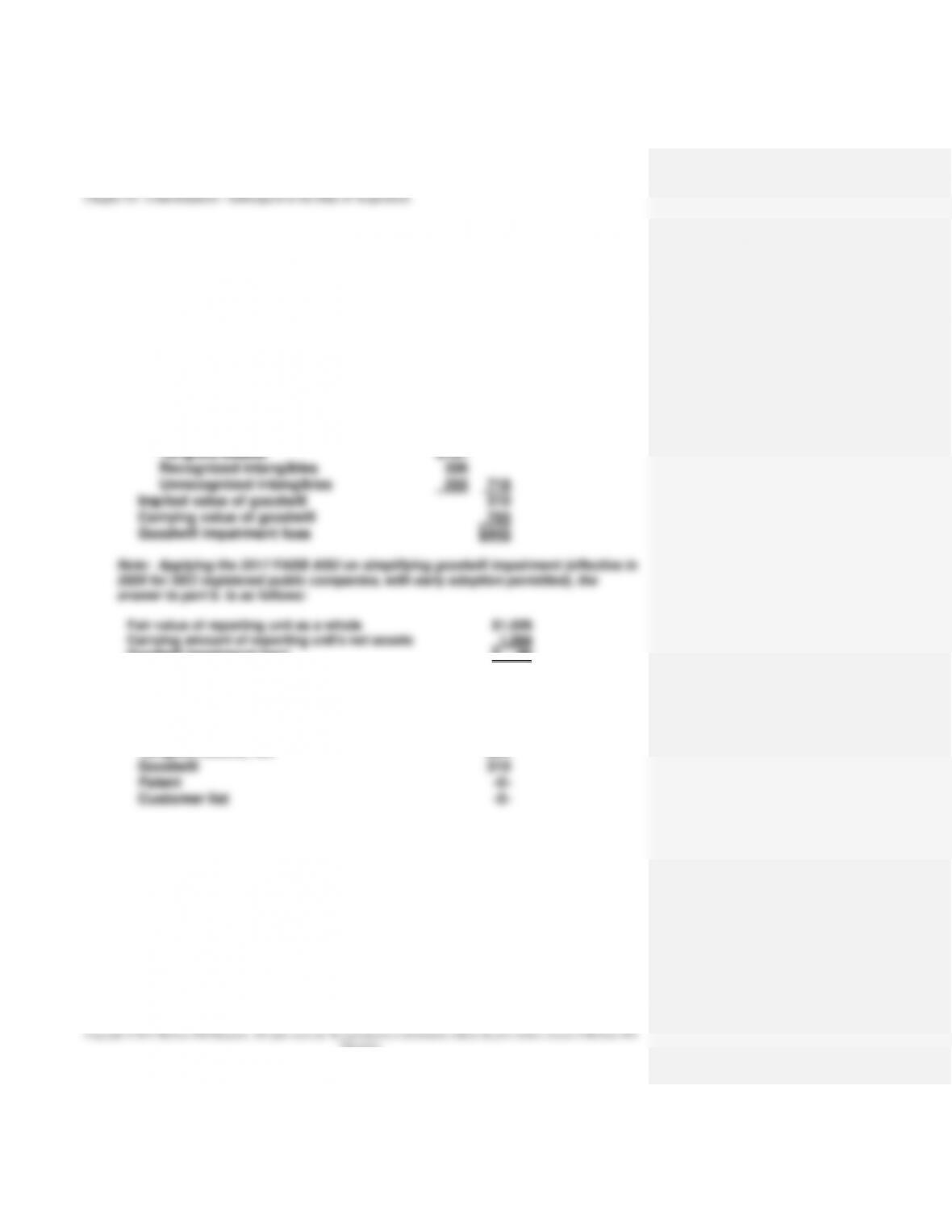
b. Step one in goodwill impairment test:
Fair value of reporting unit as a whole $1,425,000
Carrying amount of reporting unit’s net assets $1,585,000
Because the total fair value of the reporting unit is less than its carrying value,
a potential goodwill impairment loss exists, step two is performed:
Fair value of reporting unit as a whole $1,425,000
Fair values of reporting unit’s net assets (excluding goodwill) 1,325,000
3-14
Education.
17. (20 minutes) (Goodwill impairment testing.)
a. Goodwill Impairment
Step 1
Fair value of reporting unit = $1,028
Carrying amount of reporting unit = 1,094
Because fair value < carrying value, there is a potential goodwill impairment
loss.
Step 2
Fair value of reporting unit $1,028
Fair value of net assets excluding goodwill
Tangible assets $137
Goodwill impairment loss* $ 66
*Must be less than $755 (carrying amount of goodwill).
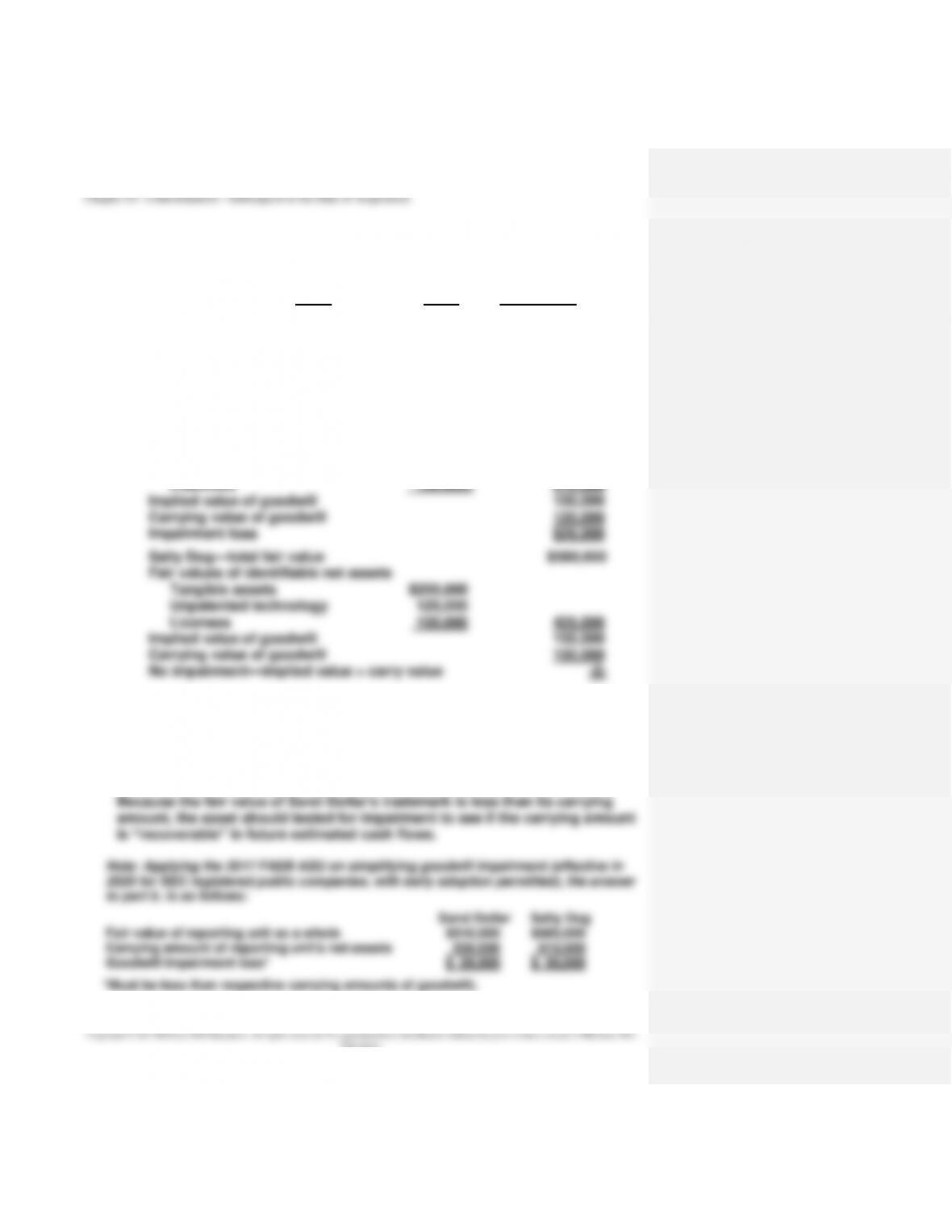
b.
Tangible assets, net $84
3-15
Education.
18. (30 minutes) (Goodwill impairment and intangible assets.)
Part a: Goodwill Impairment Test—Step 1
Total fair Carrying Potential goodwill
value value impairment?
Sand Dollar $510,000 < $530,000 yes
Salty Dog 580,000 < 610,000 yes
Baytowne 560,000 > 280,000 no
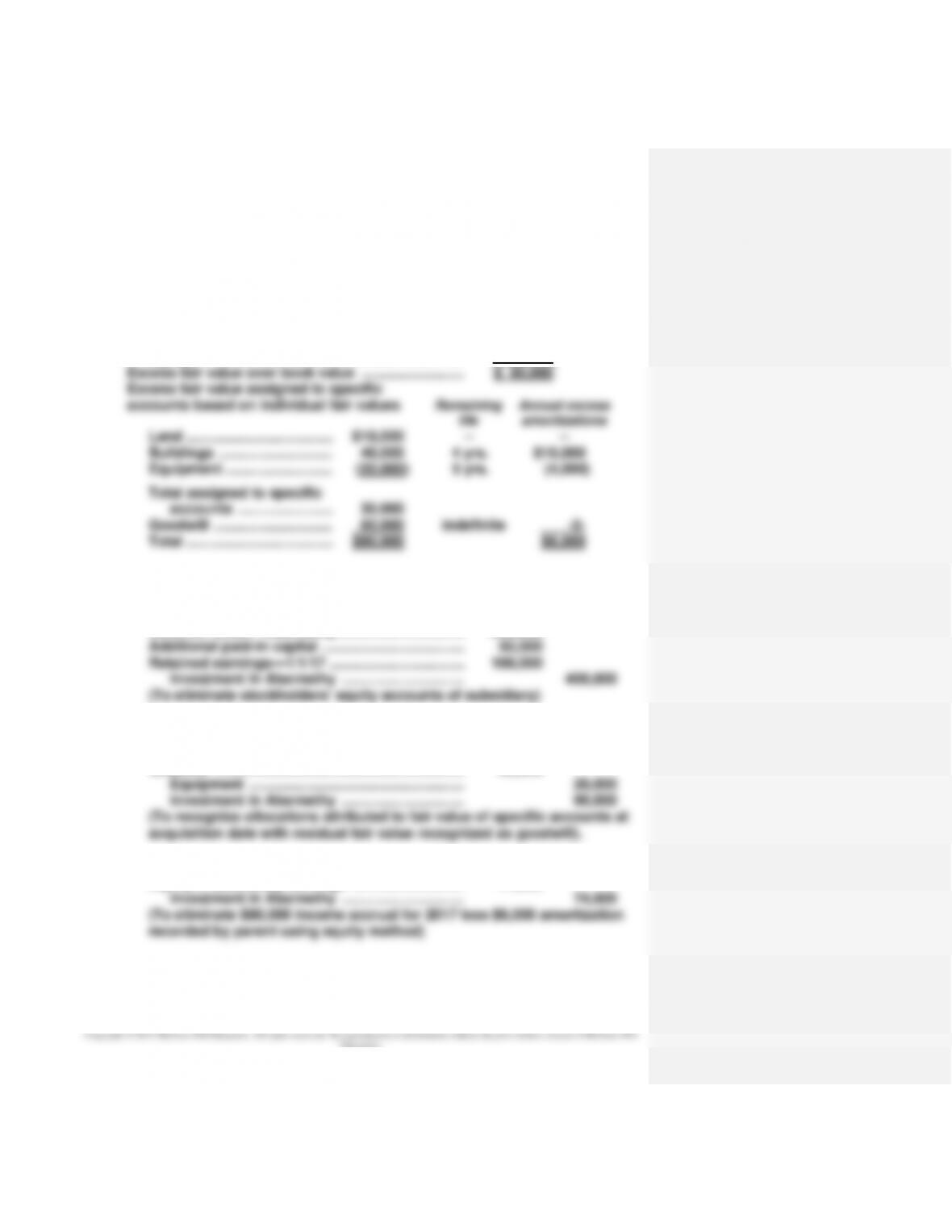
Goodwill Impairment Test—Step 2 (Sand Dollar and Salty Dog only)
Sand Dollar—total fair value $510,000
Fair values of identifiable net assets
Tangible assets $190,000
Trademark 150,000
Customer list 100,000
Part c:
No changes identifiable assets are reported based on goodwill impairment
testing. The sole purpose of the valuation exercise is to estimate an implied
value for goodwill. Destin will report a goodwill impairment loss of $20,000,
which will reduce the amount of goodwill allocated to Sand Dollar.
Chapter 03 – Consolidations—Subsequent to the Date of Acquisition
3-16
Education.
19. (30 Minutes) (Consolidation entries for two years. Parent uses equity
method.)
Fair Value Allocation and Annual Amortization:
Acquisition fair value (consideration transferred) . $490,000
Book value (assets minus
liabilities or total stockholders’
equity) …………………………..………………………….... (400,000)
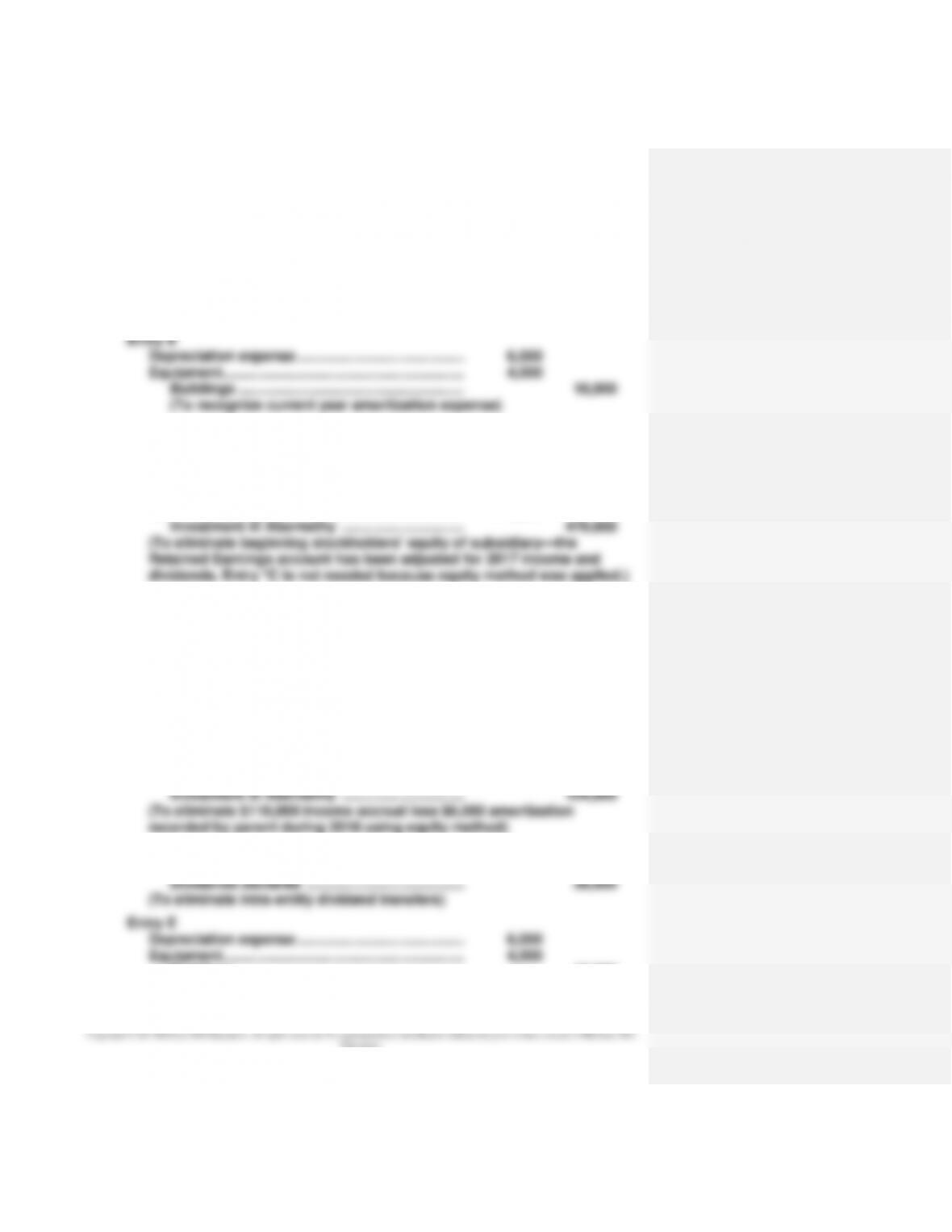
Consolidation Entries as of December 31, 2017
Entry S
Common stock—Abernethy ………………………….. 250,000
Entry A
Land ……………………………………………………….…… 10,000
Buildings …………………………..………………………… 40,000
Goodwill …………………………..…………………………. 60,000
Entry I
Equity in subsidiary earnings ………………………. 74,000
Chapter 03 – Consolidations—Subsequent to the Date of Acquisition
3-17
Education.
19. (continued)
Entry D
Investment in Abernethy ……………………………… 10,000
Dividends declared …………………………..…….. 10,000
(To eliminate intra-entity dividend transfers)
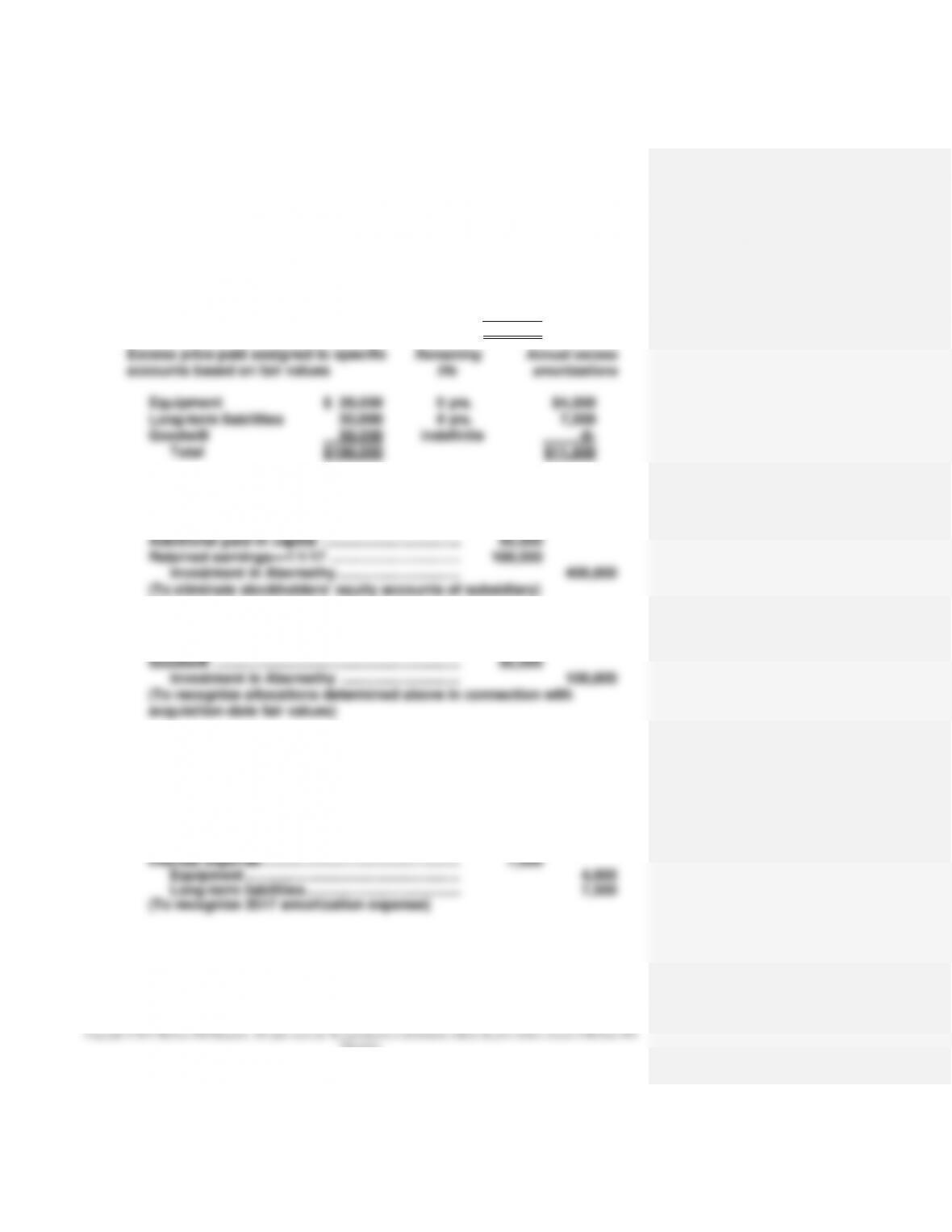
Consolidation Entries as of December 31, 2018
Entry S
Common stock—Abernethy …………………………. 250,000
Additional paid-in capital …………………………..…. 50,000
Retained earnings—1/1/18 …………………………..… 170,000
Entry A
Land ……………………………………………………….…… 10,000
Buildings …………………………..………………………… 30,000
Goodwill …………………………..…………………………. 60,000
Equipment …………………………..…………………. 16,000
Investment in Abernethy …………………………. 84,000
(To recognize allocations relating to investment—balances shown here
are as of beginning of current year [original allocation less excess
amortizations for the prior period])
Entry I
Equity in subsidiary earnings ………………………. 104,000
Entry D
Investment in Abernethy ……………………………… 30,000
Buildings ………………………………………………… 10,000
Chapter 03 – Consolidations—Subsequent to the Date of Acquisition
3-18
Education.
20. (35 Minutes) (Consolidation entries for two years. Parent uses initial value
method.)
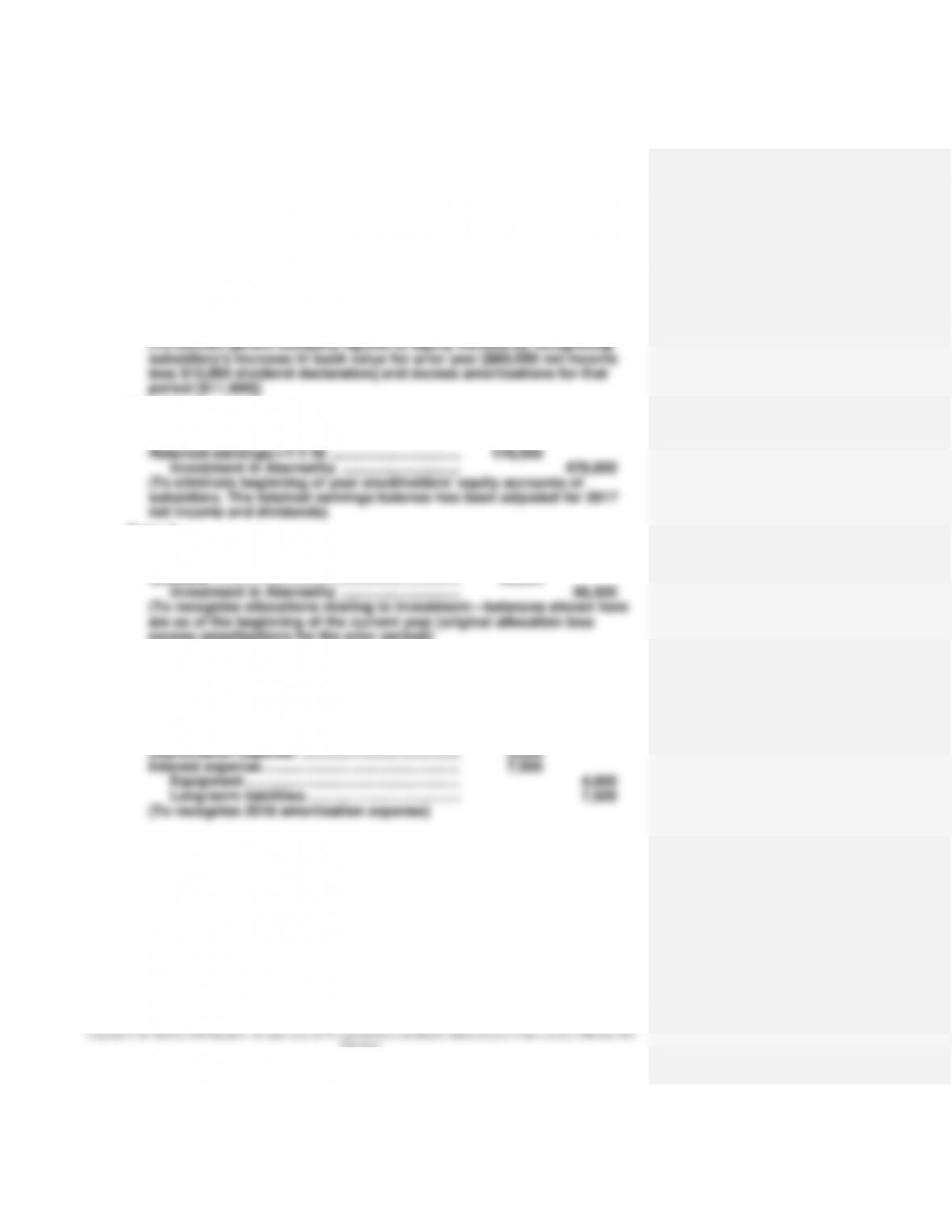
Acquisition-date allocation and annual excess fair value amortizations:
Acquisition date value (consideration paid) ….. $500,000
Book value …………………………..……………………… (400,000)
Excess price paid over book value ……………….. $100,000
Consolidation entries as of December 31, 2017
Entry S
Common stock—Abernethy ………………………… 250,000
Entry A
Equipment …………………………..……………………… 20,000
Long-term liabilities …………………………..……….. 30,000
Entry I
Dividend income ………………………………………… 10,000
Dividends declared …………………………..……. 10,000
(To eliminate intra-entity dividend declarations recorded by parent as
income)
Entry E
Depreciation expense …………………………..…….. 4,000
Chapter 03 – Consolidations—Subsequent to the Date of Acquisition
3-19
Education.
20. (continued)
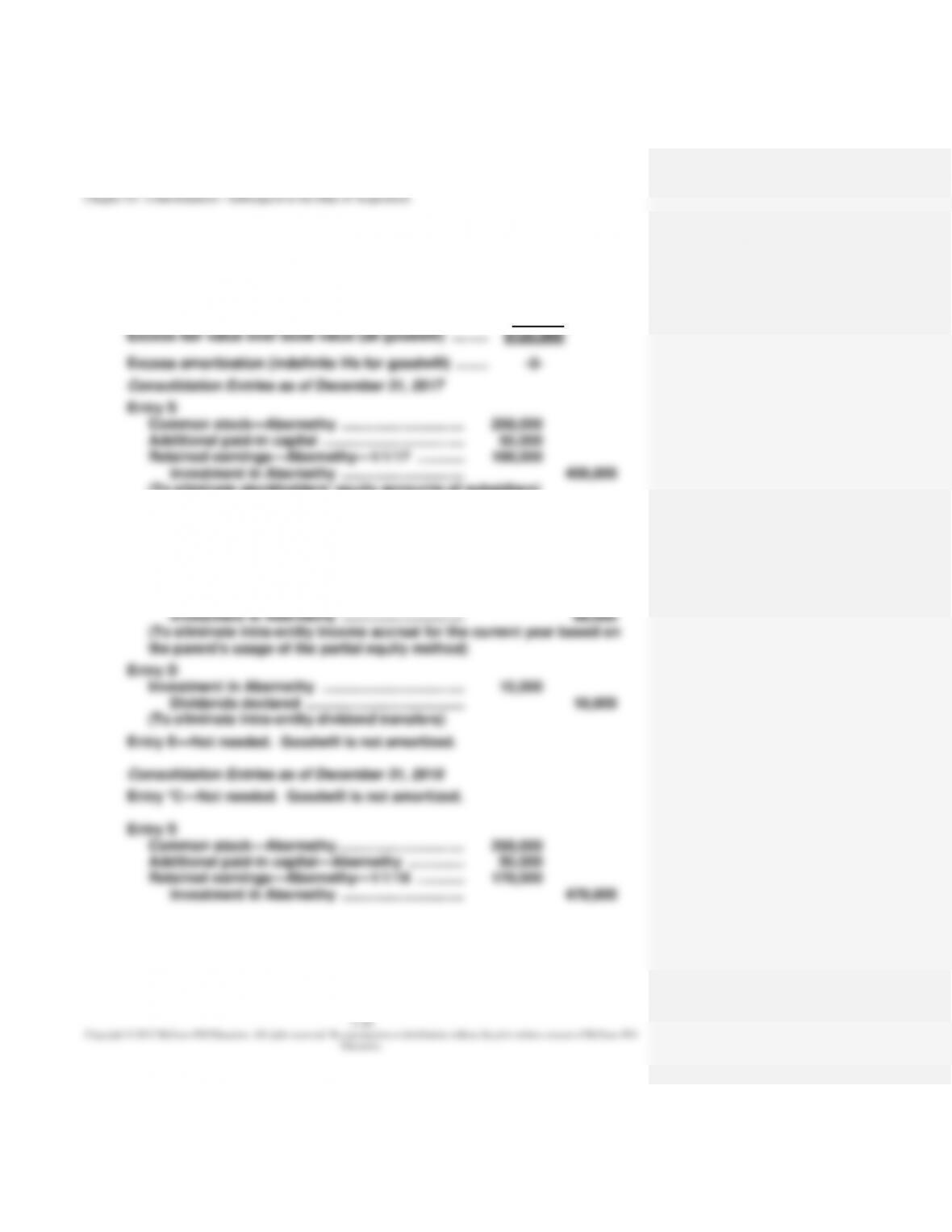
Consolidation Entries as of December 31, 2018
Entry *C
Investment in Abernethy …………………………….. 58,500
Retained earnings—1/1/18 (Chapman) …….. 58,500
Entry S
Common stock—Abernethy ………………………… 250,000
Additional paid-in capital …………………………..… 50,000
Entry A
Equipment …………………………..……………………… 16,000
Long-term liabilities …………………………..……….. 22,500
Goodwill …………………………..………………………… 50,000
excess amortizations for the prior period])
Entry I
Dividend income ………………………………………… 30,000
Dividends declared ………………………….... 30,000
(To eliminate intra-entity dividend declarations recorded by parent as
income)
Entry E
21. (20 Minutes) (Consolidation entries for two years. Parent uses partial equity
method.)
Fair value allocation and annual excess amortizations:
Abernethy fair value (consideration paid) ……………….. $520,000
Book value …………………………..……………………………….. (400,000)
(To eliminate stockholders’ equity accounts of subsidiary)
Entry A
Goodwill …………………………..…………………………. 120,000
Investment in Abernethy …………………………. 120,000
(To recognize goodwill portion of the original acquisition fair value)
Entry I
Equity in earnings of subsidiary ……………………. 80,000