Chapter 02 – Consolidation of Financial Information – Hoyle, Schaefer, Doupnik, 13e
2-16
29. (continued) Pratt Company and Subsidiary
Consolidated Balance Sheet
December 31, 2018
Assets Liabilities and Owners’ Equity
Cash $ 54,000 Accounts payable $ 113,000
Receivables 168,000 Notes payable 575,000
Inventory 230,000
30. (15 minutes) (Acquisition method entries for a merger)
Case 1: Fair value of consideration transferred $145,000
Fair value of net identifiable assets 120,000
Excess to goodwill $25,000
Case 1 journal entry on Allerton’s books:
Current Assets 60,000
Case 2: Bargain Purchase under acquisition method
Fair value of consideration transferred $110,000
Fair value of net identifiable assets 120,000
Gain on bargain purchase $ 10,000
Case 2 journal entry on Allerton’s books:
Current Assets 60,000
Chapter 02 – Consolidation of Financial Information – Hoyle, Schaefer, Doupnik, 13e
2-17
Education.
Problem 30. (continued)
In a bargain purchase, the acquisition method employs the fair value of the net
identifiable assets acquired as the basis for recording the acquisition. Because
31. (25 minutes) (Combination entries—acquired entity dissolved)
Cash consideration transferred $310,800
Contingent performance obligation 17,900
Consideration transferred (fair value) 328,700
Fair value of net identifiable assets 294,700
Goodwill $ 34,000
Journal entries:
Receivables 83,900
Chapter 02 – Consolidation of Financial Information – Hoyle, Schaefer, Doupnik, 13e
2-18
Education.
32. (30 Minutes) (Overview of the steps in applying the acquisition method when
shares have been issued to create a combination. Part h. includes a bargain
purchase.)
a. The fair value of the consideration includes
Fair value of stock issued $1,500,000
Contingent performance obligation 30,000
Fair value of consideration transferred $1,530,000
b. Stock issue costs reduce additional paid-in capital.
In-process research and development 300,000
Liabilities (400,000) 1,180,000
Goodwill $ 350,000
f. Revenues and expenses of the subsidiary from the period prior to the
combination are omitted from the consolidated totals. Only the operational
figures for the subsidiary after the purchase are applicable to the business
combination. The previous owners earned any previous profits.
g. The subsidiary’s Common Stock and Additional Paid-in Capital accounts
have no impact on the consolidated totals.
Chapter 02 – Consolidation of Financial Information – Hoyle, Schaefer, Doupnik, 13e
2-19
Education.
33. (50 Minutes) (Prepare balance sheet for a statutory merger using the
acquisition method. Also, use worksheet to derive consolidated totals.)
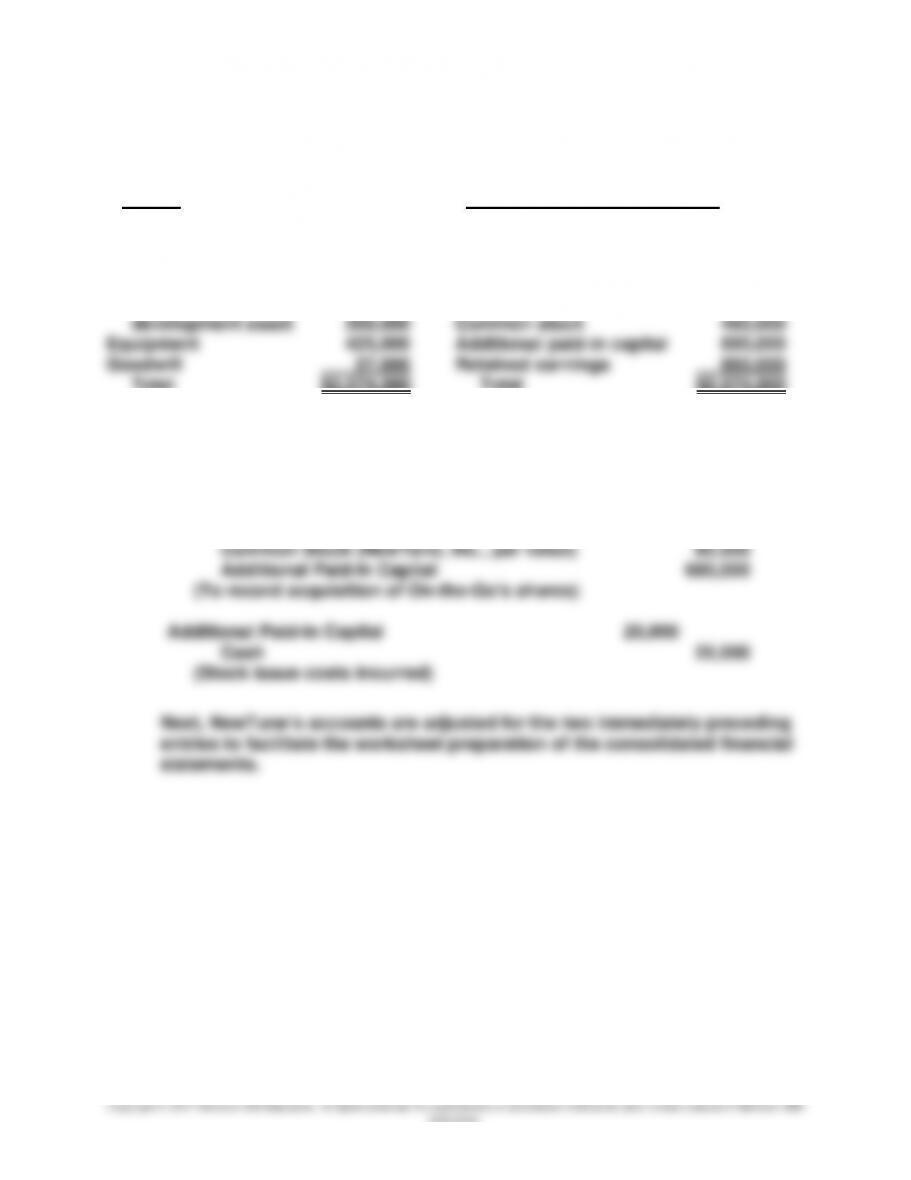
a. In accounting for the combination of NewTune and On-the-Go, the fair value of
the acquisition is allocated to each identifiable asset and liability acquired with
any remaining excess attributed to goodwill.
Fair value of consideration transferred (shares issued) $750,000
Fair value of net assets acquired:
Cash $ 29,000
Receivables 63,000
Trademarks 225,000
Chapter 02 – Consolidation of Financial Information – Hoyle, Schaefer, Doupnik, 13e
2-20
Education.
Problem 33 (continued):
Post-Combination Balance Sheet:
Assets Liabilities and Owners’ Equity
Cash $ 64,000 Accounts payable $ 144,000
Receivables 213,000 Notes payable 415,000
Trademarks 625,000
Record music catalog 1,020,000
Research and
Total $2,574,000 Total $2,574,000
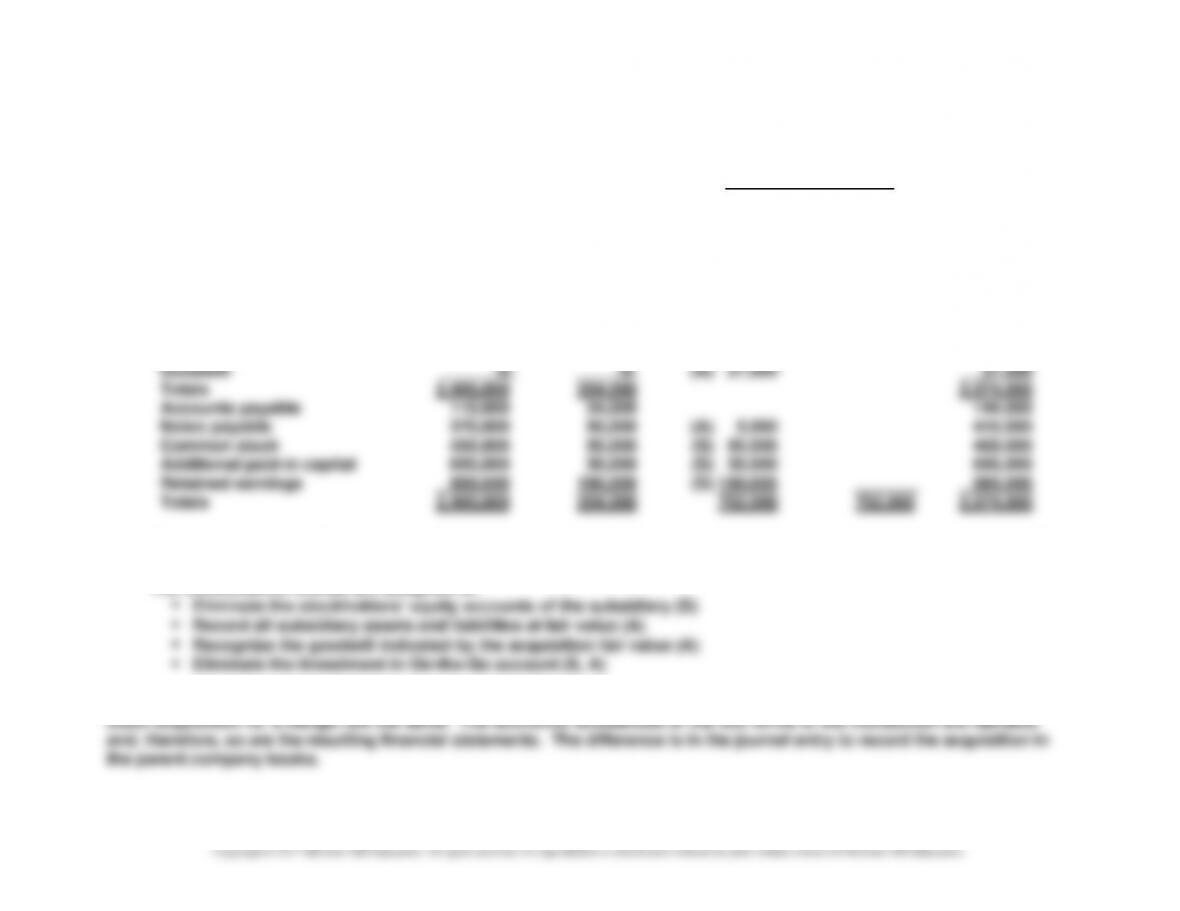
b. Because On-the-Go continues as a separate legal entity, NewTune first
records the acquisition as an investment in the shares of On-the-Go.
Journal entries:
Investment in On-the-Go 750,000
Chapter 02 – Consolidation of Financial Information – Hoyle, Schaefer, Doupnik, 13e
2-21
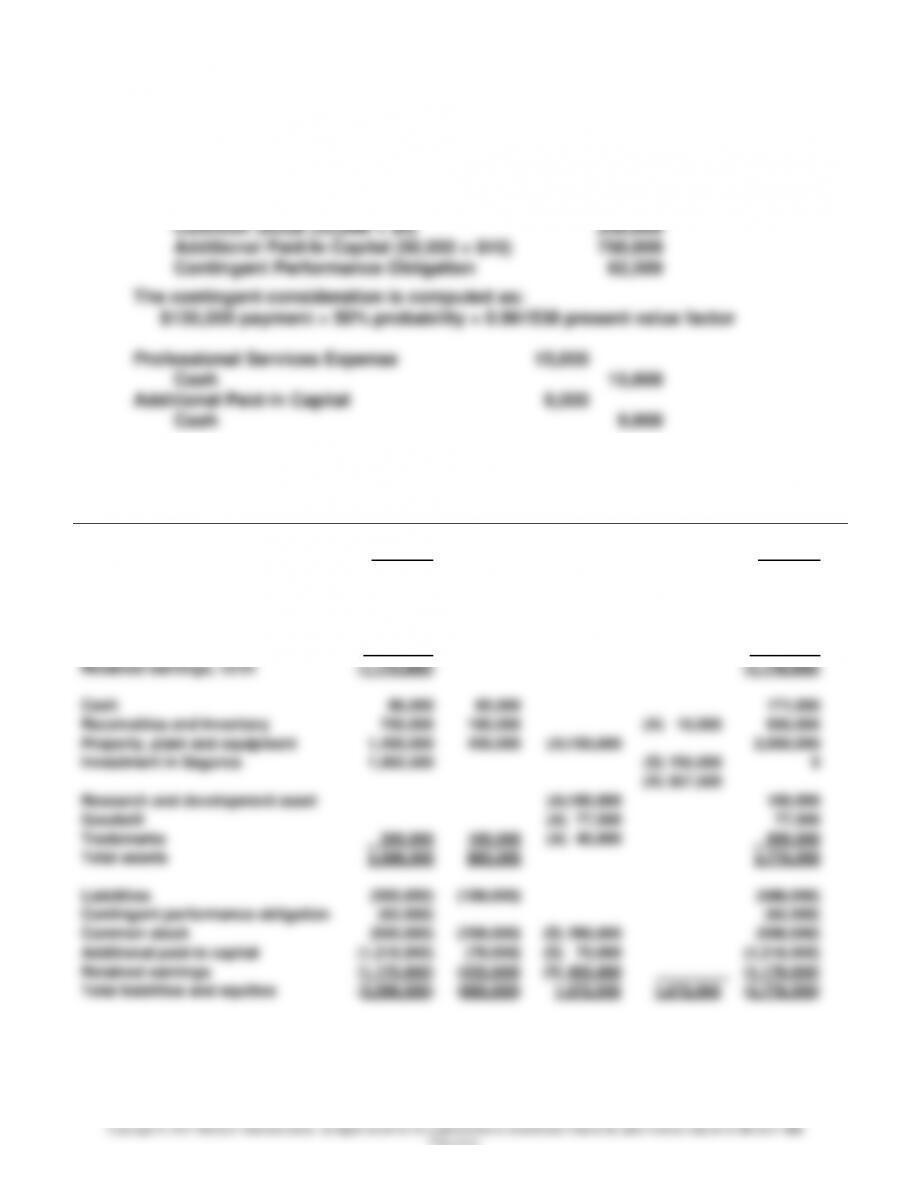
33. (continued) NEWTUNE, INC., AND ON-THE-GO CO.
b. Consolidation Worksheet
January 1, 2018
Consolidation Entries Consolidated
Accounts NewTune, Inc. On-the-Go Co. Debit Credit Totals
Cash 35,000 29,000 64,000
Receivables 150,000 65,000 (A) 2,000 213,000
Investment in On-the-Go 750,000 -0- (S) 270,000
(A) 480,000 -0-
Trademarks 400,000 95,000 (A) 130,000 625,000
Record music catalog 840,000 60,000 (A) 120,000 1,020,000
Research and development asset -0- -0- (A) 200,000 200,000
Equipment 320,000 105,000 425,000
Note: The accounts of NewTune have already been adjusted for the first three journal entries indicated in the answer to Part
b. to record the acquisition fair value and the stock issuance costs.
The consolidation entries are designed to:
c. The consolidated balance sheets in parts a. and b. above are identical. The financial reporting consequences for a 100%
Chapter 02 – Consolidation of Financial Information – Hoyle, Schaefer, Doupnik, 13e
2-22
Education.
34. (40 minutes) (Prepare a consolidated balance sheet using the acquisition
method).
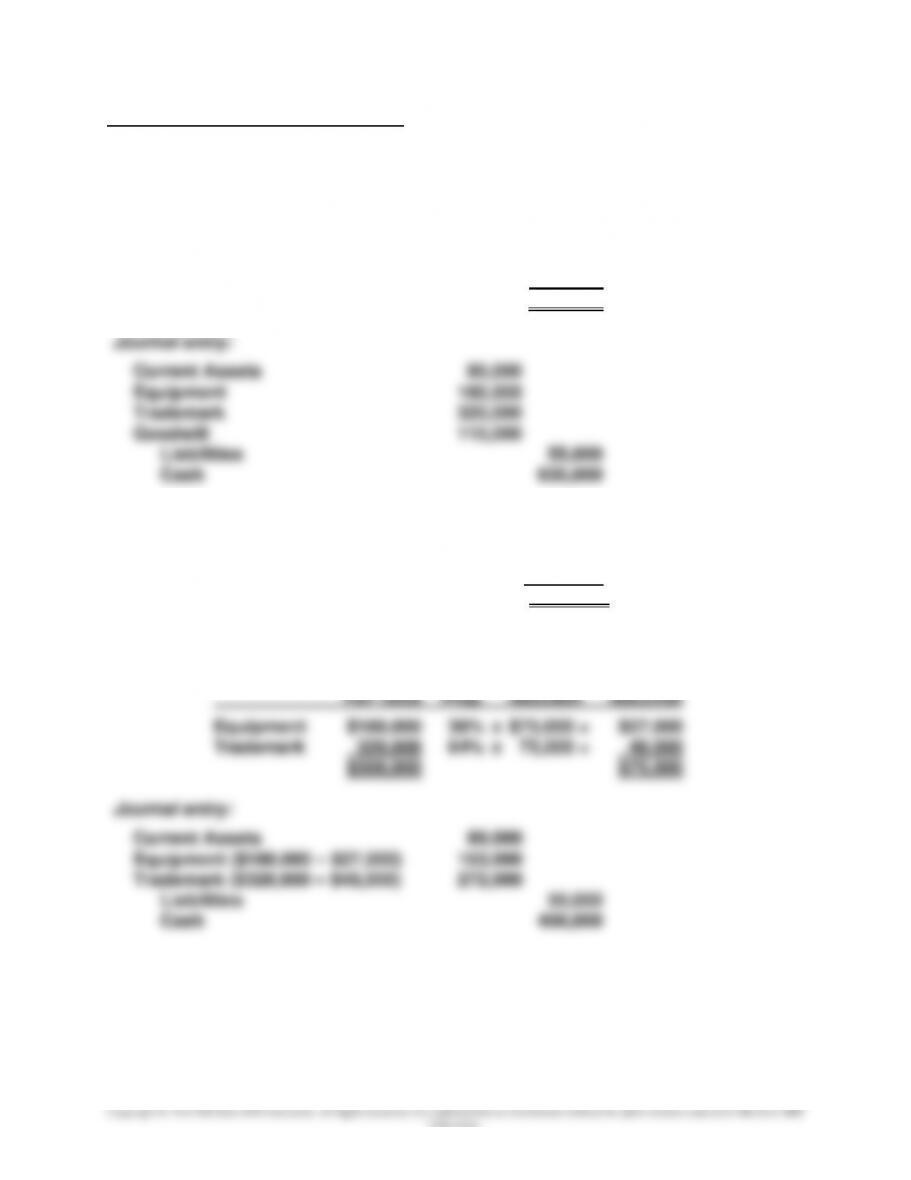
a. Journal entries to record the acquisition on Pacifica’s records.
Investment in Seguros 1,062,500
b. and c.
Pacifica
Seguros
Consolidation Entries
Consolidated
Balance
Sheet
Revenues
(1,200,000)
(1,200,000)
Expenses
890,000
890,000
Net income
(310,000)
(310,000)
Retained earnings, 1/1
(950,000)
(950,000)
Net income
(310,000)
(310,000)
Dividends declared
90,000
90,000
Retained earnings, 12/31
(1,170,000)
(1,170,000)
Cash
86,000
85,000
171,000
Receivables and inventory
750,000
190,000
(A) 10,000
930,000
Property, plant and equipment
1,400,000
450,000
(A)150,000
2,000,000
Investment in Seguros
1,062,500
(S) 705,000
0
(A) 357,500
Research and development asset
(A)100,000
100,000
Goodwill
(A) 77,500
77,500
Trademarks
300,000
160,000
(A) 40,000
500,000
Total assets
3,598,500
885,000
3,778,500
Liabilities
(500,000)
(180,000)
(680,000)
Contingent performance obligation
(62,500)
(62,500)
Common stock
(650,000)
(200,000)
(S) 200,000
(650,000)
Additional paid-in capital
(1,216,000)
(70,000)
(S) 70,000
(1,216,000)
Retained earnings
(1,170,000)
(435,000)
(S) 435,000
(1,170,000)
Total liabilities and equities
(3,598,500)
(885,000)
1,072,500
1,072,500
(3,778,500)
Chapter 02 – Consolidation of Financial Information – Hoyle, Schaefer, Doupnik, 13e
2-23
Education.
Answers to Appendix 2A Problems
35. (25 minutes) Journal entries for a merger using legacy purchase method.
Also compare to acquisition method.
a. Purchase Method
1. Purchase price (including acquisition costs) $635,000
Fair values of net assets acquired 525,000
Goodwill $110,000
2. Acquisition date fair values:
Purchase price (including acquisition costs) $450,000
Fair values of net assets acquired 525,000
Bargain purchase ($ 75,000)
Allocation of bargain purchase to long-term assets acquired:
Total Asset
Chapter 02 – Consolidation of Financial Information – Hoyle, Schaefer, Doupnik, 13e
2-24
Education.
35. continued
b. Acquisition Method
1. Consideration transferred $ 610,000
Fair values of net assets acquired 525,000
Goodwill $ 85,000
Journal entry:
Current Assets 80,000
2. Consideration transferred $425,000
Fair values of net assets acquired 525,000
Gain on bargain purchase ($100,000)
Journal entry:
Current Assets 80,000
2-25
Education.
36. (25 minutes) (Pooling vs. purchase involving an unrecorded intangible)
a. Purchase Pooling
Inventory $ 650,000 $ 600,000
Land 750,000 450,000
b. The purchase method excluded pre-acquisition revenues and expenses
from consolidated results, but the pooling method included them.
c. Poolings typically produced higher rates of return on assets than purchase
accounting because the denominator was often much lower. The Swimwear
acquisition pooling produced an increment to total assets of $1,950,000
Answers to Appendix 2B Problems
37. C
38. (12 minutes) (Pushdown Accounting Application)
Quigley Corporation
Balance Sheet
May 1
Cash $ 95,000
Receivables 200,000
Inventory 260,000
Land 110,000
Building and equipment (net) 330,000
Patented technology 220,000
Chapter 02 – Consolidation of Financial Information – Hoyle, Schaefer, Doupnik, 13e
2-26
Education.
Chapter 2 Develop Your Skills
CONSIDERATION OR COMPENSATION CASE (estimated time 50 minutes)
According to FASB ASC (805-10–55-25):
If it is not clear whether an arrangement for payments to employees or selling
shareholders is part of the exchange for the acquiree or is a transaction separate from
the business combination, the acquirer should consider the following indicators:
a. Continuing employment. The terms of continuing employment by the selling
shareholders who become key employees may be an indicator of the substance of
a contingent consideration arrangement. The relevant terms of continuing
employment may be included in an employment agreement, acquisition
agreement, or some other document. A contingent consideration arrangement in
which the payments are automatically forfeited if employment terminates is
shareholders who become employees is compensation.
e. Number of shares owned. The relative number of shares owned by the selling
shareholders who remain as key employees may be an indicator of the substance
of the contingent consideration arrangement. For example, if the selling
shareholders who owned substantially all of the shares in the acquiree continue
as key employees, that fact may indicate that the arrangement is, in substance, a
profit-sharing arrangement intended to provide compensation for
postcombination services. Alternatively, if selling shareholders who continue as
key employees owned only a small number of shares of the acquiree and all
selling shareholders receive the same amount of contingent consideration on a
per-share basis, that fact may indicate that the contingent payments are additional
consideration. The preacquisition ownership interests held by parties related to
selling shareholders who continue as key employees, such as family members,
also should be considered.
f. Linkage to the valuation. If the initial consideration transferred at the acquisition
arrangement is to provide compensation.
Chapter 02 – Consolidation of Financial Information – Hoyle, Schaefer, Doupnik, 13e
2-27
g. Formula for determining consideration. The formula used to determine the
contingent payment may be helpful in assessing the substance of the
arrangement. For example, if a contingent payment is determined on the basis of a
multiple of earnings, that might suggest that the obligation is contingent
consideration in the business combination and that the formula is intended to
establish or verify the fair value of the acquiree. In contrast, a contingent payment
that is a specified percentage of earnings might suggest that the obligation to
employees is a profit-sharing arrangement to compensate employees for services
rendered.
Suggested answer:
Note: This case was designed to have conflicting indicators across the various criteria
identified in the FASB ASC for determining the issue of compensation vs. consideration.
Thus, the solution is subject to alternative explanations and student can be encouraged
to use their own judgment and interpretations in supporting their answers.
In the author’s judgment, the $8 million contingent payment (fair value = $4 million) is
contingent consideration to be included in the overall fair value NaviNow records for its

Chapter 02 – Consolidation of Financial Information – Hoyle, Schaefer, Doupnik, 13e
Education.
ASC RESEARCH CASE—DEFENSIVE INTANGIBLE ASSET (45 MINUTES)
a. The ASC Glossary defines a defensive intangible asset as
“An acquired intangible asset in a situation in which an entity does not intend to actively
use the asset but intends to hold (lock up) the asset to prevent others from obtaining
access to the asset.”
ASC 820–10–35-10D also observes that
To protect its competitive position, or for other reasons, a reporting entity may intend not
According to ASC 350-30–25-5 a defensive intangible asset should be accounted for as a
separate unit of accounting (i.e., an asset separate from other assets of the acquirer). It
should not be included as part of the cost of an entity‘s existing intangible asset(s)
presumably because the defensive intangible asset is separately identifiable.
b. The identifiable assets acquired in a business combination should be measured at
their acquisition-date fair values (ASC 805–20–30–1).
c. A fair value measurement assumes the highest and best use of an asset by market
participants. Highest and best use is determined based on the use of the asset by market
participants, even if the intended use of the asset by the reporting entity is different (ASC
820-10–35-10). Importantly, highest and best use provides maximum value to market
participants. The highest and best use of the asset establishes the valuation premise used
to measure the fair value of the asset—in this case an in-exchange premise maximizes the
value of the asset at $2 million.
d. A defensive intangible asset shall be assigned a useful life that reflects the entity‘s
consumption of the expected benefits related to that asset. The benefit a reporting entity
fair value. The period over which a defensive intangible asset diminishes in fair value is a
proxy for the period over which the reporting entity expects a defensive intangible asset to
contribute directly or indirectly to the future cash flows of the entity. (ASC 350-30–35A)
It would be rare for a defensive intangible asset to have an indefinite life because the fair
value of the defensive intangible asset will generally diminish over time as a result of a
Chapter 02 – Consolidation of Financial Information – Hoyle, Schaefer, Doupnik, 13e
RESEARCH CASE—CELGENE’S ACQUISITION OF RECEPTOS
(40 Minutes)
1. From Celgene’s 2015 press release announcing the acquisition
The acquisition of Receptos significantly enhances Celgene’s
Inflammation & Immunology (I&I) portfolio, further diversifies the
2. Celgene accounted for its August 27, 2015 acquisition of Receptos using the
acquisition method. Accordingly, Celgene recorded the acquisition at $7.62 billion.
3. According to ASC 805-30–30–11
The portion of the fair-value-based measure of the replacement award
that is part of the consideration transferred in exchange for the acquiree
equals the portion of the acquiree award that is attributable to pre–
combination service.
4. From Celgene’s 12/31/15 10–K report (dollars in millions)
Cash consideration:
Cash $7,311.2
5. The fair value assigned to acquired IPR&D was based on the present value of
6. Acquired in-process research and development product rights are accounted for as
an intangible asset with an indefinite life.
Chapter 02 – Consolidation of Financial Information – Hoyle, Schaefer, Doupnik, 13e
RESEARCH CASE—ARCTIC CAT’S ACQUISITION OF MOTORFIST, LLC.
(30 minutes)
1. According to Arctic Cat’s 2015 10-K report
In February 2015, the Company acquired substantially all of the
2. Total consideration transferred $9,118,000
3. Consideration transferred $9,118,000
Accounts receivable $1,137,000
4. From Arctic Cat’s 2015 10–K report, “The acquisition cost included contingent
consideration consisting of up to five earnout payments, plus a catch-up payment, for
a total of up to $4.0 million.”