Chapter 02 – Consolidation of Financial Information – Hoyle, Schaefer, Doupnik, 13e
2-1
Education.
CHAPTER 2
CONSOLIDATION OF FINANCIAL INFORMATION
Accounting standards for business combination are found in FASB ASC Topic 805, “Business
Combinations” and Topic 810, “Consolidation.” These standards require the acquisition method
which emphasizes acquisition-date fair values for recording all combinations.
In this chapter, we first provide coverage of expansion through corporate takeovers and an
overview of the consolidation process. Then we present the acquisition method of accounting for
business combinations followed by limited coverage of the purchase method and pooling of
interests provided in the Appendix 2A and pushdown accounting in Appendix 2B.
Chapter Outline
I. Business combinations and the consolidation process
A. A business combination is the formation of a single economic entity, an event that
occurs whenever one company gains control over another
B. Business combinations can be created in several different ways
1. Statutory merger—only one of the original companies remains in business as a
legally incorporated enterprise.
2. Statutory consolidation—assets or capital stock of two or more companies are
transferred to a newly formed corporation
3. Acquisition by one company of a controlling interest in the voting stock of a
second. Dissolution does not take place; both parties retain their separate legal
1. If the acquired company is legally dissolved, a permanent consolidation is
2. If separate incorporation is maintained, consolidation is periodically simulated
whenever financial statements are to be prepared. This process is carried out
through the use of worksheets and consolidation entries. Consolidation worksheet
entries are used to adjust and eliminate subsidiary company accounts. Entry “S”
eliminates the equity accounts of the subsidiary. Entry “A” allocates exess
payment amounts to identifiable assets and liabilities based on the fair value of
the subsidiary accounts. (Consolidation journal entries are never recorded in the
books of either company, they are worksheet entries only.)
Chapter 02 – Consolidation of Financial Information – Hoyle, Schaefer, Doupnik, 13e
II. The Acquisition Method
A. The acquisition method replaced the purchase method. For combinations resulting in
complete ownership, it is distinguished by four characteristics.
1. All assets acquired and liabilities assumed in the combination are recognized and
measured at their individual fair values (with few exceptions).
2. The fair value of the consideration transferred provides a starting point for valuing
and recording a business combination.
3. Any excess of the fair value of the consideration transferred over the net amount
4. Any excess of the net amount assigned to the individual assets acquired and
liabilities assumed over the fair value of the consideration transferred is
recognized by the acquirer as a “gain on bargain purchase.”
B. In-process research and development acquired in a business combination is
recognized as an asset at its acquisition-date fair value.
III. Convergence between U.S. GAAP and IAS IFRS 3 – nearly identical to U.S. GAAP
because of joint efforts
APPENDIX 2A:
I. The Purchase Method
A. The purchase method was applicable for business combinations occurring for fiscal
years beginning prior to December 15, 2008. It was distinguished by three
characteristics.
1. One company was clearly in a dominant role as the purchasing party
2. A bargained exchange transaction took place to obtain control over the second
company.
3. A historical cost figure was determined based on the acquisition price paid.
a. The cost of the acquisition included any direct combination costs.
1. The assets and liabilities acquired were measured by the buyer at fair value as of
the date of acquisition.
2. Any portion of the payment made in excess of the fair value of these assets and
liabilities was attributed to an intangible asset commonly referred to as goodwill.
3. If the price paid was below the fair value of the assets and liabilities, the acquired
company accounts were still measured at fair value except that certain noncurrent
asset values were reduced by the excess cost. If these values were not great
Chapter 02 – Consolidation of Financial Information – Hoyle, Schaefer, Doupnik, 13e
2-3
Education.
II. The Pooling of Interest Method (prohibited for combinations after June 2002)
A. A pooling of interests reflected united ownership of two companies through the
exchange of equity securities. The characteristics of a pooling are fundamentally
different from either the purchase or acquisition methods.
1. Neither party was truly viewed as an acquiring company.
2. Precise cost figures from the exchange of securities were difficult to ascertain.
3. The transaction affected the stockholders rather than the companies.
B. Pooling of interests accounting
1. Because of the nature of a pooling, an acquisition price was not relevant.
a. Since no acquisition price was computed, all direct costs of creating the
2. The book values of the two companies were simply brought together to produce
3. The results of operations reported by both parties were combined on a retroactive
basis as if the companies had always been together.
4. Controversy historically surrounded the pooling of interests method.
a. Cost figures indicated by the exchange transaction were ignored.
b. Income balances previously reported were combined on a retrospective basis.
c. Reported net income was usually higher in subsequent years than in a
purchase because the lack of valuation adjustments reduced amortization.
APPENDIX 2B: Pushdown Accounting
I. Pushdown accounting is the application of the parent’s acquisition-date valuations for the
subsidiary’s standalone financial statements. A newly acquired entity may elect the option to
apply pushdown accounting in the reporting period immediately following the acquisition. The
rationale is that the acquisition-date fair values for the subsidiary’s assets and liabilities are
more representationally faithful and relevant to users of the subsidiary’s financial statements.
II. When push-down accounting is elected,
A. The subsidiary revalues its assets and liabilities based on the acquisition-date fair value
allocations. The subsidiary then recognizes periodic amortization expense on those
allocations with definite lives. Therefore, the subsidiary’s recorded income equals its
impact on consolidated earnings (except in the presence of a bargain purchase gain).
B. Any goodwill from the combination is reported in the acquired entity’s separate financial
statements. In the case of a bargain purchase gain, pushdown accounting recognize an
adjustment to its additional paid-in capital, not as a gain in its income statement.
C. the subsidiary’s retained earnings are revalued to zero recognizing the new reporting
entity as of the parent’s acquisition date.
III. The parent uses no special procedures when push-down accounting is being applied.
However, if the equity method is in use, amortization need not be recognized by the parent
since that expense is included in the figure reported by the subsidiary.
Chapter 02 – Consolidation of Financial Information – Hoyle, Schaefer, Doupnik, 13e
2-4
Answers to Questions
1. A business combination is the process of forming a single economic entity by the uniting
2. (1) A statutory merger is created whenever two or more companies come together to
form a business combination and only one remains in existence as an identifiable entity.
This arrangement is often instituted by the acquisition of substantially all of an
3. Consolidated financial statements represent accounting information gathered from two or
4. Companies that form a business combination will often retain their separate legal
identities as well as their individual accounting systems. In such cases, internal financial
data continues to be accumulated by each organization. Separate financial reports may
5. Several situations can occur in which the fair value of the 50,000 shares being issued
might be difficult to ascertain. These examples include:
▪ The shares may be newly issued (if Jones has just been created) so that no accurate
value has yet been established;
6. For combinations resulting in complete ownership, the acquisition method allocates the
7. The revenues and expenses (both current and past) of the parent are included within
reported figures. However, the revenues and expenses of the subsidiary are
2-5
Education.
8. Morgan’s additional acquisition value may be attributed to many factors: expected
synergies between Morgan’s and Jennings’ assets, favorable earnings projections,
9. In the vast majority of cases the assets acquired and liabilities assumed in a business
combination are recorded at their fair values. If the fair value of the consideration
10. Shares issued are recorded at fair value as if the stock had been sold and the money
11. The direct combination costs of $98,000 are allocated to expense in the period in which
they occur. Stock issue costs of $56,000 are treated as a reduction of APIC.
Chapter 02 – Consolidation of Financial Information – Hoyle, Schaefer, Doupnik, 13e
Answers to Problems
1. D
2. B
11. B Consideration transferred (fair value) $800,000
Cash $150,000
Goodwill $120,000
12. C Legal and accounting fees accounts payable $15,000
Contingent liabilility 20,000
Donovan’s liabilities assumed 60,000
Liabilities assumed or incurred $95,000
13. D Consideration transferred (fair value) $420,000
Current assets $90,000
Building and equipment 250,000
Unpatented technology 25,000
Chapter 02 – Consolidation of Financial Information – Hoyle, Schaefer, Doupnik, 13e
2-7
14. C Value of shares issued (51,000 × $3) ……………………………….. $153,000
Par value of shares issued (51,000 × $1) ………………………….. 51,000
15. B Consideration transferred (fair value) …………………….. $400,000
Book value of subsidiary (assets minus liabilities) …. (300,000)
Fair value in excess of book value ……………………… 100,000
16. D TruData patented technology …………………………………. $230,000
17. C TruData common stock before acquisition ……………… $300,000
18. B TruData’s 1/1 retained earnings ……………………………… $130,000
19. C Patrick’s assets $1,395,000
Less: investment in Sean ………………………………………. (460,000)
Sean’s assets ……………………………………………………….. 415,000
20. B Patrick’s stockholders’ equity total.
Chapter 02 – Consolidation of Financial Information – Hoyle, Schaefer, Doupnik, 13e
2-9
Education.
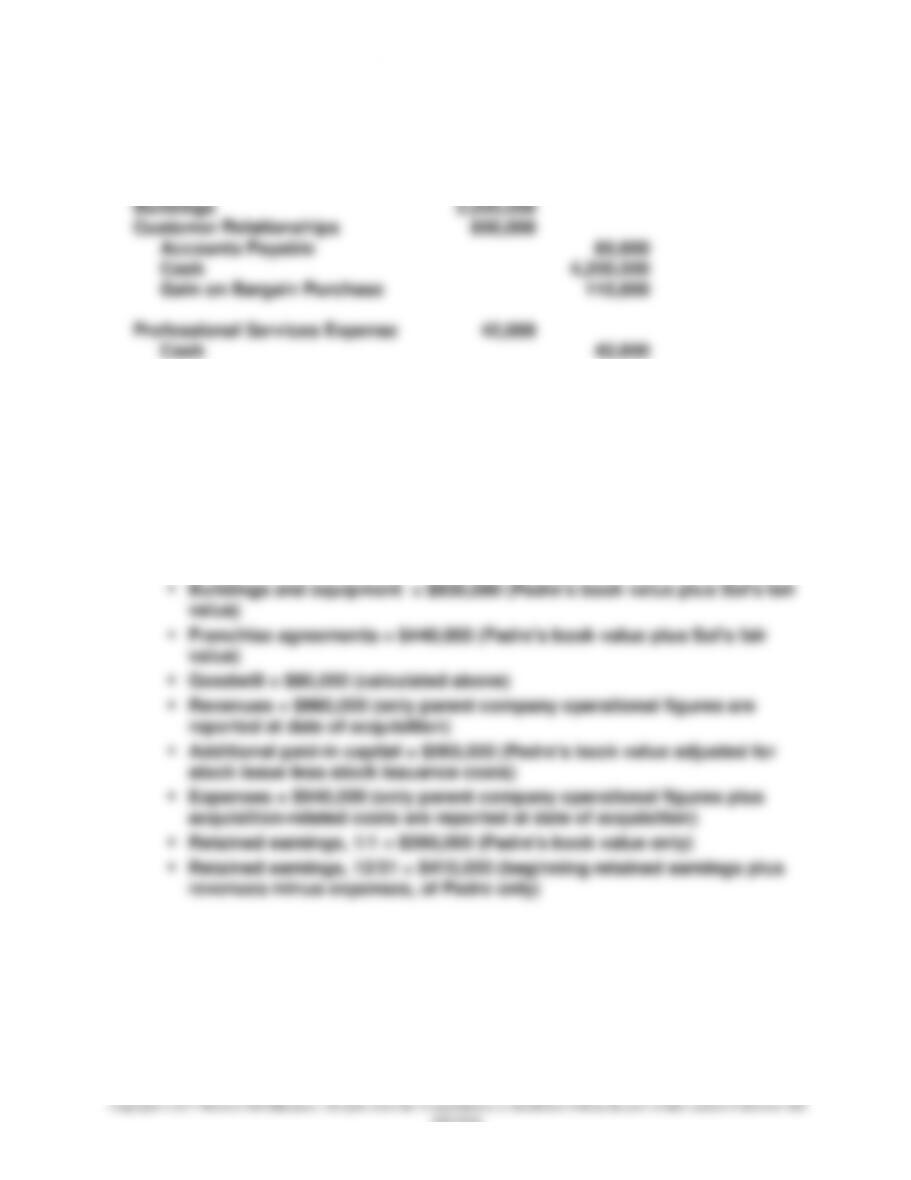
23. (12 minutes) (Journal entries to record a bargain purchase—acquired company
dissolved)
Inventory 600,000
Land 990,000
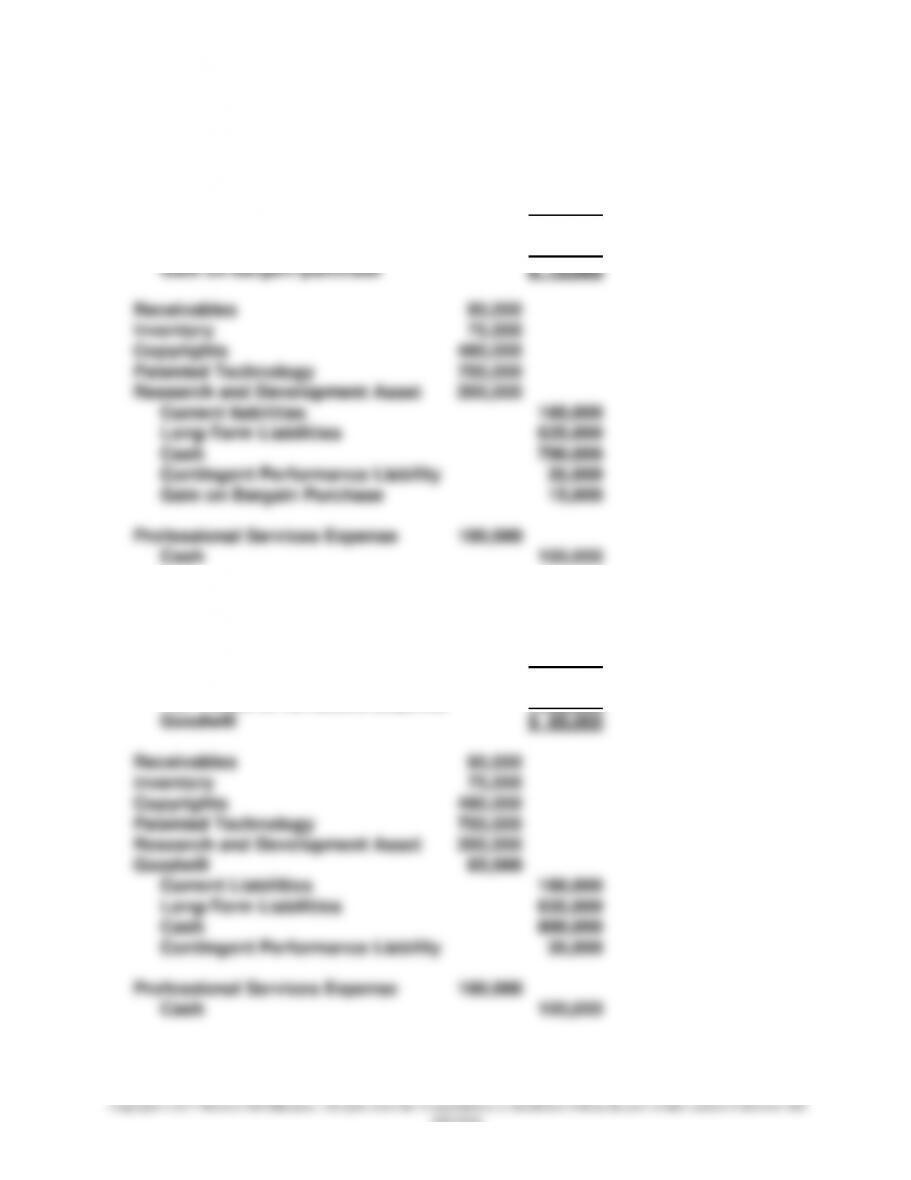
24. (15 Minutes) (Consolidated balances)
In acquisitions, the fair values of the subsidiary‘s assets and liabilities are
consolidated (there are a limited number of exceptions). Goodwill is reported
at $80,000, the amount that the $760,000 consideration transferred exceeds the
$680,000 fair value of Sol’s net assets acquired.
▪ Inventory = $670,000 (Padre’s book value plus Sol’s fair value)
▪ Land = $710,000 (Padre’s book value plus Sol’s fair value)
Chapter 02 – Consolidation of Financial Information – Hoyle, Schaefer, Doupnik, 13e
2-10
Education.
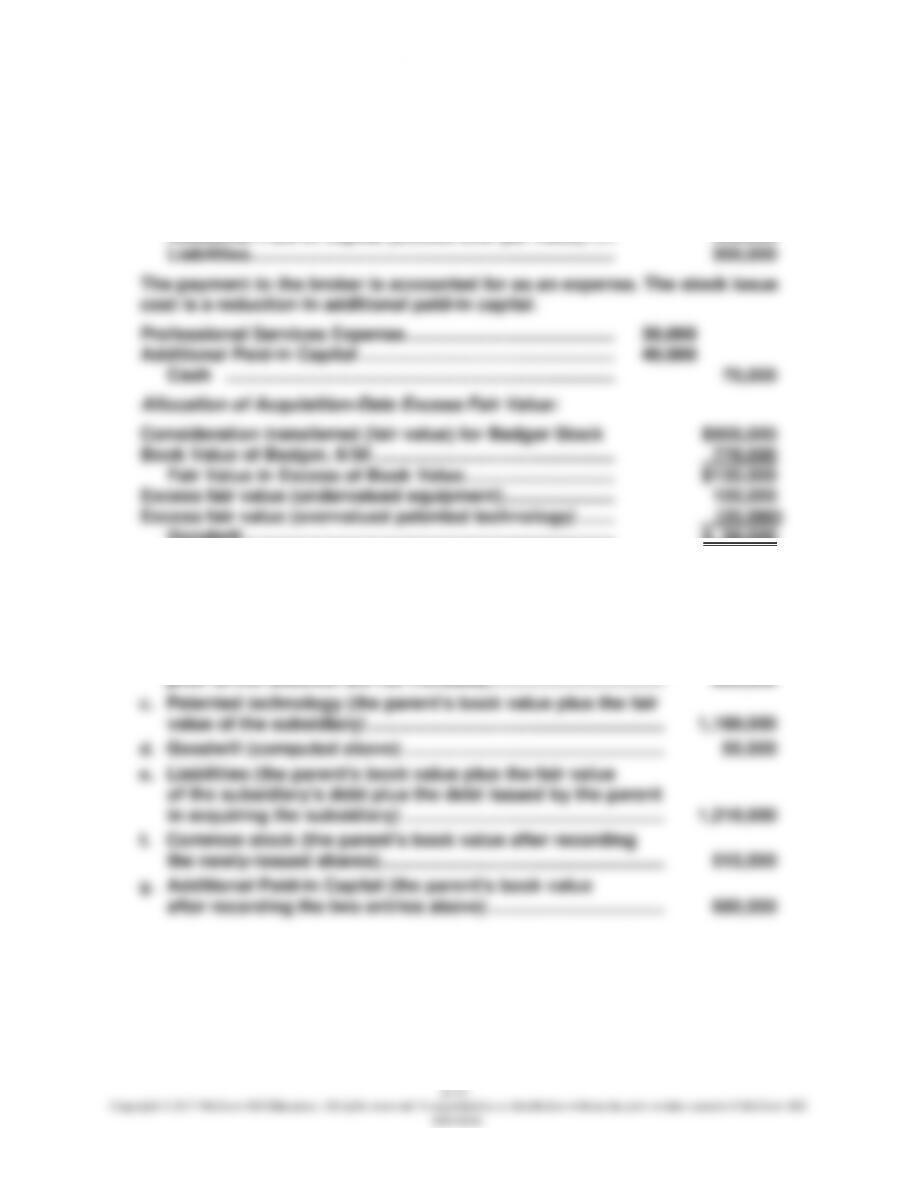
25. (20 minutes) Journal entries for a merger using alternative values.
a. Acquisition date fair values:
Cash paid $700,000
Contingent performance liability 35,000
Consideration transferred $735,000
Fair values of net assets acquired 750,000
b. Acquisition date fair values:
Cash paid $800,000
Contingent performance liability 35,000
Consieration transferred $835,000
Fair values of net assets acquired 750,000
Chapter 02 – Consolidation of Financial Information – Hoyle, Schaefer, Doupnik, 13e
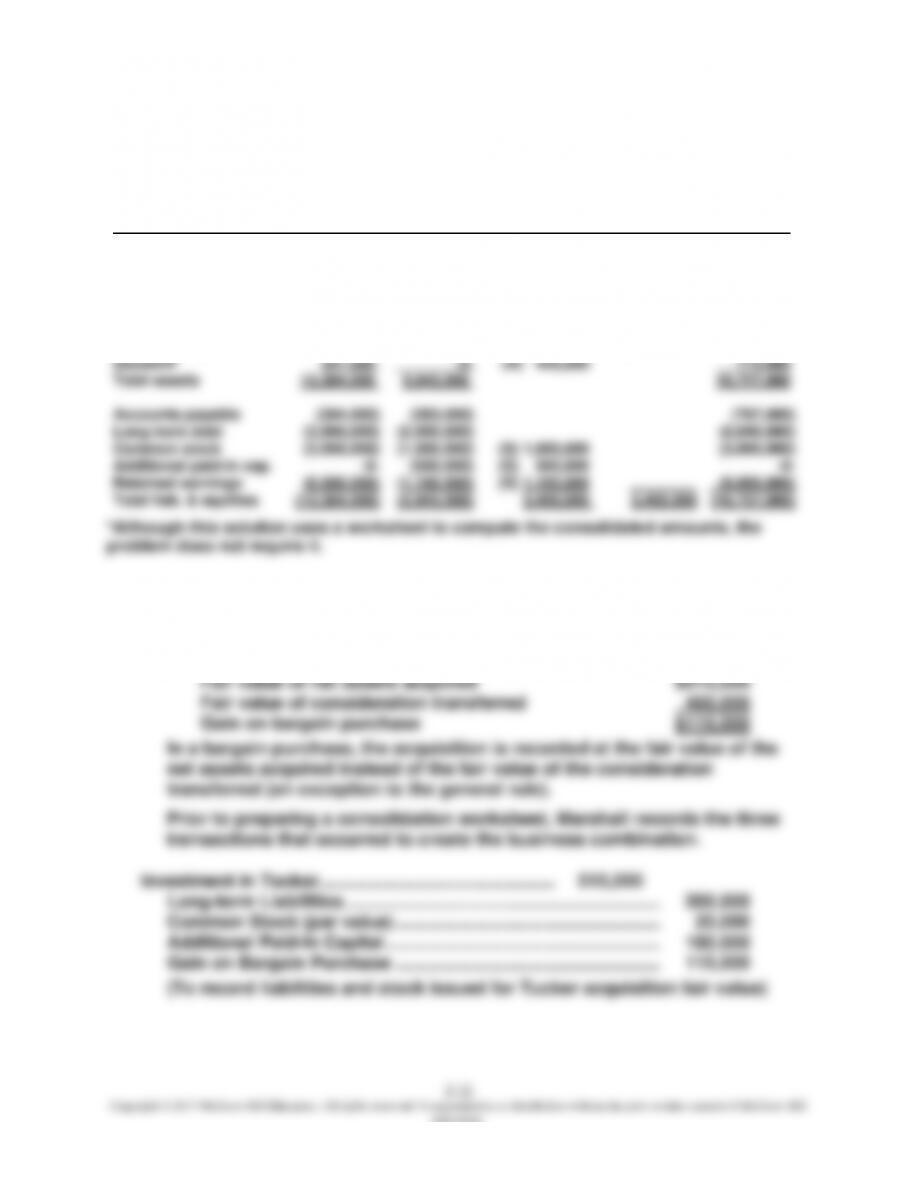
26. (20 Minutes) (Determine selected consolidated balances)
Under the acquisition method, the shares issued by Wisconsin are recorded at
fair value using the following journal entry:
Investment in Badger (value of debt and shares issued). 900,000
Common Stock (par value) …………………………………….. 150,000
Additional Paid-In Capital (excess over par value) ….. 450,000
Goodwill ……………………………………………………………….. $ 50,000
CONSOLIDATED BALANCES:
a. Net income (adjusted for professional services expense. The
figures earned by the subsidiary prior to the takeover
are not included) ……………………………………………………….…… $ 210,000
b. Retained earnings, 1/1 (the figures earned by the subsidiary
prior to the takeover are not included) …………………………….. 800,000
Chapter 02 – Consolidation of Financial Information – Hoyle, Schaefer, Doupnik, 13e
Education.
27. (20 minutes) (Preparation of a consolidated balance sheet)*
CASEY CORPORATION AND CONSOLIDATED SUBSIDIARY KENNEDY
Worksheet for a Consolidated Balance Sheet
January 1, 2018
Casey Kennedy Adjust. & Elim. Consolidated
Cash 457,000 172,500 629,500
Accounts receivable 1,655,000 347,000 2,002,000
Inventory 1,310,000 263,500 1,573,500
Investment in Kennedy 3,300,000 -0- (S) 2,600,000
(A) 700,000 -0-
Buildings (net) 6,315,000 2,090,000 (A) 382,000 8,787,000
Licensing agreements -0- 3,070,000 (A) 108,000 2,962,000
28. (50 Minutes) (Determine consolidated balances for a bargain purchase.)
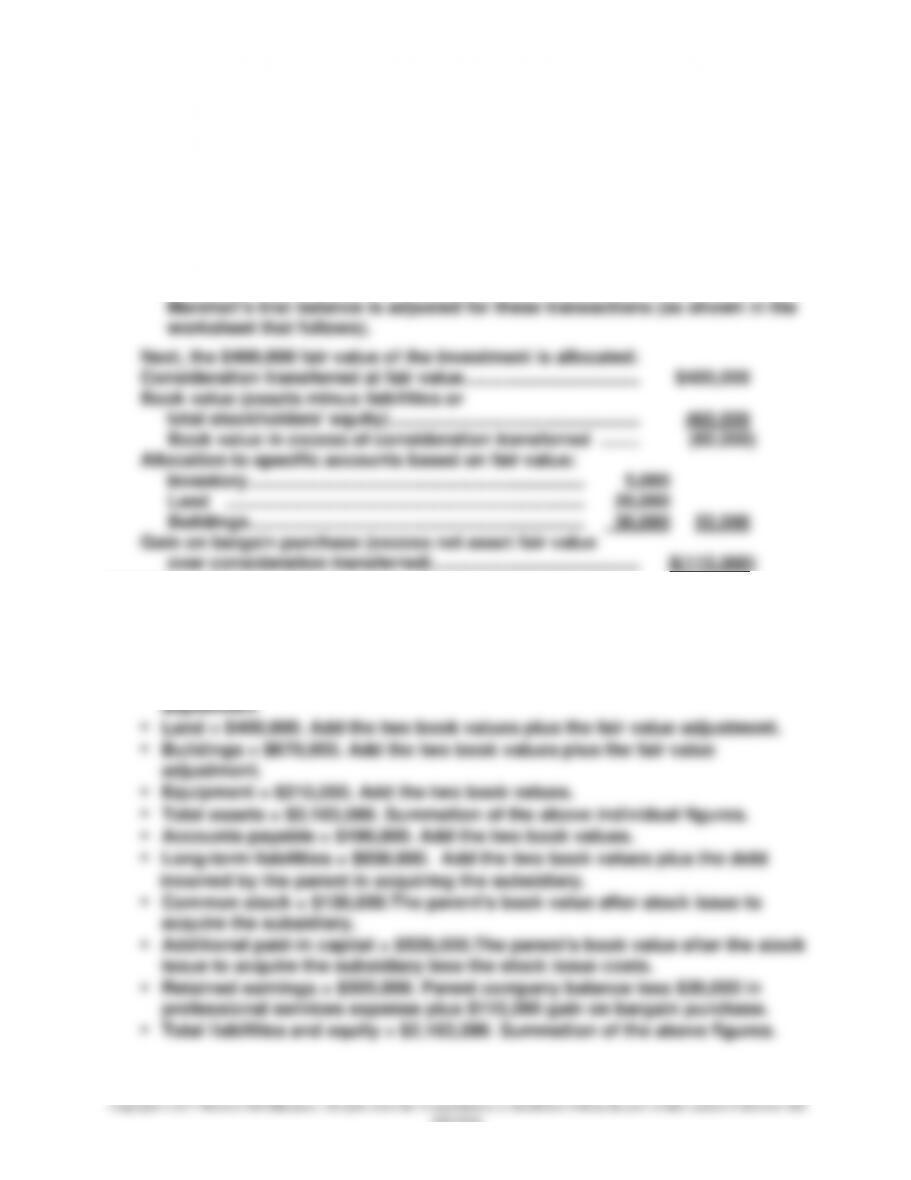
a. Marshall’s acquisition of Tucker represents a bargain purchase because
the fair value of the net assets acquired exceeds the fair value of the
consideration transferred as follows:
Chapter 02 – Consolidation of Financial Information – Hoyle, Schaefer, Doupnik, 13e
2-13
Education.
28. (continued)
Professional Services Expense …………………….. 30,000
Cash …………………………………………………….. 30,000
(to record payment of professional fees)
Additional Paid-In Capital …………………………….. 12,000
Cash …………………………………………………….. 12,000
(To record payment of stock issuance costs)
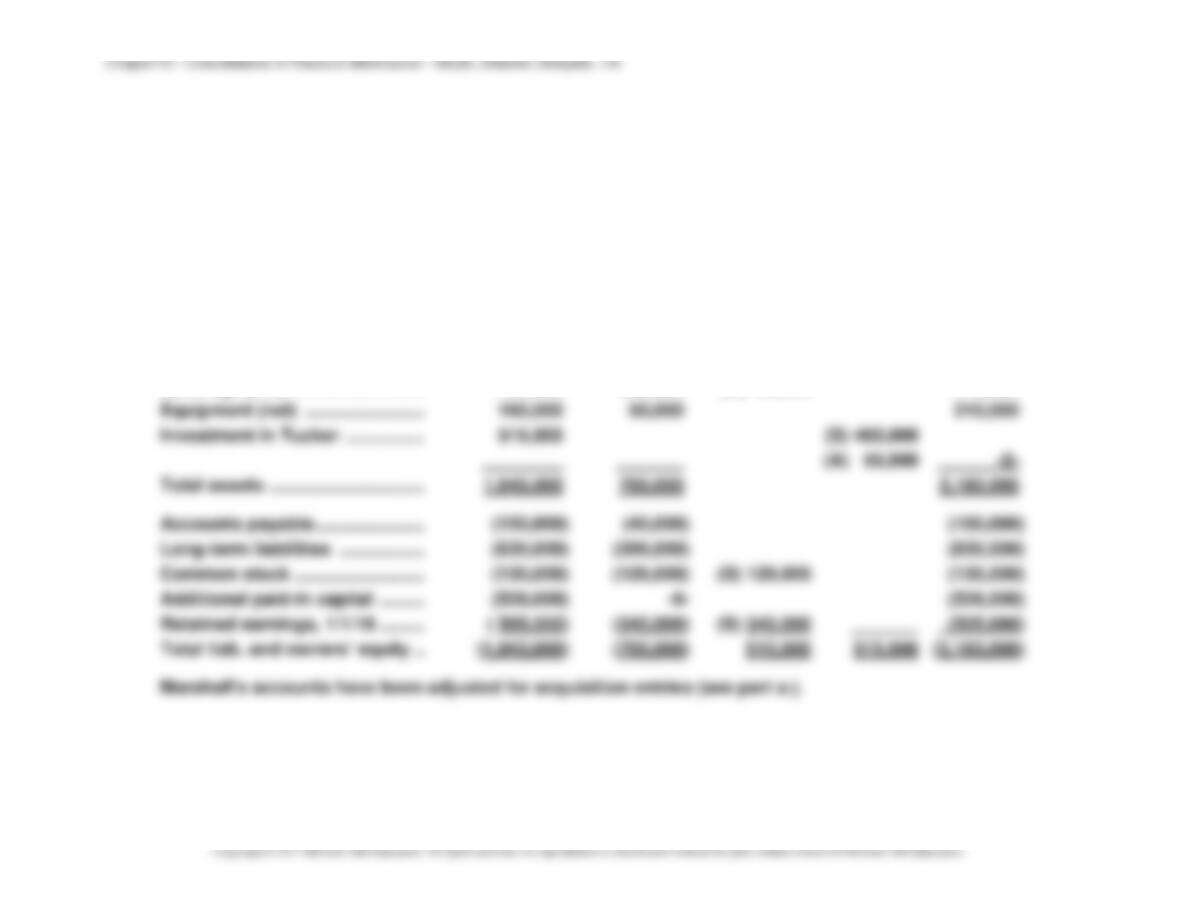
CONSOLIDATED TOTALS
▪ Cash = $38,000. Add the two book values less acquisition and stock issue
costs
▪ Receivables = $360,000. Add the two book values.
▪ Inventory = $505,000. Add the two book values plus the fair value
2-14
28. (continued)
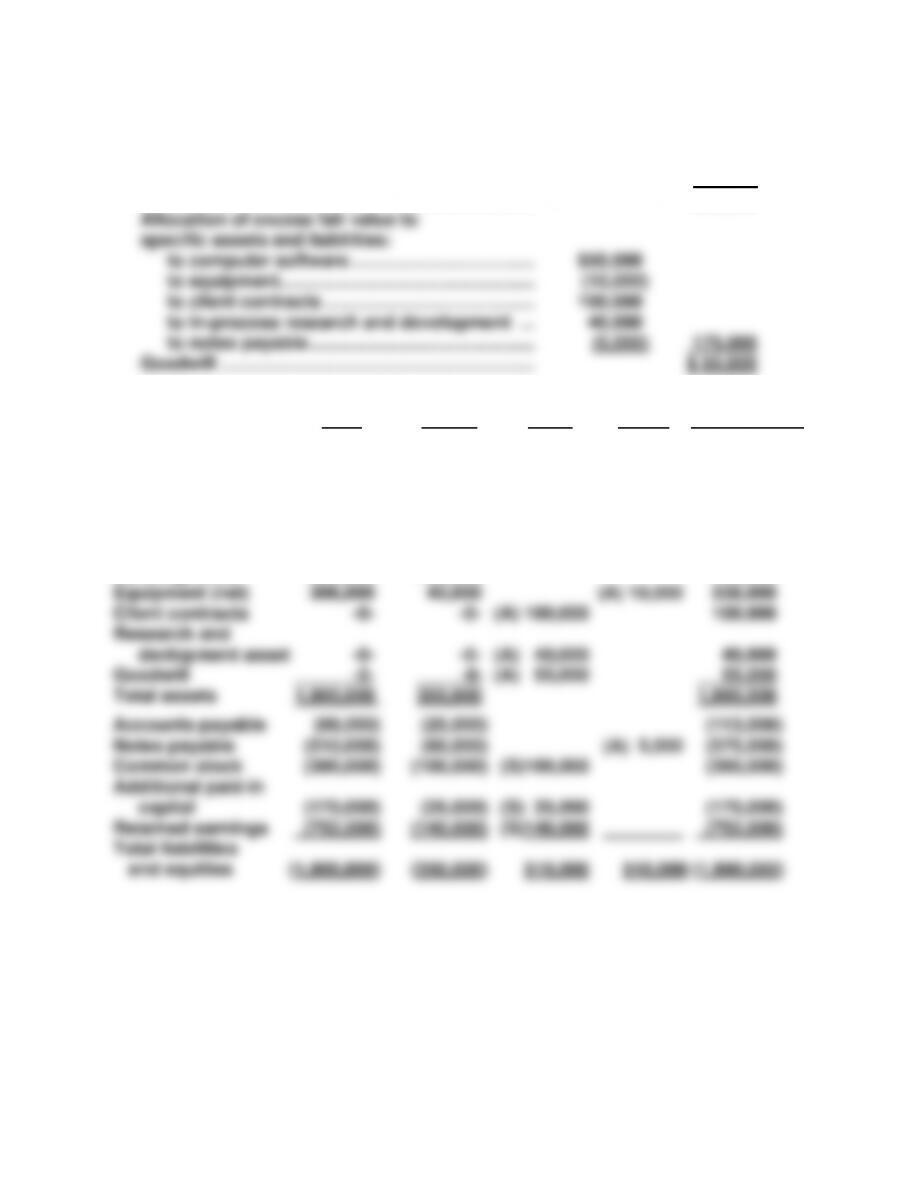
b. MARSHALL COMPANY AND CONSOLIDATED SUBSIDIARY
Worksheet
January 1, 2018
Marshall Tucker Consolidation Entries Consolidated
Accounts Company* Company Debit Credit Totals
Cash …………………………………….. 18,000 20,000 38,000
Receivables …………………………. 270,000 90,000 360,000
Inventory …………………………….. 360,000 140,000 (A) 5,000 505,000
Land ……………………………………. 200,000 180,000 (A) 20,000 400,000
Buildings (net) …………………….. 420,000 220,000 (A) 30,000 670,000
29. (Prepare a consolidated balance sheet)
Consideration transferred at fair value ………….. $495,000
Book value …………………………..……………………… 265,000
Excess fair over book value …………………………. 230,000
Pratt Spider Debit Credit Consolidated
Cash 36,000 18,000 54,000
Receivables 116,000 52,000 168,000
Inventory 140,000 90,000 230,000
Investment in Spider 495,000 -0- (S) 265,000
(A) 230,000 -0-
Computer software 210,000 20,000 (A) 50,000 280,000
Buildings (net) 595,000 130,000 725,000