Chapter 18 – Accounting and Reporting for Private Not-for-Profit Entities – Hoyle, Schaefer, Doupnik, 13e
18-33
—Notes payable – $1,720,000 ($1,100,000 plus $620,000)
c. This transaction is a merger: two not-for-profit entities are brought
together to form a new not-for-profit under a newly-formed governing
body.
As a merger, the carryover method is used. Book values are simply added
together to get new balances to be reported. No cash was spent and no
adjustments to fair value are made.
Balances to Be Reported:
—Unrestricted net assets – $1,520,000 ($1,100,000 plus $420,000)
48. (10 minutes) (Adjusting totals for incorrectly reported student tuition)
a. The tuition was properly recorded as revenue. However, the financial aid
figure should have been a direct reduction to the tuition revenue rather
Chapter 18 – Accounting and Reporting for Private Not-for-Profit Entities – Hoyle, Schaefer, Doupnik, 13e
18-34
Education.
b. As indicated in (a), the financial aid should not have been an expense but,
rather, a reduction in the tuition revenue. Removing the $140,000 from the
49. (15 minutes) (Adjusting totals for incorrectly recorded restricted giving)
a. Because the use of the interest was specified by the donor, both interest
balances should have been recorded initially as increases within
Temporarily Restricted Net Assets. Later, when properly spent, these
b. Each amount was reported as expenses in unrestricted net assets and that
50. (15 minutes) (Adjusting the incorrect recording of a donation and subsequent
expenditure)
a. Because a time restriction has been assumed, only $5,000 ($50,000/10
years) should have been reclassified from Temporarily Restricted Net
final Unrestricted Net Asset figure from $400,000 to $355,000.
b. Depreciation expense of $5,000 ($50,000/10 years) was recorded within the
Chapter 18 – Accounting and Reporting for Private Not-for-Profit Entities – Hoyle, Schaefer, Doupnik, 13e
18-35
Education.
not affect this category. Permanently Restricted Net Assets should not
have been reduced by $50,000 but that is not relevant to this particular
question.
51. (5 minutes) (Incorrect reporting of membership dues)
In this case, because nothing was received in exchange for the members’
dues, these collections should have been recorded as contributed support
52. (15 minutes) (Reporting of donated services)
a. The problem here is that an expense of $70,000 was reported when the
donation was a garage that should have been capitalized as an asset.
b. The entity reported no assets as a result of the contributed garage. The
entity should report a $70,000 garage less $7,000 in accumulated
53. (10 minutes) (Reporting a gift that must be transferred to another party)
a. Because the donor can take the money back, the gift is still under the
control of the donor. Consequently, the not-for-profit entity should have
Chapter 18 – Accounting and Reporting for Private Not-for-Profit Entities – Hoyle, Schaefer, Doupnik, 13e
18-36
b. The issue in this problem is about whether contributed support or a
54. (15 minutes) (Handling of various events by two different charities)
a. Charity A debits repair expense and credits contributed support. These
two changes offset so that unrestricted net assets are not impacted.
b. Charity A will report the investment income as an increase in unrestricted
net assets and then report salary expense for the same amount. These
two changes offset so that unrestricted net assets are not impacted.
of unrestricted net assets.
c. The only difference here between Charity A and Charity B is in the
handling of the excess $20,000 acquisition value. Charity A records this
amount as goodwill because the acquired charity gains a significant
d. Charity A records the $100,000 as patient service revenue and then writes
the amount off as uncollectible. The provision for bad debts is a direct
e. Charity A reports the entire $50 per cake as earned revenue. Charity B
reports $30 per cake as revenue and $20 per cake as contributed support.
Develop Your Skills
Research Case 1
Chapter 18 – Accounting and Reporting for Private Not-for-Profit Entities – Hoyle, Schaefer, Doupnik, 13e
18-37
Education.
This assignment is an excellent way to demonstrate the wealth of information
available on the Internet about charities and other not-for-profit entities. Many
individuals want to be generous and help entities that deserve assistance.
Determining whether a specific entity is truly worthy of support is not necessarily
easy. Every charity will claim that it is effectively helping to improve some
element of society that is in need.
Obviously, the information that a student finds at this website depends on the
specific charities that are examined. However, some of the information that is
normally available includes:
▪ the entity’s stated purpose,
▪ year it was started,
From this type of information, a student should be able to write a detailed
overview of the not-for-profit entity and its operations and finances.
Research Case 2
Charity Navigator provides a wealth of information about its methodology that
should help students understand how a charity can be evaluated.
The following information was listed on the charity’s website at April 28, 2016,
under methodology as the first part of the response to the question: How Do We
Rate Charities’ Financial Health?
“We base our evaluations on the financial information each charity provides in its
18-38
Education.
“A more detailed discussion of our financial rating system follows. For more
information on the scales we use to assign financial health ratings, please visit
our Financial Ratings Tables.
“Financial Efficiency Performance Metrics
“Analyzing a charity’s financial efficiency reveals how well it manages its
Research Case 3
This case is designed to introduce students to the information that can be found
on the Form 990 that must be made public by tax–exempt organizations. Some of
quantity of assets managed? What, for example, would the president of a
comparable-sized for-profit business make in salary and other compensation?
Throughout the chapter, mention was made of the statement of functional
expenses and the amount expended by an entity for program service expenses.
most important and why include each of these items?
Research Case 4
Chapter 18 – Accounting and Reporting for Private Not-for-Profit Entities – Hoyle, Schaefer, Doupnik, 13e
18-39
Students often have trouble envisioning the amount of evolution that can take
place in accounting and financial reporting. By comparing the 1987 financial
—The statements have multiple columns that include Current Funds, Loan Funds,
and Plant Funds.
—Current funds are separated into “unrestricted” and “restricted” but the type of
Analysis Case 1
Many times a potential donor might be interested in an array of information that
can best be found by studying the actual financial statements of a not-for-profit
entity. The purpose of financial statements is to provide a complete picture of the
financial operations and position of the entity to help outsiders make decisions.
Students can observe the construction of financial statements in textbooks but
Chapter 18 – Accounting and Reporting for Private Not-for-Profit Entities – Hoyle, Schaefer, Doupnik, 13e
18-40
1—This not-for-profit entity has four program services listed in its financial
statements: research, public health education, professional
education/training, and community services.
2—The charity reported total expenses for the year ended June 30, 2015, in
services (management and general and fundraising).
3—In the statement of activities, the American Heart Association recognized
4—A question that is raised in connection with virtually any charity has to
5—As of June 30, 2015, the financial statements show that the American
permanently restricted net assets.
6—For the year ended June 30, 2015, $147.1 million of temporarily
Analysis Case 2
A number of private colleges and universities now place their latest audited
financial statements on their websites. However, in some cases, a bit of
Chapter 18 – Accounting and Reporting for Private Not-for-Profit Entities – Hoyle, Schaefer, Doupnik, 13e
18-41
Education.
1—Tuition and fee revenue for the period totaled $604.6 while the total for
the school’s “scholarships” was $244.8 million. Hence, this financial aid
covered approximately 40.5 percent (up from 39.9 percent in 2012) of the
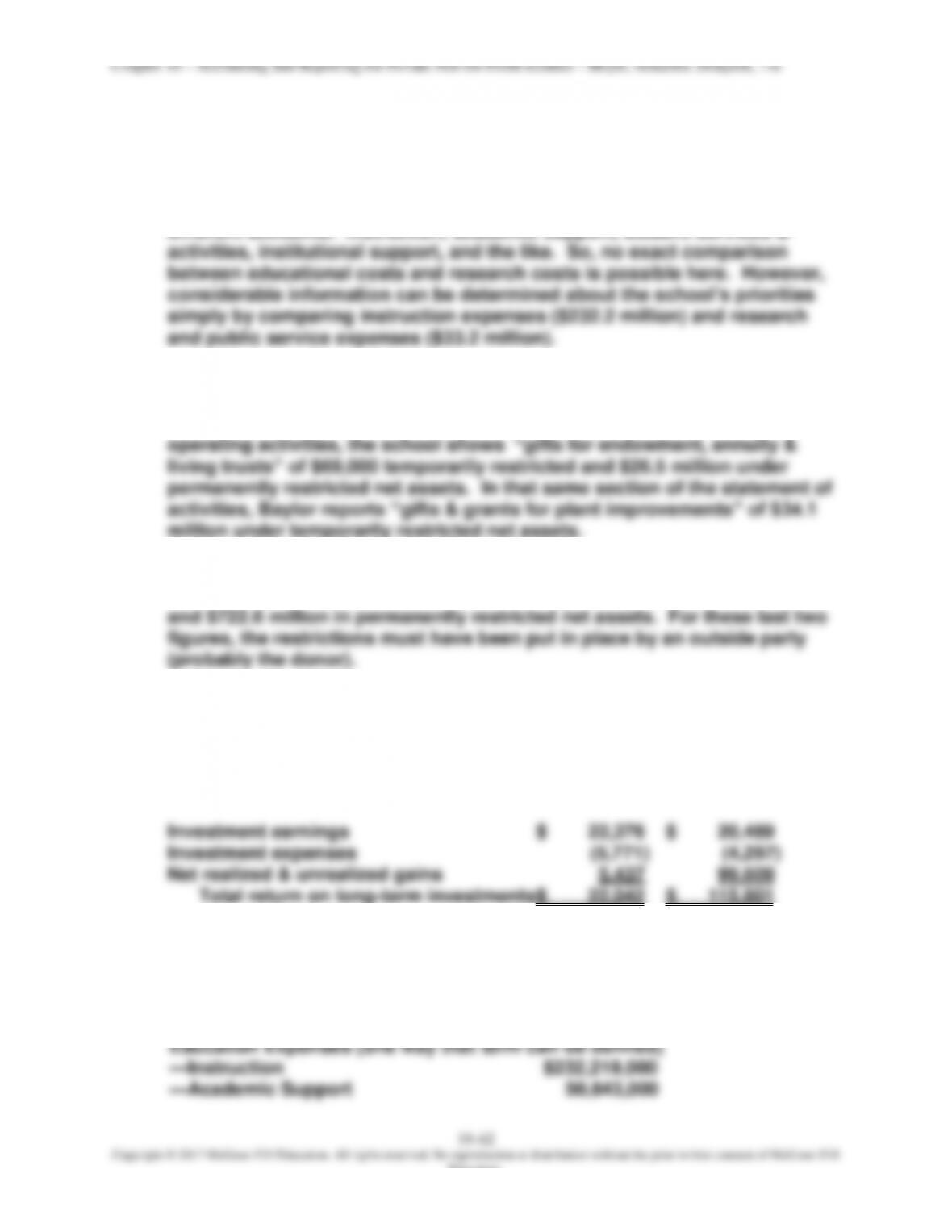
2— Note five to the financial statements provides the following information
about contributions receivable as of May 31, 2015:
As gift pledges are made to the University, the intent of the donor, the
circumstances surrounding the pledge and any action taken by the
As of May 31, 2015 and 2014, contributions receivable consist of the
following (in thousands of dollars):
2015 2014
Due in 1 year $ 32,093 $ 24,380
Due in 2 to 5 years 58,795 64,261
Due in 6 to 10 years 18,476 24,978
Contributions receivable expected to be fulfilled more than one year from
the date of the financial statements are discounted at .33% to 2.89%, with
the discount amortized over the life of the unconditional promise.
At May 31, 2015, contributions receivable primarily consisted of
Education.
$29,220,000 and $34,417,000 as of May 31, 2015 and 2014, respectively.
Payments on these intents to give are due in varying periods.
3—This is an extremely difficult question for any school to answer because
the costs of “educating the students” can be included within several
different accounts: instruction, academic support, student services &
4—For the year ended May 31, 2015, Baylor University shows “gifts and
grants” as operating revenue of $25.1 million under unrestricted net assets
and $9.5 million under temporarily restricted net assets. Under non-
5—As of May 31, 2015, Baylor University reported $660.1 million in
unrestricted net assets, $393.2 million in temporarily restricted net assets,
6—Footnote 4 to the financial statements provides the following
information:
Return on long-term investments for the years ended May 31, 2015 and
2014, consist of the following (in thousands of dollars):
7—The problem with this computation is determining exactly what is meant
by “education expenses.” One way to compute that figure for the Baylor
University for the year ended May 31, 2015 is as follows:
Net Tuition and Fees $359,841,000
Chapter 18 – Accounting and Reporting for Private Not-for-Profit Entities – Hoyle, Schaefer, Doupnik, 13e
18-43
—Student Services and Activities 134,777,000
Communication Case
Under the Strong Financial Oversight section, six principles serve as practical
guidance for the accountant of a private not-for-profit entity. Students will
already expect some of these recommendations based on their education and
21.
A charitable organization must keep complete, current, and accurate financial
records and ensure strong financial controls are in place. Its board should
22.
The board of a charitable organization must institute policies and procedures to
ensure that the organization (and, if applicable, its subsidiaries) manages and
23.
A charitable organization should not provide loans (or the equivalent, such as
24.
Chapter 18 – Accounting and Reporting for Private Not-for-Profit Entities – Hoyle, Schaefer, Doupnik, 13e
18-44
Education.
25.
A charitable organization should establish clear, written policies for paying or
reimbursing expenses incurred by anyone conducting business or traveling on
26.
A charitable organization should neither pay for nor reimburse travel
expenditures for spouses, dependents or others who are accompanying someone