
Chapter 18 – Accounting and Reporting for Private Not-for-Profit Entities – Hoyle, Schaefer, Doupnik, 13e
CHAPTER 18
ACCOUNTING AND REPORTING FOR PRIVATE
NOT-FOR-PROFIT ENTITIES
Chapter Outline
I. At one time, the financial reporting for private not-for-profit entities differed significantly
according to the type of organization. For example, the financial statements prepared by a
health care entity might be quite different from the statements of a college or university. The
reporting of not-for-profit entities has now been largely standardized by FASB
pronouncements that focus on (a) the reporting of financial statements for the entity as a
whole and (b) significant events such as the receipt of contributions and the recording of
mergers and acquisitions. However, public colleges and universities and similar
governmental organizations follow the standards issued by GASB so that reporting
differences with private entities continue to exist.
A. This chapter examines the financial reporting for private not-for-profit entities with special
emphasis on private colleges and universities, voluntary health and welfare entities, and
health care operations.
B. Reporting for these entities is usually similar to a business enterprise unless critical
differences exist that impact the needs of financial statement users. Several critical
differences can be identified.
1. Many private not-for-profit entities receive a significant amount of their financial
2. A significant amount of the financial resources given to a private not-for-profit entity
include donor-imposed restrictions.
3. No single indicator of success is present in the financial reporting. No figure
provides a convenient means for evaluating operating efficiency as reported net
income does in a for-profit business.
II. FASB has established the following financial statements for private not-for-profit entities.
A. Statement of Financial Position reports assets, liabilities, and net assets.
and raise funds). In the future, all not-for-profit entities will be required to provide this
information.
III. For reporting purposes, all economic resources held by a private not-for-profit entity are
classified within one of three categories. In the future, the classifications will narrow to “net
assets without donor restrictions” and “net assets with donor restrictions.”
18-2
Copyright © 2017 McGraw-Hill Education. All rights reserved. No reproduction or distribution without the prior written consent of McGraw-Hill
Education.
subject to external donor restrictions. Entity officials can do whatever they wish with
these assets in order to further the stated mission.
B. “Temporarily restricted net assets” are restricted by an outside party (often a donor) for a
particular purpose or for use in a future period of time. When the restriction is eventually
satisfied, the classification of these resources is reclassified to unrestricted net assets.
based on the specifications of the donor.
IV. Contributions are recognized as increases in net assets when received.
A. Restricted contributions are reported either within temporarily restricted net assets or
permanently restricted net assets based on the stipulations established by the donor.
B. Donated assets are recorded at fair value. Recognition of art works, historical treasures,
1. The items are added to a collection for public exhibition, education, or research.
2. The items are protected and preserved.
3. If sold, receipts must be used to acquire other collection items.
1. If not to be collected within one year, the promise is recorded at the present value of
2. Uncollectible balances are also estimated and deducted from the net realizable value
of the contributions receivable.
3. Conditional promises of support are not recognized as support until the conditions
are met.
D. Services contributed to a not-for-profit entity are recognized as increases in net assets if
the services (1) create or enhance a nonfinancial asset or (2) require a specialized skill
18-3
Education.
VI. Over the years, mergers and acquisitions have become more common in private not-for-
profit entities as a way of expanding impact or to reduce costs. Accounting rules for
recording these combinations differ from those applied to a for-profit business because the
transaction can be judged to be either an acquisition or a merger.
1. All identifiable assets and liabilities of the acquired company are combined at fair
value on the date of acquisition.
2. If the acquisition value of the acquired company is greater than the sum of the fair
3. However, if the acquisition value of the acquired company is greater than the sum of
the fair value of all identified assets and liabilities, the excess is charged off
immediately as a reduction in net assets if the acquired company expects to be
predominantly supported by contributions and investment income in the future.
B. In a merger, two not-for-profits come together to form a new entity with a new governing
board. Identifiable assets and liabilities are not adjusted to fair value but retain their
previous carrying amounts.
VII. Health care entities exhibit some unique reporting features that must be addressed in
not-for-profit accounting.
A. Third-party payors such as Medicare and insurance companies have a significant impact
on the reporting process because of their need for usable financial information
B. A net patient service revenue figure is reported by these entities but only after reduction
for contractual adjustments. These adjustments are decreases determined by some
third-party payors based on the approved cost for a particular service in that geographic
region.
C. Charity care services are not included in either receivables or revenues if there is no
expectation of collection. The cost of that charity work must be disclosed.
D. FASB requires the inclusion of performance indicators (such as revenues in excess of
expenses) to help show operational effectiveness because net income is not viewed as
applicable for a not-for-profit entity.
Answers to Discussion Questions
Are Two Sets of GAAP Really Needed for Colleges and Universities?
Over the years, a number of differences have appeared between the accounting for public
colleges and universities and for those that are private. GASB holds authority over the reporting
Chapter 18 – Accounting and Reporting for Private Not-for-Profit Entities – Hoyle, Schaefer, Doupnik, 13e
18-4
Education.
meet the required criteria. If this decision is made, the school reports only fund financial
statements as would be produced by a proprietary fund. These statements have a resemblance
to the statements prepared by private schools.
Important distinctions do continue to exist. Accounting students can be asked to address the
question of whether a public and a private school need to have comparable financial
Is This Really an Asset?
In theory, accounting for a pledge is a relatively straightforward process. If unconditional, a
receivable is established (at present value if the money is not to be received within a year) along
with an adequate allowance for doubtful collections. However, in practice, the reporting process
might well be more complicated.
In this case, for example, was a pledge actually made or was this just a superfluous statement
spoken at a moment of overwhelming emotions? Is this a promise to give or an intention to
give? Can the donor change his mind? Does this potential donor really own land in Idaho and
At a minimum, hospital officials need to contact this donor and have a serious discussion. He
needs to understand their reasons for attempting to establish a valuation of this promise. In
class discussion, students can be asked to identify questions that should be posed to this
person. They would probably include the following:
—Does he really plan to give $10 million to the hospital?
—When does he project that the land will be sold and the gift conveyed?
—How did he establish a $30 million price? Could the land ultimately be sold for less and, if
so, how will that impact on the gift to the hospital?
—How does the donor want the $10 million to be used?
—Is there any chance that he will change his mind?
—What other charities has he supported? Has he previously made such large gifts?
Chapter 18 – Accounting and Reporting for Private Not-for-Profit Entities – Hoyle, Schaefer, Doupnik, 13e
—Would he be willing to furnish financial statements as well as a list of references who
could verify his intentions and his ability to carry out those intentions?
—Does the hospital have legal recourse to force fulfillment of the promise since it is in
writing and signed?
If this individual has supported other charities over the years, is committed to the work of Mercy
Hospital, has adequate financial resources, and the land appears to be worth $30 million, the
hospital should report the pledge as a receivable. However, a large allowance should probably
be established because of the uncertainties involved in collecting this money over an extended
period of time. Conversely, if too much uncertainty exists (a value for the land cannot be
determined or the donor refuses to provide information about his ability to meet the
commitment), the hospital may decide that there is no pledge but merely the promise of a
possible future pledge. In that case, the information should be spelled out in a disclosure note.
Unless clear evidence exists to substantiate the pledge, disclosure is most likely.
Answers to Questions
1. The Financial Accounting Standards Board (FASB) has authority for establishing accounting
2. If a user of financial statements is a potential donor, that party is interested in assessing
whether a gift to a not-for-profit entity is a wise use of resources. To make that assessment,
3. According to FASB, three financial statements are required to be produced by private
not–for-profit entities: a statement of financial position, a statement of activities, and a state-
4. Temporarily restricted net assets have been restricted by an external donor or grantor for a
specified purpose or for use at a future point in time. For example, cash might be given to a
5. Permanently restricted net assets have been restricted by an external donor and grantor.
That restriction is expected to last for as long as the entity continues to function. Normally,
any income generated by these assets can be used by the entity although its specific usage
18-6
Copyright © 2017 McGraw-Hill Education. All rights reserved. No reproduction or distribution without the prior written consent of McGraw-Hill
Education.
6. The two general types of expenses are (a) program service expenses and (b) supporting
7. Not-for-profit entities (especially voluntary health and welfare entities) are frequently
8. A statement of functional expenses is produced by a voluntary health and welfare entity to
assist the reader of its financial statements in measuring the entity’s efficiency in using
9. When a donor conveys a gift to a private not–for-profit entity (such as the United Way) that
must be conveyed to a separate beneficiary, a question arises as to the recording of the
expense and the contribution. Under normal circumstances, the original donor records an
expense at the time of the conveyance while the charity reports both an asset and a liability
10. If a donor makes a contribution to a charity for conveyance to a separate beneficiary but can
still revoke or redirect the gift before it is made, the donor records a receivable (rather than
11. If a donor makes a contribution to a charity for conveyance to a separate beneficiary but
grants it variance powers to change the identity of the beneficiary, the donor reports an
expense immediately. Because control of the gift now lies with the charity, that party should
18-7
Copyright © 2017 McGraw-Hill Education. All rights reserved. No reproduction or distribution without the prior written consent of McGraw-Hill
Education.
still change. Here, the charity initially receiving the gift records both revenue and,
eventually, an expense for the contribution even though it was not the original donor.
12. The value of donated services is recognized by a private not-for-profit entity if the service (a)
creates or enhances a nonfinancial asset (such as adding a room to a building) or (b)
13. Except in specified situations, the costs of a direct mailing that contains a solicitation for
funds is classified entirely as a fundraising (supporting services) expense. However, within
certain guidelines, these costs can be allocated in a logical manner between supporting
14. Unconditional promises to give must be recorded immediately by a private not-for-profit
15. An unconditional promise to give is recorded immediately by the private not-for-profit entity
that anticipates receiving the gift. Conversely, an intention to give is not recorded. In
16. A number of private not-for-profit entities collect dues from their membership and also
receive contributions. Dues are considered revenues rather than contributions if the member
17. If a not-for-profit entity gains control over another entity, combined financial statements
should be prepared. This type of transaction is viewed as an acquisition.
18-8
Education.
18. Because one party gained control over the other, this transaction is viewed as an
acquisition.
Here, the acquisition value is in excess of the fair value of all identifiable assets and
19. If Helping Hand acquires Fancy Fingers, then the reported value of the equipment on
consolidated statements is $2.3 million. That figure is the net carrying value reported by
Helping Hand ($1.1 million) plus the fair value of the property held by Fancy Fingers ($1.2
20. A third-party payor is any outside entity who assumes responsibility for a portion or even all
of a patient’s medical charges. The most commonly encountered third-party payors include
21. A contractual adjustment refers to a portion of a patient’s charged fee that a health care
entity estimates will not be received because of agreements with third-party payors. These
arrangements specify that the provider (the health care entity) is willing to accept an amount
that is less than its normal charge if the third-party payor determines that the lesser figure is
reasonable for the services rendered.
Chapter 18 – Accounting and Reporting for Private Not-for-Profit Entities – Hoyle, Schaefer, Doupnik, 13e
1. D (Amounts charged to patients less contractual adjustments and the
provision for bad debts)
7. C (The work of the librarian does not enhance a nonfinancial asset nor does it
require a specialized skill that would be purchased if not donated.)
8. D (If the other information that is included contains a call for a specific action
to be acquired, the donated service is reported. The amount paid by the
18-10
Education.
13. A (Patient service revenue is reduced by any charity care services. That
amount is not recorded because the entity does not expect to be paid. In
addition, a direct reduction is shown for the provision for doubtful
18. A (The key factor here is that YZ is expected to be predominantly supported
by contributions. Thus, future exchange revenues will likely be minor. The
acquisition value ($1 million) in excess of the fair value of all assets and
Chapter 18 – Accounting and Reporting for Private Not-for-Profit Entities – Hoyle, Schaefer, Doupnik, 13e
20. B (This transaction is an acquisition and the acquired entity is not supported
predominantly by contributions or investment income. Thus, the difference
21. D
28. A (As an educational institution, Belwood University will qualify as a 501(c)(3)
tax-exempt organization.)
29. D (These volunteer services, although important, do not meet the criteria for
recognition. They do not require a specialized skill that would be otherwise
purchased. They do not enhance a nonfinancial asset.)
18-12
Education.
34. B
Charges to patients = increase in unrestricted net assets shown as net patient
service revenues
Charity care = not recorded if the entity has no intention of seeking collection;
if an amount has been recorded, it must be removed from the receivable
and the revenue.
Provision for bad debts = amount is anticipated and this provision for bad
debts is reported as a direct reduction in patient service revenues to arrive
at net patient service revenues.
37. (15 Minutes) (Series of questions about the reporting of health care entities)
a. A third-party payor is an entity (such as Medicare or an insurance company)
that pays a portion, or all, of a patient’s medical expenses. They are common
b. A contractual adjustment is a reduction to patient service revenues created
when a lesser amount is paid by a third-party payor than the billed amount,
but is still accepted as payment in full by a health care entity. These outside
parties often establish contractual arrangements whereby the health care
Chapter 18 – Accounting and Reporting for Private Not-for-Profit Entities – Hoyle, Schaefer, Doupnik, 13e
18-13
Education.
c. At the time that materials are donated to a health care entity (or any private
not-for-profit entity), the asset is recorded at fair value. Because of the
donation, the contribution is recognized as an increase in unrestricted net
assets. If the asset has a finite life, officials can assume a time restriction on
38. (6 Minutes) (Reporting of various accounts by a not-for-profit entity)
Only $7.6 million is reported as patient service revenues. Charity care of $1.4
39. a). (8 Minutes) (Recording donations by a voluntary health and welfare
entity)
Pledges ……………………………………………………………….. $600,000
Anticipated Amount Deemed to be Uncollectible (15%) (90,000)
Net Pledge Balance …………………………………………… $510,000
40. (65 Minutes) (Preparation of statements for a private not-for-profit entity)

Chapter 18 – Accounting and Reporting for Private Not-for-Profit Entities – Hoyle, Schaefer, Doupnik, 13e
Education.
a. Statement of Activities
Unrestricted
Net Assets
Temporarily Restricted
Net Assets
Permanently Restricted
Net Assets
Public Support
a. Contributions
$210,000
$78,000
b. Contribution—Interest
3,000
Revenue
c. Membership dues
30,000
d. Investment income
3,900
9,100
e.
Net assets released from
restriction
72,000
(72,000)
Total Public Support and
Revenue
$315,900
$18,100
Expenses
Program service expenses
—Cure disease
f. Salaries
(26,500)
g. Depreciation
(16,000)
h. Supplies
(93,000)
Total
(135,500)
Supporting service expenses
– General and administrative
i. Salaries
(32,000)
j. Depreciation
(2,000)
Total
(34,000)
40. (continued)
– Fundraising
k. Salaries
(26,500)
l. Advertising
(2,000)
m. Depreciation
(2,000)
Total
(30,500)
Total Expenses
(200,000)
Change in Net Assets
$115,900
$18,100
-0-
Net Assets – Beginning
of Year
400,000
200,000
$100,000

Chapter 18 – Accounting and Reporting for Private Not-for-Profit Entities – Hoyle, Schaefer, Doupnik, 13e
18-15
Education.
Net Assets – End of Year
$515,900
$218,100
$100,000
Chapter 18 – Accounting and Reporting for Private Not-for-Profit Entities – Hoyle, Schaefer, Doupnik, 13e
18-16
Education.
40. (continued)
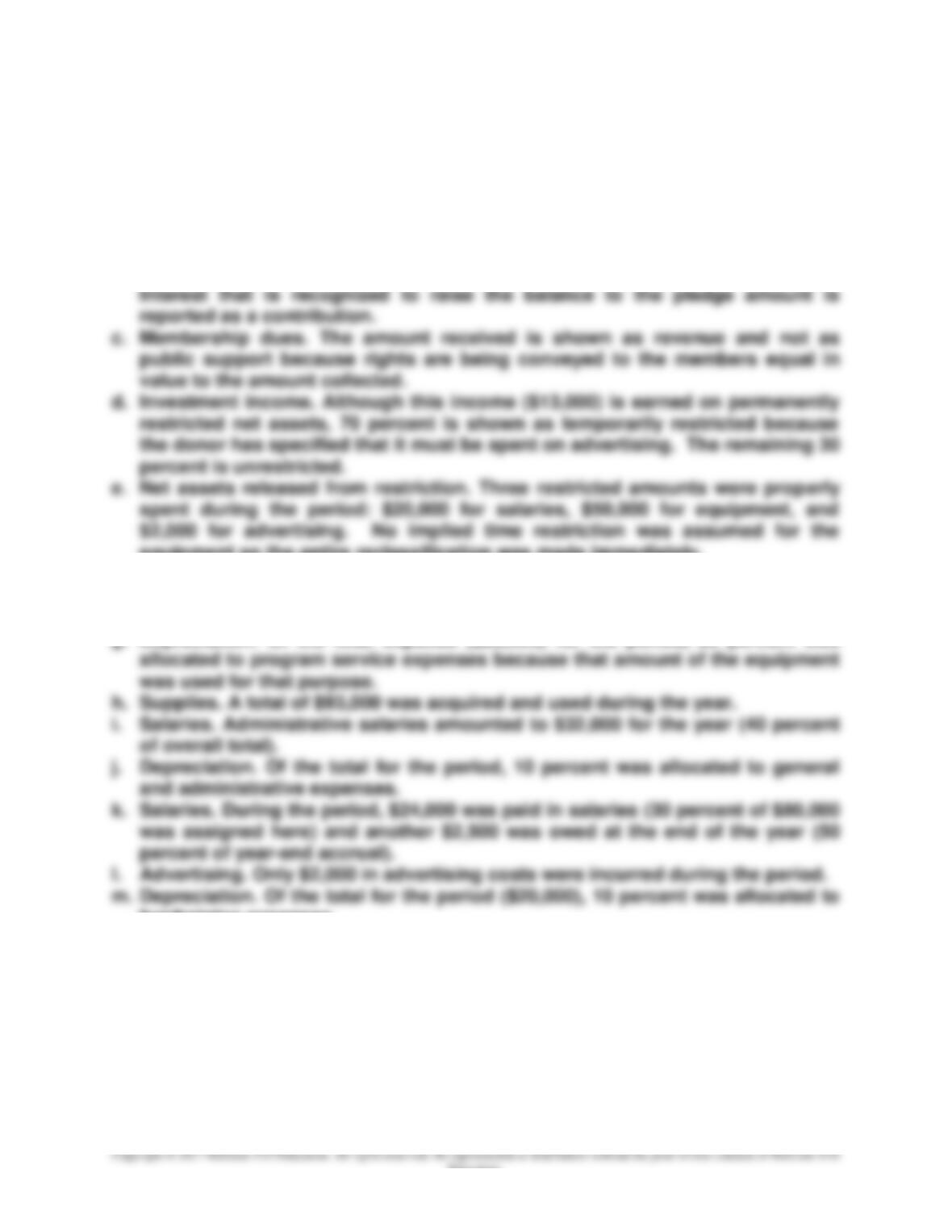
Explanation of Balances
a. Contributions. The balances to be reported are the unrestricted gifts
($210,000) plus present value of unrestricted pledge ($78,000). Pledge is
viewed as temporarily restricted because it will not be collected for three
years.
b. Contribution-Interest. The pledge is recorded at its present value of $78,000.
equipment so the entire reclassification was made immediately.
f. Salaries. During the period, $24,000 in salaries were paid (30 percent of
$80,000 was assigned here) and another $2,500 was owed at the end of the
year (50 percent of year-end accrual).
g. Depreciation. Of the total expense ($20,000) for the period, 80 percent was
fundraising expenses.
—Because it qualifies as a museum piece, recording of the painting is optional.
Officials do not want to report the painting, and they are not required to do so.
–—The $10,000 gift must be conveyed to an outside beneficiary and is reported by
the not-for-profit entity as a liability.
Chapter 18 – Accounting and Reporting for Private Not-for-Profit Entities – Hoyle, Schaefer, Doupnik, 13e
18-17
Education.
40. (continued)
b.
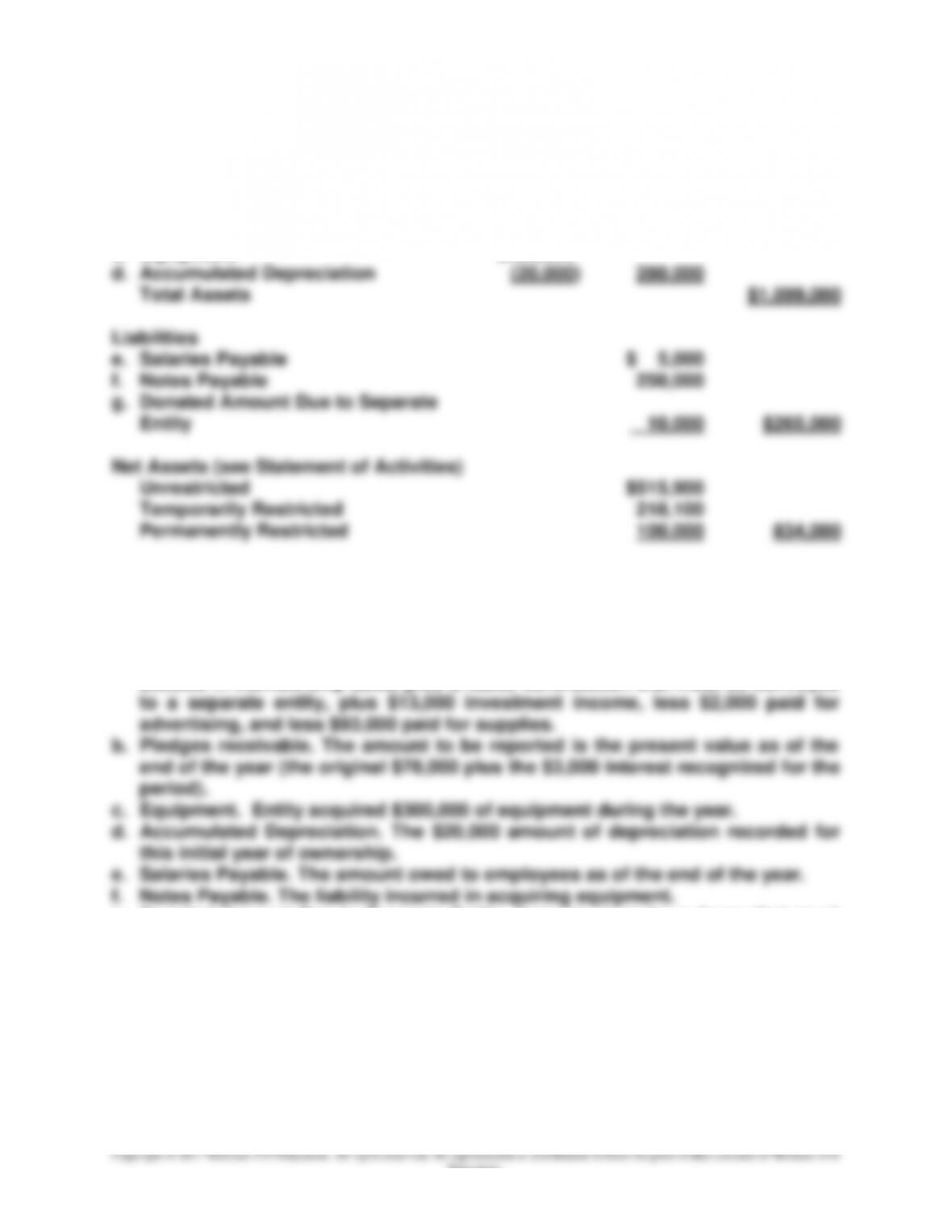
Statement of Financial Position
Assets
a. Cash
$738,000
b. Pledge Receivable
81,000
c. Equipment
$300,000
d. Accumulated Depreciation
(20,000)
280,000
Total Assets
$1,099,000
Liabilities
e. Salaries Payable
$ 5,000
f. Notes Payable
250,000
g. Donated Amount Due to Separate
Entity
10,000
$265,000
Net Assets (see Statement of Activities)
Unrestricted
$515,900
Temporarily Restricted
218,100
Permanently Restricted
100,000
834,000
Explanation of Balances:
a. Cash. The final balance is the beginning cash figure of $700,000 plus $210,000
in contributions, less $80,000 for salaries, less $50,000 for equipment, plus
$30,000 in membership dues, plus $10,000 contribution that must be conveyed
g. Donated Amount Due to Separate Entity. Amount given by a donor that must
be conveyed to a separate organization. The amount must be shown as a
liability since no mention was made that the entity here had variance powers
that would allow it to change the beneficiary.
Chapter 18 – Accounting and Reporting for Private Not-for-Profit Entities – Hoyle, Schaefer, Doupnik, 13e
18-18
Education.
41. (50 Minutes) (Effect of various transactions on unrestricted and restricted net
assets)
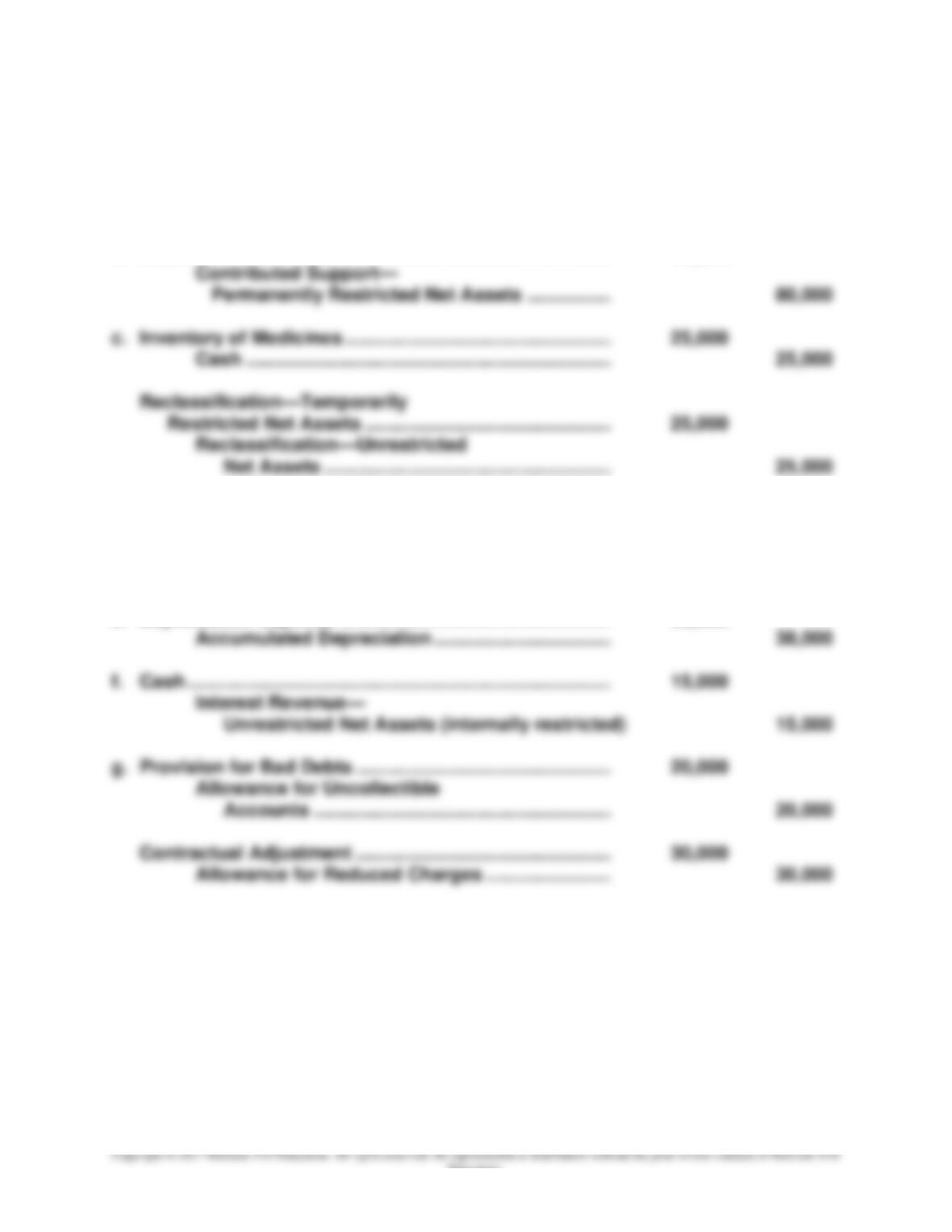
a. Investments—Internally Restricted ………………………… 160,000
Cash ……………………………………………………………. 160,000
b. Cash ……………………………………………………………………… 80,000
d. Accounts Receivable—Patients ……………………………… 120,000
Accounts receivable—Third-Party
Payors ……………………………………………………………… 480,000
Patient service revenues ………………………………. 600,000
e. Depreciation Expense ……………………………………………. 38,000
Chapter 18 – Accounting and Reporting for Private Not-for-Profit Entities – Hoyle, Schaefer, Doupnik, 13e
18-19
Education.
41. (continued)
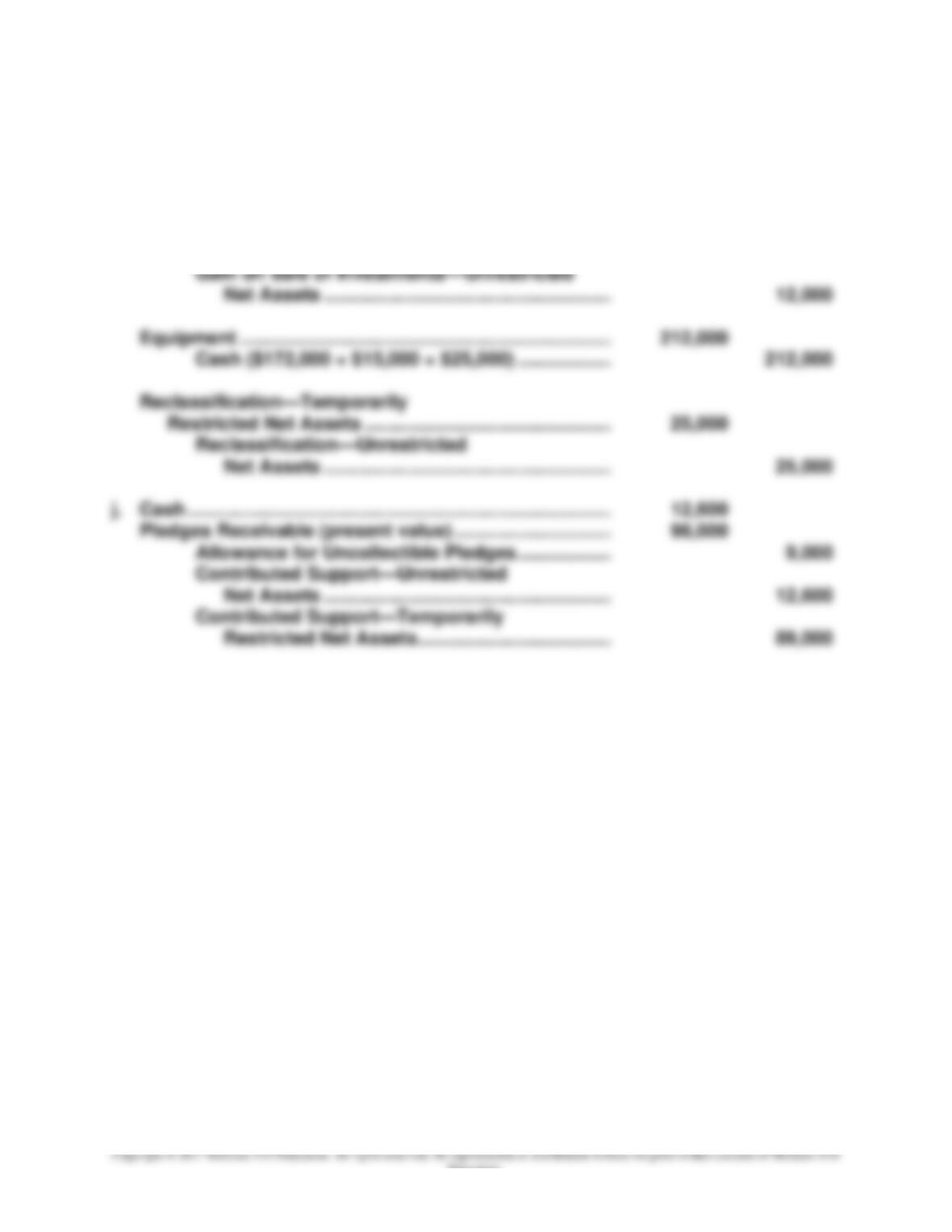
h. Supplies Expense …………………………..…………………….. 25,000
Inventory of Medicines …………………………………. 25,000
i. Cash ……………………………………………………….……………. 172,000
Investments—Internally Restricted ……………….. 160,000
Chapter 18 – Accounting and Reporting for Private Not-for-Profit Entities – Hoyle, Schaefer, Doupnik, 13e
18-20
Education.
41. (continued)
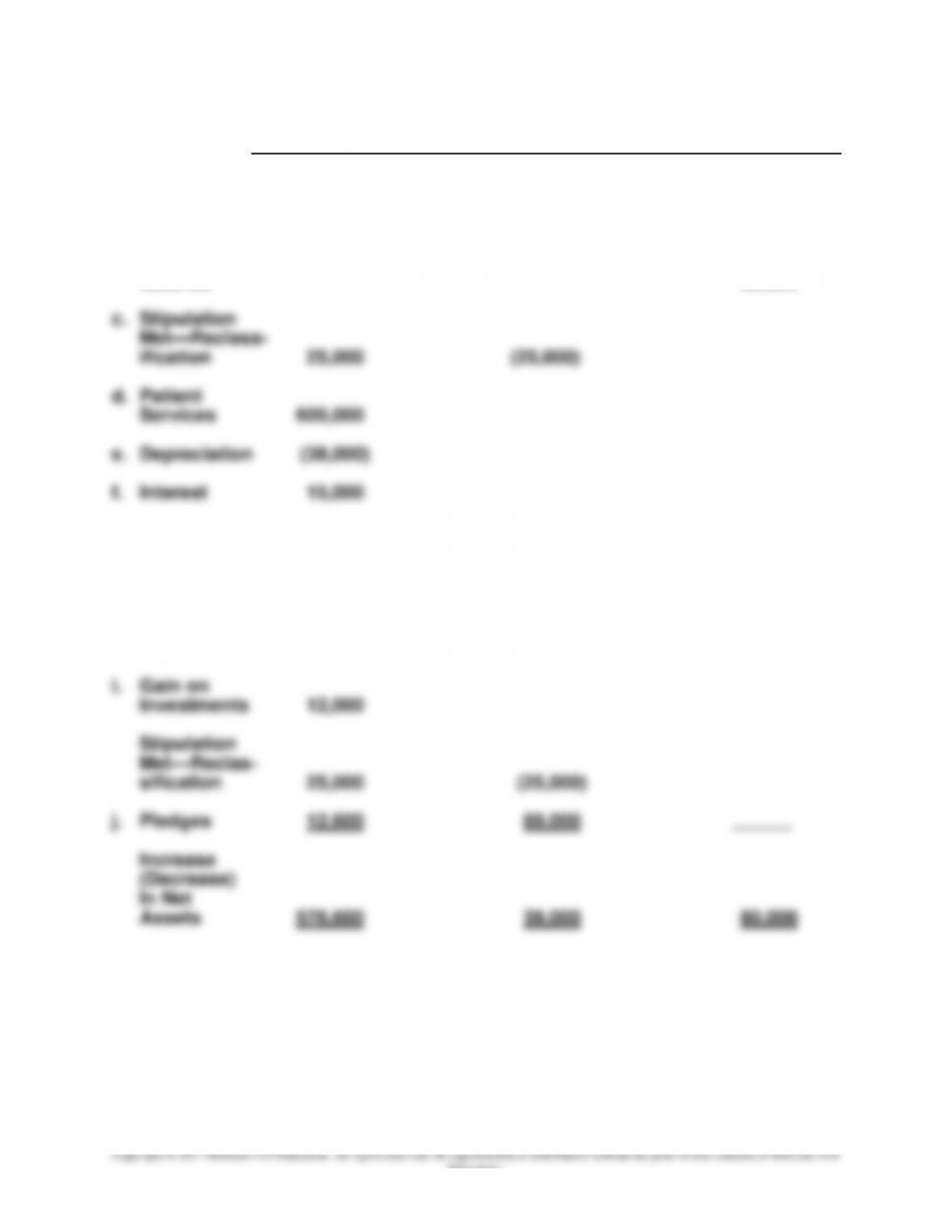
Calculation of Changes in Net Assets
Unrestricted Temporarily Restricted Permanently Restricted
Net Assets Net Assets Net Assets
a. No change
b. Donation—
Income for
Salaries 80,000
g. Bad Debts (20,000)
Contractual
Adjustment (30,000)
h. Supplies
Expense (25,000)