Chapter 17 – Accounting for State and Local Governments (Part Two) – Hoyle, Schaefer, Doupnik, 13e
17–44
38. (continued)
s.
General Fund (mention is made that no separate Debt Service Fund is used)
Expenditures—Interest 9,000
Expenditures—Bonds Payable 5,000
Balances for the above accounts can be determined by posting each of these
entries into the appropriate ledger account.
17–45
38. (continued)
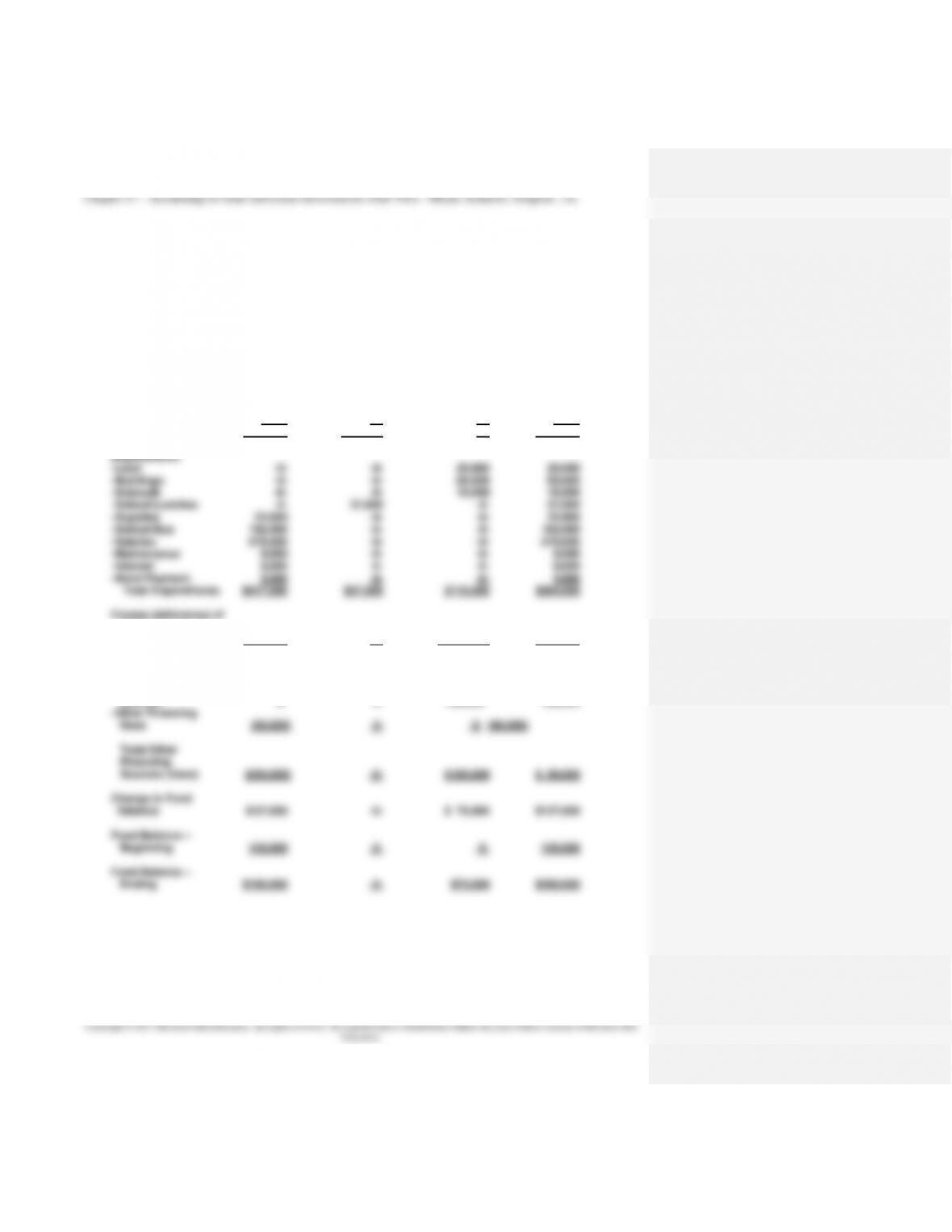
City of Pfeiffer
Statement of Revenues, Expenditures, and Changes in Fund Balance
Fund Financial Statements – Governmental Funds
Year ending December 31, 2017
Total
General Special Capital Projects Governmental
Fund Revenue Funds Funds Funds
Revenues
-Property Taxes $560,000 -0- -0- $560,000
-Park 8,000 -0- -0- 8,000
-Operating Grant -0- $ 37,000 -0- 37,000
-School Fees 6,000 -0- -0- 6,000
Total Revenues $574,000 $ 37,000 -0- $611,000
revenues over
expenditures $157,000 -0- $(110,000) $ 47,000
Other Financing
Sources (Uses)
-Other Financing
Sources -0- -0– 180,000 180,000
17–46
Education.
38. (continued)
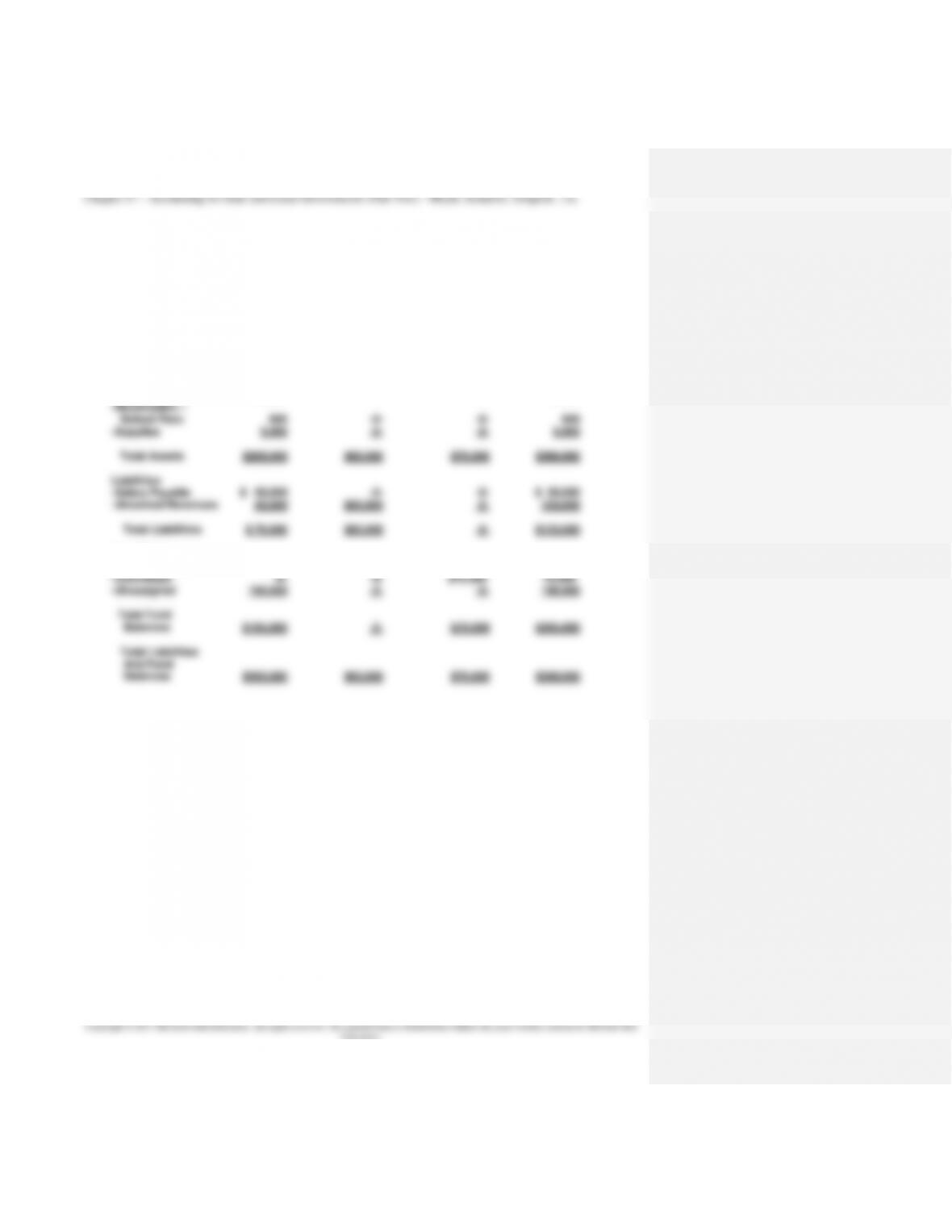
City of Pfeiffer
Balance Sheet
Fund Financial Statements – Governmental Funds
December 31, 2017
Total
General Special Capital Projects Governmental
Fund Revenue Funds Funds Funds
Assets
-Cash $169,400 $63,000 $70,000 $302,400
-Property Tax
Receivable 90,000 -0- -0- 90,000
Fund Balances
-Nonspendable $ 5,000 -0- -0- $ 5,000
Chapter 17 – Accounting for State and Local Governments (Part Two) – Hoyle, Schaefer, Doupnik, 13e
17–47
Education.
38. (continued)
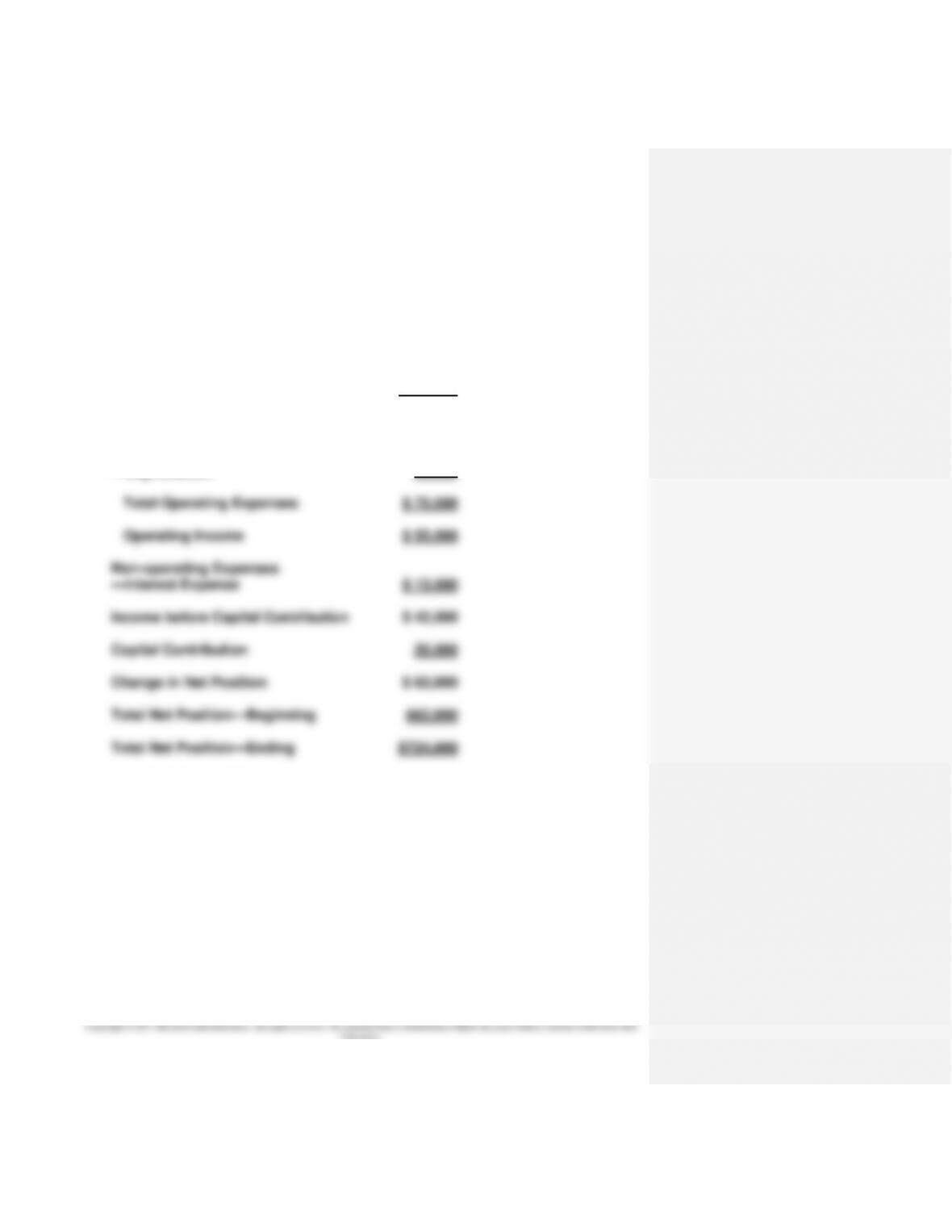
City of Pfeiffer
Statement of Revenues, Expenses, and Changes in Net Position
Fund Financial Statements—Proprietary Funds
Year Ending December 31, 2017
Enterprise Fund (Civic Auditorium)
Operating Revenues
—Rent Revenues $130,000
Operating Expenses
—Salaries $ 45,000
—Vacations 5,000
—Depreciation 25,000
17–48
Education.
38. (continued)
City of Pfeiffer
Statement of Net Position
Fund Financial Statements—Proprietary Funds
December 31, 2017
Enterprise Fund (Civic Auditorium)
Assets
Current Assets
—Cash $130,000
—Rent Receivable 20,000
Total Current Assets $150,000
Liabilities
Current Liabilities
—Salary Payable $ 3,000
—Vacation Payable 5,000
—Interest Payable 13,000
Chapter 17 – Accounting for State and Local Governments (Part Two) – Hoyle, Schaefer, Doupnik, 13e
17–49
39. (17 Minutes) (Impact of various government transactions)
a. False – A pension trust fund is one of the fiduciary funds because the
money cannot be used by city officials for the benefit of the government.
b. True – The permanent funds are included within the governmental funds
because the income generated from the resources being held is to be used
by the government. Although the principal amount cannot be spent by
government officials, the income can.
c. True – A commitment of current financial resources was made when this
amount of current financial resources required.
d. True – The expense to be recognized each year is the adjustment required
to establish the proper liability. At the end of Year One, that liability should
be $96,000 or 12 percent of $800,000. At the end of the second year, the
wide financial statements.
e. True – The expense to be recognized each year is the adjustment required
in the liability. At the end of Year One, that liability should be $99,000 or
11 percent of $900,000. At the end of the second year, the liability has
39. (continued)

Chapter 17 – Accounting for State and Local Governments (Part Two) – Hoyle, Schaefer, Doupnik, 13e
f. False – An Agency Fund is used when passing money through the
government to a specified recipient. Thus, the only two accounts typically
found in an Agency Fund are cash (or similar monetary assets) and the
liability to indicate where that cash is destined.
40. (12 Minutes) (Recording the gift of a work of art)
a. This gift did not involve a current financial resource and should not have
been recorded in the fund financial statements (for the governmental
funds). In this problem, nothing indicates that it was recorded in the fund
b. Apparently, in the government-wide financial statements, revenue of
$15,000 was reported when the asset was recognized at that value.
Depreciation recognized for the first year would have been $500 ($15,000
c. Government officials wanted to use the alternative which was to record an
expense (rather than an asset) along with a revenue for the donation.
41. (5 Minutes) (Reporting a component unit)
The revenue of $30,000 and the expense of $42,000 were not included within
the primary government figures for the government-wide financial
17–51
Education.
42. (10 Minutes) (Recording a city landfill)
a. Apparently, the amounts recorded this year (in the parks which is within
the General Fund) were in the wrong fund. The landfill should have
continued to be reported as an Enterprise Fund. By itself, that does not
have any net impact on the net position reported for the entire government
b. Revenues ($4,000) and expenses ($15,000) for the current year must now
be moved from the General Fund to the Enterprise Funds ($11,000 net
c. Revenues and expenditures have been correctly reported this year within
the General Fund. In addition, there is no indication that the clean-up
43. (6 Minutes) (Recording and depreciating capital assets)
a. The modified approach only applies to infrastructure assets and not to
b. The depreciation expense discussed in (a) above increases the net
expenses for education from $710,000 to $714,000.
44. (10 Minutes) (Reporting by a government of a solid waste landfill)
Chapter 17 – Accounting for State and Local Governments (Part Two) – Hoyle, Schaefer, Doupnik, 13e
17–52
Education.
a. False – The handling in the government-wide financial statements will be
the same whether the landfill is reported as a part of the General Fund or
as an Enterprise Fund.
e. True – The liability is $2 million times 26 percent or $520,000. However,
payments of $100,000 have already been made by this time so the reported
45. (10 Minutes) (Reporting by a government of a landfill)
a. True – The amount of the liability to be reported in each of the past years
would then have been based on $3 million rather than on $2 million.
b. True – The government-wide financial statements accrue all liabilities
whether they are governmental activities or business-type activities. The
46. (12 Minutes) (Reporting the gift of a historical treasure to a government)
Chapter 17 – Accounting for State and Local Governments (Part Two) – Hoyle, Schaefer, Doupnik, 13e
17–53
Education.
a. True – One of the requirements for being able to choose to not capitalize
an art work or historical treasure is that a formal policy must be in place
d. False – Revenue recognition is required for gifts of this type. It is only the
decision as to whether to record an asset or an expense that is at the
47. (8 Minutes) (The presentation of component units)
a. False – Although the city here appoints a majority of the board members,
nothing here indicates that (a) the city can impose its will on this board, (b)
that the library provides a financial benefit or a financial burden for the
48. (12 Minutes) (The basic reporting of a state or local government.)
Chapter 17 – Accounting for State and Local Governments (Part Two) – Hoyle, Schaefer, Doupnik, 13e
17–54
Copyright © 2017 McGraw-Hill Education. All rights reserved. No reproduction or distribution without the prior written consent of McGraw-Hill
Education.
a. False – The $900,000 will be added and not subtracted. On the fund-
based financial statements, an expenditure is reported which reduces the
fund balance. On the government-wide financial statements, the cost is
capitalized so that no change occurs in the government’s overall net
position. The reconciliation starts with the total change in fund balances
for the governmental funds (including this $900,000 reduction) and moves
to the total change in net position in the governmental activities (no
change for this transaction). To go from a $900,000 reduction to no
change, an addition of $900,000 is required.
b. False – Appointing the governing board alone is not sufficient to be
labeled as a component unit. In addition, either the primary government
The modified approach enables governments to avoid recording
depreciation for these particular items.
f. False – The textbook indicates some use of the modified approach but not
a significant amount. Apparently, the cost of the work necessitated by the
statements rather than as an other financing source. The handling is the
17–55
Copyright © 2017 McGraw-Hill Education. All rights reserved. No reproduction or distribution without the prior written consent of McGraw-Hill
Education.
same in the government-wide financial statements and the fund financial
statements so that no adjustment is needed for reconciliation purposes.
Develop Your Skills
Research Case 1
GASB 34 required the creation of government-wide financial statements which
necessitated the reporting of capital assets and other infrastructure items. When
released in 1999, one of the most controversial aspects of GASB 34 was the
capitalization of previously acquired and constructed infrastructure items (such
Because of this criticism, GASB tempered this one reporting requirement more
than any other. First, only a limited number of these earlier assets had to be
reported. According to the GASB Codification, Section 1400.167, “governments
are required to capitalize and report major general infrastructure assets that were
acquired (purchased, constructed, or donated) in fiscal years ending after June
of the total of all general capital assets.
In addition, only assets acquired or renovated after June 30, 1980, had to be
assessed for reporting purposes. This parameter limited the required reporting
to assets that were relatively new at that time. For example, a bridge constructed
in 1922 did not have to be reported unless renovated after June 30, 1980.
“The initial capitalization amount should be based on historical cost. If
determining historical cost is not practical because of inadequate records,
estimated historical cost may be used.” (Section 1400.170)
17–56
Copyright © 2017 McGraw-Hill Education. All rights reserved. No reproduction or distribution without the prior written consent of McGraw-Hill
Education.
“A government may estimate the historical cost of general infrastructure assets
by calculating the current replacement cost of a similar asset and deflating this
cost through the use of price-level indexes to the acquisition year (or estimated
acquisition year if the actual year is unknown). There are a number of price-level
indexes that may be used, both private- and public-sector, to remove the effects
of price-level changes from current prices. Accumulated depreciation would be
calculated based on the deflated amount, except for general infrastructure assets
reported according to the modified approach.” (Section 1400.171)
Research Case 2
The reason for this question is rather obvious: The transit authority has lost
money and city officials are concerned by how those negative financial results
will impact the financial picture reported by the city.
The reporting rules for component units were first created by GASB Statement
discrete presentation. Discrete presentation entails reporting component unit
financial data in columns and rows separate from the financial data of the primary
government.” (Section 2600.107)
“Even though it is desirable for users to be able to distinguish between the
primary government and its component units, there are nevertheless some
balances and transactions should be reported in a manner similar to the balances
and transactions of the primary government itself. This method of inclusion is
known as blending.” (Section 2600.112)
17–57
Copyright © 2017 McGraw-Hill Education. All rights reserved. No reproduction or distribution without the prior written consent of McGraw-Hill
Education.
burden for the city? Do transit authority officials have to get permission from the
city to adopt its budget or set rates for passenger use? Can the transit authority
issue bonds without having to get approval of city officials? These questions
should be fairly easy to answer.
The transit authority can also be a component unit of the city if city officials
transit authority has been losing money. Eventually, if that situation does not
improve, what responsibility will the city have?
Analysis Case 1
Students often appear to believe that the financial reporting presented in a
textbook has actually been applied, unchanged, for decades. They often do not
pronouncement provides a clear line of demarcation between the financial
statements that are currently reported and those that were traditionally used for
many decades.
In looking at any source of information prior to 2000, several significant
differences should be evident:
Revenue Fund, Capital Projects Fund, and the like) rather than showing specific
major funds within these categories.
—Because only current financial resources were reported, at least in the
governmental funds, no capital assets or long-term liabilities are reported.
However, columns identified as “general fixed asset account group” and “general
17–58
Education.
long-term debts.
—Some of the fund type names have changed over the years. For example, the
Permanent Fund within the governmental funds did not exist prior the passage of
GASB 34.
—Depreciation was not reported in connection with the reporting of capital assets
–Budgetary information was reported but through the use of a different type of
format.
—A management’s discussion and analysis is now included in government
financial statements to provide a verbal explanation of the financial events of the
period.
Analysis Case 2
One of the most significant changes in governmental accounting created by
GASB 34 in 1999 was the requirement that the Management’s Discussion and
Analysis be included as part of the CAFR. This written report is meant to be a
discussion of the financial information for the government in a verbal rather than
a purely quantitative fashion. Students often do not understand the range of
information provided by the MD&A. In this assignment, the student can read the
MD&A for an actual city.
Here are just a few of the pieces of information discussed in the 2015 MD&A for
the City of Phoenix, Arizona.
following: Various street and storm sewer projects throughout the City valued
at $94.0 million.
— The City’s total long-term obligations increased by $3.7 billion, 53.2%,
primarily due to the overall impact of net pension liability on the City’s
financial statements.
City as a whole of $69.7 million. Governmental Activities accounted for $16.0
Chapter 17 – Accounting for State and Local Governments (Part Two) – Hoyle, Schaefer, Doupnik, 13e
17–59
Education.
— The total revenues in the General Fund were within 0.9 percent of the final
amended budget and total expenditures were less than the final amended
budget. The final amended general fund budget projected fiscal year
expenditures of $1,148.8 million. The actual general fund budgetary
expenditures for the fiscal year ended June 30, 2015, were $1,051.4 million
which is $97.4 million less than the amended budget.
Communication Case 1
Students do not always fully comprehend the evolutionary nature of financial
accounting and reporting. In connection with for-profit businesses, ongoing
changes have occurred over a number of decades under the Financial
Accounting Standards Board, the Accounting Principles Board, and a variety of
other organizations. In comparison, the Governmental Accounting Standards
Board has been in operation for a shorter period of time and has produced fewer
official standards. The changes that governmental accounting has gone through
over the years may be a bit easier for a student to grasp.
recently, has been very unstructured. The amount of authoritative guidance has
gone from almost nonexistent just a few decades ago to a fairly well developed
system of financial reporting.
Communication Case 2
If the city assesses a user charge, then officials always have the right to record
similar. The statements measure all economic resources and timing is recorded
Chapter 17 – Accounting for State and Local Governments (Part Two) – Hoyle, Schaefer, Doupnik, 13e
17–60
Copyright © 2017 McGraw-Hill Education. All rights reserved. No reproduction or distribution without the prior written consent of McGraw-Hill
Education.
based on accrual accounting. Perhaps most importantly, the anticipated cost of
closure and post-closure activities must be accrued in both sets of financial
statements.
Conversely, if the landfill is recorded within the General Fund, there is no impact
on the government-wide financial statements except that all transactions and
balances are shown as governmental activities rather than as business-type
activities. However, in the fund financial statements, as a governmental fund,
only current financial resources and the changes in those financial resources are
reported. Capital assets, in these statements, as well as long-term liabilities such
as closure costs are omitted.
Excel Case
This spreadsheet would be extremely helpful for a government attempting to
determine the historical cost (less depreciation) of infrastructure assets not
problem. Here is one possible approach:
In Cell A1, enter text label “City of Loveland—Reported Value of Each Mile of
Road”
In the next three rows, enter the criteria on which calculations will be based:
Enter Column Headings:
In Cell A7, enter text label of “# of Years.”
In Cell B7, enter text label of “Date.”
In Cell C7, enter text label of “Inflation Reduced Cost.”
In Cell D7, enter text label of “Total Depreciation.”
A9. Once these cells are highlighted, you will see a small black box in the
lower right corner of this selection, which is the “fill handle.” Click on the
fill handle and drag across Cells A10 through A27 and release to display
Education.