
Chapter 17 – Accounting for State and Local Governments (Part Two) – Hoyle, Schaefer, Doupnik, 13e
17-1
Education.
CHAPTER 17
ACCOUNTING FOR STATE AND LOCAL GOVERNMENTS
(PART TWO)
Chapter Outline
I. In the financial reporting for a state or local government, transactions and other events can
be encountered where officials are unsure about the reporting that would be in conformity
with generally accepted accounting principles. To help resolve such problems, the
Governmental Accounting Standards Board (GASB) has established a hierarchy of
generally accepted accounting principles (GAAP) that lists both authoritative and
nonauthoritative sources for guidance.
A. Authoritative sources of GAAP are divided into two categories with Category A having
more authority than Category B.
a. Category A is made up of GASB Statements of Governmental Accounting
Standards
b. Previously issued GASB Interpretations are also included in Category A although
the Board does not anticipate issuing additional interpretations in the future
c. Category B is made up of GASB Technical Bulletins, GASB Implementation
Guides, and any literature of the American Institute of Certified Public Accountants
(AICPA) that has been cleared by GASB.
B. Nonauthoritative sources of GAAP can be used if authoritative GAAP does not provide
a definitive answer. The list of these sources include GASB Concepts Statements,
pronouncements of other accounting bodies such as FASB and the IASB, practices that
are prevalent in state and local governments, published literature of professional
associations and regulatory agencies, and accounting textbooks and articles.
II Governments often reduce or eliminate a business’s tax burden as an incentive for staying
or expanding operations in the area. The details of such tax abatements must now be
disclosed as part of the financial reporting process. Disclosed information should include
the following
A. The purpose of the tax abatement program.
B. The tax being abated.
C. Dollar amount of taxes abated.
D. The type of commitments made by the tax abatement recipients.
E. Other commitments made by the government such as agreeing to build infrastructure
assets such as roads.
III. Governments often establish solid waste landfills for use by local citizens and businesses.
These facilities can be recorded either within the proprietary funds, if a user fee is
assessed, or as part of the General Fund if the landfill is open to the public without a
charge.
A. A landfill can eventually create a large liability for a government because of closure
costs and postclosure maintenance and monitoring.
B. On government-wide financial statements, recognition of this liability is based on
accrual accounting and the economic resource measurement focus. Thus, the liability is
recognized proportionally as the available space becomes filled. If the landfill is

Chapter 17 – Accounting for State and Local Governments (Part Two) – Hoyle, Schaefer, Doupnik, 13e
17-2
Education.
recorded as an Enterprise Fund, this same reporting is also appropriate for fund
financial statements.
C. If the landfill is reported within the General Fund, a liability is only reported on the fund
statements when a claim to current financial resources comes into existence.
IV. Many state and local government entities maintain have defined benefit pension plans for
their employees such as school teachers and police officers. Pension trust funds are
often set up as fiduciary funds to manage the money and investments held to pay for these
pensions. As fiduciary funds, these pension trust funds are not included in government-
wide financial statements.
A. Government-wide financial statements must report a net pension liability if the present
value of the estimated future payments that relate to past work is greater than the net
position of the pension trust fund. That is a net pension liability.
B. GASB requires that in most cases, but not all, the present value of the future benefits is
determined based on the estimated long-term investment yield for plan assets. That
decision has created a significant amount of controversy because it recognizes more
future interest and a lower amount of currently-reported debt.
C. The components to be reported as pension expense are the service cost for the current
period, interest expense on the total pension liability, and projected earnings on plan
investments. In addition, any increases or decreases in the liability caused by changes
in benefit terms are also included in pension expense immediately.
V. Works of art and historical treasures
A. Artworks, historical treasures, and similar assets should be capitalized at cost (or fair
value at the date of donation) in government-wide financial statements.
B. An expense rather than an asset can be recorded but only if the item does not generate
economic benefits and meets the following three criteria.
a. Held for public exhibition, education, or research in furtherance of public service,
rather than financial gain.
b. Protected, kept unencumbered, cared for, and preserved.
c. Subject to the policy that revenues generated from sales of items in the collection
must be used to add to the collection.
C. If capitalized, depreciation is not required if this type of asset (a bronze sculpture, for
example) is considered to be inexhaustible.
D. On fund financial statements for the governmental funds, expenditures are recognized
for any purchases because the acquired property is not a current financial resource.
VI. Infrastructure Assets and Depreciation
A. Infrastructure assets (such as roads, bridges, and sidewalks) are capitalized at
historical cost in the government-wide financial statements and also in fund financial
statements for proprietary funds.
B. In fund financial statements for the governmental funds, these acquisitions are recorded
as expenditures as they reduce current financial resources.
C. If capitalized, depreciation of all capital assets other than land and inexhaustible
artworks is required.
D. Infrastructure assets are also subject to depreciation. However, the “modified
approach” allows the expensing of maintenance costs in lieu of depreciation for
infrastructure assets but only if specified criteria are met.

Chapter 17 – Accounting for State and Local Governments (Part Two) – Hoyle, Schaefer, Doupnik, 13e
17-3
Education.
a. A minimum acceptable condition level is established for a network of infrastructure
assets and documentation is provided to verify that this minimum level has been
maintained.
b. An asset management system must be in place to monitor the condition of the items
in this system of assets.
VII. Primary governments produce a comprehensive annual financial report (CAFR) which
includes general purpose external financial statements. These statements are divided into
three distinct sections.
A. Management’s discussion and analysis (MD&A) which provides a broad range of
information to help decision–makers evaluate the operations and financial position of the
government entities.
B. Financial statements
a. Government-wide financial statements.
b. Fund financial statements.
c. Notes to the financial statements.
C. Other required supplementary information.
VIII. In governmental accounting, a general purpose government (such as a city, town, county,
state or the like) is a primary government that must produce and distribute a CAFR. In
creating this CAFR, many governments must also include component units which are
legally separate organizations or activities.
A. Any agency, board, or the like that meets either of the following two criteria is reported
as a component unit within the CAFR of the primary government even though the
separate organization is an independent operation.
a. It must be fiscally dependent upon the primary organization and the primary
government and the component unit must be financially interdependent (there is a
relationship of potential financial benefit or burden between the two of them) or
b. The primary government must appoint a voting majority of the governing board and
either be able to impose its will on the board or the separate organization provides a
financial benefit or imposes a financial burden on the primary government.
B. Once identified, component units can be discretely presented in a separate column on
the right side of the government-wide statements or blended with the primary
government as if it made up one of the funds within the primary government.
C. In addition, a special purpose government (such as a school board, university, or water
commission) qualifies as a primary government if it meets the following three criteria:
a. It has a separately elected governing body.
b. It is legally independent
c. It is fiscally independent of any other state and local governments
IX. Government entities will occasionally combine. These transactions can be recorded as
acquisitions or as mergers.
A. In a merger, significant consideration is not exchanged. The governments simply
come together—often to form a new government unit. The net carrying value of all
assets, liabilities, deferred outflows of resources, and deferred inflows of resources
are retained. No excess consideration is paid nor recognized.
B. In an acquisition, significant consideration is exchanged. Assets, liabilities, deferred
outflows of resources, and deferred inflows of resources are recorded at acquisition
value—the amount required to buy or dispose of the items on that day. Any excess
consideration is recorded as a deferred outflow of resources and amortized to expense
Chapter 17 – Accounting for State and Local Governments (Part Two) – Hoyle, Schaefer, Doupnik, 13e
17-4
Education.
over a period of time determined based on a number of factors.
X. Public colleges and universities are required to meet GASB standards for reporting
purposes, whereas private schools are required to use FASB standards.
A. Private colleges and universities generally depend more on tuition and usually have
larger endowments whereas governments generally provide a major part of the support
for public schools.
B. GASB assumes public colleges and universities are special purpose entities so that
they must use the same reporting model as a state or local government. However,
many of these schools assume that they function solely as an Enterprise Fund (open to
the public for a user charge). Thus, they are allowed to produce fund financial
statements (for a proprietary fund) without need for government-wide statements. The
government-wide statements are viewed as redundant.
Answer to Discussion Question
Is It Part of the County?
In financial accounting for a for-profit organization, the boundary that defines the reporting entity
and its various activities (or subsidiaries) is relatively easy to determine. US GAAP provides the
basis for inclusion in consolidated financial statements, which includes all entities over which a
company has control.
A special purpose government is also a primary government for reporting purposes. To qualify,
it must have a separately elected governing body, be legally independent, and also be fiscally
independent. The entity can demonstrate its fiscal independence by setting its own budget,
levying taxes, and/or issuing bonds without outside approval. Here, the industrial development
commission’s budget must be approved by the county government and deficits will be covered
by the county, the commission appears to qualify as a component unit for Harland County.
Can the commission also be a component unit of the state? Fiscal dependence is not present
but a component unit does exist if the primary government appoints a voting majority of the
Chapter 17 – Accounting for State and Local Governments (Part Two) – Hoyle, Schaefer, Doupnik, 13e
board and (a) the primary government can impose its will on that board or (b) the separate
organization provides a financial benefit for the primary government or imposes a financial
burden. The state appoints 15 out of 20 of the board members. Appointment of that number of
Answers to Questions
1. All sources of authoritative US GAAP for state and local governments can be divided into
two categories with Category A having more authority than Category B. Category A is
been cleared by GASB.
2. If specific guidance cannot be found in either Category A or Category B, accountants and
auditors should consider guidance for similar transactions or events. In addition, GASB has
3. According to GASB, a state or local government must disclose significant information about
abatement agreements that should include the following. Note that the governments are not
required to identify specific companies that are involved.
• The purpose of the tax abatement program.
4. Solid waste landfills can be a significant source of liability for many local governments. The
5. Government-wide financial statements recognize expenses on the accrual and economic
resource measurement basis. Therefore, seven percent of the expected landfill closure
liability cost is accrued during the current year as an expense along with the related liability.
Chapter 17 – Accounting for State and Local Governments (Part Two) – Hoyle, Schaefer, Doupnik, 13e
In the fund financial statements, the entry is the same as above if an Enterprise Fund is
involved.
6. Government-wide financial statements recognize expenses on the accrual and economic
resource measurement basis. At the end of the first year, 11 percent is multiplied times the
expected closing and other related costs and that figure is recognized as both an expense
and a liability. Current costs are used for this estimation process. At the end of the second
year, 24 percent is multiplied times the expected costs (which may have changed since the
7. The money set aside by this government for its retirement program is maintained in a
pension trust fund that will likely have a positive net position because of the money and
investments being held for future payments. At the same time, an estimate is made of the
8. For state and local government units, pension expense begins with the service cost for the
current year and is increased by interest expense on the amount of the obligation. The
resulting figure is then reduced by any projected earnings on plan investments. In addition,
any increases or decreases in the liability caused by changes in benefit terms are included
in pension expense immediately.
9. Governments should capitalize donated works of art, historical treasures, and similar assets
at the fair value at the date of the gift. However, if no charge is assessed for admission to
see the art, it is difficult to consider it an asset in a traditional sense because no direct
economic benefit is raised for the government. Thus, the artwork does not have to be
Chapter 17 – Accounting for State and Local Governments (Part Two) – Hoyle, Schaefer, Doupnik, 13e
Education.
used up by display, education, or research). Otherwise, depreciation is not required.
10. Revenue still must be reported because of the donation. If the government chooses not to
record the qualifying asset in the government-wide financial statements, an expense is
11. The modified approach is an alternative to depreciating infrastructure assets. This option
allows the government to expense all maintenance costs rather than record depreciation,
but only if specified guidelines are met. The government must accumulate certain
information about the infrastructure assets within either a network or subsystem of a
12. If the modified approach is applied, depreciation of infrastructure assets is not recorded but
all maintenance costs are expensed. Certain disclosures are required on the government-
wide financial statements. This requirement includes disclosure that the government is
13. A Management’s Discussion and Analysis (MD&A) similar to that found in for-profit financial
statements is required for state and local governments. The MD&A is presented before the
financial statements and provides the following information:
(1) A brief discussion of the financial statements and information provided and their
relationships to each other.
(2) Condensed financial information at least including
a. Total capital and other assets
b. Total long-term and other liabilities
g. Program expenses, by function.
h. Total expenses
Chapter 17 – Accounting for State and Local Governments (Part Two) – Hoyle, Schaefer, Doupnik, 13e
k. Special and extraordinary items
l. Transfers
m. Change in net position
(7) Information about the modified approach for infrastructure assets
(8) Any known facts, decisions, or conditions that are expected to significantly impact on
financial position or results of operations.
14. The Comprehensive Annual Financial Report (CAFR) includes three sections
a. Introductory Section
1. Letter of transmittal
2. Organizational chart
4. Other required supplementary information
c. Statistical Section
15. A general purpose government is a traditional government such as a city, county, or state.
A special purpose government (such as a school system or transit authority) can also be a
primary government for reporting purposes if certain requirements are met.
Classification as a special purpose government requires meeting three criteria:
a. It has a separately elected governing body.
16. Classification as a component unit requires an organization to meet one of two criteria:
a. The activity is fiscally dependent on a primary government. It cannot determine its own
budget, levy and set tax rates, or issue bonded debt without outside approval. Further,
the primary government and the component unit must be financially interdependent (a
17. If blended, component units are included in the primary government as if they were part of
the government (one of its own funds). The component unit is legally separate but so
intertwined and substantially the same as the primary government so that inclusion is
Chapter 17 – Accounting for State and Local Governments (Part Two) – Hoyle, Schaefer, Doupnik, 13e
17-9
Copyright © 2017 McGraw-Hill Education. All rights reserved. No reproduction or distribution without the prior written consent of McGraw-Hill
Education.
A discretely presented component unit is shown separately on the far right side of the
government-wide financial statements because the organization is not substantially the
same as the government and can stand alone.
18. The two government-wide financial statements are the Statement of Net Position and the
Statement of Activities.
The Statement of Net Position includes:
a. All assets and long-term liabilities.
e. Net expense or net revenue for each category of the government.
f. General revenues for governmental activities, business-type revenues, or component
units.
19. The two fund financial statements for the governmental funds are the Balance Sheet and the
Statement of Revenues, Expenditures, and Changes in Fund Balance. The Balance Sheet
measures current financial resources and uses modified accrual accounting and includes:
a. Separate columns are included for the general fund and every other major fund that
f. A reconciliation between the ending change in fund balances and the ending change in
net position for governmental activities in the government-wide financial statements.
20. Program revenues are those revenues derived from a specific program (such as parks and
recreation) or from outsiders seeking to contribute to the cost of that function. They include
charges rendered for services, operating grants and contributions, and capital grants and
contributions.
21. The net expense or net revenue format allows the readers of a government’s financial
statements to determine the relative financial burden (or benefit) that each of its reporting
22. On government-wide financial statements, internal service funds are combined with the
governmental activities (or business-type activities if that connection is more appropriate).
Their placement is based on the identity of the functions that they primarily serve. If an
23. A combination is viewed as a merger if two legally separate entities are brought together to
form a new entity and no significant consideration is exchanged. A merger is also formed if
one of those entities ceases to exist while the other continues. In a merger, the net carrying
values for all assets, deferred outflows of resources, liabilities, and deferred inflows of
24. In for-profit accounting, excess consideration paid in an acquisition is reported as goodwill
and then tested periodically for impairment. For a state or local government, excess
consideration paid in an acquisition is not reported on the statement of net position as an
17–11
25. From an external reporting perspective, FASB sets accounting standards for private
colleges and universities whereas GASB sets standards for public schools. Operationally,
26. Many public colleges and universities make the assumption that they are solely an
Enterprise Fund because they are open to the public butand have a user charge (tuition and
other fees). An Enterprise Fund is a proprietary fund. For proprietary funds, government-
Answers to Problems
1. C (GASB Concepts Statements are held to be nonauthoritative accounting
literature.)
2. B (GASB Implementation Guides have a higher level of authority than does
GASB Concepts Statements and should be followed. These
implementation guides are classified as Category B authoritative
literature. GASB Concepts Statements are classified as
nonauthoritative.)
5. D (Tax abatements do not create actual transaction. Therefore, only
disclosure of the relevant facts is required.)
6. D
17–12
Education.
10. B (The present value of the pension payments that have been earned to
date is $49.8 million. The net position of the pension trust fund is $32.7
million. Thus, the $17.1 million difference is the net pension
liability.)
12. C
14. B
19. A
20. C
25. C
27. (20 Minutes) (Journal entries for landfill on government-wide financial
statements and fund financial statements)
Chapter 17 – Accounting for State and Local Governments (Part Two) – Hoyle, Schaefer, Doupnik, 13e
17–13
Education.
GOVERNMENT-WIDE FINANCIAL STATEMENTS
Accounted for as an Enterprise Fund (within the Business-type Activities)
December 31, 2017
Expense—Landfill Closure (3% of $1.9 million) 57,000
Landfill Closure Liability 57,000
b.
GOVERNMENT-WIDE FINANCIAL STATEMENTS (same as above in a.)
Accounted for within the General Fund (part of the Governmental Activities)
December 31, 2017
Expense—Landfill Closure 57,000
Landfill Closure Liability 57,000
27. (continued)
Landfill Closure Liability 50,000
Cash 50,000
c.
FUND FINANCIAL STATEMENTS (same as above in a.)
Accounted for as an Enterprise Fund (within the Proprietary Funds)
December 31, 2017
Expense—Landfill Closure 57,000
Chapter 17 – Accounting for State and Local Governments (Part Two) – Hoyle, Schaefer, Doupnik, 13e
Landfill Closure Liability 57,000
Landfill Closure Liability 50,000
Cash 50,000
Cash 50,000
d.
FUND FINANCIAL STATEMENTS
Accounted for within the General Fund (one of the Governmental Funds)
December 31, 2017
Expenditures—Landfill Closure 50,000
Cash 50,000
28. (10 Minutes) (Reporting a landfill in both government-wide financial
statements and fund financial statements)
a. GOVERNMENT-WIDE FINANCIAL STATEMENTS
28. (continued)
Landfill Closure Liability $1,296,000 (54 percent of $2.4 million)
Expense—Landfill Closure $1,296,000 (amount needed to establish
Chapter 17 – Accounting for State and Local Governments (Part Two) – Hoyle, Schaefer, Doupnik, 13e
17–16
Education.
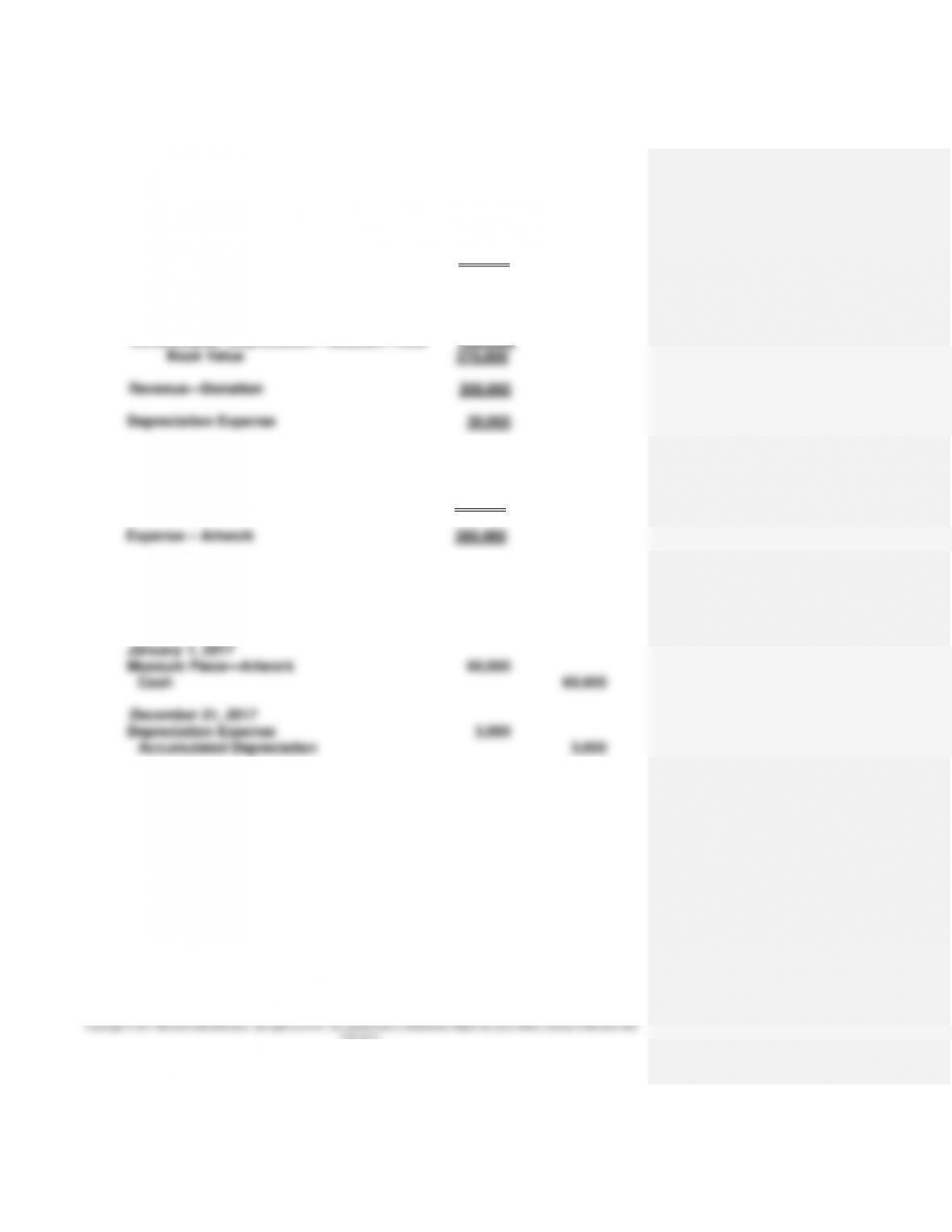
Revenue—Donation 300,000
b. GOVERNMENT-WIDE FINANCIAL STATEMENTS (Depreciation recognized)
Museum Piece—Artwork 300,000
Accumulated Depreciation—Museum Piece (30,000)
c. GOVERNMENT-WIDE FINANCIALSTATEMENTS (gift not recognized as
asset)
Revenue – Donation 300,000
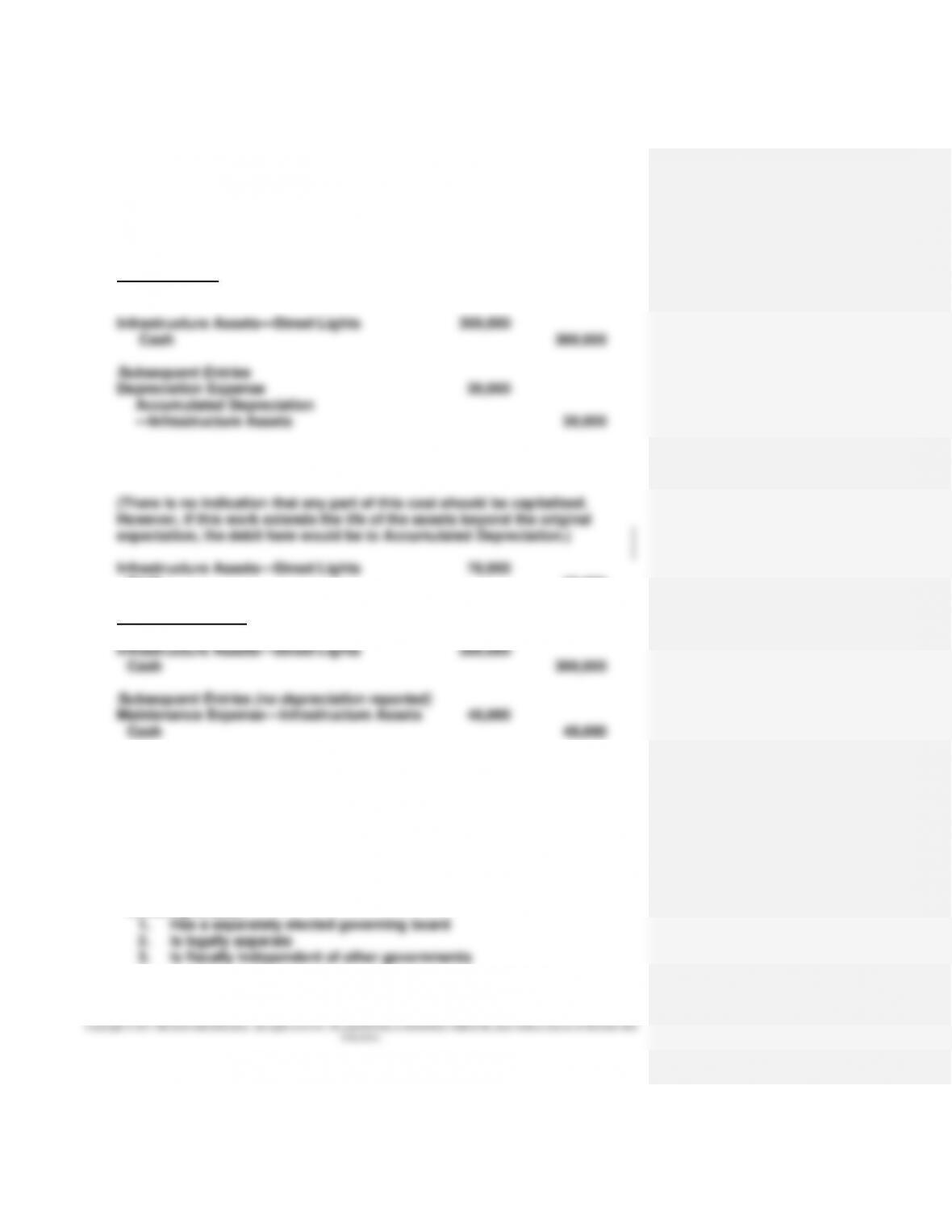
31. (5 Minutes) (Purchase of artwork with capitalization required)
a. GOVERNMENT-WIDE FINANCIAL STATEMENTS (Governmental Activities)
31. (continued)
b. FUND FINANCIAL STATEMENTS (General Fund)
January 1, 2017
Expenditures—Artwork 60,000
Cash 60,000
32. (8 Minutes) (Accounting for infrastructure in government-wide financial
statements)
Chapter 17 – Accounting for State and Local Governments (Part Two) – Hoyle, Schaefer, Doupnik, 13e
17–17
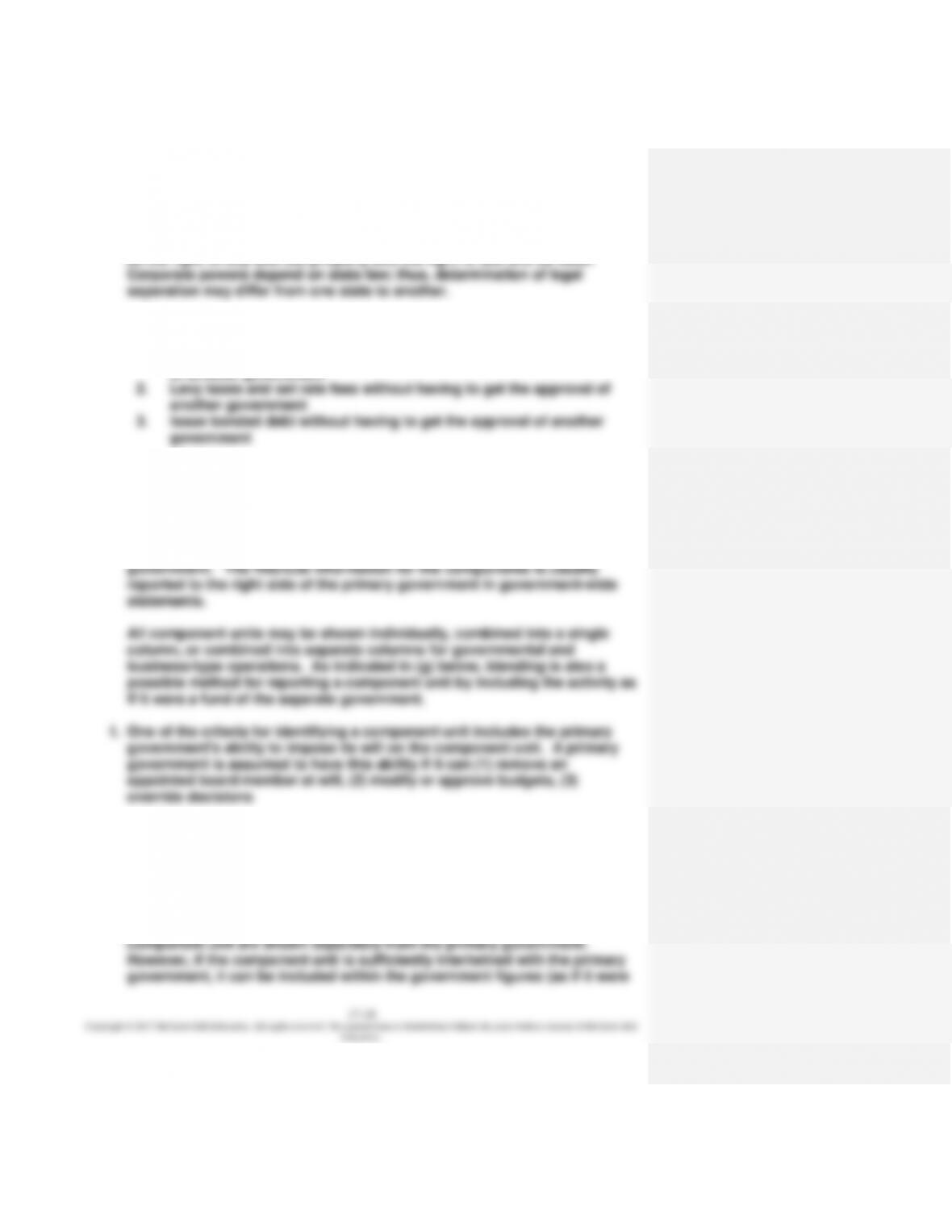
GOVERNMENT-WIDE FINANCIAL STATEMENTS
One possibility: Infrastructure assets are capitalized with depreciation
recorded
Maintenance Expense—Infrastructure Assets 48,000
Cash 48,000
Cash 78,000
Second possibility: Infrastructure assets capitalized with government using
the modified approach
Infrastructure Assets—Street Lights 78,000
Cash 78,000
33. (12 Minutes) (The reporting of a special purpose government and a
component unit)
a. The major criterion for inclusion in a government’s comprehensive annual
financial report (CAFR) is financial accountability.
b. An activity is viewed as a special purpose government if it meets the
following criteria:
Chapter 17 – Accounting for State and Local Governments (Part Two) – Hoyle, Schaefer, Doupnik, 13e
c. Legal separation is usually demonstrated by having corporate powers such
as the right to buy and sell property and the right to sue and be sued.
d. The fiscal independence of a government is indicated by having authority
to do specific actions:
1. Determine and modify its budget without having to get the approval
of another government
e. A component unit is any activity that is legally separate from a primary
government but so closely tied to that government that some inclusion in
the government’s CAFR is necessary. The account balances of the
component unit are included along with the financial statements of the
primary government. However, these reported figures are normally
discretely presented separate from the balances of the primary
33. (continued)
of the board, or (4) hire as well as dismiss the individuals in charge of the
day-to-day activities of the component unit.
g. Normally, as indicated above, the financial position and operations of a
17–19
Copyright © 2017 McGraw-Hill Education. All rights reserved. No reproduction or distribution without the prior written consent of McGraw-Hill
Education.
a fund). Inclusion in this manner is referred to as blending. A component
unit must be blended if its total debt will be repaid entirely, or almost
entirely, from resources of the primary government.
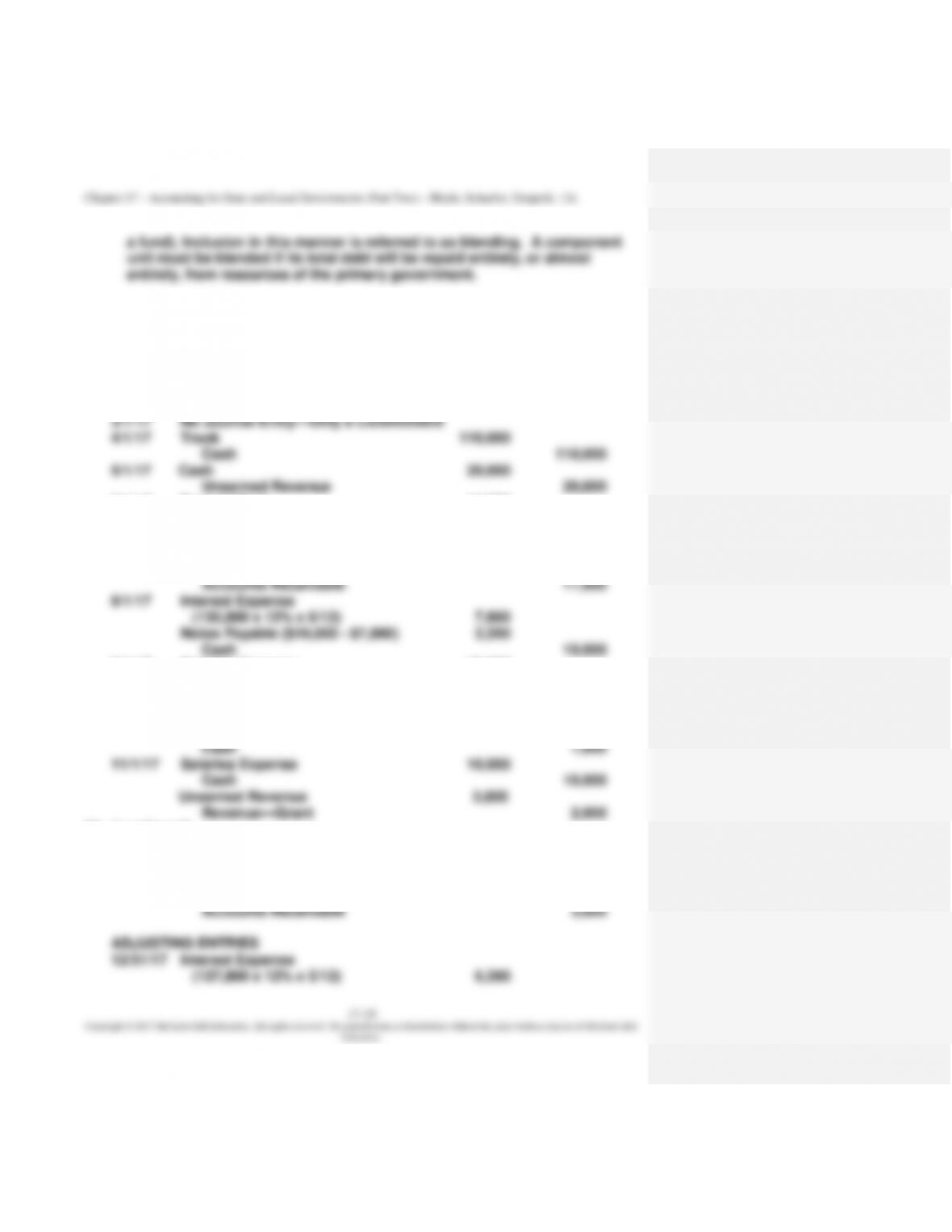
34. (15 Minutes) (Journal entries for an enterprise fund)
1/1/17 Cash 160,000
Capital Contributions 160,000
2/1/17 Cash 130,000
Notes Payable 130,000
6/1/17 Prepaid Rent 12,000
Cash 12,000
7/1/17 Accounts Receivable 13,000
Revenues—Services 13,000
Cash 11,000
9/1/17 Salaries Expense 18,000
Cash 18,000
Unearned Revenue 18,000
Revenue—Grant 18,000
10/1/17 Maintenance Expense 1,000
34. (continued)
12/31/17 Accounts Receivable 19,000
Revenues—Services 19,000
Cash 3,000

17–20
Copyright © 2017 McGraw-Hill Education. All rights reserved. No reproduction or distribution without the prior written consent of McGraw-Hill
Education.
Interest Payable 6,390
12/31/17 Depreciation Expense
(110,000 x 1/10 x 9/12) 8,250
Accumulated Depreciation 8,250
12/31/17 Rent Expense ($1,000 x 7 months) 7,000
Prepaid Rent 7,000
12/31/17 Expense-Landfill Closure 480,000
Landfill Closure Liability 480,000
(12% of current cost total of
$4 million)