Chapter 16 – Accounting for State and Local Governments (Part One) – Hoyle, Schaefer, Doupnik, 13e
16-21
a. Capital Projects Fund (could also be recorded in the General Fund
followed by a transfer into the Capital Projects Fund)
Cash 900,000
Other Financing Sources—Bonds Proceeds 900,000
Debt Service Fund
Cash 130,000
Other Financing Sources—Transfers In 130,000
f. Special Revenue Fund
Grant Receivable 90,000
Unavailable Grant Revenue 90,000
GOVERNMENT-WIDE FINANCIAL STATEMENTS
a. Governmental Activities
Cash 900,000
Bonds Payable 900,000
Chapter 16 – Accounting for State and Local Governments (Part One) – Hoyle, Schaefer, Doupnik, 13e
16-22
Education.
d. Governmental Activities
Machinery and Equipment 12,000
Vouchers or Accounts Payable 12,000
g. Governmental Activities
Taxes Receivable 600,000
Revenues – Property Taxes 576,000
Allowance for Uncollectible Current Taxes 24,000
40. (25 Minutes) (Answer questions about ledger account balances)
a. As the Appropriations account balance in the General Fund shows a
total of $171,000, that amount of money has been authorized for
b. The governmental funds are all designed to monitor current financial
resources and their inflows and outflows. Therefore, the Capital
Projects Fund records expenditures made to acquire or construct
c. The Appropriations balance represents the amount that government
Chapter 16 – Accounting for State and Local Governments (Part One) – Hoyle, Schaefer, Doupnik, 13e
16-23
Education.
d. At the end of the year, any remaining commitments will be removed
from the accounting records by reversing the original encumbrance
entry (which eliminates both the encumbrance and the encumbrance
outstanding).
e. Money is not recorded in any of the governmental funds (except for the
General Fund) without some explicit reason. It comes from a tax,
perhaps, or a gift or grant. These amounts are only put into these
made the decision to spend the money in this particular way.
f. Two reasons are most likely for the $150,000 Other Financing Sources
balance. First, a bond may have been issued to finance the
construction project. Because the debt itself is not recorded in the fund
financial statements, the governmental fund must record the receipt by
g. The Debt Service Fund is utilized to accumulate money to pay off the
principal and interest of any long-term liability incurred by the
governmental funds. Payment of both debt and interest is made from
h. Special assessment projects are undertaken by a government to benefit
particular properties with the owners bearing part (or all) of the cost.
Curbing, as an example, or the installation of lights can be special
assessment projects.
Chapter 16 – Accounting for State and Local Governments (Part One) – Hoyle, Schaefer, Doupnik, 13e
16-24
Education.
If the government has no responsibility for costs, recording of all
financial resources inflows and outflows is made in an Agency Fund.
being benefited. The money will be used in paying for the construction.
i. This designation indicates that the government is reporting one or more
assets that are not free to be spent for future expenditures. In the asset
section of the trial balance, a $4,000 figure is included as the
41. (25 Minutes) (Analyzing and reporting government transactions for fund
financial statements)
a. Estimated Revenues $232,000
Appropriations 225,000
Budgetary Fund Balance $ 7,000
b. Initially, under the consumption method, all of the school supplies are
recorded in an asset account such as “Inventory of Supplies.” As the
supplies are used, the cost is reclassified into an Expenditures account.
c. At the end of the year, both the encumbrance balance and the
encumbrance outstanding are removed from the financial records. They
do not represent actual transactions. In creating a balance sheet for the
governmental funds, if this amount has already been set up as a fund–
balance restricted, committed, or assigned, no further action is needed.
Chapter 16 – Accounting for State and Local Governments (Part One) – Hoyle, Schaefer, Doupnik, 13e
16-25
Copyright © 2017 McGraw-Hill Education. All rights reserved. No reproduction or distribution without the prior written consent of McGraw-Hill
Education.
This shows that this money cannot be freely spent but must be held to
meet the financial commitment.
However, if no amount has been disclosed in the fund balance, then the
expected monetary amount to be paid should be reclassified from fund
balance-unassigned to either fund balance-committed or fund balance-
assigned depending on the level of authority that made the
commitment. A fund balance-restricted designation cannot be
established internally.
d. FUND FINANCIAL STATEMENTS
General Fund
Encumbrances Outstanding 111,000
Encumbrances – Ambulance 111,000
Cash 33,000
Debt Service Fund
Cash 33,000
Other Financing Sources—Transfers In 33,000
f. REVENUES:
Government grant appropriately expended $ 24,000
Property taxes to be received 190,000
Total revenues $228,000
g. EXPENDITURES:
Salary for police officers $ 21,000
Rent on equipment (assuming payments are
from current financial resources) 3,000
City hall acquisition 1,044,000
h. FUND FINANCIAL STATEMENTS
Capital Projects Fund (or this entry could be recorded in the General
Fund with the money then transferred to the Capital Projects Fund)
Chapter 16 – Accounting for State and Local Governments (Part One) – Hoyle, Schaefer, Doupnik, 13e
16-26
Education.
42. (20 Minutes) (Prepare basic journal entries for both fund financial
statements and government-wide financial statements)
FUND FINANCIAL STATEMENTS
a. General Fund
Estimated Revenues 834,000
Appropriations 540,000
b. Capital Projects Fund (encumbrances for these types of contracts are
optional but are more likely to be made when budgetary entries are being
used)
Encumbrances – Office Building 8,000,000
Encumbrances Outstanding 8,000,000
Expenditures 8,000,000
Contracts Payable 8,000,000
Contracts Payable 8,000,000
Cash 8,000,000
f. Debt Service Fund
Expenditures—Bonds 900,000
Chapter 16 – Accounting for State and Local Governments (Part One) – Hoyle, Schaefer, Doupnik, 13e
16-27
Education.
Expenditures—Interest 100,000
Cash 1,000,000
i. Permanent Fund (when the balance sheet is created, a Fund Balance–
Nonspendable of $300,000 must be reported because only the income can
be spent.)
Investments 300,000
Contribution Revenue 300,000
GOVERNMENT-WIDE FINANCIAL STATEMENTS
a. No entry (budgets are not reported)
d. Governmental Activities
Buildings 8,000,000
Cash 8,000,000
e. No entry (transfer is within the government activities)
Chapter 16 – Accounting for State and Local Governments (Part One) – Hoyle, Schaefer, Doupnik, 13e
16-28
Education.
h. This entry is made in Governmental Activities unless toll road is
reported as an Enterprise Fund (a business-type activity).
43. (15 Minutes) (Prepare fund financial statements)
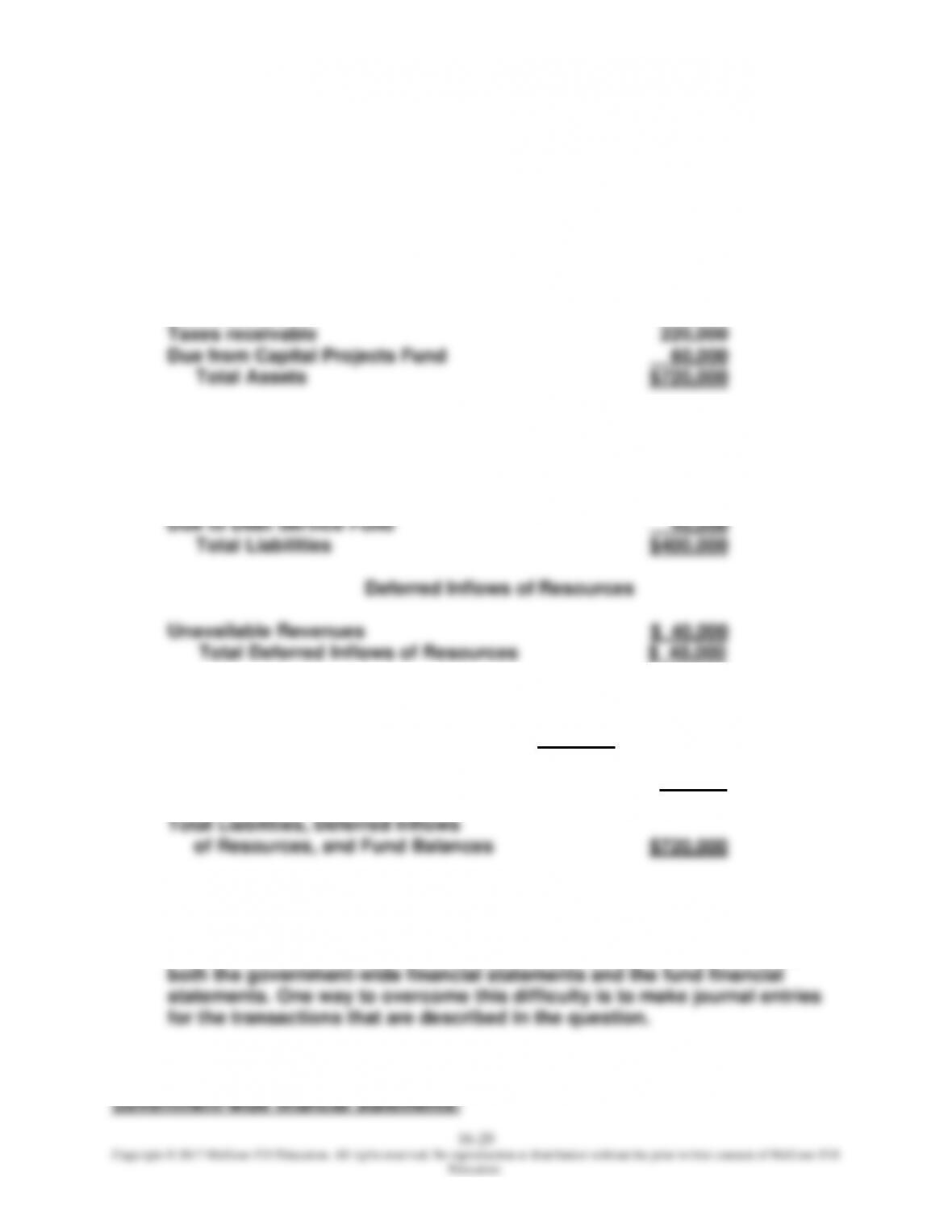
CITY OF JENNINGS
GENERAL FUND
Statement of Revenues, Expenditures, and Other Changes in Fund Balance
(Condensed)
Year Ending December 31, 2017
Revenues $ 760,000
Transfers in 50,000
Transfers out (470,000)
Total Other Financing Sources and Uses (120,000)
Chapter 16 – Accounting for State and Local Governments (Part One) – Hoyle, Schaefer, Doupnik, 13e
CITY OF JENNINGS
GENERAL FUND
Balance Sheet (condensed)
December 31, 2017
Assets
Cash $ 30,000
Investments 410,000
Liabilities
Accounts payable $ 90,000
Vouchers payable 180,000
Contracts payable 90,000
Fund Balances
Unassigned $280,000
Total Fund Balance 280,000
44. (40 Minutes) (Prepare government-wide and fund financial statements)
The most difficult aspect of this problem is gathering the information for
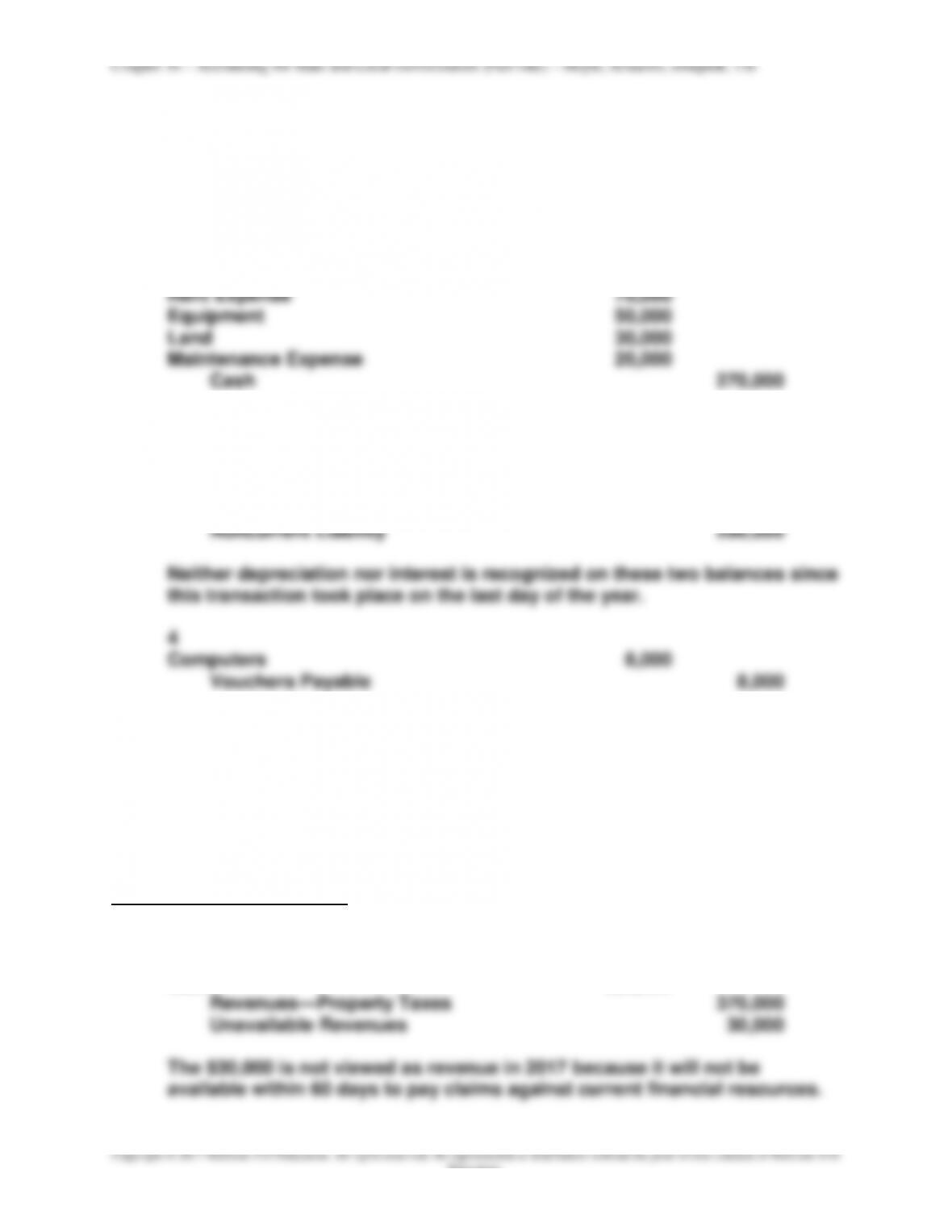
16-30
Education.
1
Property Tax Receivable 80,000
Cash 320,000
General Revenues—Property Taxes 400,000
2
Salary Expense 100,000
Depreciation Expense 10,000
Accumulated Depreciation—Equipment 10,000
3
Building 200,000
No depreciation is recognized on the computer since this transaction
occurred on the last day of the year.
5
Cash 3,000
Program Revenues—Student Fees 3,000
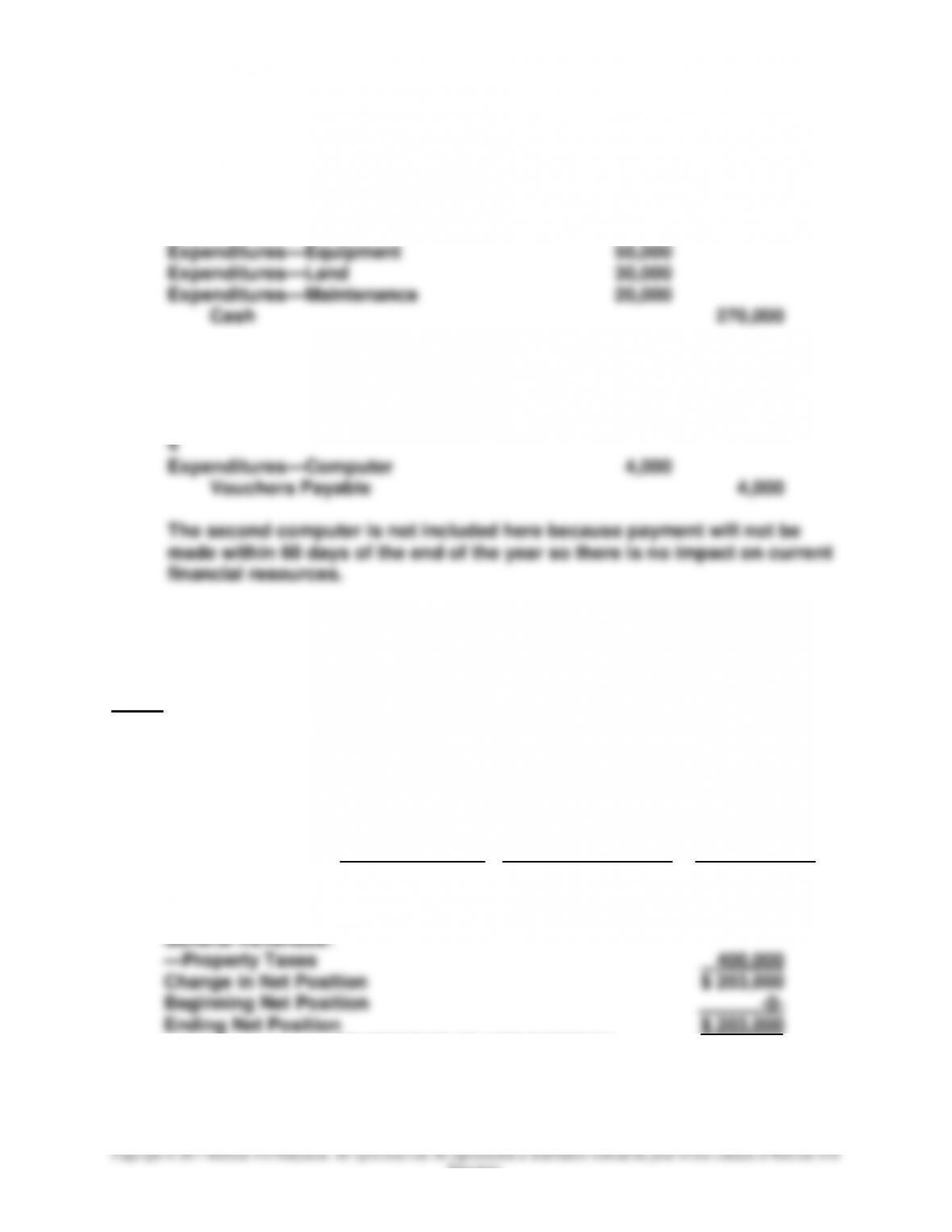
Fund financial statements:
1
Property Tax Receivable 80,000
Cash 320,000
Chapter 16 – Accounting for State and Local Governments (Part One) – Hoyle, Schaefer, Doupnik, 13e
16-31
Education.
This balance is not reported as a liability because there is no chance of
repayment. Instead, it is a deferred inflow of resources.
2
Expenditures—Salaries 100,000
Expenditures—Rent 70,000
3
No entry is made on the building acquisition since there was no impact on
current financial resources.
5
Cash 3,000
Revenues—Student Fees 3,000
Part a
GOVERNMENT-WIDE FINANCIAL STATEMENTS
STATEMENT OF ACTIVITIES
For the Year Ended December 31, 2017
Governmental
Activities
Direct Expenses Program Revenues (net expense)
Governmental Activities:
—School System $200,000 $3,000 $(197,000)
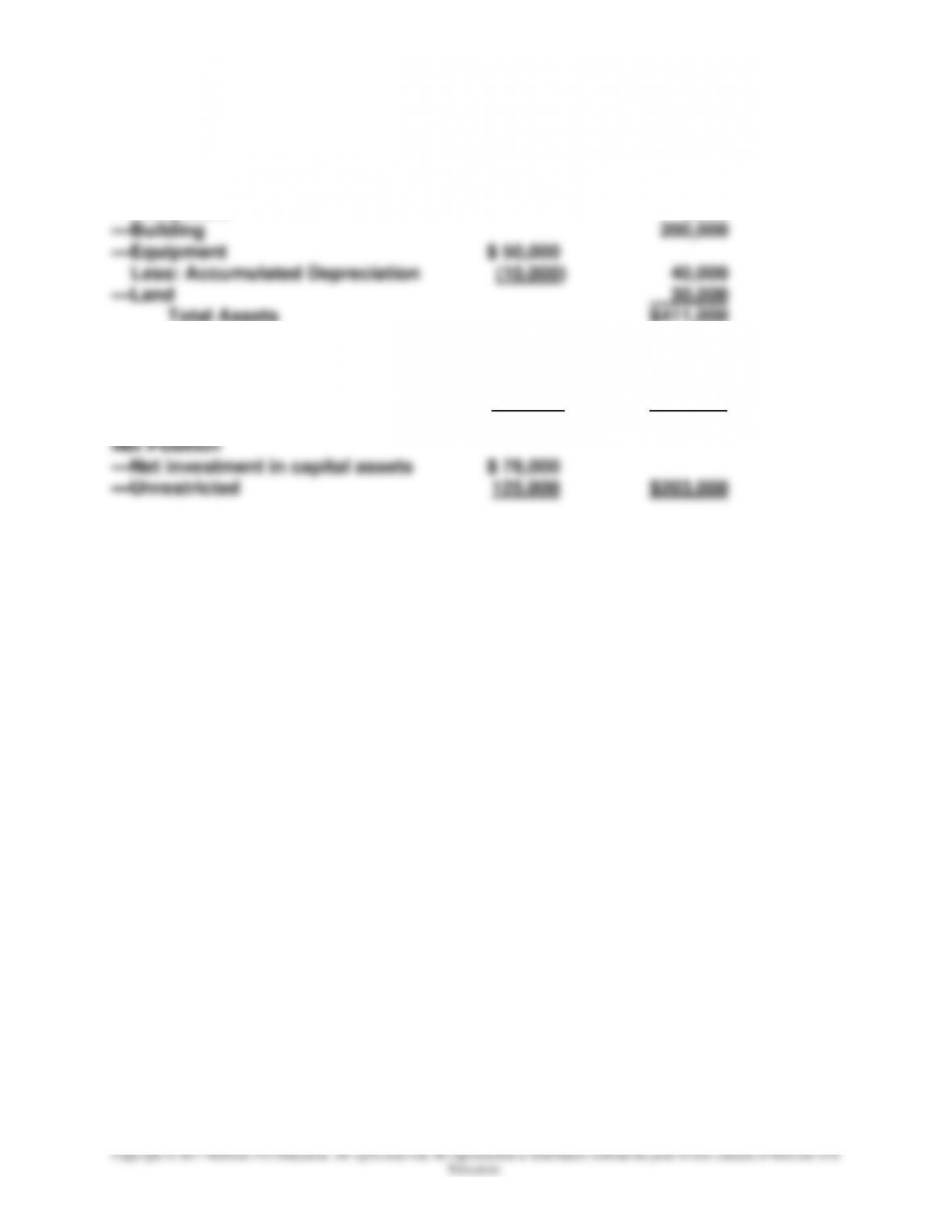
STATEMENT OF NET POSITION
December 31, 2017
Governmental
Chapter 16 – Accounting for State and Local Governments (Part One) – Hoyle, Schaefer, Doupnik, 13e
16-32
Activities
Assets
—Cash $53,000
—Property Tax Receivable 80,000
—Computers 8,000
Total Assets $411,000
Liabilities
—Vouchers Payable $ 8,000
—Long-Term Liabilities 200,000 $208,000
Part b — FUND FINANCIAL STATEMENTS
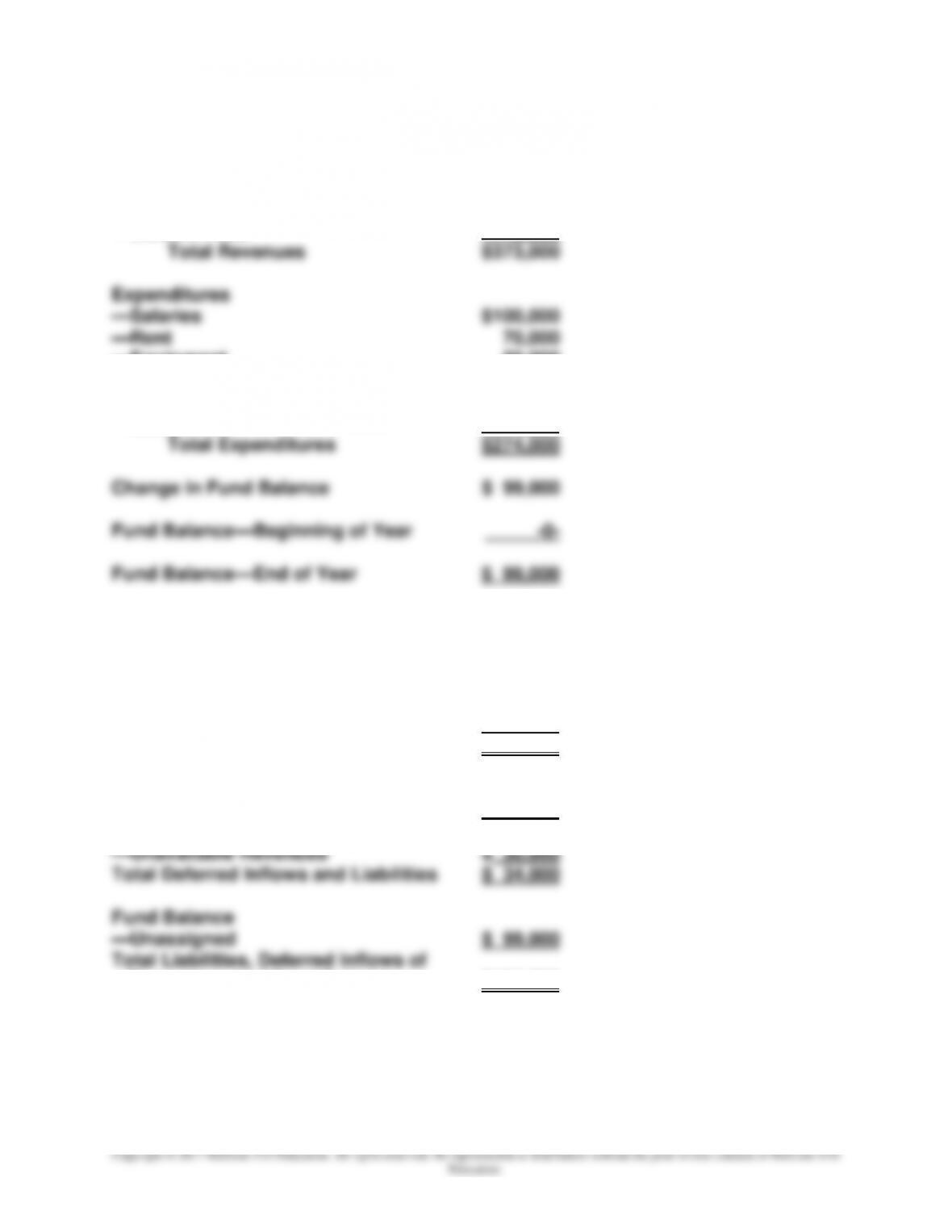
STATEMENT OF REVENUES, EXPENDITURES
AND CHANGES IN FUND BALANCE
Chapter 16 – Accounting for State and Local Governments (Part One) – Hoyle, Schaefer, Doupnik, 13e
16-33
For the Year Ended December 31, 2017
General Fund
Revenues
—Property Taxes $370,000
—Student Fees 3,000
—Equipment 50,000
—Land 30,000
—Maintenance 20,000
—Computer 4,000
BALANCE SHEET
December 31, 2017
General Fund
Assets
—Cash $ 53,000
—Property Tax Receivable 80,000
Total Assets $133,000
Liabilities
—Voucher Payable $ 4,000
Deferred Inflows of Resources
Resources, and Fund Balance $133,000
45. (25 Minutes) (Assessing the impact of various government transactions.)
a. This statement is false. Internal service funds are included in
governmental accounting within the proprietary funds. However, most internal
service funds are reported in government-wide financial statements as
Chapter 16 – Accounting for State and Local Governments (Part One) – Hoyle, Schaefer, Doupnik, 13e
16-34
Copyright © 2017 McGraw-Hill Education. All rights reserved. No reproduction or distribution without the prior written consent of McGraw-Hill
Education.
governmental activities. Therefore, the proprietary funds will almost always be
larger than the business-type activities.
b. This statement is false because not enough information is available to
say that this fund “must be” reported as a major fund. The asset balance
($32,000) for this governmental fund is larger than 10 percent of the total assets
held by all governmental funds ($300,000). This is one of the criteria for being
judged a major fund. (The same threshold can also be used with liabilities,
available to make the required determination.
c. This statement is false. If (a) the user charge is the sole security for
the debts of the bus system or (b) the activity’s costs are required to be
recovered through the fee or (c) the fee is set to recover the activity’s costs, then
reporting as an Enterprise Fund is required. Otherwise, if a user charge is
anticipated surplus and a debit is an anticipated deficit), estimated revenues are
debited and appropriations are credited.
e. This statement is false. To record a budget so that the projected
increase or decrease in fund balance will be obvious (a credit is an anticipated
surplus and a debit is an anticipated deficit), estimated revenues are debited and
recorded as an expenditure. Three years of insurance has been bought but only
one year has been used. The expenditure is larger for the purchase method.
g. This statement is true. Income taxes and sales taxes are both derived
tax revenues because the tax is assessed based on a specific event (the earning
of income or the making of a sale).
Chapter 16 – Accounting for State and Local Governments (Part One) – Hoyle, Schaefer, Doupnik, 13e
Education.
the time of the underlying event (the earning of income). Therefore, the revenue
is recognized in Year Five and is $98,000, the amount expected to be collected.
i. This statement is false. The encumbrance (commitment) is removed
and an expenditure and liability is then recognized. However, the encumbrance is
This amount should be recorded as a “fund balance – assigned” to reflect the
difference in this level of authority.
k. This statement is false. This is an intra-activity transaction between
two governmental funds. Total balances for the governmental activities are not
46. (25 Minutes) (The handling of various government transactions.)
a. This statement is false. This transfer is an internal exchange
transaction; it is payment for work done. Because the purchase and sale of
printing services was the same as with an outside party, the transaction will be
handled in that way. The school system records an expenditure rather than an
Year Five because these resources come from an imposed nonexchange revenue
that cannot be used until Year Six. No change in fund balance occurs in Year
Five.
d. This statement is false. The $5,000 cannot be used at this time.
However, revenue recognition will occur after the passage of time. The
Chapter 16 – Accounting for State and Local Governments (Part One) – Hoyle, Schaefer, Doupnik, 13e
16-36
Education.
balance – nonspendable figure is appropriate. Use of the $480,000 (the
subsequent income) has been restricted by an outside party and is labeled as a
h. This statement is false. All eligibility requirements have been met and
the money will be received within 75 days of the end of the year. It is revenue
recognized on both government-wide financial statements and fund financial
statements.
47. (25 Minutes) (Prepare a statement of revenues, expenditures, and other
changes in fund balance)
a.
Cash 700,000
Property Taxes Receivable 100,000
Revenues—Property Taxes 750,000
b.
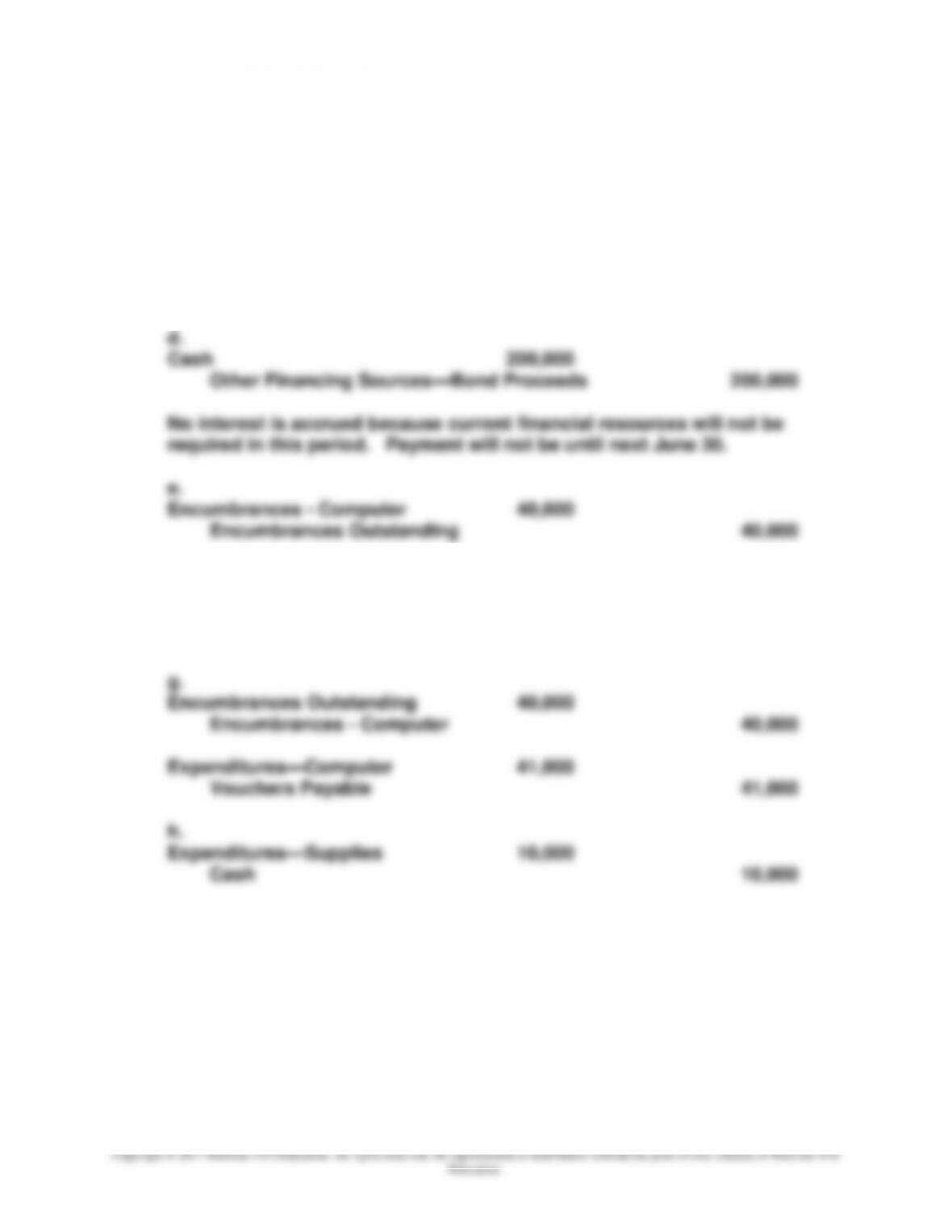
Expenditures—Police Cars 200,000
Cash 200,000
Chapter 16 – Accounting for State and Local Governments (Part One) – Hoyle, Schaefer, Doupnik, 13e
16-37
No depreciation is recorded on the police cars because fund financial
statements are being produced for the General Fund.
c.
Other Financing Uses—Transfers Out 90,000
Cash 90,000
Because the statements being prepared here are only for the General Fund,
the entry for the Debt Service Fund is not included.
f.
Expenditures—Salaries 40,000
Cash 30,000
Salary Payable 10,000
i.
Supplies 2,000
Fund Balance—Nonspendable 2,000
FUND FINANCIAL STATEMENTS
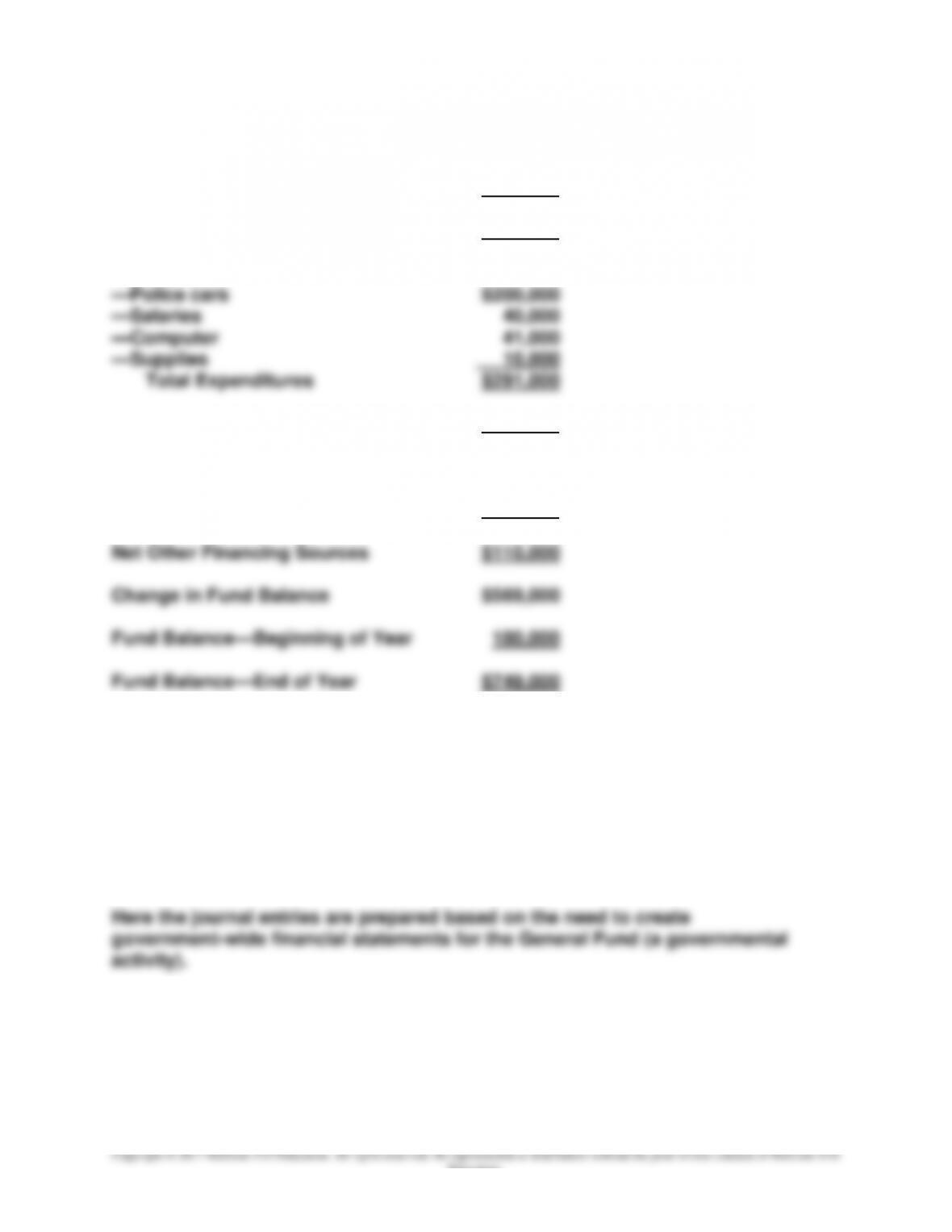
CITY OF LOST ANGELS
STATEMENT OF REVENUES, EXPENDITURES AND OTHER CHANGES IN FUND
BALANCE
Chapter 16 – Accounting for State and Local Governments (Part One) – Hoyle, Schaefer, Doupnik, 13e
16-38
Education.
For the Year Ended December 31, 2017
General Fund
Revenues
—Property Taxes $750,000
Total Revenues $750,000
Expenditures
Excess of revenues over expenditures $459,000
Other Financing Sources (Uses)
—Transfer to Debt Service Fund $(90,000)
—Issued Long-Term Bond 200,000
48. (25 Minutes) (Prepare a statement of net position for governmental
activities)
One way to approach this problem is to make the journal entries for the
transactions that are described as the basis for gathering information for the
financial statement to be produced.
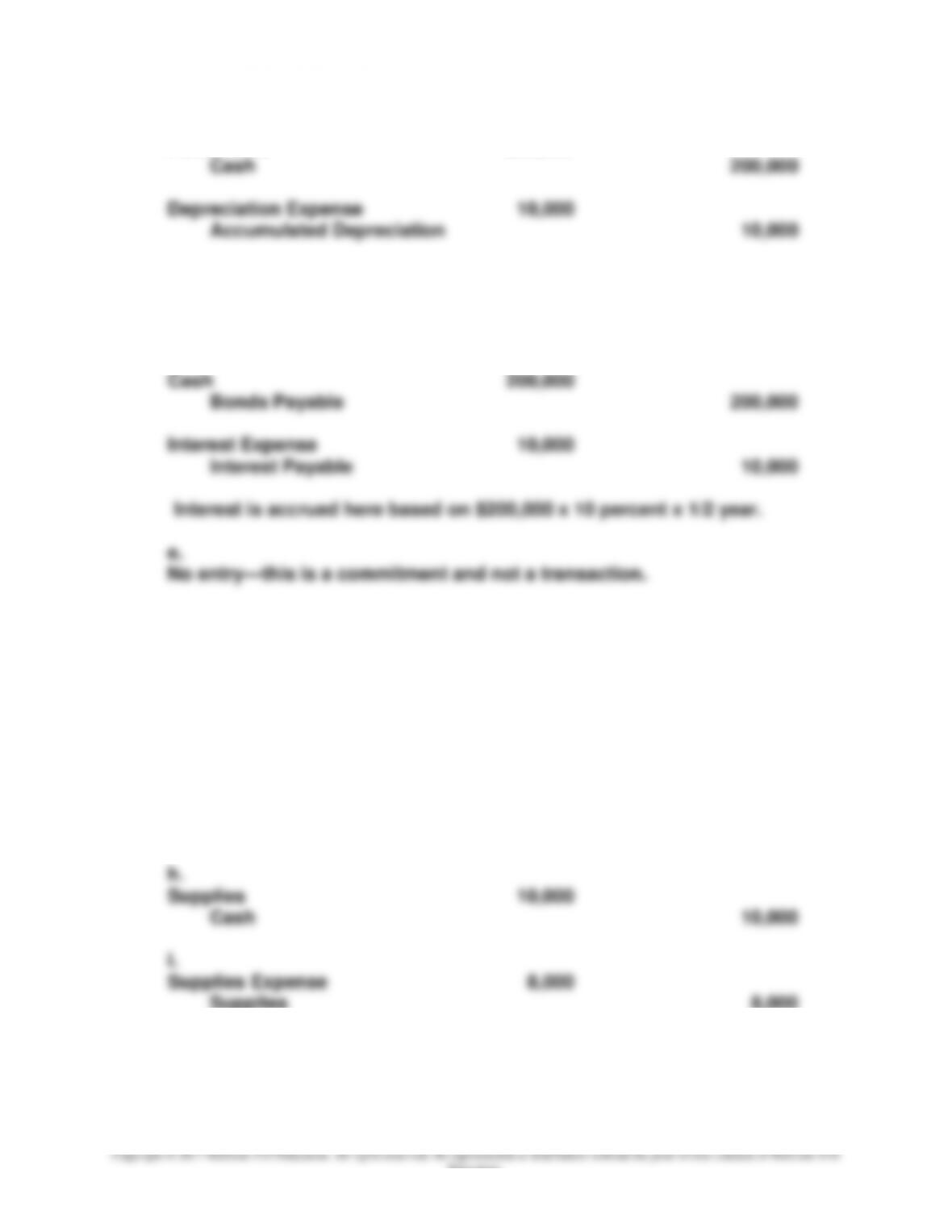
a.
Cash 700,000
Property Taxes Receivable 100,000
Property Tax Revenue 800,000
Chapter 16 – Accounting for State and Local Governments (Part One) – Hoyle, Schaefer, Doupnik, 13e
16-39
Education.
b.
Police Cars 200,000
c.
No entry is needed because no change occurs in the total net position of
the governmental activities. It is an intra-activity transaction.
d.
f.
Salary Expense 40,000
Cash 30,000
Salary Payable 10,000
g.
Computer 41,000
Vouchers Payable 41,000
Depreciation Expense 4,100
Accumulated Depreciation 4,100
Supplies 8,000
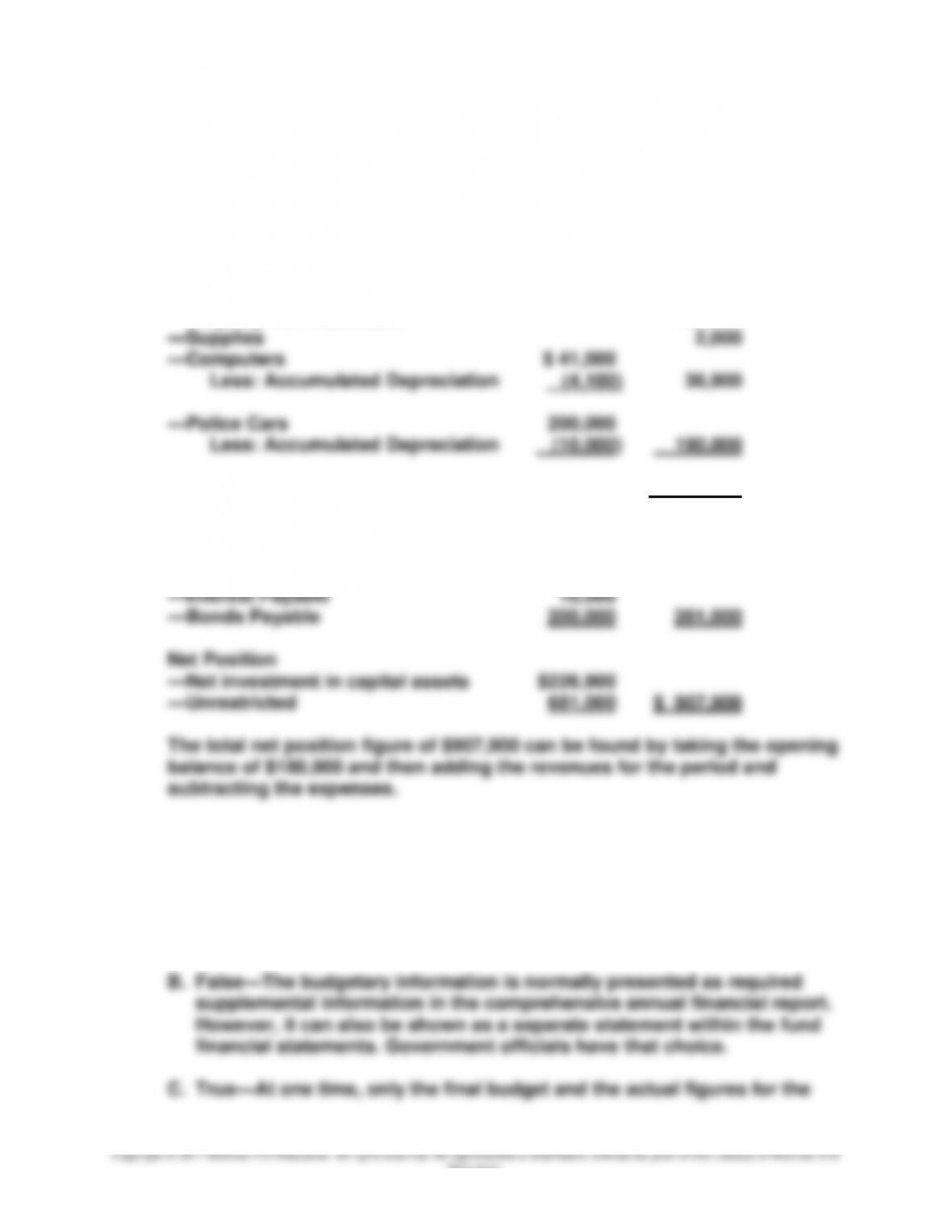
This problem indicates that the General Fund held $180,000 in cash at the start of
the year. The following account balances have been determined based on the
above journal entries.
Chapter 16 – Accounting for State and Local Governments (Part One) – Hoyle, Schaefer, Doupnik, 13e
16-40
Education.
GOVERNMENT-WIDE FINANCIAL STATEMENTS
CITY OF LOST ANGELS
STATEMENT OF NET POSITION
December 31, 2017 Governmental
Activities
Assets
—Cash $840,000
—Property Tax Receivable 100,000
Total Assets $1,168,900
Liabilities
—Vouchers Payable $41,000
—Salary Payable 10,000
49. (10 Minutes) (The budgetary process)
A. True—The initial approval of spending was $380,000 and that amount
should be recorded immediately. The budgetary entry debits Estimated
Revenues and credits Appropriations.