
Chapter 16 – Accounting for State and Local Governments (Part One) – Hoyle, Schaefer, Doupnik, 13e
16-1
Education.
CHAPTER 16
ACCOUNTING FOR STATE AND LOCAL GOVERNMENTS
(PART ONE)
Chapter Outline
I. State and local governments are different than for-profit entities in a number of specific
ways.
A. Governments serve a broader group of stakeholders.
B. Most government revenues are raised through involuntary taxes and tolls.
C. Monitoring compliance with budgeted public policy priorities is central to public
accountability.
D. Governments exist for a longer period of time than for-profit businesses.
E. The primary purpose of governments is to enhance or maintain the well-being of its
citizens.
II. State and local government units produce two complete and distinct sets of financial
statements.
A. User needs for governmental financial information are so diverse that the Governmental
Accounting Standards Board (GASB) requires two sets of statements to be prepared.
The fund financial statements are more for the citizens whereas the government-wide
statements are more for investors, such as bondholders.
B. Fund financial statements are designed primarily to present information about the
general fund and other major funds. This approach stresses the government’s fiscal
accountability over its financial resources.
a. For governmental funds, all current financial resources and claims to those financial
resources are presented using modified accrual accounting for timing purposes.
b. For proprietary funds and fiduciary funds, all economic resources are reported using
accrual accounting for timing purposes.
C. Government-wide financial statements (a statement of net position and a statement of
activities) are designed to present an overview of the government as a whole and they
emphasize operational accountability.
a. In these statements, all economic resources are measured using accrual accounting
for timing purposes.
b. Governmental funds and most of the internal service funds are combined and
reported together as governmental activities.
c. Enterprise funds and any remaining internal service funds are combined and
reported as business-type activities.
d. Because the government does not have control over the use of the assets held in the
fiduciary funds, they are excluded from the government-wide financial statements.
III. For internal purposes, governmental accounting records its individual activities within a
number of self-balancing sets of accounts known as funds.
A. Governmental funds account for activities where service to the public is the main
emphasis.
a. General fund
b. Special revenue funds

Chapter 16 – Accounting for State and Local Governments (Part One) – Hoyle, Schaefer, Doupnik, 13e
16-2
Education.
c. Capital projects funds
d. Debt service funds
e. Permanent funds
B. Proprietary funds account for activities of the government where a user charge is
assessed.
a. Enterprise funds
b. Internal service funds
C. Fiduciary funds account for assets held in a trustee capacity for external parties.
a. Investment trust funds
b. Private-purpose trust funds
c. Pension trust funds
d. Agency funds
IV. In reporting current financial resources and the claims to the current financial resources of a
governmental fund, the Fund Balance accounts indicate the use that can be made of these
resources by government officials.
A. Fund-Balance—Nonspendable – any amount of resources reported by a fund in this way
cannot be spent by government officials.
B. Fund-Balance—Restricted – any amount of resources reported by a fund in this way
must be spent in a manner designated by an external party.
C. Fund-Balance—Committed – any amount of resources reported by a fund in this way
has been designated for a particular purpose by the highest level of decision–making
authority in the government.
D. Fund-Balance—Assigned – any amount of resources reported by a fund in this way has
been designated for a particular purpose internally but not by the highest level of
decision-making authority.
E. Fund-Balance—Unassigned – any amount of resources reported in this way has been
designated or otherwise restricted and can be spent at the discretion of government
officials. This balance is normally found only in the general fund because resources
appear in other funds only if there is an intended use.
V. Governmental accounting has traditionally stressed establishing control over current
financial resources to ensure appropriate usage of the public’s money.
A. Budgets are required to be approved by representatives of the governing body – for
example, city council, state legislature. When amendments are made to the budget, the
governing body has to approve them also.
B. Budgetary entries are recorded for a number of the activities monitored within the
governmental funds.
a. The entry is recorded at the start of the year and is then reversed to remove at the
end of the year.
b. Budget amendments may be recorded during the year.
C. Financial commitments (such as contracts and purchase orders) are recorded during
the year as encumbrances.
a. These entries help avoid overspending of appropriated amounts.
b. Encumbrances are removed from the records when the commitment becomes a
liability.
VI. In government-wide financial statements, an acquired capital asset is reported as a capital
asset and an incurred expense is reported as an expense in the same manner as a for-profit
business. However, in reporting the governmental funds within the fund financial
statements, the purchase of a capital asset, incurrence of an expense, and payment of a

Chapter 16 – Accounting for State and Local Governments (Part One) – Hoyle, Schaefer, Doupnik, 13e
16-3
Education.
noncurrent debt are all reported as “expenditures” to reflect the reduction in current financial
resources. Through this reporting, the statements indicate the usage made of the current
financial resources held by the government.
A. Within the fund financial statements, supplies and prepaid items can be reported by
either the consumption method (expenditure is recorded as the item is consumed) or the
purchases method (expenditure is recorded when liability is first incurred). The
consumption method is required for the government-wide statements.
B. On the government-wide financial statements, acquisitions of infrastructure items —such
as bridges and sidewalks— are required to be recorded as capital assets.
VII. Governments often have nonexchange transactions where revenues such as taxes and
grants are received without a corresponding earning process. To guide the timing of
recognition of such transactions, four separate categories have been identified.
A. Derived tax revenues—such as income taxes and sales taxes—are recognized when the
underlying event that is taxed takes place.
B. Imposed nonexchange transactions—such as property taxes, fines, and penalties—are
recognized as revenues when the resources are required to be used or in the first period
when use is permitted.
C. Government-mandated nonexchange transactions (usually a government grant to fulfill a
legally required objective) are recognized when all eligibility requirements have been
met.
D. Voluntary nonexchange transactions—such as most grants and gifts—are recognized
when all eligibility requirements have been met.
VIII. Governments often raise significant amounts of financial resources by issuing long-term
bonds.
A. In the government-wide financial statements, the debt is a liability that will appear on the
Statement of Net Position.
B. In the fund financial statements for the governmental funds, the inflow of financial
resources is reported as an “other financing source.” Eventual payment of the debt is
shown as an expenditure. Noncurrent debt balances are not shown in the fund financial
statements of the governmental funds.
IX. Transfers are separated into three categories: intra-activity transactions, interactivity
transactions, and internal exchange transactions.
Answer to Discussion Question
Is it an Asset or a Liability?
Even after more than 20 years, Mautz’s comments go straight to the problem posed by
government accounting. State and local governments are just fundamentally different than for–
profit businesses.
Chapter 16 – Accounting for State and Local Governments (Part One) – Hoyle, Schaefer, Doupnik, 13e
16-4
Discussing the construction of a new high school building is an excellent example of the
essential accounting problems created by a government’s unique perspective. The decision to
build this facility virtually assures the government that it will incur significant cash outflows for
reduction in current financial resources is the focus of one statement whereas the cost of
construction is shown as an asset in the other set of statements.
Prior to class discussion, students can be asked to read Mautz’s entire article as additional
background information. In class, students can be encouraged to discuss whether showing this
Answers to Questions
1. Individuals and groups who seek information about a state or local government have needs
that are often complex and contradictory. Specific procedures in the governmental reporting
process are an outgrowth of those needs. Three primary user groups have been identified:
results in the production of two distinct types of financial statements.
2. Accountability and control have been a constant goal of governmental accounting over the
decades. Governmental accounting provides the citizenry of a democracy with a method for
evaluating the essential government activities of raising and allocating resources. Elected
3. The traditional approach of government accounting places its priority on individual
accountability for the various separate government activities. Unfortunately, the resulting
information has not necessarily met all user needs (especially the needs of bond investors
4. Two financial statements make up the government-wide financial statements: The
Statement of Net Position and the Statement of Activities. There are a number of fund
Chapter 16 – Accounting for State and Local Governments (Part One) – Hoyle, Schaefer, Doupnik, 13e
16-5
Copyright © 2017 McGraw-Hill Education. All rights reserved. No reproduction or distribution without the prior written consent of McGraw-Hill
Education.
financial statements. The two fundamental financial statements covered in the current
chapter are the Balance Sheet for the governmental funds and the Statement of Revenues,
Expenditures, and Other Changes in Fund Balances for the governmental funds. Additional
fund financial statements will be introduced in the following chapter.
5. In fund accounting, governmental funds use the current financial resources measurement
focus and the modified accrual basis for the timing of revenue and expense recognition.
Current financial resources include assets such as cash, receivables, and investments that
can be used for spending. Reported liabilities are ones to be paid from current resources.
Proprietary and fiduciary funds generally use the economic resources measurement focus
and the accrual basis for the timing of revenue and expense recognition. The economic
6. Government-wide financial statements use the economic resources measurement focus and
7. Current financial resources are primarily cash, investments, and receivables because they
8. Liabilities are recognized under the current financial resources focus when a claim against
current financial resources is created. That normally means that a debt is owed and
9. Governmental Funds: Account for activities with a service orientation
a. General Fund
b. Special Revenue Fund
c. Capital Projects Fund
Chapter 16 – Accounting for State and Local Governments (Part One) – Hoyle, Schaefer, Doupnik, 13e
d. Agency Fund
10. The following fund types fall within the governmental funds classification:
a. The General Fund is used to account for ongoing activities such as public safety and
sanitation. More specifically, the General Fund records any activities that do not fall
under one of the other fund types.
11. The following fund types fall within the proprietary funds classification:
a. An Enterprise Fund accounts for any governmental activity that is open to the public and
financed in whole or in part by user charges, such as a subway system or a toll road.
12. Fiduciary Funds: Account for monies held by the government in a trustee capacity.
a. Investment Trust Fund. Accounts for the outside portion of investment pools where the
reporting government has accepted funds from other governments resulting in a larger
investment and hopefully a higher return.
13. In government-wide financial statements, financial figures are shown as either governmental
activities or business-type activities. All governmental funds and most internal service funds
are included within the governmental activities. All enterprise funds and any remaining
Chapter 16 – Accounting for State and Local Governments (Part One) – Hoyle, Schaefer, Doupnik, 13e
16-8
Education.
20. Modified accrual accounting recognizes expenditures when a claim against the current
21. Within the governmental funds, fund financial statements focus on expenditures rather than
expenses or capital assets. Expenditures should be recorded when the related liability is
22. Traditionally, in government accounting, the purchases method has been used for prepaid
items and supplies. The cost is recorded immediately as an expenditure when the liability is
incurred. Any assets that remain at the end of the period are inserted into the records along
with an offsetting increase to “Fund Balance-Nonspendable.”
23. The four classifications of nonexchange revenues that a state or local government can
recognize are:
a. Derived tax revenues. A tax assessment is levied because an underlying exchange
takes place. The revenue is recorded at the time of the underlying event. For example,
revenues are recognized for a sales tax when a sale occurs and the tax is imposed.
are recognized when all eligibility requirements have been met.
d. Voluntary nonexchange transactions. Monies conveyed willingly to a state or local
government by an individual, another government, or an organization usually for a
specific purpose but without legally mandated requirements. Revenues are recognized
Chapter 16 – Accounting for State and Local Governments (Part One) – Hoyle, Schaefer, Doupnik, 13e
16-9
Education.
when all eligibility requirements have been met. An example would be money donated
to the city for the beautification of the local parks.
24. A receivable is not recorded for property taxes until the demand for money represents an
enforceable legal claim, which is normally specified by state or local laws. Many
governments encourage early payment of property taxes (by sending out bills early or by
giving some type of a cash discount). Thus, cash can actually be reported before the
government even records the initial receivable.
25. No revenues are recognized in either set of financial statements because the proceeds of
bonds must be repaid. In fund financial statements, Cash is increased along with an “Other
Financing Sources” figure. For example, if the bonds were issued for a construction project,
this entry is recorded in the Capital Projects Fund. Payments of both interest and debt are
26. A special assessment project is an improvement made to property by a government, which
is paid for in part or in whole by the owners of the property being benefited. Adding curbing
and sidewalks to a local street is an example of a special assessment if the residents of that
street are required to pay a portion of the cost. Typically, the government places a lien on
the property to insure payment.
Even if the government has liability, the infrastructure asset and long-term debt are not
recorded in the fund financial statements. Instead, expenditures for the work are recorded
16-10
Education.
in a Capital Projects Fund while cash collected from citizens is recorded as revenue and
accumulated in a Debt Service Fund to pay off any amount borrowed to finance the work.
27. In fund financial statements, interfund transactions are recorded in both funds
simultaneously at the time of authorization. For example, monetary transfers from the
General Fund to another fund such as the Debt Service Fund are recorded in both funds.
28. Intra-activity transactions occur totally within the governmental activities or totally within the
business-type activities so that no net effect is created for that group of funds. Therefore,
these transfers do not appear in the reporting of government-wide financial statements.
29. An internal exchange transaction is a transfer within the government that is recorded as if
the transaction had actually occurred with an outside party. Such transactions occur
between one of the government’s activities and an internal service or enterprise fund and
are paid for work or services rendered. These exchanges are reported as revenues and as
Chapter 16 – Accounting for State and Local Governments (Part One) – Hoyle, Schaefer, Doupnik, 13e
Answers to Problems
1. B (Internal service fund is a proprietary fund)
5. A (The term “interperiod equity” refers to incurring a cost in one period that
is paid for in a later period.)
7. D
statements.)
10. B (Because the assistant treasurer was not the highest level of decision–
making authority, his decision to use the money in this way was indicated by
the end of the year.)
12. B (As a governmental fund, the General Fund records expenditures rather
than expenses.)
16-13
Education.
24. C (As a noncurrent liability, the balance is not reported in the fund financial
statements.)
27. D (The transfer here is between a Government Activity and a Business-Type
Activity.)
30. D (This transaction was the same as might have occurred with an outside
party and is accounted for in the same manner.)
32. (5 Minutes) (Budgetary entries)
Beginning of Year-Recording of budget
GENERAL FUND
Estimated Revenues ……………………………………………. 1,000,000
Estimated Other Financing Sources—Bond Proceeds 400,000
End of Year-Removal of budget
GENERAL FUND
Appropriations ……………………………………………….. 900,000
Appropriations-Other Financing Uses—Operating
Transfers Out ……………………………………………… 300,000
Chapter 16 – Accounting for State and Local Governments (Part One) – Hoyle, Schaefer, Doupnik, 13e
16-14
Education.
33. (8 Minutes) (Order of a capital asset and subsequent receipt)
GOVERNMENT-WIDE FINANCIAL STATEMENTS
GOVERNMENT ACTIVITIES
Computer 89,400
Vouchers (or Accounts) Payable 89,400
the cost of the computer and cash has been reduced by the same amount.
FUND FINANCIAL STATEMENTS
GENERAL FUND
Encumbrances – Computer 88,000
Encumbrances Outstanding 88,000
Encumbrances Outstanding 88,000
Encumbrances – Computer 88,000
34. (10 Minutes) (Issuance of bond to finance construction project)
GOVERNMENT-WIDE FINANCIAL STATEMENTS
Chapter 16 – Accounting for State and Local Governments (Part One) – Hoyle, Schaefer, Doupnik, 13e
GOVERNMENT ACTIVITIES (Intra-activity transfer from the General Fund to
the Capital Projects Fund is not reported because Government Activities
totals are not affected.)
Issuance of Bonds
Cash 1,800,000
Bonds Payable 1,800,000
FUND FINANCIAL STATEMENTS
To Record Transfer
GENERAL FUND
Other Financing Uses—Transfers Out 90,000
Cash 90,000
CAPITAL PROJECTS FUND
Cash 90,000
Other Financing Sources—Transfers In 90,000
On the statement of revenues, expenditures, and other changes in fund
balance, the General Fund reports an other financing uses – transfer out of
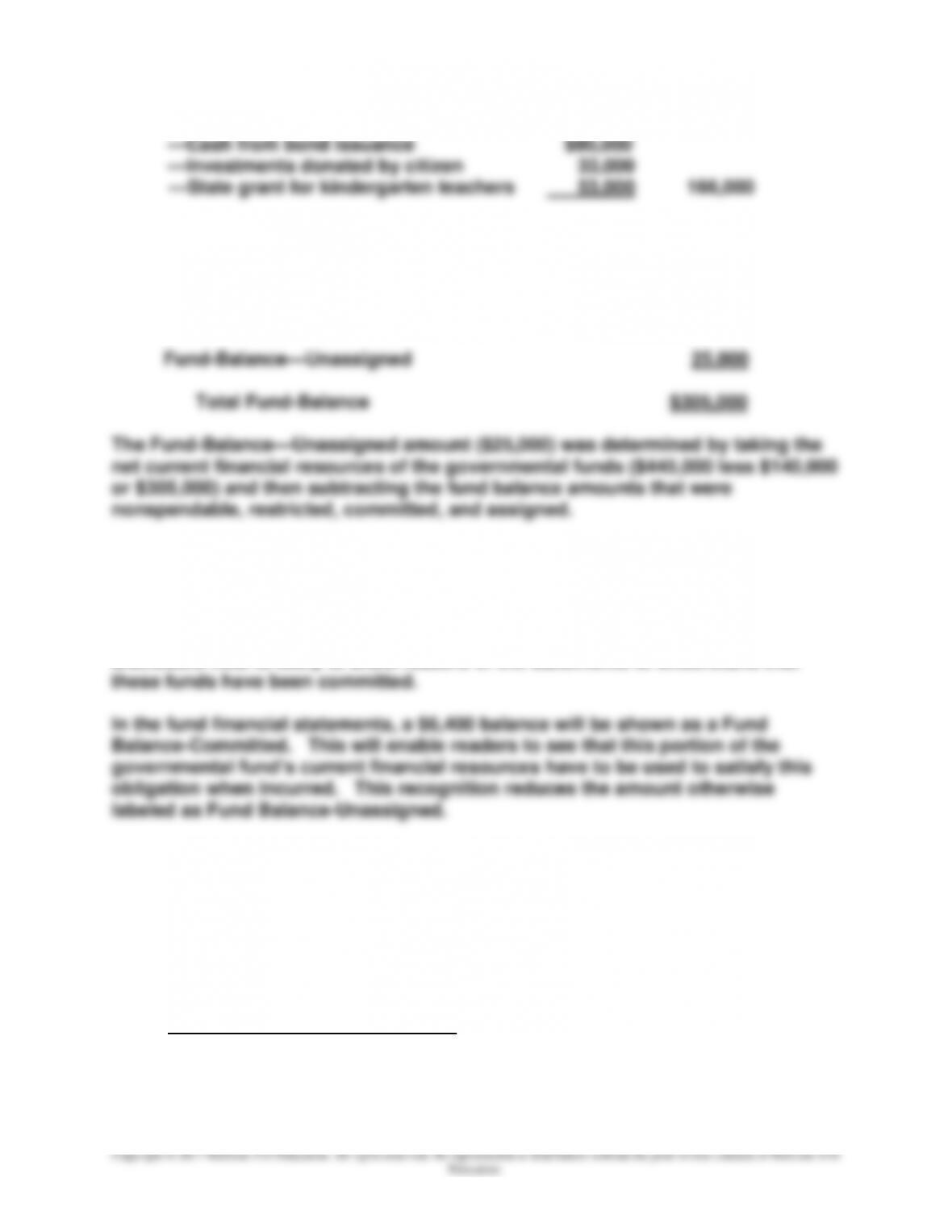
35. (12 Minutes) (Reporting of fund balance amounts)
Fund-Balance—Nonspendable
—Prepaid items $ 7,000
—Supplies 5,000 $ 12,000
Chapter 16 – Accounting for State and Local Governments (Part One) – Hoyle, Schaefer, Doupnik, 13e
16-16
Fund-Balance—Restricted
Fund-Balance—Committed
—Cash to be used for renovation 62,000
Fund-Balance—Assigned
—Cash to upgrade roads 40,000
36. (8 Minutes) (Reporting of commitments)
In the government-wide financial statements, the commitment for this computer
will not be formally reported because no liability has yet been incurred. A
disclosure note is likely to allow readers of the statements to understand that
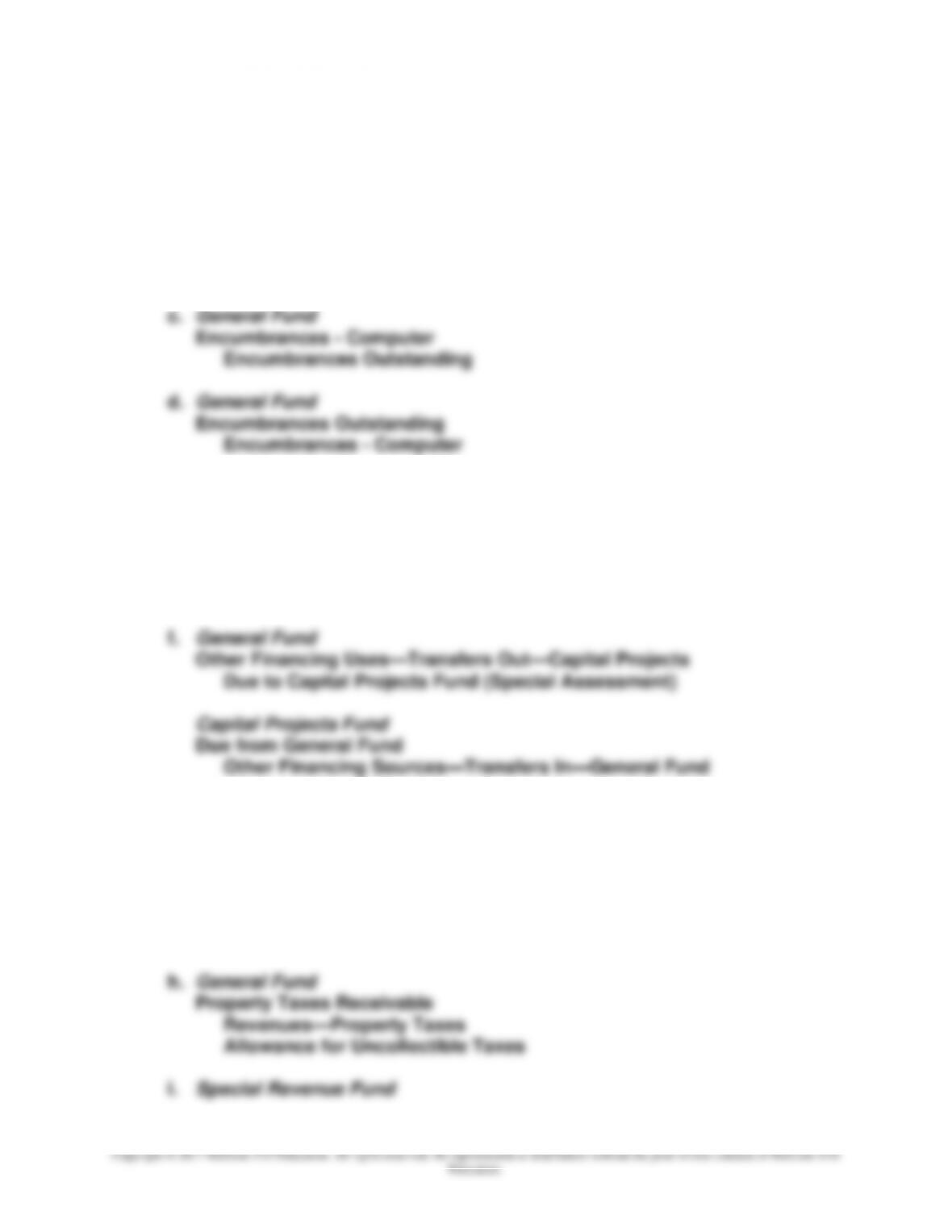
37. (20 Minutes) (Recording of basic journal entries)
FUND FINANCIAL STATEMENTS
a. General Fund
Estimated Revenues
Chapter 16 – Accounting for State and Local Governments (Part One) – Hoyle, Schaefer, Doupnik, 13e
16-17
Estimated Other Financing Sources
(Budgetary) Fund Balance
Appropriations
b. Capital Projects Fund (could also be recorded initially in the General
Fund with a subsequent transfer to the Capital Projects Fund)
Cash
Other Financing Sources—Bond Proceeds
Expenditures – Computer
Vouchers Payable
e. General Fund
Vouchers Payable
Cash
g. General Fund
Other Financing Uses—Transfers Out—Motor Pool
Cash
Internal Service Fund
Cash
Contributed Capital
Chapter 16 – Accounting for State and Local Governments (Part One) – Hoyle, Schaefer, Doupnik, 13e
16-18
Education.
Cash
Cash
Grant Revenue Collected in Advance
Revenues—Grant
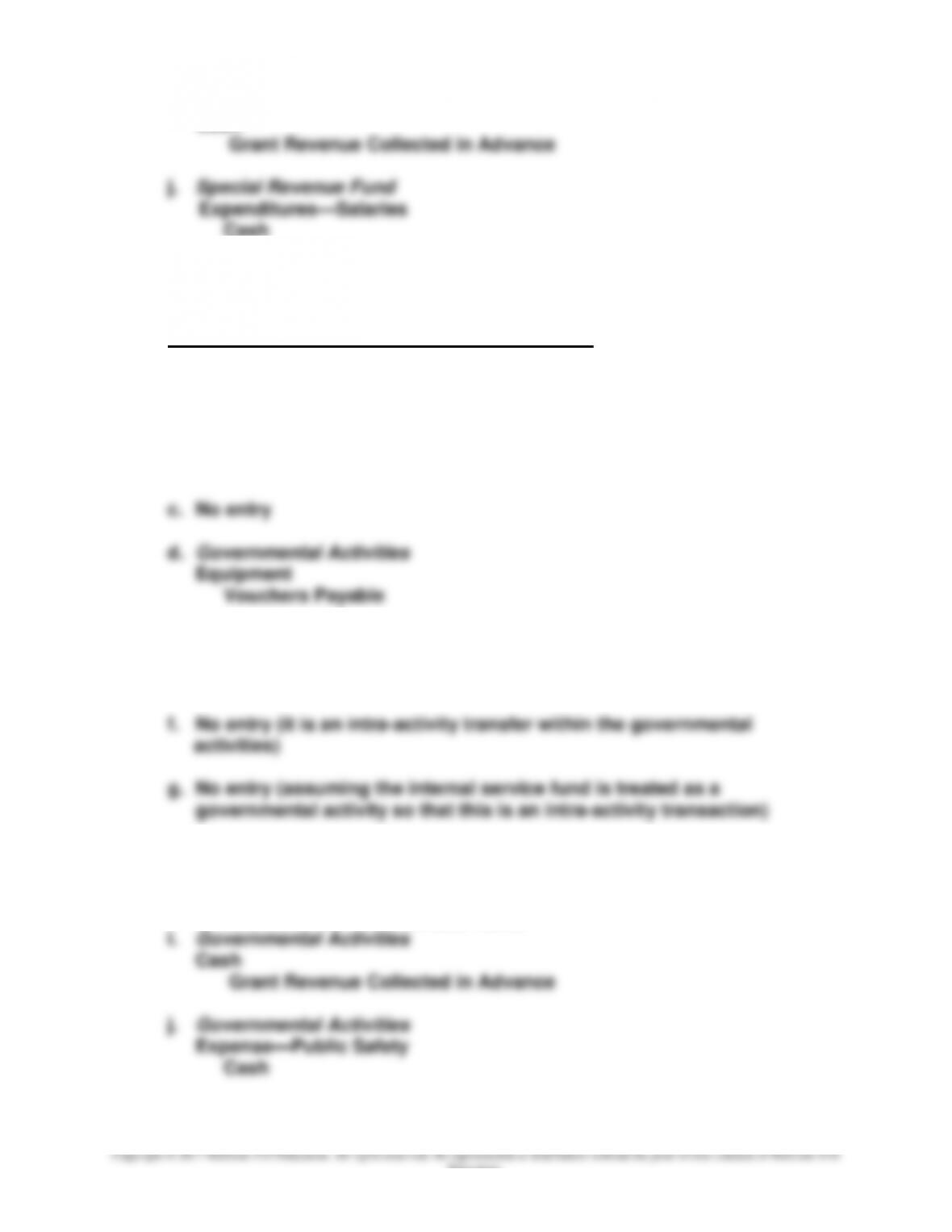
GOVERNMENT-WIDE FINANCIAL STATEMENTS
a. No entry
b. Governmental Activities
Cash
Bonds Payable
e. Governmental Activities
Vouchers Payable
Cash
h. Governmental Activities
Property Taxes Receivable
Revenues—Property Taxes
Allowance for Uncollectible Taxes
Chapter 16 – Accounting for State and Local Governments (Part One) – Hoyle, Schaefer, Doupnik, 13e
16-19
Education.
Revenue
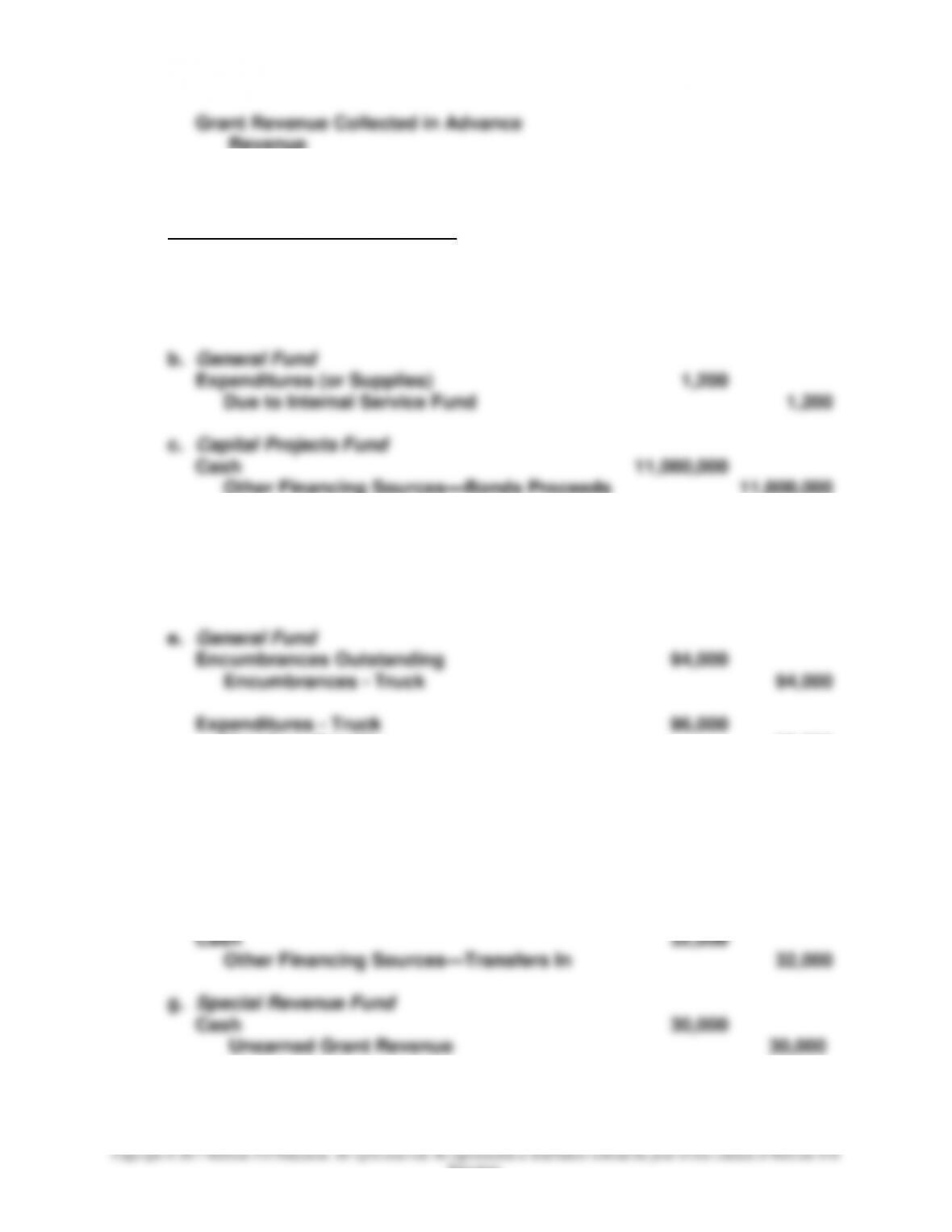
38. (16 Minutes) (Recording of basic journal entries)
FUND FINANCIAL STATEMENTS
a. General Fund
Encumbrances – Truck 94,000
Encumbrances Outstanding 94,000
Other Financing Sources—Bonds Proceeds 11,000,000
d. General Fund
Other Financing Uses—Transfers Out—
Swimming Pool 140,000
Cash 140,000
Vouchers Payable 96,000
f. General Fund
Other Financing Uses—Transfers Out 32,000
Cash 32,000
Capital Projects Fund
h. Special Revenue Fund
Chapter 16 – Accounting for State and Local Governments (Part One) – Hoyle, Schaefer, Doupnik, 13e
16-20
Copyright © 2017 McGraw-Hill Education. All rights reserved. No reproduction or distribution without the prior written consent of McGraw-Hill
Education.
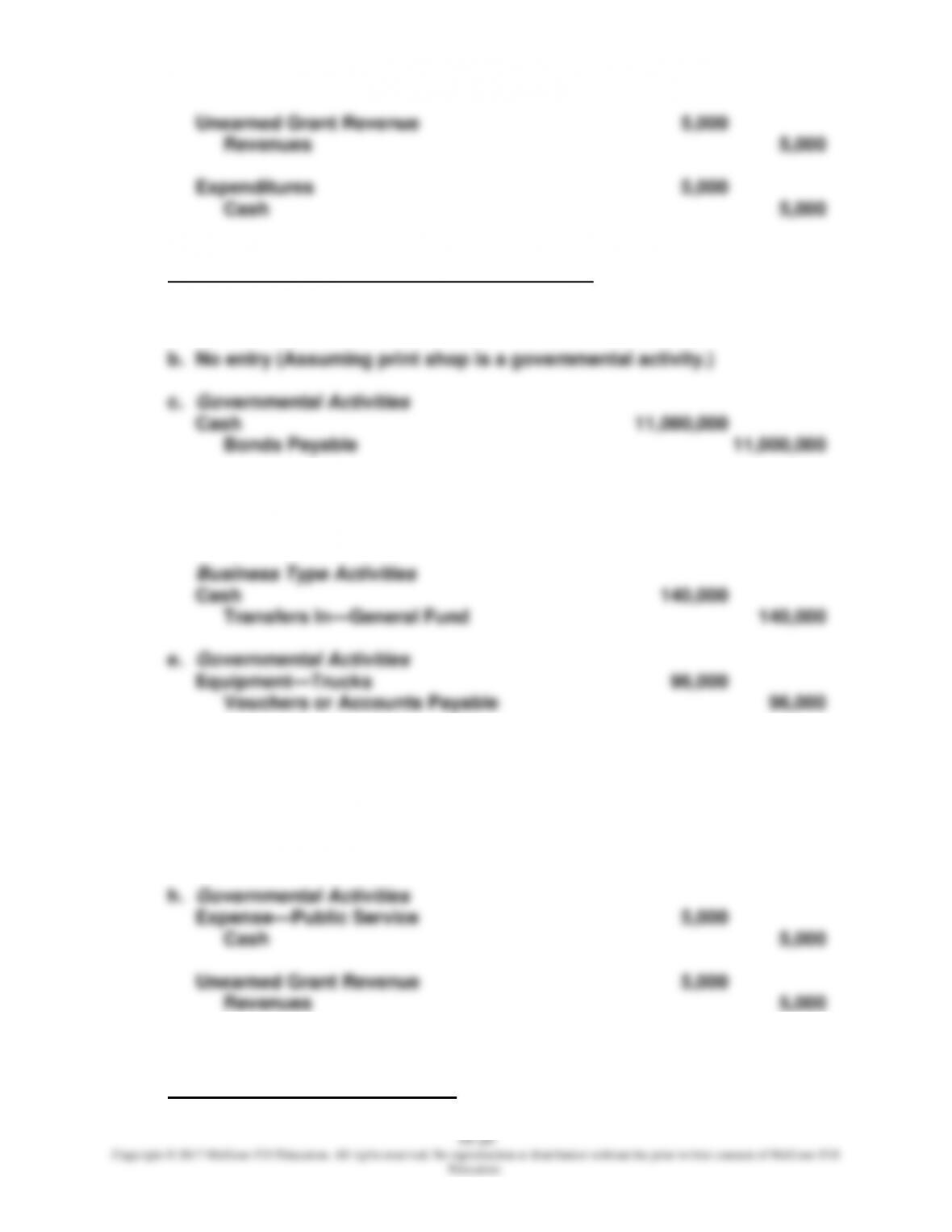
Unearned Grant Revenue 5,000
Revenues 5,000
Expenditures 5,000
Cash 5,000
GOVERNMENT-WIDE FINANCIAL STATEMENTS
a. No entry
d. Governmental Activities
Transfers Out—Swimming Pool 140,000
Cash 140,000
f. No entry – intra-activity transfer
g. Governmental Activities
Cash 30,000
Unearned Grant Revenue 30,000
39. (15 Minutes) (Prepare basic journal entries)
FUND FINANCIAL STATEMENTS