Chapter 15 – Partnerships: Termination and Liquidation
31. (continued)
Part B Preparation of Final Statement of Partnership Liquidation
FRICK, WILSON, AND CLARKE
Statement of Partnership Liquidation
Final Balances
Noncash
Frick,
Capital
Wilson,
Capital
Clarke,
Capital
Cash
Assets Liabilities 60% 20% 20%
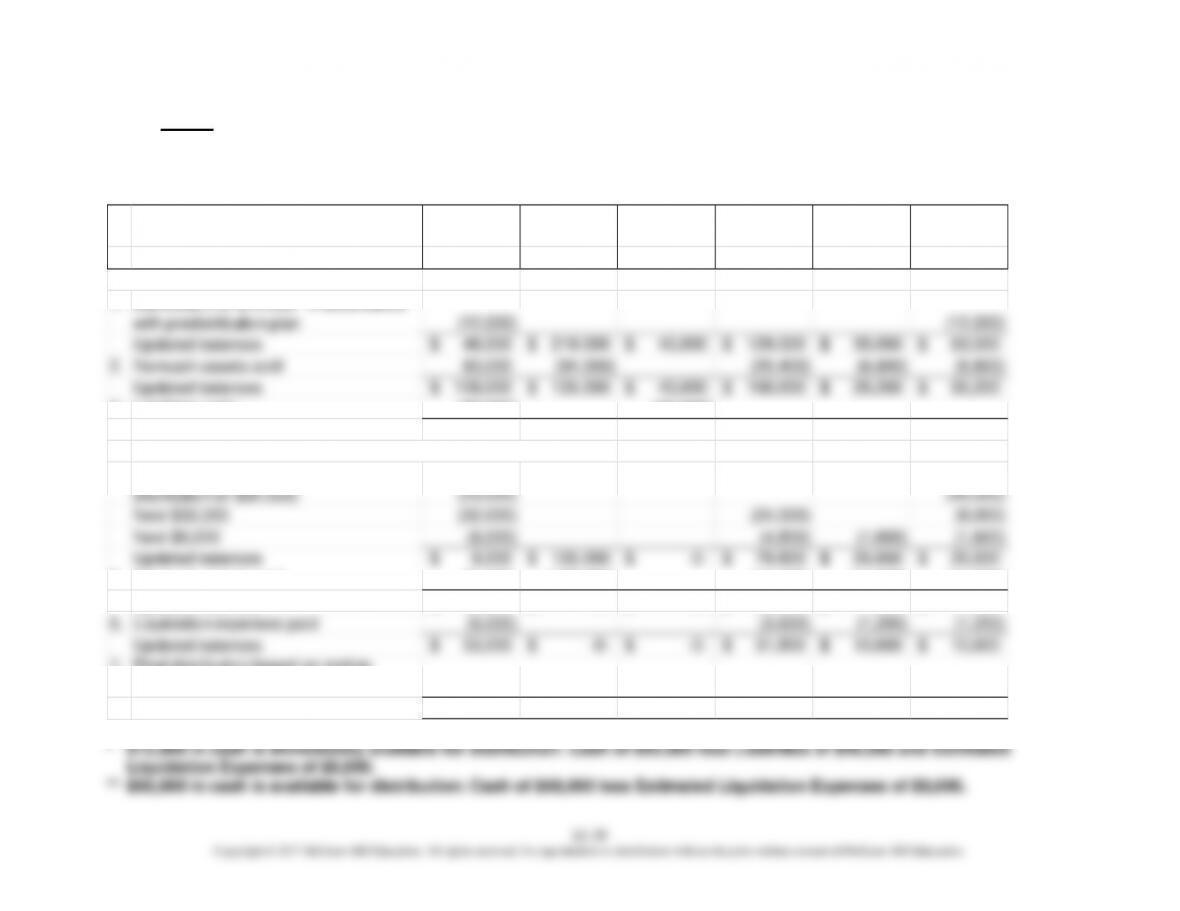
Beginning balances 60,000$ 219,000$ 40,000$ 129,000$ 35,000$ 75,000$
1.
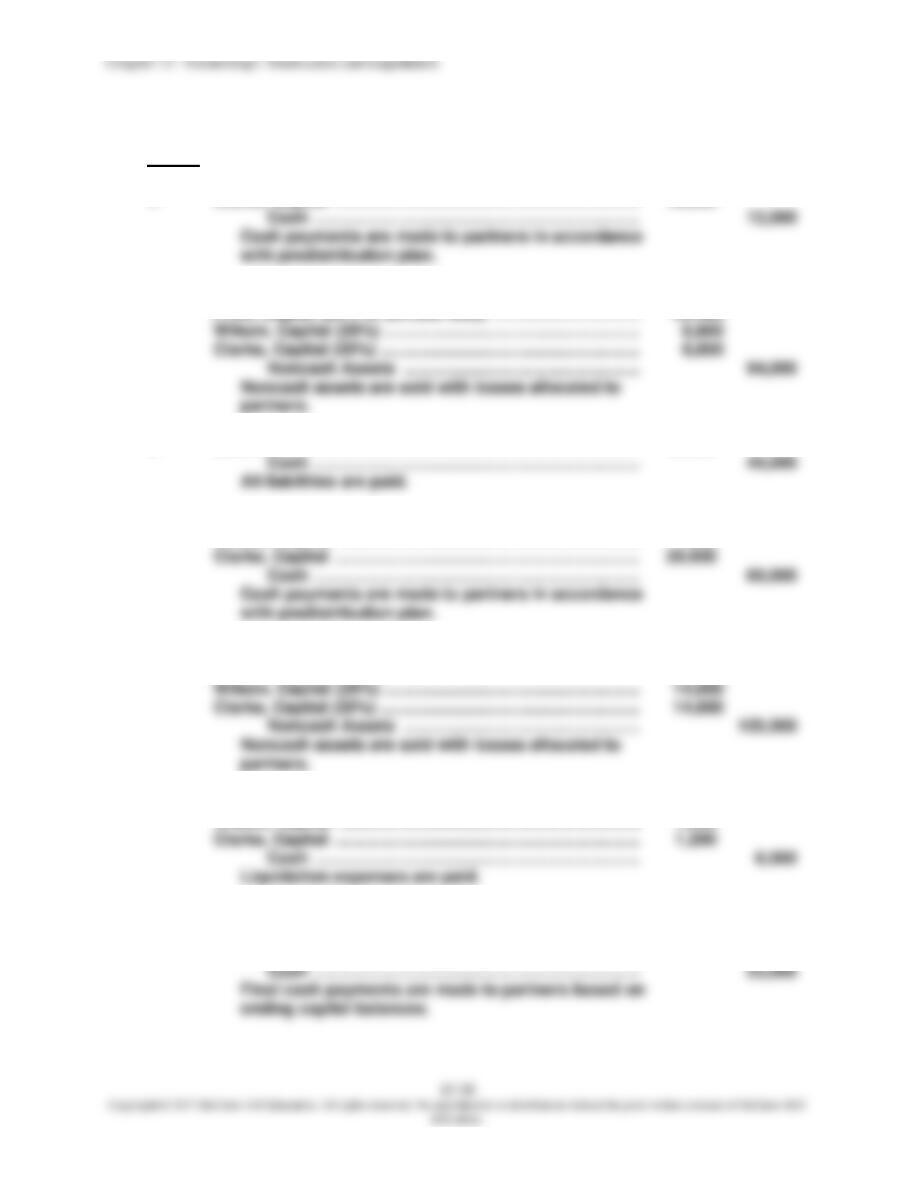
Distribution of $12,000* in accordance
with predistribution plan
(12,000) (12,000)
Updated balances 48,000$ 219,000$ 40,000$ 129,000$ 35,000$ 63,000$
2. Noncash assets sold 60,000 (94,000) (20,400) (6,800) (6,800)
Updated balances 108,000$ 125,000$ 40,000$ 108,600$ 28,200$ 56,200$
3. Liabilities paid (40,000) (40,000)
Updated balances 68,000$ 125,000$ $ –0- 108,600$ 28,200$ 56,200$
4. Distribution of $60,000** in accordance with predistribution plan –
First $20,000 (remainder of first
distribution of $32,000)
(20,000) (20,000)
Next $32,000 (32,000) (24,000) (8,000)
Next $8,000 (8,000) (4,800) (1,600) (1,600)
Updated balances 8,000$ 125,000$ $ –0- 79,800$ 26,600$ 26,600$
5. Noncash assets sold 51,000 (125,000) (44,400) (14,800) (14,800)
Updated balances 59,000$ $ –0- $ –0- 35,400$ 11,800$ 11,800$
6. Liquidation expenses paid (6,000) (3,600) (1,200) (1,200)
Updated balances 53,000$ $ –0- $ –0- 31,800$ 10,600$ 10,600$
7.
Final distribution based on ending
capital balances
(53,000) (31,800) (10,600) (10,600)
Ending balance $ –0- $ -0- $ –0- $ -0- $ -0- $ -0-
15-40
Education.
32. (continued)
Schedule 4
Rodgers,
Wingler, Norris, Loan and Guthrie,
Capital Capital Capital Capital
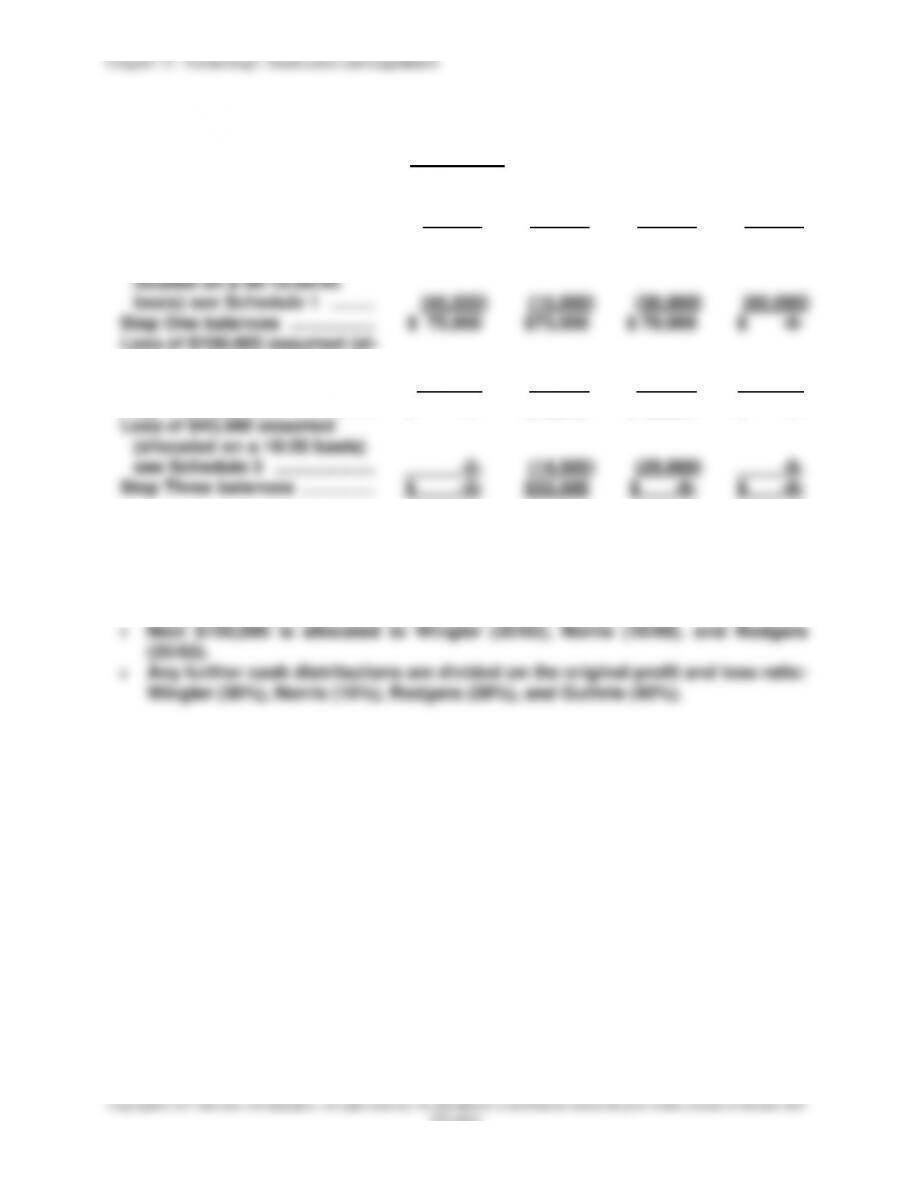
Beginning balances …………… $120,000 $88,000 $109,000 $60,000
Loss of $150,000 assumed (al–
located on a 30:10:20 basis)
see Schedule 2 ………………… (75,000) (25,000) (50,000) -0-
Step Two balances …………….. $ -0- $48,000 $ 29,000 $ -0-
PREDISTRIBUTION PLAN
• Payment of all liabilities and liquidation expenses must be assured.
• Next $33,500 goes entirely to Norris.
• Next $43,500 is allocated to Norris (10/30) and Rodgers (20/30).
15-41
Education.
32. (continued)
Part B Journal Entries
1. Cash ………………………………………………………………… 65,600
Wingler, Capital (30% of $16,400 loss) ……………….. 4,920
Norris, Capital (10%) …………………………………………. 1,640
2. Cash ………………………………………………………………… 150,000
Wingler, Capital (30% of $103,000 loss) ……………… 30,900
Norris, Capital (10%) …………………………………………. 10,300
3. Wingler, Capital ………………………………………………… 31,800
Norris, Capital ………………………………………………….. 58,600
Rodgers, loan …………………………………………………… 35,000
• First $90,000 is held to pay liabilities ($74,000) and estimated liquidation
expenses ($16,000); $140,600 is paid to partners.
Chapter 15 – Partnerships: Termination and Liquidation
32. b. (continued)
4. No journal entry is currently required by Guthrie’s insolvency.
5. Liabilities ……………………………………………….. 74,000
6. Cash ………………………………………………………. 71,000
Wingler, Capital (30% of $30,000 loss) ……… 9,000
7. Wingler, Capital ……………………………………….. 35,500
Norris, Capital …………………………………………. 11,833
Rodgers, Capital ……………………………………… 23,667
Cash …………………………..…………………. 71,000
of $134,600) is paid out on this 30:10:20 basis.
8. Wingler, Capital (30% of expenses)…………… 3,300
Norris, Capital (10%) ………………………………… 1,100
Liquidation expenses are paid.
9.a. Wingler, Capital (30/60 of deficit)………………. 2,080
Norris, Capital (10/60) ………………………………. 693
Rodgers, Capital (20/60) …………………………... 1,387
15-43
Education.
32. b. (continued)
CAPITAL ACCOUNT BALANCES
Rodgers,
Wingler, Norris, Loan and Guthrie,
Capital Capital Capital Capital
Beginning balances …………….. $120,000 $88,000 $109,000 $60,000
Loss on accounts receivable .. (4,920) (1,640) (3,280) (6,560)
Loss on land, building, and
equipment ……………………….. (30,900) (10,300) (20,600) (41,200)
Cash distribution ………………… (31,800) (58,600) (50,200) -0-
9.b. Wingler, Capital ……………………………………….. 2,500
Norris, Capital …………………………………………. 834
15-44
33. (40 minutes) (Prepare a predistribution plan and journal entries for a
partnership liquidation)
Part A Preparation of Predistribution Plan
Schedule 1
Maximum Loss
Capital Balance/ That Can Be
Partner Loss Allocation Absorbed
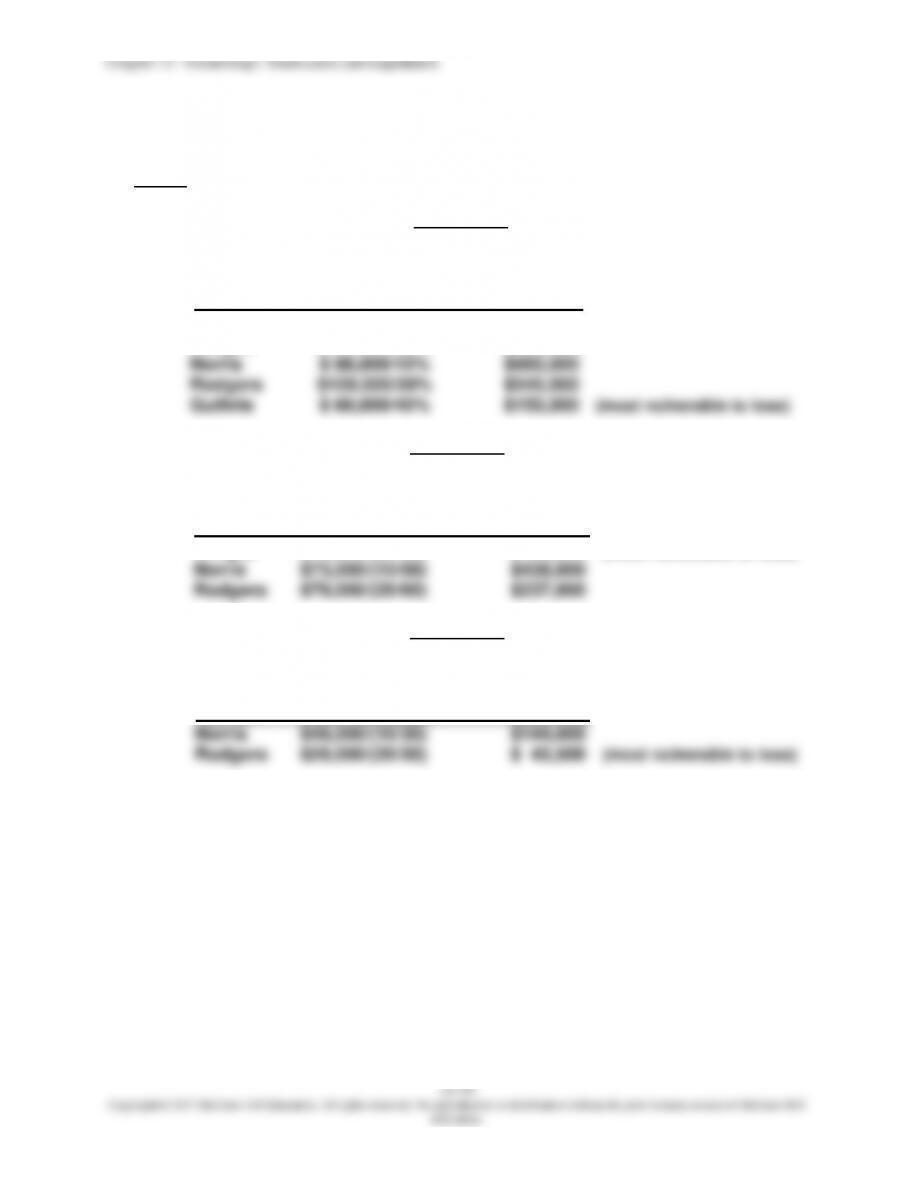
Butler $80,000/25% $320,000
Schedule 2
Maximum Loss
Capital Balance/ That Can Be
Partner Loss Allocation Absorbed
Butler $50,000/(25/75) $150,000
Schedule 3
Butler,
Loan and Osman, Ward
Capital Capital Capital
Beginning balances …………….. $80,000 $30,000 $70,000
PREDISTRIBUTION PLAN
• Payment of all liabilities and liquidation expenses must be assured.
• Next $45,000 goes entirely to Butler.
15-45
Education.
33. (continued)
Part B Journal Entries
1. Cash ………………………………………………………………… 54,000
Butler, Capital (25% of $6,000 loss) ……………………. 1,500
Osman, Capital (25%) ……………………………………….. 1,500
2. Cash ………………………………………………………………… 220,000
Butler, Capital (25% of $40,000 loss) ………………….. 10,000
Osman, Capital (25%) ……………………………………….. 10,000
3. Butler, Loan ………………………………………………………. 30,000
Butler, Capital ………………………………………………….. 30,000
• First $204,000 is held to pay liabilities ($170,000) and estimated liquidation
expenses ($34,000); $100,000 is paid to partners.
• Next $45,000 goes entirely to Butler.
Chapter 15 – Partnerships: Termination and Liquidation
15-46
Education.
33. (continued)
4. Liabilities ……………………………………………….. 170,000
5. Butler, Capital (25% of $30,000 in expenses) 7,500
Osman, Capital (25%) ………………………………. 7,500
6. Butler, Capital (25%) ………………………………… 1,000
Osman, Capital (25%) ………………………………. 1,000
CAPITAL ACCOUNT BALANCES
Butler,
Loan and Osman, Ward,
Capital (25%) Capital (25%) Capital (50%)
Beginning balances …………….. $80,000 $30,000 $70,000
Loss on accounts receivable .. (1,500) (1,500) (3,000)
Loss on sale of assets ………… (10,000) (10,000) (20,000)
15-47
Education.
Chapter 15 Develop Your Skills
Research Case
1. Students often seem to believe that definitive answers can be found for all
2. Several questions can be raised that may impact the ultimate resolution:
▪ In what state will the court case be handled? Different states have somewhat
different laws as to the potential liabilities incurred by partners and different
courts seem to have varying ways of interpreting those laws.
▪ How difficult was the surgery that was performed? Should the doctor have
should not be undertaken?
▪ What is meant in the case by the term “very poor judgment?” How serious
was the mistake made by the doctor?
The answers to such questions as these can have a huge impact on the extent of
the liability of the other doctors.
protection the limited-liability partnership provides them, many are now consulting
lawyers for advice.”
“The limited–liability partnership is a comparatively new corporate structure,
untested by the kind of stress now besetting Andersen. But that testing appears to
be just around the corner as Enron creditors, shareholders and employees seek to
liability at all,’ said Larry Ribstein, a law professor at George Mason University.”
Chapter 15 – Partnerships: Termination and Liquidation
15-48
Education.
“‘There is a strong legal tradition that you don’t pierce the corporate veil and go
after individual partners except under extraordinary circumstances,’ said Lynn
LoPucki, a professor at the University of California Los Angeles law school. ‘But
the law is very vague and lets the courts do what they feel appropriate. It is very
case specific and fact intensive.’”
1984 were required to dig into their own pockets to share a $46 million liability.”
15-49
Education.
Analysis Case
1. In looking at the financial statements of a partnership, a number of obvious
differences can be spotted in comparison to the financial statements of a
corporation. For example, in looking at this set of statements, the following
differences can be noted:
2. There is a considerable amount of information provided in the notes to the
financial statements about the unique characteristics of a limited partnership.
For example:
▪ Note 1 – Organization and Summary of Significant Accounting Policies
discusses the creation and structure of this limited partnership under the
partnership to the General Partner (NAPICO).
▪ Note 4 – Income Taxes describes the manner in which individual partners are
taxed on their share of partnership income.
In addition, in Item 5 (page 4), which precedes the financial statements, disclosures
are provided related to the market for partnership interests. Because the
a limited partner interest in the company.
Chapter 15 – Partnerships: Termination and Liquidation
15-50
Education.
Partners were required to make contributions from their own personal funds, often
in amounts of up to several hundred thousand dollars to pay off the debts of the
partnership after its failure. A number of the partners eventually went bankrupt as
a result of the litigation that arose.
Today, the partners in a general partnership would still seem to have the same risk
15-51
Education.
Excel Case
There are a number of different ways that a spreadsheet could be created to solve
In Cell D1, enter label text “Initial Loss Share”.
In Cell E1, enter label text “Subsequent Loss Share”.
In Cell F1, enter label text “Remaining Balance”.
—Enter Account Information for each partner:
In Cell A2, enter label text “Wilson.” In Cell B2, enter Wilson’s Capital Balance of
—Enter the amounts on which to base the calculations for each partner:
In Cell A7, enter label text “Losses during liquidation” and, in Cell B7, enter the
amount of $50,000.
In Cell A8, enter label text “Final Losses” and, in Cell B8, enter the amount of
$100,000.
and D4, the reference to Cell B7 will automatically change to B8 and B9 respectively
and the reference to Cell C2 will change to C3 and C4 respectively in order to adjust
for the new cell position. The change to C3 and C4 is correct because those are the
individual profit and loss percentages. No change, though, should be made to the
reference to B7 because that is the overall loss in question. In order to “hold” the
Chapter 15 – Partnerships: Termination and Liquidation
15-52
Cell D3 will be =$B$7*C3 and in Cell D4 it will be =$B$7*C4. The location of the
Copy this formula to Cells E3 and E4.
—Calculate the Remaining Capital Balance:
To calculate the Remaining Capital Balance, the beginning Capital Balance must be
reduced by the Initial Loss Share and Subsequent Loss Share.
In creating this last formula, it is important to note that the losses should be added
Once this spreadsheet has been created, any of the variables may be changed and
the results will adjust automatically. There are eight variables that can be changed:
B2, B3, B4, B7, B8, C2, C3, and C4. C2, C3, and C4 must always add to 100%.
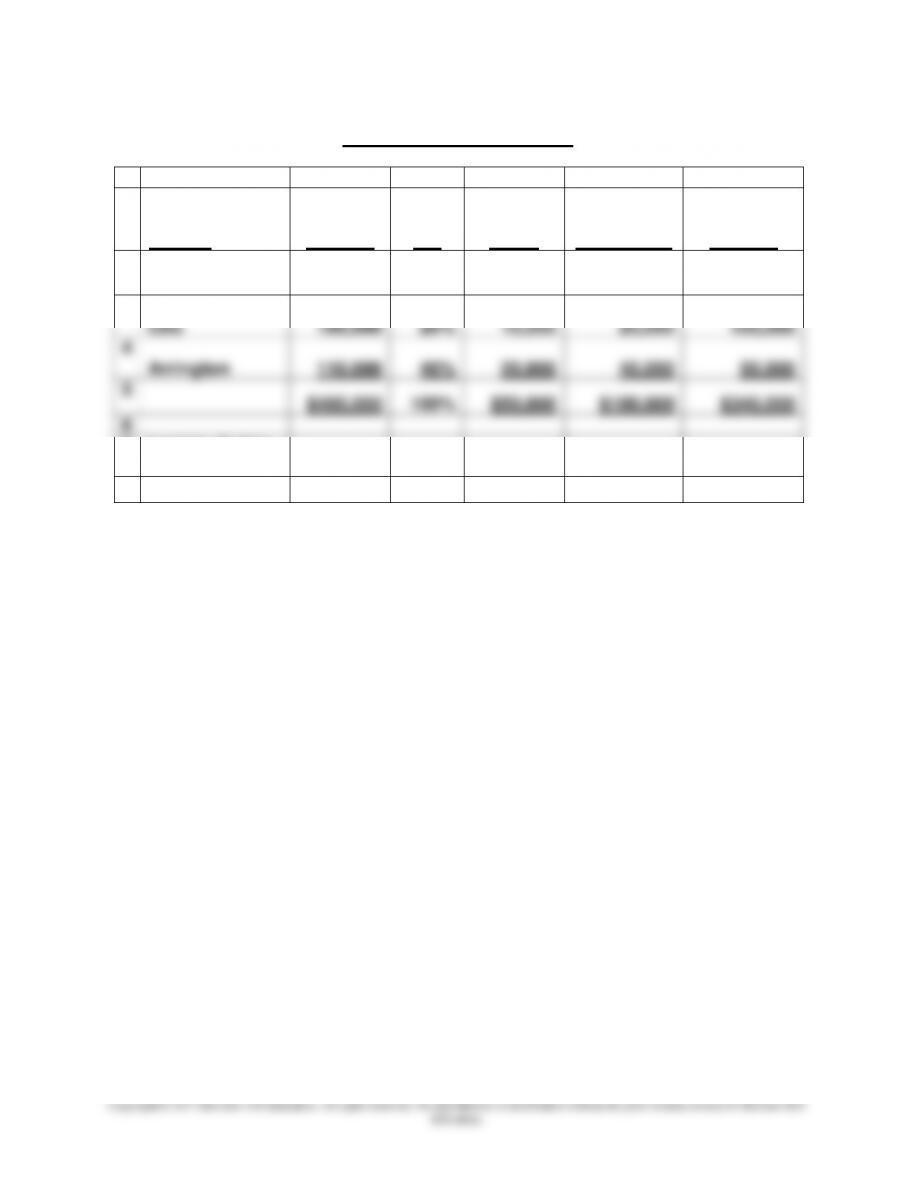
15-53
Spreadsheet to Determine the Remaining Capital Balances for
Wilson, Cho, and Arrington
A
B
C
D
E
F
1
Partner
Capital
Balance
Share
P/L
Initial
Loss
Share
Subsequent
Loss Share
Remaining
Balance
2
Wilson
$200,000
40%
$20,000
$40,000
$140,000
3
Cho
180,000
20%
10,000
20,000
150,000
4
Arrington
110,000
40%
20,000
40,000
50,000
5
$490,000
100%
$50,000
$100,000
$340,000
6
7
Losses during
liquidation
50,000
8
Final losses
100,000