Chapter 15 – Partnerships: Termination and Liquidation
15-21
Education.
21. (continued)
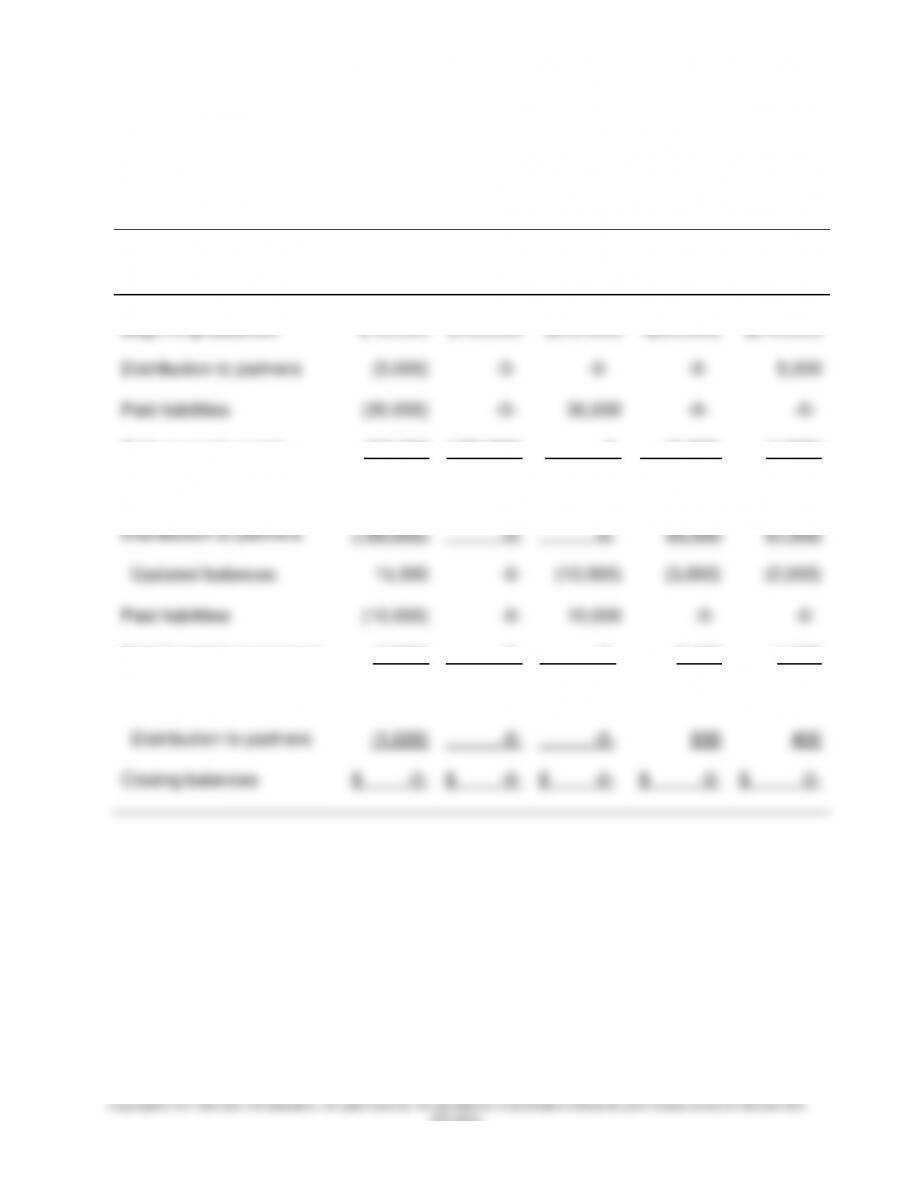
Part B. Prepare a final statement of partnership liquidation.
Alex and Bess Partnership
Statement of Partnership Liquidation
Cash
Non-
cash
Assets
Liabilities
Alex,
Capital
(60%)
Bess,
Capital
(40%)
Beginning balances
$ 50,000
$150,000
$(40,000)
$(90,000)
$(70,000)
Distribution to partners
(5,000)
-0-
-0-
-0-
5,000
Paid liabilities
(30,000)
-0-
30,000
-0-
-0-
Sold noncash assets
160,000
(150,000)
-0-
(6,000)
(4,000)
Updated balances
175,000
-0-
(10,000)
(96,000)
(69,000)
Distribution to partners
(160,000)
-0-
-0-
93,000
67,000
Updated balances
15,000
-0-
(10,000)
(3,000)
(2,000)
Paid liabilities
(10,000)
-0-
10,000
-0-
-0-
Paid liquidation expenses
(4,000)
-0-
-0-
2,400
1,600
Updated balances
1,000
-0-
-0-
(600)
(400)
Distribution to partners
(1,000)
-0-
-0-
600
400
Closing balances
$ -0-
$ -0-
$ -0-
$ -0-
$ -0-
Chapter 15 – Partnerships: Termination and Liquidation
15-22
Education.
22. (30 minutes) (Prepare a predistributlon plan)
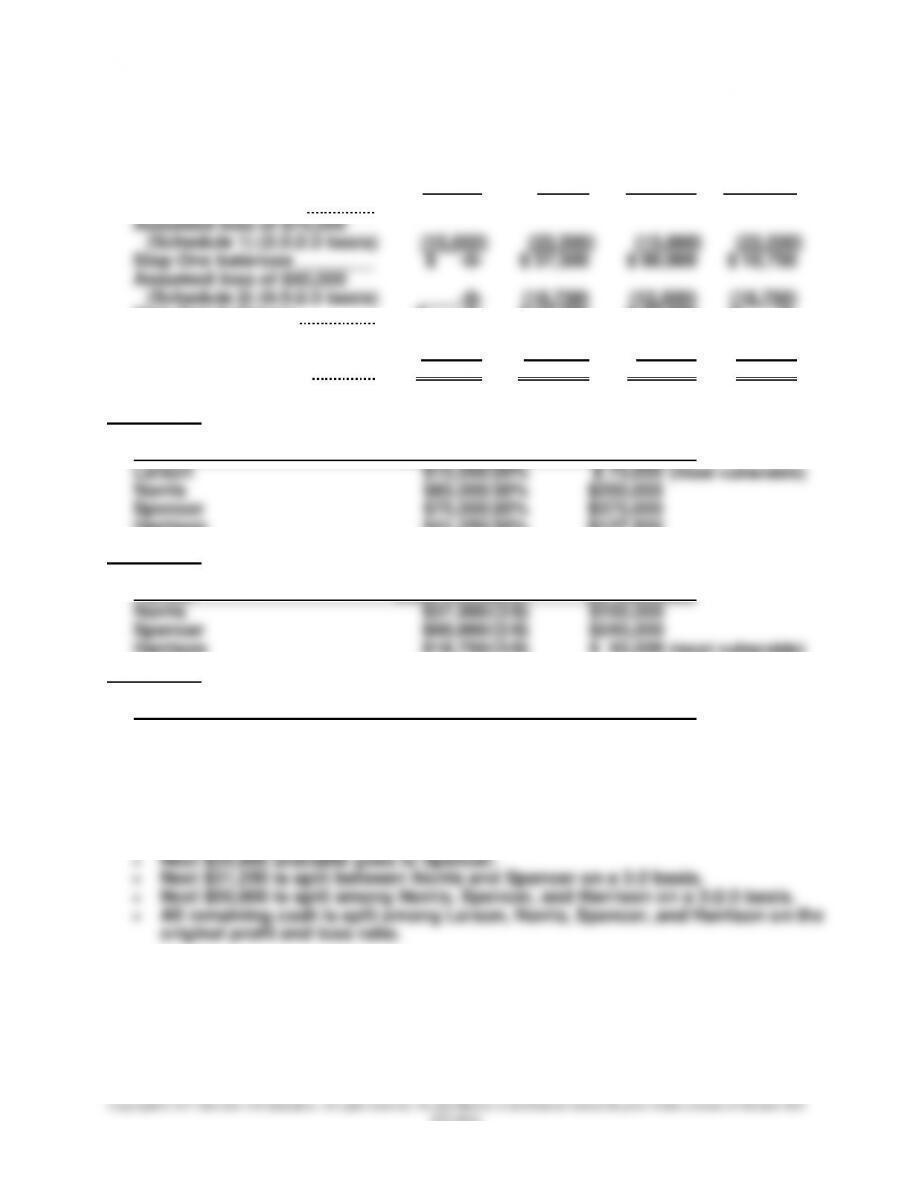
An assumed series of losses is simulated which eliminates each partner’s
capital account in turn:
Larson Norris Spencer Harrison
Beginning balances $ 15,000 $ 60,000 $ 75,000 $ 41,250
Step Two balances $ -0- $ 18,750 $ 47,500 $ -0-
Assumed loss of $31,250
(Schedule 3) (0:3:2:0 basis) -0- (18,750) (12,500) -0-
Step Three balances $ -0- $ -0- $ 35,000 $ –0-
Schedule 1 Maximum Loss
Capital Balance/ That Can
Partner Loss Allocation Be Absorbed
Harrison $41,250/30% $137,500
Schedule 2 Maximum Loss
Capital Balance/ That Can
Partner Loss Allocation Be Absorbed
Harrison $18,750/(3/8) $ 50,000 (most vulnerable)
Schedule 3 Maximum Loss
Capital Balance/ That Can
Partner Loss Allocation Be Absorbed
Norris $18,750/(3/5) $ 31,250 (most vulnerable)
Spencer $47,500/(2/5) $118,750
PREDISTRIBUTION PLAN
• First $55,000 goes to pay liabilities ($47,000) and liquidation expenses
(estimated at $8,000).
Chapter 15 – Partnerships: Termination and Liquidation
Education.
23. (20 minutes) (Prepare and use a predistribution plan)
a.
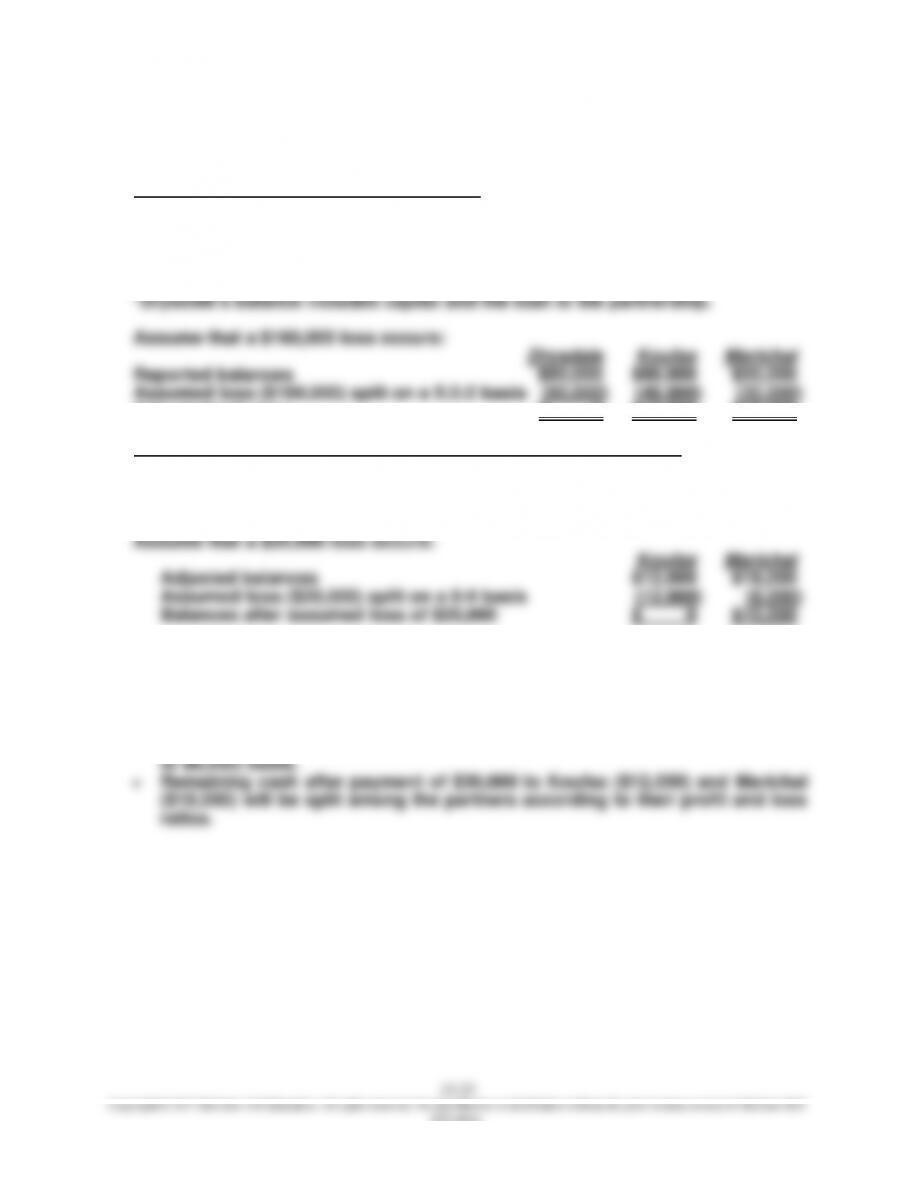
Maximum Losses That Can Be Absorbed
Drysdale* $80,000/50% $160,000 (most vulnerable to losses)
Koufax $60,000/30% 200,000
Marichal $50,000/20% 250,000
Adjusted balances $ 0 $12,000 $18,000
Maximum Losses That Now Can Be Absorbed (in 60%:40% ratio)
Koufax $12,000/.6 $20,000 (most vulnerable to losses)
Marichal $18,000/.4 $45,000
PREDISTRIBUTION PLAN
• The first $65,000 is used to pay liabilities ($50,000) and liquidation expenses
($15,000).
• The next $10,000 is paid entirely to Marichal.
• The next $20,000 is split between Koufax and Marichal on a 60%/40% ($12,000
Chapter 15 – Partnerships: Termination and Liquidation
15-24
23. (continued)
b.
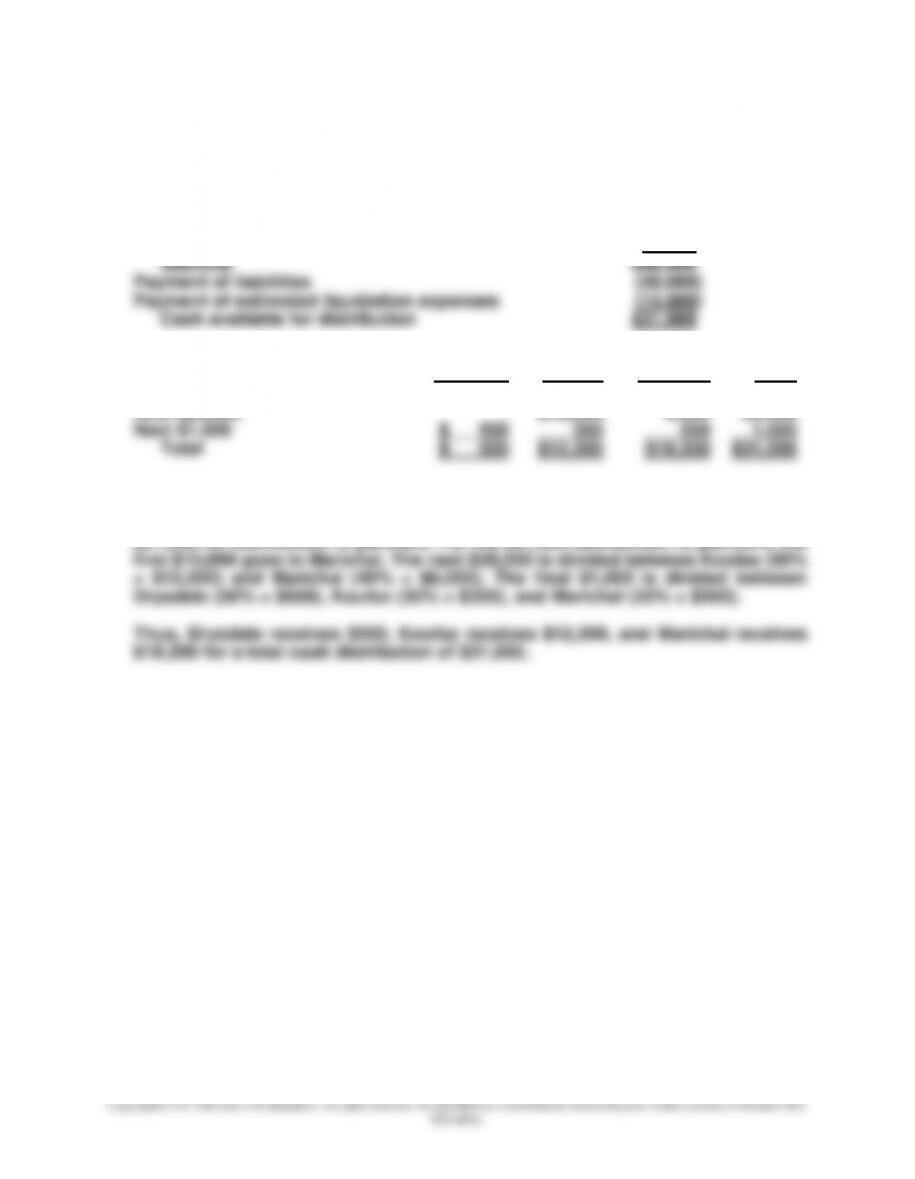
Cash available for distribution:
Beginning cash balance $36,000
Sale of noncash assets 60,000
Cash distribution to partners:
Drysdale Koufax Marichal Total
First $10,000 – – $10,000 $10,000
Next $20,000 – $12,000 8,000 20,000
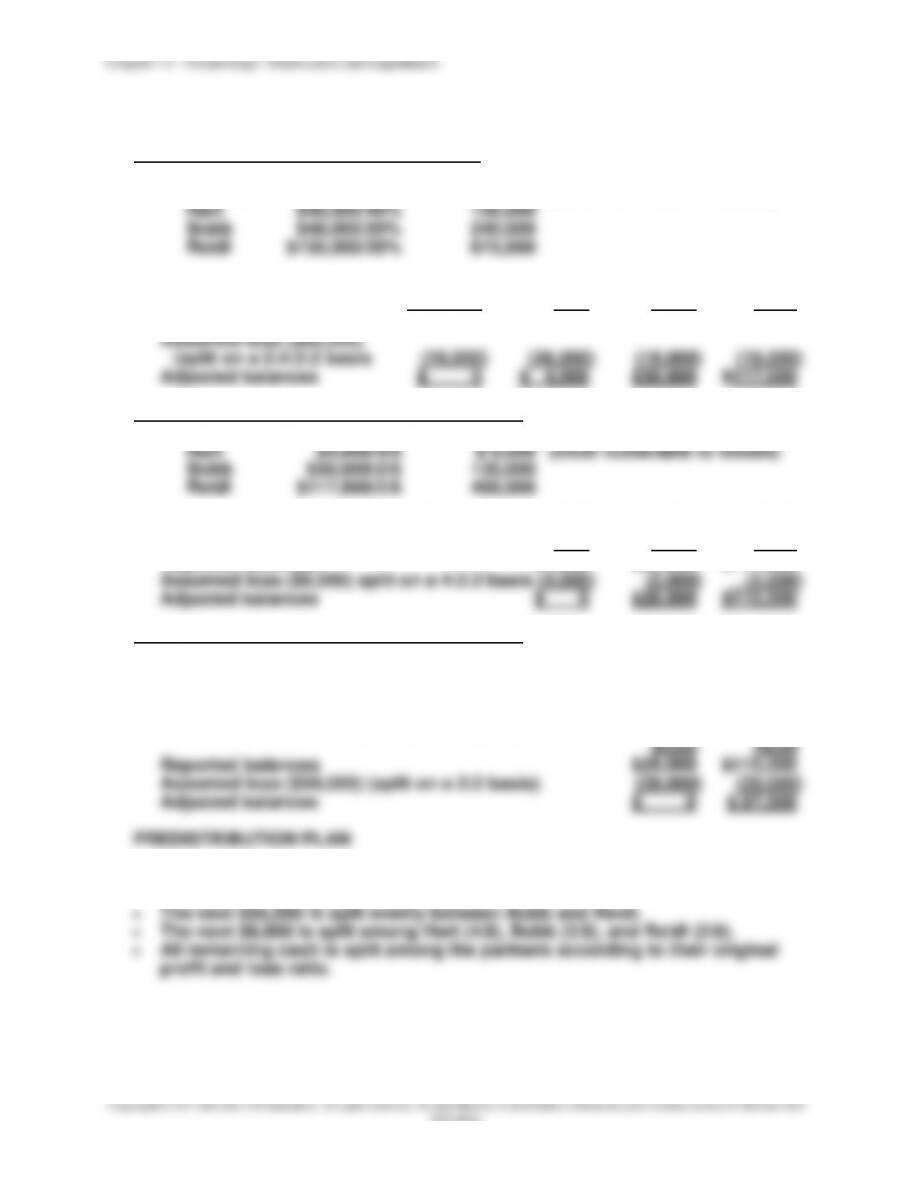
After the sale of assets for $60,000, the partnership has $96,000 in cash. The first
$65,000 must be held for payment of liabilities and liquidation expenses, leaving
$31,000 for distribution to partners. For the $31,000 distribution to partners, the
15-25
Education.
24. (25 minutes) (Prepare a predistribution plan for a partnership liquidation)
Maximum Losses That Can Be Absorbed
Simpson $18,000/20% $ 90,000 (most vulnerable to losses)
The assumption is made that a $90,000 loss occurs:
Simpson Hart Bobb Reidl
Reported balances $18,000 $40,000 $48,000 $135,000
Maximum Losses That Now Can Be Absorbed
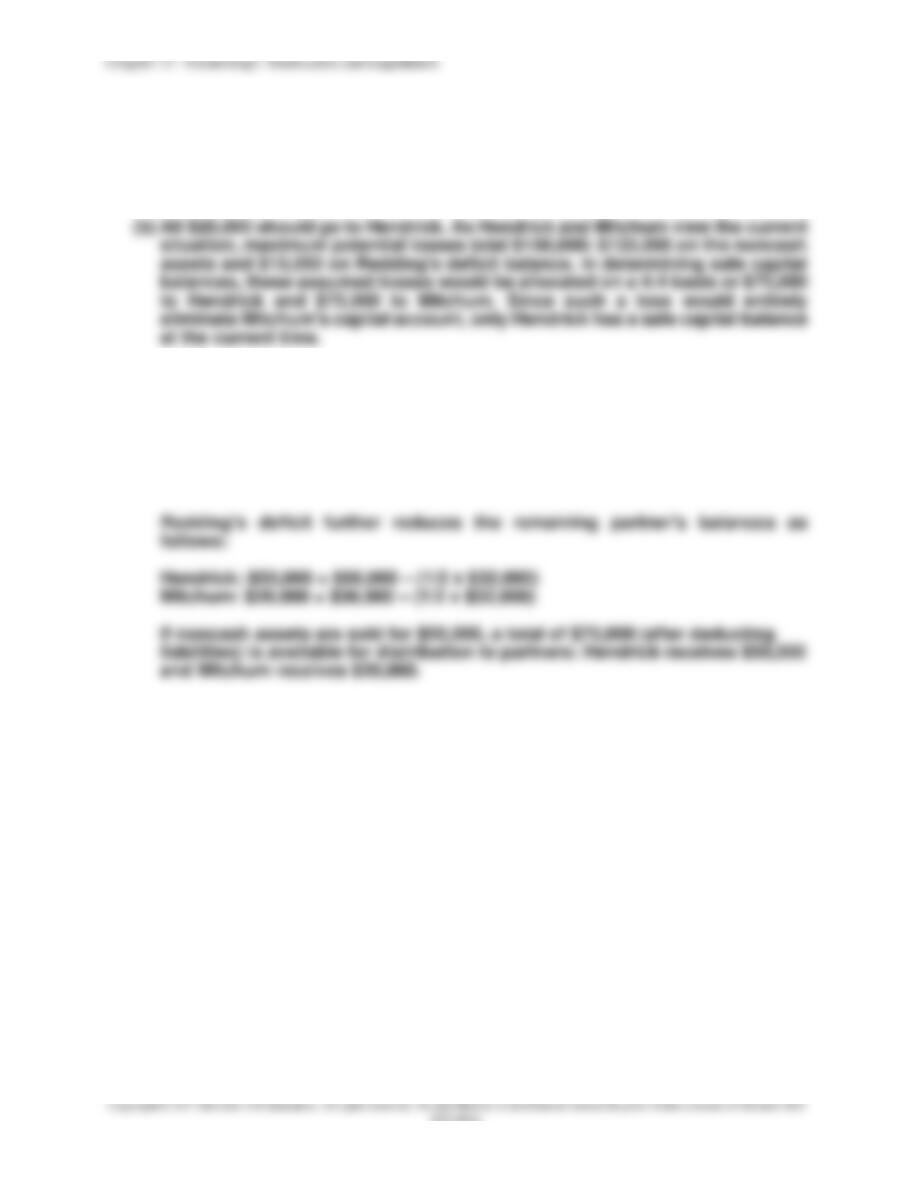
The assumption is made that an $8,000 loss occurs:
Hart Bobb Reidl
Reported balances $4,000 $30,000 $117,000
Maximum Losses That Now Can Be Absorbed
Bobb $28,000/2/4 56,000 (most vulnerable to losses)
Reidl $115,000/2/4 230,000
The assumption is made that a $56,000 loss occurs:
• The first $59,000 goes to pay liabilities and expected liquidation expenses.
• The next $87,000 goes entirely to Reidl.
15-26
Education.
25. (15 minutes) (Determine the ramifications of a partner with a deficit capital
balance)
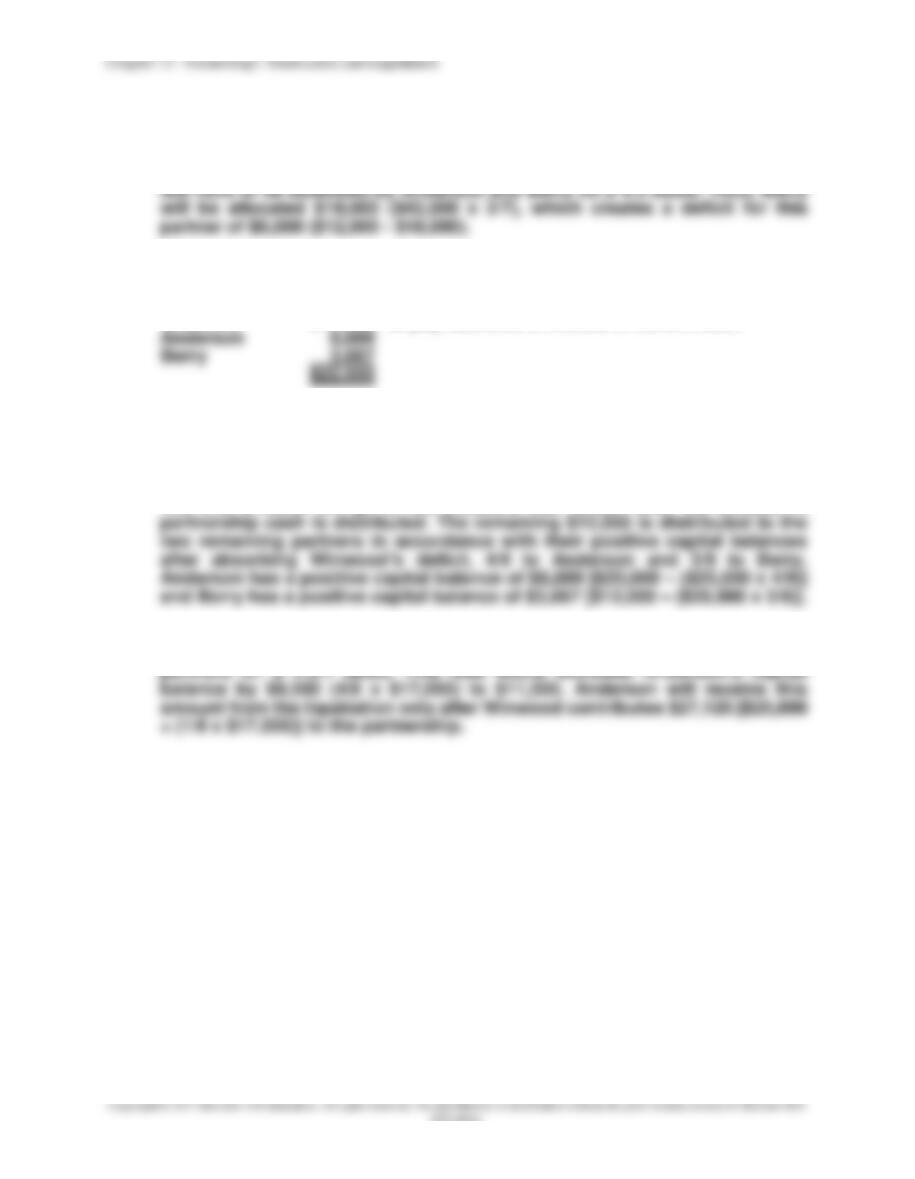
(a) $42,000. Maximum losses of $135,000 on the noncash assets would increase
Reddings‘s deficit balance by $27,000 (20%), to $42,000 ($15,000 + $27,000).
(c) The minimum cash payment to Hendrick would be $50,000.
A loss of $85,000 on the noncash assets would result in the following capital
balances:
Hendrick: $66,000 = $100,000 – (40% x $85,000)
Mitchum: $36,000 = $70,000 – (40% x $85,000)
Redding: ($32,000) = ($15,000) – (20% x $85,000)
15-27
Education.
26. (15 minutes) (Determine the ramifications of partners with deficit capital
balances and personally insolvent)
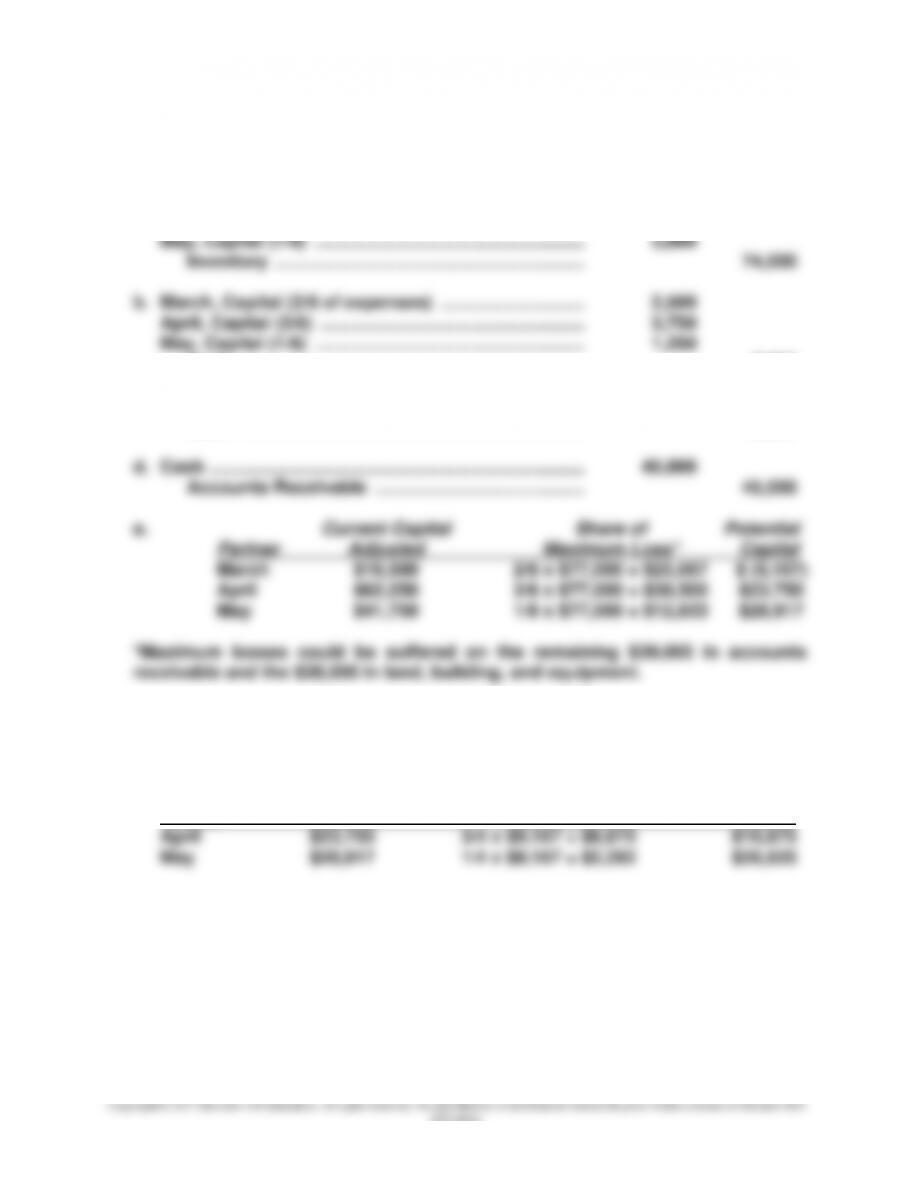
(a) Berry will have to contribute $6,000. The $42,000 in deficit capital balances
(b) Hammond will have to contribute $22,555 [$17,000 + ($25,000 x 2/9)] that will
be distributed as follows:
Creditors $10,000 to pay liabilities in excess of current cash
Because Winwood is personally insolvent, the remaining partners will have
to absorb the $25,000 deficit on a 4:3:2 basis. This allocation increases
Hammond’s deficit by 2/9 of $25,000 or $5,555. Hammond must contribute an
amount equal to the new deficit balance of $22,555.
The first $10,000 will go to the creditors that remain after the $20,000 in
(c) Anderson should receive $11,500. If Hammond is personally insolvent, the
$17,000 deficit balance will have to be absorbed by the remaining three
Chapter 15 – Partnerships: Termination and Liquidation
15-28
Education.
27. (25 minutes) (Prepare journal entries for a partnership liquidation)
JOURNAL ENTRIES
a. Cash . ……………………………………………………………….. 56,000
March, Capital (2/6 of loss) ……………………………….. 6,000
April, Capital (3/6) …………………………………………….. 9,000
Cash …………………………………………………………… 7,500
c. Liabilities …………………………………………………………. 40,000
Cash …………………………………………………………… 40,000
Based on the above potential losses, March would have a deficit capital balance
of $9,167 which in turn has to be allocated to the two partners having positive
capital balances:
Potential Capital Share of Potential
Partner (above) March’s Deficit Capital
Chapter 15 – Partnerships: Termination and Liquidation
27. (continued)
As the above amounts represent safe capital balances, payments can be
presently made to these two partners.
April, Capital ……………………………………………………. 16,875
g. Cash ……………………………………………………………….. 17,000
March, Capital (2/6 of loss) ……………………………….. 7,000
April, Capital (3/6) …………………………………………….. 10,500
May, Capital (1/6) ……………………………………………… 3,500
Land, Building and Equipment …………………….. 38,000
h. Liabilities …………………………………………………………. 21,000
15-30
Education.
28. (30 minutes) (Determine liquidation proceeds necessary to give partner a
specified amount; predistribution plan)
Answer: For Zed to be able to pay his personal creditor $10,000 from the
distribution of partnership property, the partnership’s other assets must be sold
for at least $86,000, as explained below.
$96,000 in cash is needed to pay liabilities and liquidation expenses. This is
A predistribution plan must be developed to generate this information:
Winn Xie Yang Zed
Beginning capital $100,000 $84,000 $50,000 $40,000
Assumed loss of $200,000 (see
Schedule 1) (5:3:1:1) (100,000) (60,000) (20,000) (20,000)
Step One balances $ -0- $24,000 $30,000 $20,000
Schedule 1
Capital Balance/ Maximum Loss to
Partner Loss Allocation Be Absorbed
Winn $100,000/50% $200,000 (most vulnerable)
Schedule 2
Capital Balance/ Maximum Loss to
Partner Loss Allocation Be Absorbed
Xie $24,000/(3/5) $ 40,000 (most vulnerable)
15-31
Education.
28. (continued)
Schedule 3
Capital Balance/ Maximum Loss to
Partner Loss Allocation Be Absorbed
PREDISTRIBUTION PLAN
• Current cash of $40,000 goes to pay liabilities.
• Next $56,000 generated goes to pay remaining liabilities ($26,000) and to
pay estimated liquidation expenses ($30,000).
Education.
Chapter 15 – Partnerships: Termination and Liquidation
29. (continued)
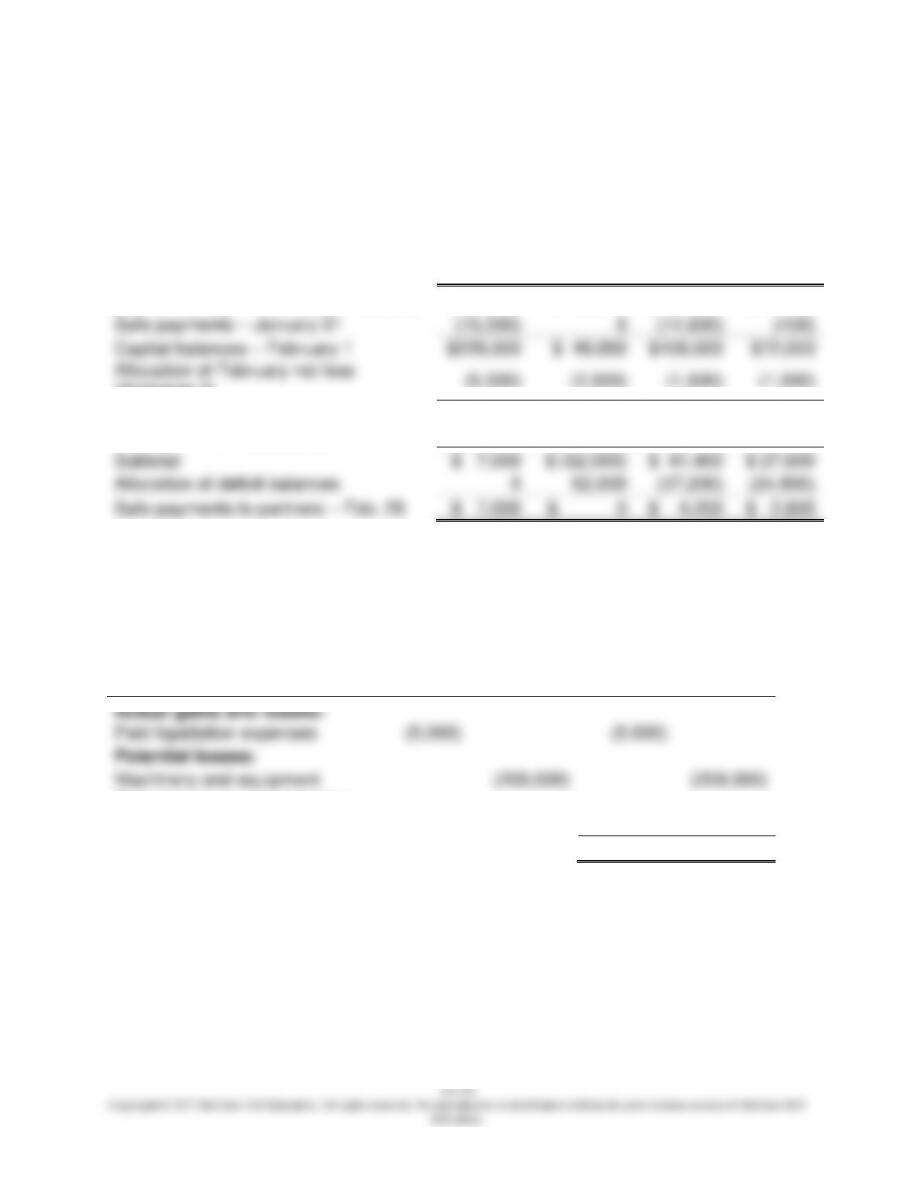
VAN, BAKEL, AND COX PARTNERSHIP
Safe Installment Payments to Partners
February 28
Total
Van
Bakel
Cox
Profit and loss ratio
100%
50%
30%
20%
Capital balances – January 31 (above)
$244,000
$ 49,000
$122,600
$ 72,400
Safe payments – January 31
(15,000)
0
(14,600)
(400)
Capital balances – February 1
$229,000
$ 49,000
$108,000
$72,000
Allocation of February net loss
(Schedule 2)
(5,000)
(2,500)
(1,500)
(1,000)
Capital balances – February 28
$224,000
$ 46,500
$106,500
$ 71,000
Potential loss (Schedule 2)
(217,000)
(108,500)
(65,100)
(43,400)
Subtotal
$ 7,000
$ (62,000)
$ 41,400
$ 27,600
Allocation of deficit balances
0
62,000
(37,200)
(24,800)
Safe payments to partners – Feb. 28
$ 7,000
$ 0
$ 4,200
$ 2,800
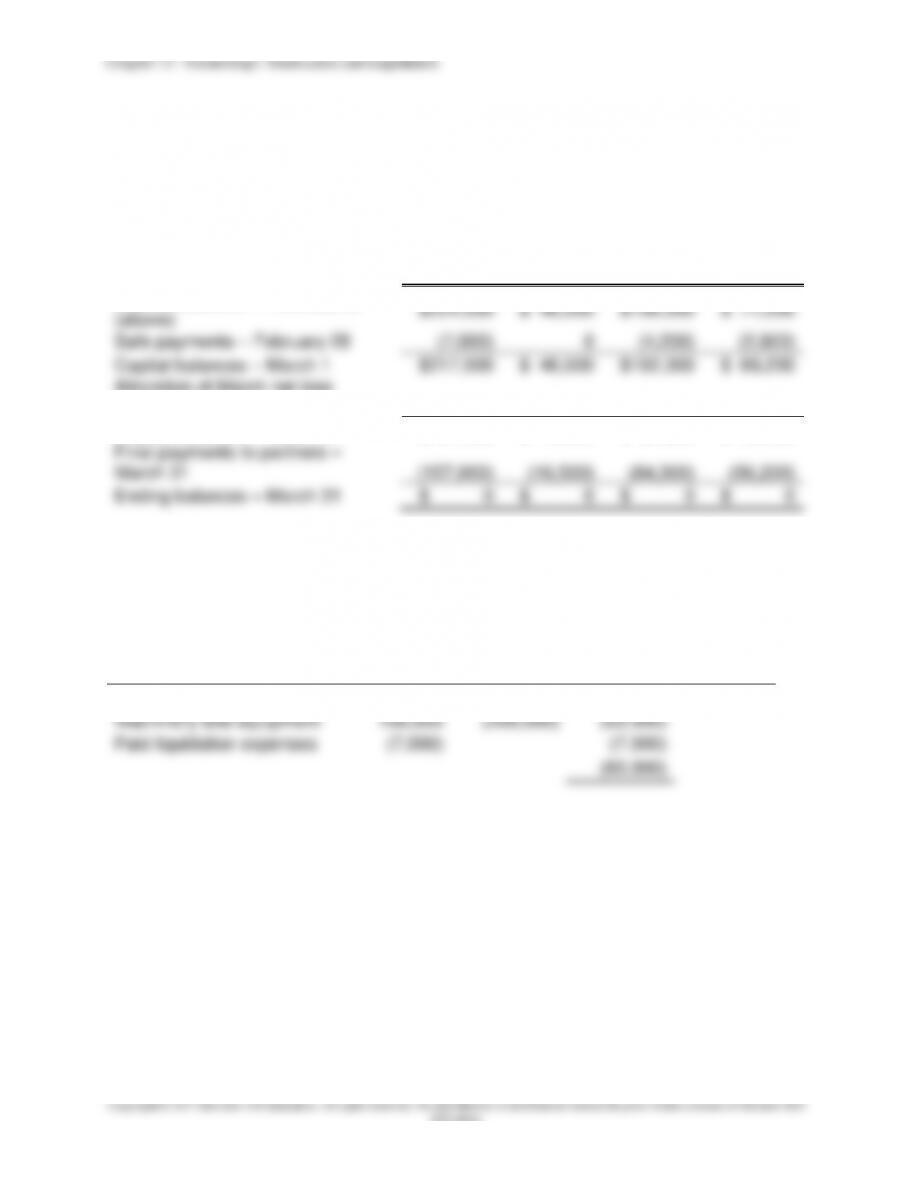
Schedule 2
Computation of Actual and Potential Gain (Loss)
February
February transactions
Cash
Book
Value
Actual
Gain
(Loss)
Potential
Gain
(Loss)
Actual gains and losses:
Paid liquidation expenses
(5,000)
(5,000)
Potential losses:
Machinery and equipment
(209,000)
(209,000)
Potential unrecorded liabilities
and expenses – end of February
(8,000)
(8,000)
(5,000)
(217,000)
15-34
Education.
29. (continued)
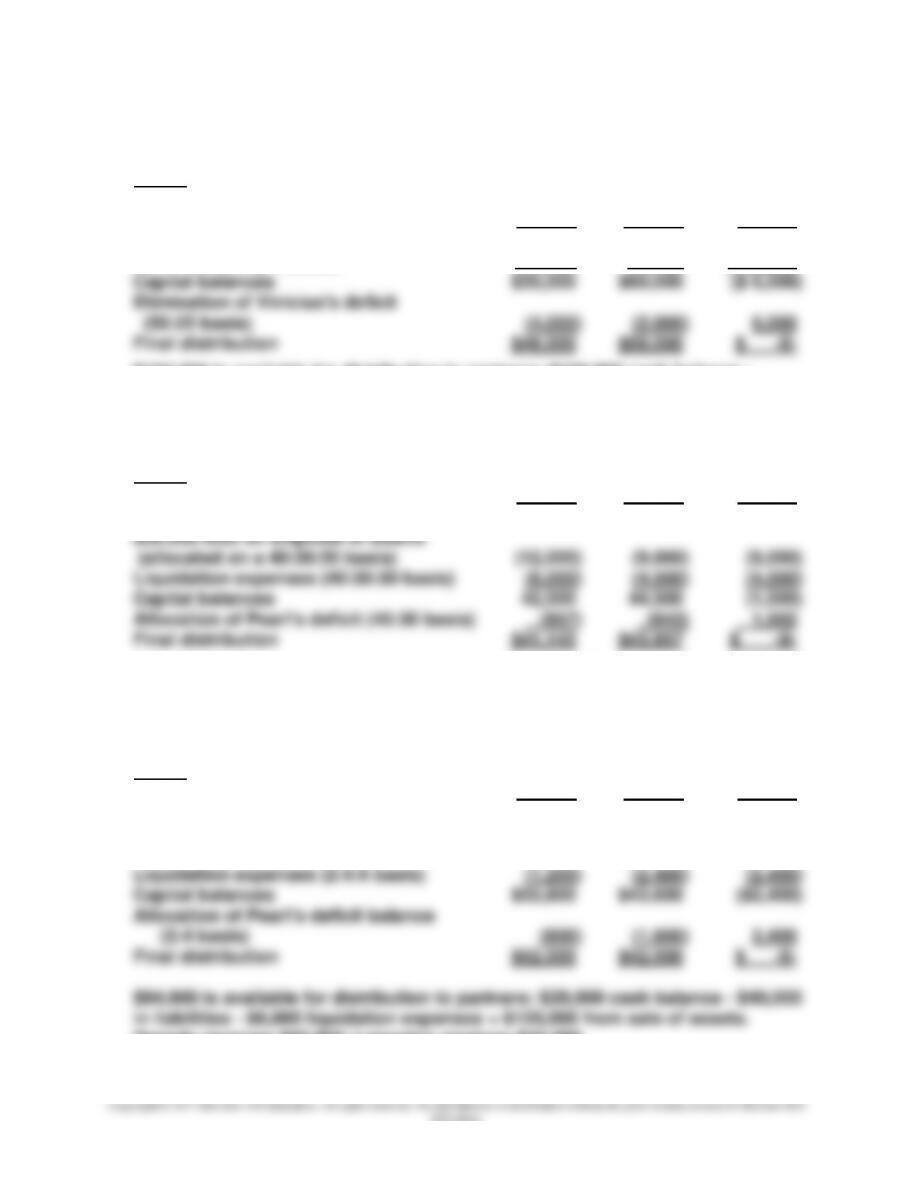
VAN, BAKEL, AND COX PARTNERSHIP
Safe Installment Payments to Partners
March 31
Total
Van
Bakel
Cox
Profit and loss ratio
100%
50%
30%
20%
Capital balances – February 28
(above)
$224,000
$ 46,500
$106,500
$ 71,000
Safe payments – February 28
(7,000)
0
(4,200)
(2,800)
Capital balances – March 1
$217,000
$ 46,500
$102,300
$ 68,200
Allocation of March net loss
(Schedule 3)
(60,000)
(30,000)
(18,000)
(12,000)
Capital balances – March 31
$157,000
$ 16,500
$ 84,300
$ 56,200
Final payments to partners –
March 31
(157,000)
(16,500)
(84,300)
(56,200)
Ending balances – March 31
$ 0
$ 0
$ 0
$ 0
Schedule 3
Computation of Actual and Potential Gain (Loss)
March
March transactions
Cash
Book Value
Actual
Gain
(Loss)
Potential
Gain
(Loss)
Actual gains and losses:
Machinery and equipment
156,000
(209,000)
(53,000)
Paid liquidation expenses
(7,000)
(7,000)
(60,000)
Chapter 15 – Partnerships: Termination and Liquidation
15-35
Education.
30. (35 minutes) (Determine cash distributions for four different partnership
liquidations; insolvent partners)
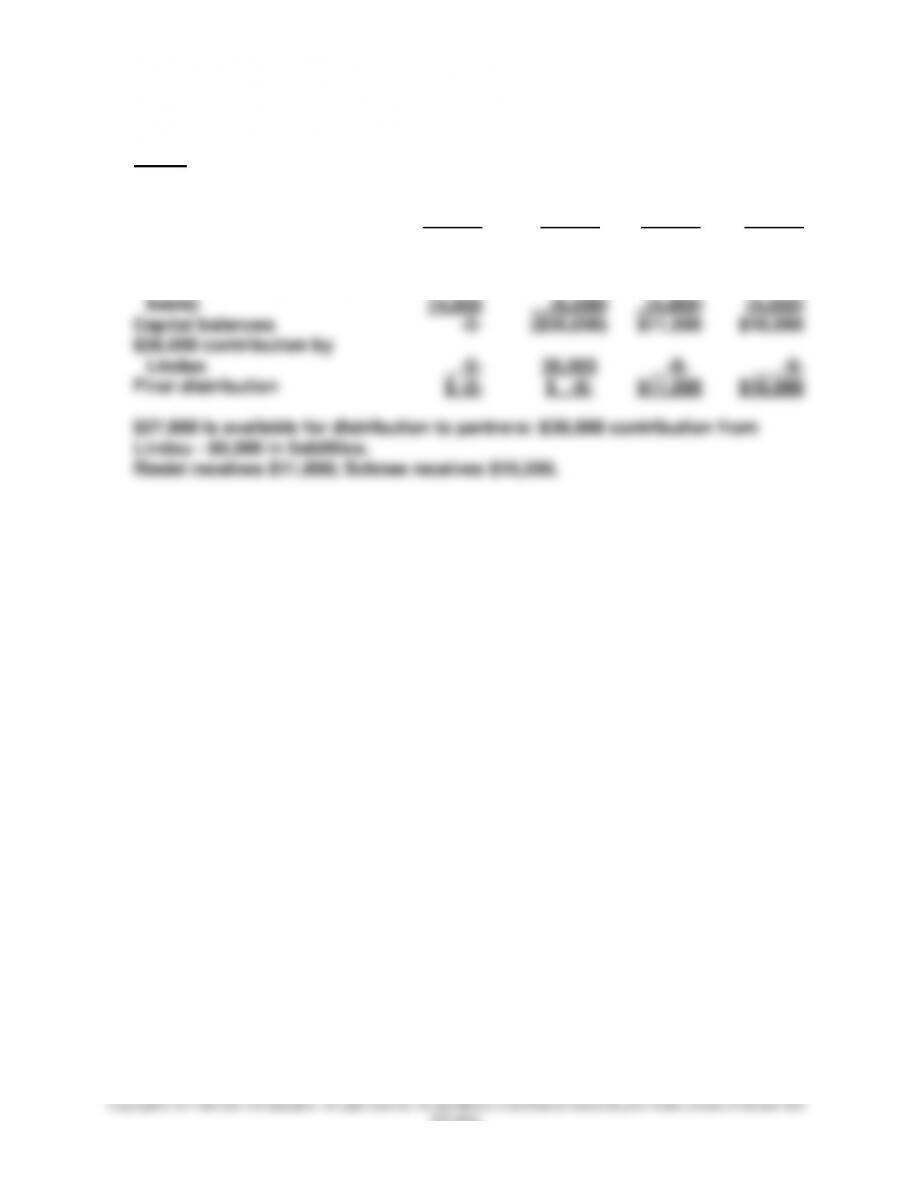
Part A Monte,
Buarque, Loan and Vinicius,
Capital Capital Capital
Beginning balances $50,000 $60,000 ($15,000)
Contribution by Vinicius -0- -0– 9,000
$104,000 is available for distribution to partners: $130,000 cash balance –
$35,000 in liabilities + $9,000 contribution from Vinicius.
Buarque receives $46,000; Monte receives $58,000.
Drawdy, Langston,
Part B Loan and Loan and Pearl,
Capital Capital Capital
Beginning balances $60,000 $58,000 $12,000
$85,000 is available for distribution to partners: $20,000 cash balance – $40,000
in liabilities – $15,000 liquidation expenses + $120,000 from sale of assets.
Drawdy receives $41,143; Langston receives $43,857.
Drawdy, Langston,
Part C Loan and Loan and Pearl,
Capital Capital Capital
Beginning balances $60,000 $58,000 $12,000
$30,000 loss on disposal of assets
(allocated on a 2:4:4 basis) (6,000) (12,000) (12,000)
Drawdy receives $52,000; Langston receives $42,000.
Chapter 15 – Partnerships: Termination and Liquidation
15-36
Education.
30. (continued)
Part D
Krups,
Loan and Lindau, Riedel, Schnee,
Capital Capital Capital Capital
Beginning balances ($14,000) ($30,000) $15,000 $20,000
Allocation of Krups’s
deficit balance (30:20:20
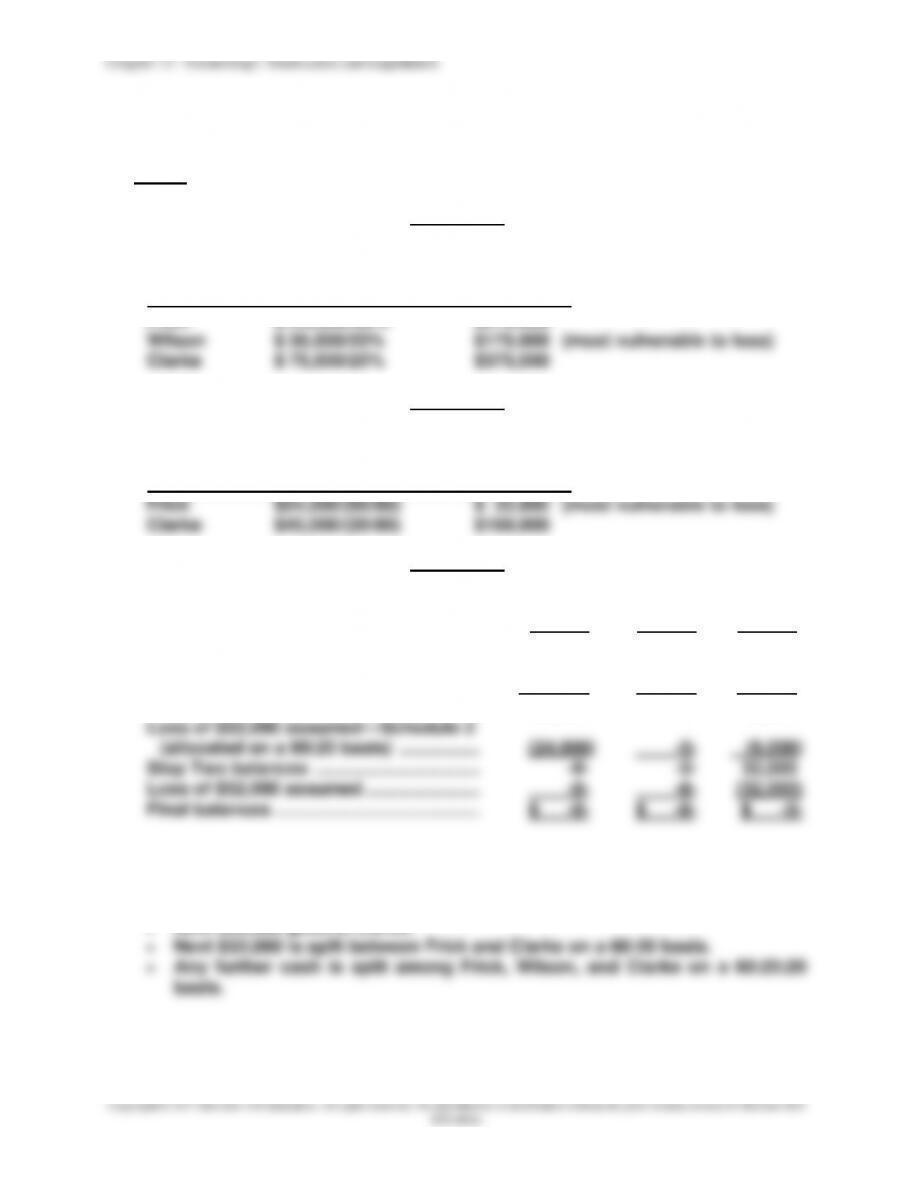
15-37
31. (60 minutes) (Prepare a predistribution plan, a final statement of liquidation,
and journal entries for a partnership liquidation)
Part A Preparation of Predistribution Plan
Schedule 1
Maximum Loss
Capital Balance/ That Can
Partner Loss Allocation Be Absorbed
Frick $129,000/60% $215,000
Schedule 2
Maximum Loss
Capital Balance/ That Can
Partner Loss Allocation Be Absorbed
Schedule 3
Frick, Wilson, Clarke,
Capital Capital Capital
Beginning balances …………………………. $129,000 $35,000 $75,000
Loss of $175,000 assumed—Schedule 1
(allocated on a 60:20:20 basis) ……….. (105,000) (35,000) (35,000)
Step One balances …………………………... 24,000 -0- 40,000
PREDISTRIBUTION PLAN
• First, payment of liabilities and liquidation expenses must be assured.
• Next $32,000 goes to Clarke.