Chapter 15 – Partnerships: Termination and Liquidation
15-1
CHAPTER 15
PARTNERSHIPS: TERMINATION AND LIQUIDATION
Chapter Outline
IV. Deficit capital balances
A. By the end of, or even during, the liquidation process, one or more partners may have a
negative (or deficit) capital balance often as a result of losses incurred in disposing of
assets.
1. Safe payments of cash to individual partners are determined based on safe capital
2. If a portion (or all) of a deficit is subsequently recovered from a partner, a further
3. Any deficit that is not recovered from a partner must be charged to the remaining
partners based on their relative profit and loss ratio.
15-2
Education.
1. This implies that the partnership would first repay partners’ loans before distributing any
cash to partners based on their capital balances.
B. However, in practice, to avoid making a cash distribution to a partner who subsequently
develops a deficit capital balance, partners’ loan accounts typically are combined with
1. The accountant may choose to produce a proposed schedule of liquidation at such
times to determine the equitable distribution of cash amounts that become available.
2. The proposed schedule of liquidation is developed based upon simulating the
accounting recognition that would be required by a possible series of transactions:
3. Ending potential capital balances that remain on a proposed schedule of liquidation are
safe capital balances, the amounts that could be immediately paid to each partner
without jeopardizing future payments. Safe capital balances indicate that the partner
will still have a sufficient interest in the partnership to absorb all potential losses even
after a preliminary distribution.
Vll. Predistribution plan
A. The proposed schedule of liquidation (described above) can be used to determine safe
payments based on safe capital balances but a newly revised schedule must be prepared
each time a distribution of cash to partners is contemplated.
B. Accountants often prefer to produce a single predistribution plan at the start of a liquidation
to provide guidance for all payments made to the partners throughout this process.
C. Information for the predistribution plan is generated by assuming the occurrence of a series
of losses, each just large enough to eliminate one partner’s claim to any partnership
property.
D. Once a series of losses has been simulated that would eliminate the capital balances of all
partners, the actual plan is developed by measuring the effects that occur if the losses do
not materialize.
Chapter 15 – Partnerships: Termination and Liquidation
15-3
Education.
E. By working backwards through this series of possible losses, a predistribution plan can be
produced that serves as a guide for all payments made during the liquidation.
Answer to Discussion Question: What Happens if a Partner Becomes Insolvent?
This case demonstrates one of the nightmares of a partnership: the apparent insolvency of a
partner is threatening the future of a successful business. The problem is especially acute to
Wilkinson and Walker since this partnership was created solely for convenience; the partners
business if Rogers is indeed insolvent.
One alternative is for Wilkinson and Walker to buy out Rogers’ partnership interest. Rogers would
receive his money and the remaining partnership could be left intact. However, they would have
to prove—for legal reasons—that a fair price was being paid, and they would need to come up
with a significant amount of cash in a short period of time. Finally, Wilkinson and Walker would
want to ensure that the new partner is someone with whom they can work comfortably. Because
of time considerations, they may not have the opportunity of getting the new partner they would
like.
Finally, the partnership can be liquidated. Wilkinson and Walker could then take their share of the
proceeds and buy a new building for the continuation of their practices. Unfortunately, in
liquidation, assets do not always bring fair market value. Thus, the partners may be forced to
Chapter 15 – Partnerships: Termination and Liquidation
Answers to Questions
1. A dissolution refers to the cessation of a partnership. In many cases, this process is simply a
preliminary step in the transfer of business property to a newly formed partnership. Therefore,
a dissolution does not necessarily affect the operations of the business or the sale of assets.
2. Many reasons can exist that would lead to the termination and liquidation of a partnership. The
business might simply have failed to generate sufficient profits or the partners may elect to
3. During the liquidation process, monitoring the balance of the partners’ capital accounts
becomes of paramount importance. That amount will eventually indicate either the cash to be
4. Final distributions made to the various partners are based solely on their ending capital
account balances unless the partners have agreed otherwise. If any partner has a deficit
balance, that partner should make an additional contribution to the partnership to offset the
5. A statement of liquidation summarizes the financial effect of the liquidation process as it has
progressed to date. Information to be presented includes the balances of all remaining assets,
6. From a legal viewpoint, any partner who incurs a negative (or deficit) capital balance is
obligated to make an additional contribution to offset that amount.
15-5
Education.
7. A safe capital balance is the amount of a partner’s capital account that exceeds all possible
needs of a partnership as it goes through liquidation. A partner should, therefore, be able to
receive this balance immediately without endangering the future amount to be received by any
other party connected with the liquidation. Safe capital balances are computed by making a
8. Although the Uniform Partnership Act states that loans from partners rank ahead of the
partners’ capital balances in the distribution of partnership assets, in practice a partner’s loan
9. A proposed schedule of liquidation is prepared by the accountant to determine the allocation
of any cash available in the early stages of a liquidation that exceeds the amount needed to
pay all liabilities and estimated liquidation expenses. The schedule is based on anticipating a
10. A predistribution plan is produced based on an assumed series of losses. Each loss is
calculated to eliminate in turn the capital balance of one of the partners. In this manner, the
accountant can determine the vulnerability to losses exhibited by each capital account. When
Chapter 15 – Partnerships: Termination and Liquidation
15-6
Answers to Problems
1. C
4. C (Partner with deficit capital balance)
Barley, Carter, Desai,
Capital (50%) Capital (30%) Capital (20%)
Bell Hardy Dennard Suddath
Reported balances $50,000 $56,000 $14,000 $80,000
Loss on sale of assets ($110,000)
(split on a 4:3:2:1 basis) (44,000) (33,000) (22,000) (11,000)
Adjusted balances $ 6,000 $23,000 $(8,000) $69,000
Potential loss from Dennard
15-7
Education.
7. B (Determine amounts received by partners from liquidation)
Cash to be distributed to partners:
Beginning cash balance $33,000
Sale of noncash assets 80,000
Loss on sale of other assets ($20,000) (split
on a 4:3:3 basis) ……………………………….. (8,000) (6,000) (6,000)
Liquidation expenses ($15,000) (split
on a 4:3:3 basis) ……………………………….. (6,000) (4,500) (4,500)
Remaining balances …………………………... $10,000 $ 18,500 $ 19,500
X Y Z
Reported balances $150,000 $120,000 $80,000
Anticipated loss ($320,000) (split on
a 5:3:2 basis) (160,000) (96,000) (64,000)
Potential balances $(10,000) $ 24,000 $ 16,000
15-8
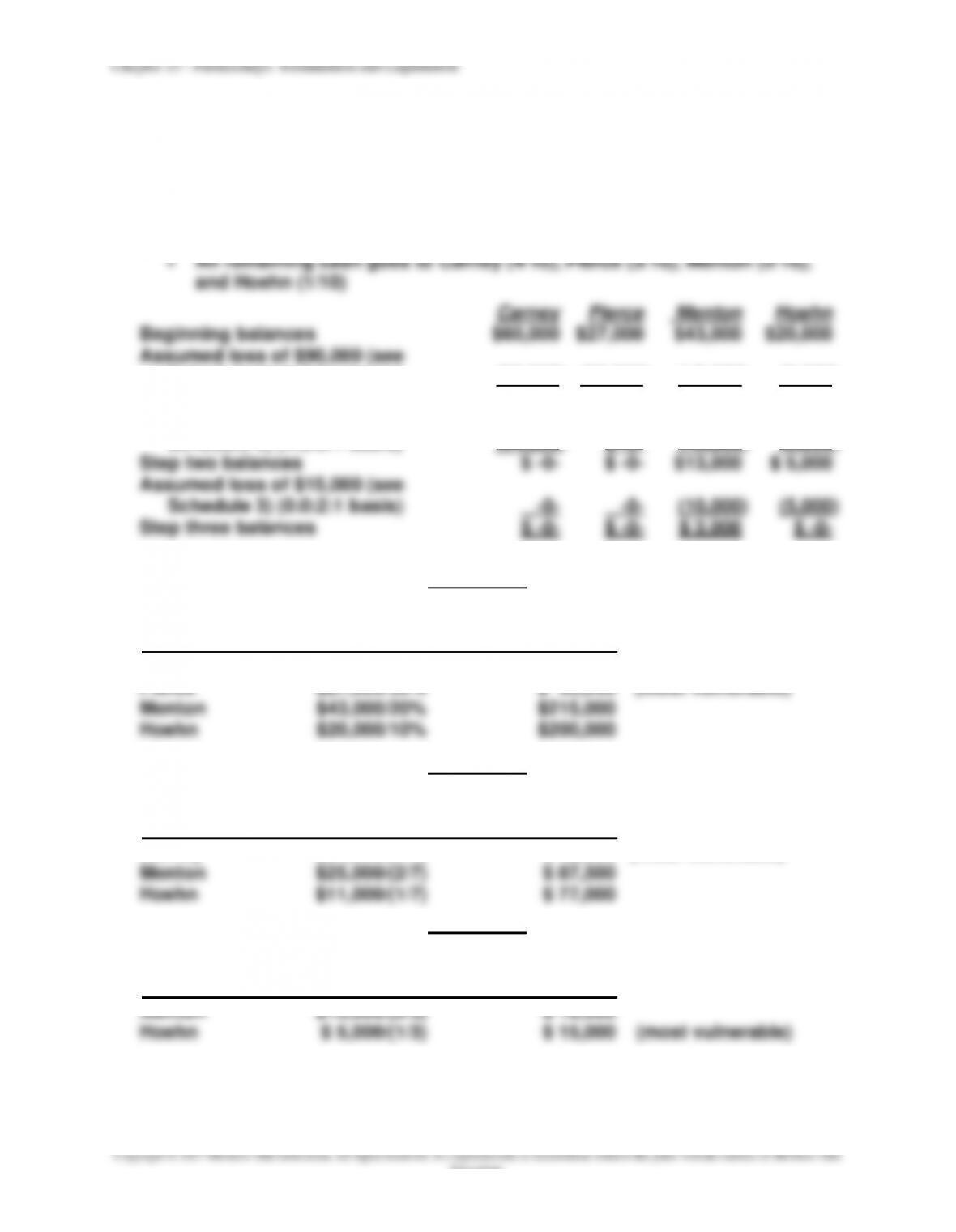
9. C (Predistribution plan)
To solve this problem a predistribution plan should be created.
Maximum Losses That Can Be Absorbed
Kevin $59,000/40% $147,500
Michael $39,000/30% 130,000 (most vulnerable to losses)
Assumed loss ($130,000) (split
on a 4:3:1:2 basis) ……………..(52,000) (39,000) (13,000) (26,000)
Adjusted balances …………………. $ 7,000 $ -0- $21,000 $ 8,000
Maximum Losses That Now Can Be Absorbed
Kevin $7,000 / 4/7 $12,250 (most vulnerable to losses)
Assumed loss ($12,250) (split
on a 4:1:2 basis) ………………………….. (7,000) (1,750) (3,500)
Adjusted balances $ -0- $19,250 $4,500
Maximum Losses That Now Can Be Absorbed
Brendan $19,250/1/3 $57,750
Adjusted balances …………………………………….. $17,000 $ -0-
Brendan will receive a $17,000 distribution from the partnership before any
of the other partners collect any cash.
15-9
Education.
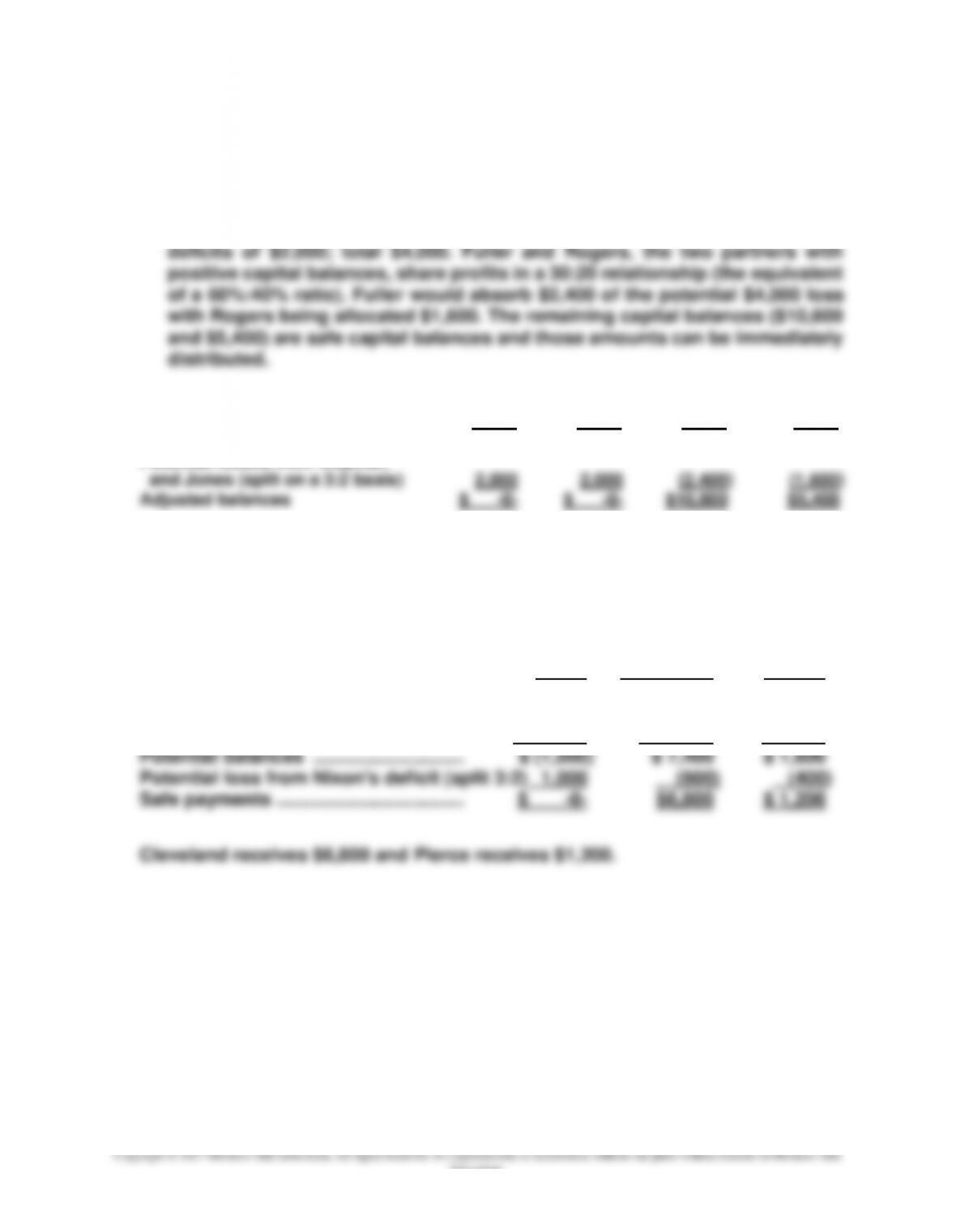
10. C (Predistribution plan)
To solve this problem, the following predistribution plan is created:
• First $3,000 goes to Menton
• Next $15,000 goes to Menton (2/3) and Hoehn (1/3)
• Next $42,000 goes to Carney (4/7), Menton (2/7), and Hoehn (1/7)
Schedule 1) (4:3:2:1 basis) (36,000) (27,000) (18,000) (9,000)
Step one balances $24,000 $ -0- $25,000 $11,000
Assumed loss of $42,000 (see
Schedule 2) (4:0:2:1 basis) (24,000) $ -0– (12,000) (6,000)
Schedule 1
Maximum Loss
Capital Balance/ That Can
Partner Loss Allocation Be Absorbed
Carney $60,000/40% $150,000
Pierce $27,000/30% $ 90,000 (most vulnerable)
Schedule 2
Maximum Loss
Capital Balance/ That Can
Partner Loss Allocation Be Absorbed
Carney $24,000/(4/7) $ 42,000 (most vulnerable)
Schedule 3
Maximum Loss
Capital Balance/ That Can
Partner Loss Allocation Be Absorbed
Chapter 15 – Partnerships: Termination and Liquidation
15-10
Education.
11. C (Partners with deficit capital balances; proposed schedule of liquidation; safe
capital balances)
The $16,000 available cash can be distributed but should be done under the
assumption that all deficit balances will be total losses. After offsetting
Jones’ loan against his deficit capital balance, both Jones and Wayman have
Wayman Jones Fuller Rogers
(30%) (20%) (30%) (20%)
Reported balances $(2,000) $(2,000) $13,000 $7,000
Potential losses from Wayman
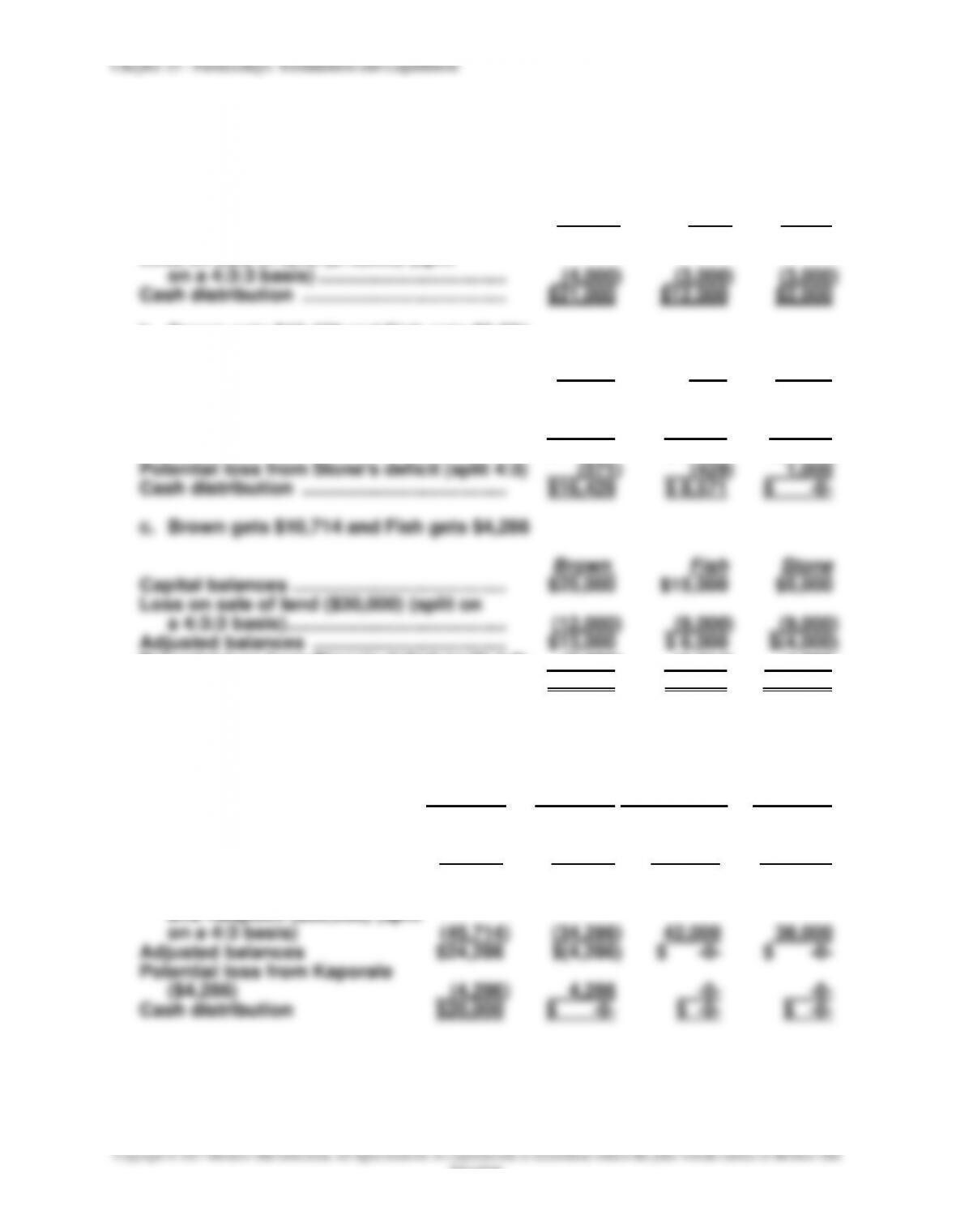
12. (8 minutes) (Determine safe payments; partner has deficit)
Because the partnership currently has total capital of $350,000, the $8,000 that
is available would indicate maximum potential losses of $342,000.
Nixon Cleveland Pierce
Reported balances ……………………….. $170,000 $110,000 $70,000
Anticipated loss ($342,000) (split
on a 5:3:2 basis) ……………………… (171,000) (102,600) (68,400)
15-11
Education.
13. (20 minutes) (Final settlement of a partnership being liquidated; various
amounts of loss on sale of assets)
a. Brown gets $21,000, Fish gets $12,000, and Stone gets $2,000.
Brown Fish Stone
Capital balances ………………………………….. $25,000 $15,000 $5,000
Loss on sale of land ($10,000) (split
b. Brown gets $16,429 and Fish gets $8,571
Brown Fish Stone
Capital balances ………………………………….. $25,000 $15,000 $5,000
Loss on sale of land ($20,000) (split on
a 4:3:3 basis) …………………………………… (8,000) (6,000) (6,000)
Adjusted balances ………………………………. $17,000 $ 9,000 $(1,000)
Potential loss from Stone’s deficit (split 4:3) (2,286) (1,714) 4,000
Cash distribution ………………………………… $10,714 $ 4,286 $ -0-
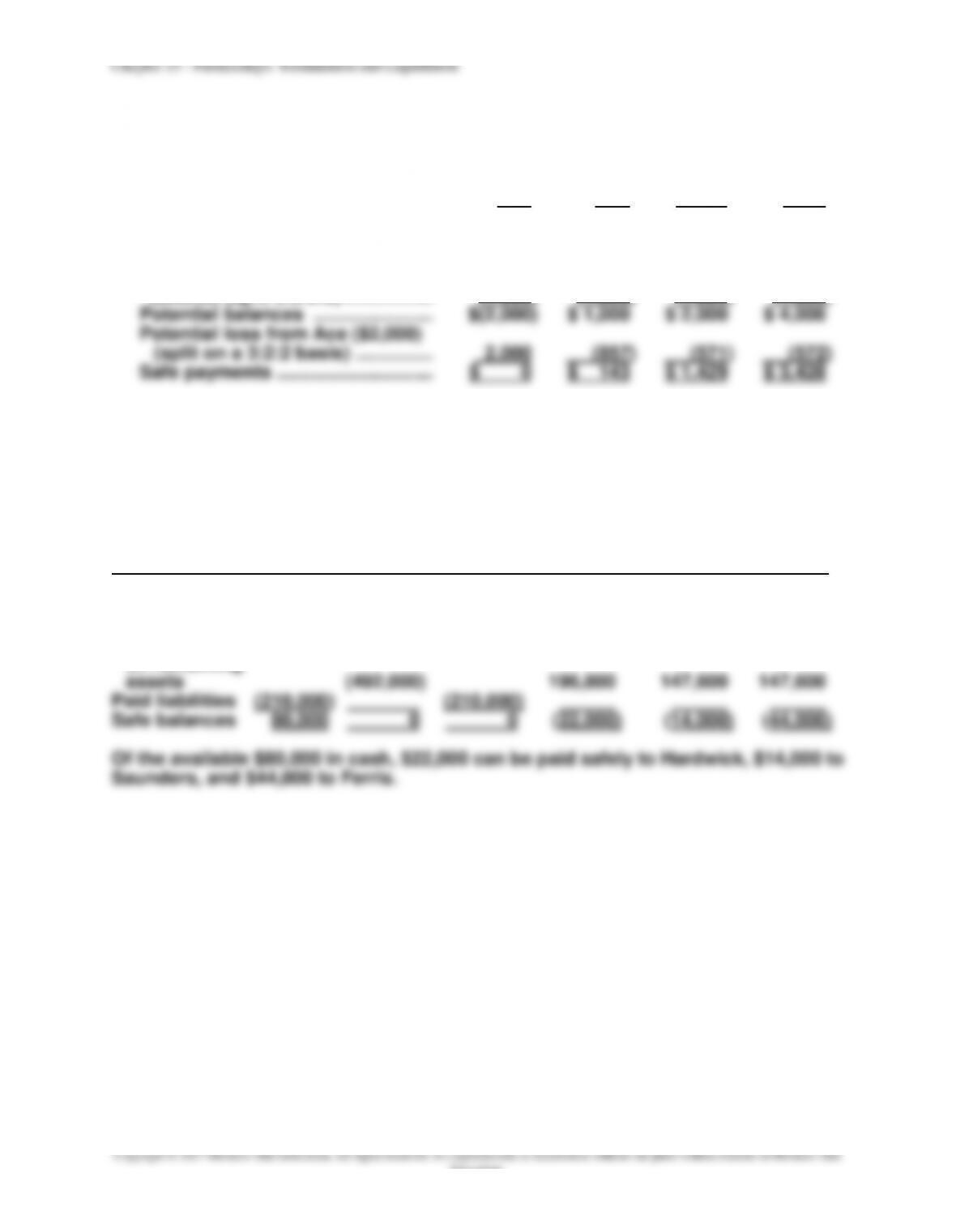
14. (10 minutes) (Distribute cash contributed by partner with deficit balance)
The entire $20,000 goes to Atkinson.
Atkinson Kaporale Dennsmore Rasputin
Reported balances $70,000 $30,000 $(42,000) $(58,000)
Capital contribution –0- -0- –0- 20,000
Adjusted balances $70,000 $30,000 $(42,000) $(38,000)
Potential loss from Dennsmore
and Rasputin ($80,000) (split
15-12
Education.
15. (8 minutes) (Determine safe payments)
Ball gets $143, Eaton gets $1,429, and Lake gets $3,428.
Ace Ball Eaton Lake
Reported balances ………………….. $25,000 $28,000 $20,000 $22,000
Maximum losses on land and building
($85,000) (split on a 3:3:2:2 basis) (25,500) (25,500) (17,000) (17,000)
Estimated liquidation expenses
($5,000) (split 3:3:2:2) …………….. (1,500) (1,500) (1,000) (1,000)
16. (15 minutes) (Prepare a proposed schedule of liquidation)
HARDWICK, SAUNDERS, AND FERRIS
Proposed Schedule of Liquidation
Hardwick, Ferris,
Other Accounts Loan and Saunders, Loan &
Cash Assets Payable Capital Capital Capital
Beginning
balances 90,000 820,000 (210,000) (270,000) (200,000) (230,000)
Sold assets 200,000 (328,000) 51,200 38,400 38,400
Assumed loss
on remaining
15-14
Education.
19. (15 minutes) (Determine amount to be contributed by partner with a deficit
capital balance)
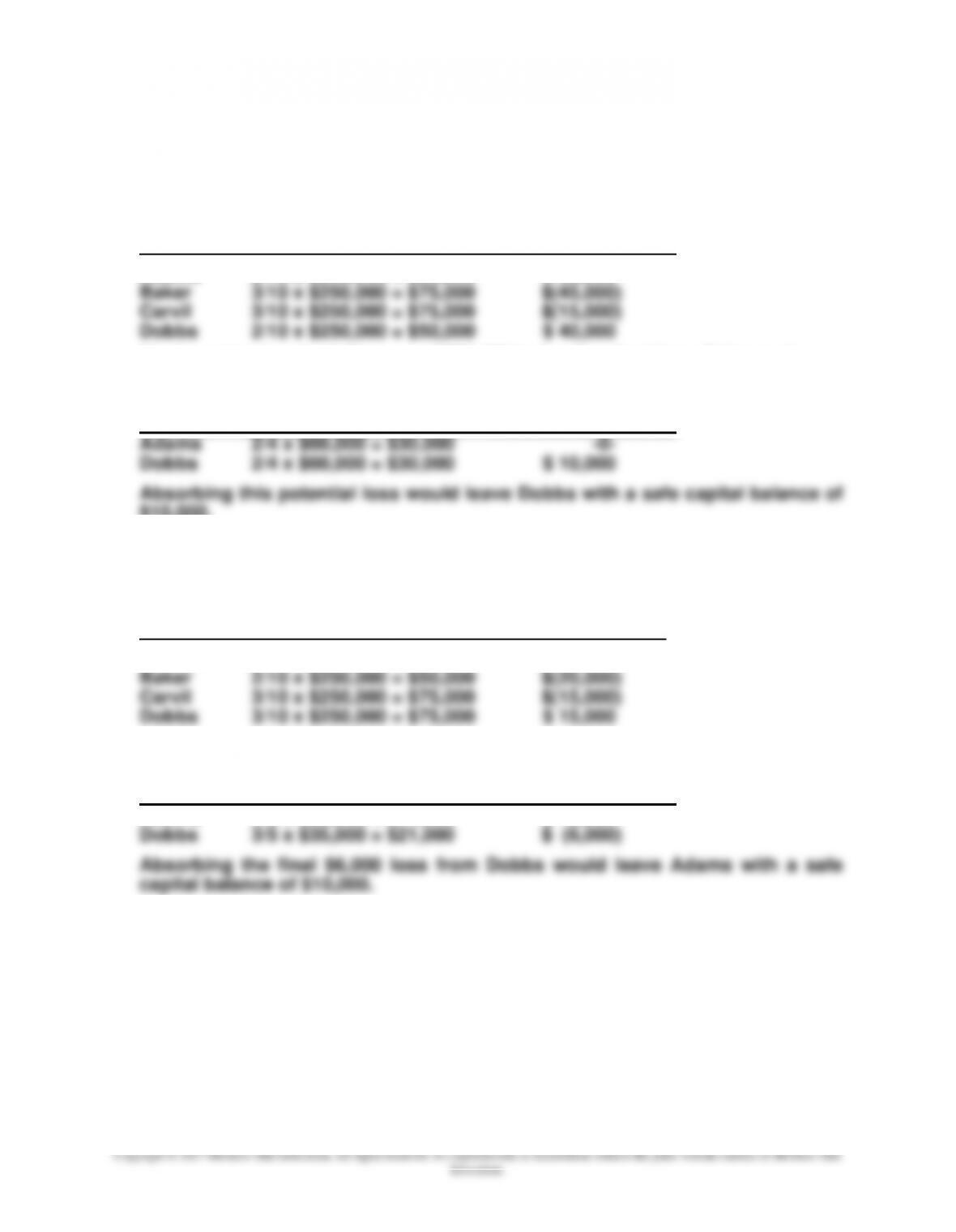
Beck and Page are both personally insolvent and have negative capital balances
(after offsetting the loan from Beck) totaling $10,000 (Beck’s deficit, $4,000;
Page’s deficit, $6,000). Absorption by the other partners of these losses would
be as follows (on a 40:10:20 basis):
Current Adjusted
Partner Capital Balance Share of Loss Capital Balance
Cisneros, who also is personally insolvent, now has a capital balance of ($714)
that would have to be absorbed by Sadak and Emerson (on a 10:20 or 1/3:2/3
basis):
Ajusted Remaining
Partner Capital Balance Share of Loss Capital Balance
Chapter 15 – Partnerships: Termination and Liquidation
15-15
20. (50 minutes) (Determine payments under a variety of circumstances; safe
capital balances; predistribution plan)
a. Dobbs receives the entire $10,000.
Maximum potential losses of $250,000 on noncash assets would be allocated
as follows:
Partner Share of Loss New Capital Balance
Adams 2/10 x $250,000 = $50,000 $ 30,000
Maximum total potential losses of $60,000 to be absorbed from Baker and
Carvil above would then be allocated to Adams and Dobbs as follows on a 2:2
basis:
Partner Share of Loss New Capital Balance
$10,000.
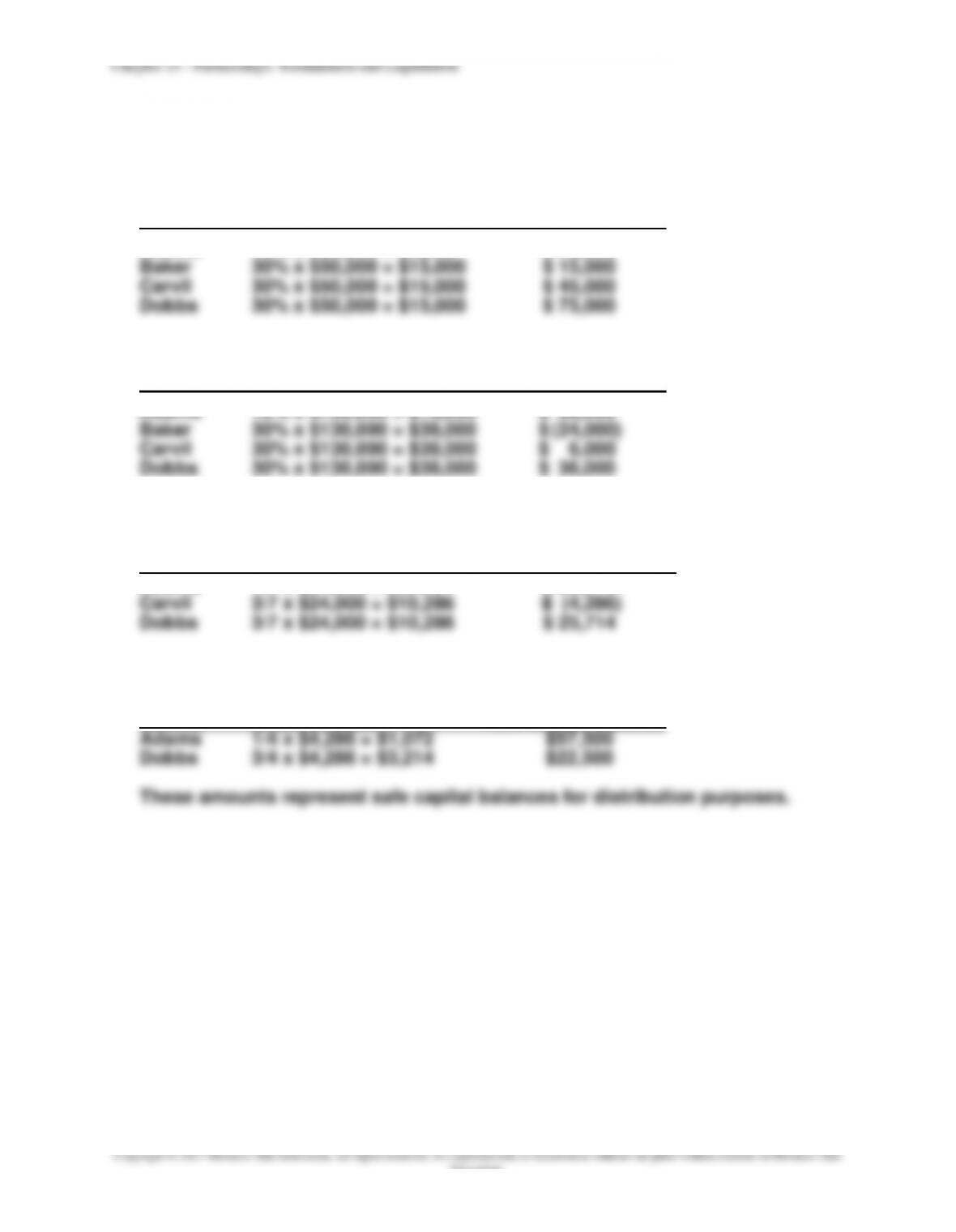
b. Adams receives the entire $10,000.
Maximum potential losses of $250,000 on noncash assets would be allocated
as follows:
Partner Share of Loss New Capital Balance
Adams 2/10 x $250,000 = $50,000 $ 30,000
Maximum total potential losses of $35,000 to be absorbed from Baker and Carvil
above would be allocated to Adams and Dobbs as follows on a 2:3 basis:
Partner Share of Loss New Capital Balance
Adams 2/5 x $35,000 = $14,000 $ 16,000
15-16
Education.
20. (continued)
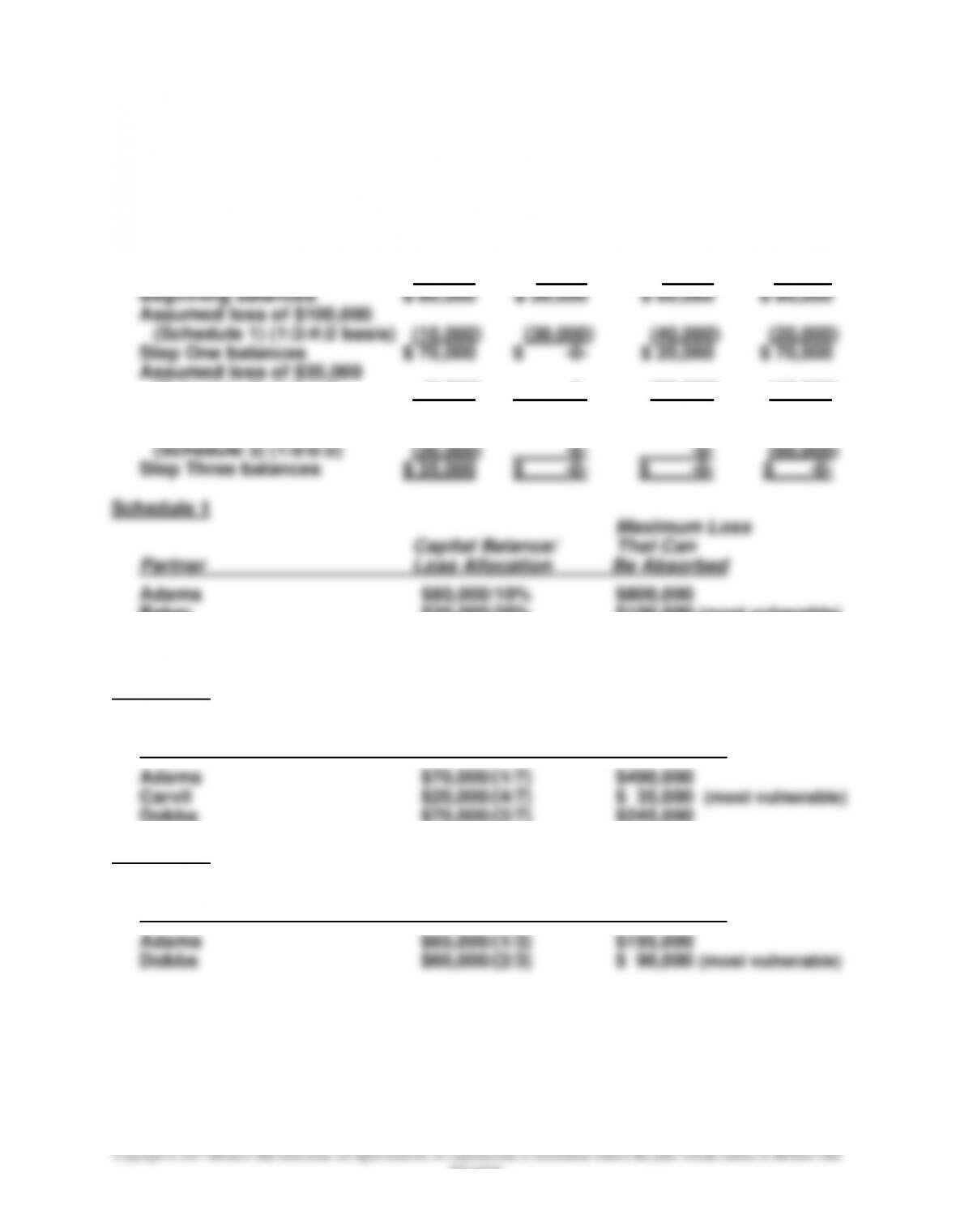
c. Adams receives $57,500 and Dobbs gets $22,500.
The $50,000 loss on sale of the building would be allocated as follows:
Partner Share of Loss New Capital Balance
Adams 10% x $50,000 = $5,000 $ 75,000
Maximum potential loss of $130,000 on the land would be allocated as follows:
Partner Share of Loss New Capital Balance
Adams 10% x $130,000 = $13,000 $ 62,000
Maximum potential loss of $24,000 to be absorbed from Baker would be
allocated as follows on a 1:3:3 basis:
Partner Share of Loss New Capital Balance
Adams 1/7 x $24,000 = $3,428 $ 58,572
Maximum potential loss of $4,286 to be absorbed from Carvil would be allocated
as follows on a 1:3 basis:
Partner Share of Loss New Capital Balance
Chapter 15 – Partnerships: Termination and Liquidation
15-17
Education.
20. (continued)
d. The land and building must be sold for over $115,000 to ensure that Carvil will
receive some cash.
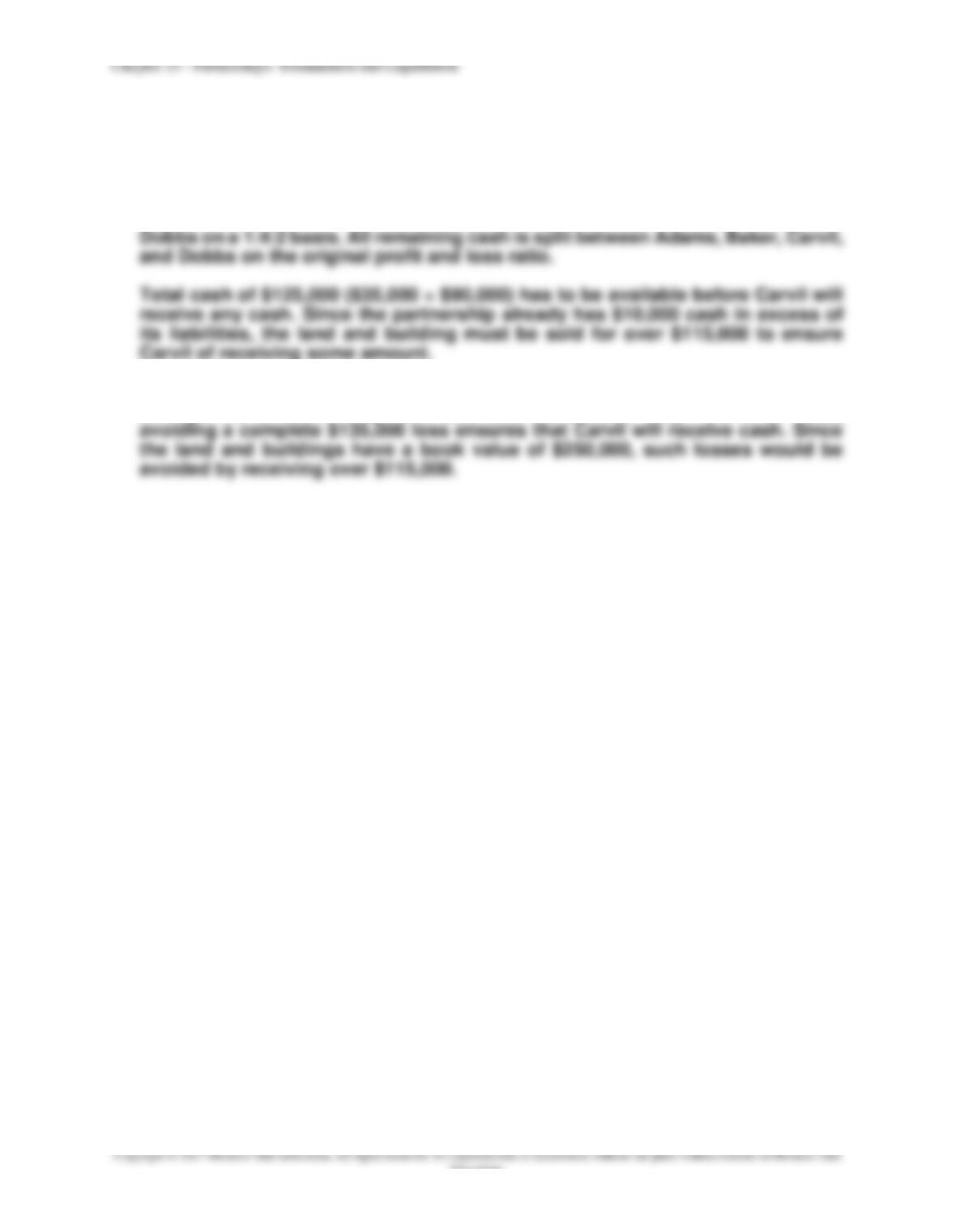
This can be determined by preparing a predistribution plan as follows:
Adams Baker Carvil Dobbs
(Schedule 2) (1:0:4:2) (5,000) -0- (20,000) (10,000)
Step Two balances $ 65,000 $ -0- $ -0- $ 60,000
Assumed loss of $90,000
Baker $30,000/30% $100,000 (most vulnerable)
Carvil $60,000/40% $150,000
Dobbs $90,000/20% $450,000
Schedule 2
Maximum Loss
Capital Balance/ That Can
Partner Loss Allocation Be Absorbed
Dobbs $70,000/(2/7) $245,000
Schedule 3
Maximum Loss
Capital Balance/ That Can
Partner Loss Allocation Be Absorbed
15-18
Education.
20. d. (continued)
PREDISTRIBUTION PLAN
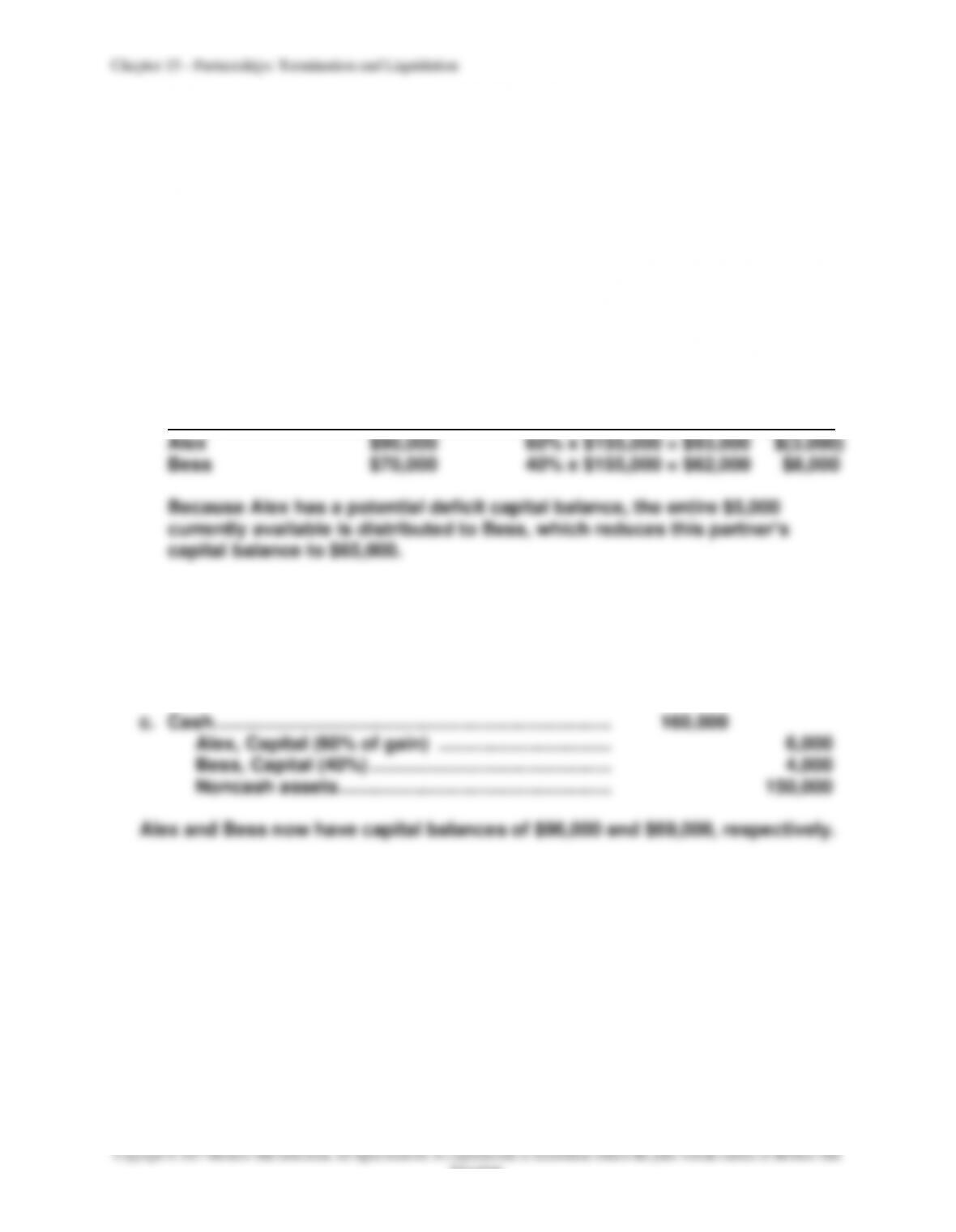
The first $35,000 available goes to Adams. Next $90,000 is split between Adams
and Dobbs on a 1:2 basis. Next $35,000 is split between Adams, Carvil, and
As another approach to the problem, Carvil’s capital balance is eliminated
through the $100,000 Step One loss and the $35,000 Step Two loss. Thus,
15-19
Education.
21. (30 minutes) (Prepare journal entries for a partnership liquidation; prepare a
final statement of partnership liquidation)
Part A. Preparation of journal entries.
a. The partnership has $50,000 in cash, liabilities of $40,000 and estimated
liquidation expenses of $5,000. Thus, there is only $5,000 that can be safely
paid to the partners before the liquidation of noncash assets. This amount
is allocated to the two partners on the basis of their potential capital
balances assuming that noncash assets are scrapped for a loss of $150,000
and liquidation expenses are $5,000:
Current Capital Share of Potential
Partner Balance Maximum Loss* Capital
Bess, Capital …………………………………………………….. 5,000
Cash ……………………………………………………….….. 5,000
b. Liabilities ……………………………………………………….… 30,000
Cash ……………………………………………………….….. 30,000
15-20
21. (continued)
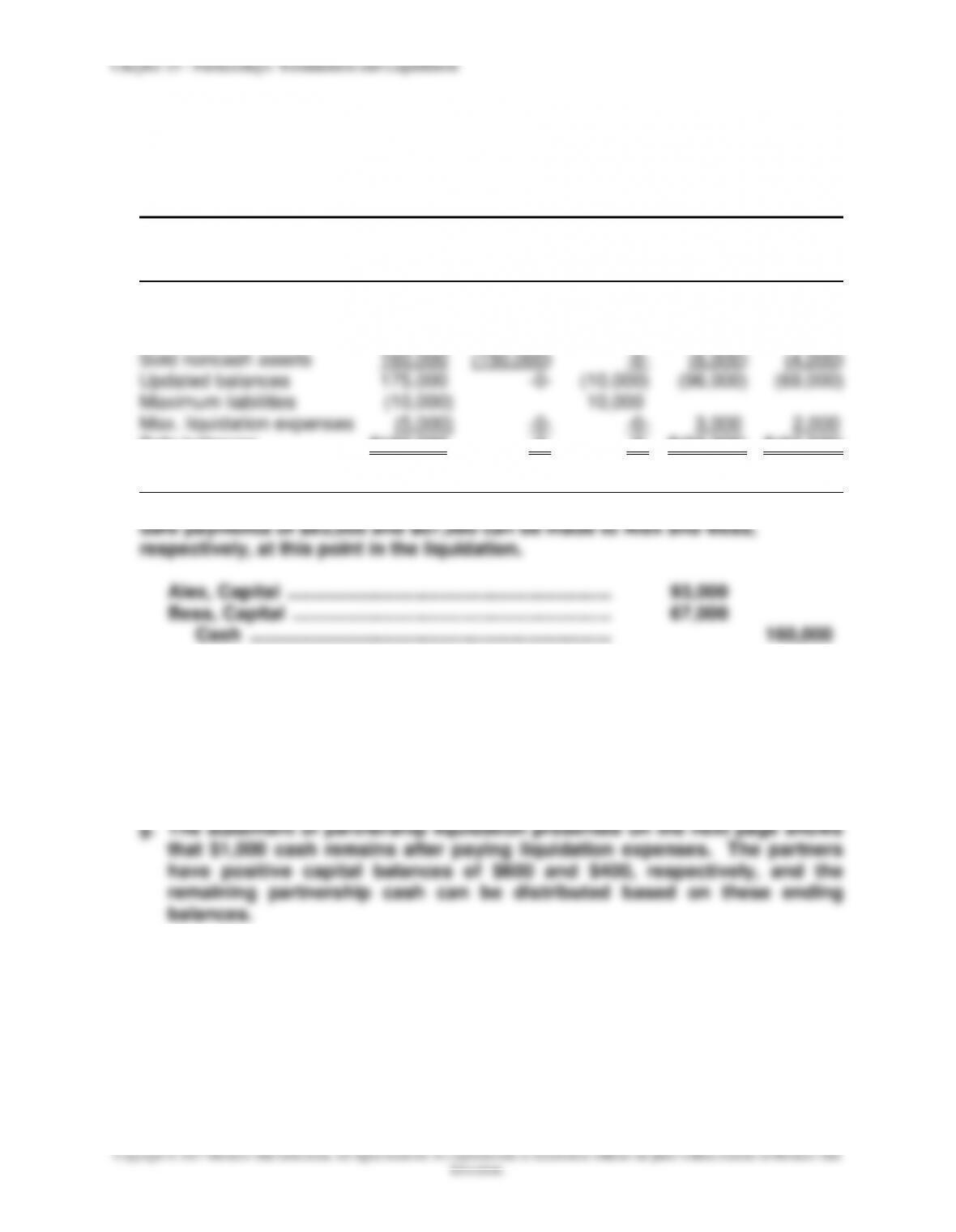
d. To determine the safe payments to be made at this point in the liquidation,
the accountant prepares the following proposed schedule of liquidation:
Alex, Bess,
Non-cash Capital Capital
Cash Assets Liabilities (60%) (40%)
Beginning balances $50,000 $150,000 $(40,000) $(90,000) $(70,000)
Distribution to partners (5,000) -0- -0- -0- 5,000
Paid liabilities (30,000) –0- 30,000 -0- -0-
Safe balances $160,000 -0- -0- $(93,000) $(67,000)
e. Liabilities …………………………………………………………. 10,000
Cash ……………………………………………………….….. 10,000
f. Alex, Capital (60% of expense) ………………………….. 2,400
Bess, Capital (40%) …………………………………………… 1,600
Cash ……………………………………………………….…… 4,000
Alex, Capital …………………………………………………….. 600
Bess, Capital ……………………………………………………. 400
Cash ……………………………………………………….….. 1,000