Chapter 14 – Partnerships: Formation and Operation – Hoyle, Schaefer, Doupnik, 13e
Education.
26. (45 Minutes) (P&L allocations and admission of a new partner)
a. The interest factor was probably inserted to reward Hugh for contributing
$50,000 more to the partnership than Jacobs. The salary allowance gives an
additional $20,000 to Jacobs in recognition of the full-time (rather than
part-time) employment. The 40:60 split of the remaining income was
two numbers are often designed to be equal but agreement is not
necessary. For example, a salary allowance might be high to recognize work
contributed by one partner. The allowance increases the appropriate capital
balance. The partner might, though, remove little or no money so that the
partnership could maintain its liquidity.
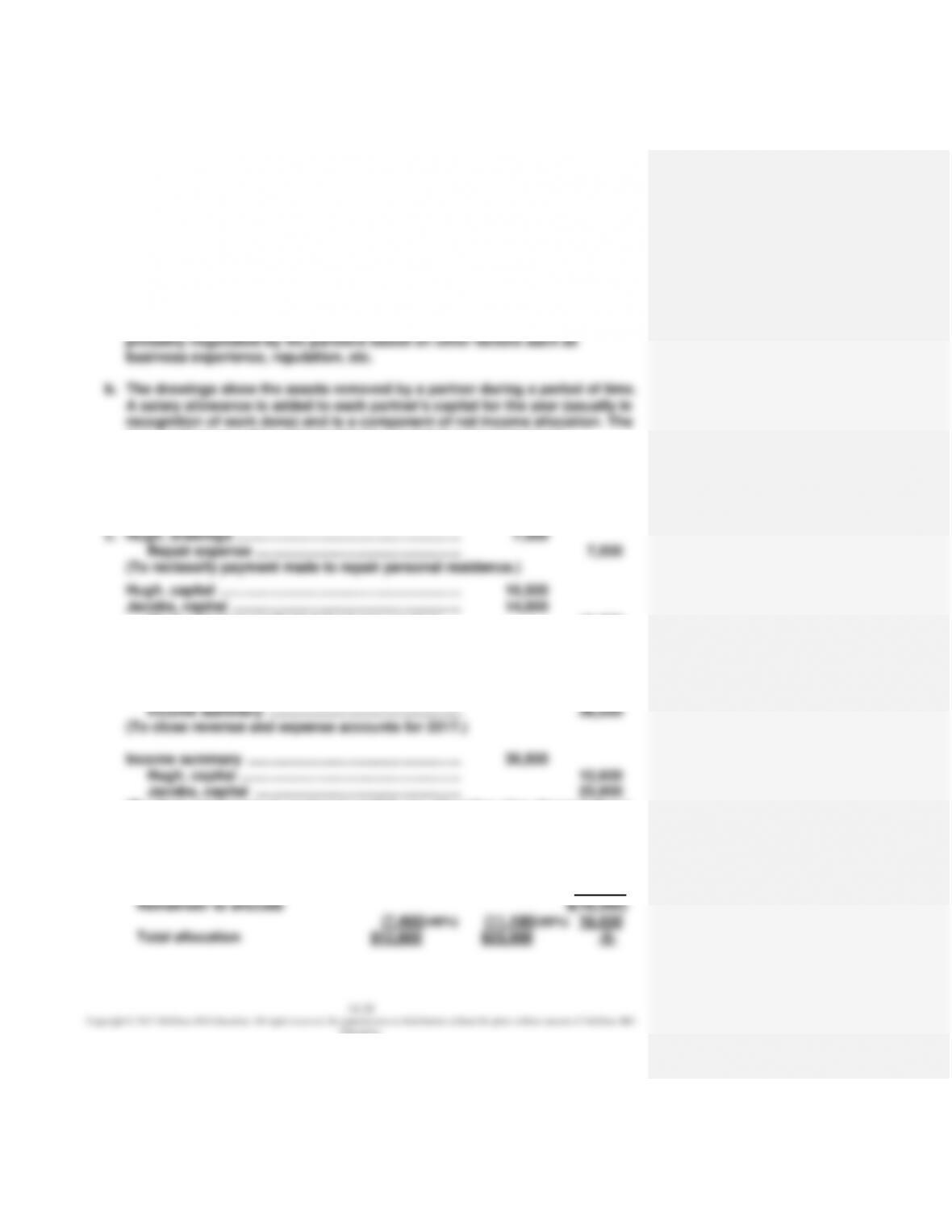
Hugh, drawings (adjusted for home repairs) …. 16,500
Jacobs, drawings ………………………………………… 14,000
(To close drawings accounts for 2017.)
Revenues …………………………..…………………………..… 175,000
Expenses (adjusted by first entry) ………………… 138,500
(To close net income to partners’ capital–see allocation plan shown below.)
Allocation of Net Income Hugh Jacobs Total
Net income $36,500
Interest (10% of beginning balance) $ 15,000 $ 10,000 (25,000)
Salary allowances 5,000 25,000 (30,000)
Chapter 14 – Partnerships: Formation and Operation – Hoyle, Schaefer, Doupnik, 13e
14–22
Education.
26. (continued)
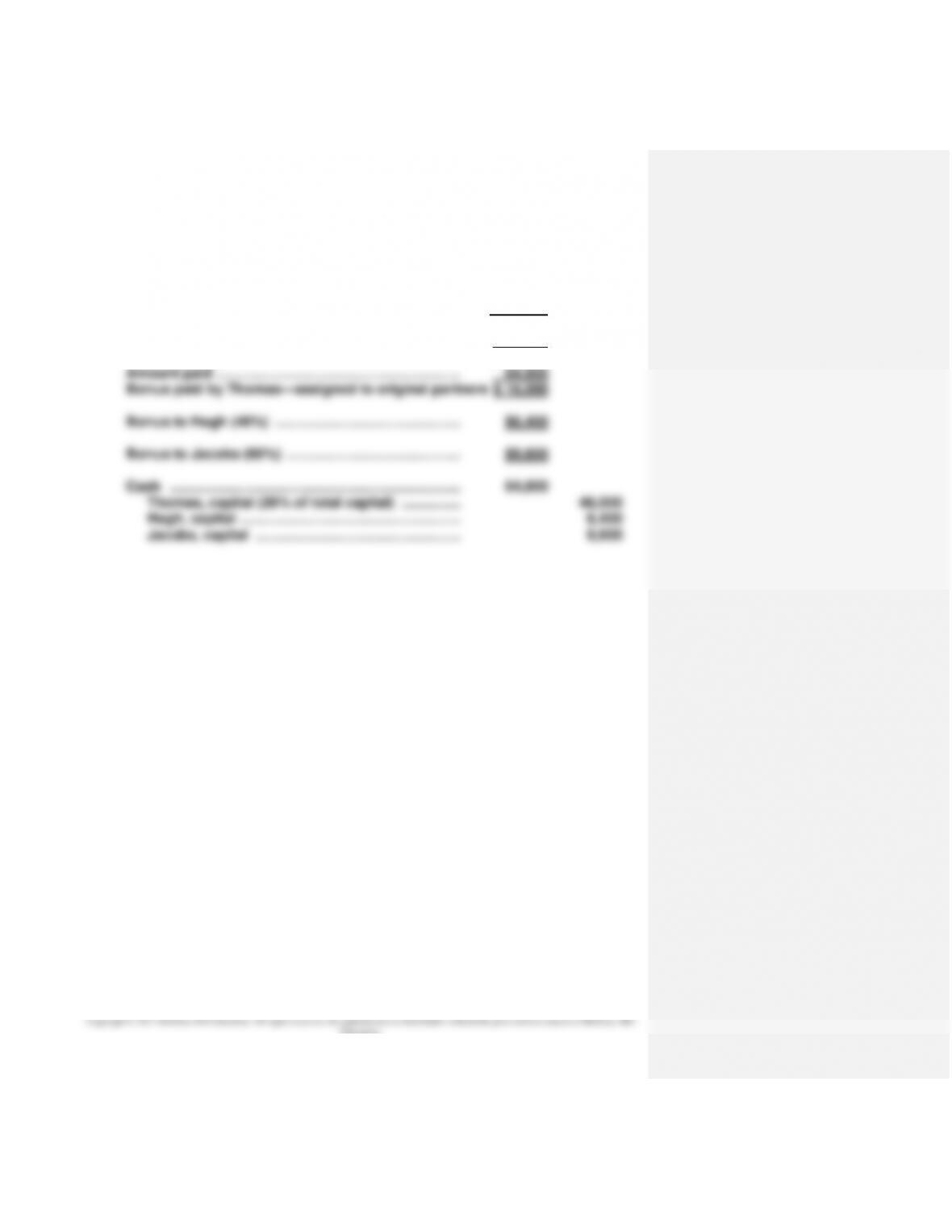
d. Total capital (original balances of $250,000 plus 2017
net income less drawings) …………………………... $256,000
Investment by Thomas ……………………………………… 64,000
Total capital after investment ………………………….... $320,000
Ownership portion acquired by Thomas ……………. 15%
Thomas, capital …………………………..…………………… $ 48,000
14–23
27. (40 Minutes) (Reporting a change in the composition of a partnership)
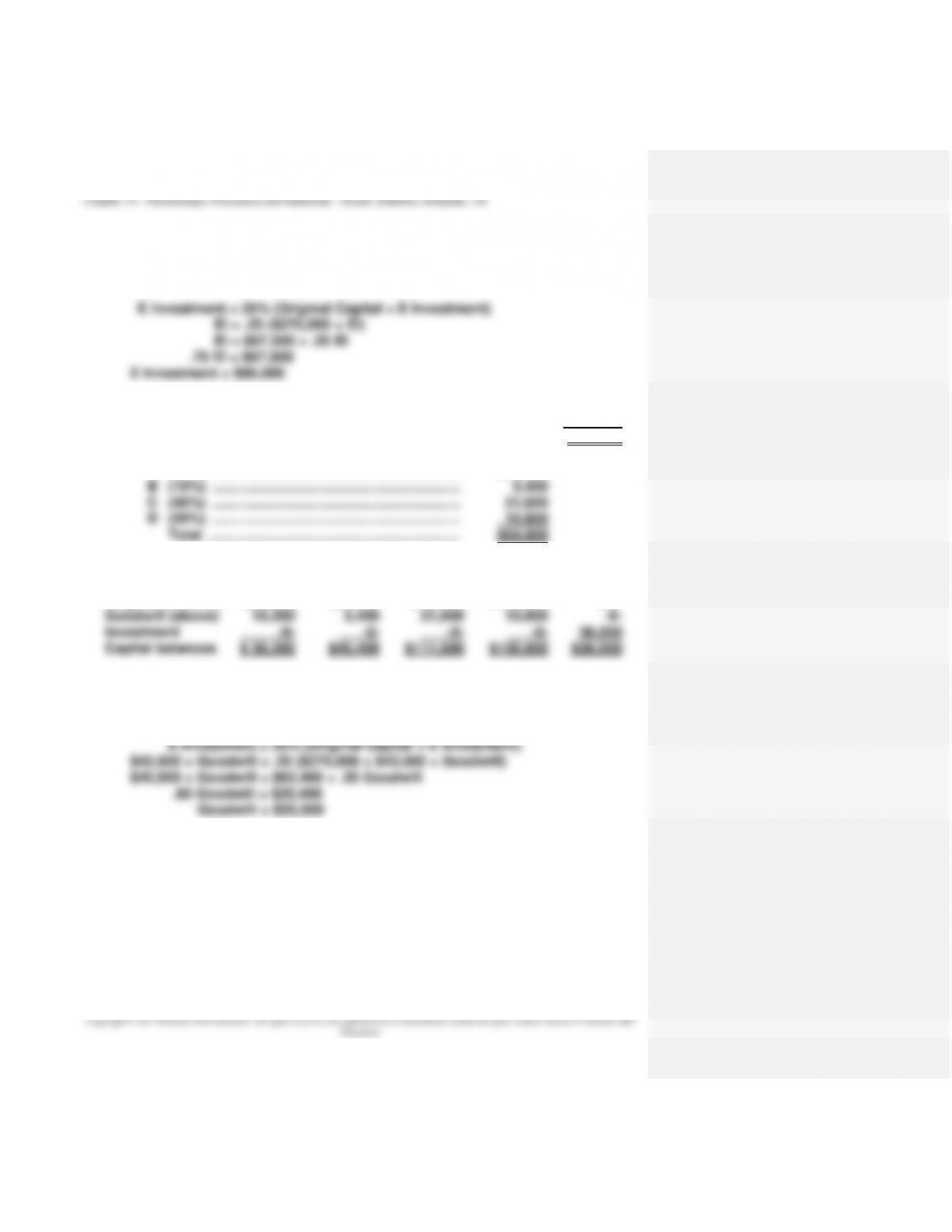
a. Exact amount of investment can only be computed algebraically:
b. Implied value of partnership ($36,000 ÷ 10%) ……… $360,000
Total capital after investment by E ($270,000 + $36,000) 306,000
Goodwill …………………………..…………………………..…. $ 54,000
Allocation of Goodwill:
A (30%) ……………………………………………………… $16,200
CAPITAL BALANCES
A B C D E
Original balances $20,000 $40,000 $ 90,000 $120,000 $-0-
c. Because E’s investment of $42,000 is less than 20% of the resulting capital
($312,000). E is apparently bringing some other attribute to the partnership
(goodwill) that must be computed:
E’s investment is, therefore, $42,000 in cash and $25,500 in goodwill for a total
capital balance of $67,500; the other capital accounts remain unchanged. Note
that E’s capital of $67,500 is 20% of the new total capital $337,500 ($270,000 +
$67,500).
14–24
Education.
27. (continued)
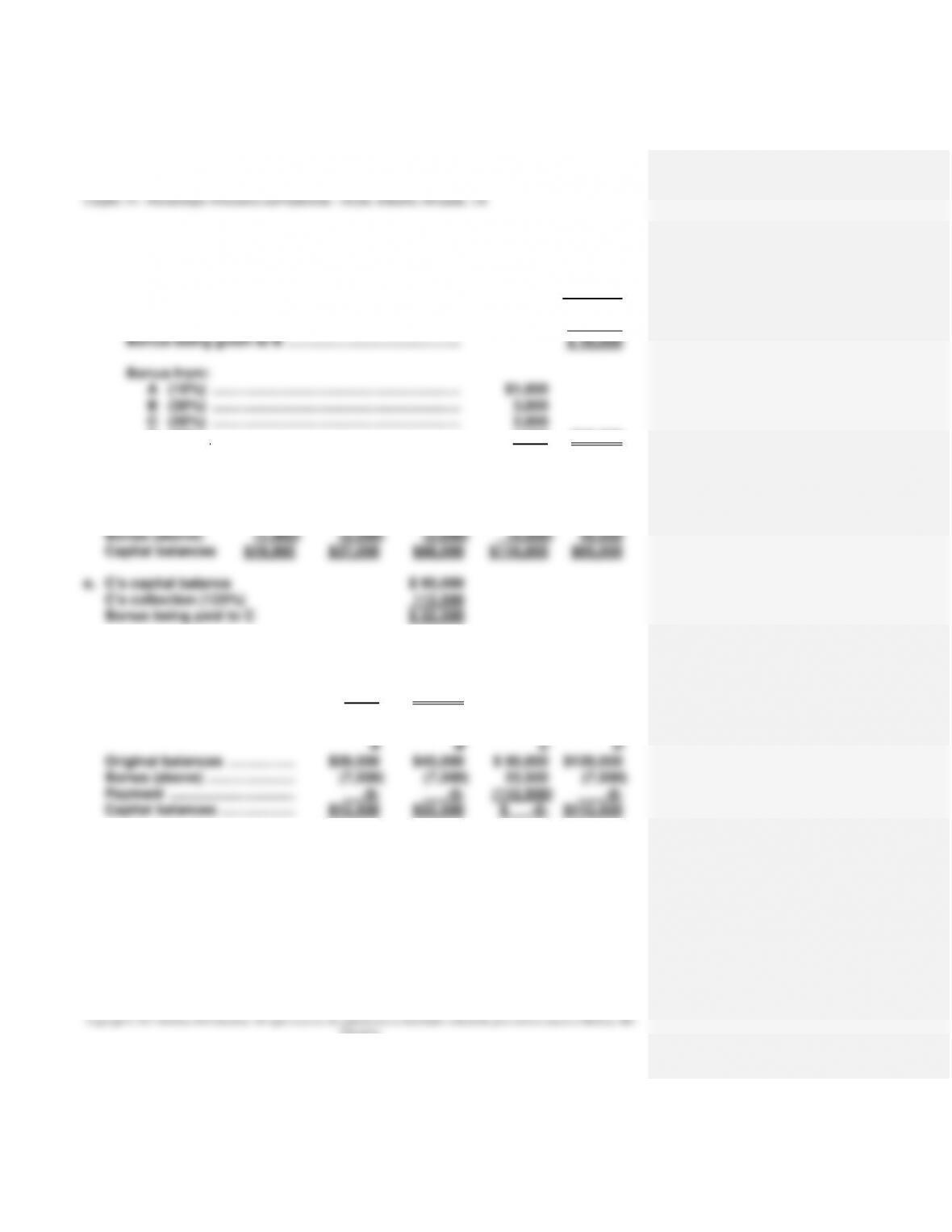
d. Total capital after investment ($270,000 + $55,000) $325,000
Amount acquired by E …………………………..………….. 20%
E’s capital balance …………………………..……………….. $ 65,000
E’s payment …………………………..…………………………. 55,000
D (40%) …………………………..…………………………. 4,000 $10,000
CAPITAL BALANCES
A B C D E
Original balances $20,000 $40,000 $90,000 $120,000 $-0-
Investment -0- -0- -0- -0- 55,000
Bonus from:
A (1/3) $7,500
B (1/3) 7,500
D (1/3) 7,500 $22,500
CAPITAL BALANCES
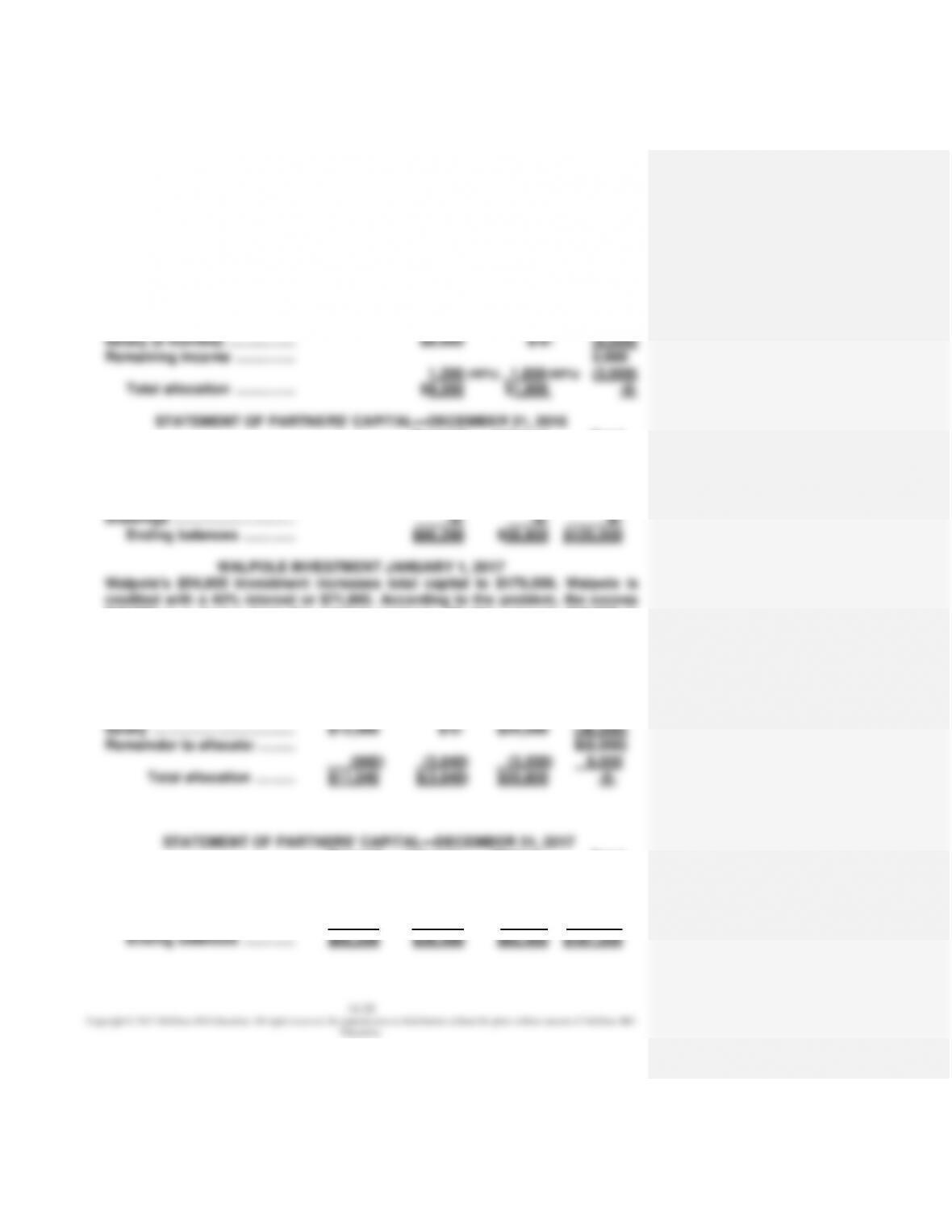
Chapter 14 – Partnerships: Formation and Operation – Hoyle, Schaefer, Doupnik, 13e
28. (55 Minutes) (Allocation of income to the partners and determination of capital
balances)
ALLOCATION OF NET INCOME—2016
Boswell Johnson Total
Net income……………………….. $11,000
Boswell Johnson Total
Beginning Balances ($114,000
Invested capital split evenly—
market value used for assets) $57,000 $57,000 $114,000
Net income allocation (above) 9,200 1,800 11,000
$17,600 is a bonus from the original partners. Of this amount, $10,560 is
allocated from Johnson (60%) and $7,040 from Boswell (40%).
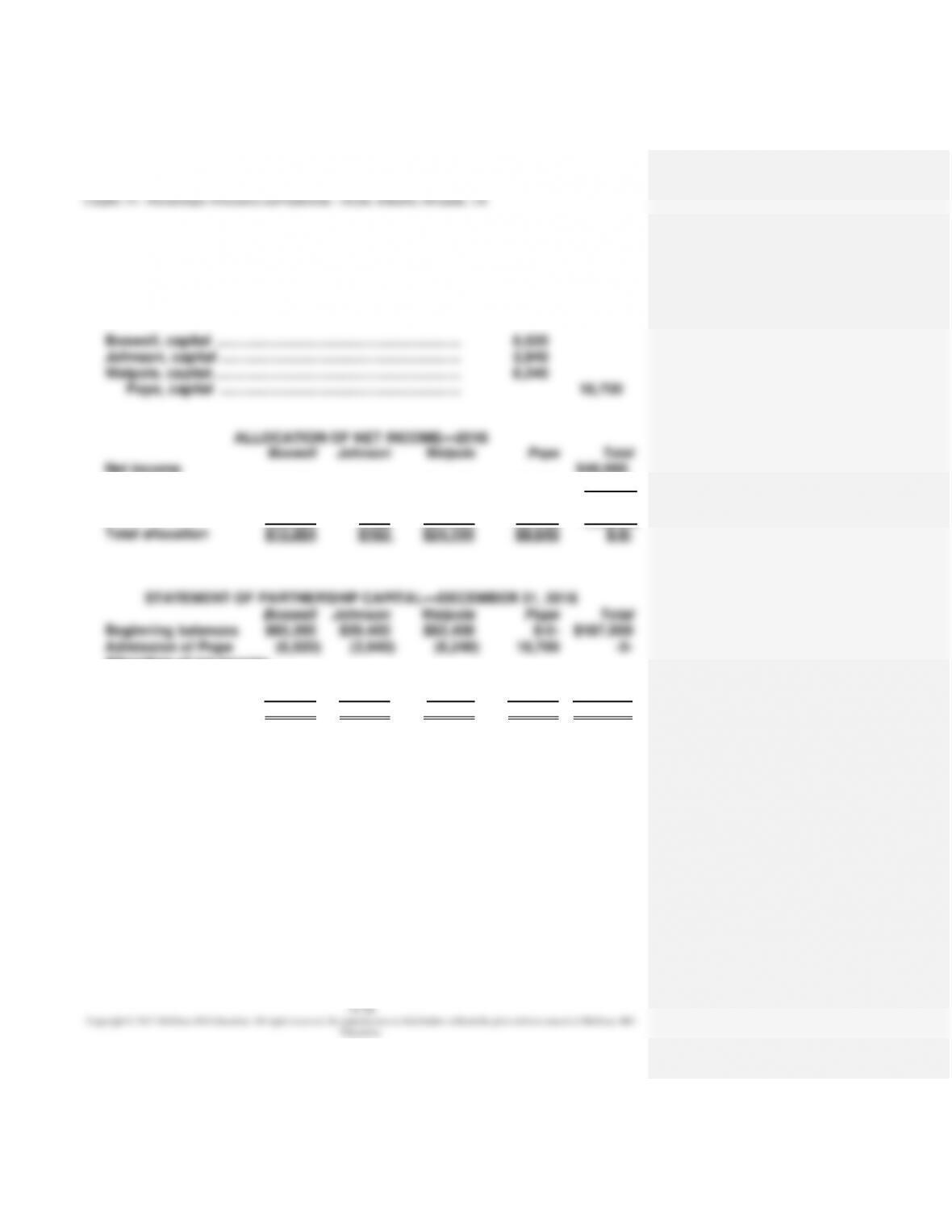
ALLOCATION OF NET INCOME—2017
Boswell Johnson Walpole Total
Net income……………………….. $28,000
Boswell Johnson Walpole Total
Beginning balances …………. $66,200 $58,800 $ -0- $125,000
Walpole’s contribution …….. (7,040) (10,560) 71,600 54,000
Income allocation (above) … 11,040 (3,840) 20,800 28,000
Drawings …………………………. (5,000) (5,000) (10,000) (20,000)
28. (continued)
ADMISSION OF POPE—JANUARY 1, 2018
Pope’s payment was made directly to the partners. Therefore, neither goodwill
nor a bonus need be recognized. Instead, 10% of each capital balance shown
above will be reclassified to Pope. The journal entry would be as follows:
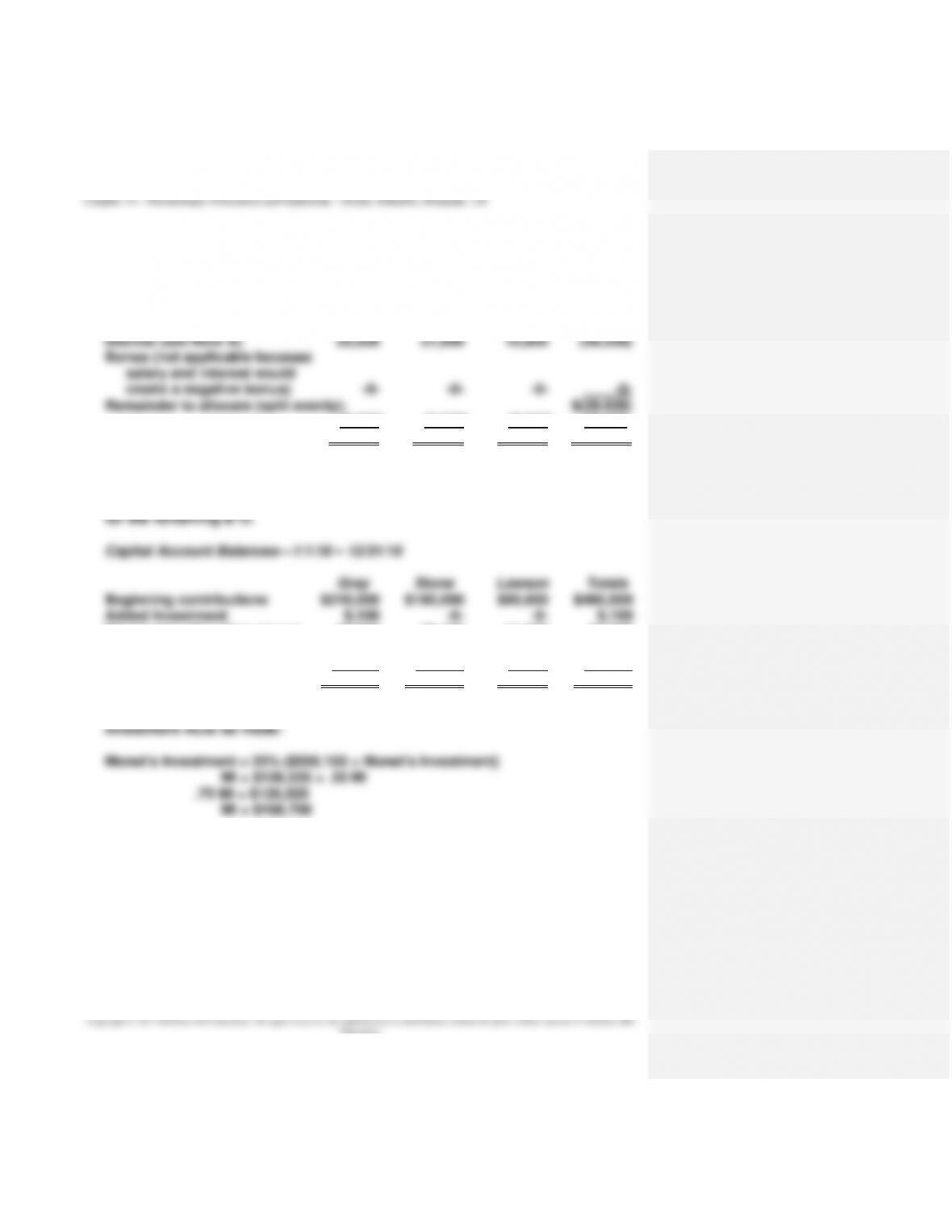
Net income $46,000
Salary $12,000 $-0- $24,000 $9,600 (45,600)
Remaining net income: $ 400
54 162 144 40 (400)
Allocation of net income
(above) 12,054 162 24,144 9,640 46,000
Drawings (5,000) (5,000) (10,000) (4,000) (24,000)
Ending balances $65,734 $30,622 $88,304 $24,340 $209,000
14–27
Education.
29. (60 Minutes) (Allocate income and prepare a statement of partners’ capital)
a. Net Income Allocation—2016
Gray Stone Lawson Totals
Net income $65,000
Salary allowance ($8 per hour) $13,680 $11,520 $10,400 (35,600)
(9,643) (9,643) (9,642) 28,928
Total allocation $29,965 $23,477 $11,558 $ -0-
Note A: Interest for Stone and Lawson is calculated at 12% of their beginning
capital balances ($180,000 and $90,000, respectively) while for Gray the
computation is based on a $210,000 balance for 4/12 of the year and $219,100
Net income allocation (above) 29,965 23,477 11,558 65,000
Drawing (10% of beginning
balances) (21,000) (18,000) (9,000) (48,000)
Ending balances $228,065 $185,477 $92,558 $506,100
Prior to developing the information for 2017, a computation of Monet’s
Chapter 14 – Partnerships: Formation and Operation – Hoyle, Schaefer, Doupnik, 13e
14–28
29. a. (continued)
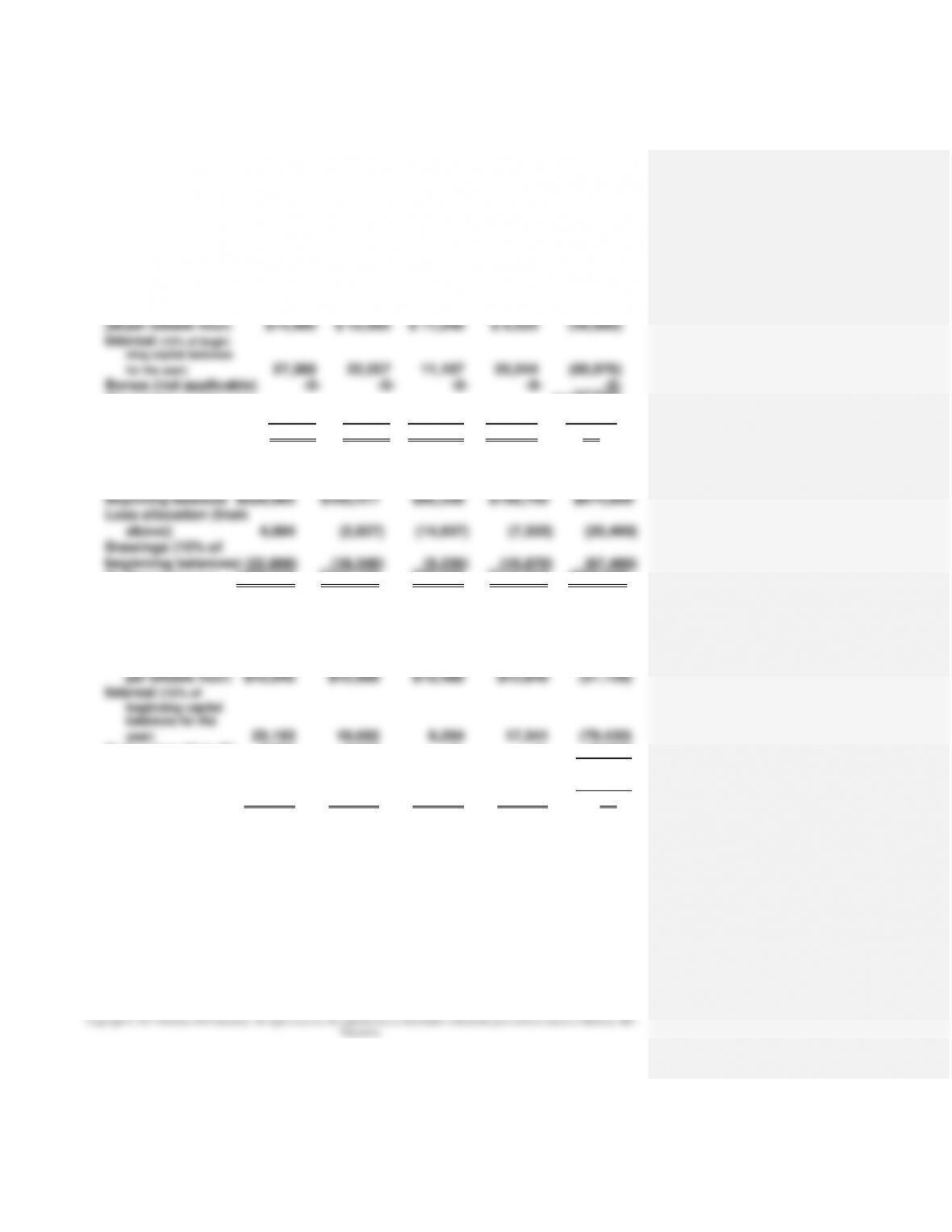
Net Loss Allocation—2017
Gray Stone Lawson Monet Totals
Net loss $(20,400)
Salary allowance
Remainder to allocate: $(148,336)
(split evenly): (37,084) (37,084) (37,084) (37,084) 148,336
Total allocation $ 4,684 $(2,827) $(14,937) $ (7,320) -0-
Capital Account Balances 1/1/17 – 12/31/17
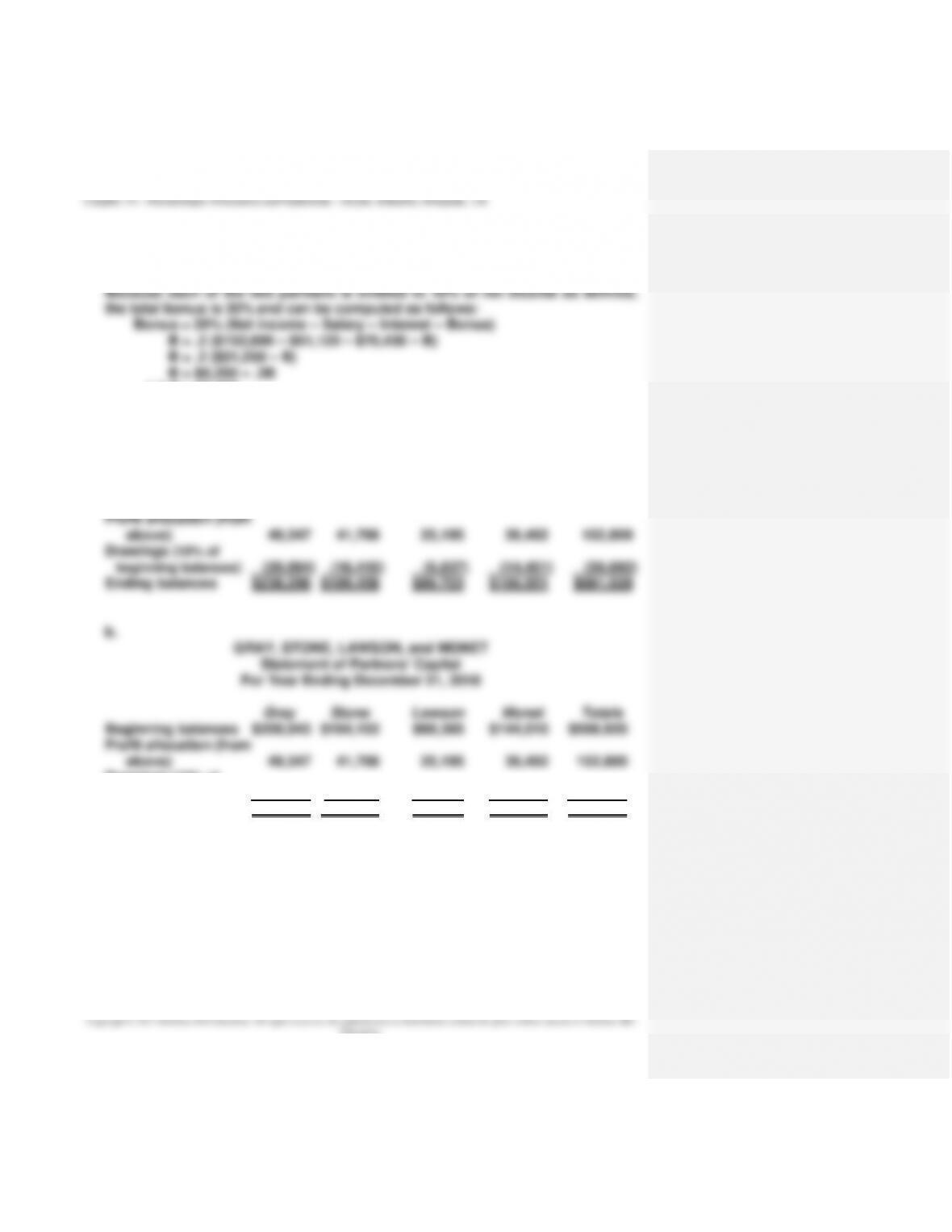
Gray Stone Lawson Monet Totals
Ending balances $209,943 $164,102 $68,365 $144,510 $586,920
Net Income Allocation—2018
Gray Stone Lawson Monet Totals
Net income $152,800
Salary allowance ($8
Bonus (see Note B) 2,604 2,604 -0– -0- (5,208)
Remaining net income $26,042
(split evenly): 6,510 6,510 6,511 6,511 (26,042)
Total allocation $49,347 $41,766 $25,195 $36,492 -0-
14–29
Education.
29. a. (continued)
Note B: The bonus to Gray and Stone can only be derived algebraically.
1.2 B = $6,250
B = $5,208 (or $2,604 per person)
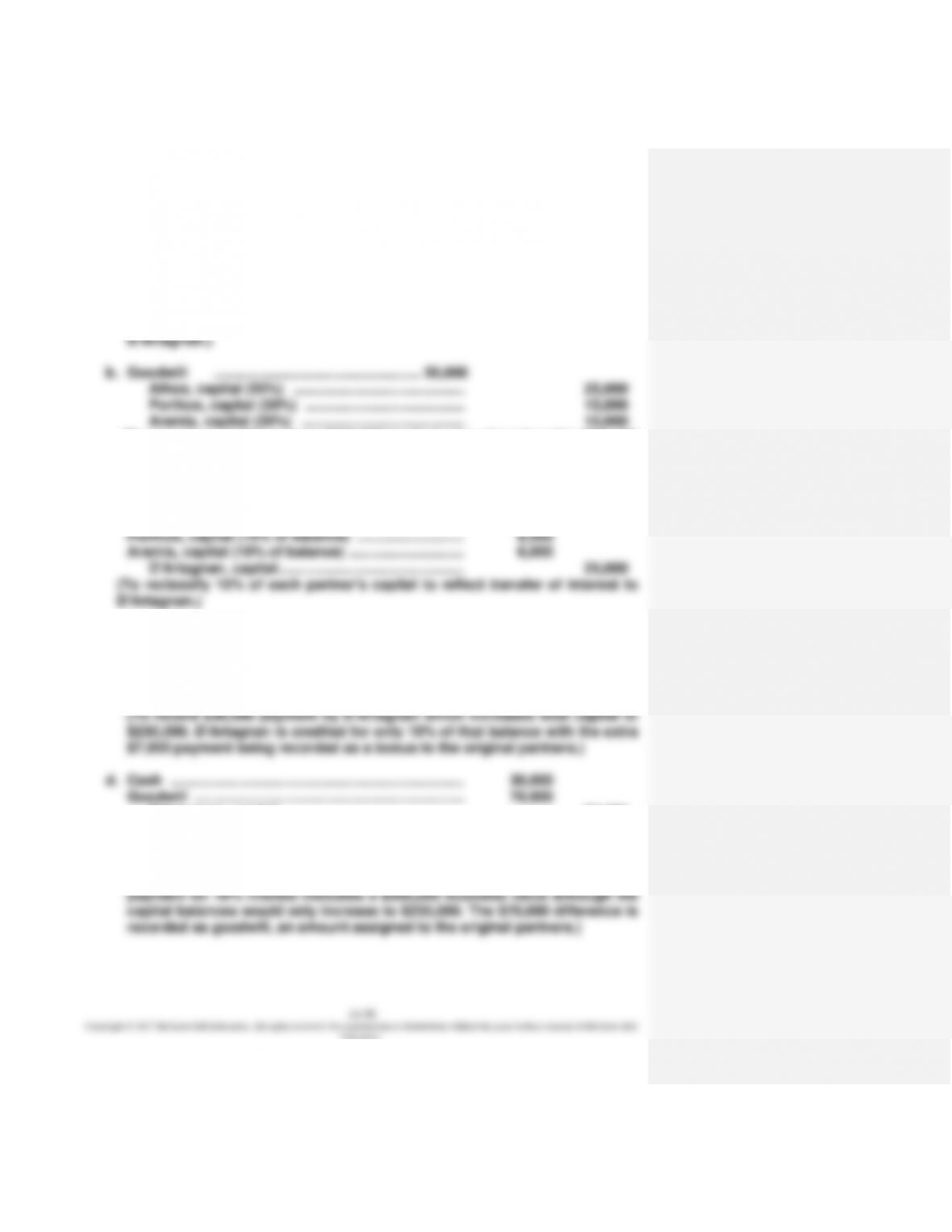
Capital Account Balances 1/1/18 – 12/31/18
Gray Stone Lawson Monet Totals
Beginning balances $209,943 $164,102 $68,365 $144,510 $586,920
Drawings (10% of
beginning balances) (20,994) (16,410) (6,837) (14,451) (58,692)
Ending balances $238,296 $189,458 $86,723 $166,551 $681,028
Chapter 14 – Partnerships: Formation and Operation – Hoyle, Schaefer, Doupnik, 13e
Education.
30. (40 Minutes) (Recording admission and retirement of partners using both the
bonus and goodwill methods)
a. Porthos, capital …………………………..……………………. 35,000
D’Artagnan, capital …………………………..………….. 35,000
(To reclassify Porthos’s capital balance to reflect transfer of interest to
(To record goodwill based on $250,000 implied value of partnership [$25,000
÷ 10%]. Because current capital is only $200,000 [the $25,000 goes directly
to the partners], goodwill of $50,000 has to be recorded and allocated using
profit and loss ratio.)
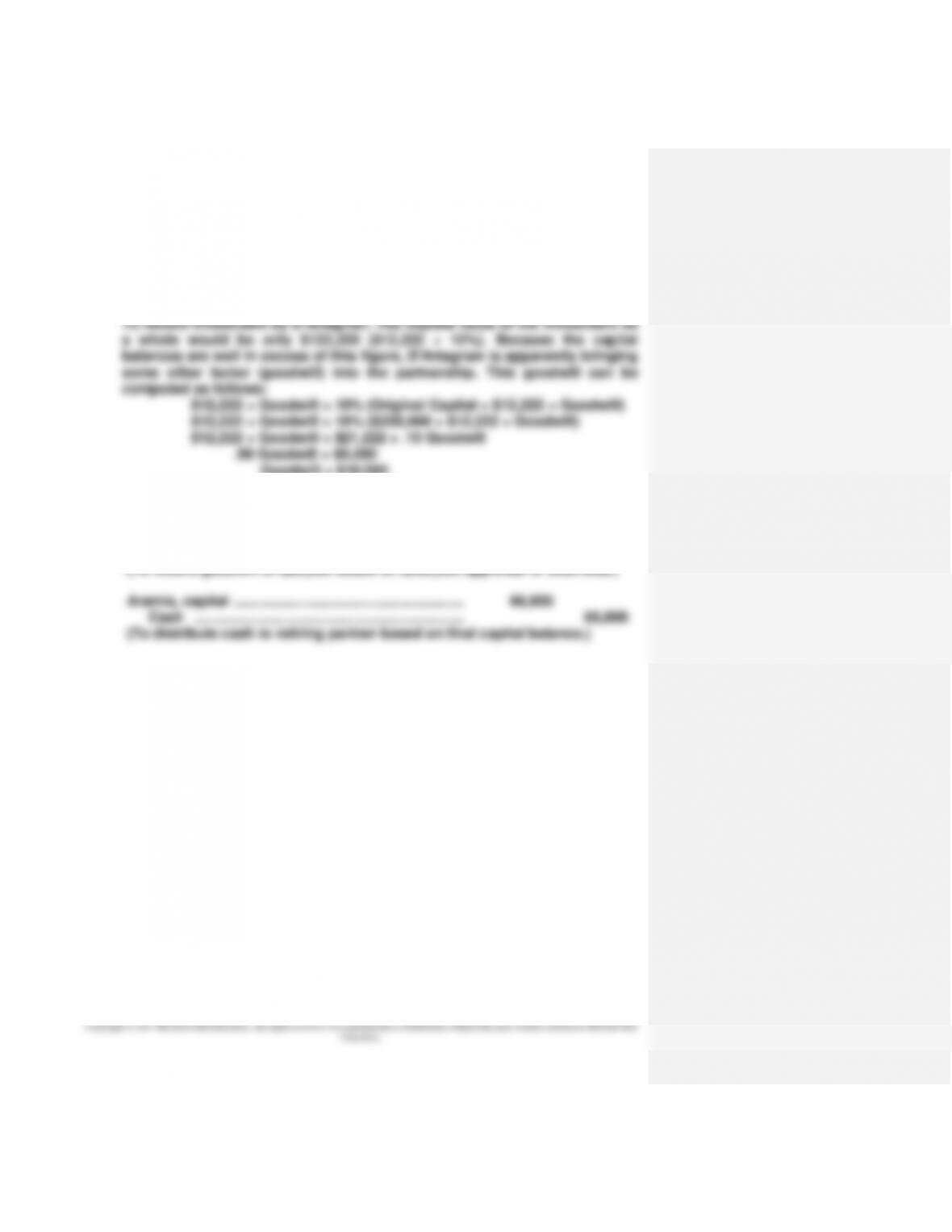
Athos, capital (10% of balance) …………………………. 10,500
c. Cash …………………………..…………………………..………. 30,000
D’Artagnan, capital (10% of total capital) ……….. 23,000
Athos, capital (50% of excess payment) ……….. 3,500
Porthos, capital (30% of excess payment) …….. 2,100
Aramis, capital (20% of excess payment) ……… 1,400
D’Artagnan, capital …………………………..………….. 30,000
Athos, capital (50% of goodwill) ………………….. 35,000
Porthos, capital (30% of goodwill) ……………….. 21,000
Aramis, capital (20% of goodwill) …………………. 14,000
(To record D’Artagnan’s contribution to the partnership. The $30,000
Chapter 14 – Partnerships: Formation and Operation – Hoyle, Schaefer, Doupnik, 13e
14–31
30. (continued)
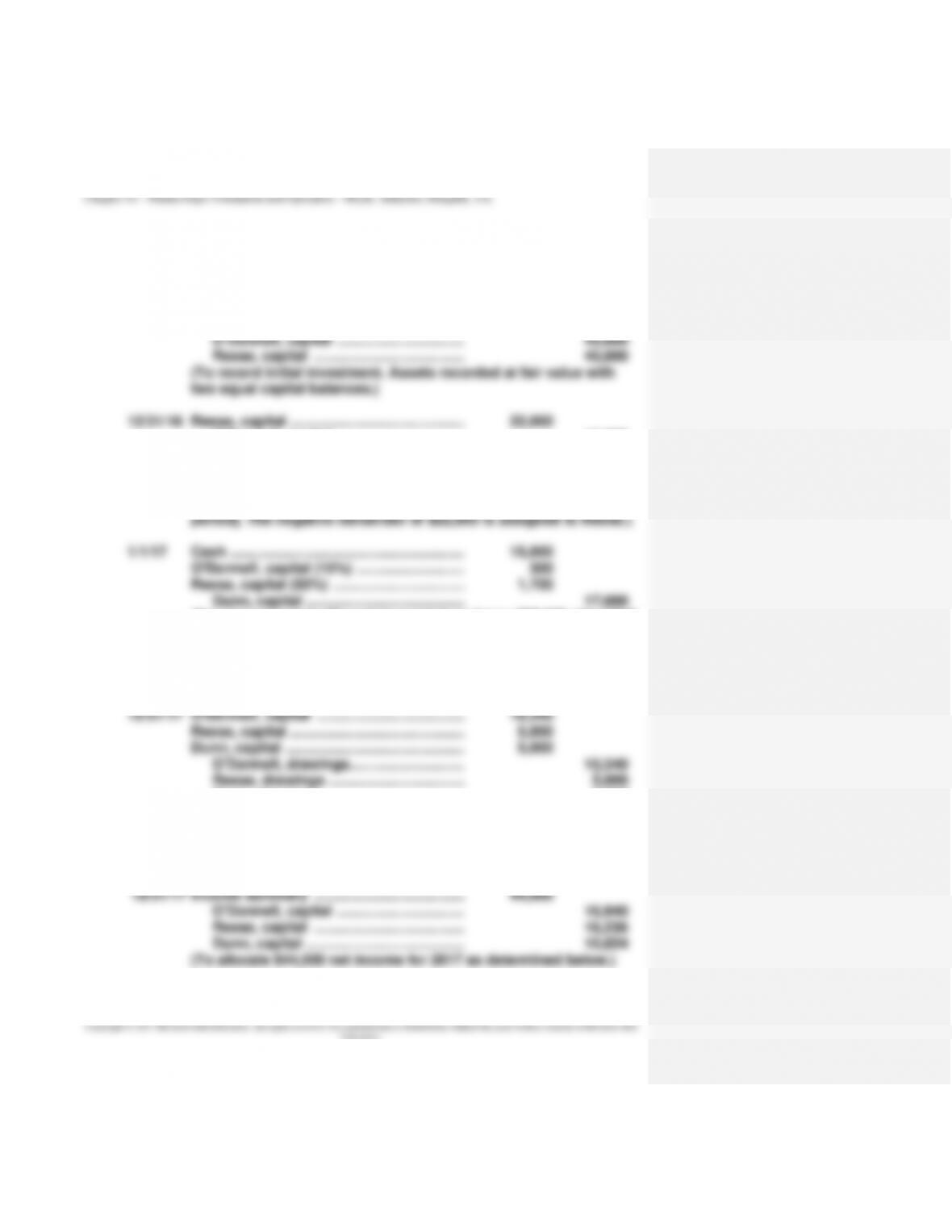
e. Cash …………………………..…………………………..……….. 12,222
Goodwill . …………………………..………………………….... 10,000
D’Artagnan, capital …………………………..………….. 22,222
Goodwill = $10,000
f. Goodwill …………………………..…………………………..…. 80,000
Athos, capital (50%) …………………………..………… 40,000
Porthos, capital (30%) …………………………..……… 24,000
Aramis, capital (20%) …………………………..………. 16,000
(To record goodwill of $80,000 based on $280,000 appraisal of business.)
14–32
Education.
31. (75 Minutes) (Recording of changes in the composition of a partnership
including allocation of income)
a. 1/1/16 Building …………………………..………………… 52,000
Equipment …………………………..……………… 16,000
Cash …………………………..……………………… 12,000
O’Donnell, capital ………………………….. 12,000
Income summary …………………………... 10,000
(The allocation plan specifies that O’Donnell receives 20% in
interest [or $8,000 based on $40,000 capital balance] plus $4,000
more [Because that amount exceeds 15% of the profits from the
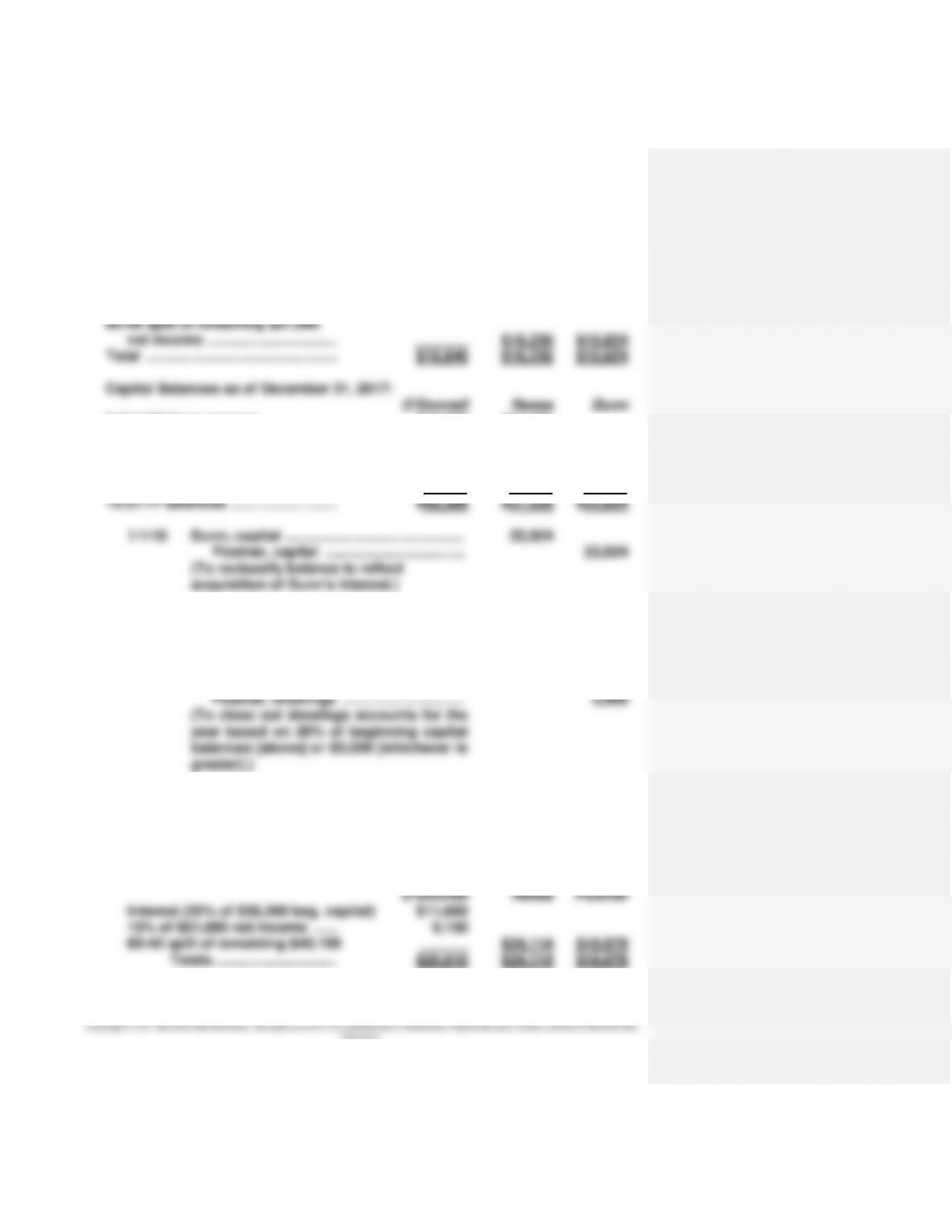
(New investment by Dunn brings total capital to $85,000 after 2016
loss [$80,000 – $10,000 + $15,000]. Dunn’s 20% interest is $17,000
[$85,000 × 20%] with the extra $2,000 coming from the two original
partners [allocated between them according to their profit and
loss ratio].)
Dunn, drawings …………………………..… 5,000
(To close out drawings accounts for the year based on
distributing 20% of each partner’s beginning capital balances
[after adjustment for Dunn’s investment] or $5,000 whichever is
greater. O’Donnell’s capital is $51,700 [$40,000 + $12,000 – $300])
Chapter 14 – Partnerships: Formation and Operation – Hoyle, Schaefer, Doupnik, 13e
14–33
Education.
31. a. (continued)
O’Donnell Reese Dunn
Interest (20% of $51,700
beginning capital balance)…….. $10,340
15% of $44,000 net income ………… 6,600
Initial 2016 investment ………………. $40,000 $40,000
2016 net loss allocation …………….. 12,000 (22,000)
Dunn’s investment ……………………. (300) (1,700) $17,000
2017 drawings ………………………….. (10,340) (5,000) (5,000)
2017 net income allocation ……….. 16,940 16,236 10,824
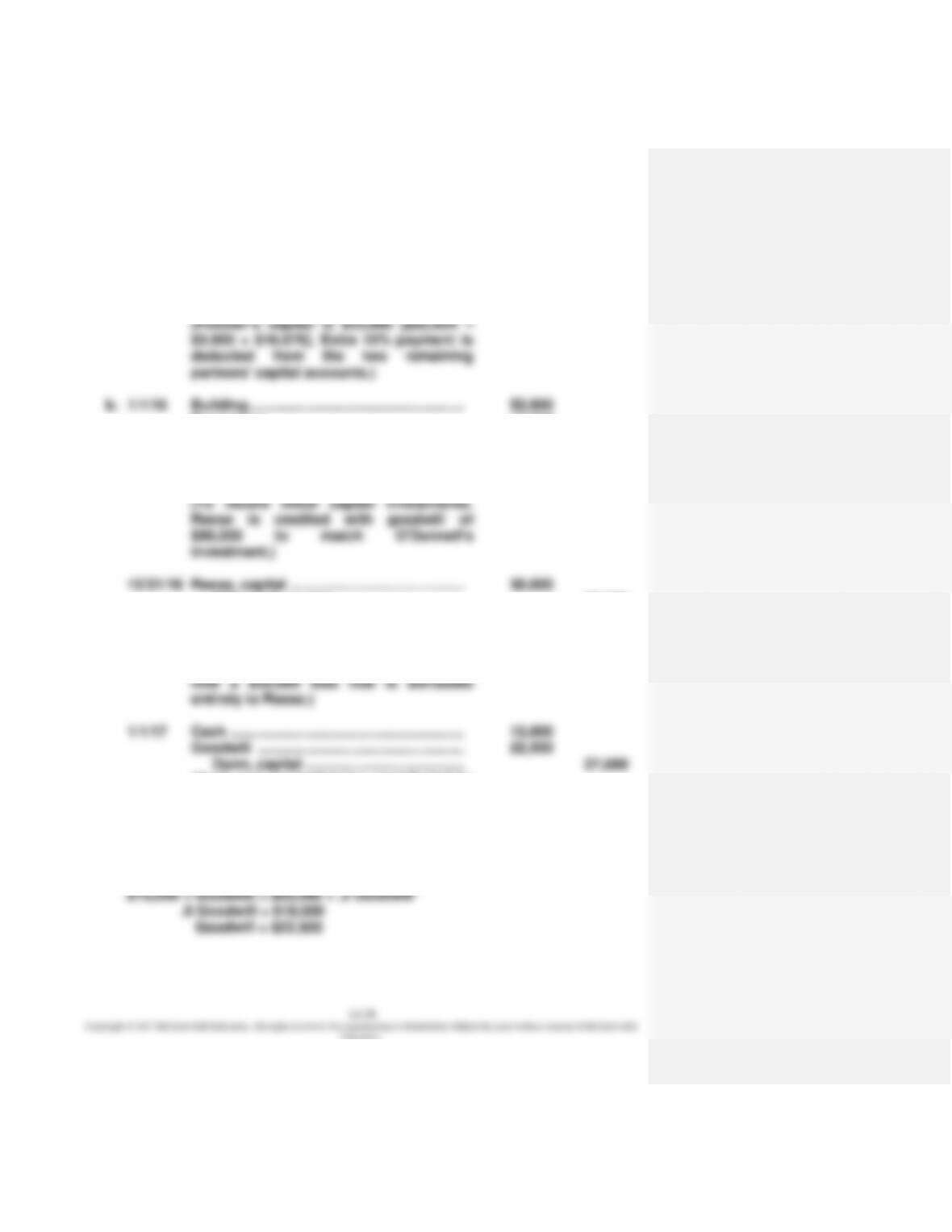
12/31/18 O’Donnell, capital …………………………..….. 11,660
Reese, capital …………………………………….. 5,507
Postner, capital …………………………..……… 5,000
O’Donnell, drawings ………………………. 11,660
Reese, drawings ………………………….... 5,507
12/31/18 Income summary ………………………………… 61,000
O’Donnell, capital ………………………….. 20,810
Reese, capital …………………………..…… 24,114
Postner, capital …………………………..… 16,076
(To allocate net income for 2018 determined as follows)
Chapter 14 – Partnerships: Formation and Operation – Hoyle, Schaefer, Doupnik, 13e
Education.
31. a. (continued)
1/1/19 Postner, capital …………………………..……… 33,900
O’Donnell, capital (15%) ……………………… 509
Reese, capital (85%) …………………………... 2,881
Cash …………………………………………….. 37,290
Equipment …………………………..…………….. 16,000
Cash …………………………..……………………… 12,000
Goodwill …………………………..……………….. 80,000
O’Donnell, capital ………………………….. 80,000
Reese, capital …………………………..…… 80,000
O’Donnell, capital ………………………….. 20,000
Income summary …………………………... 10,000
(Interest of $16,000 is credited to
O’Donnell [$80,000 × 20%] along with a
base of $4,000. The remaining amount is
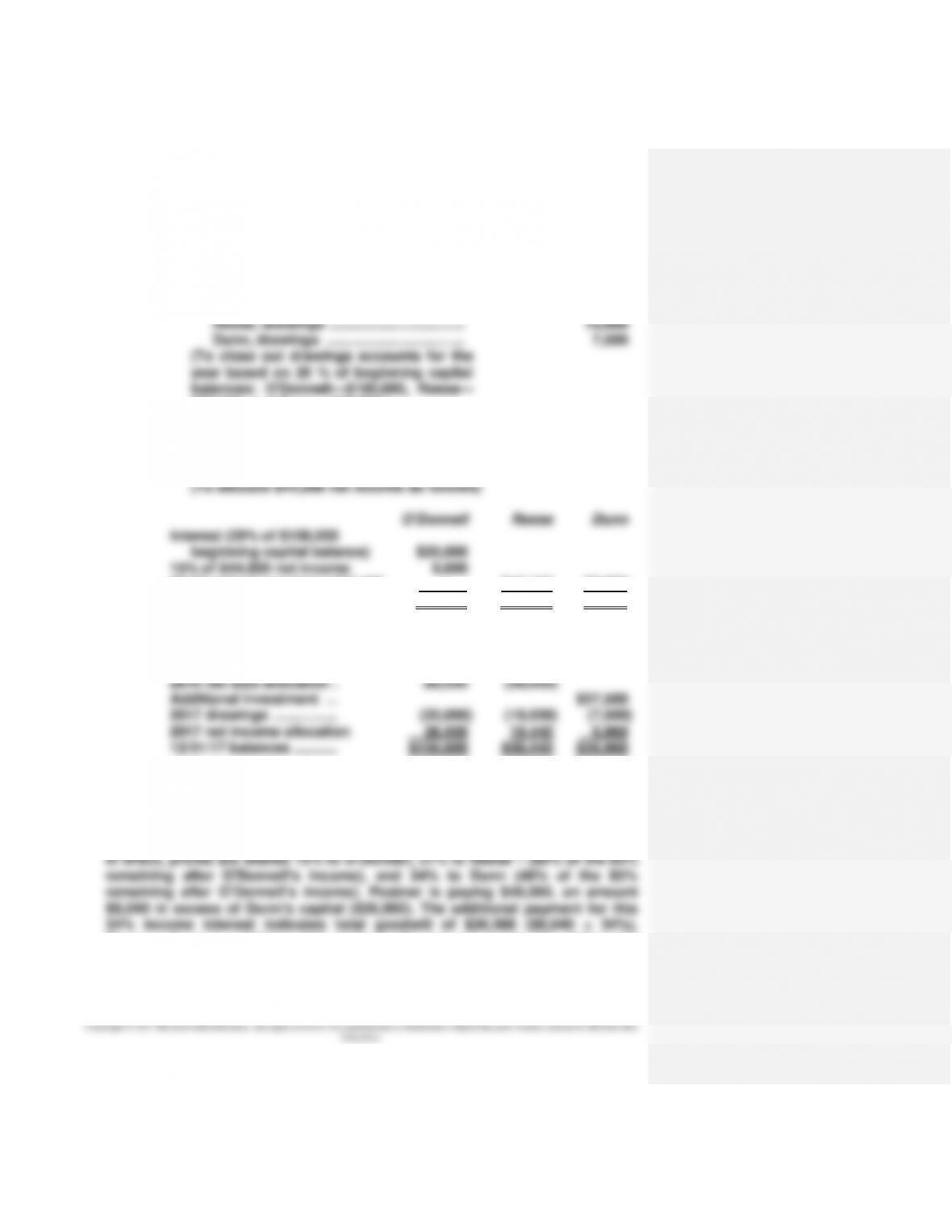
(Cash and goodwill being contributed by
Dunn are recorded. Goodwill must be
calculated algebraically.)
$15,000 + Goodwill = 20% (Current Capital + $15,000 + Goodwill)
$15,000 + Goodwill = 20% ($150,000 + $15,000 + Goodwill)
Chapter 14 – Partnerships: Formation and Operation – Hoyle, Schaefer, Doupnik, 13e
14–35
31. b. (continued)
12/31/17 O’Donnell, capital …………………………..….. 20,000
Reese, capital …………………………………….. 10,000
Dunn, capital …………………………..…………. 7,500
O’Donnell, drawings ……………………….. 20,000
$50,000, and Dunn—$37,500.)
12/31/17 Income summary …………………………..…… 44,000
O’Donnell, capital ………………………….. 26,600
Reese, capital …………………………..…… 10,440
Dunn, capital …………………………..…….. 6,960
60:40 split of remaining $17,400 $10,440 $6,960
Totals $26,600 $10,440 $6,960
Capital balances as of December 31, 2017:
O’Donnell Reese Dunn
Initial 2016 investment … $ 80,000 $80,000
1/1/18 Goodwill ……………………………………………. 26,588
O’Donnell, capital (15%) ………………… 3,988
Reese, capital (51%) ………………………. 13,560
Dunn, capital (34%) ……………………….. 9,040
(To record goodwill indicated by purchase of Dunn’s interest.)
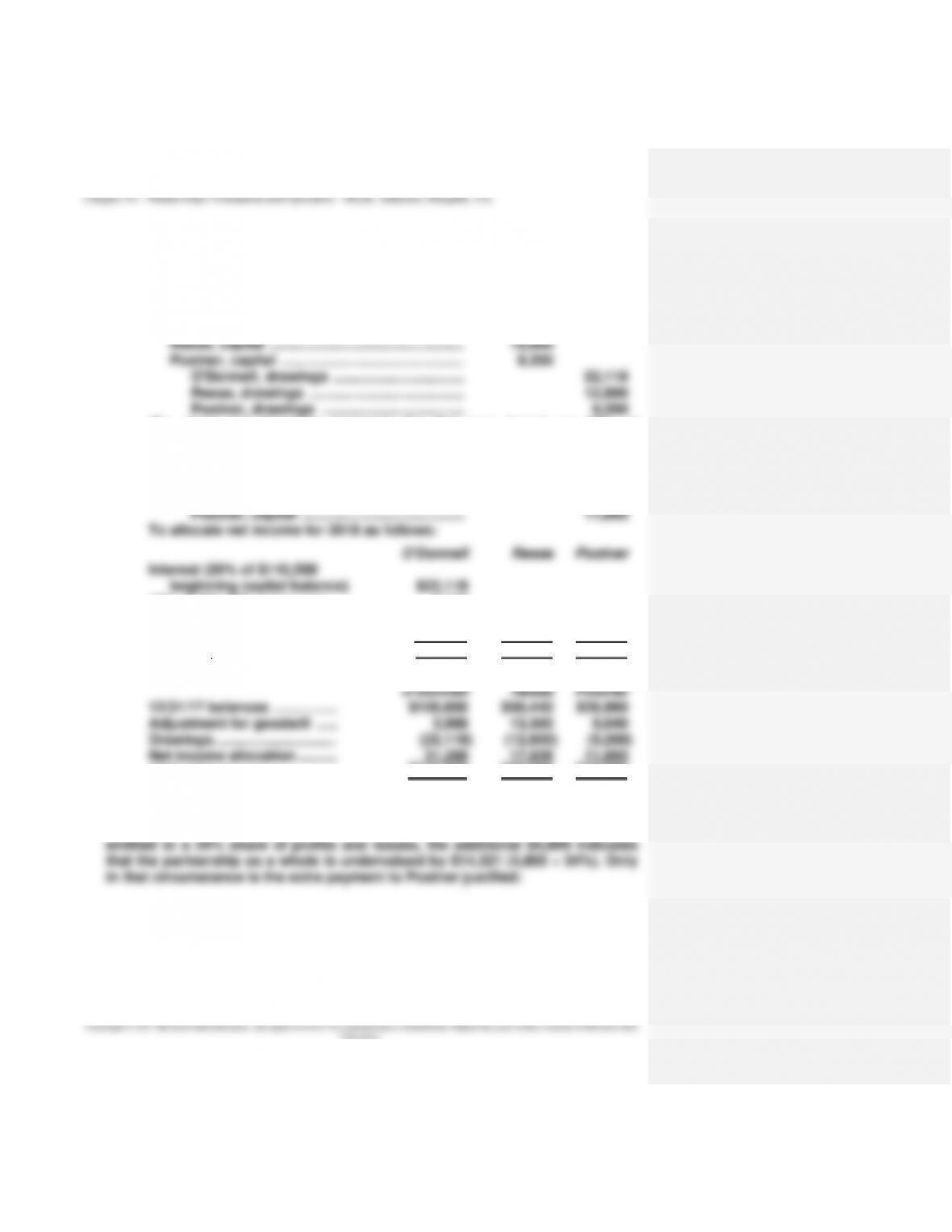
Because Dunn is entitled to 34% of the profits but only holds 19% of the total
capital, an implied value for the company as a whole cannot be determined
directly from the payment of $46,000. Thus, goodwill can only be computed
based on the excess payment.
14–36
Education.
31. b. (continued)
1/1/18 Dunn, capital ………………………………………….. 46,000
Postner, capital …………………………..……… 46,000
(To reclassify capital balance to new partner.)
12/31/18 O’Donnell, capital …………………………..……….. 22,118
(To close out drawings accounts for the year based on 20% of
beginning capital balances [after adjustment for goodwill].)
12/31/18 Income summary …………………………..……….. 61,000
O’Donnell, capital …………………………..….. 31,268
Reese, capital …………………………………….. 17,839
15% of $61,000 net income . 9,150
60:40 split of remaining
$29,732 ………………………. $17,839 $11,893
Totals …………………………. $31,268 $17,839 $11,893
Capital Balances as of December 31, 2018:
12/31/18 balances …………….. $119,738 $69,039 $48,693
Postner will be paid $53,562 (110% of the capital balance) for her interest. This
amount exceeds her capital balance by $4,869. Because Postner is only
31. b. (continued)
Chapter 14 – Partnerships: Formation and Operation – Hoyle, Schaefer, Doupnik, 13e
14–37
1/1/19 Postner, capital …………………………………………… 53,562
Cash …………………………..…………………………. 53,562
(To record final distribution to Postner.)
Chapter 14 – Partnerships: Formation and Operation – Hoyle, Schaefer, Doupnik, 13e
14–38
Develop Your Skills
Research Case
This assignment allows the student to make use of the SEC website and, then,
Probably the most noticeable characteristic of the statements for Buckeye
Partners is that they resemble corporate financial statements in most ways. A
casual overview might not bring any differences to mind. However, a close
one for the limited partners and the other for the noncontrolling interest.
▪ A statement of partners’ capital replaces a statement of stockholders’
equity.
▪ The first two paragraphs of Note One to the financial statements describe
the partnership organization.
Analysis Case
An unlimited number of allocation plans can be developed for any partnership.
Here, Carson will be interested in some reward for investing the capital used to
able to bring to the business.
One possibility would be to accrue interest to Carson on her capital balance for
the year based, perhaps, on the prime rate. Erikson could be assigned a
particularly high share of any revenues generated from new clients. The amount
Erikson and Delaney would share in the income Because they are doing the work,
one in gaining new clients and the other in the day-to-day operations of the
business.
Chapter 14 – Partnerships: Formation and Operation – Hoyle, Schaefer, Doupnik, 13e
Communication Cases 1 and 2
These two cases ask the student to identify the types of factors that will lend
themselves toward the organization becoming a corporation (in Case 1) or a
partnership (in Case 2). Several issues should be considered when looking into a
legal format for a business enterprise:
▪ Do state laws play any role in the decision? In some states, particular
types of organizations are prohibited from operating as a corporation. Will
partnership. However, if Fernandez and Webster expect the business to
prosper and grow, they should consider which type of business will enable
them to attract other capital or debt investments. Usually, it is a
corporation that is best set up to enable growth through the issuance of
securities.
▪ How well do the owners know and trust each other? As with the previous
comment, potential liability can be greatly enhanced if the owners do not
know each other well or if additional owners are expected to join at a later
point in time. Under that circumstance, everyone may feel more
comfortable if the business is created as a corporation or as one of the
various politicians have proposed the elimination of part or all of that tax.
Corporations gain appeal if dividend income is not taxed.
▪ How much money do they have available to create a legal organization? In
most states, creation of a partnership can be virtually free whereas the
legal formality of a corporation can cost money. If finances are tight, the
Chapter 14 – Partnerships: Formation and Operation – Hoyle, Schaefer, Doupnik, 13e
14–40
Excel Case: There are a variety of ways to create a spreadsheet to solve this particular problem.
Here is one possible approach:
In Cell A1, enter text “Net Income” and in Cell B1 enter $200,000.
In Cell A2, enter text “Billable Hours–Ace”. In Cell B2 enter 2,000. In Cell C2, enter $20 hourly rate.
return of 10%.
Perform calculation: In Cell D2, enter formula to multiply number of hours by hourly rate.
Formula: =+B2*C2
The formula for the next three line items is identical to this first formula; copy the formula to Cells
D3, D4, and D5. (To copy a formula across a range of cells, select the cell containing formula,
Subtract the subtotal of the partner’s initial allocations (Cell D6) from the Net Income (Cell B1)
with the following formula: In Cell A8, enter the label text “Profit to be Split” and in Cell D8, enter
the following formula: =+B1-D6.
Determine the distribution of Profit between partners:
In Cell A10, enter label text “Profit – Ace” and in Cell C10 enter “50%”.
automatically. There are eleven variables that can be changed: B1, B2, B3, B4, B5, C2, C3, C4,
and C5, as well as C10 and C11 (which must add up to 100%).
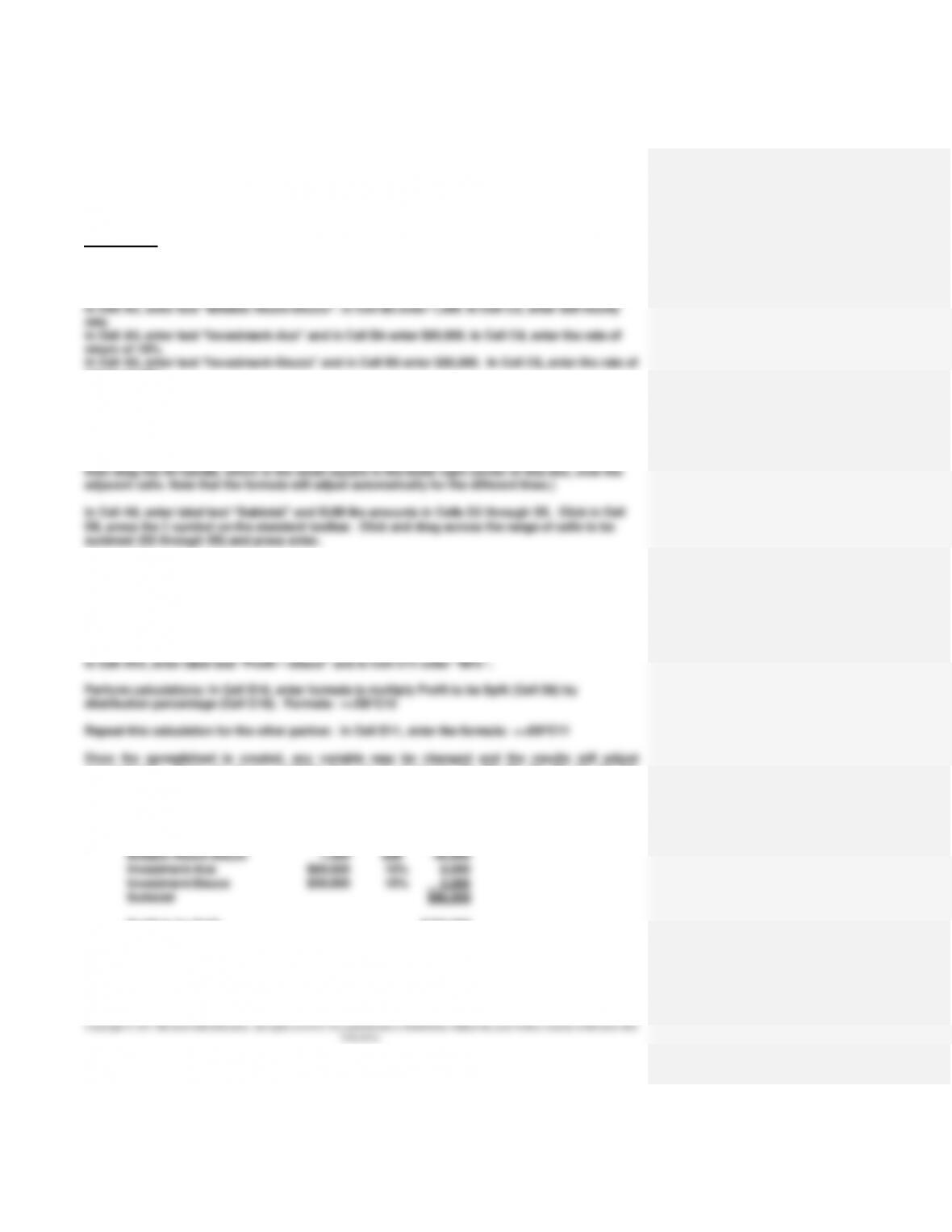
Example:
Net Income
$200,000
Billable Hours-Ace
2,000
$20
$40,000
Billable Hours-Deuce
1,500
$30
45,000
Investment-Ace
$80,000
10%
8,000
Investment-Deuce
$50,000
10%
5,000
Subtotal
$98,000
Profit to be Split:
$102,000
Profit-Ace
50%
$51,000
Profit-Deuce
50%
$51,000