Chapter 13 – Accounting for Legal Reorganizations and Liquidations
13-1
CHAPTER 13
ACCOUNTING FOR LEGAL REORGANIZATIONS
AND LIQUIDATIONS
Chapter Outline
I. Because of myriad possible financial or business difficulties, an entity can become insolvent,
unable to pay its debts as they come due.
A. To ensure the equitable treatment of all parties involved (stockholders as well as
creditors), laws have been established to provide structure for the bankruptcy process in
the United States.
B. Legal guidance is provided primarily by the Bankruptcy Reform Act of 1978 (as
amended).
1. Law attempts to arrive at a fair distribution of a debtor’s assets.
2. It also seeks to discharge the obligations of an honest debtor.
II. Entities can begin to experience financial difficulties well in advance of a formal declaration
of bankruptcy. This precarious situation poses significant accounting challenges for the
1. Substantial doubt can arise for many reasons such as operating losses and working
capital shortages.
2. Management must evaluate plans created to prevent entity from failing to pay debts.
3. If plans can be implemented that will keep entity from defaulting on debt, only the
reason for substantial doubt and the plans created by the entity need to be disclosed.
4. If management is uncertain as to whether plans can be implemented or whether the
plans will enable the entity to meet its debts as they come due, the reasons for
substantial doubt must be disclosed along with management’s plans. In addition, a
statement must be included that the substantial doubt exists about the entity’s ability
to continue as a going concern for one year from the date the financial statements
minimum level of debt.
B. After a bankruptcy petition is received, normally the court will grant an order for relief to
halt all actions against the debtor.
13-2
Copyright © 2017 McGraw-Hill Education. All rights reserved. No reproduction or distribution without the prior written consent of McGraw-Hill
Education.
having a value in excess of the related liability.
B. Partially secured creditors also have a collateral interest but the expected net realizable
value will not satisfy the entire obligation.
C. Some unsecured obligations (including administrative expenses, certain debts to
employees, and government claims for unpaid taxes) have priority over other unsecured
A. Assets are reported at net realizable value along with the disclosure of any pledged
amounts. Liabilities are classified according to the security or priority of the creditor.
B. A Statement of Financial Affairs is especially useful if prepared at the beginning of the
bankruptcy process to assist all parties in evaluating the outcome of various actions.
C. Most of the asset balances reported in this statement are merely estimates, projections
B. The trustee prepares a periodic reporting of activities. Historically, that reporting has
been in the form of a Statement of Realization and Liquidation.
1. This statement indicates the book value and classification of remaining assets and
liabilities.
2. It also discloses the effects of all transactions that have occurred to date.
3. This statement is no longer appropriate for external reporting but can still be
produced internally to help monitor the activities.
1. Liquidation is viewed as imminent when a plan has been approved by the court or by
individuals who hold that authority.
2. Under the liquidation basis, both a statement of net assets in liquidation and a
statement of changes in net assets in liquidation must be produced.
3. Assets are reported under the liquidation basis at the cash amount that is expected
to be received which is often lower than the fair value of those assets. Liabilities
are not adjusted until changed in some legal fashion.
VlI. As an alternative to liquidation, a company may seek to stay in business and attempt to
13-3
Education.
B. Specific reporting includes the following:
1. Gains, losses, revenues, and expenses that result from reorganization must be
reported separately on the income statement.
2. Professional fees incurred in connection with the bankruptcy must be expensed
immediately.
3. Liabilities subject to compromise are reported on the balance sheet based on the
expected amount of the allowed claims.
IX. Fresh start accounting is often required when a company emerges from reorganization.
A. Assets are restated to current value but only if (a) the fair value of the total assets is less
than the allowed claims and (b) the original owners are left holding less than 50 percent
of company.
B. Recognition of goodwill may also be required if the reorganization value of the emerging
company is greater than the value of the identifiable assets (both tangible and
intangible).
C. Retained earnings must be set at zero to indicate that a new entity has been formed.
Answers to Discussion Questions
What Do We Do Now?
Students are given a chance in this case to look at a non-accounting business decision: the
forcing of a valued client into bankruptcy. Thurber has already committed several unfortunate
mistakes in this case. For example, he has seen a dramatic slowdown in cash payments by
Abraham and Sons without seeking any further information about the prospects of the client.
Many important figures can be gleaned from the company’s financial statements including the
amount of working capital, the current ratio, the debt to equity ratio, the trend in sales, the trend
in long-term debt, operating cash flows, the gross profit percentage, any expenses that have
risen at a fast rate, the amount of property that has been mortgaged, and the like. Thurber
Chapter 13 – Accounting for Legal Reorganizations and Liquidations
13-4
Education.
If Thurber is not satisfied by what is found from the financial statements and the discussion with
the client, he should meet with the other clothing manufacturer who has called as well as with a
lawyer and/or accountant. They should discuss possible actions and the outcomes that could
How Much Is That Building Really Worth?
College textbooks frequently present fair value as if it were a known number that was easily
determined. Students may view an asset’s fair value as if getting that much money was virtually
assured. Thus, they often believe that producing a statement of financial affairs requires little
more than establishing and reporting what a buyer will pay for an asset.
This case was written to emphasize that net realizable value might actually be no more than a
wild guess. Obviously, the value of most stocks and many bonds can be determined with
estimate possible.
Given the problems faced in determining fair value, the accountant will probably seek a very
conservative number for reporting purposes. In most cases, less potential damage will be
created by reporting a relatively low figure. However, use of a particularly low value may tempt
Is this the Real Purpose of the Bankruptcy Laws?
During the 1980s, as described in this case, the US saw a rash of bankruptcies that were filed to
resolve major financial problems. Previously, bankruptcy laws had been used almost exclusively
to settle insolvency problems. However, if a voluntary petition is filed and accepted by the
Chapter 13 – Accounting for Legal Reorganizations and Liquidations
13-5
Education.
company lost its independence in order to satisfy the lawsuits resulting from Dalkon Shield
litigation.
As with many of the discussion questions in this book, this case is intended to alert students to a
Answers to Questions
1. “Insolvent” refers to a state of financial position whereby a company (or individual) is unable
to pay debts as they come due.
2. Goodwill is recognized when one company buys another and pays more than the combined
fair value of all acquired assets and liabilities. The justification for the extra payment is
that the acquired company has the ability to generate more revenue as a whole than the
unfortunate events.
3. No definitive list of situations exists that would raise substantial doubts about a company’s
ability to continue as a going concern for at least one year from the issuance of the
4. If management is concerned about a company’s ability to continue as a going concern for at
least one year from the issuance of the financial statements, a number of possible plans
5. Management must first decide if the company is able to implement the plans that are in
place. Some plans could be so outrageous (increase sales by 300 percent, for example)
6. If substantial doubt is raised but alleviated by management’s plans, the conditions that
caused the concern should be disclosed along with (a) management’s evaluation of their
significance and (b) the plans that are expected to solve the concern. If substantial doubt is
raised that is not deemed to be alleviated by management’s plans, the same information as
Chapter 13 – Accounting for Legal Reorganizations and Liquidations
13-6
Copyright © 2017 McGraw-Hill Education. All rights reserved. No reproduction or distribution without the prior written consent of McGraw-Hill
Education.
above is still related. In addition, a clear statement must be included to disclose that
substantial doubt exists about the entity’s ability to continue as a going concern for one
year from the date on which the financial statements were issued.
7. In the United States today, the primary piece of federal legislation that governs most
8. Bankruptcy proceedings have two overriding objectives:
9. A voluntary bankruptcy petition is one filed by an insolvent company to gain protection from
its creditors. Creditors may also seek to prevent or limit losses by filing their own
(involuntary) petition. Where a company has at least 12 unsecured creditors, a minimum of
10. The granting of an order for relief creates an automatic stay that halts all actions against an
insolvent company. The order for relief provides the company as well as its creditors with
11. A fully secured creditor has an obligation from an insolvent company but holds a collateral
interest in assets that have a value in excess of the debt. These parties can assume that
they will suffer no loss regardless of the outcome of the bankruptcy proceedings. A partially
12. A liability classified “with priority” is still unsecured. However, because of provisions of the
Bankruptcy Reform Act of 1978, these debts must be paid before any other unsecured
obligations. Thus, the chance of loss is reduced, sometimes significantly. Unsecured
liabilities having priority include the following:
— Claims for administrative expenses,
13. Administrative expenses are classified as liabilities with priority to offer some protection to
those individuals who serve the company during the period of insolvency. Without a
legitimate chance for monetary reward, few people would be willing to provide the various
13-7
Education.
14. In a Chapter 7 bankruptcy, the assets of the insolvent company are liquidated to satisfy the
claims of the creditors. Business activities cease and noncash assets are sold. Conversely,
15. The statement of financial affairs helps the parties involved with a bankruptcy to anticipate
their potential losses. It reports all assets of the insolvent company at net realizable value
16. In general, a trustee is assigned to prevent loss of the insolvent company’s assets and
oversee the liquidation and distribution process. A number of rather procedural tasks are
normally accomplished by the trustee shortly after appointment such as notifying the post
trustee needs to make periodic reportings to the court and other interested parties.
17. A trustee can demand the return of any payment (or other asset transfer) made within 90
days prior to the filing of a bankruptcy petition if the company was already insolvent. This
18. A statement of realization and liquidation is designed to report (1) the account balances of
the insolvent company at the date the order for relief is entered, (2) the liquidation of
purposes.
19. To be in conformity with U.S. GAAP, a company must follow the liquidation basis of
20. Liquidation is viewed as imminent (so that the liquidation basis of accounting is necessary
21. When a company is viewed as being in liquidation, then, at a minimum, a statement of net
assets in liquidation and a statement of changes in net assets in liquidation are required.
22. If the liquidation basis of accounting is applied, assets are reported at the amount of cash
that is expected from that liquidation. Because assets often have to be liquidated rather
Chapter 13 – Accounting for Legal Reorganizations and Liquidations
13-8
Copyright © 2017 McGraw-Hill Education. All rights reserved. No reproduction or distribution without the prior written consent of McGraw-Hill
Education.
based on the amount of each claim. The accountant does not attempt to estimate the
amount that will have to be paid until formal agreements have been reached.
23. During the liquidation of an insolvent company, control is turned over to an outside trustee.
However, in a Chapter 11 bankruptcy (a reorganization), operations will usually be
24. In a Chapter 11 bankruptcy, the debtor in possession (the present ownership of the
company) is given the initial opportunity of filing a reorganization plan with the court. If a
formal proposal is not put forth by the debtor in possession within 120 days of the order for
resolutions so that matters can be finalized even if liquidation becomes necessary.
25. Numerous types of proposals are found in reorganization plans. For example, many will set
forth specific ideas for changes to be made in the company’s operations (to increase
profitability) such as selling assets, closing stores, or terminating complete lines of business.
In addition, most reorganization plans identify sources that will be tapped in the future to
26. To become effective, a reorganization plan must be accepted by all interested parties. For
approval, each class of creditors (more than two-thirds in dollar amount and one-half in
number) must vote for the proposal. Each group of stockholders (two-thirds of the shares
equitable.
27. A “cram down” is a legal provision whereby the court can confirm a reorganization proposal
28. During reorganization, many debts are in jeopardy of being settled at a significantly reduced
amount whereas others will probably be paid at face value because they are secured or
have a high priority. Unsecured and partially secured liabilities are likely to be settled at a
lowered figure. Conversely, fully secured liabilities and any debts incurred during the
13-9
Education.
29. A company going through a Chapter 11 bankruptcy will report specified reorganization items
on its income statement separately from operating figures. However, these reorganization
30. Professional fees incurred during reorganization must be expensed as incurred.
Capitalization is not allowed.
31. “Fresh start accounting” refers to the adjustment of a company’s assets to current value at
the time the organization emerges from bankruptcy. A company must use fresh start
accounting if two criteria are met at the time the reorganization is finalized: (1) the fair value
32. Fresh start accounting is used by companies that are emerging from a bankruptcy
reorganization if the value of the assets held at that time are less than the allowed claims
33. In fresh start accounting, the tangible and intangible assets of the company are reported at
their fair values. Liabilities are reported at the present value of the future cash flows.
34. When a company emerges from bankruptcy, the reorganization value of its assets as a
whole must be determined. The figure is normally computed by discounting anticipated
future cash flows from the business. This figure is then assigned to the various assets of the

Chapter 13 – Accounting for Legal Reorganizations and Liquidations
13-10
Answers to Problems
1. B
2. B
8. D
9. C
15. A
19. D
20. B

13-11
23. C
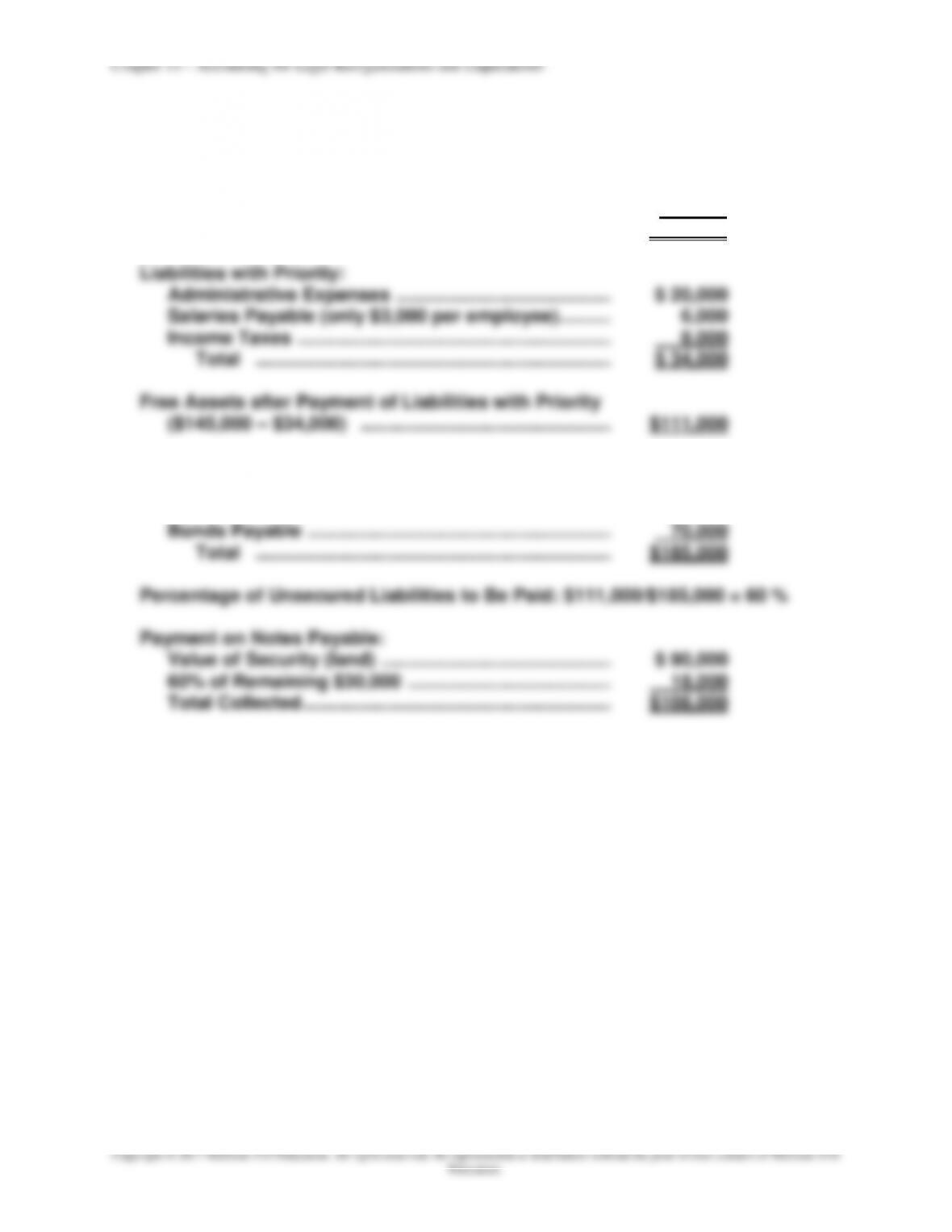
13-12
28. (10 Minutes) (Distribution of cash in a business liquidation)
Free Assets:
Current Assets …………………………………………………. $ 35,000
Buildings and Equipment …………………………………. 110,000
Total …………………………..……………………………… $145,000
Unsecured Liabilities
Notes Payable (in excess of value of security) …… $ 30,000
Accounts Payable …………………………………………….. 85,000
13-13
Education.
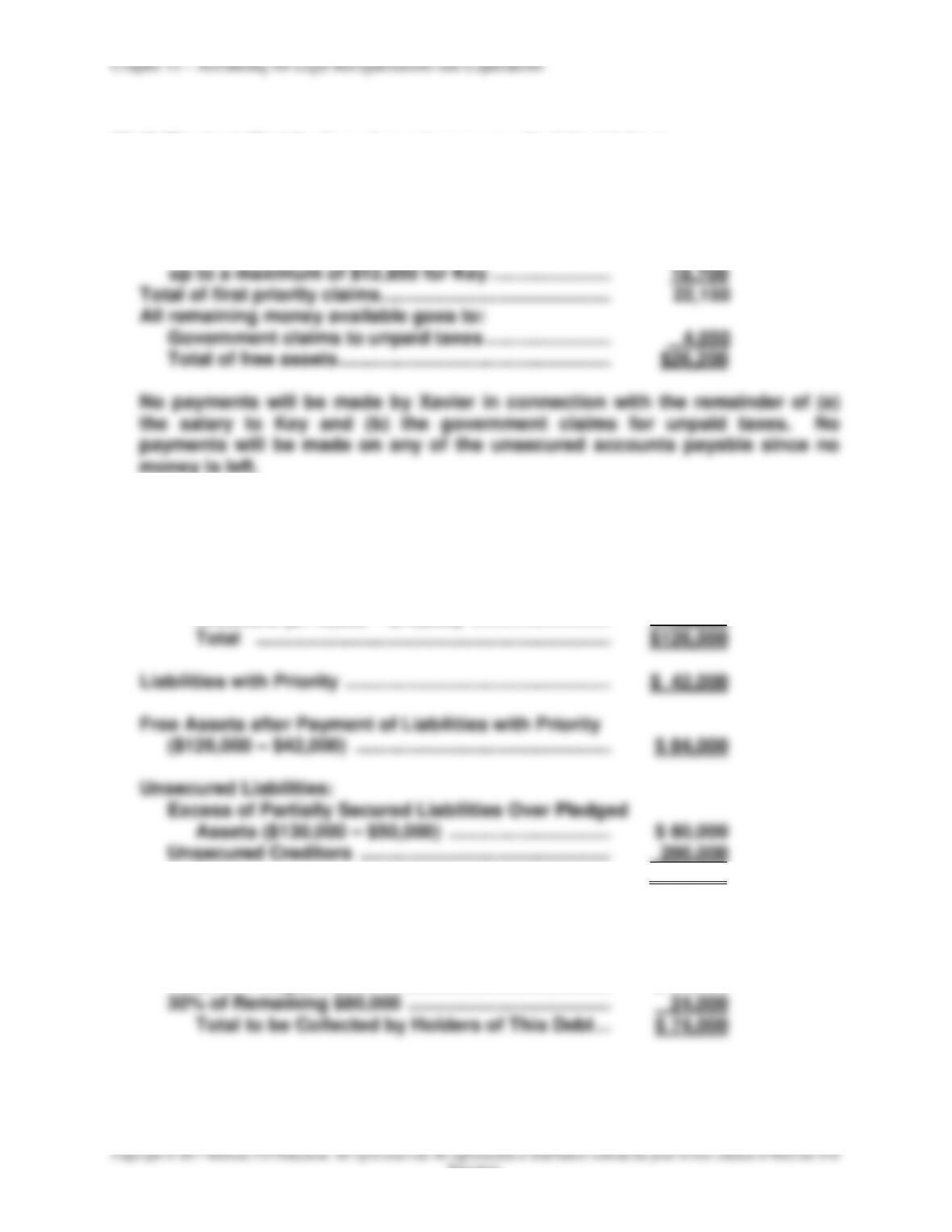
29. (5 Minutes) (Distribution of assets as a result of liquidation)
Liabilities with Priority
Paid first—administrative expense …………………………. $3,450
Paid second—wages: total of $5,850 for Rankin but only
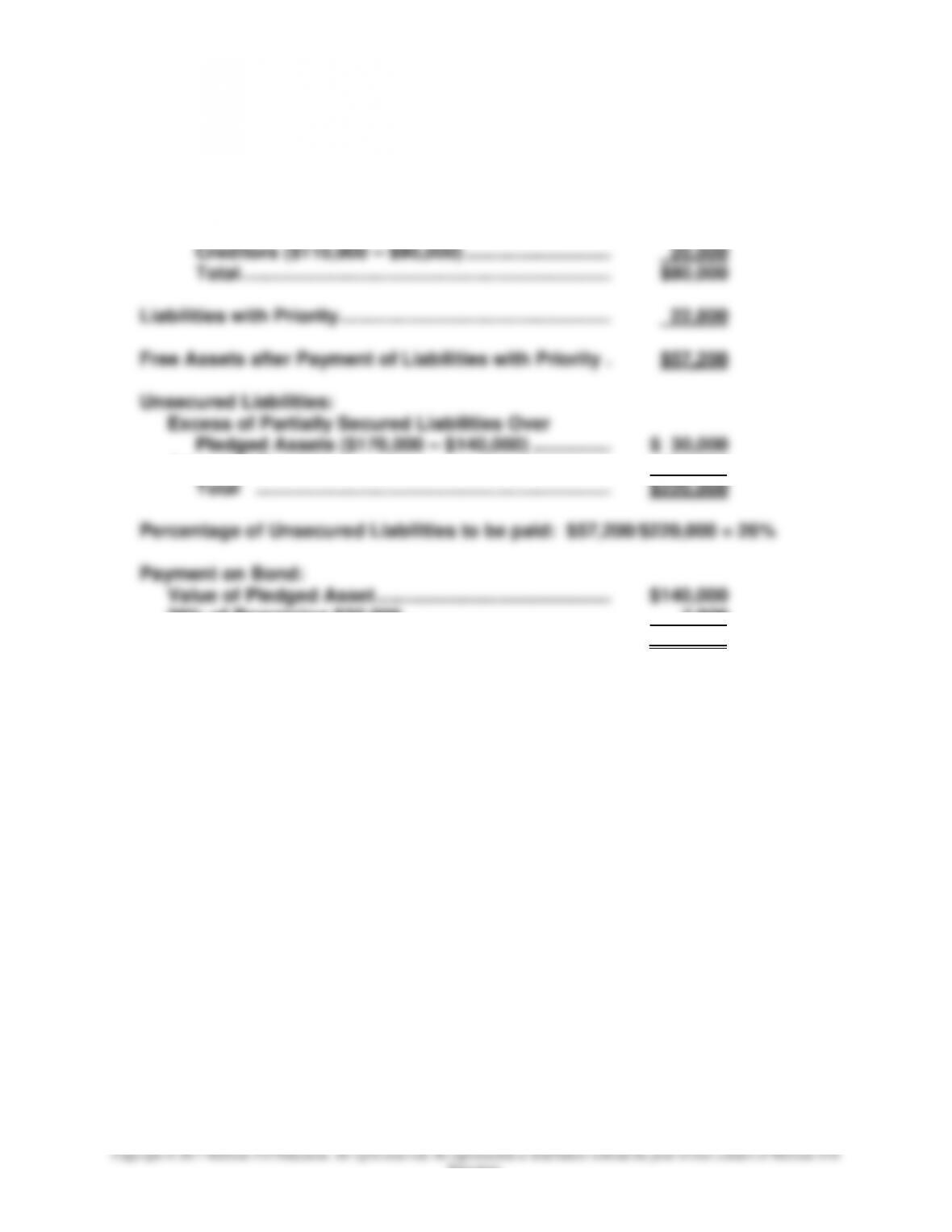
30. (8 Minutes) (Distribution of assets to partially secured creditors)
Free Assets:
Other Assets ……………………………………………………. $ 80,000
Excess from Assets Pledged with Fully Secured
Creditors ($116,000 – $70,000) ……………………… 46,000
Total …………………………..……………………………… $280,000
Percentage of Unsecured Liabilities to Be Paid: $84,000/$280,000 = 30%
Payment on Partially Secured Debt:
Value of Pledged Asset …………………………………….. $ 50,000
Chapter 13 – Accounting for Legal Reorganizations and Liquidations
13-14
Education.
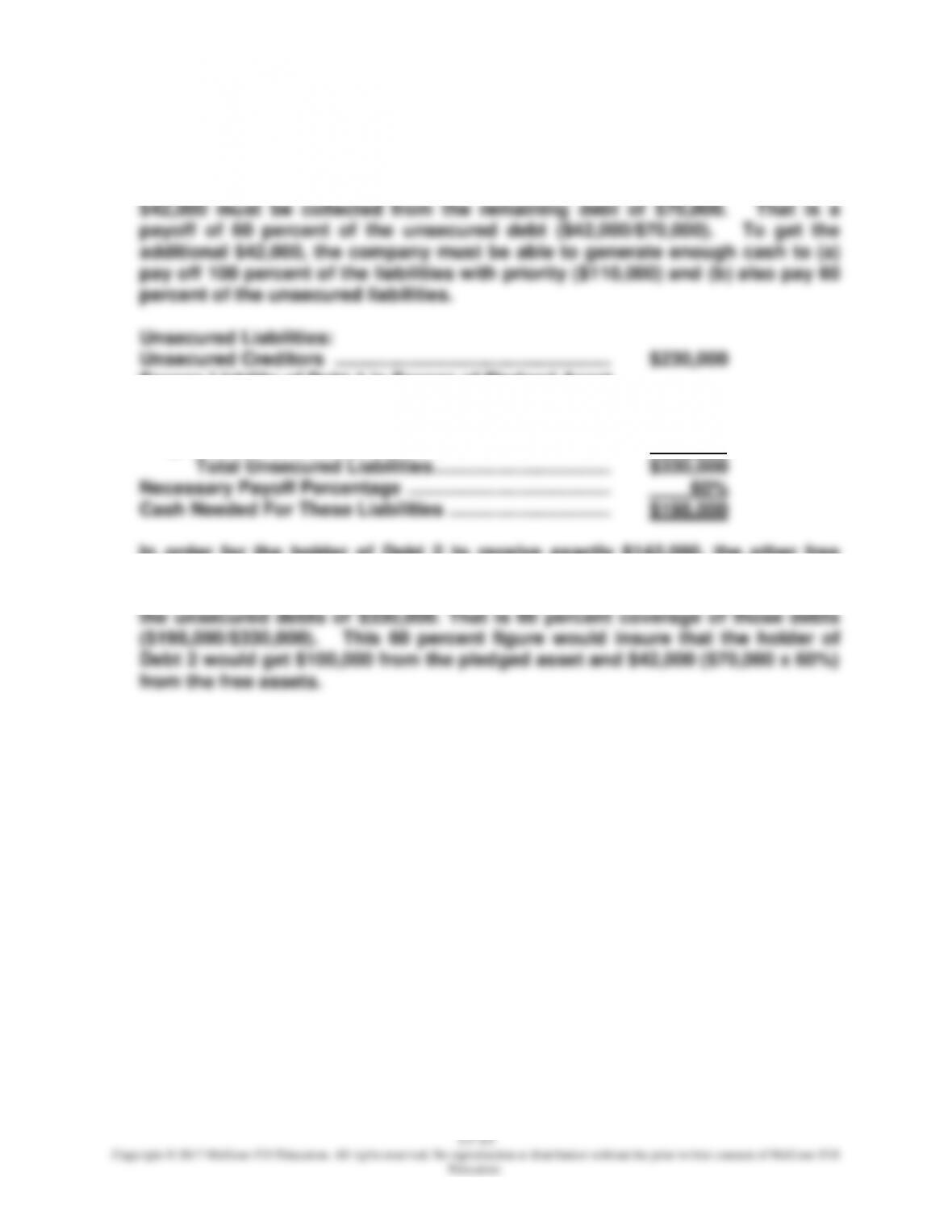
31. (8 Minutes) (Distribution of assets to partially secured creditors)
Free Assets:
Cash ……………………………………………………………….. $60,000
Excess from Assets Pledged with Fully Secured
Accounts Payable ……………………………………………… 190,000
26% of Remaining $30,000 …………………………..…….. 7,800
Total to be Received by holders ……………………. $147,800
Chapter 13 – Accounting for Legal Reorganizations and Liquidations
32. (12 Minutes) (Liquidation of assets to satisfy debt)
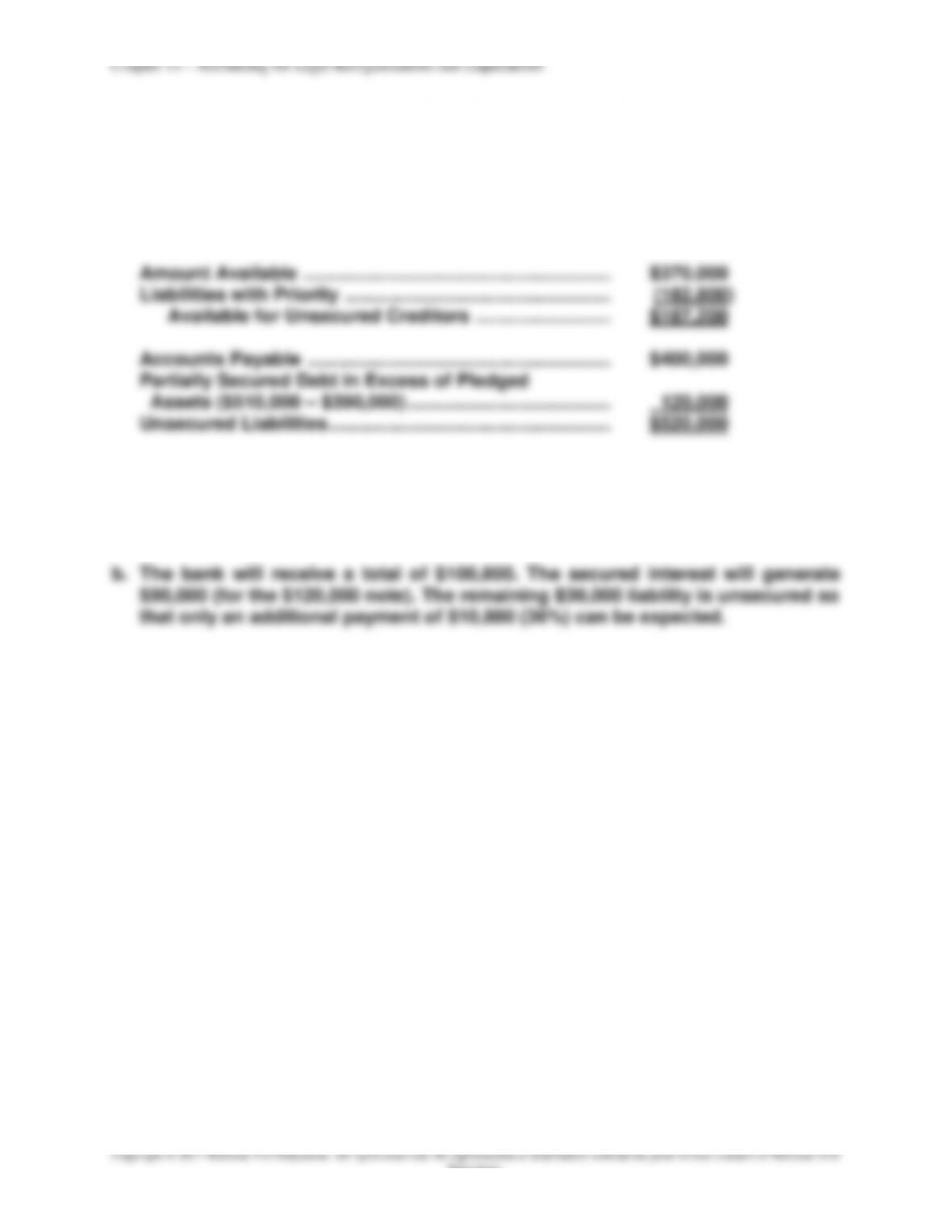
The holder of Debt 2 will receive $100,000 from the sale of the pledged asset.
This creditor wants to receive $142,000 out of the total debt of $170,000. Thus,
Excess Liability of Debt 1 in Excess of Pledged Asset
($210,000 – $180,000) ……………………………………….. 30,000
Excess Liability of Debt 2 in Excess of Pledged Asset
($170,000 – $100,000) ……………………………………….. 70,000
In order for the holder of Debt 2 to receive exactly $142,000, the other free
assets must be sold for $308,000. With that much money, the liabilities with
priority ($110,000) can be paid with the remaining $198,000 going to help cover
13-16
Education.
33. (8 Minutes) (Payments to be made on unsecured and partially secured
liabilities)
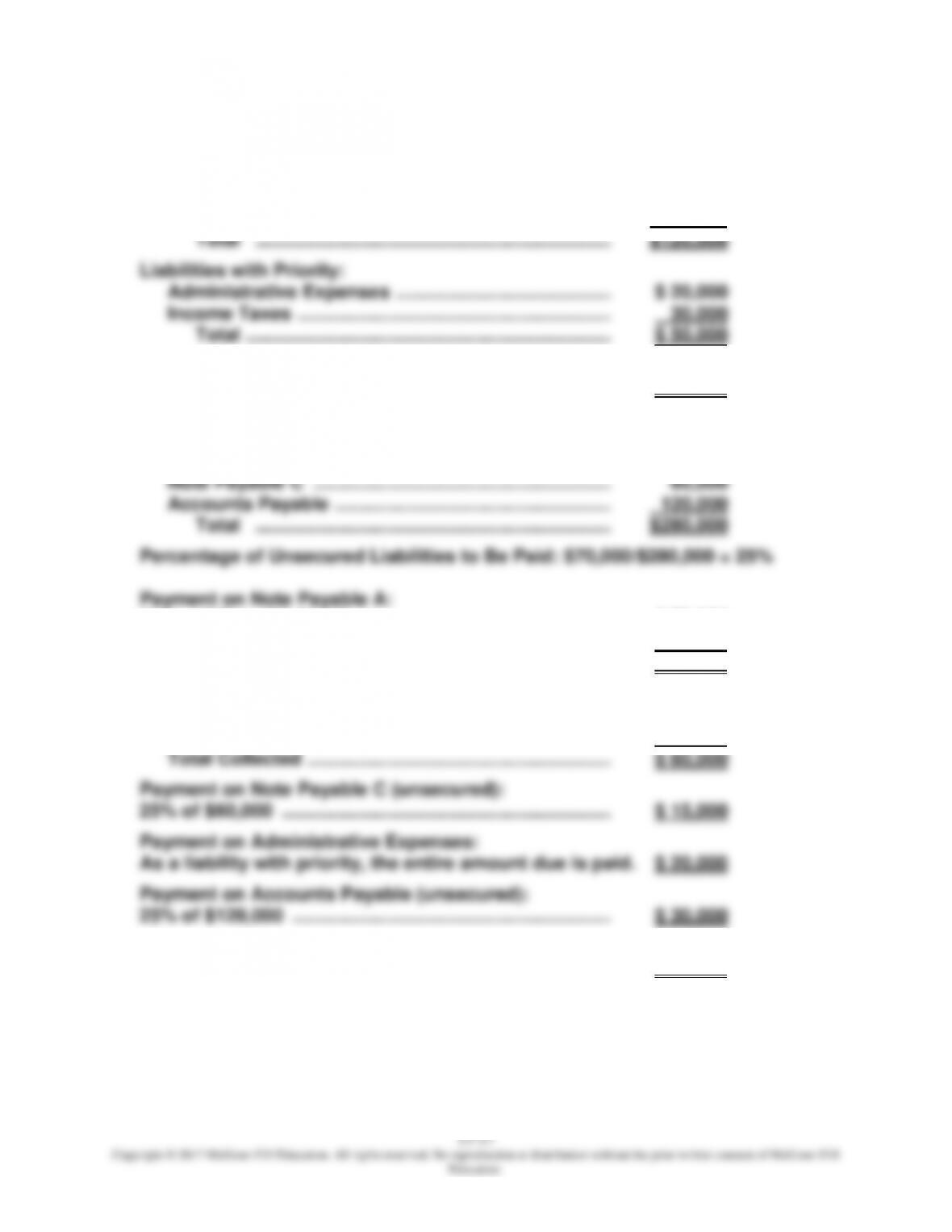
a. The unpledged assets of $310,000 must be added to any excess to be received
from assets pledged on fully secured debts ($220,000 – $160,000 = $60,000) to
get amount of free assets available of $370,000.
Distribution to Unsecured Creditors: $187,200/$520,000 = 36%
An unsecured creditor to whom $13,000 is owed can expect to receive $4,680
($13,000 x 36%).
Chapter 13 – Accounting for Legal Reorganizations and Liquidations
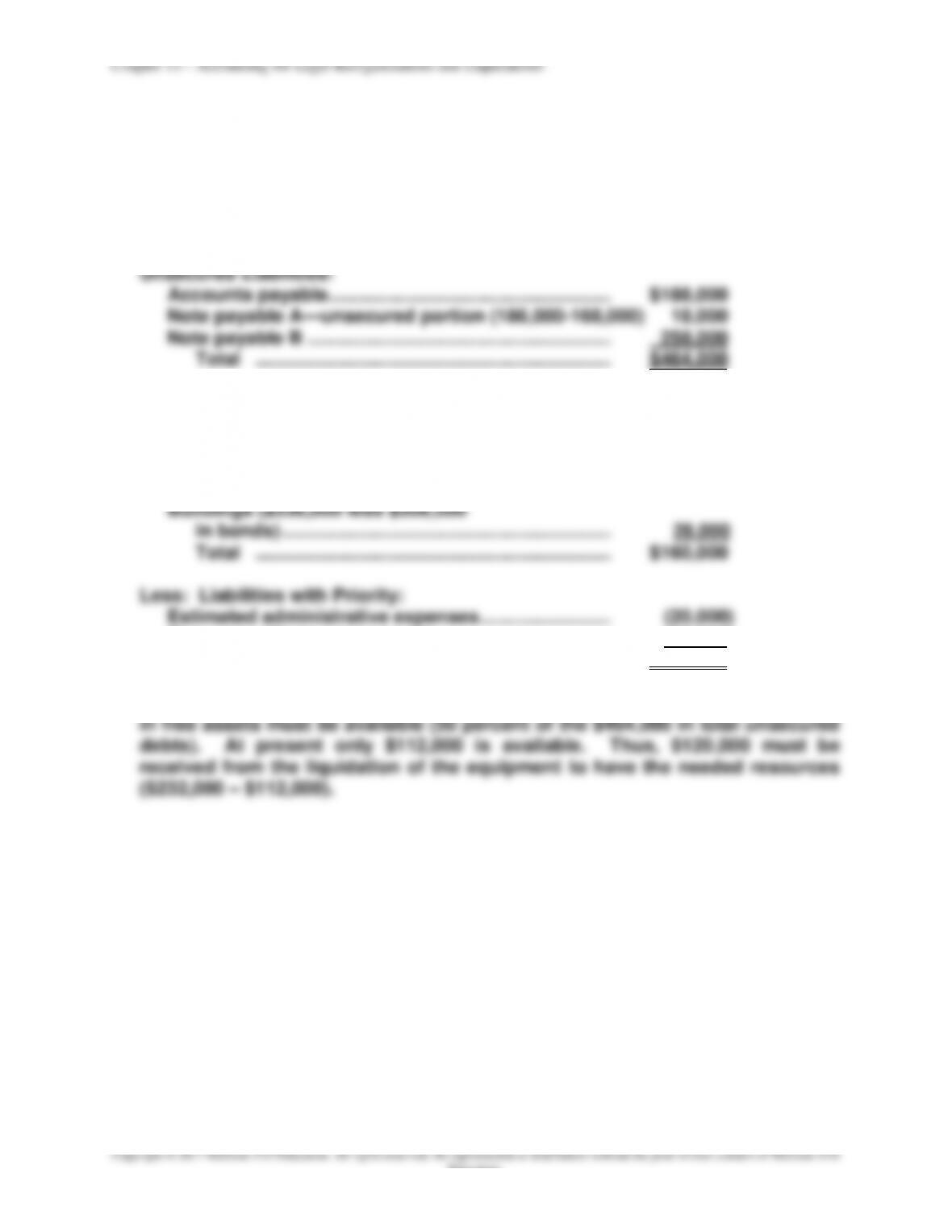
34. (20 Minutes) (Distribution of cash assets resulting from liquidation)
Free Assets: (fair value)
Cash ……………………………………………………………….. $ 10,000
Inventory ………………………………………………………….. 60,000
Equipment ………………………………………………………… 50,000
Free Assets after Payment of Liabilities with Priority
($120,000 – $50,000) …………………………………………. $ 70,000
Unsecured Liabilities
Note Payable A (in excess of value of security) …. $ 20,000
Note Payable B (in excess of value of security) …. 80,000
Value of Security (land) …………………………………………. $ 70,000
25% of Remaining $20,000 …………………………………….. 5,000
Total Collected …………………………………………………. $ 75,000
Payment on Note Payable B:
Value of Security (building) ……………………………………. $ 40,000
25% of Remaining $80,000 …………………………………….. 20,000
Payment on Income Taxes Payable:
As a liability with priority, the entire amount due is paid. $ 30,000
13-18
Education.
35. (15 Minutes) (Liquidation of assets to satisfy debt)
Note payable B is unsecured. The holders want at least $129,000 of the total
balance of $258,000. Thus, at least enough money must become available to
pay 50 percent of the unsecured debts ($129,000/$258,000). All values for
assets are known except for the company’s equipment.
Free Assets (except for equipment):
Cash ……………………………………………………………….. $32,000
Accounts receivable ………………………………………….. 36,000
Inventory ………………………………………………………….. 64,000
Land (value does not cover related debt) ……………. -0-
Taxes payable to government ……………………………. (28,000)
Total free assets except for equipment ………….. $112,000
In order for unsecured creditors to receive 50 percent of their claims, $232,000
Chapter 13 – Accounting for Legal Reorganizations and Liquidations
13-19
Education.
36. (15 Minutes) (Payment of various liabilities as a result of liquidation)
Free Assets:
Cash ………………………………………………………….. $30,000
Receivables (30 percent collectible) …………………… 15,000
Unsecured Liabilities:
Accounts payable ……………………………………………… $90,000
Bonds payable (less secured interest in
in full) ………………………………………………………….. $10,000
Accounts payable (unsecured—will collect 40%
of debts of $90,000) ………………………………………. $36,000
Note payable (fully secured by land—will collect
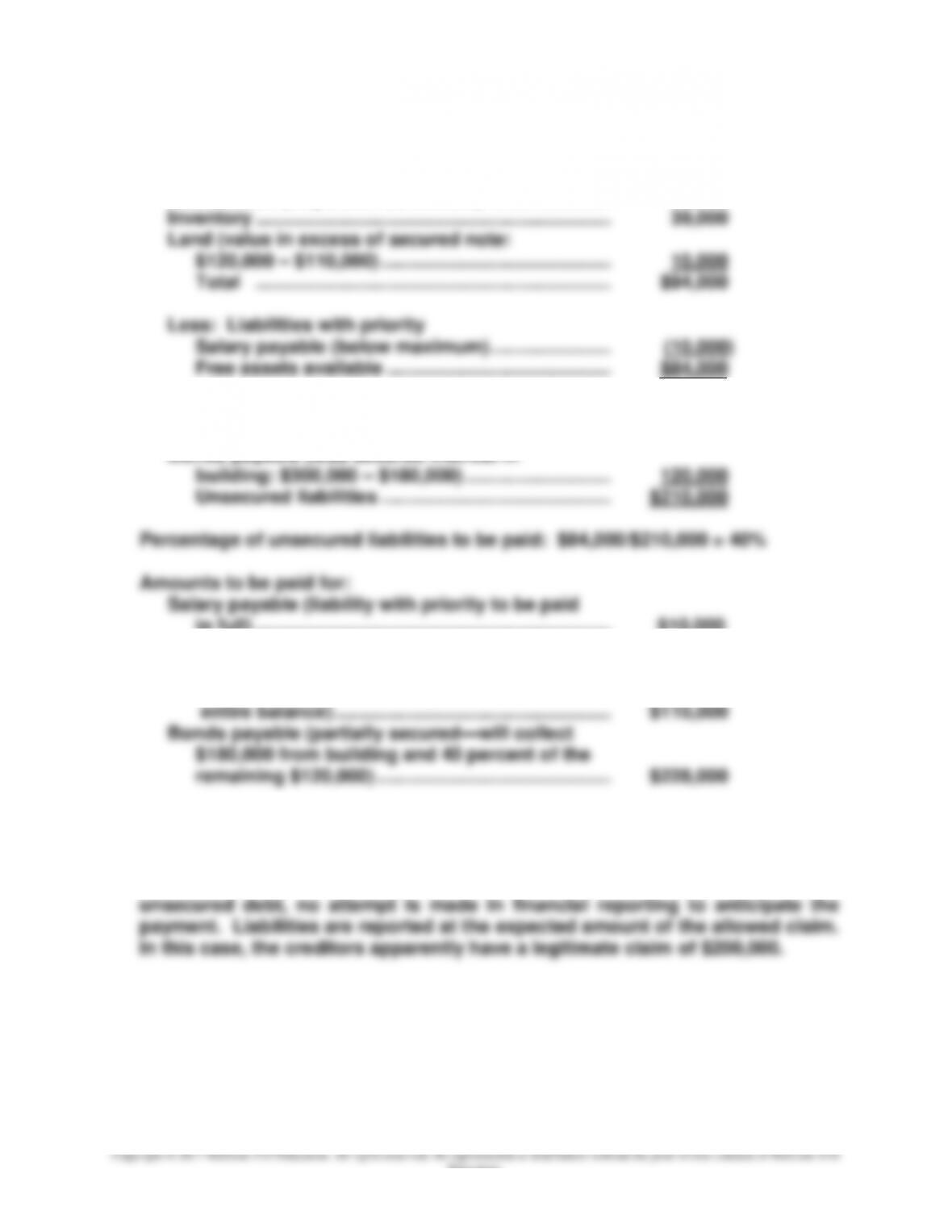
37. (2 Minutes) (Reporting of debts during liquidation)
Because of the uncertainty about the amount that will be paid on an
13-20
Education.
38. (9 Minutes) (Adjusting a company’s records to fresh start accounting as it
comes out of bankruptcy)
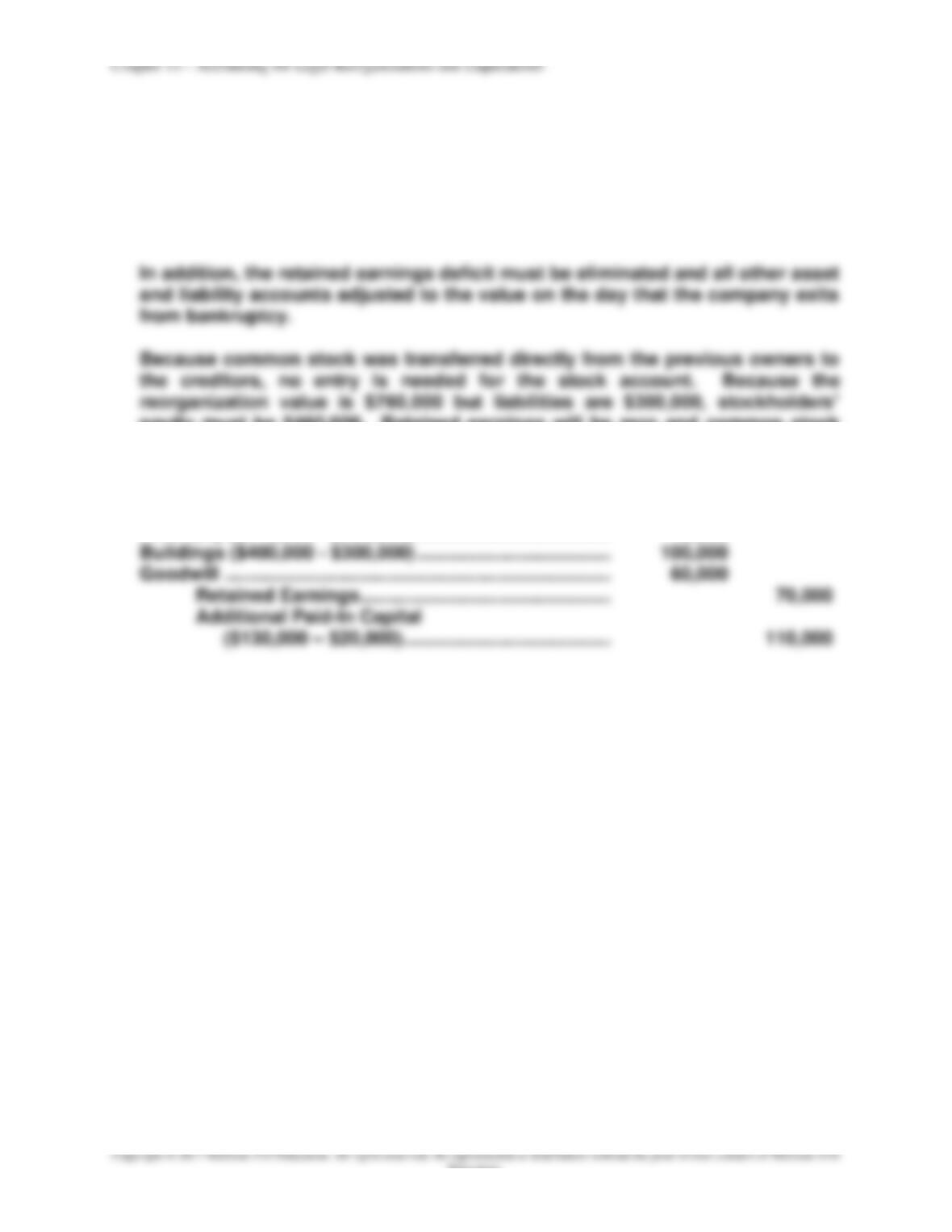
The individual assets of Larisa Company have a total fair value of $700,000 but
a reorganization value of $760,000. Thus, an intangible asset (Goodwill) equal
to the $60,000 must be recognized.
equity must be $460,000. Retained earnings will be zero and common stock
will remain $330,000. Thus, additional paid-in capital should be adjusted to
$130,000 ($460,000 less $330,000).
Receivables ($90,000 – $80,000) ……………………………… 10,000
Inventory ($210,000 – $200,000) ………………………………. 10,000