Chapter 11 – Worldwide Accounting Diversity and International Standards
11-38
27. (45 minutes) (Property, Plant, and Equipment – Revaluation)
Summary of Facts:
Equipment
Cost, 1/1/17 $78,400
Residual value, 1/1/17 $10,000
U.S. GAAP and IFRS
In 2017, the company would record the acquisition of the equipment at its cost of $78,400
and recognize depreciation of $11,400 [($78,400 – 10,000) ÷ 6 years]. The following
entries would be made under both U.S. GAAP and IFRS. No conversion entry is needed.
1/1/17
2018
U.S. GAAP
In 2018, depreciation expense of $11,400 again would be recognized under U.S. GAAP.
in a net increase in the carrying amount of Equipment of $7,500, which is offset by a credit
to Revaluation Surplus, a separate component of Accumulated Other Comprehensive
Income (AOCI). The journal entry to revalue Equipment under IFRS is:
11-40
Education.
27. (continued)
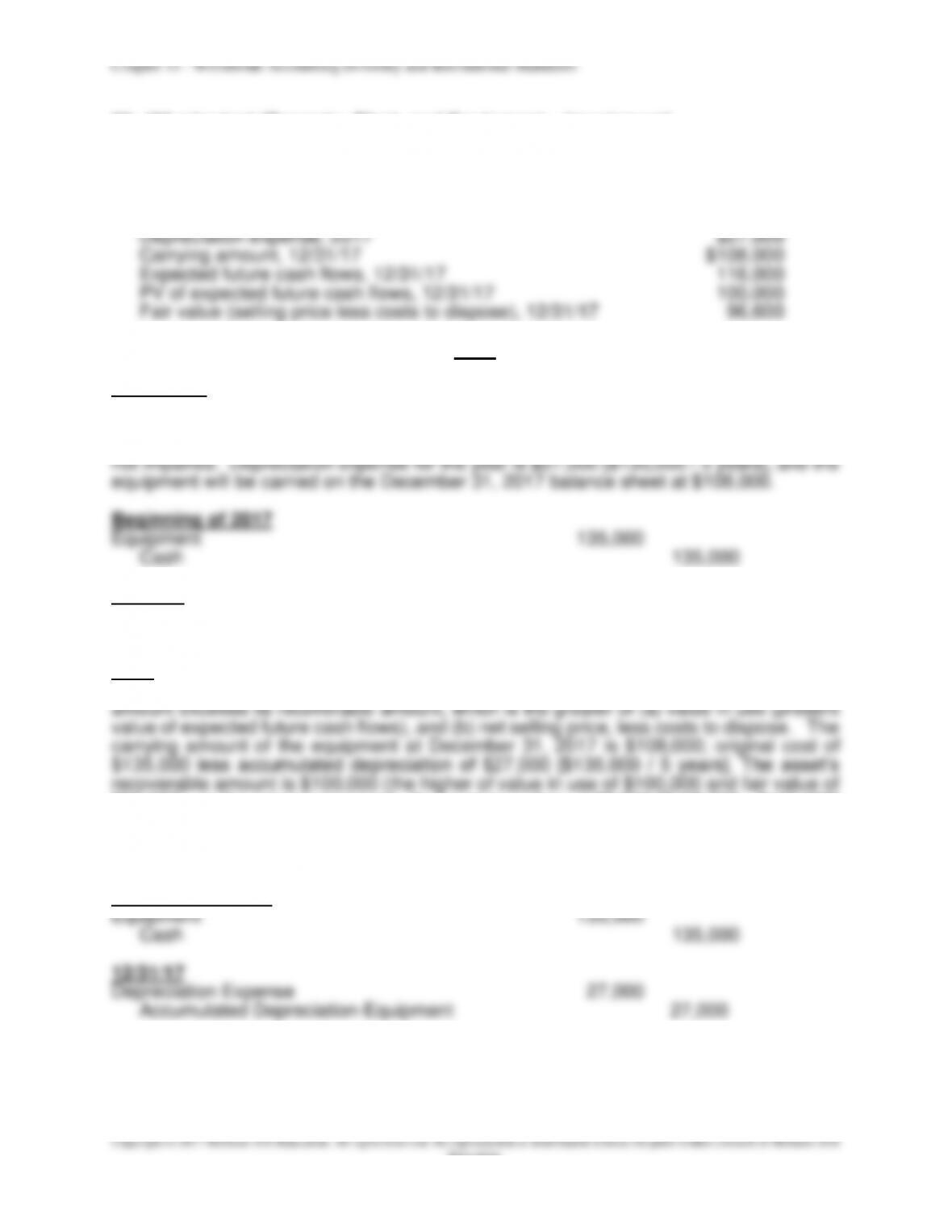
[Note: The 12/31/18 partial conversion worksheet below summarizes the above entries,
and shows that the conversion entries result in the correct amounts being reported in
the IFRS column.]
Partial Conversion Worksheet, 12/31/18
(amounts in $)
Conversion Entry
Account
U.S.
GAAP
Debit
Credit
IFRS
Depreciation expense
11,400
(2) 1,500
12,900
Net income, 2018
11,400
12,900
Retained earnings, 1/1/18*
11,400
11,400
Retained earnings, 12/31/18
22,800
24,300
Revaluation surplus (AOCI)
-0-
(1) 7,500
(7,500)
AOCI, 1/1/18
-0-
-0-
AOCI, 12/31/18
-0-
(7,500)
Cash
(78,400)
(78,400)
Equipment
78,400
(1) 3,900
74,500
Accumulated depreciation-equipment
(22,800)
(1) 11,400
(2) 1,500
(12,900)
Total assets
(22,800)
(16,800)
Total liabilities
-0-
-0-
AOCI, 12/31/18 (above)
-0-
(7,500)
Retained earnings, 12/31/18 (above)
22,800
24,300
Total liabilities and equity
22,800
16,800
12,900
12,900
Note: Parentheses reflect credit balances.
* Reflects depreciation expense recognized in 2017.
Chapter 11 – Worldwide Accounting Diversity and International Standards
28. (15 minutes) (Intangible Assets – Research and Development Costs)
Summary of Facts:
Research and Development Costs, 2017 $650,000
2017.
2017
Research and Development Expense 650,000
Cash 650,000
Research and Development Expense 195,000
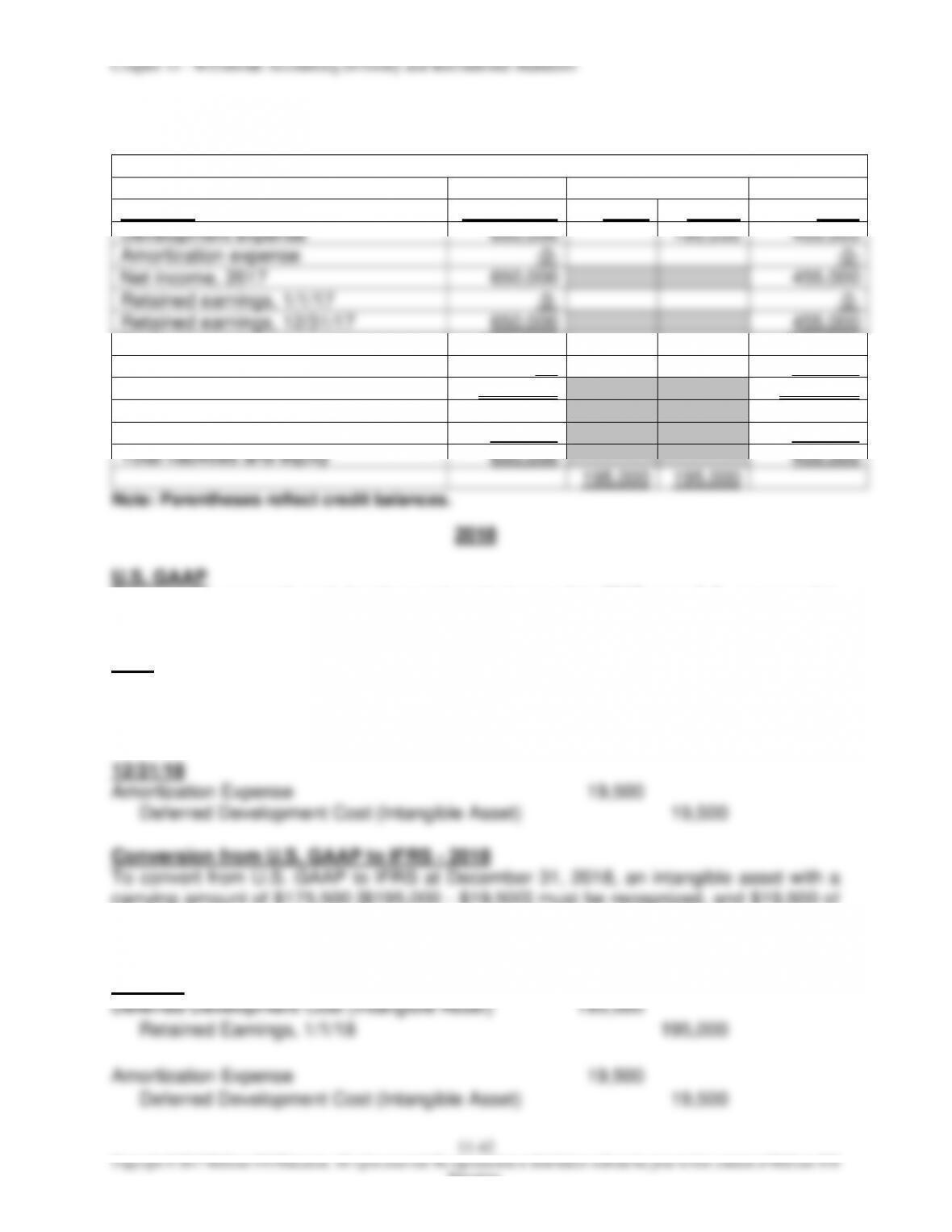
[Note: The 12/31/17 partial conversion worksheet on the next page summarizes the
above entries, and shows that the conversion entry results in the correct amounts being
reported in the IFRS column.]
Education.
Chapter 11 – Worldwide Accounting Diversity and International Standards
11-43
Education.
28. (continued)
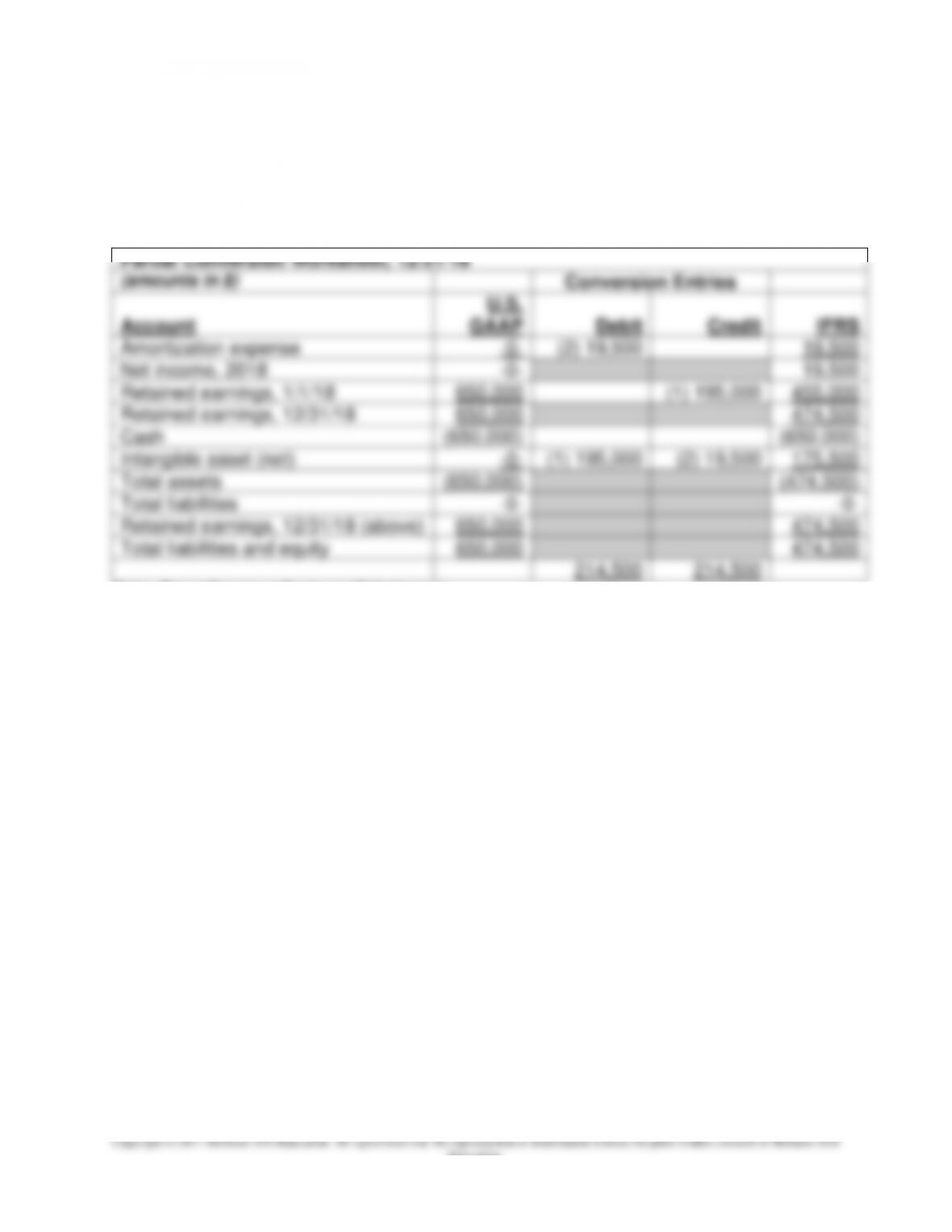
[Note: The 12/31/18 partial conversion worksheet below summarizes the above entries,
and shows that the conversion entries result in the correct amounts being reported in
the IFRS column.]
Partial Conversion Worksheet, 12/31/18
(amounts in $)
Conversion Entries
Account
U.S.
GAAP
Debit
Credit
IFRS
Amortization expense
-0-
(2) 19,500
19,500
Net income, 2018
-0-
19,500
Retained earnings, 1/1/18
650,000
(1) 195,000
455,000
Retained earnings, 12/31/18
650,000
474,500
Cash
(650,000)
(650,000)
Intangible asset (net)
-0-
(1) 195,000
(2) 19,500
175,500
Total assets
(650,000)
(474,500)
Total liabilities
-0-
-0-
Retained earnings, 12/31/18 (above)
650,000
474,500
Total liabilities and equity
650,000
474,500
214,500
214,500
Note: Parentheses reflect credit balances.
11-44
Education.
29. (20 minutes) (Gain on Sale and Leaseback transaction)
Summary of Facts:
Building (net), 1/1/17 $500,000
Gain on sale of building, 1/1/17 $76,000
Life of leaseback 4 years
1/1/17
Cash 576,000
Building (net) 500,000
Deferred Gain on Sale of Building (liability) 76,000
12/31/17
1/1/17
Cash 576,000
Building (net) 500,000
Gain on Sale of Building 76,000
Conversion from U.S. GAAP to IFRS – 2017
Deferred Gain on Sale of Building (liability) 57,000
Gain on Sale of Building 57,000
11-45
Education.
29. (continued)
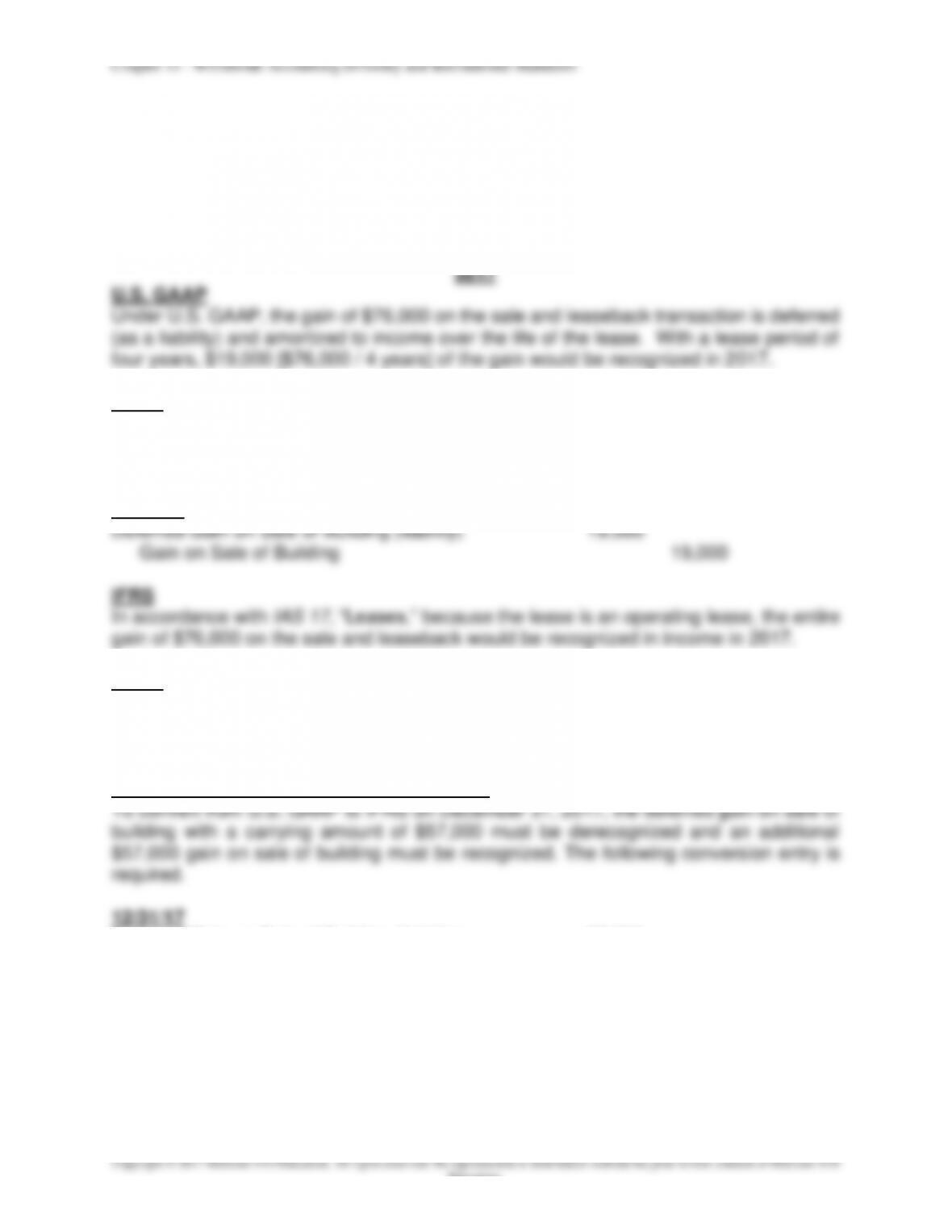
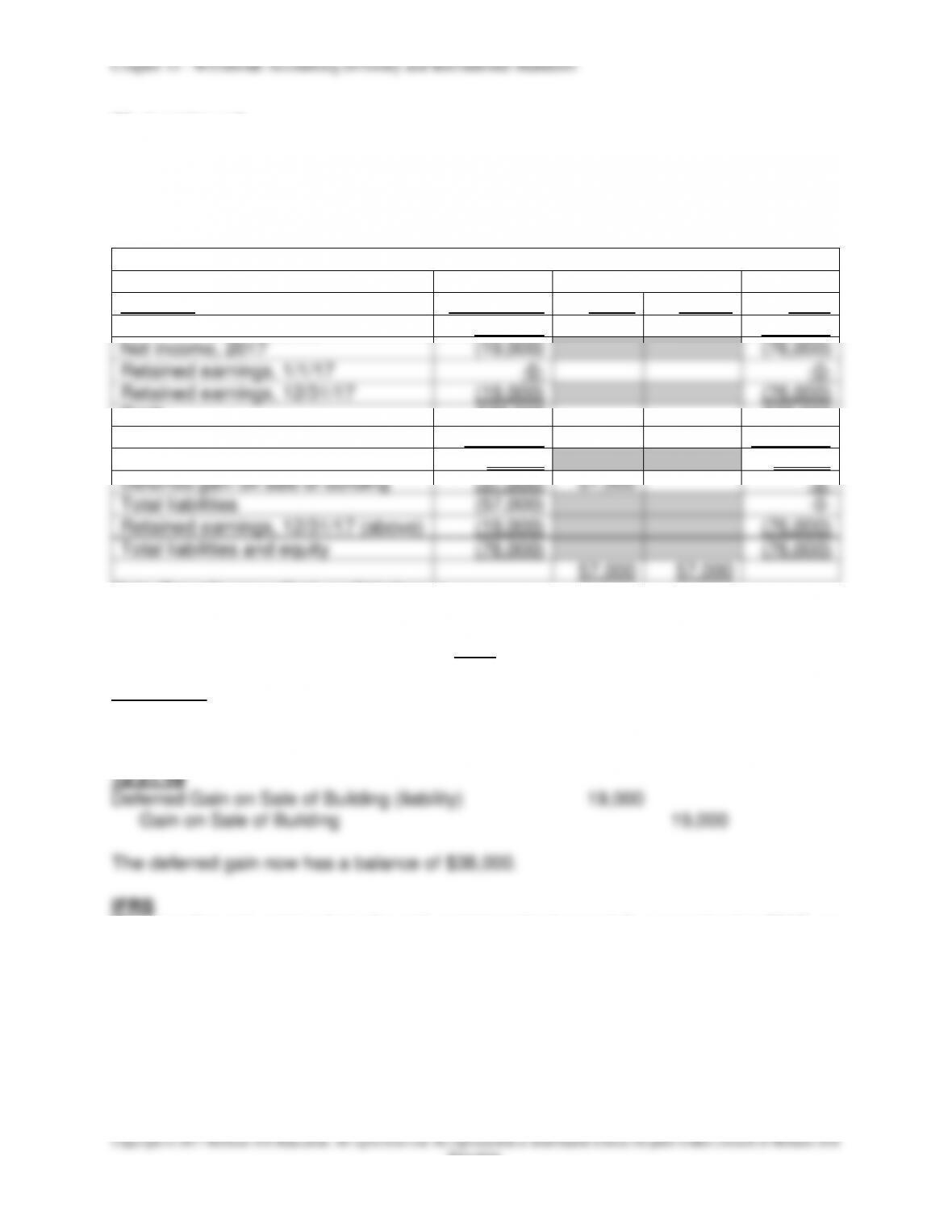
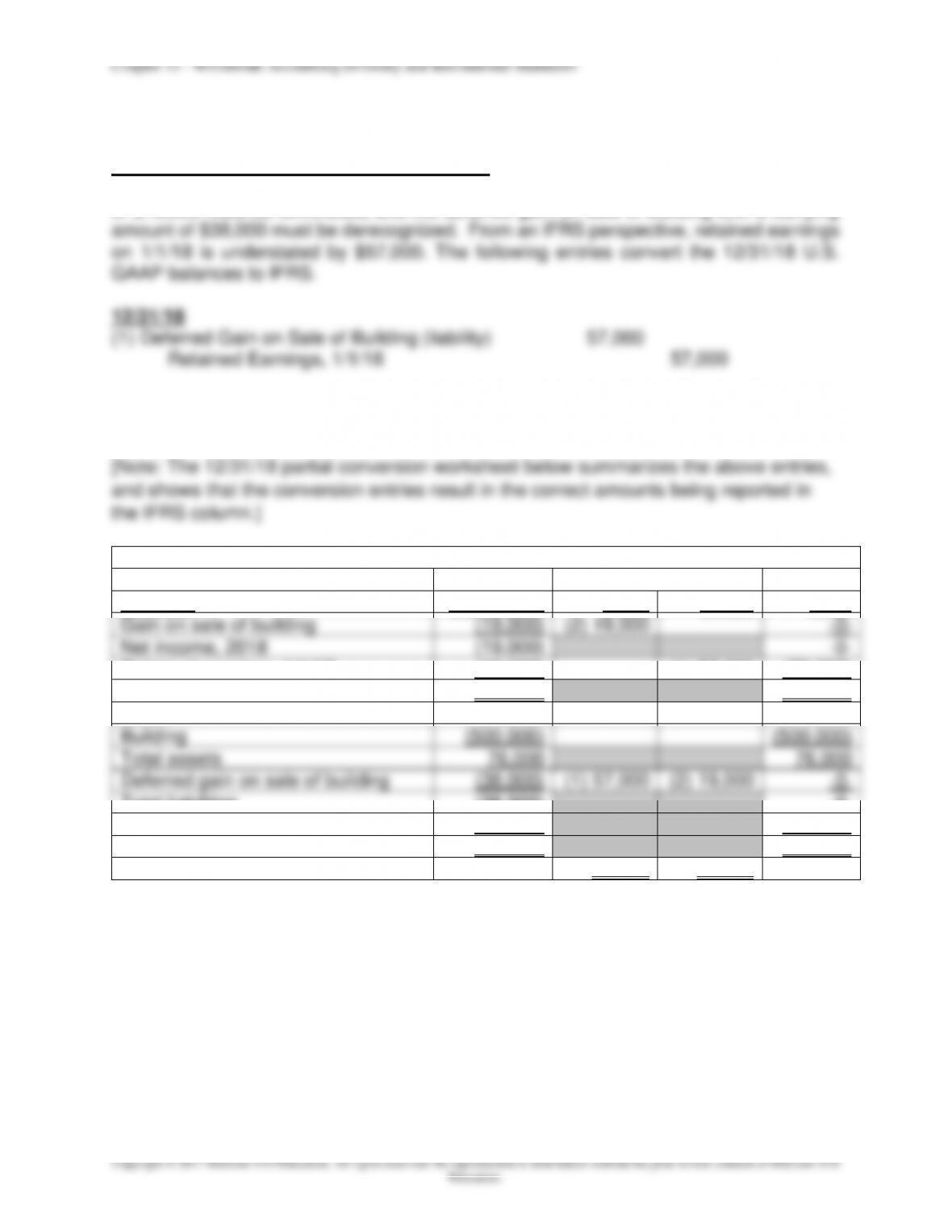
[Note: The 12/31/17 partial conversion worksheet below summarizes the above entries,
and shows that the conversion entry results in the correct amounts being reported in the
IFRS column.]
Partial Conversion Worksheet, 12/31/17
(amounts in $)
Conversion Entry
Account
U.S. GAAP
Debit
Credit
IFRS
Gain on sale of building
(19,000)
57,000
(76,000)
Net income, 2017
(19,000)
(76,000)
Retained earnings, 1/1/17
-0-
-0-
Retained earnings, 12/31/17
(19,000)
(76,000)
Cash
576,000
576,000
Building
(500,000)
(500,000)
Total assets
76,000
76,000
Deferred gain on sale of building
(57,000)
57,000
-0-
Total liabilities
(57,000)
-0-
Retained earnings, 12/31/17 (above)
(19,000)
(76,000)
Total liabilities and equity
(76,000)
(76,000)
57,000
57,000
Note: Parentheses reflect credit balances.
2018
U.S. GAAP
In 2018, an additional $19,000 of the deferred gain on sale of building would be
recognized in net income.
Because the gain arising from the sale and leaseback was fully recognized in 2017, no
further entries related to the gain are required.
11-46
29. (continued)
Conversion from U.S. GAAP to IFRS – 2018
To convert from U.S. GAAP to IFRS on December 31, 2018, the gain on sale of building
of $19,000 must be eliminated, and the deferred gain on sale of building with a carrying
(2) Gain on Sale of Building 19,000
Deferred Gain on Sale of Building (liability) 19,000
Partial Conversion Worksheet, 12/31/18
(amounts in $)
Conversion Entries
Account
U.S. GAAP
Debit
Credit
IFRS
Gain on sale of building
(19,000)
(2) 19,000
-0-
Net income, 2018
(19,000)
-0-
Retained earnings, 1/1/18
(19,000)
(1) 57,000
(76,000)
Retained earnings, 12/31/18
(38,000)
(76,000)
Cash
576,000
576,000
Building
(500,000)
(500,000)
Total assets
76,000
76,000
Deferred gain on sale of building
(38,000)
(1) 57,000
(2) 19,000
-0-
Total liabilities
(38,000)
-0-
Retained earnings, 12/31/18 (above)
(38,000)
(76,000)
Total liabilities and equity
(76,000)
(76,000)
76,000
76,000
Note: Parentheses reflect credit balances.
11-47
Education.
30. (20 minutes) (Property, Plant, and Equipment – Impairment)
Summary of facts:
Cost of equipment, 1/1/17 $135,000
Salvage value zero
Useful life 5 years
2017
U.S. GAAP
Under U.S. GAAP, an asset is impaired when its carrying amount exceeds the expected
future cash flows (undiscounted) to be derived from use of the asset. Expected future
cash flows are $116,000, which exceeds the carrying value of $108,000, so the asset is
12/31/17
Depreciation Expense 27,000
Accumulated Depreciation-Equipment 27,000
IFRS
In accordance with IAS 36, “Impairment of Assets,” an asset is impaired when its carrying
$96,600), so the asset is impaired. An impairment loss of $8,000 [$108,000 – $100,000]
would be recognized at the end of 2017, in addition to depreciation expense for the year
of $27,000. The equipment will be carried on the December 31, 2017 balance sheet at
$100,000.
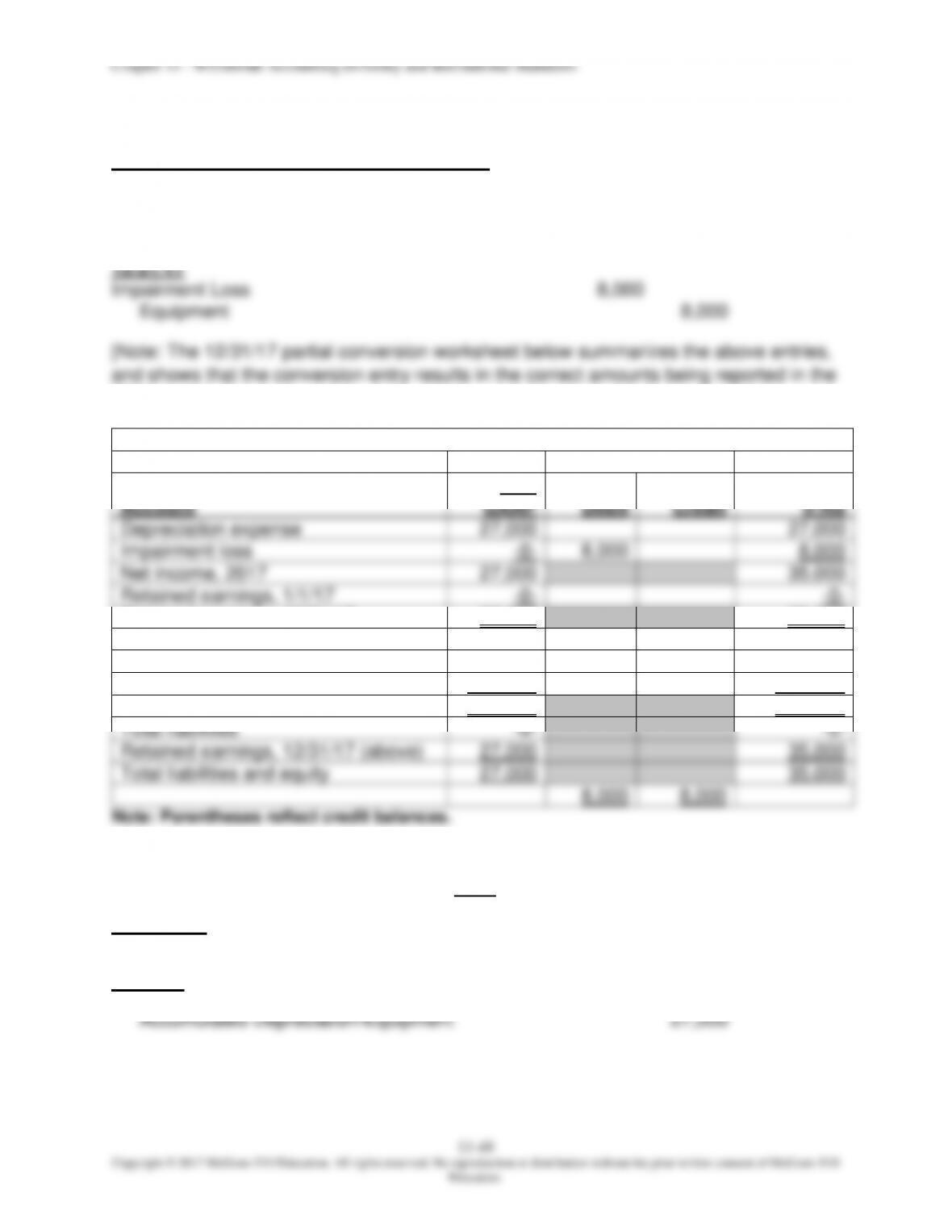
Beginning of 2017
Impairment Loss 8,000
Equipment 8,000
11-49
Education.
30. (continued)
IFRS
Under IFRS, equipment has a carrying amount on January 1, 2018 of $100,000 and a
remaining useful life of 4 years. Depreciation to be recognized in 2018 is $25,000
[$100,000 ÷ 4 years].
and IFRS. From an IFRS perspective, depreciation expense is overstated by $2,000,
retained earnings (1/1/18) is overstated by $8,000, equipment is overstated by $8,000,
and accumulated depreciation-equipment is understated by $2,000. The following
conversion entries convert the U.S. GAAP balances to the appropriate amounts under
IFRS.
[Note: The 12/31/18 partial conversion worksheet below summarizes the above entries,
and shows that the conversion entries result in the correct amounts being reported in
the IFRS column.]
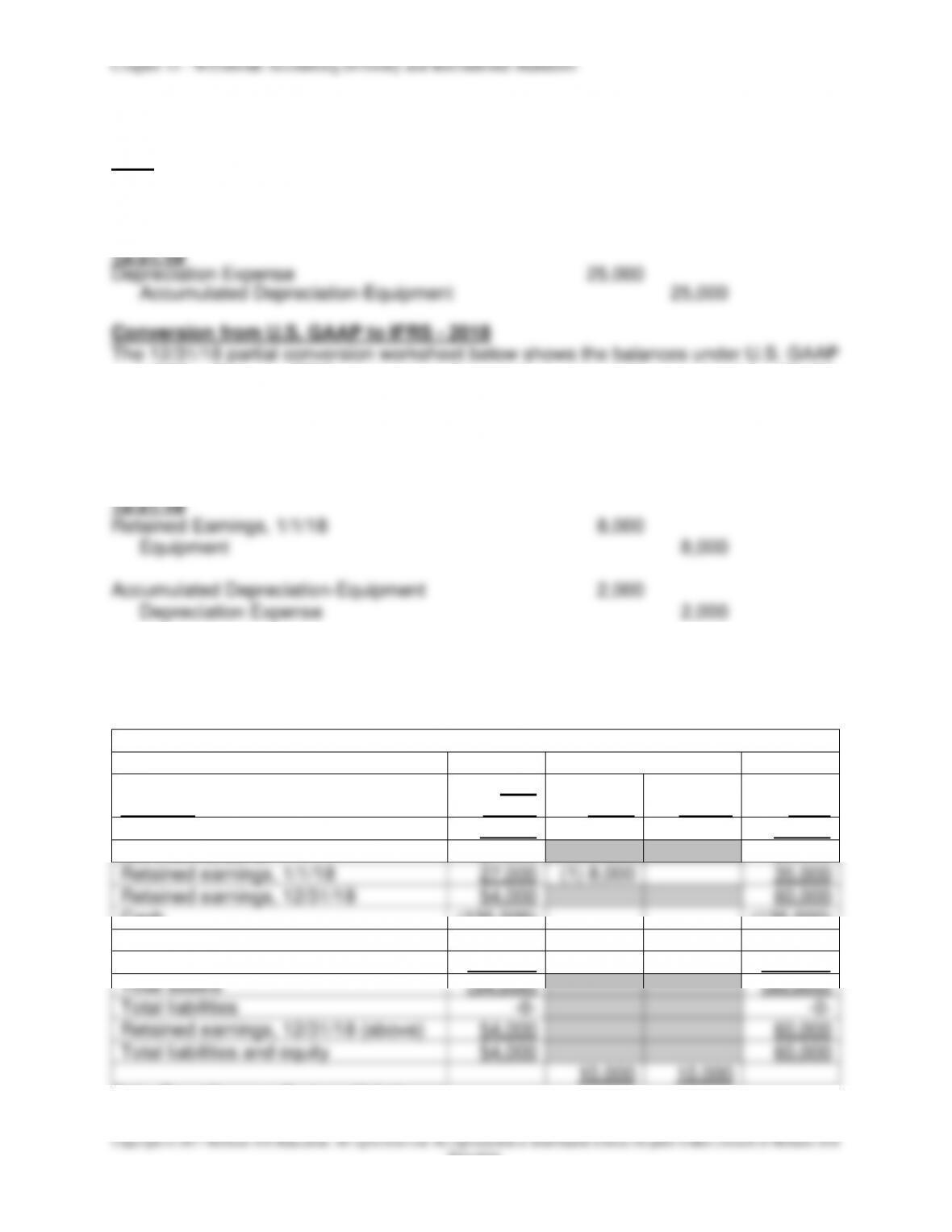
Partial Conversion Worksheet, 12/31/18
(amounts in $)
Conversion Entry
Account
U.S.
GAAP
Debit
Credit
IFRS
Depreciation expense
27,000
(2) 2,000
25,000
Net income, 2018
27,000
25,000
Retained earnings, 1/1/18
27,000
(1) 8,000
35,000
Retained earnings, 12/31/18
54,000
60,000
Cash
(135,000)
(135,000)
Equipment
135,000
(1) 8,000
127,000
Accumulated depreciation-equipment
(54,000)
(2) 2,000
(52,000)
Total assets
(54,000)
(60,000)
Total liabilities
-0-
-0-
Retained earnings, 12/31/18 (above)
54,000
60,000
Total liabilities and equity
54,000
60,000
10,000
10,000
Note: Parentheses reflect credit balances.
Chapter 11 – Worldwide Accounting Diversity and International Standards
11-50
Education.
Chapter 11 Develop Your Skills
Analysis Case 1—Application of IAS 16
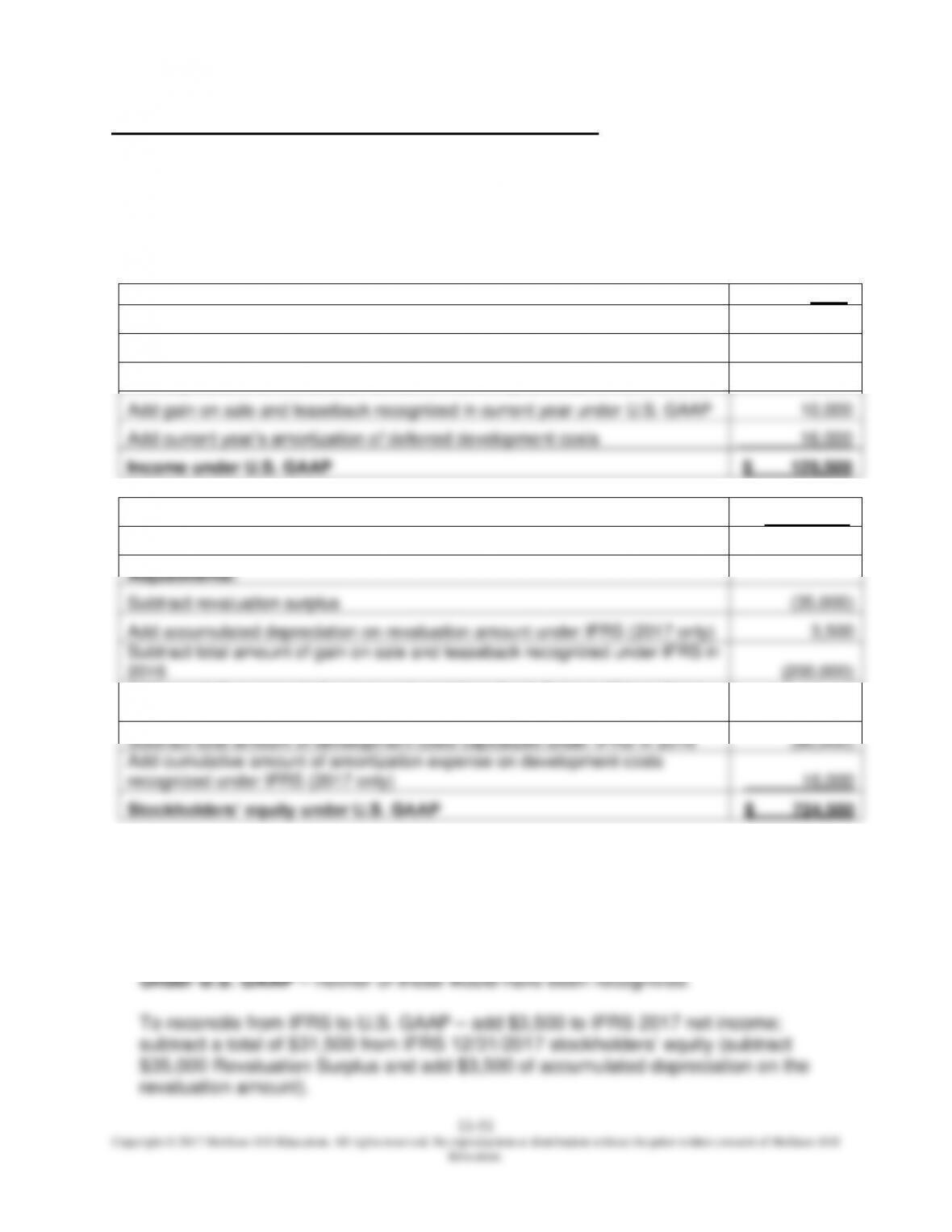
Depreciation expense in Years 1 and 2 under both sets of rules is $500,000
[$10,000,000 / 20 years] per year. Accumulated depreciation on January 1, Year 3 is
$1,000,000. On that date, under IFRS, Abacab would revalue the building through
the following journal entry:
Accumulated Depreciation 1,000,000
a. Depreciation Expense Year 2 Year 3 Year 4
IFRS $500,000 $666,667 $666,667
U.S. GAAP $500,000 $500,000 $500,000
c. Pre-tax income will be $166,667 smaller in each year (Year 3 -Year 20) under
IFRS. Cumulatively, IFRS-pretax income will be $3,000,000 smaller than U.S.
GAAP pretax income over this 18-year period. Stockholders’ equity (AOCI) will
be $3,000,000 greater under IFRS at January 1, Year 3. This difference will
standards.
Chapter 11 – Worldwide Accounting Diversity and International Standards
Analysis Case 2— Reconciliation of IFRS to U.S. GAAP
Note: Income taxes are ignored in this case.
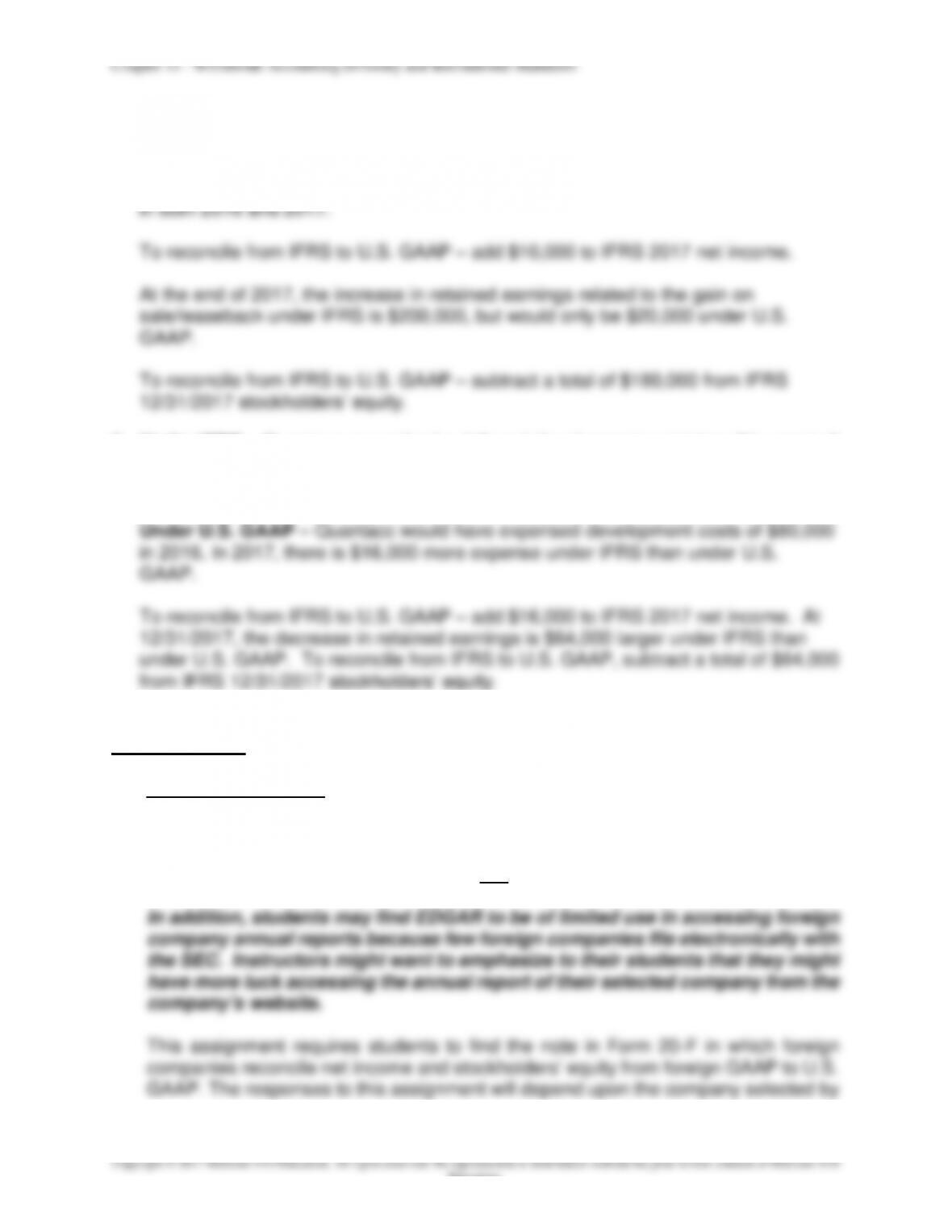
Quantacc Ltd.
Schedule to Reconcile IFRS Net Income and Stockholders’ Equity
to U.S. GAAP
2017
Income under IFRS
$ 100,000
Adjustments:
Add depreciation on revaluation amount in current year under IFRS
3,500
Add gain on sale and leaseback recognized in current year under U.S. GAAP
10,000
Add current year’s amortization of deferred development costs
16,000
Income under U.S. GAAP
$ 129,500
12/31/2017
Stockholders’ equity under IFRS
$ 1,000,000
Adjustments:
Subtract revaluation surplus
(35,000)
Add accumulated depreciation on revaluation amount under IFRS (2017 only)
3,500
Subtract total amount of gain on sale and leaseback recognized under IFRS in
2016
(200,000)
Add cumulative amount of gain on sale and leaseback that would have been
recognized under U.S. GAAP in 2016 and 2017
20,000
Subtract total amount of development costs capitalized under IFRS in 2016
(80,000)
Add cumulative amount of amortization expense on development costs
recognized under IFRS (2017 only)
16,000
Stockholders’ equity under U.S. GAAP
$ 724,500
Explanation for adjustments:
1. Under IFRS – Quantacc recorded a Revaluation Surplus (stock equity account) of
$35,000 on 1/1/2017. In 2017, $3,500 of additional depreciation expense was taken
on the revaluation amount ($35,000 / 10 years).
11-52
Education.
2. Under IFRS – Quantacc recognized a gain on sale/leaseback of $200,000 in 2016.
No gain was recognized in 2017.
Under U.S. GAAP – Quantacc would recognize a gain on sale/leaseback of $10,000
3. Under IFRS – Quantacc recognized a deferred development cost intangible asset of
$80,000 in 2016. In 2017, amortization expense related to this asset was $16,000
($80,000 / 5 years).
Research Case—Reconciliation to U.S. GAAP
Note to instructors: The SEC no longer requires a U.S. GAAP reconciliation
from foreign companies using IFRS. As more foreign companies adopt IFRS
over time, it will become increasingly difficult for students to find foreign
companies that provide a U.S. GAAP reconciliation in their Form 20-F. Exhibit
11.6 can help in identifying countries not using IFRS.
Chapter 11 – Worldwide Accounting Diversity and International Standards
the student to research. Examining the reconciliation from foreign GAAP to U.S.
GAAP in Form 20-F is a good way to learn some of the major differences between
lead to a lively classroom discussion.
The instructor might wish to complete this assignment for a non-U S. company of
his/her choice to lead the discussion.
Internet Case 2—IFRS Website
The responses to this assignment will depend on the country selected by the student.
“Afghanistan has adopted IFRS for all companies other than micro–sized companies
and for all banks.”
“Evidence of this support are the Corporations and Limited Liability Companies Law
and the Law of Banking, both of which have adopted International Financial Reporting
Standards as issued by the IASB. Further Articles 28 and 101 of the Central Bank
companies?,” the response is “IFRS as issued by the IASB.”
“Currently, the English language standards are required. However, the Central Bank
recognises a need to translate IFRS into Dari, the national language of Afghanistan.”
In response to the question “Has the jurisdiction adopted the IFRS for SMEs for at
least some SMEs?,” the answer is “no.”