Chapter 11 – Worldwide Accounting Diversity and International Standards
Education.
CHAPTER 11
WORLDWIDE ACCOUNTING DIVERSITY
AND INTERNATIONAL STANDARDS
Chapter Outline
I. Accounting and financial reporting rules differ across countries. There are a variety of factors
influencing a country’s accounting system.
A. Legal system—primarily relates to how accounting principles are established; code law
countries generally having legislated accounting principles and common law countries
having principles established by non-legislative means.
B. Taxation—financial statements serve as the basis for taxation in many countries. In
those countries with a close linkage between accounting and taxation, accounting
practice tends to be more conservative so as to reduce the amount of income subject to
taxation.
C. Financing system—where shareholders are a major provider of financing, the demand
accounting principles in which traditional historical cost accounting is abandoned in favor
of inflation adjusted figures. As inflation has been brought under control in most
countries, this factor is no longer of significant influence.
E. Political and economic ties—can explain the usage of a British style of accounting
throughout most of the former British Empire. They also explain why member nations of
provide financial statements prepared in accordance with accounting rules in that
country, which are likely to differ from rules in the home country.
C. Investors interested in investing in foreign companies may have a difficult time in making
comparisons across potential investments because of differences in accounting rules
across countries.
B. The membership of the IASC was composed of over 140 accountancy bodies from more
than 100 nations.
C. The IASC was not in a position to enforce its standards. Instead, member accountancy
bodies pledged to work toward acceptance of IASs in the respective countries.
D. Because of criticism that too many options were allowed in its standards and therefore
Chapter 11 – Worldwide Accounting Diversity and International Standards
11-2
endorsement of its activities by the International Organization of Securities
Commissions. IOSCO and the IASC agreed that, if the IASC could develop a set of core
standards, IOSCO would recommend that stock exchanges allow foreign companies to
members are required to sever their relationships with former employers to ensure
independence. To ensure a broad international diversity, there normally are four
members from Europe; four from North America; four from the Asia/Oceania region; one
from Africa; one from South America; and two from any area to achieve geographic
balance. Ten affirmative votes are required for passage of a new standard and if there
Interpretations issued by the International Financial Reporting Interpretations
Committee (IFRIC).
C. In addition to 26 IASs (still in effect) and 16 IFRSs (as of January 2016), the IASB also
has a Conceptual Framework for the Preparation and Presentation of Financial
Statements, which serves as a guide to determine the proper accounting in those areas
E. There are two primary methods used by countries to incorporate IFRS into their financial
reporting requirements for listed companies: (1) full adoption of IFRS as issued by the
IASB, without any intervening review or approval by a local body, and (2) adoption of
IFRS after some form of national or multinational review and approval process.
F. The IASB created IFRS for SMEs in 2008, which is a simplified version of full IFRS
presents full comparative information under IFRS. For example, for a company
preparing its first set of financial statements for the calendar year 2019, the date of
transition is January 1, 2018.
B. An entity must complete the following steps to prepare the opening IFRS balance sheet:
1. Determine applicable IFRS accounting policies based on standards in force on the
reporting date.
2. Recognize assets and liabilities required to be recognized under IFRS that were
3. Measure assets and liabilities recognized on the opening balance sheet in
accordance with IFRS.
4. Reclassify items previously classified in a different manner from what is acceptable
under IFRS.
11-3
Education.
1. Apply specifically relevant standards (IASs, IFRSs, or Interpretations) dealing with
an accounting issue.
2. Refer to other IASB standards dealing with similar or related issues.
3. Refer to the definitions, recognition criteria, and measurement concepts in the
IASB Framework.
where steps 1 through 3 are not helpful.
VII. The U.S. FASB adopted a strategy of convergence with IASB standards.
A. In 2002, the IASB and FASB signed the so–called “Norwalk Agreement” to “use their
best efforts to (a) make their existing financial reporting standards fully compatible as
soon as is practicable and (b) coordinate their work program to ensure that once
achieved, compatibility is maintained.”
B. The FASB-IASB convergence process has resulted in changes made to U.S. GAAP,
IFRS, or both in a number of areas including: Share-based payment, Discontinued
operations, Segment reporting, Business combinations, Borrowing costs, Joint
Boards have no plans to work together on future projects.
VIII. The U.S. SEC’s early interest in IFRS stemmed from IOSCO’s endorsement of IFRS for
cross-listing purposes.
A. After considering this issue for several years, in 2007 the SEC amended its rules to allow
foreign registrants to prepare financial statements in accordance with IFRS without
and U.S. GAAP in preparing financial statements. Many comment letter writers were
not in favor of allowing U.S. companies to choose between IFRS and U.S. GAAP instead
recommending that U.S. companies be required to use IFRS.
C. In November 2008, the SEC issued the so–called “IFRS Roadmap.” The SEC
indicated it would monitor several milestones until 2011 at which time it would decide
2016.”
Chapter 11 – Worldwide Accounting Diversity and International Standards
11-4
Education.
D. In 2011, the SEC Staff published a discussion paper that suggested an alternative
framework for incorporating IFRS into the U.S. financial reporting system. This
framework combines the existing FASB-IASB convergence project with the
endorsement process followed in many countries and the EU. Some refer to this
method as “condorsement.”
E. The 2011 deadline established by the SEC in its IFRS Roadmap came and went
without the Commission making a decision whether to require the use of IFRS in the
U.S. In July 2012, the SEC staff issued a Final Staff Report that summarized analysis
conducted by the SEC Staff on the possible use of IFRS by U.S. companies, but it did
not include conclusions or recommendation for action by the Commission and did not
provide insight into the nature or timetable for next steps.
F. In 2015, the SEC chief accountant indicated that he was not going to recommend
requiring or allowing the use of IFRS by U.S. publicly traded companies.
IX. Numerous differences exist between IFRS and U.S. GAAP.
A. Differences exist with respect to recognition, measurement, presentation, and
called rules-based approach used by the FASB. The IASB tends to avoid the use of
bright line tests and provides a limited amount of implementation guidance in its
standards.
X. Many foreign subsidiaries of U.S.-based companies use IFRS to prepare financial
statements, and these must be converted to U.S. GAAP before they can be consolidated.
A. As a result, many U.S. accountants involved in the preparation of consolidated financial
statements need to be able to convert IFRS financial statement balances to U.S. GAAP.
from point A (IFRS) to point B (U.S. GAAP).
XI. Even if all countries adopt a similar set of accounting standards, two obstacles remain in
achieving the goal of worldwide comparability of financial statements.
A. IFRS must be translated into languages other than English to be usable by non-English
Chapter 11 – Worldwide Accounting Diversity and International Standards
11-5
Education.
Answer to Discussion Question: Which Accounting Method Really is Appropriate?
Students in the United States often assume that U.S. GAAP is superior and that all reporting
issues can (or should) be resolved by following U.S. rules. However, the reporting of research
and development costs is a good example of a rule where different approaches can be justified
(a) the technical feasibility of completing the intangible asset so that it will be available for use or
sale;
(b) its intention to complete the intangible asset and use or sell it;
(c) its ability to use or sell the intangible asset;
(d) how the intangible asset will generate probable future economic benefits. Among other things,
the enterprise should demonstrate the existence of a market for the output of the intangible
asset or the existence of the intangible asset itself or, if it is to be used internally, the
Chapter 11 – Worldwide Accounting Diversity and International Standards
Answers to Questions
1. The five factors most often cited as affecting a country’s accounting system are: (1) legal
system, (2) taxation, (3) providers of financing, (4) inflation, and (5) political and economic
ties. The legal system is primarily related to how accounting principles are established; code
law countries generally having legislated accounting principles and common law countries
2. Problems caused by accounting diversity for a company like Nestlé include: (a) the additional
cost associated with restating foreign GAAP financial statements of foreign subsidiaries to
3. Several of the IASC’s original standards were criticized for allowing too many alternative
methods of accounting for a particular item. As a result, through the selection of different
4. A major difference between the IASB and the IASC is the composition of the Board and the
manner in which Board members are selected. IASB has at least 13 and as many as 16 full-
time members, the IASC had zero. Full-time IASB members must sever their employment
relationships with former employers and must maintain their independence. This was not the
11-8
Education.
11. IFRS 1 requires an entity transitioning to IFRS to prepare an IFRS opening balance sheet
two years prior to the first IFRS reporting date. To be able to prepare the IFRS opening
12. The extreme approaches that a company might follow in determining appropriate
accounting policies for preparing its initial set of IFRS financial statements are:
1. Adopt accounting policies acceptable under IFRS that minimize change from existing
transactions and present the most economically meaningful information possible.
13. In the Norwalk Agreement, the IASB and FASB agreed to “use their best efforts to (a) make
14. The IASB-FASB convergence process has been successful in that it has resulted in the
Boards adopting a common approach in several areas. In some cases, the IASB adopted
the U.S. GAAP approach, in other cases, the FASB adopted the IFRS approach, and there
15. Since 2007, foreign companies listed on U.S. stock exchanges may file IFRS financial
statements with the U.S. SEC without providing any reconciliation to U.S. GAAP. Domestic
16. According to the AICPA, many entry-level accountants work for U.S. subsidiaries of foreign
parent companies and must prepare reporting packages in accordance with IFRS.
11-9
Education.
17. Recognition differences between IFRS and U.S. GAAP include:
• Recognition of development costs as an intangible asset under IFRS when certain criteria
18. Measurement differences between IFRS and U.S. GAAP include:
• Acceptable use of LIFO under U.S. GAAP, but not IFRS.
19. Classification differences between IFRS and U.S. GAAP include:
• Compound financial instruments are split into liability and equity components under IFRS
20. Even if all countries adopt a similar set of accounting standards, two obstacles remain in
achieving the goal of worldwide comparability of financial statements.
• First, IFRS must be translated into languages other than English to be usable by non–

Chapter 11 – Worldwide Accounting Diversity and International Standards
11-10
Answers to Problems
1. B
10. A
11. B
Chapter 11 – Worldwide Accounting Diversity and International Standards
Education.
Problems 18-25 require IFRS balances to be converted to U.S. GAAP.
Note that the solutions provided here for Problems 18-25 also include a partial
conversion worksheet to show how the conversion entry correctly converts IFRS
balances to U.S. GAAP. The problems do NOT require students to prepare a
partial conversion worksheet.
18. (25 minutes) (Gain on Sale and Leaseback)
Note: Other than dates and number of years, all amounts are in reais.
Because the building had a fair value of 200,000 reais and a carrying amount of
IFRS
1/1/17
Cash 200,000
Building 150,000
Gain on Sale of Building 50,000
U.S. GAAP
1/1/17
Cash 200,000
12/31/17
Deferred Gain on Sale of Building (liability) 5,000
Gain on Sale of Building [50,000 ÷ 10 years] 5,000
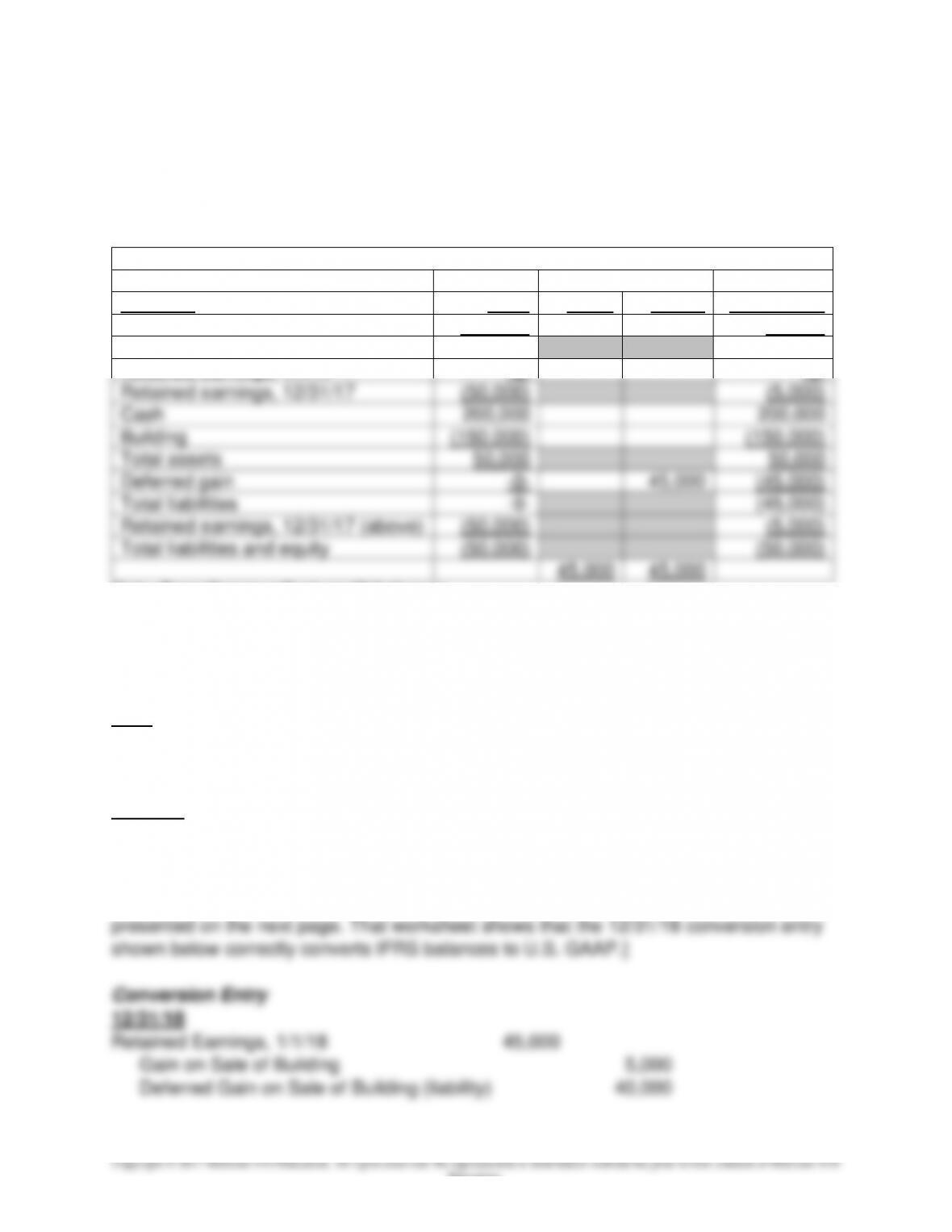
The following entry is needed at December 31, 2017, to convert from IFRS to U.S.
GAAP:
Conversion Entry
Chapter 11 – Worldwide Accounting Diversity and International Standards
11-12
Education.
18. (continued)
[Note: The 12/31/17 partial conversion worksheet below summarizes the above entries,
and shows that the conversion entry results in the correct amounts being reported in the
U.S. GAAP column.]
Partial Conversion Worksheet, 12/31/17
(amounts in reais)
Conversion Entry
Account
IFRS
Debit
Credit
U.S. GAAP
Gain on sale
(50,000)
45,000
(5,000)
Net income, 2017
(50,000)
(5,000)
Retained earnings, 1/1/17
-0-
-0-
Retained earnings, 12/31/17
(50,000)
(5,000)
Cash
200,000
200,000
Building
(150,000)
(150,000)
Total assets
50,000
50,000
Deferred gain
-0-
45,000
(45,000)
Total liabilities
-0-
(45,000)
Retained earnings, 12/31/17 (above)
(50,000)
(5,000)
Total liabilities and equity
(50,000)
(50,000)
45,000
45,000
Note: Parentheses reflect credit balances.
The 2018 journal entries under IFRS and U.S. GAAP to account for the gain on sale
and leaseback are as follows:
IFRS
2018
No entries are needed. The gain was recognized in full in 2017.
U.S. GAAP
12/31/18
Deferred Gain on Sale of Building (liability) 5,000
Gain on Sale of Building [50,000 ÷ 10 years] 5,000
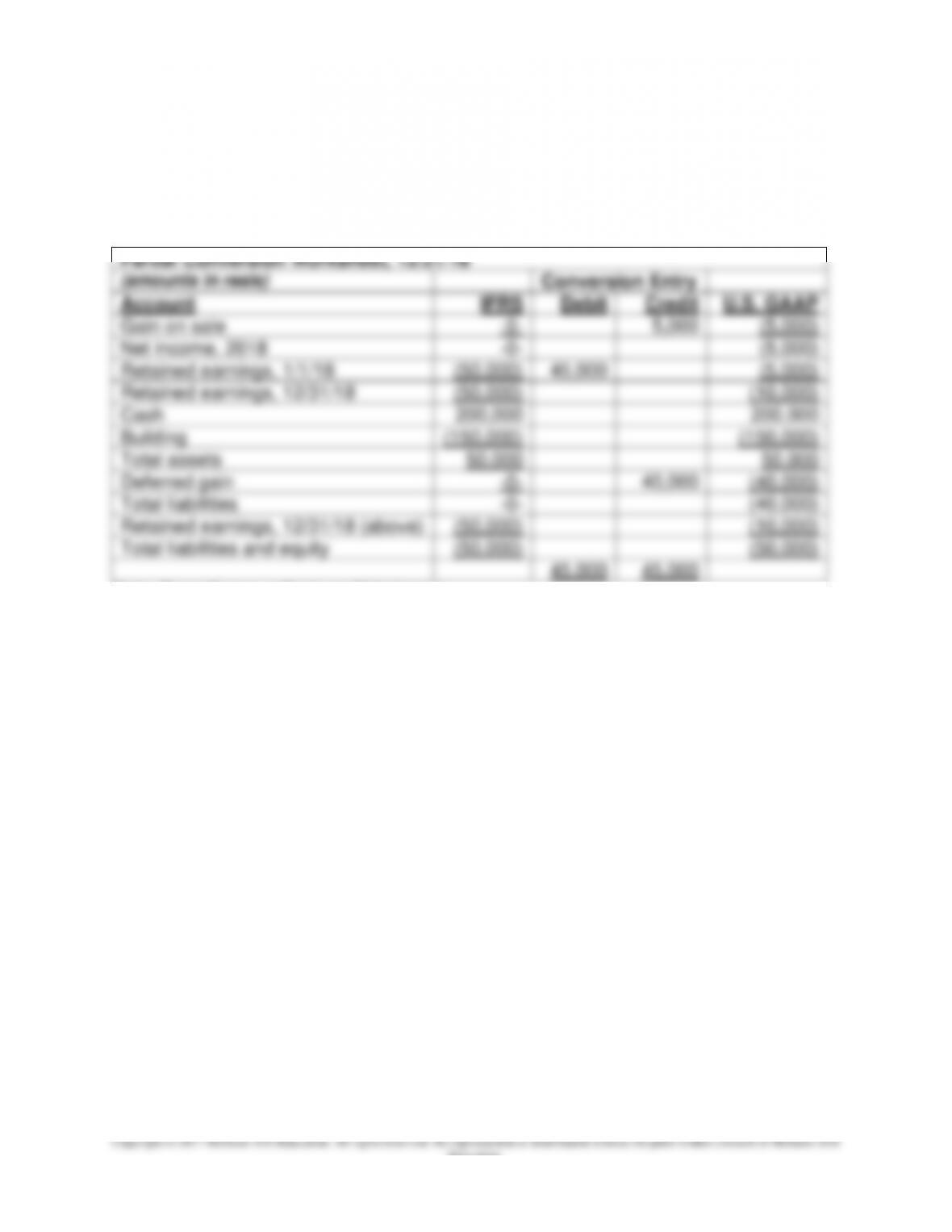
[Note: The U.S. GAAP entry is reflected in the 12/31/18 partial conversion worksheet
Chapter 11 – Worldwide Accounting Diversity and International Standards
11-13
Education.
18. (continued)
[Note: The 12/31/18 partial conversion worksheet below summarizes the above entries,
and shows that the conversion entry results in the correct amounts being reported in the
U.S. GAAP column.]
Partial Conversion Worksheet, 12/31/18
(amounts in reais)
Conversion Entry
Account
IFRS
Debit
Credit
U.S. GAAP
Gain on sale
-0-
5,000
(5,000)
Net income, 2018
-0-
(5,000)
Retained earnings, 1/1/18
(50,000)
45,000
(5,000)
Retained earnings, 12/31/18
(50,000)
(10,000)
Cash
200,000
200,000
Building
(150,000)
(150,000)
Total assets
50,000
50,000
Deferred gain
-0-
40,000
(40,000)
Total liabilities
-0-
(40,000)
Retained earnings, 12/31/18 (above)
(50,000)
(10,000)
Total liabilities and equity
(50,000)
(50,000)
45,000
45,000
Note: Parentheses reflect credit balances.
11-14
19. (20 minutes) (Compound Financial Instruments – Convertible Bonds)
Note: Other than dates, percentages, number of years, and present value factors,
all amounts are in lira.
Under IFRS, convertible bonds are a compound financial instrument that must be split
into separate debt and equity components based upon their fair values. The fair value of
the debt component is equal to the present value of a similar bond without a conversion
feature; such bonds pay interest of 12%. Thus, Ismir’s bond must be discounted at 12%
to determine the fair value of the debt component.
Present value of 100,000, 10-year bonds, 12% discount rate
PV of face value of bonds 100,000 x 0.3219732 = 32,197
PV of annuity of annual interest payments
IFRS
12/31/17
Cash 100,000
Bonds Payable 88,699
Additional Paid-in Capital-Convertible Bonds 11,301
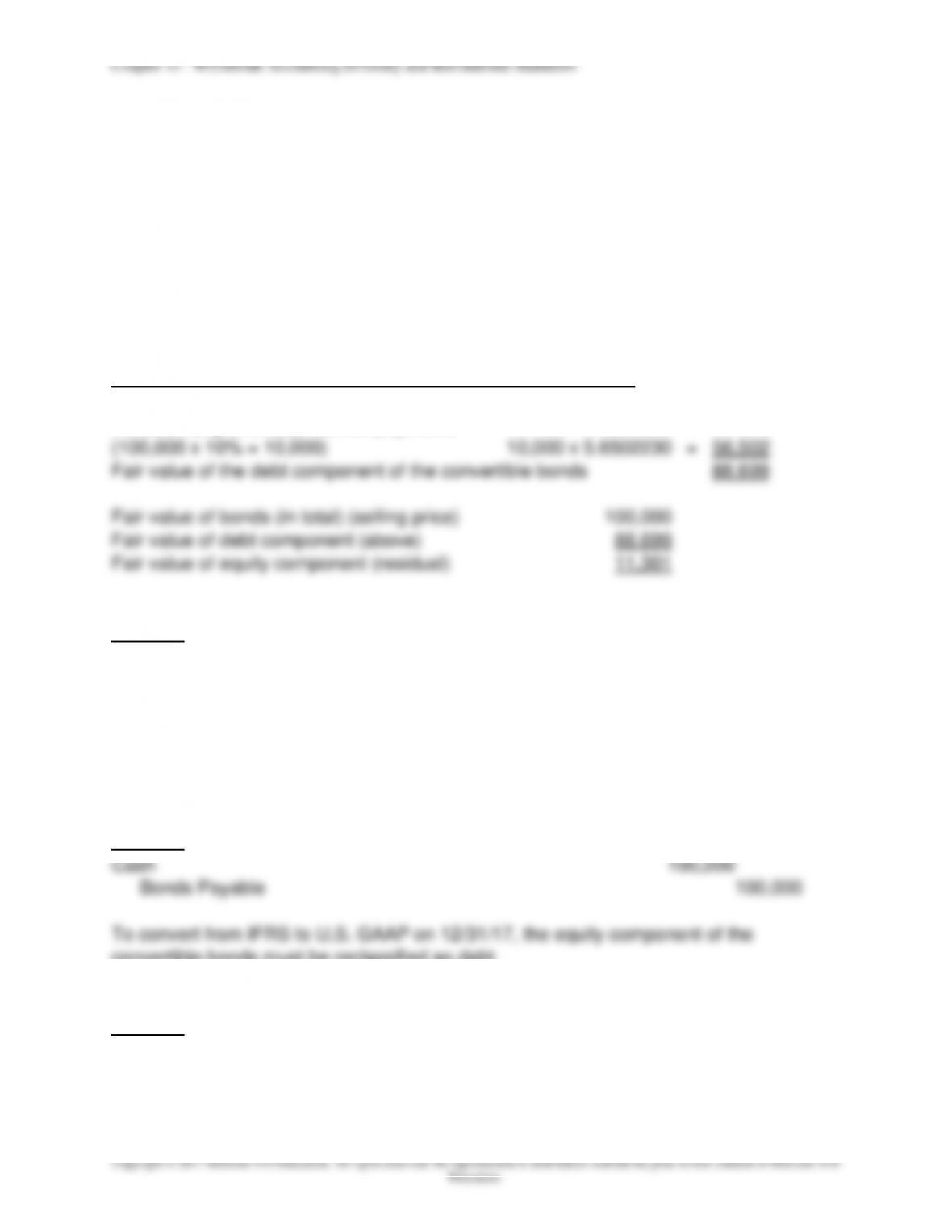
Under U.S. GAAP, bonds are not split into separate debt and equity components but
are treated solely as debt.
U.S. GAAP
12/31/17
convertible bonds must be reclassified as debt.
Conversion Entry
12/31/17
Additional Paid-in Capital-Convertible Bonds 11,301
Bonds Payable 11,301
11-15
Education.
19. (continued)
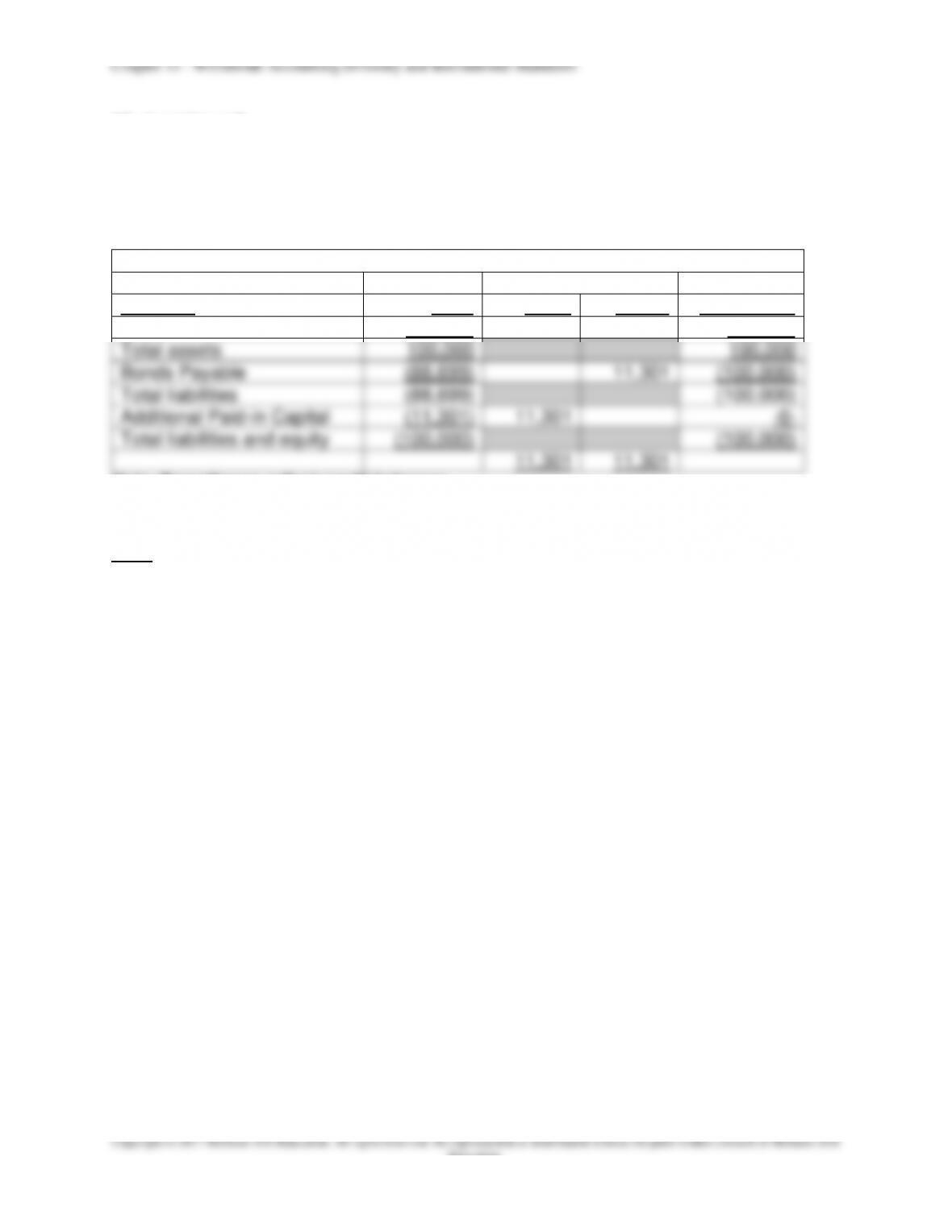
[Note: The 12/31/17 partial conversion worksheet below summarizes the above entries,
and shows that the conversion entry results in the correct amounts being reported in the
U.S. GAAP column.]
Partial Conversion Worksheet, 12/31/17
(amounts in lira)
Conversion Entry
Account
IFRS
Debit
Credit
U.S. GAAP
Cash
100,000
100,000
Total assets
100,000
100,000
Bonds Payable
(88,699)
11,301
(100,000)
Total liabilities
(88,699)
(100,000)
Additional Paid-in Capital
(11,301)
11,301
-0-
Total liabilities and equity
(100,000)
(100,000)
11,301
11,301
Note: Parentheses reflect credit balances.
2018
The same conversion entry made on 12/31/17 also would be made on 12/31/18, and
every year after that until the bonds are repaid.
Chapter 11 – Worldwide Accounting Diversity and International Standards
11-16
20. (30 minutes) (Property, Plant, and Equipment – Component Depreciation)
Note: Other than dates and number of years, all amounts are in rupees.
Under IFRS, a depreciable asset comprised of components with different useful lives
and/or salvage values must be depreciated on a component basis. Thus, Surat has
determined depreciation expense should be 1,000,000 rupees as shown here (amounts
are in rupees):
Component
Cost
Useful Life
Depreciation
Fuselage
10,000,000
40 years
250,000
Engines
15,000,000
30 years
500,000
Interior
5,000,000
20 years
250,000
Total
30,000,000
1,000,000
The U.S. parent of Surat does not depreciate assets on a component basis, but instead
depreciates assets over their useful life as a whole. Thus, depreciation expense under
U.S. GAAP would be 750,000 [30,000,000 ÷ 40 years].
The journal entries in 2017 under the two sets of standards are as follows:
IFRS
1/1/17
Aircraft 30,000,000
Cash 30,000,000
12/31/17
Depreciation Expense 1,000,000
Accumulated Depreciation-Aircraft 1,000,000
U.S. GAAP
1/1/17
Aircraft 30,000,000
Conversion Entry
12/31/17
Accumulated Depreciation-Aircraft 250,000
Depreciation Expense 250,000
Education.
Chapter 11 – Worldwide Accounting Diversity and International Standards
11-18
Education.
20. (continued)
[Note: The 12/31/18 partial conversion worksheet below summarizes the above entries,
and shows that the conversion entry results in the correct amounts being reported in the
U.S. GAAP column.]
Partial Conversion Worksheet, 12/31/18
(amounts in rupees)
Conversion Entry
Account
IFRS
Debit
Credit
U.S. GAAP
Depreciation expense
1,000,000
250,000
750,000
Net income, 2018
1,000,000
750,000
Retained earnings, 1/1/18
1,000,000
250,000
750,000
Retained earnings, 12/31/18
2,000,000
1,500,000
Cash
(30,000,000)
(30,000,000)
Aircraft
30,000,000
30,000,000
Accumulated depreciation-Aircraft
(2,000,000)
500,000
(1,500,000)
Total assets
(2,000,000)
(1,500,000)
Total liabilities
-0-
-0-
Retained earnings, 12/31/18 (above)
2,000,000
1,500,000
Total liabilities and equity
2,000,000
1,500,000
500,000
500,000
Note: Parentheses reflect credit balances.