Chapter 10 – Translation of Foreign Currency Financial Statements – Hoyle, Schaefer, Doupnik, 13e
38. (continued)
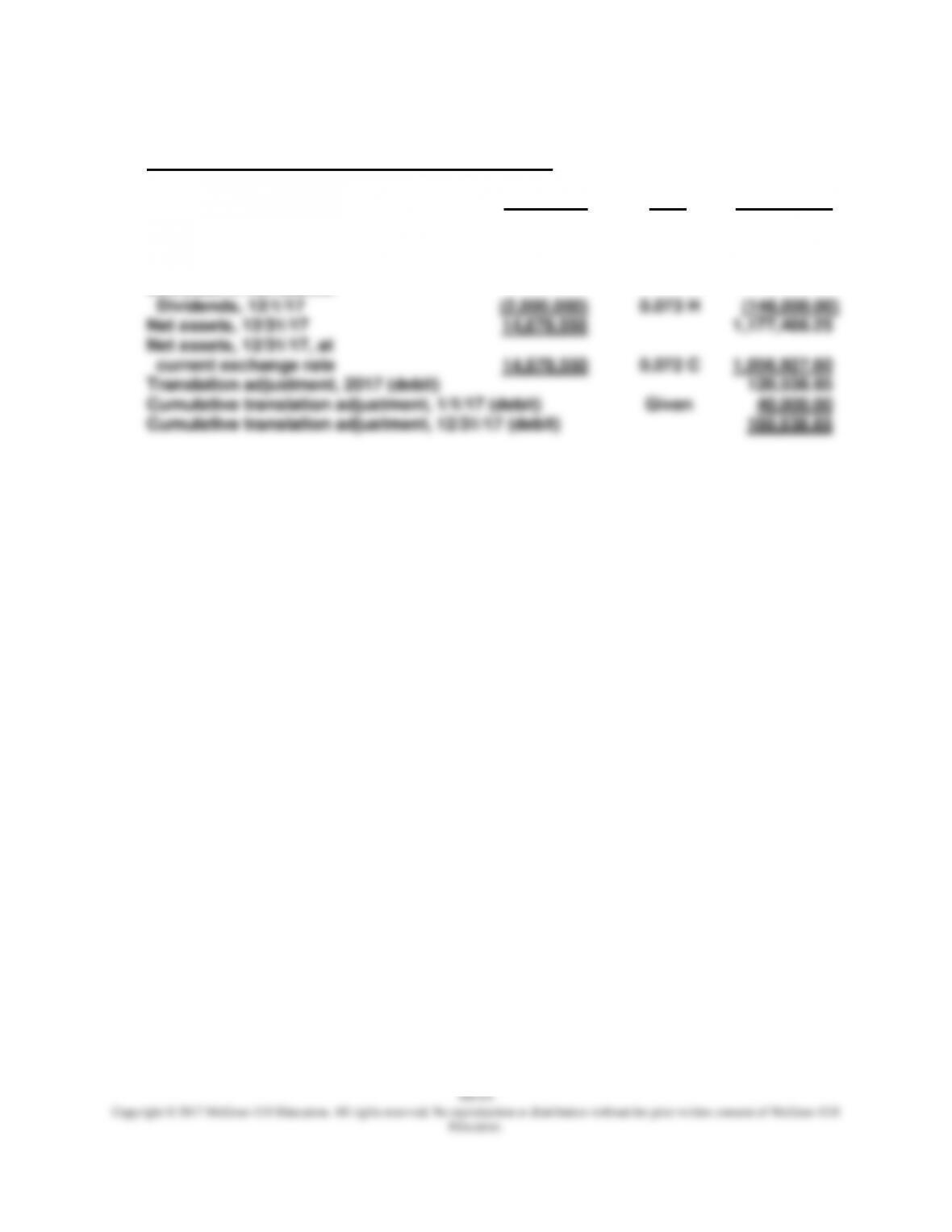
Calculation of Cumulative Translation Adjustment
Exchange
MXN Rate USD
Net asset balance, 1/1/17 14,500,000 0.080 H 1,160,000.00
Increase in net assets:
Income, 2017 2,179,550 0.075 A 163,466.25
Decrease in net assets:
Chapter 10 – Translation of Foreign Currency Financial Statements – Hoyle, Schaefer, Doupnik, 13e
10-42
Education.
Chapter 10 Develop Your Skills
Research Case 1—Foreign Currency Translation and Hedging Activities
The responses to this assignment will depend upon the company selected
by the student for analysis. It is unlikely that the company selected will
disclose the amount of any remeasurement gains and losses. The amount of
Research Case 2—Foreign Currency Translation Disclosures in the Computer
Industry
The responses to requirements in this case will depend upon the annual
reports used by students to complete the case. The solution provided here
is based upon 2014 annual reports.
a. In 2014, in addition to providing information related to foreign currency
Currency Amounts and Derivative Financial Instruments, p. 93.
iii. Note D. Financial Instruments, under Derivatives Financial Instruments
and Foreign Exchange Risk, pp. 105–107.
In its Form 10-K for the year ended December 27, 2014, Intel provided
information related to foreign currency hedging activities in the following
Hedging Instruments, p. 65, and Derivative Financial Instruments, p.
57–58.
iv. Note 6. Derivative Financial Instruments, p. 70–75.
Chapter 10 – Translation of Foreign Currency Financial Statements – Hoyle, Schaefer, Doupnik, 13e
10-43
Education.
Research Case 2 (continued)
b. IBM’s foreign operations do not have a predominant functional currency.
The company indicates that it operates in multiple functional currencies
(AR, p. 105). Most of IBM’s foreign operations probably have the foreign
currency as functional currency and therefore are translated into dollars
using the current rate method with translation adjustments reflected in
stockholders’ equity. There is no mention of foreign currency amounts
being remeasured or remeasurement gains and losses being reflected in
net income.
reflected in net income. Thus, Intel’s foreign operations probably have
the foreign currency as functional currency and are translated into dollars
using the current rate method. The lack of any obvious difference in
translation method and disposition of the translation adjustment between
IBM and Intel enhances the comparability of information provided by the
two companies.
c. From the Consolidated Statement of Comprehensive Income (AR, p. 81), it
can be seen that IBM reported translation adjustments as follows:
2014: negative $1,636 million
2013: negative $1,335 million
2012: negative $44 million
The negative sign of the translation adjustment in each year indicates
that, on average, the foreign currency functional currencies of IBM’s
Chapter 10 – Translation of Foreign Currency Financial Statements – Hoyle, Schaefer, Doupnik, 13e
10-44
Education.
Research Case 2 (continued)
The magnitude of the translation adjustments reported in other
comprehensive income is much larger for IBM than for Intel. This most
likely occurs because Intel has a much smaller balance sheet exposure
related to foreign currency functional currency operations.
d. In Note D. Financial Instruments, under Foreign Exchange Risk, IBM
indicates that a significant portion of the company’s foreign currency
denominated debt is designated as a hedge of its foreign currency
balance sheet exposures (p. 107). The company also uses foreign
10-45
Education.
Accounting Standards Case 1—More than One Functional Currency
This case requires students to search the authoritative literature to determine
how the functional currency should be determined for a foreign entity that
has more than one distinct and separable operation.
Source of guidance: FASB ASC 830–10–55–6 Foreign Currency Matters;
they are conducted in different economic environments, those two operations
might have different functional currencies. Similarly, a single subsidiary of a
financial institution might have relatively self-contained and integrated
operations in each of several different countries. In those circumstances,
each operation may be considered to be an entity as that term is used in this
the functional currency for the Small Appliance division and the U.S. dollar as
the functional currency for the Electronics division.
Chapter 10 – Translation of Foreign Currency Financial Statements – Hoyle, Schaefer, Doupnik, 13e
Education.
Accounting Standards Case 2—Change in Functional Currency
This case requires students to search the authoritative literature to determine
how an entity should handle a change in foreign currency from the foreign
currency to the U.S. dollar. Specific questions are:
• Should the change in functional currency be treated as a change in
accounting principle with retrospective restatement of the carrying
values of nonmonetary assets?
• Should the cumulative translation adjustment be removed from equity
and, if so, where should it go?
shall not be removed from equity and the translated amounts for
nonmonetary assets at the end of the prior period become the accounting
basis for those assets in the period of the change and subsequent periods.”
In essence, the authoritative guidance indicates that the change in functional
currency from the Canadian dollar to the U.S. dollar should not be treated as
Chapter 10 – Translation of Foreign Currency Financial Statements – Hoyle, Schaefer, Doupnik, 13e
10-47
Education.
Excel Case—Translating Foreign Currency Financial Statements
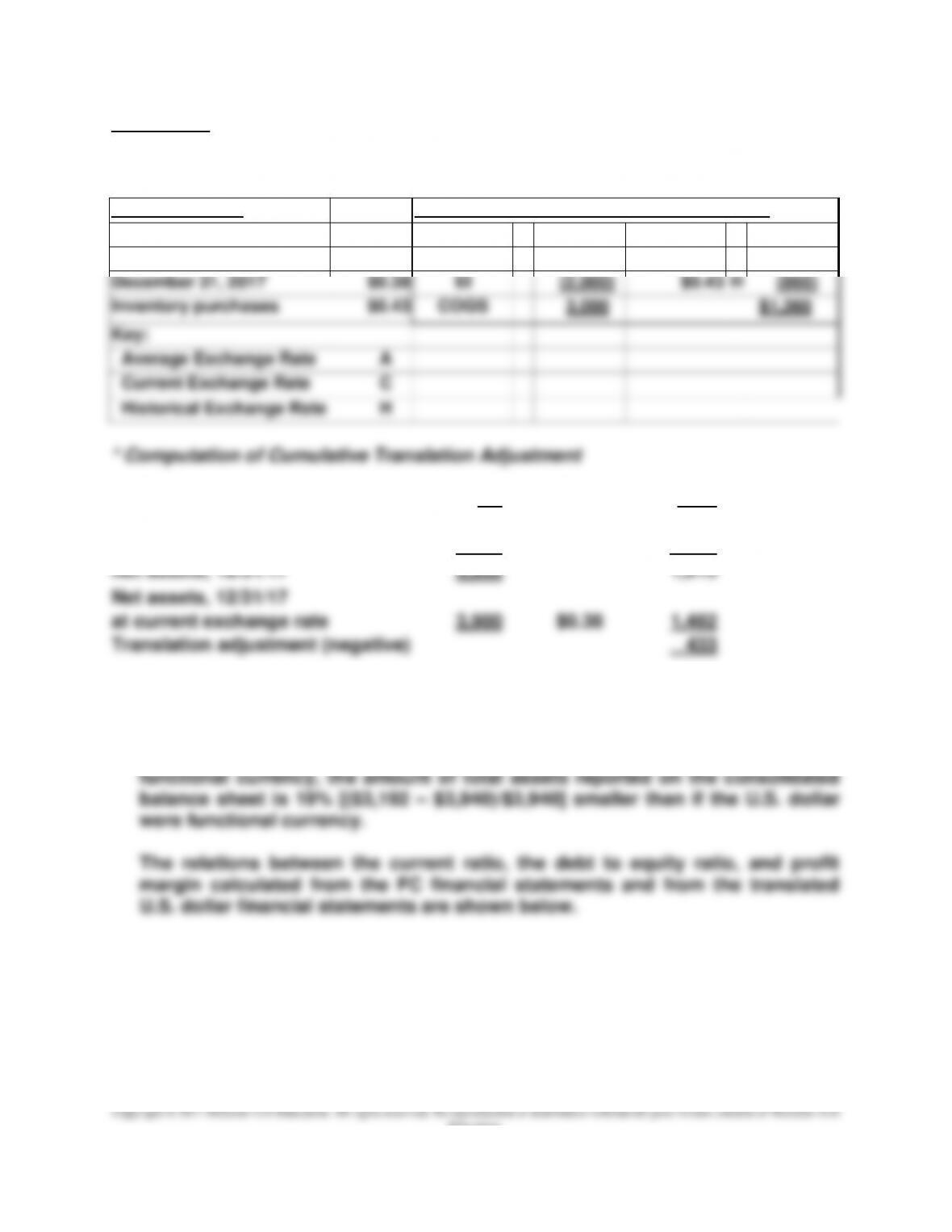
a. b. Spreadsheet for the translation (current rate method) and remeasurement
(temporal method) of the FC financial statements of the foreign subsidiary.
Current Rate Method
Temporal Method
December 31, 2017
FC
Rate
USD
Rate
USD
Sales
5,000
$0.45
A
$2,250
$0.45
A
$2,250
Cost of goods sold
(3,000)
$0.45
A
(1,350)
Schedule A
(1,360)
Gross profit
2,000
subtotal
900
subtotal
890
Selling expense
(400)
$0.45
A
(180)
$0.45
A
(180)
Depreciation expense
(600)
$0.45
A
(270)
$0.50
H
(300)
Remeasurement gain/loss
0
n/a
0
to balance
355
Income before tax
1,000
subtotal
450
subtotal
765
Income taxes
(300)
$0.45
A
(135)
$0.45
A
(135)
Net income
700
subtotal
315
subtotal
630
Retained earnings, 1/1/17
0
0
0
Ret. earnings, 12/31/17
700
total
315
from B/S
630
Cash
1,000
$0.38
C
380
$0.38
C
380
Inventory
2,000
$0.38
C
760
$0.43
H
860
Property, plant &
equipment
6,000
$0.38
C
2,280
$0.50
H
3,000
Less: Accum. deprec.
(600)
$0.38
C
(228)
$0.50
H
(300)
Total assets
8,400
total
3,192
total
3,940
Current liabilities
1,500
$0.38
C
570
$0.38
C
570
Long-term debt
3,000
$0.38
C
1,140
$0.38
C
1,140
Contributed capital
3,200
$0.50
H
1,600
$0.50
H
1,600
Cum. trans. adjustment*
0
to balance
(433)
n/a
0
Retained earnings
700
from I/S
315
to balance
630
Total liabilities and stock–
holders’ equity
8,400
A=L+SE
3,192
A=L+SE
3,940
Key:
Average Exchange Rate
A
Current Exchange Rate
C
Historical Exchange Rate
H
Chapter 10 – Translation of Foreign Currency Financial Statements – Hoyle, Schaefer, Doupnik, 13e
10-48
Education.
Excel Case (continued)
Schedule A – Calculation of COGS Under the Temporal Method
Exchange Rates
Temporal method—COGS (on a FIFO basis)
January 1-31, 2017
$0.50
BI
1,000
$0.50
H
$500
Average 2017
$0.45
P
4,000
$0.43
H
1,720
December 31, 2017
$0.38
EI
(2,000)
$0.43
H
(860)
Inventory purchases
$0.43
COGS
3,000
$1,360
Key:
Average Exchange Rate
A
Current Exchange Rate
C
Historical Exchange Rate
H
* Computation of Cumulative Translation Adjustment
FC
USD
Net assets, 1/1/17
3,200
$0.50
1,600
Net income, 2017
700
$0.45
315
Net assets, 12/31/17
3,900
1,915
Net assets, 12/31/17
at current exchange rate
3,900
$0.38
1,482
Translation adjustment (negative)
433
c. With the FC as functional currency, the U.S. dollar net income reflected in the
consolidated income statement is $315. If the U.S. dollar were the functional
currency, the amount would be twice as much—$630. With the FC as
10-49
Excel Case (continued)
FC
Current Rate
Temporal
Current ratio
CA
3,000
1,140
1,240
CL
1,500
570
570
2.0
2.0
2.1754
Debt to equity ratio
Total liabilities
4,500
1,710
1,710
Total stockholders’
equity
3,900
1,482
2,230
1.15385
1.15385
0.76682
Profit margin
NI
700
315
630
Sales
5,000
2,250
2,250
0.14
0.14
0.28
Return on equity
NI
700
315
630
Average TSE
3,550
1,541
1,915
0.19718
0.20441
0.32898
Inventory turnover
COGS
3,000
1,350
1,360
Average Inventory
1,000
380
430
3
3.55263
3.16279
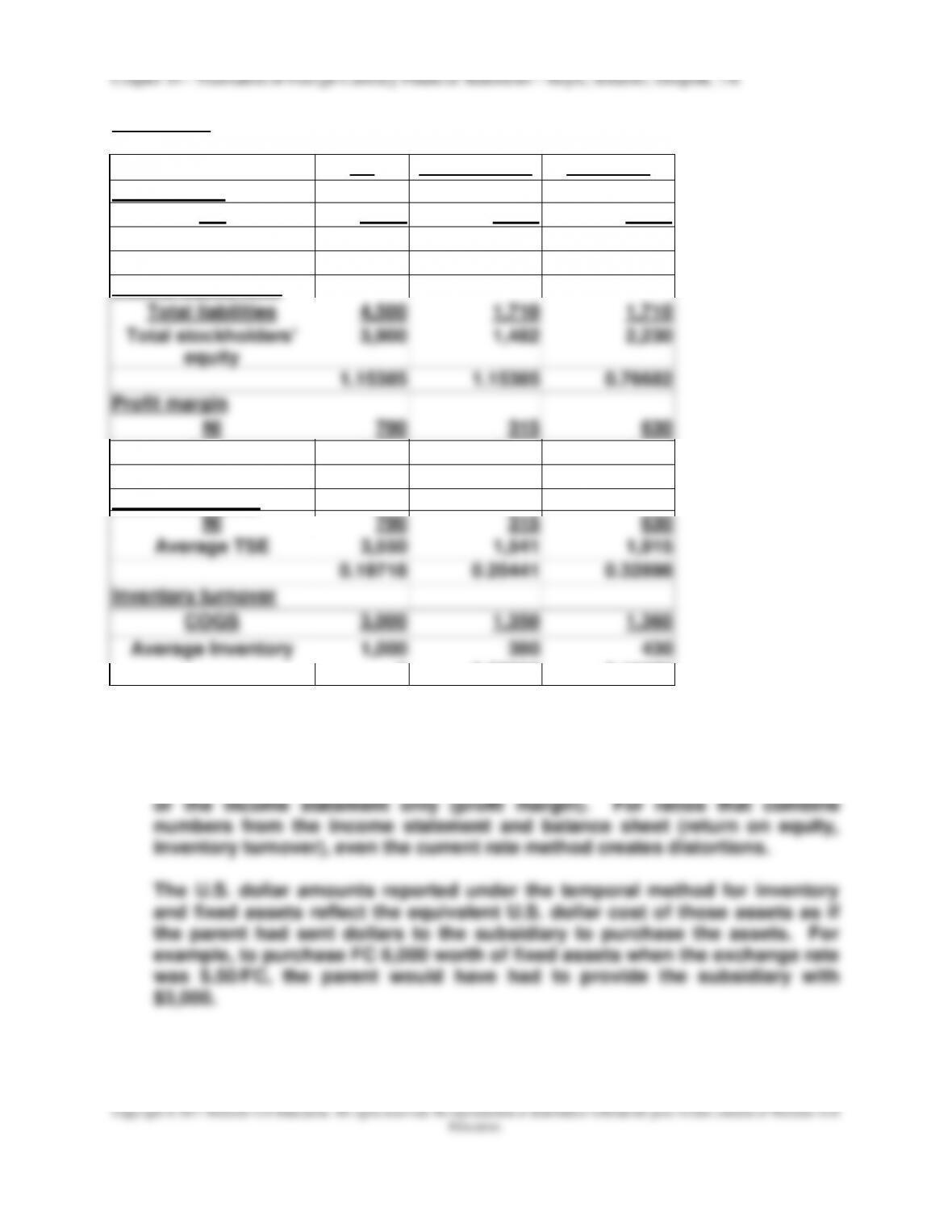
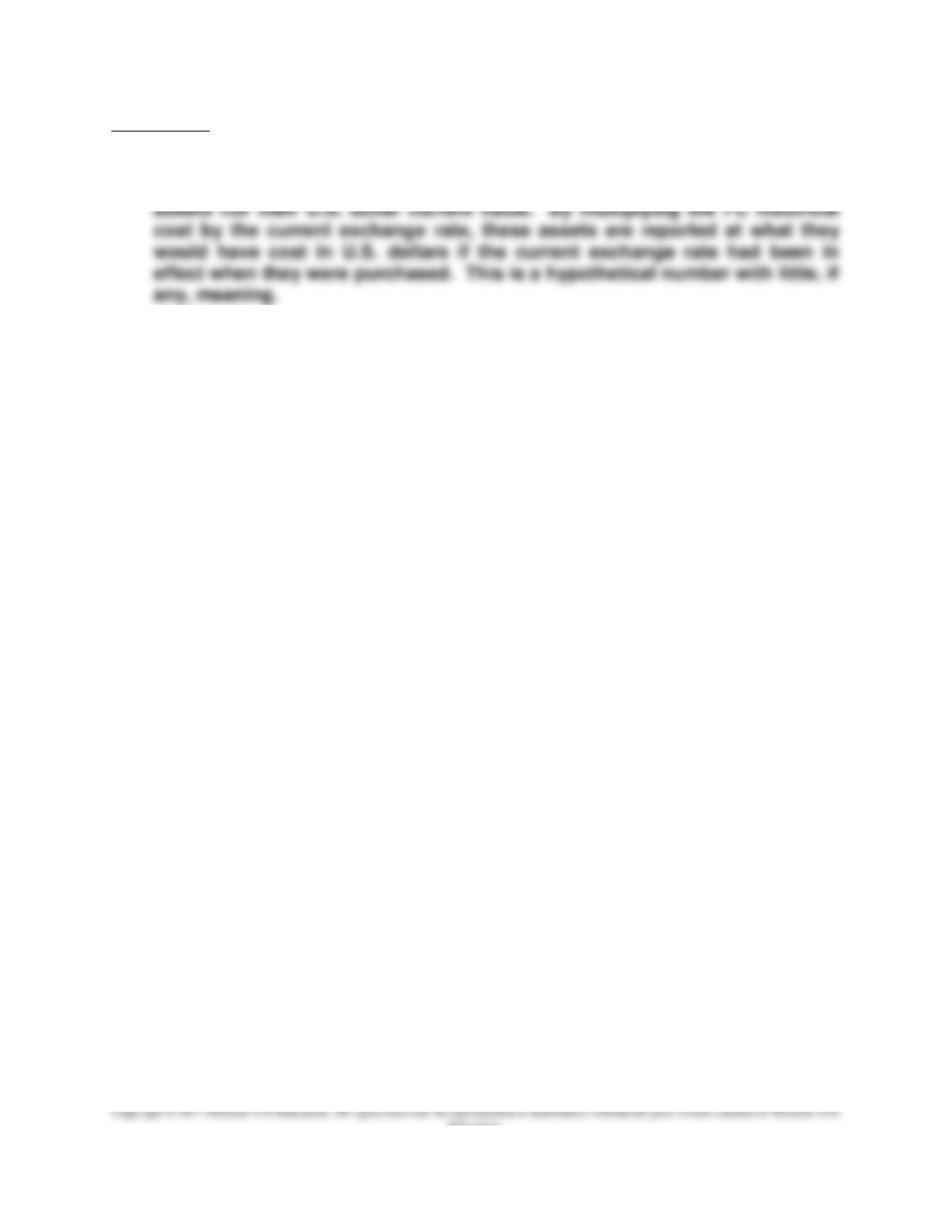
These results show that the temporal method distorts all ratios as calculated
from the original foreign currency financial statements. The current rate
method maintains all ratios that use numbers in the numerator and
denominator from the balance sheet only (current ratio, debt–to-equity ratio)

Education.
Chapter 10 – Translation of Foreign Currency Financial Statements – Hoyle, Schaefer, Doupnik, 13e
10-51
Education.
Excel Case (continued)
The U.S. dollar amounts reported under the current rate method for inventory
and fixed assets reflect neither the equivalent U.S. dollar cost of those
Chapter 10 – Translation of Foreign Currency Financial Statements – Hoyle, Schaefer, Doupnik, 13e
10-52
Education.
Excel and Analysis Case—Parker Inc. and Suffolk PLC
This assignment requires translation of foreign currency financial
statements under three different sets of assumptions regarding changes in
the U.S. dollar value of the British pound. Under the first set of
assumptions, the British pound appreciates steadily from $1.60 at 1/1/16 to
Chapter 10 – Translation of Foreign Currency Financial Statements – Hoyle, Schaefer, Doupnik, 13e
10-53
Excel and Analysis Case (continued)
a. Translation of Suffolk’s December 31, 2017 trial balance from British pounds
to U.S. dollars.
Suffolk PLC
Trial Balance
December 31, 2017
Exchange
Pounds Rate Dollars
Cash £ 1,500,000 $1.68 $ 2,520,000
Accounts receivable 5,200,000 $1.68 8,736,000
Inventory 18,000,000 $1.68 30,240,000
Property, plant, & equipment (net) 36,000,000 $1.68 60,480,000