
Chapter 10 – Translation of Foreign Currency Financial Statements – Hoyle, Schaefer, Doupnik, 13e
10-1
CHAPTER 10
TRANSLATION OF FOREIGN
CURRENCY FINANCIAL STATEMENTS
Chapter Outline
I. In today’s global economy, many companies have invested in operations in foreign
countries.
A. In preparing consolidated financial statements on a worldwide basis, the foreign
currency accounts prepared by foreign operations must be restated into the parent
company’s reporting currency.
B. There are two major issues related to the translation of foreign currency financial
statements.
1. Which method should be used?
2. How should the resulting translation adjustment be reported on the consolidated
financial statements?
C. Translation methods differ on the basis of which accounts are translated at the current
exchange rate and which are translated at a historical exchange rate. Translating
accounts at the current exchange rate creates a translation adjustment.
D. Historically, accountants have experimented with a number of different translation
methods. The dominant methods currently in use are the temporal method and the
current rate method.
E. Translation adjustments can be either (1) reported as a gain or loss in income or (2)
deferred in the stockholders’ equity section of the balance sheet.
II. The primary objective of the temporal method is to maintain the underlying valuation method
used by the foreign entity to account for its assets and liabilities.
A. Assets and liabilities carried at current or future value are translated at the current
exchange rate. Assets and liabilities carried at cost and stockholders’ equity items are
translated at a historical exchange rate.
B. By translating some assets at the current exchange rate and others at historical rates the
temporal method distorts financial ratios calculated in the foreign currency.
C. Most income statement items are translated at average-for-the-period rates. However,
cost-of–goods-sold, depreciation, and amortization expense are translated at relevant
historical exchange rates.
D. Balance sheet exposure under the temporal method is defined as cash, marketable
securities, and receivables minus total liabilities. A net liability exposure often exists.
1. When a liability balance sheet exposure exists, depreciation of the foreign currency
2. Reporting a translation loss when the foreign currency appreciates is thought to be
inconsistent with economic reality.
Chapter 10 – Translation of Foreign Currency Financial Statements – Hoyle, Schaefer, Doupnik, 13e
10-2
Education.
III. With the current rate method, the net investment in a foreign operation is considered to be
exposed to foreign exchange risk.
A. Assets and liabilities are translated at the current exchange rate; equity is translated at
historical rates.
B. Translating assets which are carried at cost using the current exchange rate results in a
translated value which is not readily interpretable; it is neither a current value nor a
historical cost.
C. However, translating all assets at the current rate does maintain underlying ratios and
relationships that exist in the foreign currency statements.
D. Revenues and expenses which occur evenly throughout the period are translated at the
average-for-the-period exchange rate. Income items, such as gains and losses, which
are the result of a discrete event, are translated at the actual exchange rate on the date
of occurrence.
E. Balance sheet exposure under the current rate method is equal to the foreign entity’s net
assets (stockholders’ equity).
1. Appreciation in the foreign currency results in a positive translation adjustment
(gain); depreciation results in a negative translation adjustment (loss).
1. U.S. GAAP lists six indicators that are to be used in determining an entity’s functional
currency. There are no guidelines as to how these indicators are to be weighted.
1. Upon the sale or liquidation of a specific foreign entity, the cumulative translation
adjustment related to that entity is taken to income as an adjustment to the gain or
loss on sale or liquidation.
C. If the U.S. dollar is the functional currency, foreign currency financial statements are
“remeasured” using the temporal method with “remeasurement” gains and losses
reported in operating income.
D. If a foreign entity operates in a highly inflationary economy (cumulative three-year
inflation greater than 100%), its financial statements are remeasured into U.S. dollars
using the temporal method and remeasurement gains and losses are reported in
income.
V. Some companies hedge the balance sheet exposures of their foreign entities so as to avoid
adverse effects on income and/or stockholders’ equity.
A. FASB ASC Topic 815, Derivatives and Hedging, refers to this as a hedge of a net
investment in a foreign operation and stipulates that gains and losses on hedging
instruments used in this manner should be treated in the same fashion as the translation
adjustment (remeasurement gain/loss) being hedged.
B. The paradox of hedging balance sheet exposure is that by avoiding a translation
adjustment (remeasurement gain/loss), which are not immediately realized in cash,
realized foreign exchange gains and losses can arise.
Chapter 10 – Translation of Foreign Currency Financial Statements – Hoyle, Schaefer, Doupnik, 13e
10-3
Education.
Answer to Discussion Question: How Do We Report This?
This case represents the ongoing debate as to the proper reporting of foreign currency
balances. Southwestern has invested the equivalent of $30,000 (150,000 vilseks) in each of
three assets. The relative value of the vilsek has now changed. Thus, 150,000 vilseks now can
be converted into $34,500. However, the subsidiary does not have vilseks—only land, inventory,
and investments. Although the current exchange rate is given, the company has no apparent
reflect the proceeds in U.S. dollars because 150,000 vilseks is the historical cost and not the
current market value of each of these assets.
As a classroom exercise or written assignment, students could be required to select a reported
value for each of the three assets and then defend their position. What figure is actually the
fairest representation of each of the three assets? What figure is the best conveyor of
information to an outside party? There is no single best answer to these questions. The
purpose of this type of exercise is to encourage students to consider the objectives of financial
reporting. Students should not just assume that the current official pronouncement is correct.
Chapter 10 – Translation of Foreign Currency Financial Statements – Hoyle, Schaefer, Doupnik, 13e
Answers to Questions
1. The two major issues related to the translation of foreign currency financial statements are:
(a) which method should be used and (b) where should the resulting translation adjustment
2. Balance sheet exposure arises when a foreign currency balance is translated at the current
exchange rate. By translating at the current exchange rate, the foreign currency item in
essence is being revalued in U.S. dollar terms on the consolidated financial statements.
3. Although balance sheet exposure does not result in cash inflows and outflows, it does
nevertheless affect amounts reported in consolidated financial statements. If the foreign
currency is the functional currency, translation adjustments will be reported in stockholders’
equity. If translation adjustments are negative and therefore reduce total stockholders’
4. The gains and losses arising from financial instruments used to hedge balance sheet
exposure are treated in a similar manner as the item the hedge is intended to cover. If the
foreign currency is the functional currency, gains and losses on hedging instruments will be
10-6
Education.
10. Application of the equity method to a foreign subsidiary results in the cumulative translation
adjustment (CTA) related to that foreign subsidiary being included in the parent’s Investment
in Subsidiary account and also as a separate component of the parent’s equity (reported in
a separate line in the parent company’s column on the consolidation worksheet). In addition,
consolidation worksheet.
11. Translation is required when a foreign currency is the functional currency. Remeasurement
is required in two situations:
12. The temporal method must be used to remeasure the financial statements of operations in
highly inflationary countries. One reason for mandating the use of the temporal method is
13. Differences exist between IFRS and U.S. GAAP with regard to (a) the hierarchy of factors
used to determine the functional currency and (b) the method used to translate the financial
statements of a subsidiary located in a hyperinflationary country.
IAS 21 establishes primary factors and other factors to be considered in determining an
entity’s functional currency. When the indicators are mixed and the functional currency is

Chapter 10 – Translation of Foreign Currency Financial Statements – Hoyle, Schaefer, Doupnik, 13e
10-7
Education.
Chapter 10 – Translation of Foreign Currency Financial Statements – Hoyle, Schaefer, Doupnik, 13e
10-8
Education.
Answers to Problems
1. C (Definition of functional currency)
Because the yuan is the functional currency, the financial statements must
be translated using the current rate method. Therefore, answers a. and d.
can be eliminated. Because the subsidiary has a net asset position and the
6. A (Translation process (current rate method) – assets)
Because the foreign currency is the functional currency, translation (rather
than remeasurement) is required. All assets accounts are translated at
current rates.
The U.S. dollar is the foreign subsidiary’s functional currency, so
remeasurement is appropriate. Cost of goods sold is translated at the
historical rate in effect when the inventory was acquired [100,000 x $.16 =
$16,000].
10-9
Education.
11. C (Remeasurement process (temporal method) – marketable securities and
inventory)
The U.S. dollar is the functional currency, so remeasurement is
appropriate. Inventory (carried at cost) is remeasured at the historical
current exchange rate ……………. R 60,000 x $.31 = $ 18,600
Translation adjustment (positive) . $ (2,400)
14. C (Concepts underlying current rate and temporal methods)
By translating items carried at historical cost by the historical exchange
rate, the temporal method maintains the underlying valuation method used
by the foreign subsidiary in preparing its financial statements.
10-11
Education.
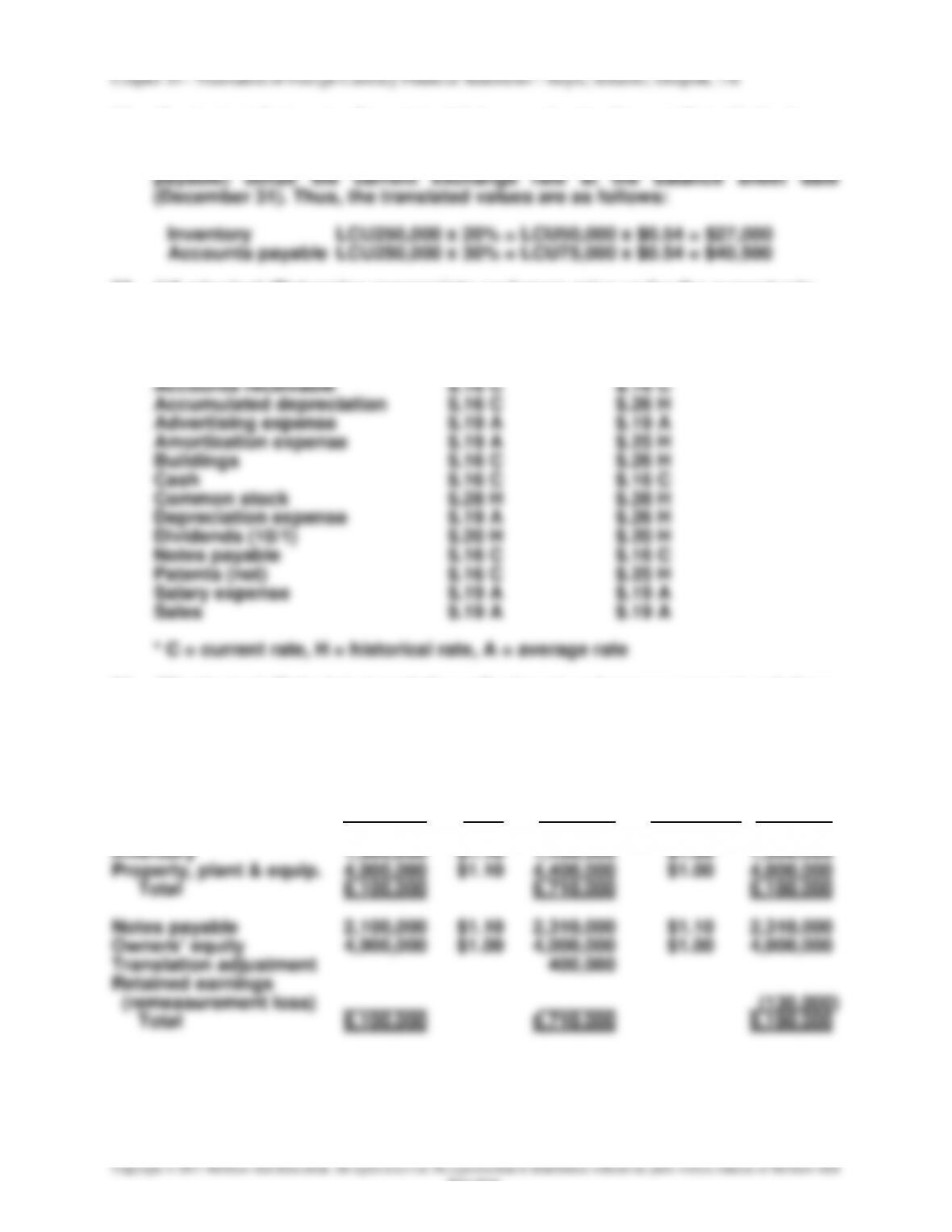
22. (5 minutes) Determine Translated Values under the Current Rate Method
As a translation, both the asset (inventory) and the liability (accounts
23. (10 minutes) (Determine appropriate exchange rates under the current rate
method [translation] and temporal method [remeasurement])
Translation Remeasurement
Accounts payable $.16 C $.16 C
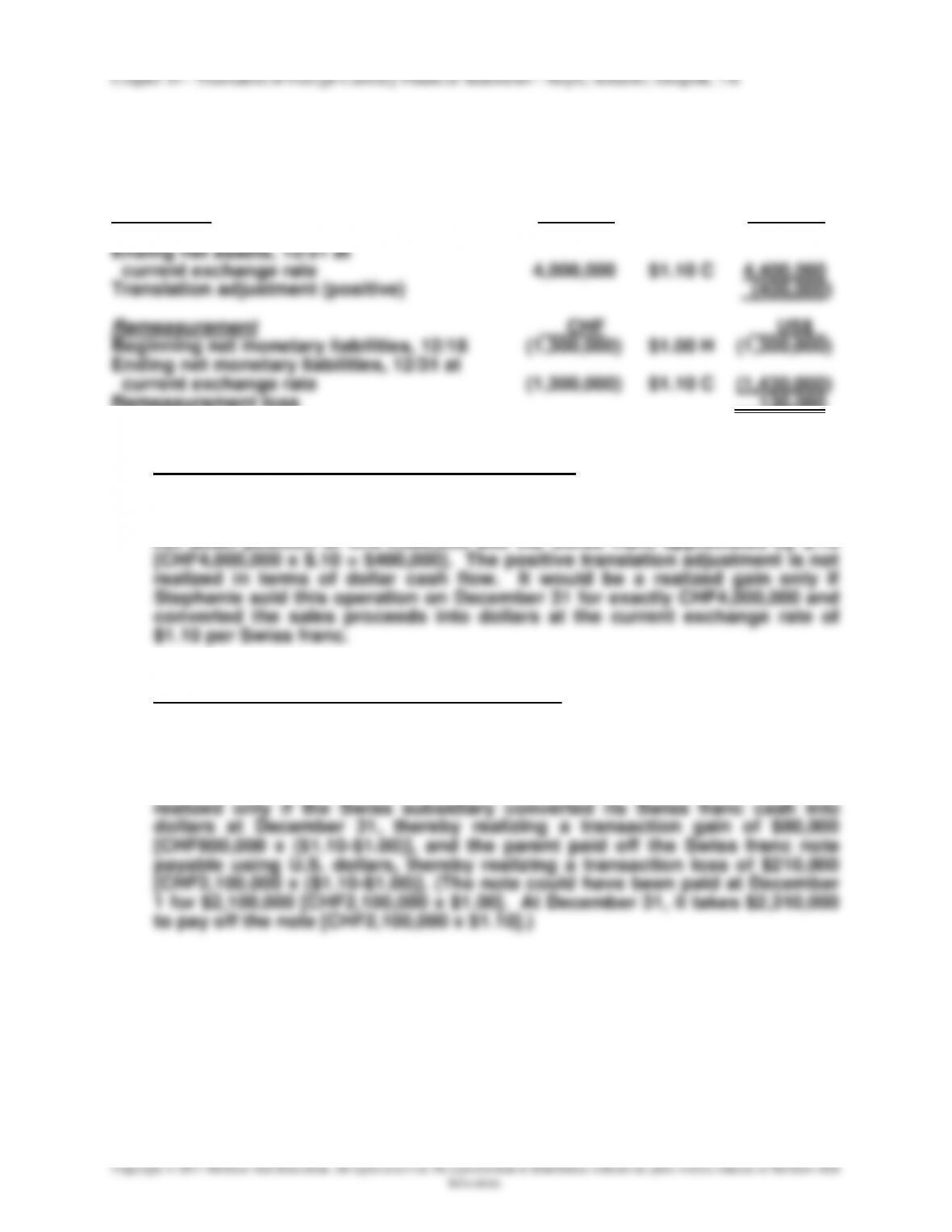
24. (20 minutes) (Calculate translation adjustment and remeasurement gain/loss
and explain their economic relevance)
The translation adjustment and remeasurement gain/loss can be determined
as the plug figure that keeps the dollar balance sheet in balance:
Translation Remeasure-
CHF Rate US$ ment Rate US$
Cash 800,000 $1.10 880,000 $1.10 880,000
10-12
24. (continued)
Alternatively, the translation adjustment and remeasurement loss can be
calculated by analyzing the subsidiary’s balance sheet exposure:
Translation CHF US$
Beginning net assets, 12/18 4,000,000 $1.00 H 4,000,000
Remeasurement loss 130,000
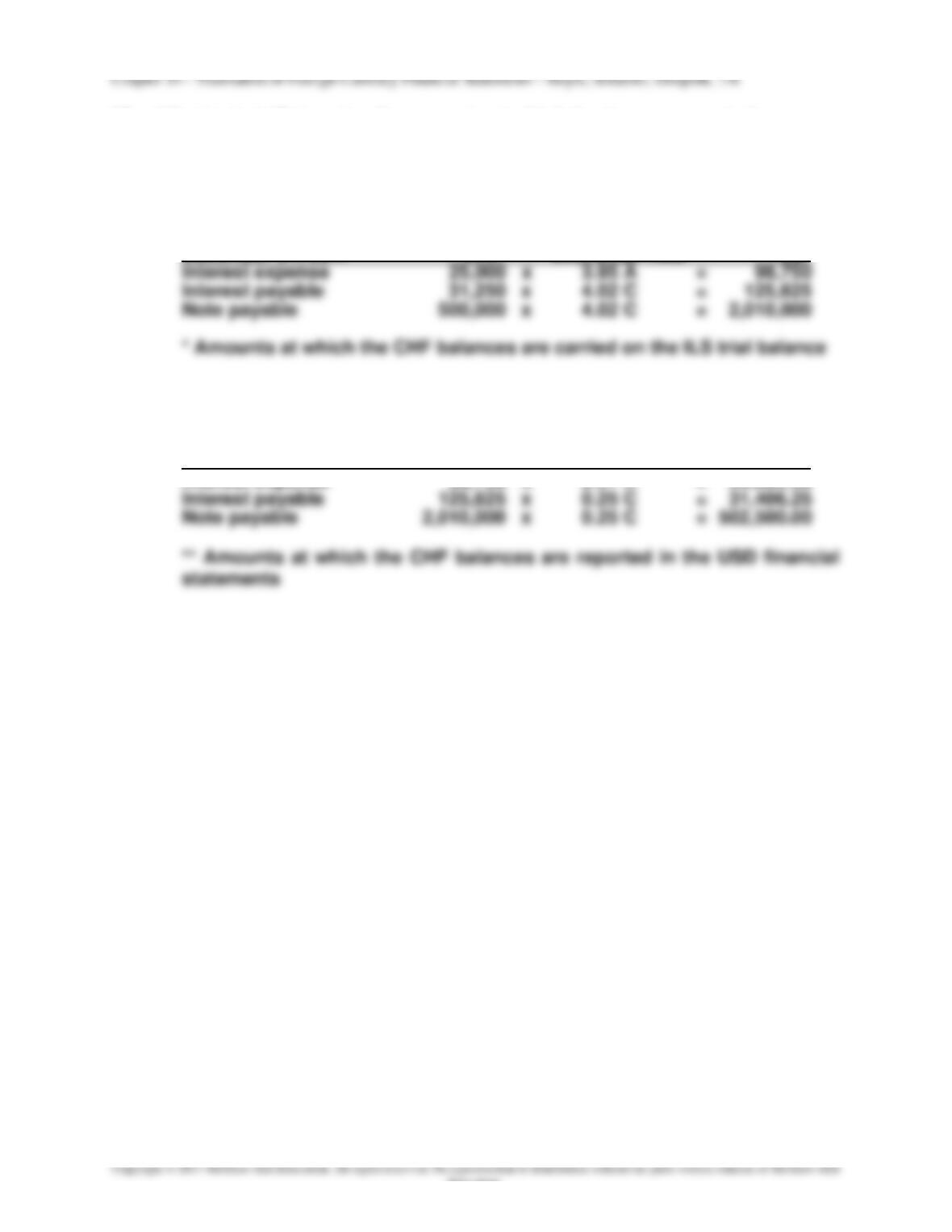
Economic Relevance of Translation Adjustment
The translation adjustment increases stockholders’ equity by $400,000. The
positive translation adjustment arises because the Swiss subsidiary has a
net asset position of CHF4,000,000 and the Swiss franc appreciates by $.10
Economic Relevance of Remeasurement Loss
The remeasurement loss arises because the Swiss subsidiary has a net
monetary liability position of CHF1,300,000 (Cash of CHF800,000 less Notes
payable of CHF2,100,000) and the Swiss franc has appreciated by $.10
[CHF1,300,000 x $.10 = $130,000]. The loss is unrealized. It would be
10-13
Education.
25. (15 minutes) (Determine the amounts at which foreign currency balances are
reported on a foreign subsidiary’s trial balance and in the parent’s
consolidated financial statements)
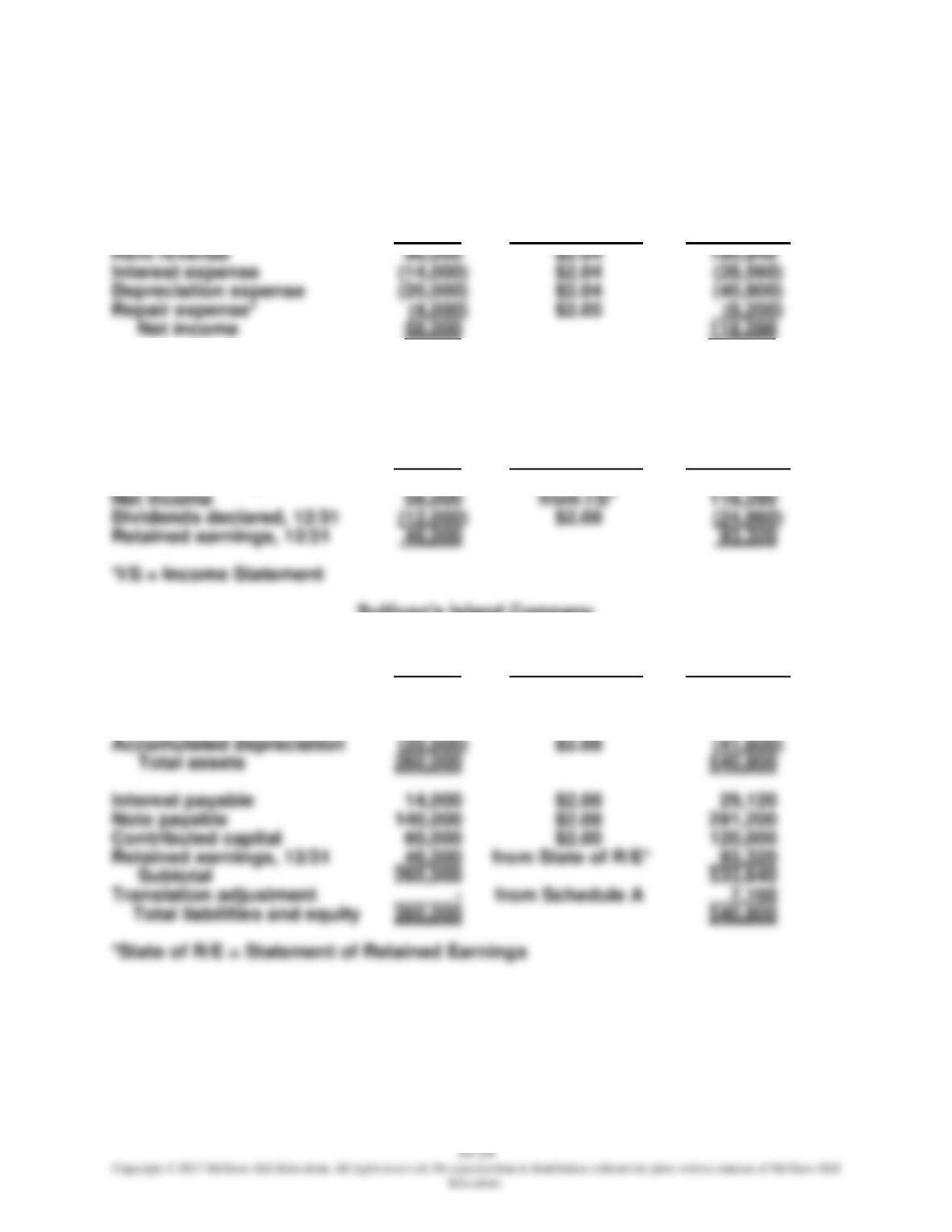
a. Remeasurement of Swiss franc (CHF) balances into Israeli shekels (ILS)
to report on the Israeli subsidiary’s trial balance.
December 31, 2017 CHF Exchange Rate ILS*
b. Translation of remeasured Swiss franc (CHF) balances into U.S. dollars
(USD) to report in the U.S. parent’s consolidated financial statements.
December 31, 2017 ILS Exchange Rate USD**
Interest expense 98,750 x 0.27 A = 26,662.50
Chapter 10 – Translation of Foreign Currency Financial Statements – Hoyle, Schaefer, Doupnik, 13e
26. (30 minutes) (Prepare financial statements for a foreign subsidiary and then
translate them into U.S. dollars)
Sullivan’s Island Company
Income Statement
Pounds Exchange Rate U.S. Dollars
* Repair expense is the only expense not incurred evenly throughout the year.
Sullivan’s Island Company
Statement of Retained Earnings
Pounds Exchange Rate U.S. Dollars
Retained earnings, 1/1 -0- given -0-
Sullivan’s Island Company
Balance Sheet
Pounds Exchange Rate U.S. Dollars
Cash 64,000 $2.08 133,120
Accounts receivable 16,000 $2.08 33,280
Building 200,000 $2.08 416,000
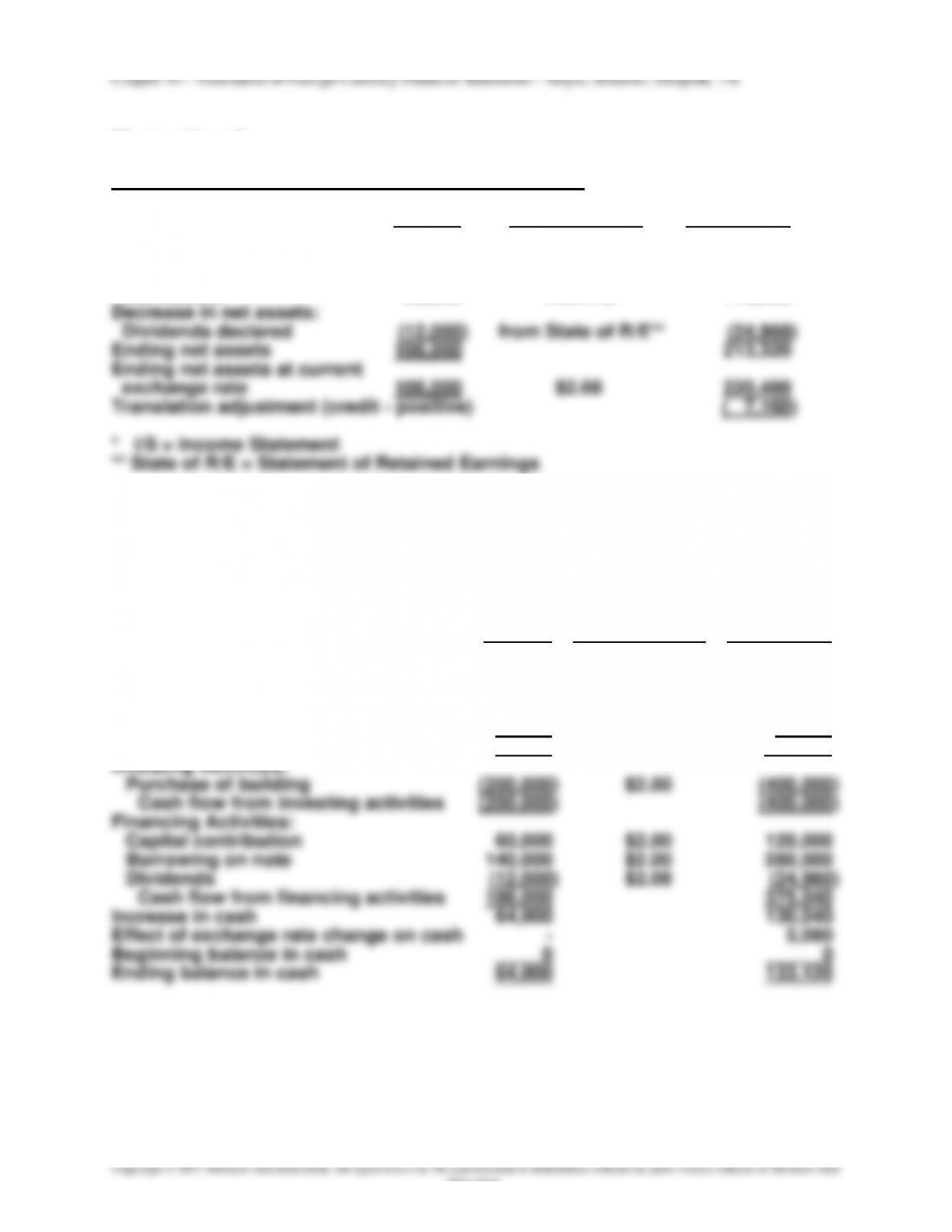
10-15
Education.
26. (continued)
Schedule A – Computation of Translation Adjustment
Pounds Exchange Rate U.S. Dollars
Beginning net assets –0- $2.00 -0-
Increase in net assets:
Contributed capital 60,000 $2.00 120,000
Net income 58,000 from I/S* 118,280
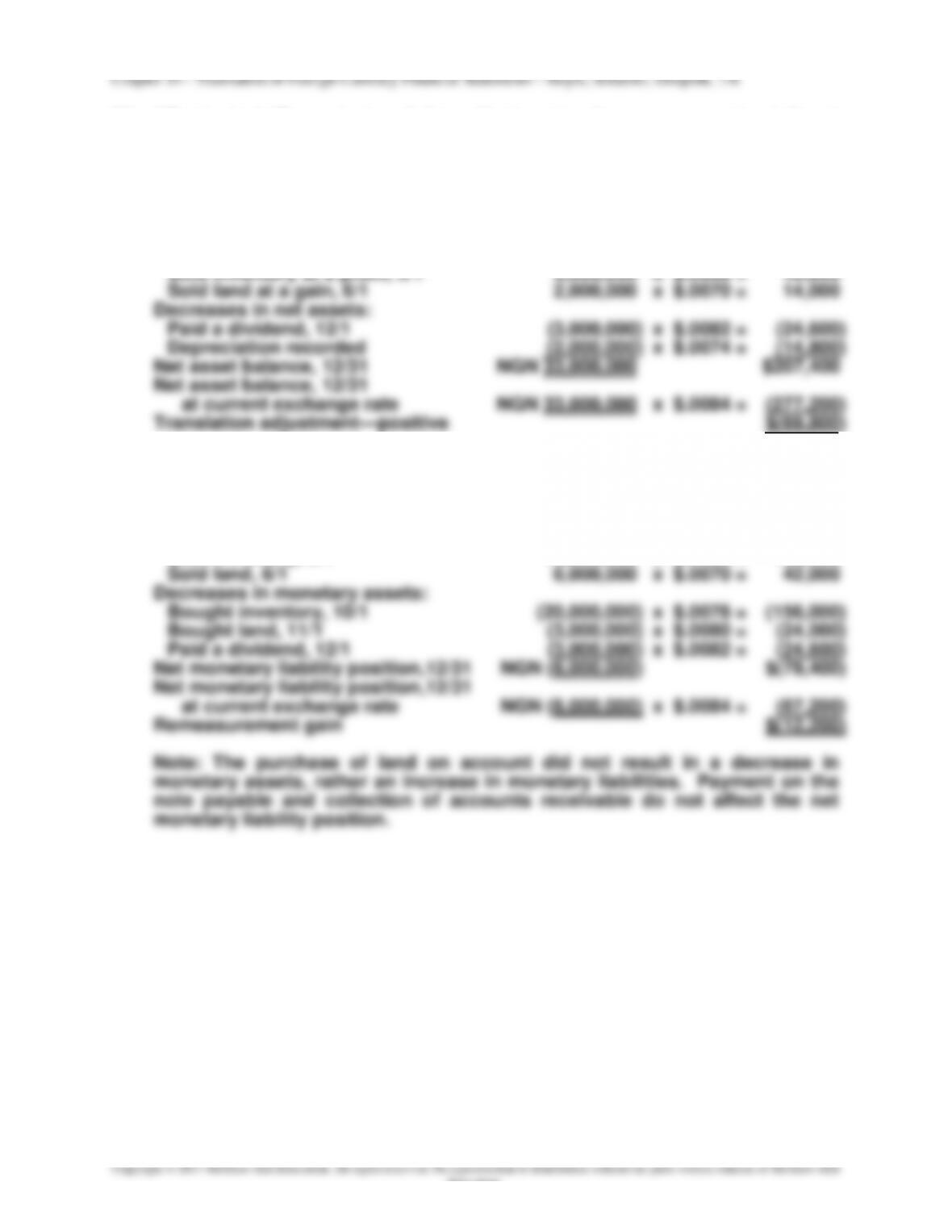
27. (30 minutes) (Prepare a statement of cash flows for a foreign subsidiary and
then translate it into U.S. dollars)
Sullivan’s Island Company
Statement of Cash Flows
Pounds Exchange Rate U.S. Dollars
Operating Activities:
Net income 58,000 from Problem 26 118,280
plus: Depreciation 20,000 $2.04 40,800
less: Increase in accounts receivable (16,000) $2.04 (32,640)
plus: Increase in interest payable 14,000 $2.04 28,560
Cash flow from operating activities 76,000 155,000
10-16
Education.
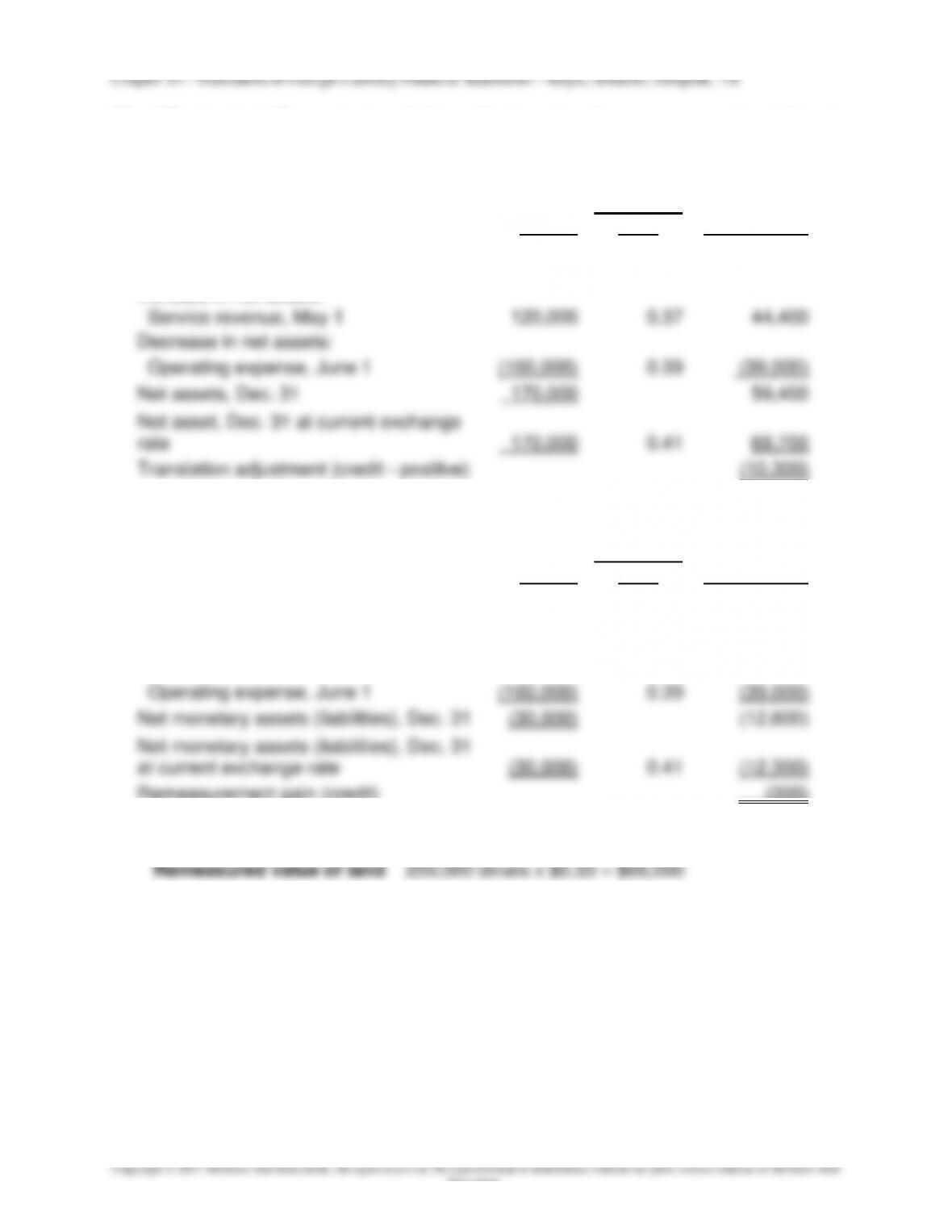
28. (25 minutes) (Compute translation adjustment and remeasurement gain/loss)
a. Translation—only changes in net assets have an impact on the computation
of the translation adjustment.
Net asset balance, 1/1 NGN 30,000,000 x $.0064 = $192,000
Increases in net assets (income):
Sold inventory at a profit, 5/1 6,000,000 x $.0068 = 40,800
b. Remeasurement—only changes in net monetary assets and liabilities have an
impact on the computation of the remeasurement gain.
Net monetary liability position, 1/1 NGN (4,000,000) x $.0064 = $(25,600)
Increases in monetary assets:
Sold inventory, 5/1 16,000,000 x $.0068 = 108,800
10-17
Education.
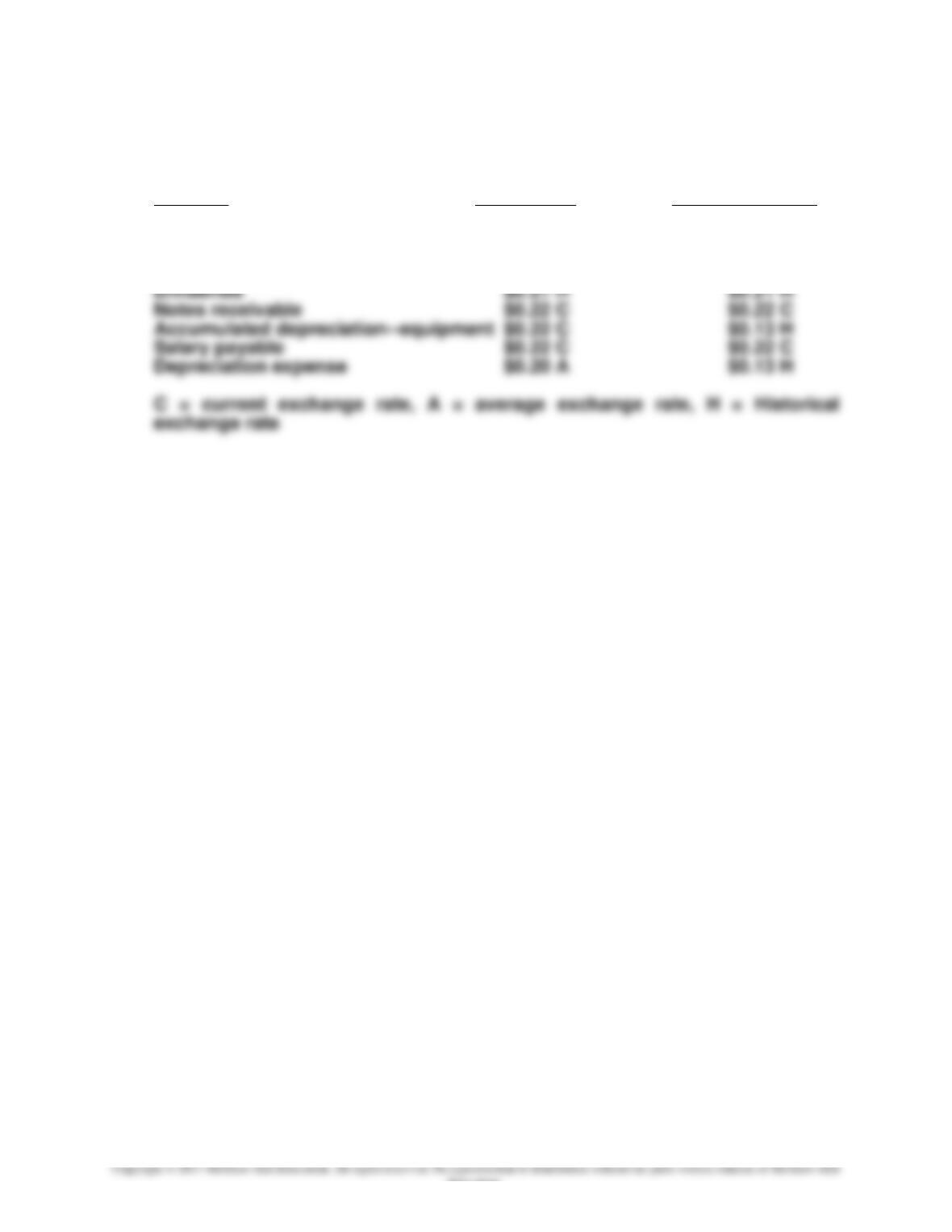
29. (20 minutes) (Compute translation adjustment and remeasurement gain/loss)
a. The translation adjustment is based on changes in the net assets of the
subsidiary.
Dinars
Exchange
Rate
U.S. Dollars
Net assets, Jan. 1
150,000
0.36
54,000
Increase in net assets:
Service revenue, May 1
120,000
0.37
44,400
Decrease in net assets:
Operating expense, June 1
(100,000)
0.39
(39,000)
Net assets, Dec. 31
170,000
59,400
Net asset, Dec. 31 at current exchange
rate
170,000
0.41
69,700
Translation adjustment (credit – positive)
(10,300)
b. The remeasurement gain or loss is based on changes in the net monetary
assets (liabilities) of the subsidiary.
Dinars
Exchange
Rate
U.S. Dollars
Net monetary assets (liabilities), Jan. 1
(50,000)
0.36
(18,000)
Changes in net monetary assets:
Service revenue, May 1
120,000
0.37
44,400
Operating expense, June 1
(100,000)
0.39
(39,000)
Net monetary assets (liabilities), Dec. 31
(30,000)
(12,600)
Net monetary assets (liabilities), Dec. 31
at current exchange rate
(30,000)
0.41
(12,300)
Remeasurement gain (credit)
(300)
c. Translated value of land 200,000 dinars x $0.41 = $82,000
Remeasured value of land 200,000 dinars x $0.33 = $66,000
Chapter 10 – Translation of Foreign Currency Financial Statements – Hoyle, Schaefer, Doupnik, 13e
10-18
Education.
30. (10 minutes) (Determine the appropriate exchange rate under the current rate
method [translation] and temporal method [remeasurement])
(a) Current Rate Method (b) Temporal Method
Account Translation Remeasurement
Sales $0.20 A $0.20 A
Inventory $0.22 C $0.19 H
Equipment $0.22 C $0.13 H
Rent expense $0.20 A $0.20 A
10-19
Education.
31. (30 minutes) (Determine translation adjustment; prepare journal entries for
forward contract hedge of balance sheet exposure; determine amount to be
reported in accumulated other comprehensive income)
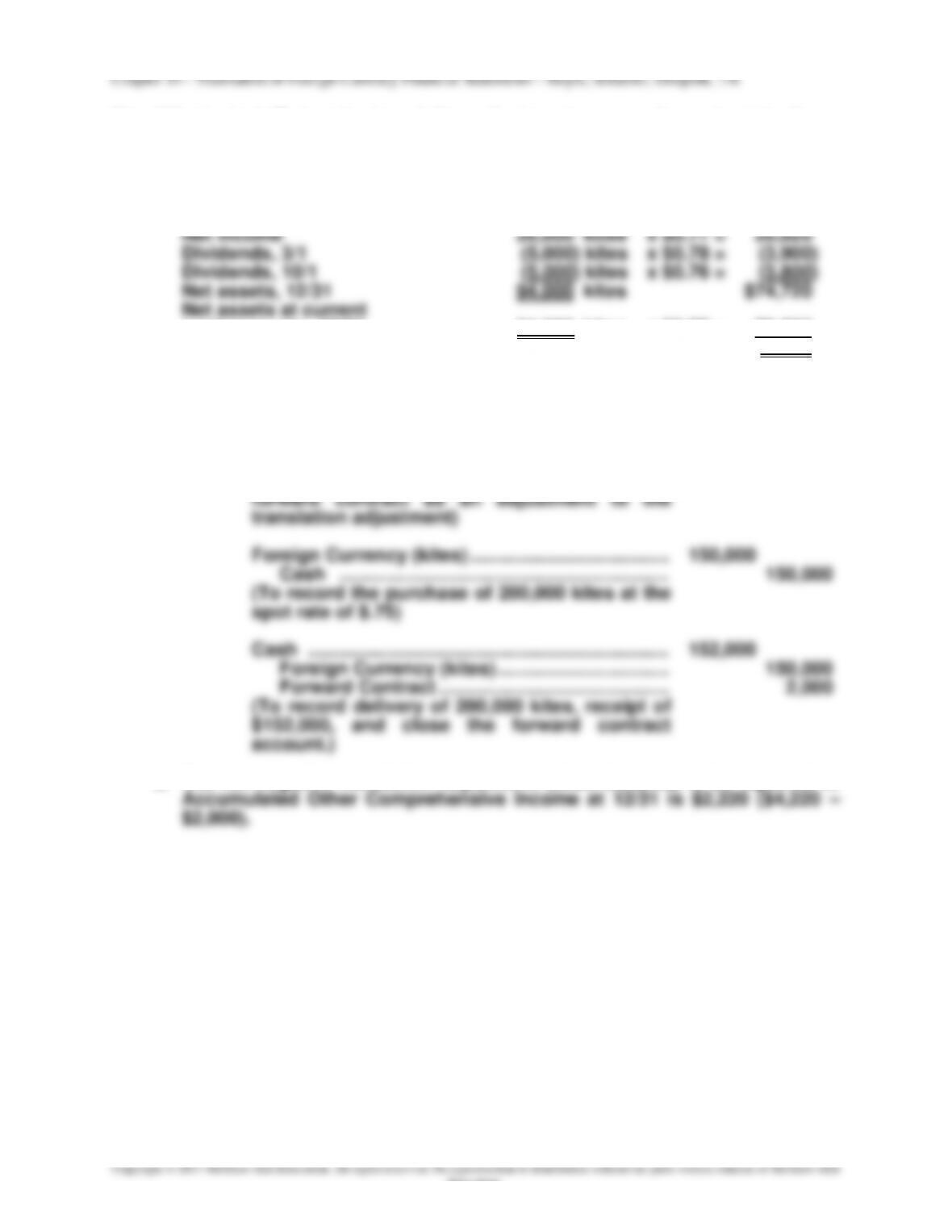
a. Net assets, 1/1 (132,000 – 54,000) 78,000 kites x $0.80 = $62,400
Change in net assets:
exchange rate, 12/31 94,000 kites x $0.75 = 70,500
Translation adjustment (negative) $ 4,220
b. Forward contract journal entries
10/1 No entry
12/31 Forward Contract………………………………………….. 2,000
Translation Adjustment (positive) …………….. 2,000
(To record the change in the value of the
c. The net negative translation adjustment (debit balance) to be reported in
Chapter 10 – Translation of Foreign Currency Financial Statements – Hoyle, Schaefer, Doupnik, 13e
10-20
Education.
32. (45 minutes) (Translation and remeasurement of foreign subsidiary trial
balance)
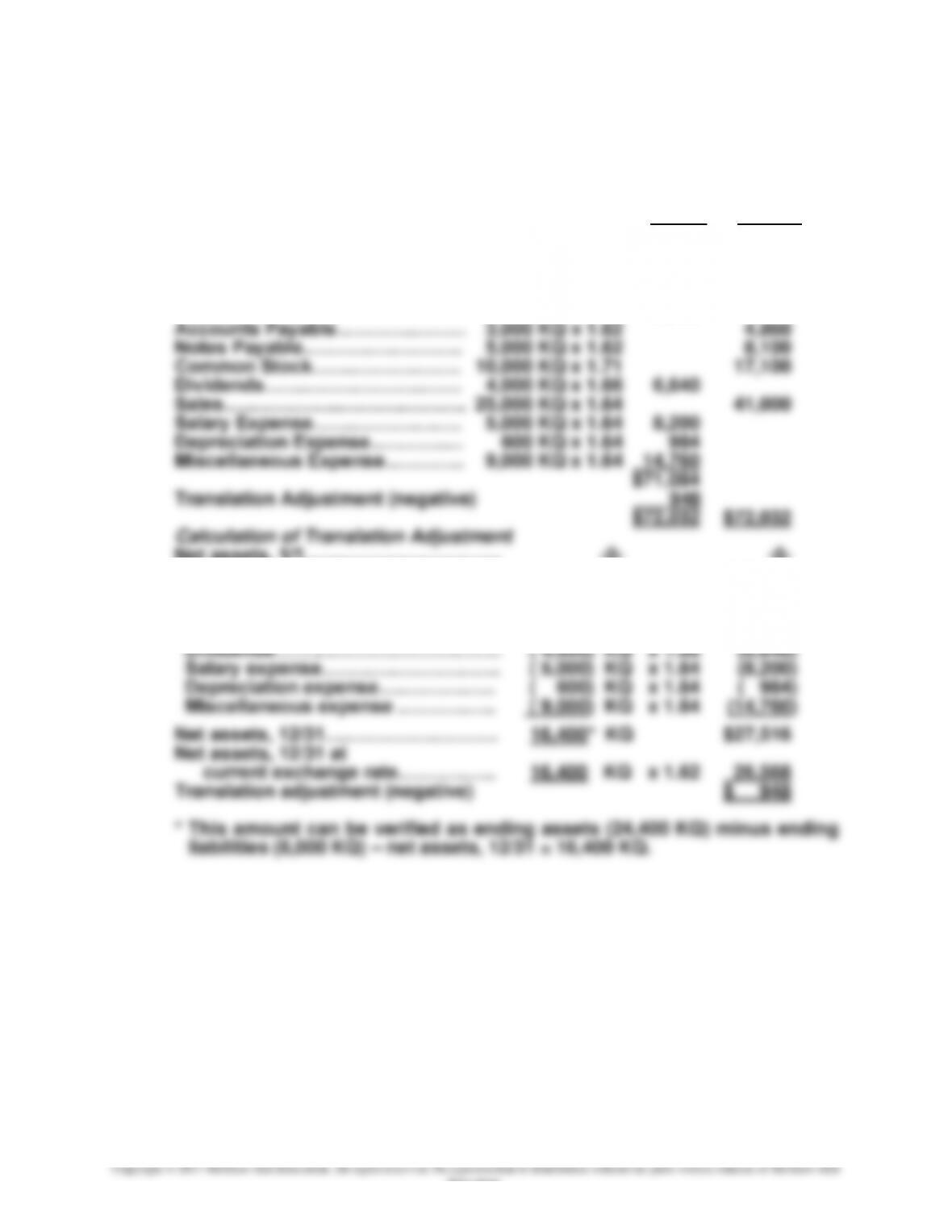
a. Translation of Subsidiary Trial Balance
Debits Credits
Cash…………………………………. 8,000 KQ x 1.62 $12,960
Accounts Receivable…………….. 9,000 KQ x 1.62 14,580
Equipment………………………….. 3,000 KQ x 1.62 4,860
Accumulated Depreciation……… 600 KQ x 1.62 $ 972
Land………………………………… 5,000 KQ x 1.62 8,100
Net assets, 1/1………………………….. -0- -0-
Increase in net assets:
Common stock issued………………. 10,000 KQ x 1.71 $17,100
Sales……………………………………. 25,000 KQ x 1.64 41,000
Decrease in net assets: