Chapter 01 – The Equity Method of Accounting for Investments – Hoyle, Schaefer, Doupnik, 13e
1-20
26. (20 Minutes) (Equity method including prospective application; Allocate
investment cost and calculate amortization expense; Fair-value accounting)
Part a
Allocation and annual amortization—12/31/17
Purchase price of 25% interest ………………………………………….. $95,000
Carrying amount of 5% interest (5% × $380,000)…………………. 19,000
Total fair value of Akron’s investment in Zip …………………. 114,000
Net book value ($290,000 × 30%) …………………………..…………… (87,000)
Franchise agreements ………………………………………………………. $27,000
Remaining life of franchise agreements …………………………….. ÷ 10 years
Annual amortization …………………………………………………….. $ 2,700
1. Equity Income—2018
2. Investment in Zip account
December 31, 2017 total fair value ……………………………………… $114,000
Part b
1. Dividend income (30% × 15,000) ……………………………………….. $ 4,500
2. Investment in Zip (30% × 480,000) ……………………………………… $144,000
1-21
Education.
27. (30 minutes) (Equity method, sale of investment, and intra-entity gross profit)
Part a
Allocation and annual amortization
Purchase price of 30 percent interest ………………………………… $312,000
Net book value ($800,000 × 30%) ……………………………………. (240,000)
Copyright …………………………………………………………………………. $ 72,000
Equity income 2018
2018 basic equity income accrual ($230,000 × 30%) ……………. $69,000
2018 excess fair over book value amortization (above)……….. (4,500)
Equity income 2018 ……………………………………………………………….. $64,500
Part b
Investment in Sheffield
Purchase price—January 1, 2017 ……………………………………………. $312,000
2017 equity income (above) ………………………………………………. 49,500
Chapter 01 – The Equity Method of Accounting for Investments – Hoyle, Schaefer, Doupnik, 13e
1-22
Education.
Problem 27 continued:
Part c
2017 intra-entity gross profit to be recognized in 2018
Ending inventory ………………………………………………………………. $20,000
Gross profit percentage ($20,000 ÷ $50,000) ………………………. × 40%
Intra-entity gross profit deferred …………………………………… $ 5,400
Equity Income—2018
2018 equity income (part a above) ……………………………………… $64,500
1-23
Education.
28. (25 Minutes) (Preparation of journal entries for two years, includes losses and
intra-entity transfers of inventory)
Journal Entries for Harper Co.
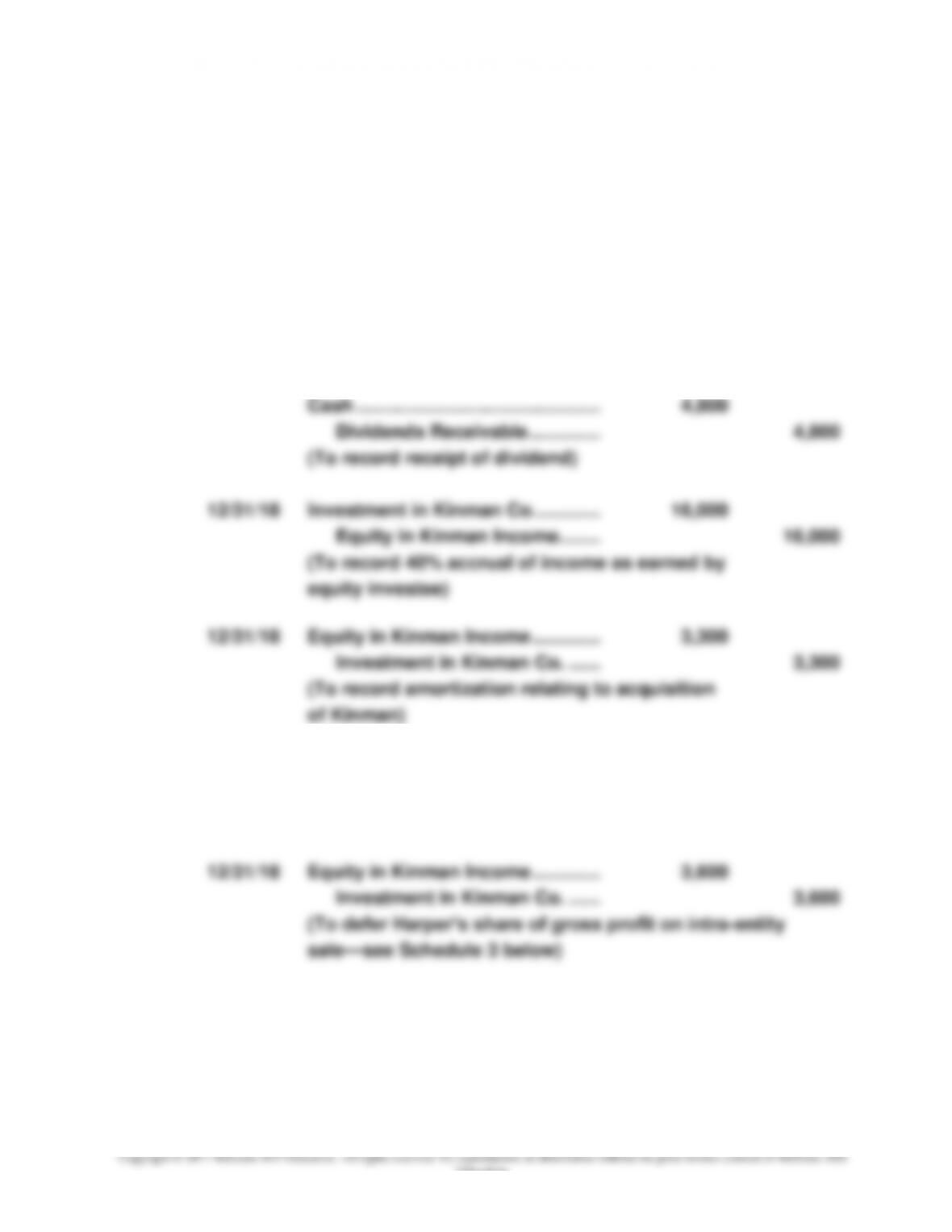
1/1/17 Investment in Kinman Co. ………… 210,000
Cash…………………………………… 210,000
(To record initial investment)
12/31/17 Equity in Kinman Income .. 16,000
Other Comprehensive Loss of Kinman 8,000
Investment in Kinman Co. …… 24,000
(To record accrual of income and OCI from
equity investee, 40% of reported balances)
Chapter 01 – The Equity Method of Accounting for Investments – Hoyle, Schaefer, Doupnik, 13e
1-24
Education.
28. (continued)
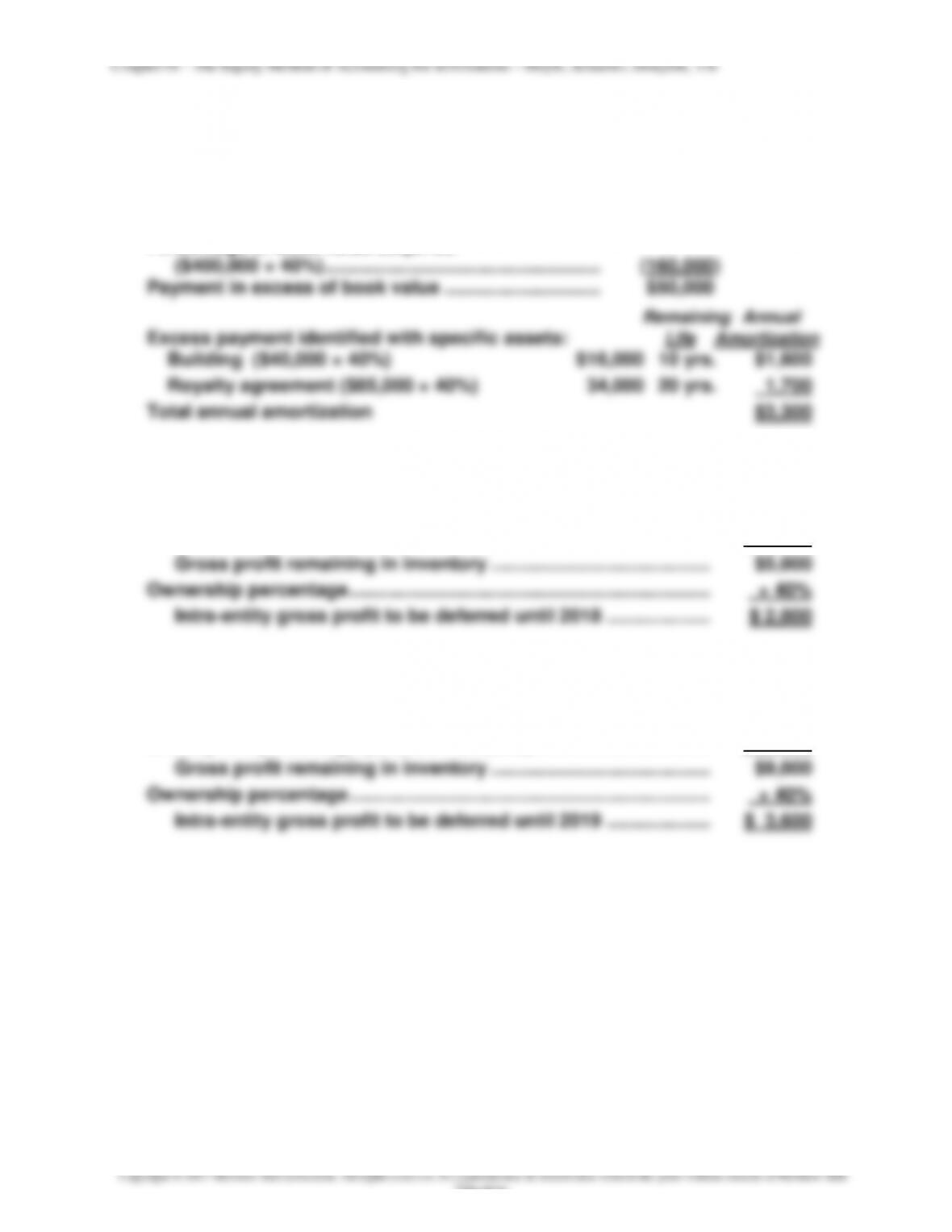
12/31/17 Equity in Kinman Income …………. 2,000
Investment in Kinman Co. …… 2,000
(To defer Harper’s share of gross profit on intra-entity
sale, see Schedule 2 below)
During Dividends Receivable ………………. 4,800
2018 Investment in Kinman Co. …… 4,800
(To record dividend declaration: $12,000 x 40%)
12/31/18 Investment in Kinman Co. ………… 2,000
Equity in Kinman Income …….. 2,000
(To recognize income deferred from 2017)
1-25
Education.
28. (continued)
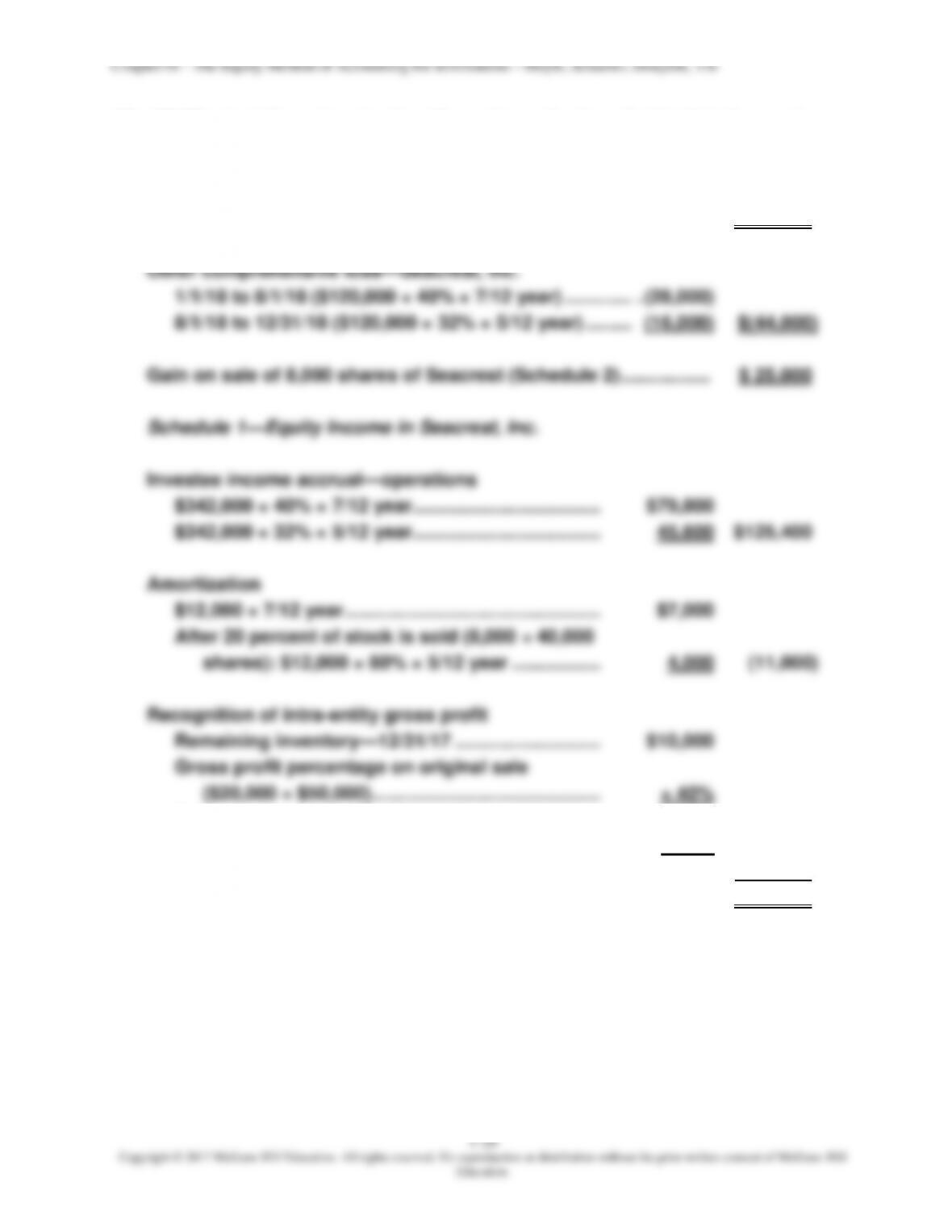
Schedule 1—Allocation of Purchase Price and Related Amortization
Purchase price ……………………………………………….. $210,000
Percentage of book value acquired
Schedule 2—Deferral of Intra-entity Gross Profit—2017
Inventory remaining at end of year …………………………………………. $15,000
Gross profit percentage ($30,000 ÷ $90,000) ……………………………. × 33⅓%
Schedule 3—Deferral of Intra-entity Gross Profit—2018
Inventory remaining at end of year (30%)…………………………..……. $24,000
Gross profit percentage ($30,000 ÷ $80,000) ……………………………. × 37½%
Chapter 01 – The Equity Method of Accounting for Investments – Hoyle, Schaefer, Doupnik, 13e
1-28
Education.
30. (continued)
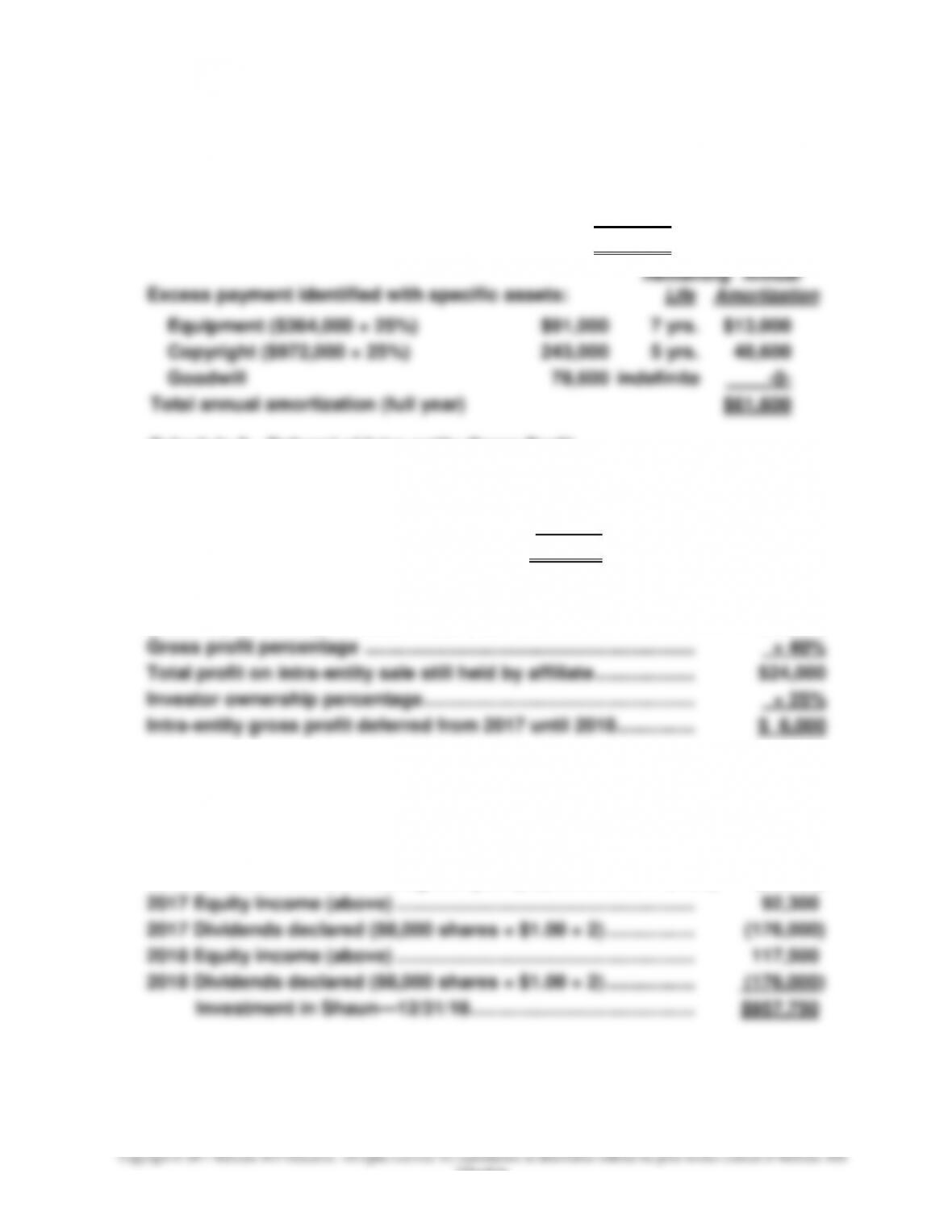
Schedule 1—Acquisition Price Allocation and Amortization
Acquisition price (88,000 shares × $13) $1,144,000
Book value acquired ($2,925,600 × 25%) 731,400
Payment in excess of book value $412,600
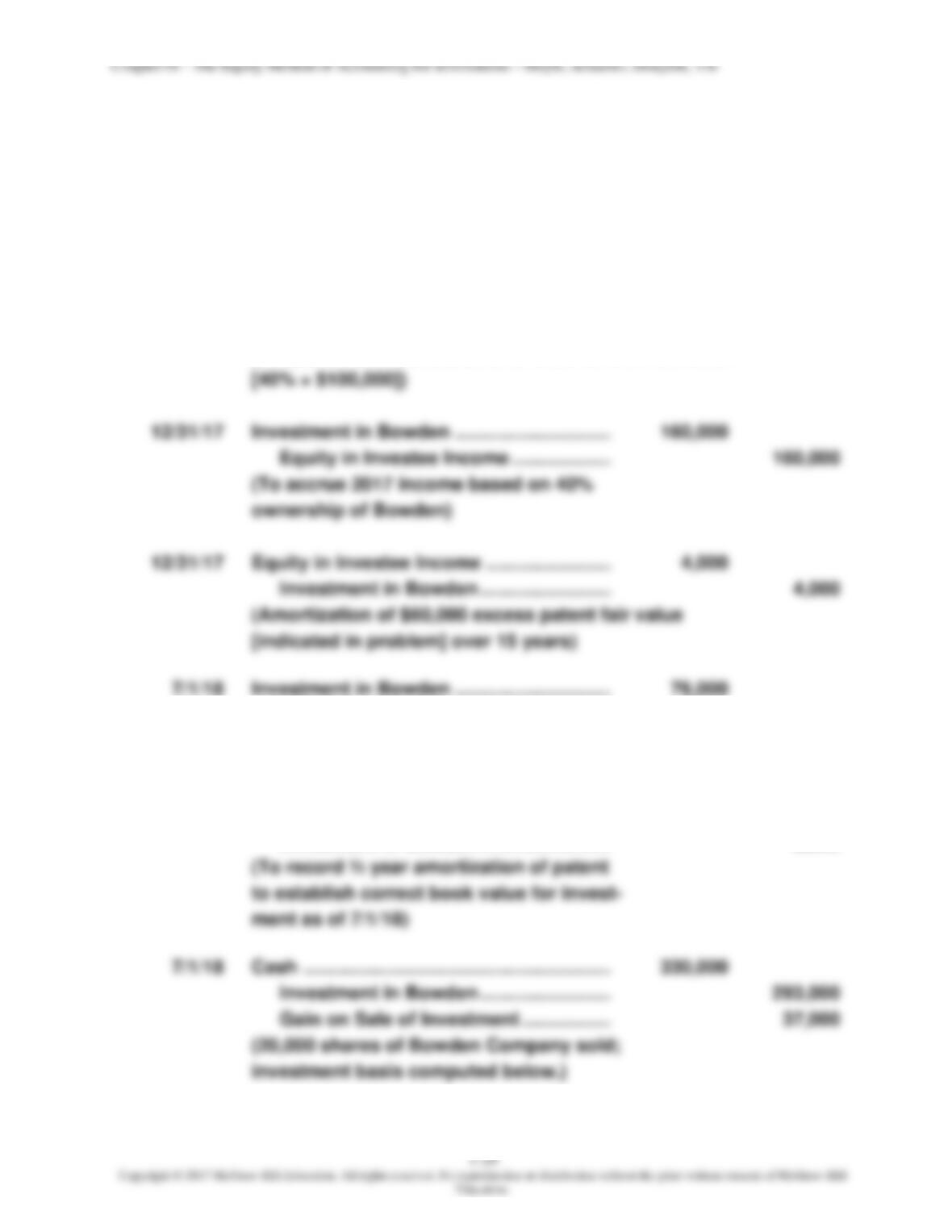
Schedule 2—Deferral of Intra-entity Gross Profit
Intra-entity Gross Profit Percentage:
Sales $152,000
Cost of goods sold 91,200
Gross profit $ 60,800
Gross profit percentage: $60,800 ÷ $152,000 = 40%
Inventory remaining at December 31, 2017 …………………………... $60,000
Part b.
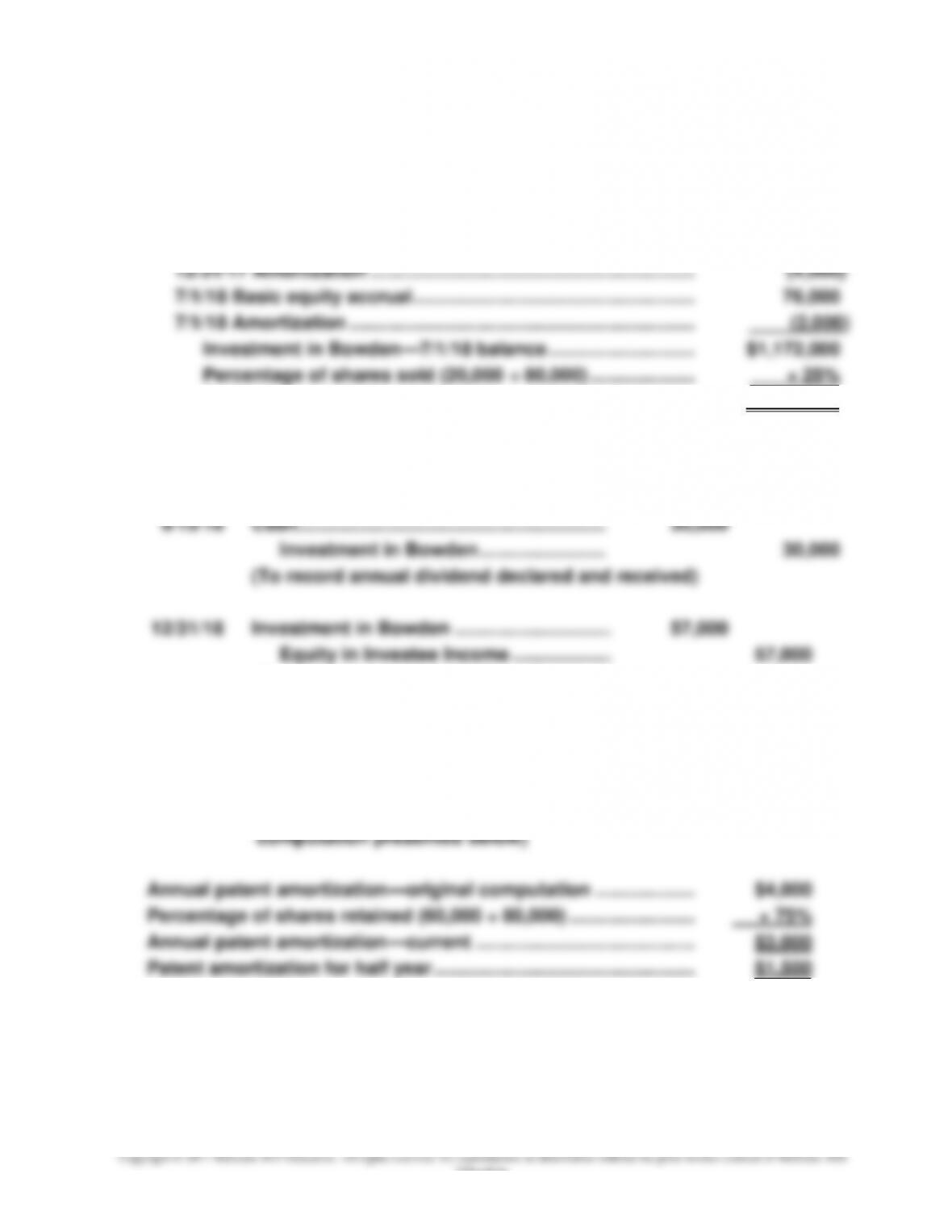
Investment in Shaun—December 31, 2018 balance
Acquisition price ………………………………………………………………… $1,144,000
2016 Equity income (above) …………………………..……………………. 43,950
2016 Dividends declared during half year (88,000 shares × $1.00) (88,000)
Chapter 01 – The Equity Method of Accounting for Investments – Hoyle, Schaefer, Doupnik, 13e
1-30
Education.
31. (continued)
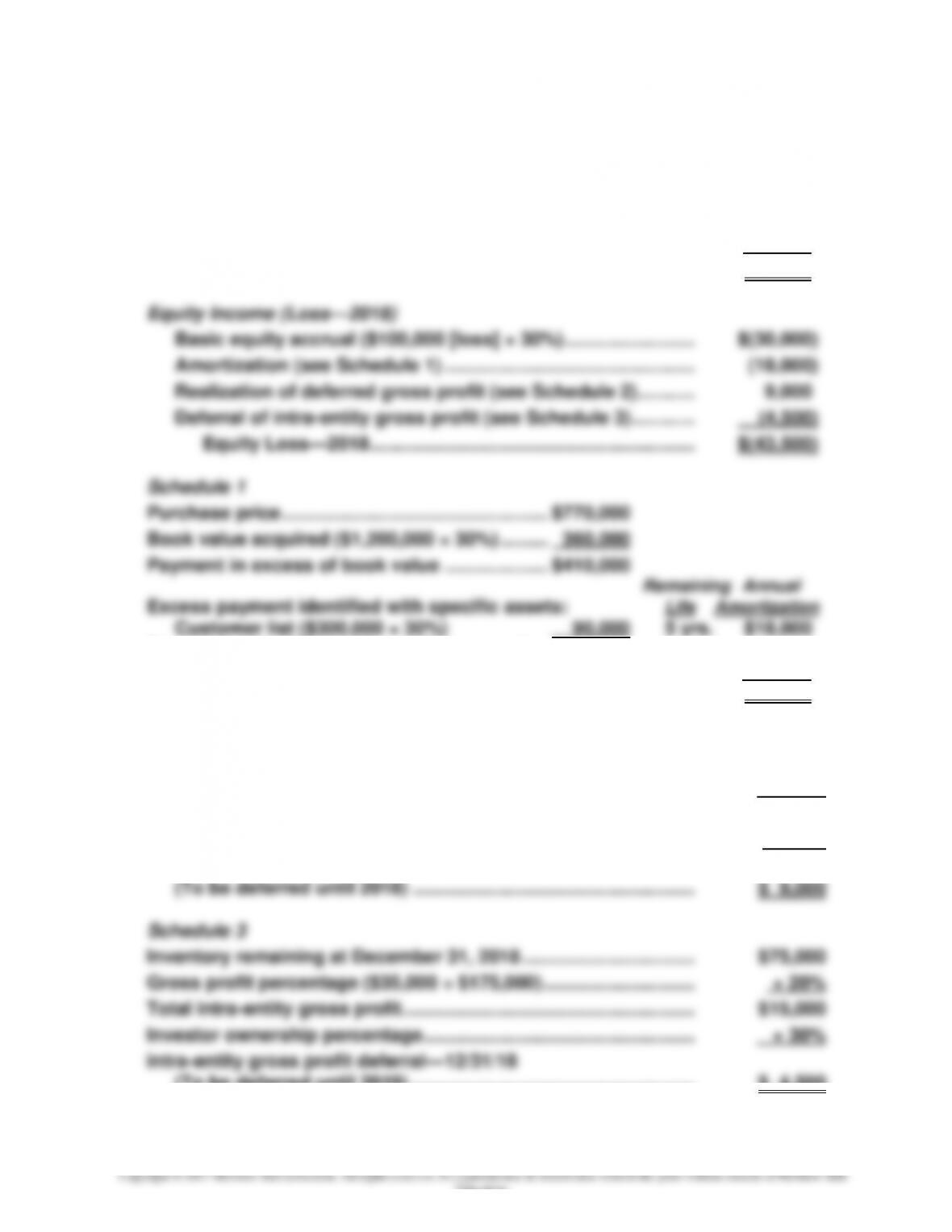
Investment in Bowden and cost of shares sold:
1/1/17 Acquisition ……………………………………………………….…. $ 982,000
9/15/17 Dividends ……………………………………………………….….. (40,000)
12/31/17 Basic equity accrual …………………………..……………… 160,000
Carrying amount of shares sold …………………………………. $ 293,000
Because 20,000 of 80,000, or ¼, of shares are sold, the percentage retained is
¾ of 40% = 30%.
(To record ½ year income based on
remaining 30% ownership: $380,000 × 1/2 × 30%)
12/31/18 Equity in Investee Income …………………… 1,500
Investment in Bowden ……………………. 1,500
(To record ½ year of patent amortization—
Chapter 01 – The Equity Method of Accounting for Investments – Hoyle, Schaefer, Doupnik, 13e
1-31
Education.
32. (25 Minutes) (Equity income balances for two years, intra-entity transfers)
Equity Income 2017
Basic equity accrual ($250,000 × 30%) …………………………….. $75,000
Amortization (see Schedule 1) ………………………………………… (18,000)
Deferral of intra-entity gross profit (see Schedule 2) ………… (9,000)
Equity Income—2017 …………………………………………………. $48,000
Excess not identified with specific accounts
Goodwill $320,000 indefinite –0-
Total annual amortization $18,000
Schedule 2
Inventory remaining at December 31, 2017 …………………………... $80,000
Gross profit percentage ($60,000 ÷ $160,000) ……………………….. × 37½%
Total intra-entity gross profit ……………………………………………….. $30,000
Investor ownership percentage ……………………………………………. × 30%
Intra-entity gross profit deferral—12/31/17
(To be deferred until 2019) ……………………………………………… $ 4,500
Chapter 01 – The Equity Method of Accounting for Investments – Hoyle, Schaefer, Doupnik, 13e
1-32
Education.
Solutions to Develop Your Skills
Excel Assignment No. 1 (less difficult)—see textbook Website for the Excel file solution
Parts 1, 2 and 3
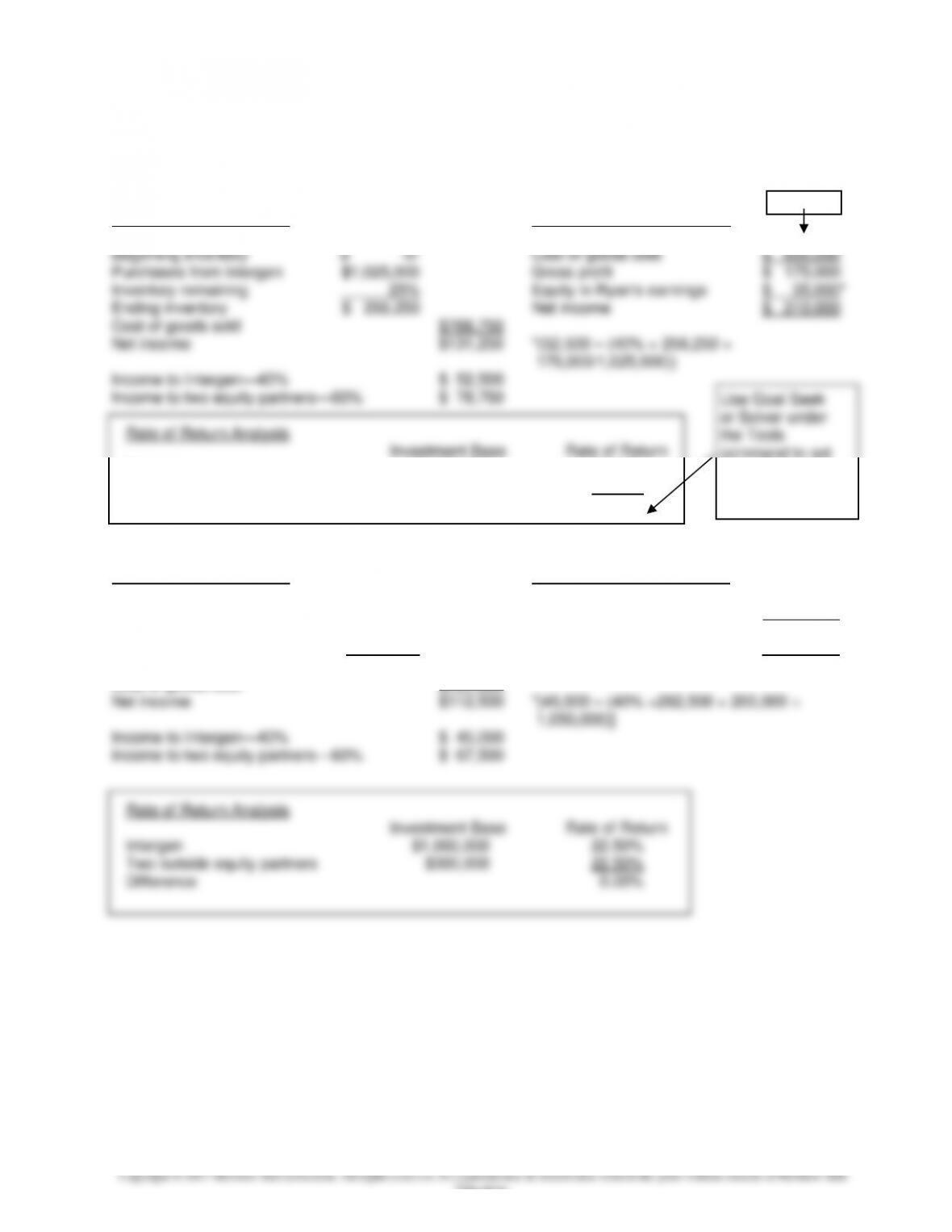
Growth rate in income 10%
Dividends $30,000
Cost $700,000 (given in problem)
Annual amortization $15,000
1st year PHC income $185,000
Percentage owned 40%
ROI 8.43% 8.89% 9.30% 9.66% 9.98%
Average 9.25%
Part 3
Growth rate in income 10%
Dividends $30,000
Cost $639,794 (Determined through Solver
under Tools command)
Annual amortization $15,000
1st year PHC income $185,000
Percentage owned 40%
PHC reported income $74,000 $81,400 $89,540 $98,494 $108,343
Chapter 01 – The Equity Method of Accounting for Investments – Hoyle, Schaefer, Doupnik, 13e
1-33
Education.
Excel Assignment No. 2 (more difficult)—see textbook Website for the Excel file solution
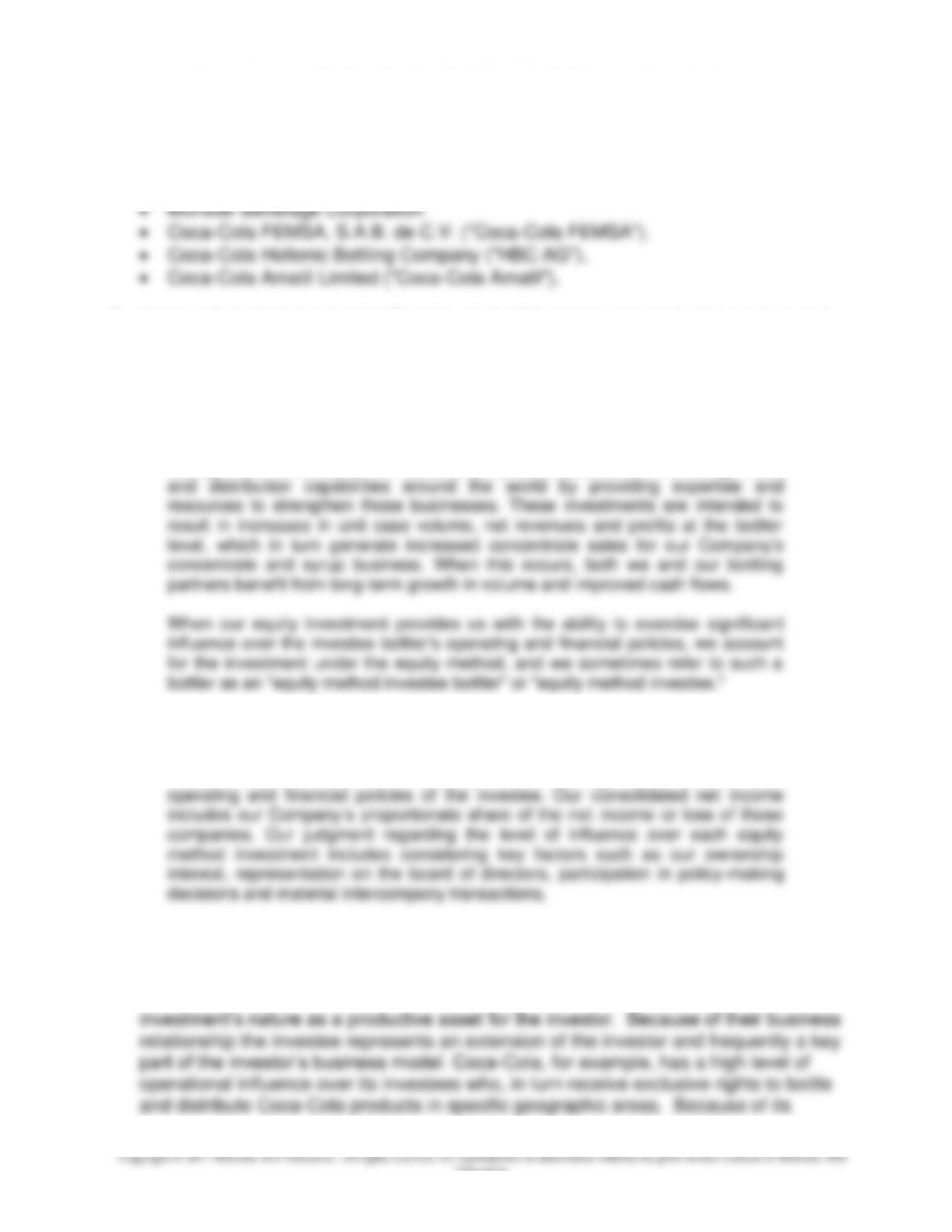
Intergen’s ownership percentage of Ryan 40% Intra-entity Transfer Price = $1,025,000
Cell F4
Ryan’s Income Statement Intergen’s Income Statement
Sales $900,000 Sales $1,025,000
Intergen $1,000,000 21.00%
Two outside equity partners $300,000 26.25%
Difference -5.25%
Intergen’s ownership percentage of Ryan = 40% Intra-entity Transfer Price = 1,050,000
Ryan’s Income Statement Intergen’s Income Statement
Sales $900,000 Sales $1,050,000
Beginning inventory $ -0- Cost of goods sold $ 850,000
Purchases from Intergen $1,050,000 Gross profit $ 200,000
Inventory 25% Equity in Ryan‘s earnings $ 25,000*
Ending inventory $ 262,500 Net income $ 225,000
Cost of goods sold $787,500
Cell D20 to zero
by changing Cell
F4
Chapter 01 – The Equity Method of Accounting for Investments – Hoyle, Schaefer, Doupnik, 13e
1-34
Education.
Solution to Coca-Cola Company Analysis Case
1. In its 2015 10-K, Coca-Cola lists the following companies among its significant equity
method investees:
2. As part of strategic business alliances, each of these companies bottle, market, and
distribute Coca-Cola’s products in various designated geographic areas throughout
the world, thus generating substantial revenues for the Coca-Cola Company.
According to Coca-Cola’s 2015 annual report (page 7),
…from time to time we make equity investments representing noncontrolling
interests in selected bottling operations with the intention of maximizing the
strength and efficiency of the Coca-Cola system‘s production, marketing, sales
3. From the Coca-Cola Company’s 2012 10-K report (page 81),
We use the equity method to account for investments in companies, if our
investment provides us with the ability to exercise significant influence over
4. 2015 equity income = $489 million.
5. In general, the equity method provides cost-based values while fair values provide
exit-based values. The relevance of the equity method valuation derives from the
Chapter 01 – The Equity Method of Accounting for Investments – Hoyle, Schaefer, Doupnik, 13e
1-35
Education.
RESEARCH AND ANALYSIS CASE—IMPAIRMENT
1. Paragraph 323-10–35-32 of the FASB ASC states that
A loss in value of an investment which is other than a temporary decline
shall be recognized. Evidence of a loss in value might include, but would
not necessarily be limited to, absence of an ability to recover the carrying
2. Given the facts in the case, a very good case can be made that the decline in value
3. No, according to FASB ASC para. 350–20–35-59, the equity method investment as a
Chapter 01 – The Equity Method of Accounting for Investments – Hoyle, Schaefer, Doupnik, 13e
1-36
Education.
Research Case Solution — Noncontrolling Shareholder Rights
1. Protective Rights (ASC Topic 810, Consolidation 810–10–25–10)
Noncontrolling rights (whether granted by contract or by law) that would allow the
noncontrolling shareholder to block corporate actions would be considered
protective rights and would not overcome the presumption of consolidation by the
investor with a majority voting interest in its investee. The following list is illustrative
e. Issuance or repurchase of equity interests.
2. Substantive Participating Rights (ASC Topic 810, Consolidation 810-10–25-11)
Noncontrolling rights (whether granted by contract or by law) that would allow the
noncontrolling shareholder to participate in determining certain financial and
operating decisions in the ordinary course of business shall be considered
3. (FASB ASC Topic 810, Consolidation 810-10–25–11)
Substantive participating rights would overcome the presumption that the investor
with a majority voting interest shall consolidate its investee. The following list is
illustrative of substantive participating rights, but is not necessarily all-inclusive:
Chapter 01 – The Equity Method of Accounting for Investments – Hoyle, Schaefer, Doupnik, 13e
1-37
Education.
4. Assessing Individual Noncontrolling Rights (FASB ASC Topic 810, Consolidation
810–10–55–1 b and c)
b. Existing facts and circumstances should be considered in assessing whether
the rights of the noncontrolling shareholder relating to an investee’s incurring
additional indebtedness are protective or participating rights. For example, if it is
reasonably possible or probable that the investee will need to incur the level of