International Business
Geringer, McNett, Minor, Ball
Instructor Guide to Module 11
27 Instructor’s Manual – Module 11 | Geringer, McNett, Minor, Ball © 2016 by McGraw-Hill Education.
This is proprietary material solely for authorized instructor use. Not authorized for sale or distribution in any manner. This
document may not be copied, scanned, duplicated, forwarded, distributed, or posted on a website, in whole or part.
3. Current events for sources of content on global leadership
BACK TO
MAIN PAGE

International Business
Geringer, McNett, Minor, Ball
Instructor Guide to Module 11
TEACHING SUGGESTIONS
1. This module involves a topic that everyone is likely to understand on at least a conceptual
level, but that many or most students will have limited direct experience with, so helping
learners appreciate the nature the global leader’s role and required skills can provide them with
a new approach to thinking about leadership. Highlighting the difference between domestic
and global leadership, and between leadership and management, can be particularly valuable
for generating learning and insight. The use of the models and examples from the module is
helpful. Examples of the importance of developing global leadership skills and the challenges
confronted by global managers abound in current business news. It can be useful to pick one or
two recent events and then have students discuss whether and how such events might impact
the performance of an international company operating in that industry or closely associated
with the industry or activity.
2. Analyze the similarities and differences associated with leading traditional teams and
global teams. Then move to the implications of differences in terms of what needs to be done,
why, and how, and therefore the different skills that a global leader might need in order to be
successful in such a situation.
3. The issue of women serving as global leaders is almost guaranteed to draw the interest of
students, so discussing statistics about the prevalence of women as leaders in international
corporations, as well as the relative fit between typical traits of female versus male leaders and
the requirements of global leadership positions, can help to stimulate discussion and
exploration of the material. Having students do research on the topic prior to class and then
report back to the class can be valuable for stimulating deeper discussion. Exploring how
culture and other institutional forces might impact the likelihood of women moving into global
leadership roles can also be insightful for students, particularly if students are assigned to
research different cultures and the extent to which women are accepted as leaders.
4. Guest Lecturer possibilities: Some people who could contribute to the material in this
module would be:
a. Administrators from the United Nations or other nongovernmental organizations.
b. Executives from international divisions of major companies, who can discuss the
leadership challenges they face within and across different nations.
c. You might bring such speakers in “virtually” through the use of technology–mediated
tools such as Skype, Adobe Connect, FaceTime, or the like.
International Business
Geringer, McNett, Minor, Ball
Instructor Guide to Module 11
CONNECT TOOLS FOR ASSESSEMENT OF LEARNI NG
Interactive Applications
Assigning Interactives
Consider assigning only 2 interactives per chapter. Interactive applications allow students to see
concepts in practice and assess higher order thinking skills. There are numerous exercises of
different types available. Click’n’drag, video cases, and case analysis are the types you will see
most frequently in this program.
Time-Saving Hints:
• Instructors may want to give students unlimited or multiple attempts on the first few
assignments so the students have a chance to learn and navigate the system before
selecting the option for one attempt only.
• The value of each question should probably be relatively low, since multiple questions
are usually assigned for each chapter. A good rule of thumb would be to make “Quiz
Questions” worth 1 point each and “Interactives” worth 5-10 points each since these
require more time and thought.
International Business
Geringer, McNett, Minor, Ball
Instructor Guide to Module 11
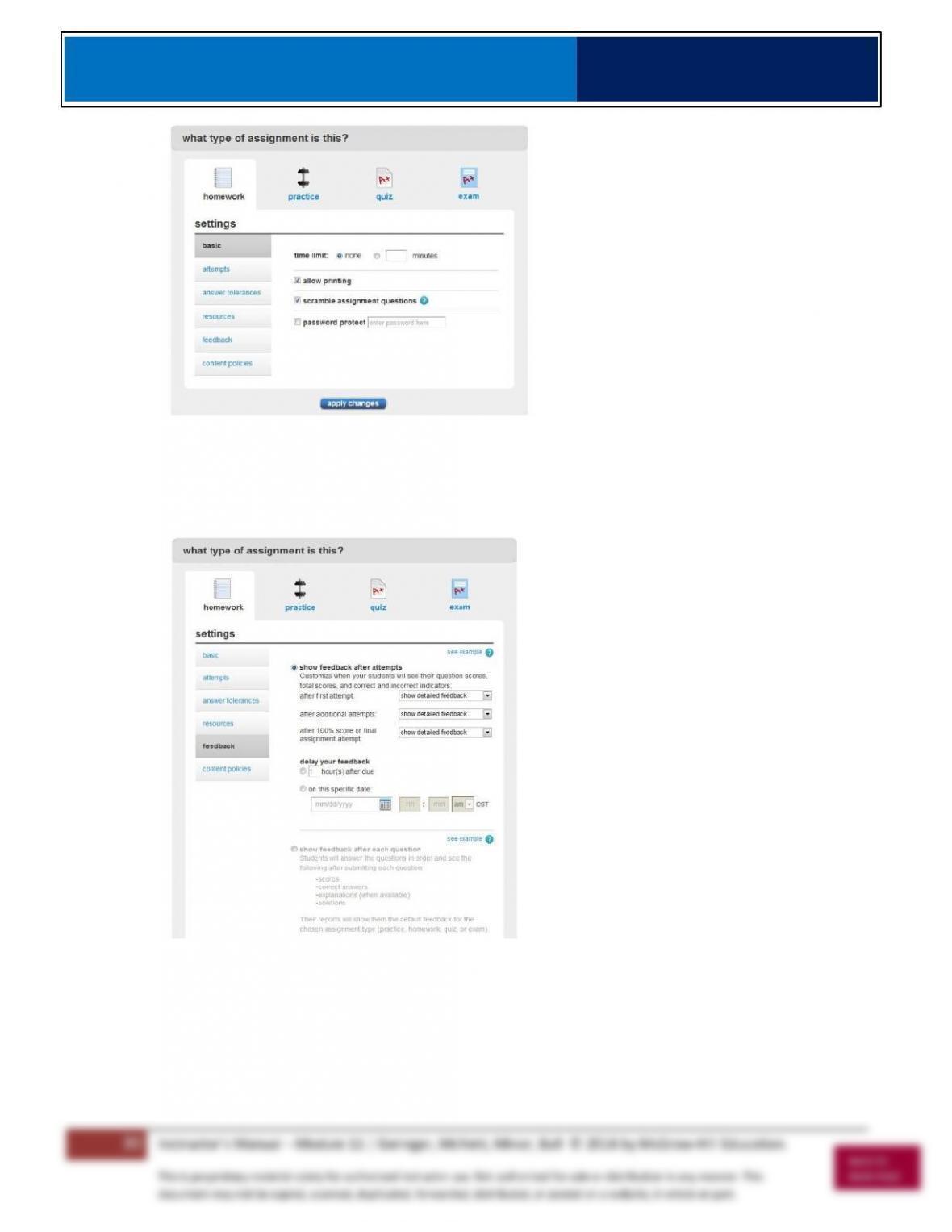
• Feedback given to students is time flexible. Selecting feedback to be displayed after the
assignment due date helps to limit students from giving the correct answers to other
students while the interactive is still available.
Connect Content Matrix
For every chapter, please refer to the Connect Content Matrix to see what application
exercises are available, what Learning Objectives they help reinforce/assess.

International Business
Geringer, McNett, Minor, Ball
Instructor Guide to Module 11
Module
Assignment
Type
Title
Topic(s)
Learning
Objective(s)
AACSB
Accreditation
Tagging
Bloom’s
Taxonomy
11
Self-Assessment
Global
Mindset
Global Mindset
11-01; 11-
02; 11-04
Analytical/
Reflective
thinking
Understand/
Analyze
11
Drag and Drop
Global
Leadership
Styles
Global
Leadership:
What It Is and
Why It Matters
11–02
Analytical/
Reflective
thinking
Understand/
Remember
11
Drag and Drop
Global
Leadership
Pyramid
Competencies
Required for
Effective
Global
Leadership
11–03
Analytical/
Reflective
thinking
Understand/
Remember
11
Video Case
Wolfensohn:
A Global
Leader?
Selecting and
Developing
Effective
Global Leaders
11-03; 11-
04
Analytical/
Reflective
thinking
Understand/
Analyze
11
Drag and Drop
Leading
Global Teams
Leading Global
Teams/Leading
Global Change
11-05; 11-
06
Analytical/
Reflective
thinking
Understand/
Analyze