
Page 7-1
prior written consent of McGraw-Hill Education.
CHAPTER 7
BUSINESS-GOVERNMENT RELATIONS
INTRODUCTION
Governments seek to protect and promote the public good and in these roles establish
rules under which business operates in society. Therefore, a government’s influence on
business through public policy and regulation is a vital concern for managers.
Government’s relationship with business can be either cooperative or adversarial.
Various economic or social assistance policies significantly affect society, in which
businesses must operate. Many government regulations also impact business directly.
Managers must understand the objectives and effects of government policy and
regulation, both at home and abroad, in order to conduct business in an ethical and legal
manner.
INTRODUCTORY CASES
Regulating Uber
Controlling the import of contaminated food
What prompted or compelled governments to become more involved in their citizens’
transportation options or the assurance of food safety? How do these government’s
actions affect businesses and what they are permitted to do? How did these actions affect
society and its safety? Did government’s involvement promote or harm companies or
allow other firms to maintain their competitive advantage? Were these efforts by the
governments necessary and effective, or can this only be answered in time?
Teaching Tip: Opening Cases
Both introductory cases, the regulation of Uber and the control over
the import of contaminated food, are ongoing issues. Students may
want to research recent updates to the cases or investigate how their
local, state or federal governments have handled these emerging cases.
There are numerous videos available through the Internet, such as
CNBC’s coverage of this topic, found at:
http://www.bing.com/videos/search?q=regulation+of+uber+videos&F
ORM=VIRE1#view=detail&mid=303554AD6AA515A820AC303554
AD6AA515A820AC
or how the City of New Orleans dealt with this issue, found at:
http://www.bing.com/videos/search?q=regulation+of+uber+videos&F
ORM=VIRE1#view=detail&mid=00FEBB144D135203181100FEBB1
44D1352031811.
Page 7-2
prior written consent of McGraw-Hill Education.
CHAPTER OUTLINE
I. HOW BUSINESS AND GOVERNMENT RELATE
A. Seeking a Collaborative Partnership
B. Working in Opposition to Government
C. Legitimacy Issues
II. GOVERNMENT’S PUBLIC POLICY ROLE
A. Elements of Public Policy
Teaching Tip: Opening Case – Contaminated Food
A highly critical CNN story on the import of contaminated food can be
found at:
http://www.bing.com/videos/search?q=import%20of%20contaminated
%20food%20videos&qs=n&form=QBVR&pq=import%20of%20conta
minated%20food%20videos&sc=0-16&sp=-
1&sk=#view=detail&mid=2095DF450D7BA16001372095DF450D7B
A1600137.
Teaching Tip: How Business-Government Relate
The proper role of government is always a matter of debate. Should
government take a pro-business (or collaborative partnership) or an
anti-business (or opposition to the government) role? A simple
exercise that can provoke some classroom enthusiasm is to split the
class into two teams – Pro-business Government and Anti-business
Government. Give one team thirty seconds to state one reason why its
approach is best. The other team can respond or offer its own point.
Allow the point/counterpoint to continue for several rounds. By
keeping a list on the board, this exercise will sharpen everyone’s sense
of what each approach offers.
Page 7-3
prior written consent of McGraw-Hill Education.
B. Types of Public Policy
Economic policies
Social assistance policies
III. GOVERNMENT REGULATION OF BUSINESS
A. Market Failure
Teaching Tip: Public Policy
New public policy issues abound frequently. This might afford an
opportunity to have students scan recent business periodicals or
magazines (e.g., BusinessWeek) to identify an emerging public policy
issue. There may be an issue that is relevant to your local community
or state. Students should be able to identify the various elements of
public policy in the issue they have discovered.
You might also challenge students to identify a public policy issue
emerging in another country. How is the public policy process
different across nations? Who are the major actors in the public policy
process in another country and how does this differ from the major
actors in your own country?
Teaching Tip: Social Assistance Policies
Social assistance policies, such as health care, are very important to
individuals and families. It is likely that the Obama Administration–
induced health care reform will remain an active controversial issue for
many years. Ask students to identify an elderly relative – such as a
grandparent or neighbor – or someone without health care insurance at
work. What is their opinion about health care reform, as compared to
someone who is covered through their employer?
Perhaps the issue of how much an employer should pay for an
employee’s health care will be a controversial issue for discussion or
debate. Or, is it acceptable that an employer hires a worker as a part-
time employee just to avoid paying for costly health care benefits
mandated by the U.S. federal government?

Page 7-4
D. Ethical Arguments
E. Types of Regulation
Economic regulations
Antitrust: A special kind of economic regulation
Social regulations
F. The Effects of Regulation
The costs and benefits of regulation
Continuous regulatory reform
Teaching Tip: Natural Monopolies
Students should be able to easily recognize natural monopolies – cable
television, electricity, railroads. Identify another common product or
service and have the students debate whether this could or should be a
monopoly, protected by the government from free competition.
Teaching Tip: Anti-trust – Microsoft in Europe
The “Microsoft anti–trust case in Europe” was explained in a video
found at:
http://www.bing.com/videos/search?q=antitrust%20action%20against
%20Microsoft%20in%20Europe%20videos&qs=n&form=QBVR&pq=
antitrust%20action%20against%20microsoft%20in%20europe%20vide
os&sc=0-0&sp=-
1&sk=#view=detail&mid=6139F32528628A06476C6139F32528628A
06476C.
This may be a good summary of the major issues in the case from a
variety of viewpoints.
Teaching Tip: How Much Regulation?
The issue of the costs of regulation is often a political one. Student
may locate political positions that favor or oppose large government.
Do the costs of regulation outweigh the benefits? Take a single
regulation and try to conduct a cost-benefit analysis to answer this
question.
Page 7-5
IV. REGULATION IN A GLOBAL CONTEXT
GETTING STARTED
KEY LEARNING OBJECTIVES
LO 7-1: Understanding why sometimes governments and business collaborate and
other times work in opposition to each other.
LO 7-2: Defining public policy and the elements of the public policy process.
LO 7-3: Explaining the reasons for regulation.
LO 7-4: Knowing the major types of government regulation of business.
Teaching Tip: “De–” or “Re–” Regulate?
The United States has experienced a cycle of deregulation, then
reregulation. Which part of this cycle are we current in, and are there
signs of moving into the next phase of this cycle? Which part of the
cycle is good for business – deregulation or reregulation? Is the answer
to this question industry-specific: “it depends on which industry is
being analyzed”?
Teaching Tip: International Regulatory Control
It seems reasonable to assume that some sort of regulatory control is
necessary. What happens when trade involves more than one country?
Can there be an international regulatory body? Does it already exist?
Students could discover and then investigate the organizations that
attempt to control international trade and then assess its achievements
as well as weaknesses.
Page 7-6
prior written consent of McGraw-Hill Education.
Regulation can take the form of laws affecting an organization’s economic operations
protection).
LO 7-5: Identifying the purpose of antitrust laws and the remedies that may be
imposed.
LO 7-6: Comparing the costs and benefits of regulation for business and society.
LO 7-7: Examining the conditions that affect the regulation of business in a global
context.
KEY TERMS AND CONCEPTS USED IN THE CHAPTER
antitrust laws
cost-benefit analysis
deregulation
Dodd-Frank Act
Page 7-7
prior written consent of McGraw-Hill Education.
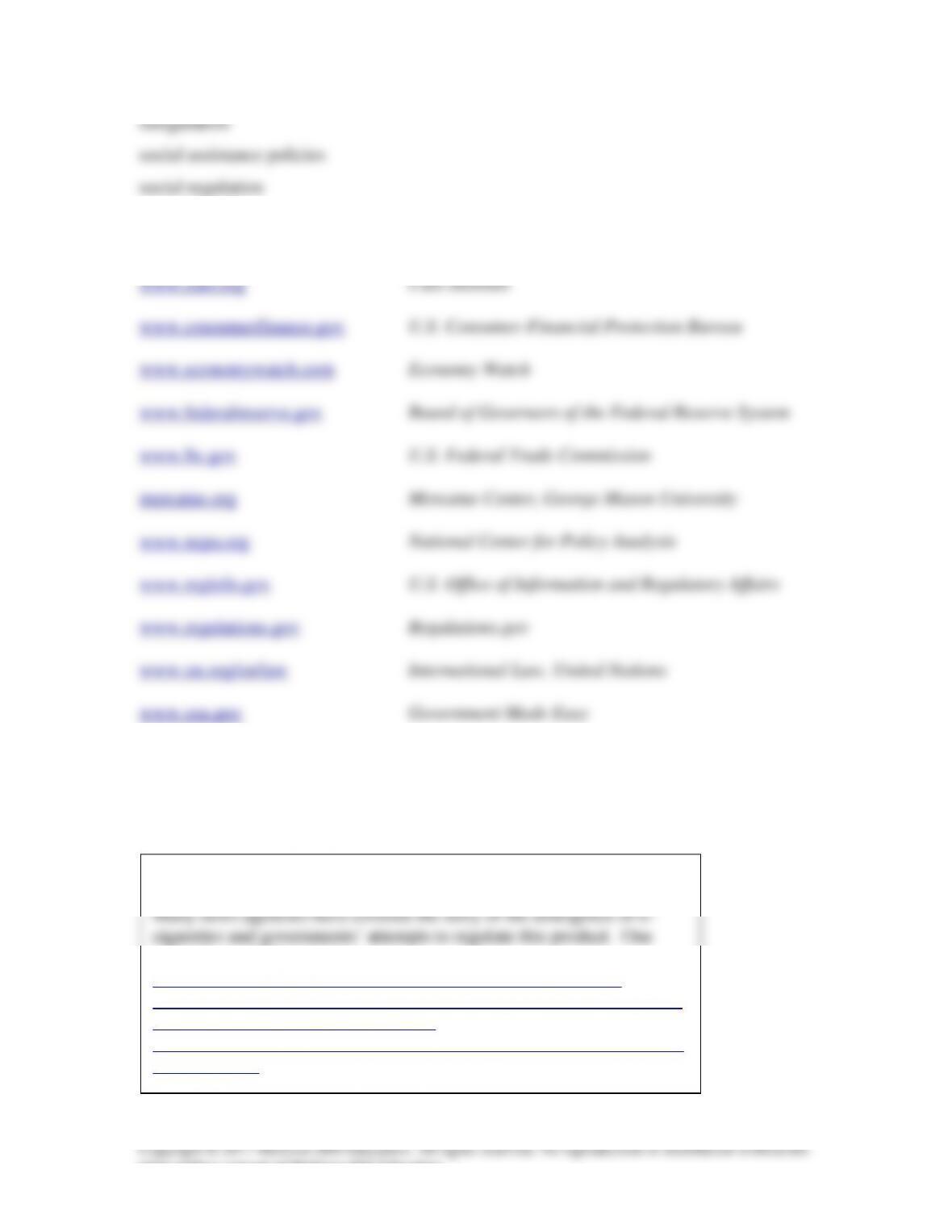
INTERNET RESOURCES
DISCUSSION CASE
SHOULD E-CIGARETTES BY REGULATED?
Teaching Tip: The Regulation of E-cigarettes
Many news agencies have covered the story of the emergence of e-
cigarettes and governments’ attempts to regulate this product. One
example can be found at:
http://www.bing.com/videos/search?q=regulation%20of%20e-
cigarettes%20videos&qs=n&form=QBVR&pq=regulation%20of%20e
-cigarettes%20videos&sc=0-21&sp=-
1&sk=#view=detail&mid=B335C3A4CD8FAD67E5E4B335C3A4CD
Page 7-8
prior written consent of McGraw-Hill Education.
Discussion Questions
1. Should the U.S. and other national governments ban or more severely regulate the
manufacture, sale and use of e-cigarettes, why or why not?
At the core of this issue is what goes into the product, the control over the sale of e-cigarettes
approach at the regulation of e-cigarettes.
2. Which stakeholders are most affected by the sale and regulation of e-cigarettes?
But, some people worry that there may be serious health consequences to others, similar to
the issue of second-hand smoke associated with smoking tobacco cigarettes.
2015.
3. Is the tobacco industry demonstrating a strategy of working in a collaborative
partnership with the FDA by its voluntary warning labels on e-cigarettes?
Page 7-9
prior written consent of McGraw-Hill Education.
But, as the case also points out, some people, such as Senator Durbin of Illinois, do not
4. Using the elements of public policy, presented earlier in this chapter, identify the inputs,
goals, tools, and effects of the FDA’s effort to regulate e-cigarettes.
Inputs: The World Health Organization appears at the forefront in providing the FDA with
external pressure to encourage regulatory action. The FDA is also interested in on-going
process.
Goals: The FDA’s primary goal is to protect society from harmful effects from food and drug
products, including e-cigarettes. As shown in the past, the agency needs to balance the
potential harms with the benefits that the sale of the product brings to the economy. Like
Tools: As mentioned above, if e-cigarettes are allowed to be manufactured and sold to the
old.
5. What reasons, discussed earlier in this chapter, could the FDA or other national
regulatory agencies use to justify greater regulatory control of e-cigarettes?
Likely the FDA or other national regulatory agencies would focus on social or health issues
surrounding the sale of e-cigarettes as the grounds for regulatory control. The potential for