End of Chapter Teaching Notes
Chapter 3: Assessing the Internal Environment of the Firm
Summary Review Questions
1. SWOT analysis is a technique to analyze the internal and external environment of a firm.
What are its advantages and disadvantages? (page 76)
Response:
SWOT provides a useful starting point for improving firms and better positioning them for
success. However, SWOT is a limited technique with at least four problems. First, SWOT may
identify strengths, but these do not always translate into competitive advantages. To generate
competitive advantages, firms have to understand the source of their strengths and focus
2. Briefly describe the primary and support activities in a firm’s value chain. (pages 77–84)
Response:
A firm’s value chain consists of a firm’s value-creating activities. Primary activities are
sequential activities that pertain to the physical creation of the product or service, its sale and
transfer to the buyer, and its service after sale; including inbound logistics, operations, outbound
3. How can managers create value by establishing important relationships among the
value-chain activities both within their firm and between the firm and its customers and
suppliers? (pages 85–86)
Response:
Relationships among value-chain activities can improve firm operations, leading to better quality
products or lower costs. For example, the human resource management practice of encouraging
4. Briefly explain the four criteria for sustainability of competitive advantages. (pages 90–
94)
Response:
Strategic resources that lead to firms’ sustainable competitive advantages must be valuable, rare,
costly to imitate, and costly to substitute. Resources must be valuable in order to give the firms
competitive advantages. They must be rare, or else competitors will be able to obtain the
5. Under what conditions are employees and managers able to appropriate some of the
value created by their firm? (pages 95–96)
Response:
Employees and managers sometimes have the capability to consume a firm’s earnings in the
form of salary and perks. Four conditions that determine their ability to do so are 1) employee
bargaining power, due to their unique skills and abilities; 2) employee replacement cost, due to
6. What are the advantages and disadvantages of conducting a financial ratio analysis of a
firm? (pages 97–99)
Response:
Financial ratios enable a firm to obtain a quick assessment of its overall performance. There are
three comparisons that lend themselves to financial ratio analysis. First is historical comparisons,
Financial ratio analysis has limitations. First is the quality of the accounting data on which the
7. Summarize the concept of the balanced scorecard. What are its main advantages? (pages
99–101)
Response:
The balanced scorecard is a method of evaluating a firm’s performance using performance
measures from internal, innovation and learning, financial, and the customers’ perspectives.
These measures include the financial perspective from financial ratio analysis, but also include
Experiential Exercise
Caterpillar, the world’s leading manufacturer of construction and mining equipment, diesel
and industrial gas turbines and diesel-electric locomotives, had 2014 revenues of $55
billion. The company consists of three product segments: construction industries; resource
industries; and, energy and transportation. Its financial products segment provides
financing and related services.
The three questions will help the student incorporate two core concepts in internal analysis
—value chain and the resource based view of the firm. The first question will center on
identifying important value-creating activities, the second question will focus on addressing
important relationships among the activities, and the third question will address how these
activities and interrelationships help a firm attain a competitive advantage (by addressing
the 4 criteria for sustainable advantages).
Students can attain a good deal of information rather quickly by accessing the Caterpillar’s
most recent Annual Report, as well as other sources that are easily obtained via the
Internet. (The sources used for this response are listed end of the third question.)
1. Where in Caterpillar’s value chain is the firm creating value for its customers?
Response:
Briefly, Caterpillar’s primary activities create value with its wide product line, creative
marketing to enhance brand identification/awareness, lean manufacturing practices to enhance
Caterpillar’s support activities create value with its excellent IT operations (part of firm
infrastructure), its financial products and corporate services unit that provides financing for both
As noted by Stu Levenick, Group President (Customer and Dealer Support): “I think our
2. What are the important relationships among Caterpillar’s value-chain activities? What
are the important interdependencies? For each activity, identify the relationships and
interdependencies?
Response:
This question, of course, builds on the first question. It is very important to not only consider
what activities add value but also to explore what are the important interrelationships among
Below are some important interrelationships among both primary and support activities:
1. The Global Supply Network created in 2014 joins procurement and logistics to focus on
2. According to Stu Levenick, Group President (Customer and Dealer Support), the firm is
making progress on dealer enterprise resource planning and data sharing. He states,
3. Caterpillar’s “Across the Table” initiative has led to deeper collaborations with its 177
4. Caterpillar’s Enterprise System Group brings together critical process and support groups
5. Caterpillar has become more “mainstream” and creative in its marketing and advertising
strategies. Its “Built for It” tagline has served to leverage the brand, including well-
received videos (one has had over 2 million views, which has put Caterpillar in
6. In 2015, Caterpillar was one of two finalists for the NYSE’s “Best In-House Legal Team
for Corporate Governance at a Large Cap Company.” This is recognition for having “met
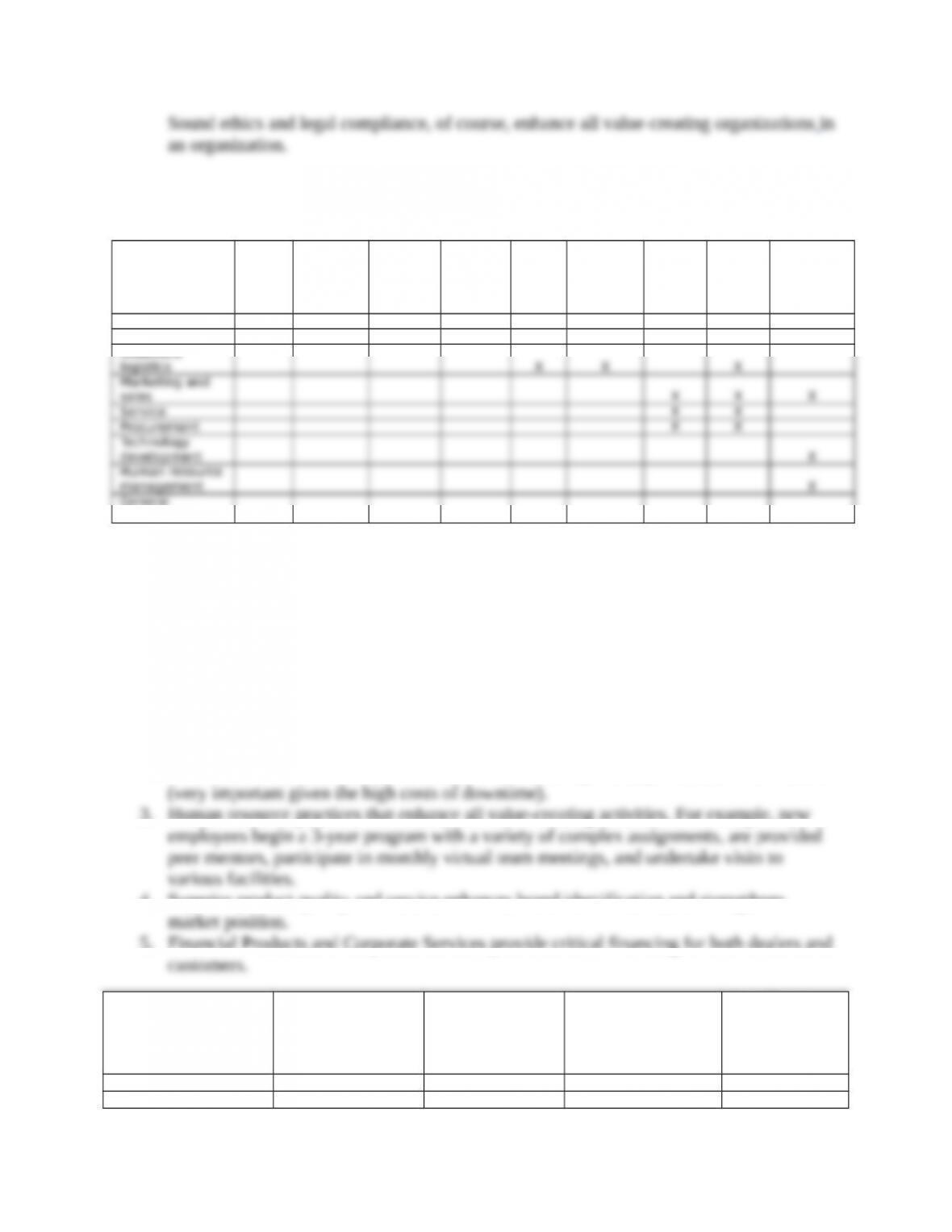
In the exhibit below, we note what could be considered the most important relationships among
value-creating activities.
Inbou
nd
logisti
cs
Operatio
ns
Outboun
d
logistics
Marketi
ng
and
sales
Servic
e
Pro-
curement
Tech-
nology
develo
p-ment
Human
resourc
e
manag
e-ment
General
admin-
istration
Inbound logistics X X X X X
Operations X X X X
Outbound
General
administration
3. What resources, activities, and relationships enable Caterpillar to achieve a sustainable
competitive advantage?
Response:
As noted in the above two questions, there are many value-chain activities—as well as important
relationships among them that help Caterpillar to attain competitive advantages that are difficult
for rivals to imitate. Key among these are:
1. Close relationships between logistics, operations, and service to build brand loyalty.
2. Excellent downstream service activities—in particular quick response to customer needs
3. Human resource practices that enhance all value-creating activities. For example, new
4. Superior product quality and service enhances brand identification and strengthens
5. Financial Products and Corporate Services provide critical financing for both dealers and
Resource/Activit
y Is It Valuable? Is It Rare?
Are There
Few
Substitutes?
Is It Difficult
to Make?
Inbound logistics X X X X
Operations X X X X
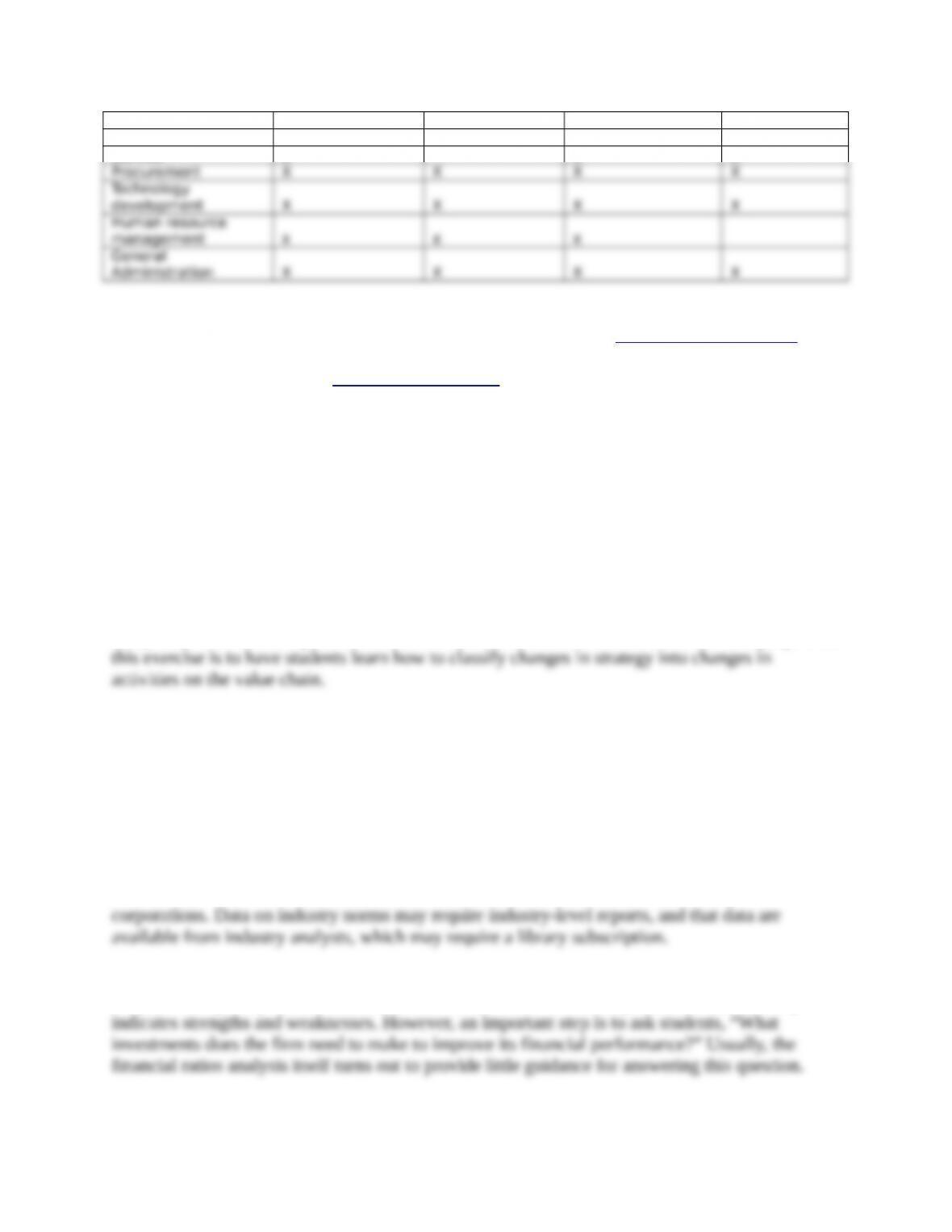
Outbound logistics X X X X
Marketing and sales X X X
Service X X X
Sources: Company records; 2015 Caterpillar Annual Report; Anonymous. 2015. NYSE
Governance Services Announces 2015 Leadership Award Winners. www.finance.yahoo.com:
June 19: np.; and, Beer, J. 2015. Behind the Brand: Caterpillar Went From Conservative to Buzz-
Building Content Marketing. www.fastcocreate.com. June 20: np.
Application Questions and Exercises
1. Using published reports, select two CEOs who have recently made public statements
regarding a major change in their firm’s strategy. Discuss how the successful
implementation of such strategies requires changes in the firm’s primary and support
activities.
Response:
Most companies have on their websites new releases that include CEO statements. In addition,
many corporate annual reports include a statement to shareholders from the CEO. The purpose of
2. Select a firm that competes in an industry in which you are interested. Drawing upon
published financial reports, complete a financial ratio analysis. Based on changes over time
and a comparison with industry norms, evaluate the firm’s strengths and weaknesses in
terms of its financial position.
Response:
Most annual reports include the relevant accounting data. In addition, some common services,
such as Hoovers, Yahoo Finance, and Lexis/Nexis, include financial ratios for many
The goal is to have students appreciate the value and limitations of financial ratio analysis.
Students can quickly tell if a firm’s ratios are above or below industry norms, which directly
3. How might exemplary human resource practices enhance and strengthen a firm’s value-
chain activities?
Response:
Exemplary human resource practices can enhance and strengthen every value-chain activity.
Such human resource practices can put people in jobs they are best able to do, improve morale
4. Using the Internet, look up your university or college. What are some of its key value-
creating activities that provide competitive advantages? Why?
Response:
Universities and colleges have support activities that are similar to other firms. For primary
activities, the value chain is different. The “raw material” is students. The activities may include
moving-in support, educational offerings, recruitment, career services, and alumni relationships.
Ethics Questions
1. What are some of the ethical issues that arise when a firm becomes overly zealous in
advertising its products?
Response:
A firm may advertise its products with inaccurate claims. If so, then it opens itself up to claims of
The solution is to have marketing and sales closely linked with technology development and
operations. Marketing should therefore only advertise products and services realistically. And
2. What are some of the ethical issues that may arise from a firm’s procurement activities?
Are you aware of any of these issues from your personal experience or businesses you are
familiar with?
Response:

Ideally, procurement involves an agreement with a supplier that specifies, in part, the product to
be delivered, the timing of delivery, the place of delivery, the price, and the timing of payment.
Malfeasance can occur along any of these dimensions. Malfeasance by suppliers may include
Any issue that arises requires a negotiation and resolution. In extreme cases, legal action is a last