End of Chapter Teaching Notes
Chapter 11: Strategic Leadership: Creating a Learning Organization and an Ethical
Organization
Summary Review Questions
1. Three key activities—setting a direction, designing the organization, and nurturing a
culture and ethics—are all part of what effective leaders do on a regular basis. Explain how
these three activities are interrelated.
Response:
Leadership is the process of transforming organizations from what they are to what the leader
Setting a direction refers to a clear organizational mission that a leader communicates with
passion and that followers believe. Designing the organization refers to the leader’s ability to
The interrelation of these three key activities is apparent when considering an organization
without any one of them. First, consider an organization without clear direction but with an
effective design and a nurturing culture. This organization would be disciplined and efficient but
2. Define emotional intelligence (EI). What are the key elements of EI? Why is EI so
important to successful strategic leadership? Address potential “downsides.”
Response:
EI is an individual’s capacity for recognizing his or her own emotions and those of others,
including the five components of self–awareness, self-regulation, motivation, empathy, and social
skills. Self-awareness refers to a person having a deep understanding of his or her emotions,
Research has shown that effective leaders have three sets of capabilities: (1) technical skills, (2)
The downside of EI is that it should be used in moderation. For example, leaders need to be
empathetic, but they also need not to be too empathetic. To maintain efficiency, leaders need to
3. The knowledge a firm possesses can be a source of competitive advantage. Describe ways
that a firm can continuously learn to maintain its competitive position.
Response:
Generally, individuals in different parts of an organization are learning, but that learning may not
be contributing to the organization’s competitive advantage. To continuously learn as an
organization, it needs to collect information from all levels of employees, from top down and
bottom up. It needs to process this information into organizational actions that will help achieve
4. How can the five central elements of “learning organizations” be incorporated into
global companies?
Response:
Learning organizations create a proactive, creative approach to the unknown, characterized by (1)
inspiring and motivating people with a mission and purpose, (2) empowering employees at all
Incorporating the five elements into global companies is more complicated than for domestic
companies because of the internal barriers between operations in different countries. For each of
the five central elements, some implementing issues are:
Mission has to apply to operations in multiple countries, so involvement of individuals
Empowering employees at all levels will require trusting people at all levels and in all
countries. People from all national cultures will have to overcome nationalistic biases and
Accumulating and sharing internal knowledge should include sharing across national
boundaries. Communication barriers will have to be bridged to include operations from all
Gathering and integrating external information will involve training employees throughout
the organization on methods for gathering external information, which should be similarly
Challenging the status quo involves developing a culture of dissent. This culture will have
to be instilled in each nation, and tailored to various national norms. In addition, there is a
Applying the learning organization elements to global companies will present various challenges
associated with international differences.
5. What are the benefits to firms and their shareholders of conducting business in an ethical
manner?
Response:
The benefits of an ethical organization are often indirect and not reflected in financial
performance. However, ethical performance has been associated with strong organizational
6. Firms that fail to behave in an ethical manner can incur high costs. What are these costs
and what is their source?
Response:
Lawsuits based on unethical behavior, such as discrimination, options backdating, tax evasion, or
fraud can be costly to settle, but the larger lack of confidence can threaten the organization’s
The past several years have been characterized by numerous examples of unethical and
illegal behavior by many top-level corporate executives. These include executives of firms
7. What are the most important differences between an “integrity organization” and a
“compliance organization” in a firm’s approach to organizational ethics?
Response:
An integrity organization (IO) combines a concern for law with an emphasis on managerial
responsibility. A compliance organization (CO) prevents, detects, and punishes legal violations.
Some of the differences are as follows. A CO seeks conformity with externally imposed standards
(i.e. laws), while an IO pursues self-governance according to chosen standards. A CO seeks to
8. What are some of the important mechanisms for promoting ethics in a firm?
Response:
Four important mechanisms are role models, corporate credos and codes of conduct, reward and
evaluation systems, and policies and procedures. Role models means that leaders must be
Corporate credos and codes of conduct provide a clear, transparent statement of norms and
beliefs as well as guidelines for decision making. These codes also provide a justification for
Reward and evaluation systems can discourage ethical conduct by rewarding outcomes without
Policies and procedures refer to written, transparent guidelines for conduct in certain routine
Experiential Exercise
Select two well-known business leaders—one you admire and one you do not. Evaluate
each of them on the five characteristics of emotional intelligence.
Response:
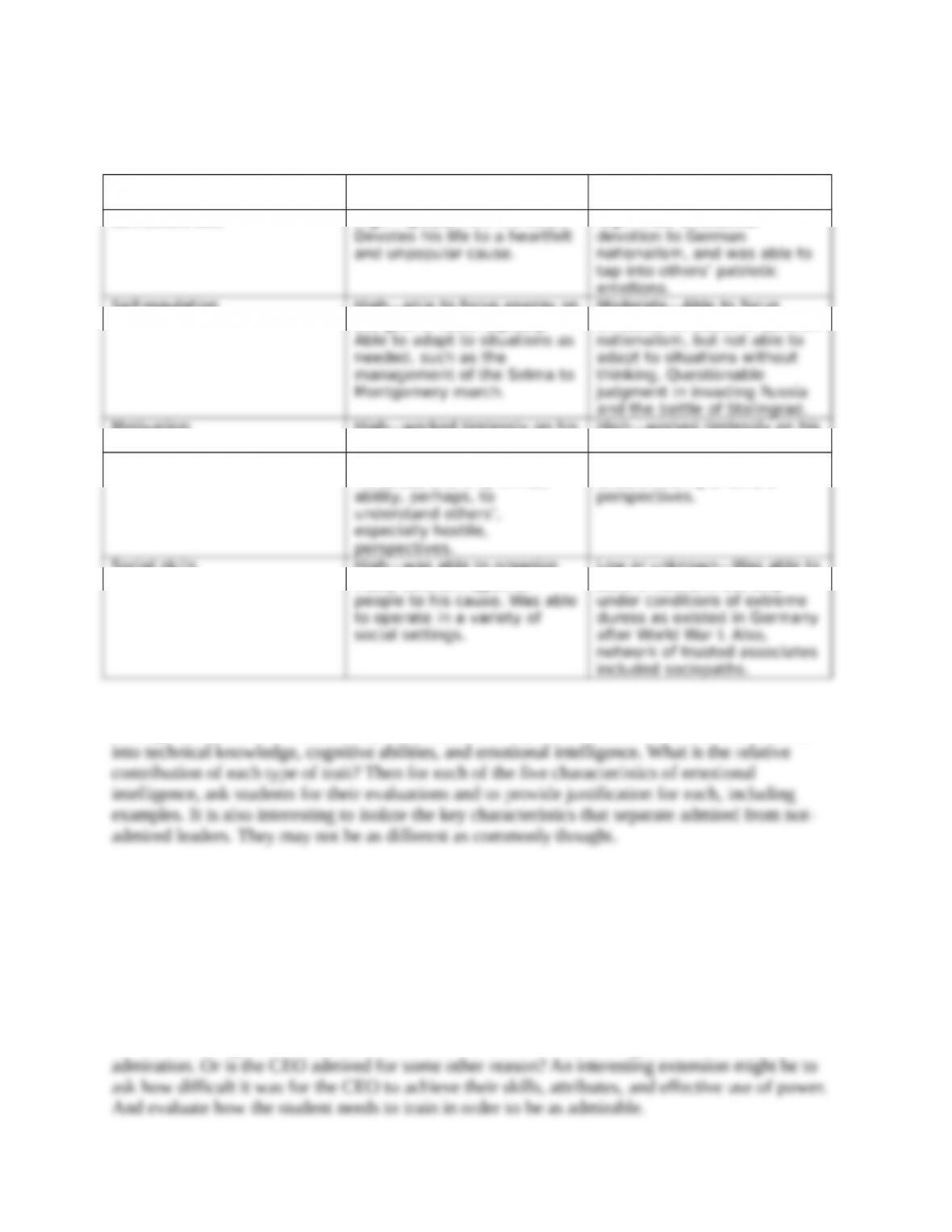
There are, of course, a nearly unlimited set of possibilities. This exhibit is illustrative and
debatable! Assessing leaders from afar is a matter of conjecture and perhaps debate.
Emotional Intelligence
Characteristics
Admired Leader
Martin Luther King
Leader Not Admired
Adolph Hitler
Self-awareness High—speaks from his heart.
High—Had a fanatical
Self-regulation High—able to focus energy on
the goal of racial equality.
Moderate—Able to focus
emotions on cause of German
Motivation High—worked tirelessly on his
cause
High—worked tirelessly on his
cause
Empathy Moderate—very focused on
his cause and only limited
Low—Was not very
understanding of others’
Social skills High—was able to organize
many di,erent types of
Low or unknown—Was able to
build a network, but only
(Note to instructor) The goal of this exercise is to increase students’ awareness of emotional
intelligence and its role in leadership. Ask students to separate the traits of the business leaders
Application Questions and Exercises
1. Identify two CEOs whose leadership you admire. What is it about their skills, attributes,
and effective use of power that causes you to admire them?
Response:
(Note to instructor) Ask students to evaluate their CEO on technical skills, cognitive ability,
emotional intelligence, and ethical role model. Ask which of these categories most causes their
2. Founders have an important role in developing their organization’s culture and values.
At times, their influence persists for many years. Identify and describe two organizations in
which the cultures and values established by the founder(s) continue to flourish. You may
find research on the Internet helpful in answering these questions.
Response:
Some corporations such as Apple, HP, GE, and Wal-Mart still have web pages devoted to the
corporate founders. These pages usually contain short bios on the founder(s) with some vignettes
(Note to instructor) The purpose of this exercise is to show the enduring power of a
founder/leader in shaping organizational culture, design, ethical standards, and mission. It may be
useful to ask students to show how the founder (a) determined the organization’s mission, (b)
designed the organization, and (c) nurtured a culture dedicated to excellence and ethical behavior.
To which of these activities is the founder’s influence strongest? Are there other activities besides
these where the founder made an impact?
3. Some leaders place a great emphasis on developing superior human capital. In what
ways does this help a firm to develop and sustain competitive advantages?
Response:
Sustainable competitive advantages are by definition rare, valuable, costly to imitate, and costly to
substitute. Human capital developed within the firm will likely contribute to a sustainable
Leaders can develop human capital through all leadership activities, but at the individual level, the
activity of nurturing a culture dedicated to excellence and ethical behavior has arguably the
greatest impact on developing human capital. Through interpersonal relationships, leaders can use
4. In this chapter we discussed the five elements of a “learning organization.” Select a firm
with which you are familiar and discuss whether or not it epitomizes some (or all) of these
elements.
Response:
(Note to instructor) We recommend that you start with the student justifying why he or she thinks
the organization is a learning organization that has a proactive approach to the unknown (or not,
but it is better to discuss an organization that is purported to be a learning organization). Then ask
students to show how the organization performs on all five elements. Which elements most
contribute to the organization’s status as a learning organization?
Ethics Questions
1. Sometimes organizations must go outside the firm to hire talent, thus bypassing
employees already working for the firm. Are there conditions under which this might raise
ethical considerations?
Response:
The primary ethical considerations pertain to fair treatment of the employees bypassed. If they are
not treated with dignity and respect, or not perceived to be treated so, then their perception of the
The conditions under which the ethical considerations are most likely are where the bypassed
employees perceive unfair treatment. This treatment might be that (a) they were not informed or
consulted regarding the new hire, (b) their concerns were not addressed by top management, (c)
2. Ethical crises can occur in virtually any organization. Describe some of the systems,
procedures, and processes that can help to prevent such crises.
Response:
Ethical crises can occur at even low levels of the organization, such as Sears’ auto repair
operations or Society Generale’s derivatives operations. An effective way to reduce such ethical
crises is to elevate ethics programs to be integrity-based, rather than compliance-based, and have
management directing ethics compliance rather than lawyers. Some systems, procedures, and
programs that help to prevent such crises include
Implementing education programs that clearly delineate acceptable and unacceptable
Having leaders be role models of ethical behavior, including clearly articulating and
Having leaders share accountability for ethical lapses, even if they were not directly
Having reward systems that include an evaluation of whether managers are acting in an

Formulating explicit policies for how to deal with certain routine activities such as
Publishing a comprehensive corporate credo and code of conduct.
Establishing a system of regular auditing of the entire organization, from top to bottom,
Changing organizational design after unethical behavior is discovered such that the