1. What are key forces in the general and industry environments that affect
Weight Watcher’s choice of strategy?
Referencing Chapter 2: Analyzing the External Environment –
Organizational leaders must become aware of factors in the overall environment that
might affect their ability to create a competitive advantage. So how do managers become
Environmental scanning involves surveillance of a firm’s external environment to predict
environmental changes and detect changes already under way. It is a BIG PICTURE
Environmental monitoring is a firm’s analysis of the external environment that tracks the
evolution of environmental trends, sequences of events, or streams of activities. Leaders
What factors or trends might be most important to Weight Watchers? The challenges for
Weight Watchers include increased competition in the weight loss industry, how to appeal
Regarding the general external environment, Weight Watchers must consider which
political/legal, economic and global, sociocultural and demographic, and technological
Demographic: In terms of demographics as relating to the weight loss industry, baby
boomers were getting older, and more and more men in this age group were now
interested in losing weight and were increasingly turning to commercial weight loss
Sociocultural: Obesity had been steadily increasing, along with awareness of its health
hazards. It was now more culturally acceptable to be on a “diet” and to be “watching ones
health.” Therefore, this wider acceptance had also been paired with an acceptance for
Technological: Technology had permeated the weight loss industry as well and had
surfaced online in the form of computerized weight loss plans. Weight Watchers had
embraced this shift with the implementation of various Weight Watchers online tools
It’s also necessary to assess the segments of the external competitive environment that
include competitors, customers, and suppliers, substitutes and new entrants. Porter’s five
forces model allows strategists to anticipate where the industry might be most vulnerable.
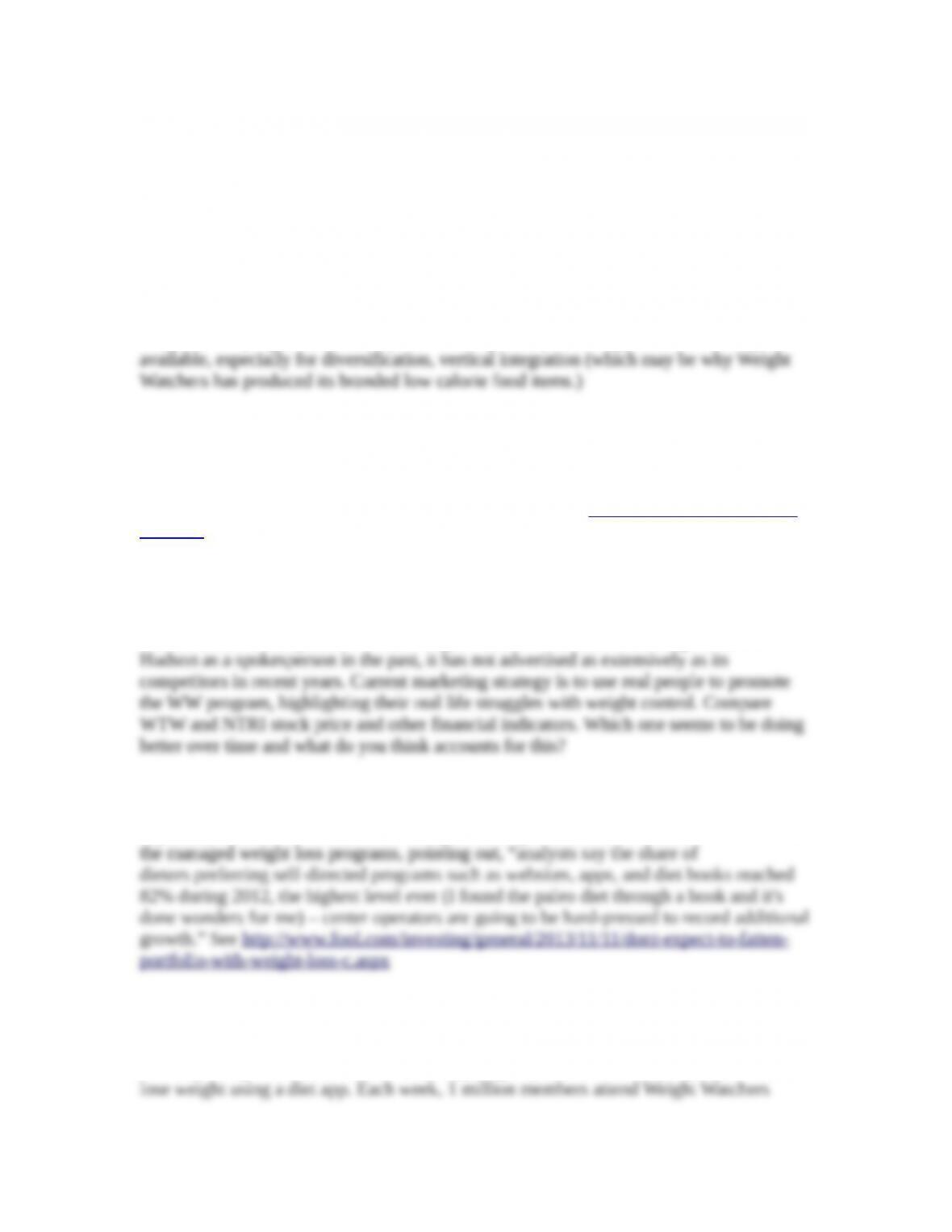
Help students apply Porter’s Five Forces of Competition to the weight loss industry by
drawing a diagram on the board similar to the following, and having students fill in the
details:
Rivalry
High
Substitutes
Power
Low
Suggested: many rivals
compete for market
Suggested: The suppliers of
consumer products have little
power because the companies in
the industry can choose to add
Suggested: In terms of a
substitute product for
standardized weight loss
plans, there are over the
Suggested: There is ease of entry
Buyers’
Power
Low
Based on the external environmental factor analysis, the weight loss business has many
competitors trying to carve out a piece of the “profit” pie, but opportunities still appear
NOTE – ADDITIONAL WEB LINKS TO FINANCIAL DATA AND
COMPETITORS:
Take a look at Weight Watchers (WTW) financial picture at http://finance.yahoo.com/q?
s=WTW
According to Yahoo Finance, competitors to Weight Watchers (WTW) include Jenny
Craig (privately held) and NutriSystem (NTRI). Both of these WW competitors use pre-
packaged meal programs to achieve goals. Both also use a number of celebrity
endorsements to sell product. While Weight Watchers had used actor/singer Jennifer
One article from 2013 points out that while lawmakers had worked with diet program
providers to forcibly change dietary habits (such as the NY ban on super-size sodas) these
regulatory restrictions wouldn’t be enough to change the consumer’s behavior in favor of
On the other hand, from 2014 comes another analyst’s opinion of how Weight Watchers
might be able to compete with the sociocultural trend toward free diet apps such as My
Fitness Pal, saying, “Weight Watchers’ core customers are not self-motivators. People
who pay $43 per month to attend a diet support group are not the kind of people who can
How has Weight Watchers dealt with the current environmental forces in its industry?
2. OPTIONAL QUESTION: How should leadership manage innovation in this
industry, and what are Weight Watchers’ options for growth?
NOTE: there are no PowerPoint slides to accompany the following.
Referencing Chapter 6: Formulating Corporate-Level Strategies –
Corporate strategy focuses discussion on the questions of what businesses a corporation
should compete in, and how the businesses should be managed so they can create
Diversification is the process of firms expanding their operations by entering new
businesses. In related diversification, a firm enters a different business in which it can
benefit from leveraging core competencies, sharing activities, or building market power.
Some possibilities include:
●Mergers and acquisitions
●Strategic alliances
Whatever the choice, it should create value for all stakeholders – employees, suppliers,
Companies can achieve synergy through diversification in two ways:
Through related businesses (horizontal relationships)
●Sharing tangible resources
Or through unrelated businesses (hierarchical relationships)
●Value creation derives from corporate office
Core competencies reflect the collective learning in organizations—how to coordinate
diverse production skills, integrate multiple streams of technologies, and market diverse
Sharing activities means that value chain elements are shared across business units, so
that two or more activities are done by one of the businesses. This allows for cost
Acquisition is the incorporation of one firm into another through purchase. It can be a
means of obtaining valuable resources that can help an organization expand its product
In order for Weight Watchers to grow, it might take more than just appealing to wider
demographics. Remember, in related diversification, a firm enters a different business in
which it can benefit from leveraging core competencies or sharing value-added activities.
Weight Watchers had value in its reputation and its operational model, which could easily
Finally, as previously mentioned, Weight Watchers appears to be in better financial
Referencing Chapter 11: Strategic Leadership: Excellence, Ethics & Change –
See the concept of leadership, the process of transforming organizations from what they
are to what the leader would have them become. Leadership is proactive, goal oriented,
and focused on the creation and implementation of the creative vision. This definition
implies dissatisfaction with the status quo, a vision of what should be, and process for
bringing about change. Leaders are change agents whose success is measured by how
effectively they formulate and implement a strategic vision and mission. See Exhibit
11.1. This involves:
●Setting a direction
The interdependent nature of these three activities is self-evident. Consider an
organization with a great mission and a superb organizational structure, but a culture that
Leaders need to set the direction for the organization by continually scanning the
environment to develop knowledge of all stakeholders, and knowledge of salient
environmental trends and events. Then leaders must integrate that knowledge into a
vision of what the organization could become. Leaders require the capacity to solve
increasingly complex problems, and must be proactive in their approach so they can
develop viable strategic options.
Leaders are responsible for designing the organization: a strategic leadership activity of
building structures, teams, systems, and organizational processes that facilitate the
Leaders play a key role in changing, developing, and sustaining an organization’s culture.
An excellent and ethical organizational culture is an organizational culture focused on
In nurturing a culture dedicated to excellence and ethical behavior, managers and top
executives must accept personal responsibility for developing and strengthening
appropriate behavior; consistently demonstrate that such behavior is central to the vision
Weight Watchers’ previous CEO David Kirchhoff had been a clear champion for the
brand, having struggled to lose weight himself. His personal story was inspirational not
only to Weight Watchers customers, but to employees and strategic partners as well.
New CEO Jim Chambers did appear skillful at scanning the external environment to
identify the trends and events that might affect the firm’s long-term strategy. The
Finally, as previously discussed, leaders at Weight Watchers from the beginning had
designed the organization in such a way as to harness the power of volunteers,
Referencing Chapter 12: Managing Innovation & Fostering Corporate
Entrepreneurship –
Innovation involves using new knowledge to transform organizational processes or create
commercially viable products and services using the latest technology, experimentation,
creative insights, and information from competitors. However it comes about, innovation
Before proceeding, firms must first define the scope of the innovation efforts, and must
A strategic envelope defines the range of acceptable projects. Strategic envelope means a
firm-specific view of innovation that defines how a firm can create new knowledge and
learn from an innovation initiative even if the project fails. The strategic envelope also
gives direction to a firm’s innovation efforts, which helps separate seeds from weeds and
In defining the innovation scope, a firm should answer several questions:
●How much will the innovation cost?
●How likely is it to actually become commercially viable?
●How much value will it add; that is, what will it be worth if it works?
●What will be learned if it does not pan out?
The challenges of innovation involve:
●Choosing when and how to continue to innovate
●The scope and pace of future innovation
●Whether or not to collaborate with innovation partners
Weight Watchers was in a difficult industry – it was crowded, without much opportunity
for growth except through vertical integration. As discussed, Weight Watchers could
However, the scope and the pace of innovation would be critical here. Any innovation in
this well-known company might be disruptive to the traditional Weight Watchers meeting
participants and to the volunteers who spread the “good” word about the Weight Watchers
Weight Watchers would always have imitators. Weight Watchers must continue to
reassess its internal and external environment in order to build its competencies, mitigate