Teaching Note: Case 14 – The Boston Beer Company
Case Objectives
1. To examine how the competitive forces in an industry affect choice of strategy.
2. To examine how formulating a competitive strategy involves assessment of internal
activities and resources.
See the table below to determine where to use this case:
NOTE: There are both PRIMARY and Secondary chapters that can be used for this case. The
Chapter Use Key Concepts Additional Readings or
Exercises
PRIMARY
Strategy
Competitive strategy; generic
NOTE additional reading.
SECONDARY
Environment
External scanning and
NOTE additional reading,
3: Internal
Value-chain analysis; resource-
Case Synopsis
The Boston Beer Company, known for its Samuel Adams brand, is the largest craft brewery in
the United States, holding a 1 percent stake in the overall beer market. It faces growing
competitive threats from other breweries, both large and small. In the past several years, the beer
industry as a whole has been on a decline, while sales of wines and spirits have increased. The
According to the Brewers Association, 1,940 craft breweries and 1,989 total breweries operated
in the United States. While craft breweries accounted for over 97 percent of all the breweries in
the United States, they only produced approximately 25 percent of all beer sold. However, with
However, The Boston Beer Company competed not only with domestic craft breweries but also
with premium beer imports, such as Heineken and Corona, which sold beer in a similar price
The Brewers Association defined a craft brewery as brewing less than six million barrels per year
and being less than 25 percent owned or controlled by another economic interest. Maintaining
status as a craft brewery could be important for image and, therefore, sales. The size of the
Boston Beer Company, however, was an issue. With continued growth, the brewery could
The Boston Beer Company was facing a difficult competitive environment. It was facing direct
competition from both larger and smaller breweries and from premium imported beers. Some of
the smaller craft breweries were growing quickly and wanted to be larger than the Boston Beer
Company. Other craft breweries felt that the Boston Beer Company was too large already. Thus,
Teaching Plan
This is a fairly brief case, which can be covered quickly, especially since it’s a familiar industry
to most students. The major opportunity here is to demonstrate how the nature of some industry
structures complicate what seems, at first, to be a straightforward strategic choice. As such, it can
We recognize that industry and internal issues drive strategy, but we start with the question of
ICEBREAKER
This case can start with an icebreaker. Starting from the perspective of a customer may make it
easier for students to transition to a strategic analysis.
How many of you are beer drinkers? Who do you think are the top beer companies in the U.S.?
Students may call out beer BRANDS, not realizing that the global strategy of companies in the
beer industry is to consolidate brands into an increasingly smaller group of beer companies. After
InBev’s acquisition of Anheuser-Busch in 2008, the top 3 beer companies in the world are InBev
(Belgium), South Africa/United Kingdom’s SABMiller, and Heineken (Dutch). Other top
companies worldwide include the Japanese firms Kirin Holdings and Asahi, Carlsberg
For an additional perspective on this industry, consider also assigning Case 20: Heineken, which
How many of you drink Sam Adams by choice? Why or why not? Do you consider Sam Adams to
be a top brand?
Here’s where students can discover just how hard it is to “differentiate” a brand. Is their
preference based on taste or on marketing? How many of them would be willing to bet they
could identify their favorite beer in a blind taste test!?
Summary of Discussion Questions
Here is a list of the suggested discussion questions. You can decide which questions to assign,
and also which additional readings or exercises to include to augment each discussion. Refer
Discussion Questions:
1. PRIMARY QUESTION: What strategy does Boston Beer follow in the beer market?
2. SECONDARY QUESTIONS: What is the structure of the beer industry, and how does
this affect choice of strategy?
3. What internal assets does Boston Beer have that may help it deal with its challenges?
Discussion Questions and Responses
1. What strategy does Boston Beer follow in the beer market?
Strategy is all about the ideas, decisions, and actions that enable a firm to succeed. See Chapter
1, Exhibit 1.1: Strategic management consists of the analyses, decisions, and actions an
organization undertakes in order to create and sustain competitive advantages:
●strategy directs the organization toward overall goals and objectives;
●includes multiple stakeholders in decision making;
See Chapter 1, Exhibit 1.3 for a depiction of the strategic management process. During strategic
analysis, the leader in the organization does “advance work” to anticipate unforeseen
environmental developments, identify unanticipated resource constraints, assess changes in his or
The basic question strategic management tries to answer is: How can we create competitive
advantages in the marketplace that are not only unique and valuable but also difficult for
competitors to copy or substitute?
Referencing Chapter 5: Business-Level Strategy
How firms compete with each other and how they attain and sustain competitive advantages go
to the heart of strategic management. In short, the key issue becomes: why do some firms
outperform others and enjoy such advantages over time? The viability of a firm’s success is
A business-level strategy is a strategy designed for firm or a division of the firm that competes
within a single business. Within the firm’s industry environment generic strategies include basic
types of business level strategies based on breadth of target market (industrywide versus narrow
market segment) and type of competitive advantage (low-cost versus uniqueness). Here are the
three generic strategies that are used to overcome industry forces and achieve a competitive
advantage:
●Overall cost leadership
oLow-cost-position relative to a firm’s peers
●Differentiation
oCreate products and/or services that are unique and valued
●Focus strategy
oNarrow product lines, buyer segments, or targeted geographic markets
Generic strategies are plotted on two dimensions: competitive advantage and strategic target. The
Both casual observation and research supports the notion that firms that identify with one or
more of the forms of competitive advantage outperform those that do not. In order to achieve a
Although any company in this crowded industry must keep costs low, if only to achieve parity
with competition, the only way Boston Beer has chosen to compete is through differentiation.
Exhibit 9 in the case, reproduced at the end of this Teaching Note, in the Appendix, with the
names of the brewers added in, shows that price per six pack doesn’t seem to matter. Beer
drinkers DO seem to be willing to pay a premium for their favorite brew, and the craft beer
Some might want to suggest that Boston Beer attempt a focus strategy, targeting those who prefer
the hand-crafted types of beers, but taking a look at the strategic groups exercise, in the
NOTE – ADDITIONAL READING, CASE UPDATE:
Here’s a video made by Jim Koch of Boston Beer, describing how he started the company:
https://www.youtube.com/watch?v=3iqUDPQl9_A
In the U.S. market, although sales are dominated by U.S. Brewers Anheuser-Busch InBev, Miller
Coors Brewing Co. and Pabst Brewing Co., with competition from global competitors Heineken
and Grupo Modelo/Crown, the “craft” brewers, notably Sam Adams, which holds .009 market
share, are gaining ground, (see Case Exhibit 9). For an historical perspective, see the 2009
documentary “Beer Wars”, which documents the rise of the craft brewers such as Boston Beer
and Dogfish Head. For instance, “Beer Wars exposes a clear and lasting dichotomy of cultures
For up-to-date financial and news information on Boston Beer (SAM), see
http://topics.nytimes.com/top/news/business/companies/boston-beer-company-inc/index.html
Or http://finance.yahoo.com/q?s=sam&ql=1
For more information on the company, see the investor relations website at
http://www.bostonbeer.com/phoenix.zhtml?c=69432&p=irol-overview
And the beer website at http://www.samueladams.com/
As the case points out, the big brewers, especially Anheuser-Busch InBev, have taken on the
taste challenge, and produced more flavorful beers such as Shock Top (A-B InBev) and Blue
Moon (MolsonCoors/SAB Miller). Has the growth of these offerings from the big competitors
been adequately anticipated by Boston Beer’s competitive strategy?
2. What is the structure of the beer industry, and how does this affect choice of strategy?
Referencing Chapter 2: Analyzing the External Environment of the Firm
As part of strategic analysis, organizational leaders must become aware of factors in the overall
environment that might affect their ability to create a competitive advantage. So how do
Environmental scanning involves surveillance of a firm’s external environment to predict
environmental changes and detect changes already under way. It is a BIG PICTURE viewpoint
Environmental monitoring is a firm’s analysis of the external environment that tracks the
evolution of environmental trends, sequences of events, or streams of activities. Leaders need to
What factors or trends might be most important to Boston Beer? To assess how the external
environment might affect the firm’s strategy, it’s necessary to take a look at the factors in the
Demographic: Although companies need to be aware of alcoholic beverage drinking age
constraints, people from all walks of life, ethnicities and genders could be interested in flavorful
beverages. There were opportunities for non-alcoholic innovations in addition to new beer
Beer was also a cheaper alternative for alcoholic consumption than hard liquor, so maintaining
low pricing was important. However, in contrast to the traditional “Joe six-pack” consumer,
According to industry data, men drank about 72 percent of beer of all types, including craft beer,
and about 59 percent of craft beer by volume is drunk by Americans whose annual household
Sociocultural: Consumption habits of beer drinkers had changed – less standard and economy
lager, but more wheat beers (dark ale) and premium lagers (predominately made by craft
Technological: Beer making is a very old technology, but refinements in flavor can come from
unexpected sources and combinations of ingredients, many discovered in home brewer’s
Political-Legal: Companies in the beer industry needed to be aware of the problems with drunk
driving and other alcohol-induced behaviors. There was an assumption that brewers had a social
Strategic analysis also assesses the segments of the external competitive environment that
include competitors, customers, and suppliers, substitutes and new entrants. One key issue that
Once the industry is defined, Porter’s five forces model allows strategists to anticipate where the
industry might be most vulnerable. Ask students to diagram the five forces. It should look
something like the diagram below:
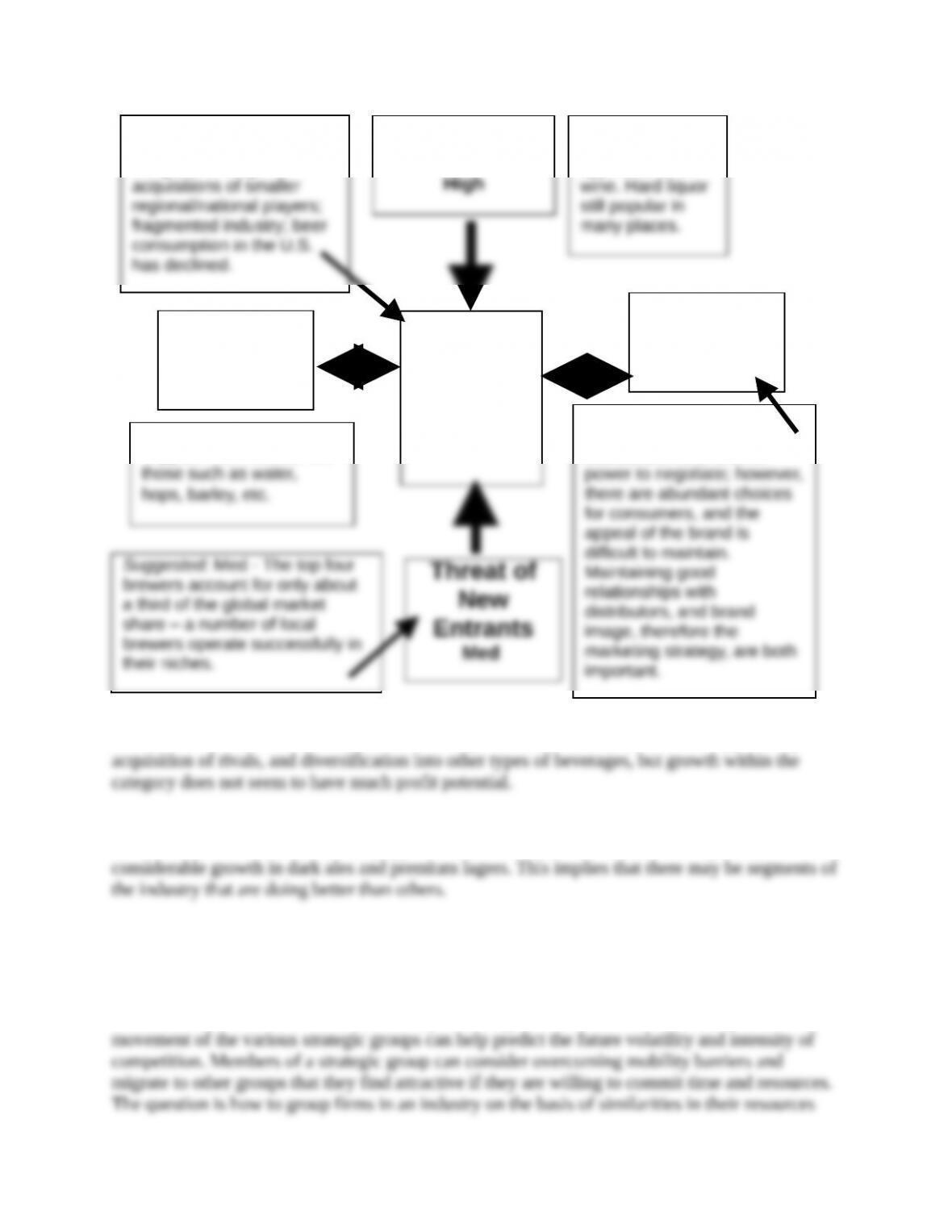
Rivalry
High
Substitutes’
Threat
Buyers’
Power
Med – High
Suppliers’
Power
Low
Suggested: High – largest
brewers expanding across
the globe through
Suggested: Med-High – With
the tier system in the U.S.,
distributors have a lot of
Suggested: Low –
Supplier commodities are
Suggested: High
– Growing
appreciation of
Based on the external environmental factor analysis, the beer business has some opportunity for
The case explains this well, highlighting the drop in total beer sales over the years. However,
there had been a shift in the sales by type of beer – the craft brew market had exploded, with
Strategic Groups: Some groups of firms are more similar to each other than other firms. Rivalry
will be greater in firms that are alike. Strategic groups are clusters of firms that share similar
strategies. The concept of strategic groups can be used as an analytical tool that helps think
through the implications of each industry trend for the strategic group as a whole. Dimensions
should be considered that reflect the variety of strategic combinations in an industry. The
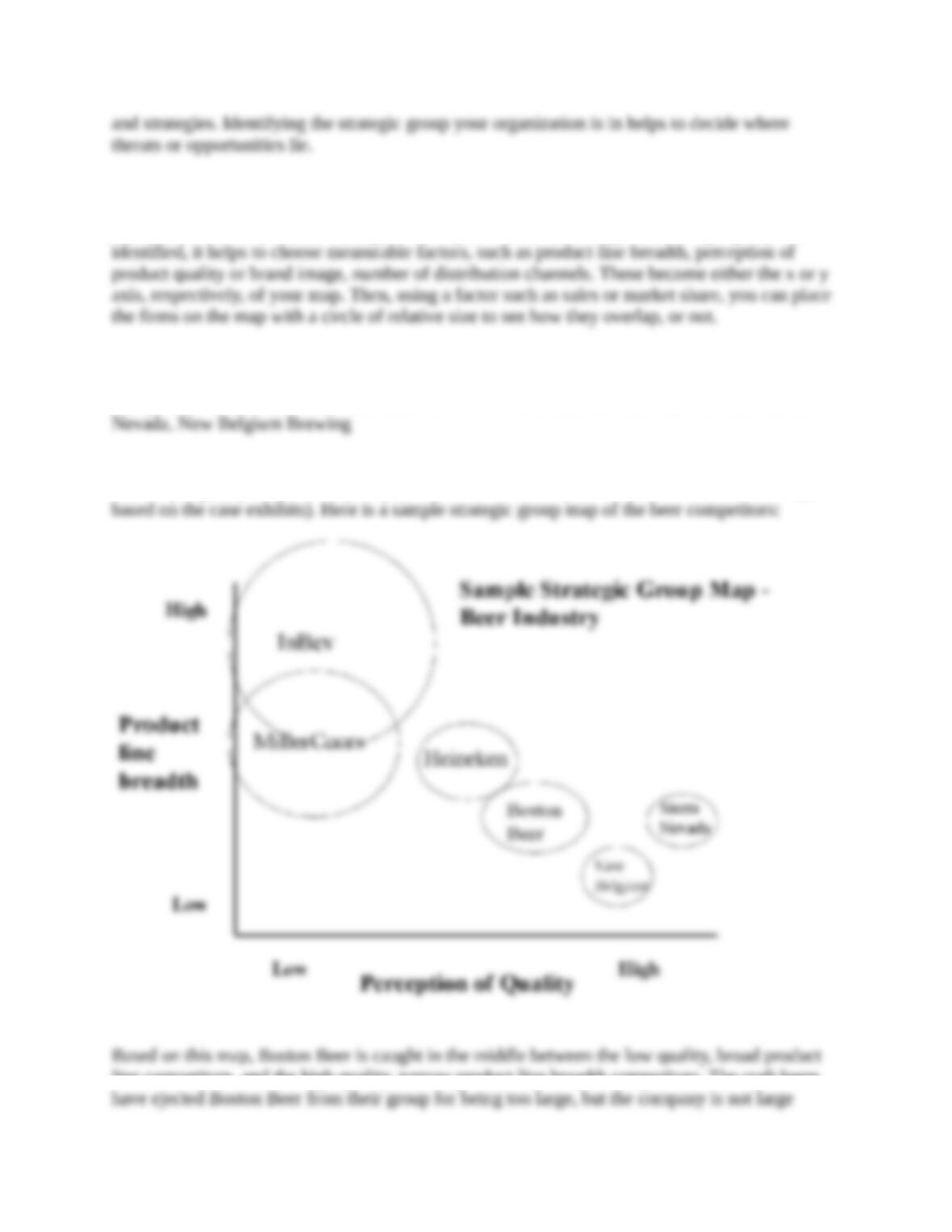
Mapping of strategic groups can be helpful to understand how rivals within an industry compete.
The map also helps determine where a given firm might be able to find opportunity, and
reposition itself for potential strategic advantage. When determining how strategic groups can be
For the beer industry, using data from within the case, the map might look something like this:
Competitors = Anheuser–Busch InBev, MolsonCoors SABMiller, Heineken, Boston Beer, Sierra
Measurable Factors = product line breadth (types of beer: dark vs lager – premium vs standard vs
economy lager), perception of quality (awards based on competitions), size of market share (all
line competitors, and the high quality, narrow product line breadth competitors. The craft beers