3-27. Solution:
Jolie Foster Care Homes Inc.
a.
Net income
Total assets
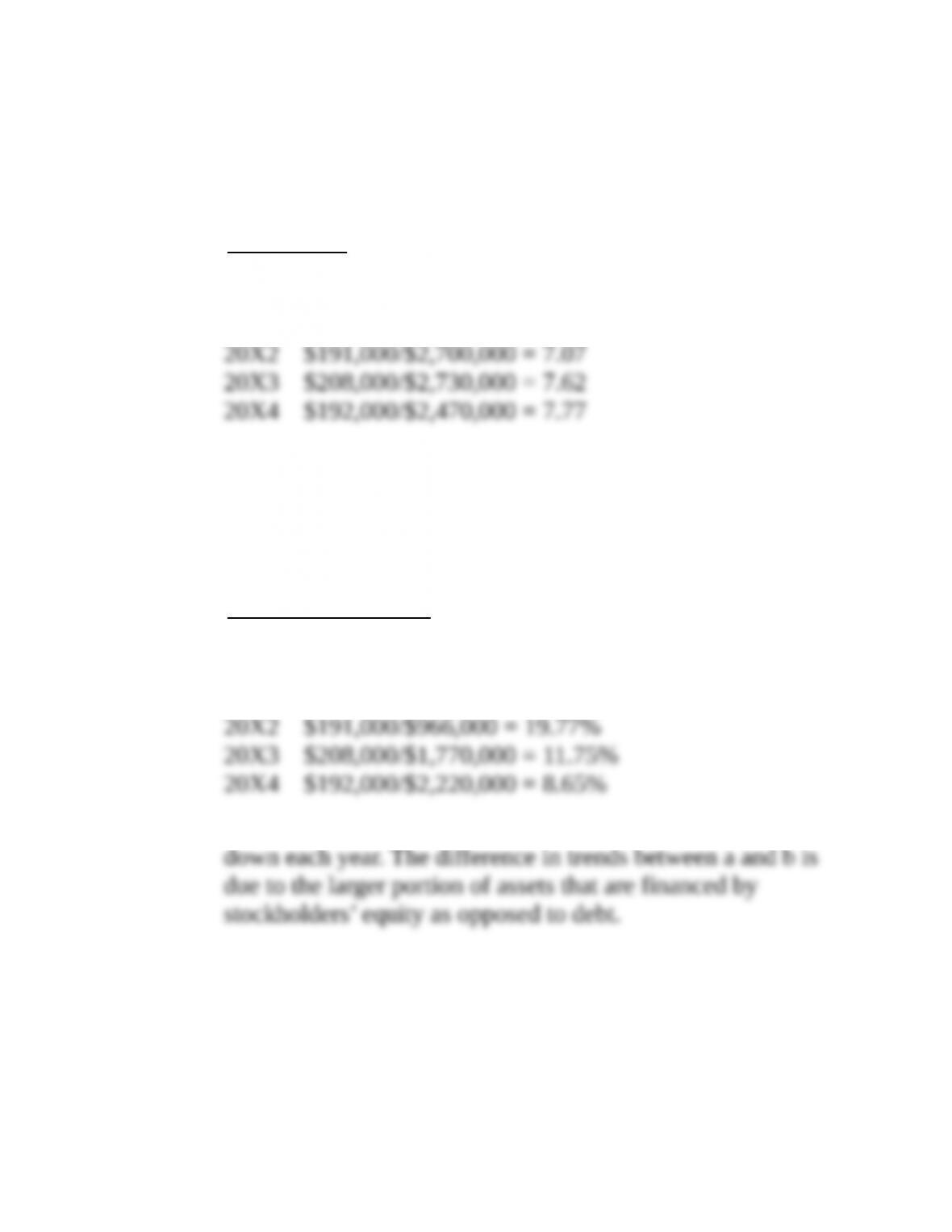
20X1 $155,000/$2,390,000 = 6.49%
Comment: There is a strong upward movement in return on
assets over the four-year period.
b.
Net income
Stockholders’ equity
20X1 $155,000/$761,000 = 20.37%
Comment: The return on stockholders’ equity ratio is going
3-27. (Continued)
Optional: This can be confirmed by computing total debt to
total assets for each year.
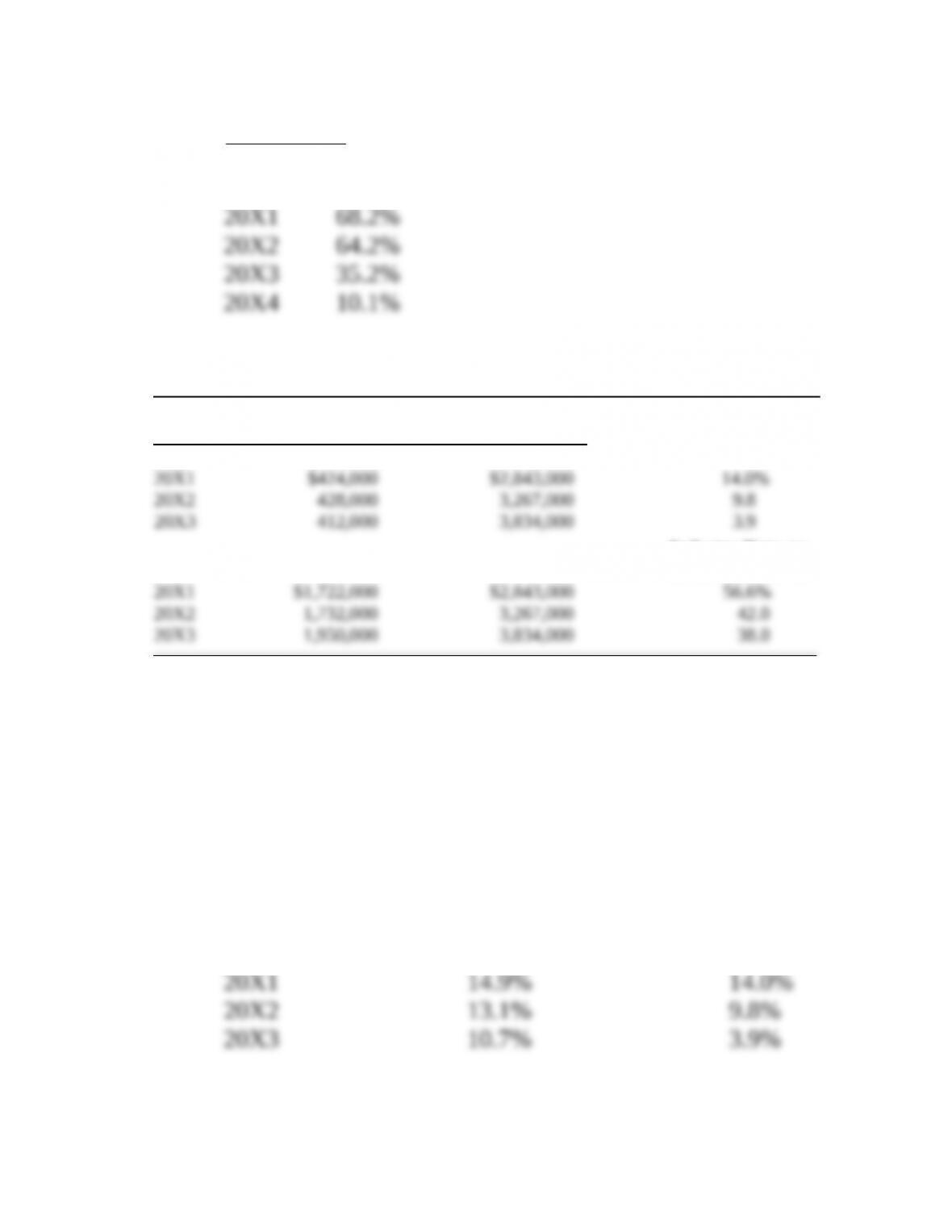
Total debt
Total assets
27. Trend analysis (LO4) Quantum Moving Company has the following data. Industry
information also is shown.
Industry Data on
Company Data Net Income/Total Assets
Year Net Income Total Assets
Industry Data on
Year Debt Total Assets Debt/Total Assets
As an industry analyst comparing the firm to the industry, are you likely to praise or
criticize the firm in terms of the following:
a. Net income/Total assets.
b. Debt/Total assets.
3-28. Solution:
Quantum Moving Company
a. Net income/total assets
Year Quantum Ratio Industry Ratio
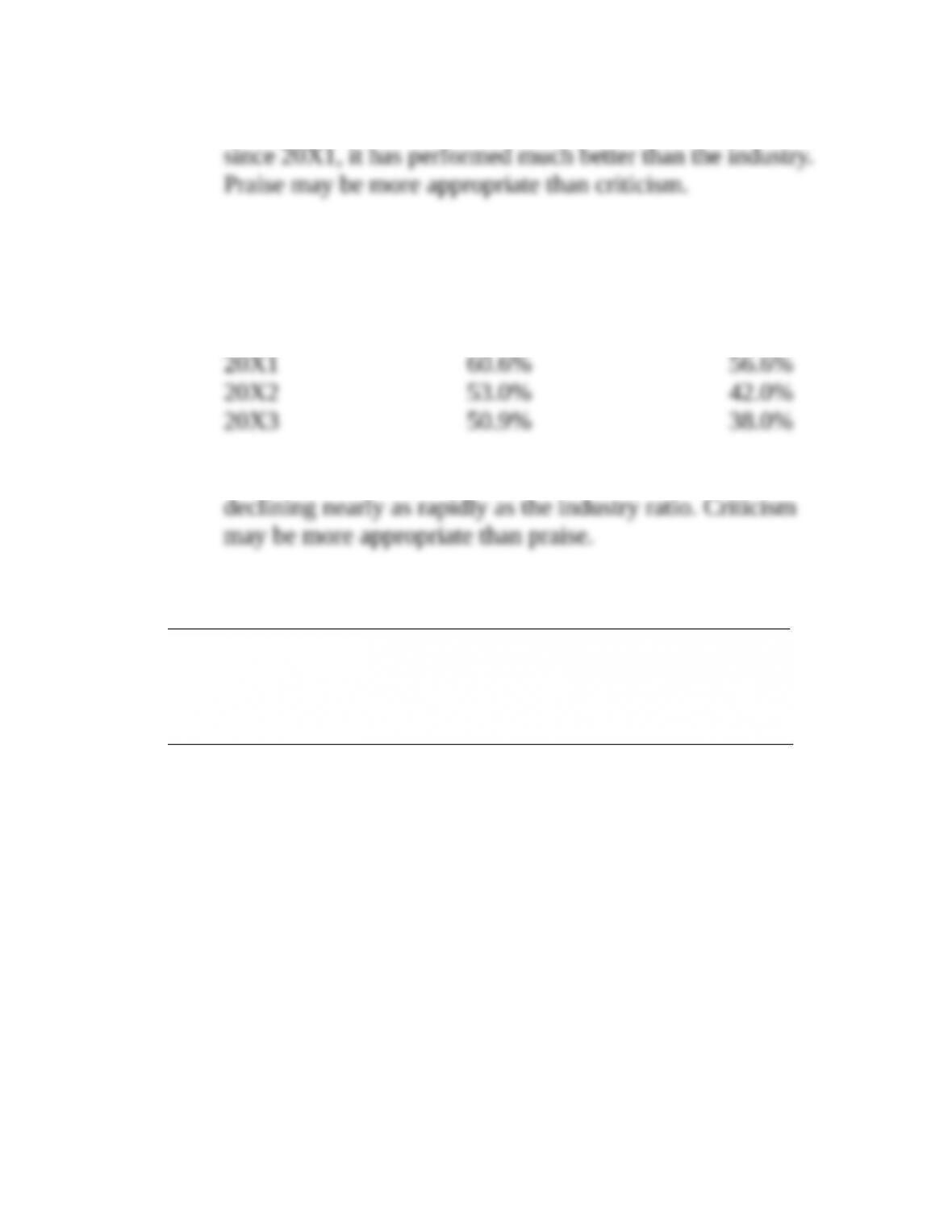
Although the company has shown a declining return on assets
3-28. (Continued)
b. Debt/total assets
Year Quantum Ratio Industry Ratio
While the company’s debt ratio is declining, it is not
29. Analysis by divisions (LO2) The Global Products Corporation has three subsidiaries.
Medical Supplies Heavy Machinery Electronics
Sales………………………………… $20,040,000 $5,980,000 $4,730,000
Net income (after taxes)……… 1,700,000 592,000 402,000
Assets………………………………. 8,340,000 8,760,000 3,570,000
.
a. Which division has the lowest return on sales?
b. Which division has the highest return on assets?
c. Compute the return on assets for the entire corporation.
d. If the $8,760,000 investment in the heavy machinery division is sold off and
redeployed in the medical supplies subsidiary at the same rate of return on assets
currently achieved in the medical supplies division, what will be the new return on
assets for the entire corporation?
3-29. Solution:
Global Products Corporation
a. Medical Heavy
Supplies Machinery Electronics
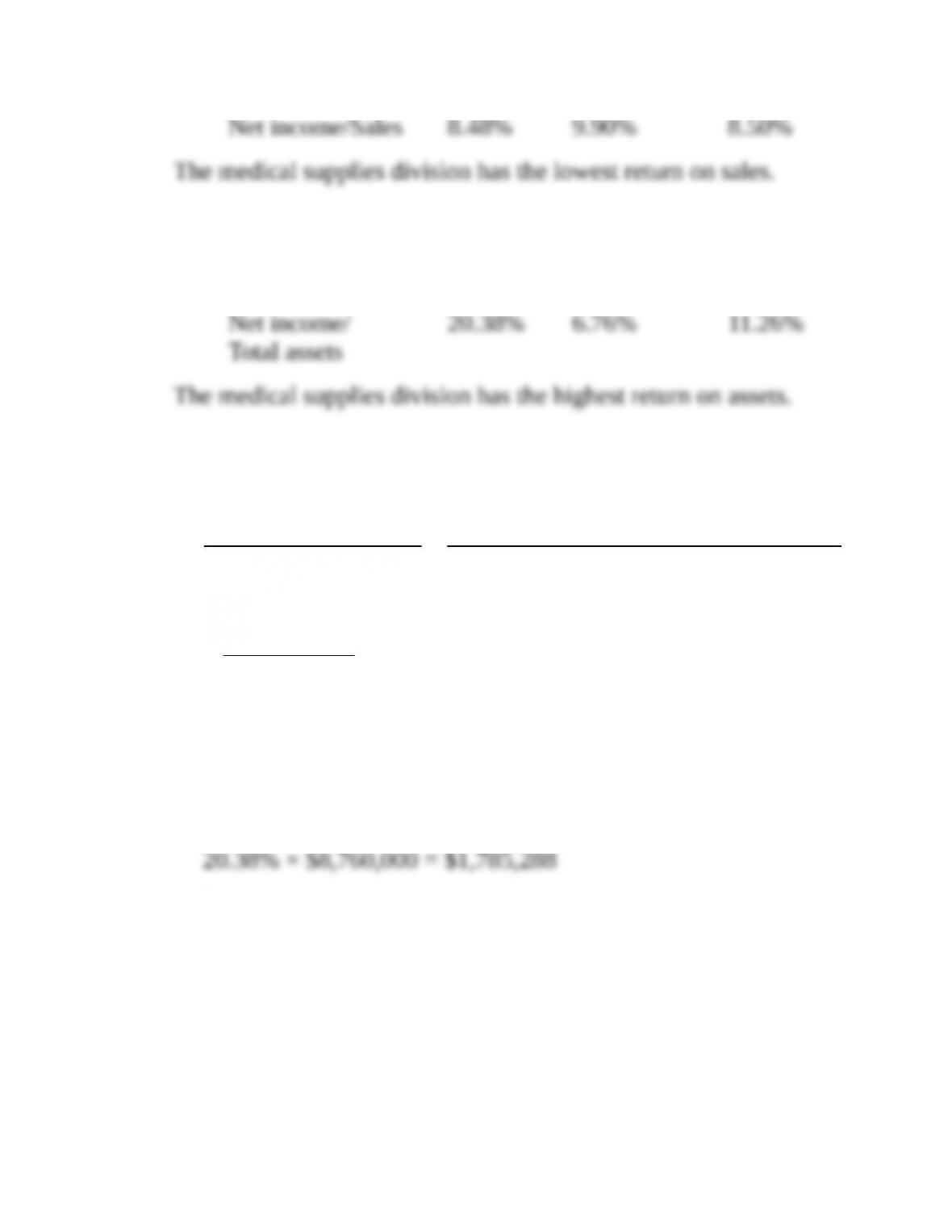
b. Medical Heavy
Supplies Machinery Electronics
3-29. (Continued)
c.
Corporate net income $1,700,000 $592,000 $402,000
Corporate total assets $8,340,000 $8,760,000 $3,570,000
$2,694,000
$20,670,000
13.03%
+ +
=+ +
=
=
d. Return on redeployed assets in heavy machinery.
20.38% × $8,760,000 = $1,785,288
Return on assets for the entire corporation:

Corporate net income $1, 700,000 $1, 785, 288 $402,000
Corporate total assets $20,670,000
$3,887, 288
$20,670,000
18.81%
+ +
=
=
=
30. Analysis by affiliates (LO1) Omni Technology Holding Company has the following three
affiliates:
Personal Foreign
Software Computers Operations
Sales…………………………… $40,200,000 $60,080,000 $100,680,000
Net income (after taxes)… 2,086,000 2,880,000 8,510,000
Assets…………………………. 5,820,000 25,790,000 60,630,000
Stockholders’ equity……… 4,090,000 10,170,000 50,950,000
a. Which affiliate has the highest return on sales?
b. Which affiliate has the lowest return on assets?
c. Which affiliate has the highest total asset turnover?
d. Which affiliate has the highest return on stockholders’ equity?
e. Which affiliate has the highest debt ratio? (Assets minus stockholders’ equity
equals debt.)
f. Returning to question b, explain why the software affiliate has the highest return on
total assets.
g. Returning to question d, explain why the personal computer affiliate has a higher
return on stockholders’ equity than the foreign operations affiliate even though it has
a lower return on total assets.
3-30. Solution:
Omni Technology Holding Company

a. Net income/Sales
Personal Foreign
Software Computers Operations
5.19% 4.79% 8.45%
The foreign operation affiliate has the highest return on sales.
b. Net income/Total assets
Personal Foreign
Software Computers Operations
35.84% 11.17% 14.04%
The personal computer affiliate has the lowest return on
assets.
3-30. (Continued)
c. Sales/Total assets
Personal Foreign
Software Computers Operations
6.91x 2.33x 1.66x
The software affiliate has the highest return on total asset
turnover.
d. Net income/
Stockholders’ equity
The software affiliate has the highest return on stockholders’
equity.
e. Debt/Total assets
Personal Foreign
Software Computers Operations
29.73% 60.57% 15.97%
The personal computer affiliate has the highest
debt-to-total-assets ratio.
f. This is because of its high total asset turnover ratio of 6.91x
g. This is because the personal computer affiliate has a higher
31. Inflation and inventory accounting effect (LO5) The Canton Corporation shows the
following income statement. The firm uses FIFO inventory accounting.
CANTON CORPORATION
Income Statement for 20X1
Personal Foreign
Software Computers Operations
51.0% 28.32% 16.70%
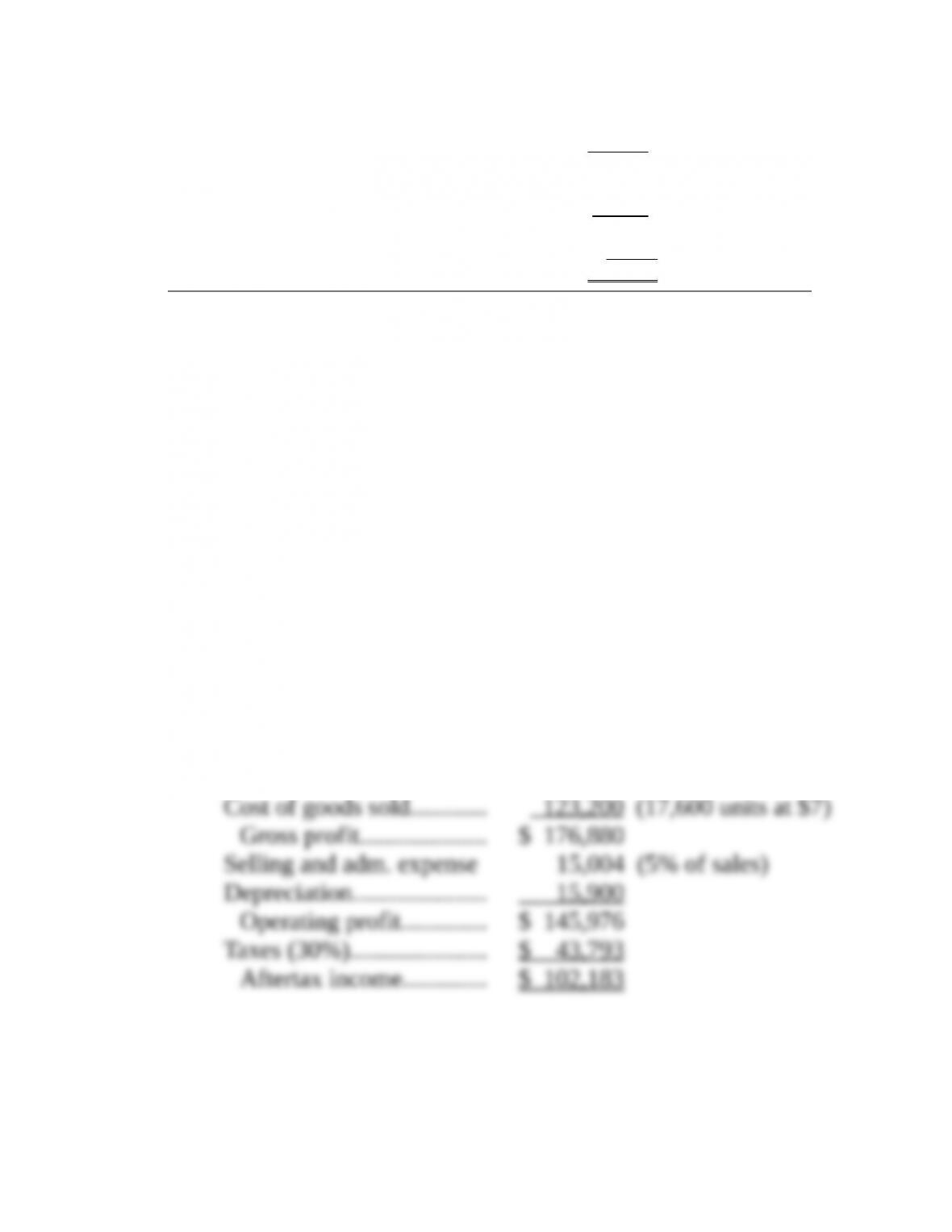
Sales…………………………………………………………… $272,800 (17,600 units at $15.50)
Cost of goods sold………………………………………… 123,200 (17,600 units at $7.00)
Gross profit…………………………………………………. 149,600
Selling and administrative expense…………………. 13,640
Depreciation………………………………………………… 15,900
Operating profit……………………………………………. 120,060
Taxes (30%)………………………………………………… 36,018
Aftertax income…………………………………………… $ 84,042
a. Assume in 20X2 that the same 17,600-unit volume is maintained, but that the sales
price increases by 10 percent. Because of FIFO inventory policy, old inventory will
still be charged off at $7 per unit. Also assume selling and administrative expense will
be 5 percent of sales and depreciation will be unchanged. The tax rate is 30 percent.
Compute aftertax income for 20X2.
b. In part a, by what percent did aftertax income increase as a result of a 10 percent
increase in the sales price? Explain why this impact took place.
c. Now assume that in 20X3 the volume remains constant at 17,600 units, but the sales
price decreases by 15 percent from its year 20X2 level. Also, because of FIFO
inventory policy, cost of goods sold reflects the inflationary conditions of the prior
year and is $7.50 per unit. Further, assume selling and administrative expense will be
5 percent of sales and depreciation will be unchanged. The tax rate is 30 percent.
Compute the aftertax income.
3-31. Solution:
Canton Corporation
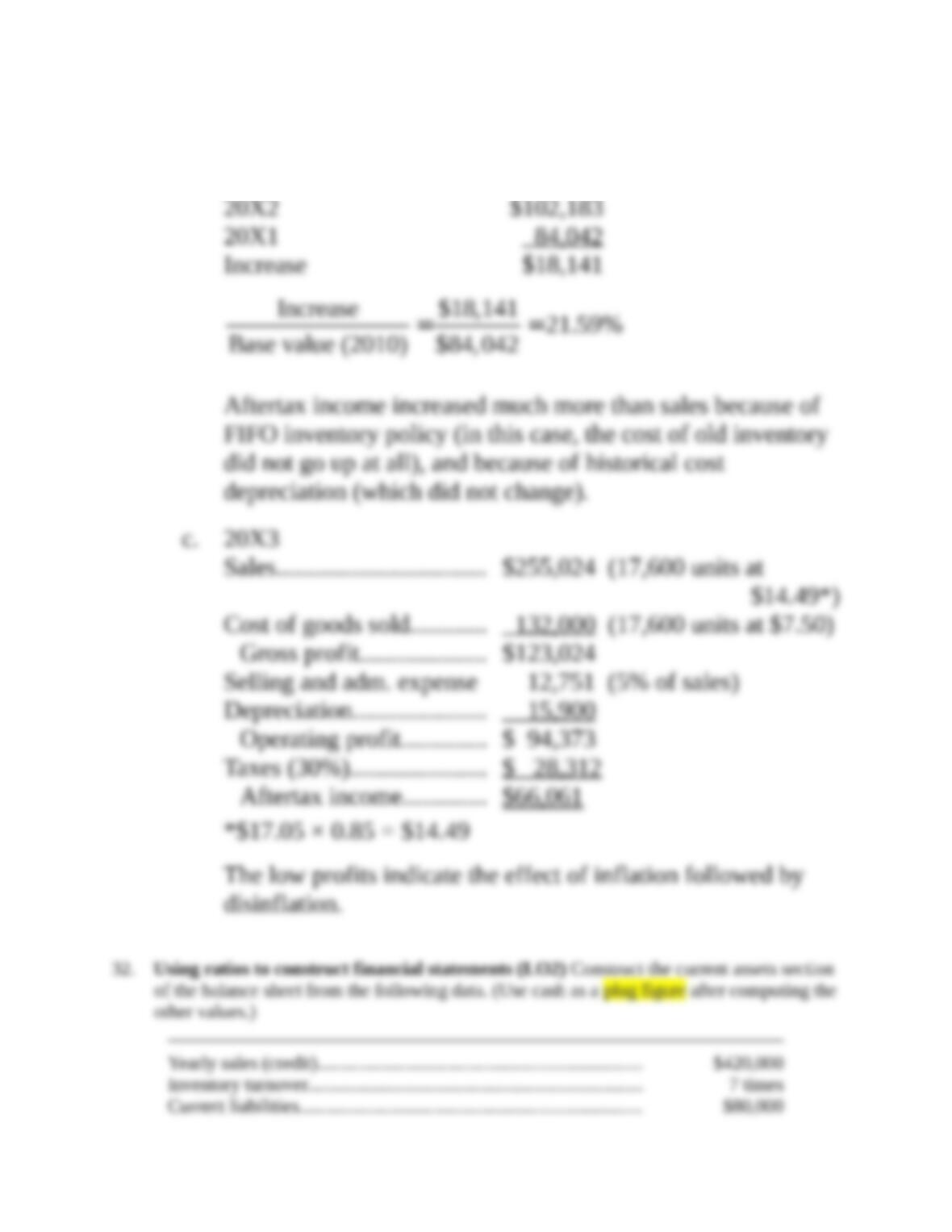
a. 20X2
Sales…………………………… $300,080 (17,600 units at
$17.05)
3-31. (Continued)
b. Gain in aftertax income
Current ratio……………………………………………………………………… 2
Average collection period…………………………………………………… 36 days
Current assets: $
Cash………………………………………………………………. ______
Accounts receivable………………………………………… ______
Inventory……………………………………………………….. ______
Total current assets……………………………………… ______
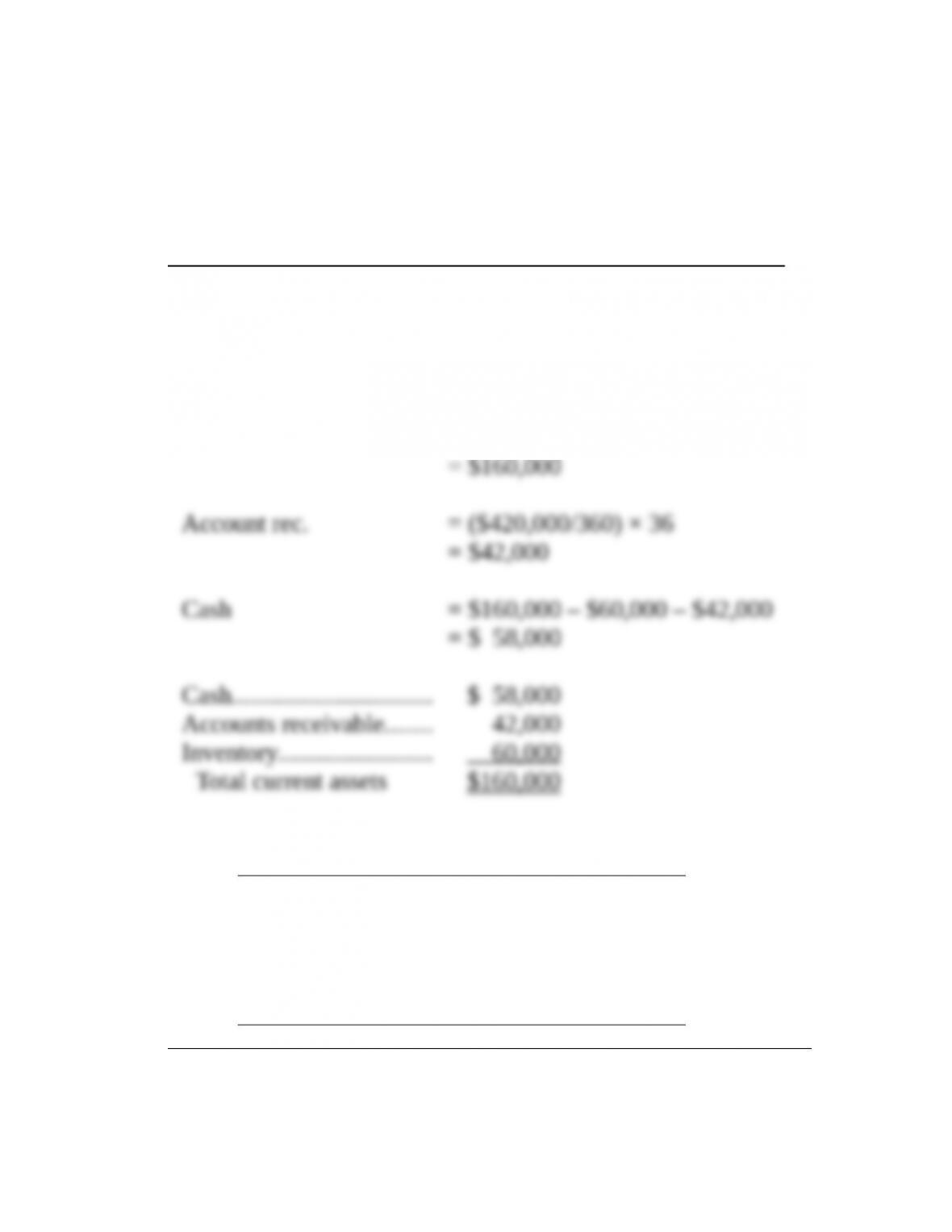
3-32. Solution:
Inventory = $420,000/7
= $60,000
Current assets = 2 × $80,000
33. Using ratios to construct financial statements (LO2) The Griggs Corporation has credit
sales of $1,200,000. Given these ratios, fill in the following balance sheet.
Total assets turnover…………………………….. 2.4 times
Cash to total assets……………………………….. 2.0%
Accounts receivable turnover………………… 8.0 times
Inventory turnover……………………………….. 10.0 times
Current ratio………………………………………… 2.0 times
Debt to total assets……………………………….. 61.0%
GRIGGS CORPORATION
Balance Sheet
Assets Liabilities and Stockholders’ Equity
Cash ………………………… _____ Current debt……………………………………… _____
Accounts receivable…… _____ Long-term debt………………………………….. _____
Inventory………………….. _____ Total debt…………………………………….. _____
Total current assets . _____ Equity………………………………………………. _____
Fixed assets ……………… _____ Total debt and stockholders’ equity _____
Total assets …………. _____