
Chapter 8 – Personal Characteristics and Sales Aptitude: Criteria for Selecting Salespeople
8-1
Chapter 8
Personal Characteristics and Sales Aptitude: Criteria for Selecting
Salespeople
Learning Objectives for Chapter 8
• Understand the answer to the question, “Are good salespeople born or made?”
• Define the characteristics of successful salespeople.
• Explain the role of sales aptitude in sales performance.
• Understand the different success characteristics for different sales positions.
Definition of Key Terms in Chapter 8
• Selection criteria
o Characteristics management looks for in selecting individuals for sales
positions.
• Physical characteristics
o Characteristics associated with the physical traits of an individual (height,
appearance).
• Psychological traits
o These are of two types. Aptitude refers to enduring personal characteristics that
determine and individual’s overall ability to perform a sales job (intelligence,
cognitive ability). Personality refers to enduring personal traits that reflect an
individual’s consistent reactions to situations encountered in the environment
(self-esteem, creativity).
• Skills variables

Chapter 8 – Personal Characteristics and Sales Aptitude: Criteria for Selecting Salespeople
8-2
o Learned proficiencies and attitudes necessary for effective performance of
specific job tasks; skills can change over time with training and experience
(vocational skills, interpersonal skills)..
Chapter Outline
I. Are Good Salespeople Born or Made? The Determinants of Successful Sales Performance
A. A Review of Past Research
B. The Costs of Inappropriate Selection Standards
II. Characteristics of Successful Salespeople
A. Characteristics Sales Managers Look For
B. Research Concerning the Personal Characteristics of Successful Salespeople
C. Overview of Findings
a. Demographic and Physical Variables
b. Gender and Race
c. Social Changes Have Improved Employment Opportunities
d. Cultural Diversity and Changing Attitudes
e. Physical Characteristics and Customer Similarity
f. Background and Experience
g. Current Status and Lifestyle Variables
h. Aptitude Variables
i. Personality Variables
j. Skill Variables
III. Job-Specific Determinants of Good Sales Performance
A. Selling Different Types of Products and Services
Chapter 8 – Personal Characteristics and Sales Aptitude: Criteria for Selecting Salespeople
8-3
B. Different Types of Sales Jobs
IV. Implications for Sales Management
V. Summary
VI. Key Terms
VII. Breakout Questions
VIII. Leadership Challenge: Characteristics of the Great Salesperson
IX. Role-Play: Bass Brokers, Inc.—Part A
X. Mini case: J.P. Reynolds Investments
PowerPoint Program—each chapter of the text has been captured in animated PowerPoint
slides
Chapter Outline with Suggestions for Class Discussion
Suggestion: PowerPoint slides 8.1 to 8.7 introduce the topic. Use the model of sales
performance from Chapter 6 to identify the area of concentration, or use the following:
Show how management actions can affect the antecedents or determinants of
performance.
• Customer Perceptions Are Critical to Sales Success in the Pharmaceutical
Industry
• Are Good Salespeople Born or Made?
• The Determinants of Successful Sales Performance
APTITUDE PERFORMANCE

Chapter 8 – Personal Characteristics and Sales Aptitude: Criteria for Selecting Salespeople
8-4
o A Review of Past Research
o The Costs of Inappropriate Selection Standards
Suggestion: Rather than discussing the very mixed results from studies investigating sales
performance and aptitude, we suggest having the students state their own hypotheses. This
can be accomplished by passing out a list of general personal characteristics and have students
either individually or in small groups to quickly formulate hypotheses. Use pluses (+) or
minuses (-) to indicate effect on performance. The exhibit on the following page can be used
for this exercise.
Allow the students 5–10 minutes to complete the task. Then, discuss the reasoning
behind their hypotheses, relating them to the mixed results cited in the chapter. Note the
results from a meta-analysis of the determinants of sales performance.
GENERAL PERSONAL CHARACTERISTICS
PHYSICAL TRAITS
1. AGE
2. SEX
3. HEIGHT
4. PHYSICAL ATTRACTIVENESS
MENTAL ABILITIES
1. GENERAL INTELLIGENCE
2. VERBAL INTELLIGENCE
3. MATHEMATICAL ABILITY
4. EDUCATIONAL ATTAINMENT
5. PREVIOUS SALES EXPERIENCE
PERSONALITY CHARACTERISTICS
1. EMPATHY
2. AGGRESSIVENESS
3. DOMINANCE
4. NEED FOR ACHIEVEMENT
5. SOCIABILITY
THE DETERMINANTS SALES PERFORMANCE
YOUR HYPOTHESIS (+or-)
Chapter 8 – Personal Characteristics and Sales Aptitude: Criteria for Selecting Salespeople
8-5
Ask students how they would investigate their hypotheses in their own company.
Then, ask them how they would investigate their hypotheses across companies.
• Characteristics of Successful Salespeople
Suggestion: Point out that research results have not been consistent or very strong. Possible
reasons are
a. Different research procedures and different measurements have been used. Not
all companies measure performance in the same way. Empathy, for example,
can be measured using different scales. Ask students to define empathy and
how this construct should be measured. Use Exhibit 8.2 to illustrate how
personal variables have been defined and measured as a way to start the
discussion. Use the same Exhibit 8.2 and show how psychological traits have
been defined. Ask them to develop sample questions for a trait such as
may use tactics with young buyers that differ from those used with older
Chapter 8 – Personal Characteristics and Sales Aptitude: Criteria for Selecting Salespeople
8-6
buyers and do this successfully. The value of age as a predictor of sales
performance in this situation is not clear.
c. Finally, the weak research findings may be due in part to the fact that different
types of sales jobs require salespeople to perform different activities. Ask
Suggestion: Several other personal characteristics are discussed in the chapter and presented
in the PowerPoint.
• Research Concerning the Personal Characteristics of Successful Salespeople
o Overview of Findings
Suggestion: Should sales managers attempt to hire the so-called “born” salesperson? The
Chapter 8 – Personal Characteristics and Sales Aptitude: Criteria for Selecting Salespeople
8-7
o Selling Different Types of Products and Services
o Types of Sales jobs
• Implications for Sales Management
Answers to Breakout Questions
1. Appearance—Weight. As indicated in the question, it is not legal to discriminate
against a person because of their weight. However, if it can be established that not being
overweight is a BFOQ (bona fide occupational qualification) then employers can use weight
to determine employment with a company. An example of this might occur because
Chapter 8 – Personal Characteristics and Sales Aptitude: Criteria for Selecting Salespeople
8-8
2. Women and Minorities: Although women and minorities have made great strides in
moving into senior positions in sales, they still face many challenges. For example, according
to the study in Exhibit 8.3, women account for less than 25 percent of sales reps and only hold
about 14 percent of the sales management positions. This discrimination problem faced by
3. Enthusiasm: No doubt, enthusiasm is an important aspect. However, if we asked sales
executives to define enthusiasm, we would probably end up with a lot of traits that in some
Chapter 8 – Personal Characteristics and Sales Aptitude: Criteria for Selecting Salespeople
8-9
that 85 percent of people who possess these traits would be enthusiastic, and 85 percent of
people who do not possess these traits would be classified as unenthusiastic.
It would also be useful if we could compare successful sales representatives with
8-10
4. Personality matching: The research of Bart Weitz and others on contingency theory
suggests that salespeople adapt to the situation at hand and adjust their style of selling as a
result. The matching approach suggests that salespeople cannot adapt and that customers
Leadership Challenge: Characteristics of a Great Salesperson
Teaching Notes
What are the characteristics that define success in a salesperson? All sales leaders seek an
answer to that question. In this challenge Thad Williams has noted changes in his sales force
as well as Logistics Logic’s customers. A new generation of professionally trained
salespeople is being hired to call on younger, more educated customers. Unfortunately, the
“one set” of characteristics that defines success across all salespeople almost certainly does
not exist. The chapter discusses many different individual characteristics (background,
aptitude, personality, skills) and while some do a better job of predicting performance than
others none are really effective at consistently distinguishing success from failure.
Chapter 8 – Personal Characteristics and Sales Aptitude: Criteria for Selecting Salespeople
8-11
customer profiles (this was suggested in the Challenge) and point out that while this seems
Answers to Leadership Challenge Questions
1. As discussed in Chapter 8, determining the key success characteristics is best done on
a company-by-company basis. Given the description of Logistics Logic, its customers and
2. This discussion does a good job of setting the stage for Chapter 9 on recruiting. Again,
given the information provided in the Challenge, Thad Williams will likely want to focus on
Chapter 8 – Personal Characteristics and Sales Aptitude: Criteria for Selecting Salespeople
8-12
Other characteristics to keep in mind are the importance of education. Given the
importance on supply chain management, salespeople will likely need a fairly strong
educational background (college) and good communication skills. Thad may also want to
focus on younger individuals who have the potential to remain with the company for a long
time.
Role-Play: Bass Brokers, Inc. A
Turnover is an insidious problem in sales management because, as highlighted in Chapter 8,
the costs of constantly hiring and training new salespeople can be astronomical. In this role-
play, two key executives at Bass Brokers, Inc. have to come to grips with formalizing the
selection criteria for company salespeople. Roscoe Lee, national sales manager, and Pat
Hints for the Instructor
• In the meeting, Roscoe and Pat will compare their ideas and jointly agree on a
finalized list of selection criteria for Bass Brokers, Inc. salespeople. One of the
players should take notes on the final list about why you agreed each item on it is
critical for persons hired as Bass Brokers, Inc. salespeople.
• After the role-play, instructors may wish to develop an extensive master list of all
the various selection criteria proposed by the dyads and record the information on

Chapter 8 – Personal Characteristics and Sales Aptitude: Criteria for Selecting Salespeople
8-13
a board or screen. It would be a great class discussion starter to try to gain
consensus across this more extensive list as to what are the Top 5 selection criteria
for this particular position, and why?
Chapter 8 – Personal Characteristics and Sales Aptitude: Criteria for Selecting Salespeople
8-14
Minicase: J.P. Reynolds Investments
Teaching Notes
Chapter 8 – Personal Characteristics and Sales Aptitude: Criteria for Selecting Salespeople
Answers to Minicase Questions
Questions 1 and 2 are best answered in the following table:
Variables
Relevant? (See
Exhibit 8.2)
Dag
Katharine
Aptitude—mental
abilities, personal
traits
Cognitive ability—yes
Intelligence—no
Enthusiasm (+)
Low test score (-)
Problem solving (+)
High sales aptitude
(+)
More willing to learn
(+)
More likable (+)
Not aggressive,
enthusiastic (-)
High test score (+)
Lower sales aptitude (-)
Less willing to learn (-)
Less likable (-)
Personal
Characteristics—
physical traits, family
background,
education, sales
experience
Demographic and
physical variables—no
Personal history and
family background—
yes*; Family status—
yes; Education and
sales experience—no
Need for
achievement—no
Young (-)
Unmarried/no
children (-)
Tall (+)
More sales
experience (+)
Disorganized (-)
Unkempt (-)
From the South (+)
Age, Maturity (+)
Married/children (+)
Professionalism (+)
Short (-)
Financial status (+)
Business in family
background (+)
Less sales experience (-)
Organized (+)
Polished (+)
From New York (-)
Skill levels—Learned
proficiencies at job
activities
Vocational skills—yes
General
management—yes;
Sales presentation—
moderate
Great presenter (+)
Limited education (-)
High sales
evaluations (+)
General
management/business
experience (+)
Higher education (+)
Role perceptions—
perceptions of job
demands and role
partners
Yes, but unknown here
N/A
N/A
Motivation—desire to
expend effort
Yes, directly related to
sales performance
Motivated by rewards
(+)
Not motivated by
rewards (-)
Organizational and
environmental
factors—sales
potential of territory
Yes, but unknown here
N/A
N/A
Chapter 8 – Personal Characteristics and Sales Aptitude: Criteria for Selecting Salespeople
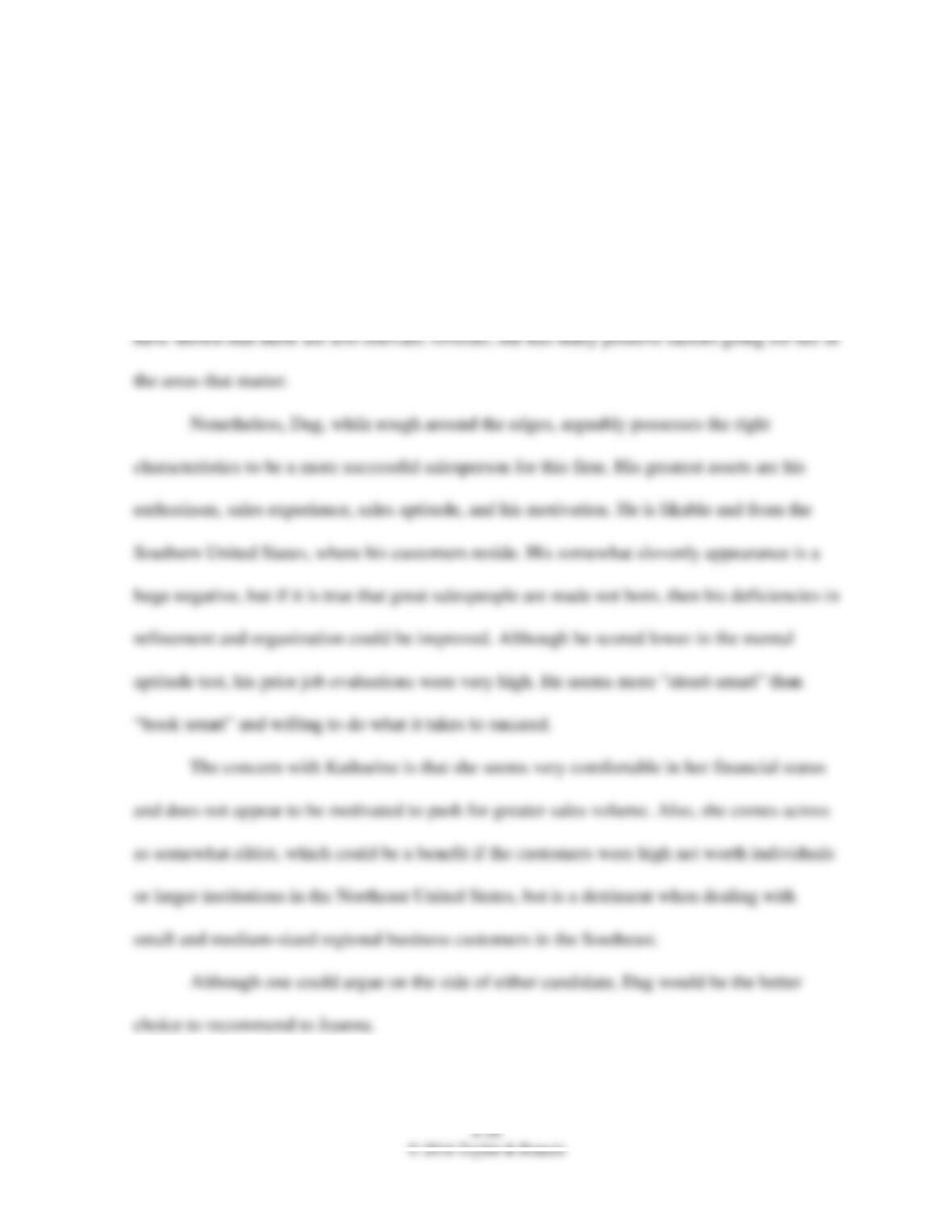
3. Although both candidates have positive and negative traits, on paper Katharine seems
like the more polished and perfect candidate. Her family background and marital status
indicate greater emotional maturity and are generally viewed as being directly correlated to
sales performance. She has a high level of education and scored highly on the mental aptitude
test. She does not have the physical characteristics usually associated with success, but studies