
Chapter 7 – Salesperson Performance: Motivating the Sales Force
7-1
Chapter 7
Salesperson Performance: Motivating the Sales Force
Learning Objectives for Chapter 7
• Understand the process of motivation.
• Discuss the effect of personal characteristics on salesperson motivation.
• Understand how an individual’s career stage influences motivation.
• Discuss the effect of environmental factors on motivations.
• Discuss the effect of factors inside the company on motivation.
Definition of Key Terms in Chapter 7
• Motivation
o It is the amount of effort the salesperson desires to expend on each activity or
task associated with the job. It can be further defined as an individual’s choice
to (1) initiate action on a certain task, (2) expend a certain amount of effort on
that task, and (3) persist in expending effort over a period of time.
• Expectancies
o Perceived linkages between expending more effort on a particular task and
achieving improved performance.
o Accuracy of expectancy estimates
▪ The degree to which the salesperson clearly understands the relationship
between effort expended on a task and the resulting achievement on some
performance dimension.
Chapter 7 – Salesperson Performance: Motivating the Sales Force
7-2
o Magnitude of expectancy estimates
▪ The degree to which the expectancy estimates of the salesperson reflect the
rep’s perceptions of his or her ability or influence his or her own job
Chapter 7 – Salesperson Performance: Motivating the Sales Force
7-3
o Unstable internal factors—these factors may vary from time to time (effort
expended or mood at the time).
o Stable external factors—these factors are external to the salesperson and

Chapter 7 – Salesperson Performance: Motivating the Sales Force
7-4
o Disengagement
▪ Salespeople who are beginning to prepare for retirement and the possible
loss of self-identity that can accompany separation form one’s job (often in
their late 50s or early 60s).
• Plateauing
o Often described as early disengagement it occurs when salespeople have
reached the limit of the potential (promotion and or performance) and begin to
exhibit negative job behaviors and attitudes.
• Earnings opportunity ratio
o The ratio of the total financial compensation of the highest paid salesperson to
the average in the sales force.
Chapter Outline
I. The Psychological Process of Motivation
A. Major Components of the Model
B. Expectancies—Perceived Links between Effort and Performance
a. Accuracy of Expectancies
b. Magnitude of Expectancies
C. Instrumentalities—Perceived Links between Performance and Rewards
a. Accuracy of Instrumentalities
b. Magnitude of Instrumentalities
D. Valences for Rewards
II. Can the Motivation Model Predict Salesperson Effort and Performance?

Chapter 7 – Salesperson Performance: Motivating the Sales Force
7-5
III. The Impact of a Salesperson’s Personal Characteristics on Motivation
A. Satisfaction
B. Demographic Characteristics
C. Job Experience
D. Psychological Traits
E. Performance Attributions
F. Management Implications
IV. Career Stages and Salesperson Motivation
A. Career Stages
a. Exploration Stage
b. Establishment Stage
c. Maintenance Stage
d. Disengagement Stage
B. The Problem of the Plateaued Salesperson
a. Causes of Plateauing
b. Possible Solutions
V. The Impact of Environmental Conditions on Motivation
VI. The Impact of Organizational Variables on Motivation
A. Supervisory Variables and Leadership
B. Incentive and Compensation Policies
VII. Summary
VIII. Key Terms
IX. Breakout Questions
Chapter 7 – Salesperson Performance: Motivating the Sales Force
7-6
X. Leadership Challenge: What Have You Done for Me Lately?
XI. Role-Play: Maven Software
XII. Minicase: Land Escape Vacation Club
PowerPoint Program—each chapter of the text has been captured in animated PowerPoint
slides
Chapter Outline with Suggestions for Class Discussion
The material in this chapter is somewhat theoretical. Students may experience difficulty
understanding the motivational process. As a result, this note is somewhat longer and
contains several examples to help explain the material.
Suggestion: Begin by using the following diagram:
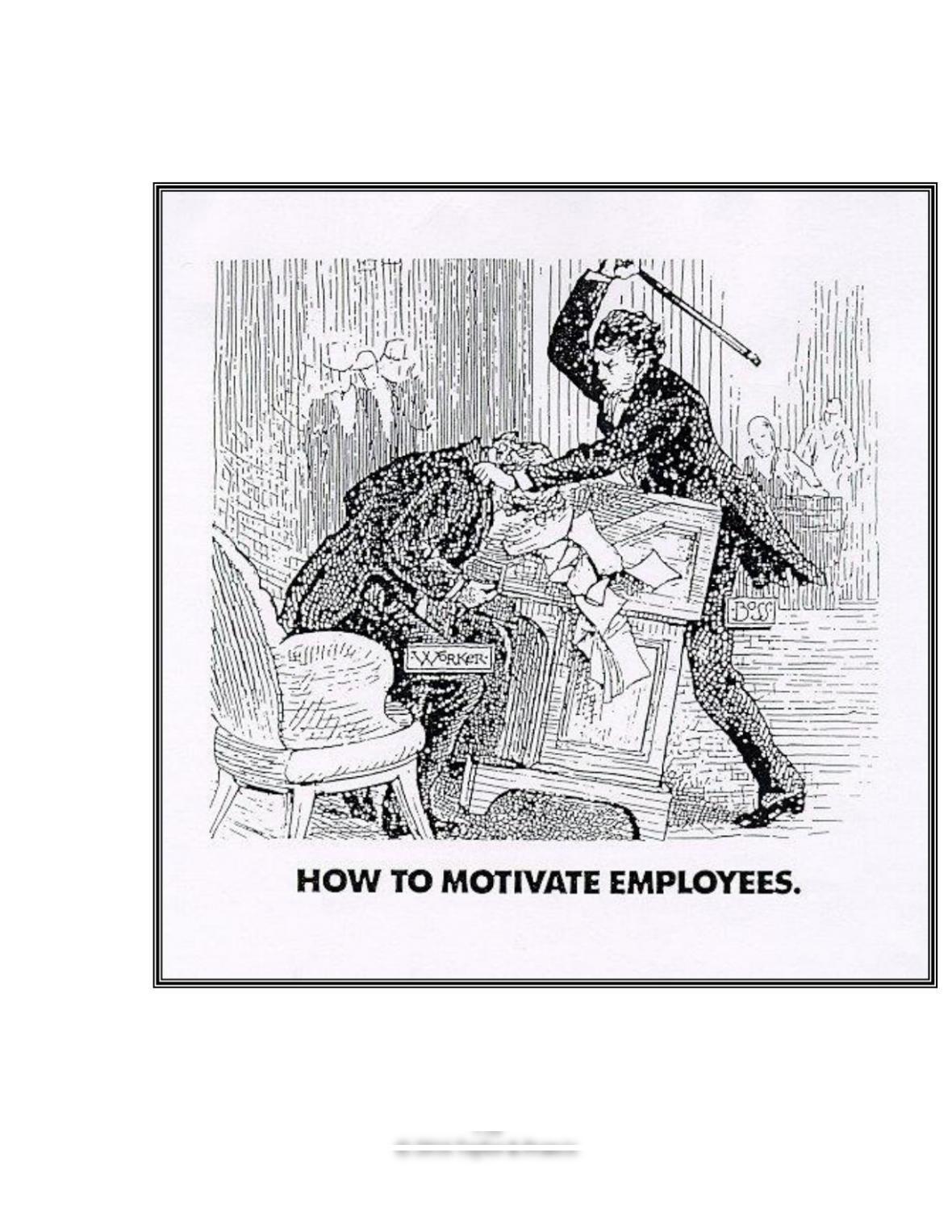
Point out that the motivation linkage with performance is a complicated subject of
great interest to sales managers. The cartoon included at the end of this section does not depict
the proper way to motivate salespeople.
To emphasize that motivation is a complicated “two–way street”, with action needed
by both salesperson and manager, you may want to summarize the points talked about in the
opening vignette, namely that the salesperson is responsible for his or her own motivation, yet
managers must understand each individual salesperson’s motivation and create an
environment that encourages them. Also, that sales force motivation—like other sales
performance determinants—does not operate in a vacuum. No matter how highly motivated
salespeople are, they will not be successful unless supported by a marketing strategy geared to
MOTIVATION PERFORMANCE

Chapter 7 – Salesperson Performance: Motivating the Sales Force
7-7
customer needs, a well-designed strategic sales program, and company policies that encourage
the best salespeople to remain with the company. PowerPoint slides 7.1 through 7.4
introduce the topic.
• Salesperson Motivators
Suggestion: Ask students to define motivation, expectancies, instrumentalities, and valence
for rewards. Trace the motivation process starting with the motivation box.
It helps to use two different activities such as calling on new accounts versus
preparing written reports to show how magnitude varies. Ask students to give their ideas as to
how the sales force might respond to sales managers asking for more effort on calling on new
accounts versus spending more time preparing written reports. Consult PowerPoint slides 7.5
through 7.7.
• The Psychological Process of Motivation
o Major Components of the Model
Suggestion: Define expectancies and review the implication of salespeople’s expectancy
estimates (PowerPoint slides 7.8 to 7.9).
• Expectancies—Perceived Links between Effort and Performance
Suggestion: Discuss instrumentalities and review the implications of salespeople’s
instrumentality estimates (PowerPoint Slides 7.10 to 7.12).
• Instrumentalities—Perceived Links between Performance and Reward
Suggestion: Valence for rewards can be discussed next. Show that even though historically
pay has been considered as the most desired reward, evidence exists to the contrary
(PowerPoint slides 7.13 to 7.15).
• Valences for Rewards

Chapter 7 – Salesperson Performance: Motivating the Sales Force
7-8
• Can the Motivation Model Predict Salesperson Effort and Performance?
Suggestion: Review the impact of personal characteristics on motivation (PowerPoint slides
7.16 to 7.22). Ask students why age is positively related with valence for higher order needs
and negatively related with valence for lower order needs.
Next, show how satisfaction with current rewards affects the valence relationship.
( – )
Satisfaction with low order needs ——— Valence for low order needs
(+)
Satisfaction with low order needs ——— Valence for low order needs
(+)
Satisfaction with high order needs ——— Valence for high order needs
• The Impact of a Salesperson’s Personal Characteristics on Motivation
o Satisfaction
o Demographic Characteristics
o Job Experience
o Psychological Traits
Suggestion: Performance attributions are a relatively new subject. Explain how expectancy
estimates will be affected based on what factors a given individual attributes the cause of
good performance or poor performance (PowerPoint slides 7.23 to 7.25). For example, if poor
performance is attributed to an unstable internal cause—such as not expending enough
effort—the salesperson’s expectancies may actually increase.
• Performance Attributions
• Management Implications
Suggestion: The role that career stages play in salesperson motivation is another new subject.
First, discuss the career stages presented (PowerPoint slides 7.26 to 7.28), and then use the
information in Exhibit 7.9 to show how a salesperson’s career stage influences motivation.
Chapter 7 – Salesperson Performance: Motivating the Sales Force
7-9
• Career Stages and Salesperson Motivation
o Career Stages
Suggestion: How to motivate the older salesperson has always been a problem (PowerPoint
slides 7.29 to 7.33). Many of these concerns are summarized in the chapter.
• The Problem of the Plateaued Salesperson
• The Impact of Environmental Conditions on Motivation
Suggestion: Finally, show how environmental and organizational variables influence
motivation.
• The Impact of Organizational Variables on Motivation
o Supervisory Variables and Leadership
o Incentive and Compensation Policies
Answers to Breakout Questions
1. Motivating support personnel: To apply the expectancy model to sales support
personnel requires showing how the successful completion of sales support activities can lead
Chapter 7 – Salesperson Performance: Motivating the Sales Force
7-10
What can a company do to motivate sales support personnel? Here are some
2. Career cycle: A major problem is that different pay plans lead to more administrative
procedures and additional costs. It is difficult to set up pay and incentive plans that would fit
7-11
3. Higher-order motivation: Many baby boomers are finding that money and toys do
not necessarily satisfy all their needs. There must be something else . . . something more. The
answer lies in the way in which the sales manager unlocks that answer from within the
4. CRM data input: A common concern by salespeople will sound like, “Putting all this
data in the CRM system keeps me from making more calls. More calls mean more sales.
Thus, data input impedes my performance.” The data input conflicts with expectancy and
possesses a very low valence. The instrumentality of the call far outweighs the report.
Applying inductive logic, rather than deductive logic, a salesperson views the data
input as a fact of life and applies no valence. Instead, this person probes the situation and
asks, “How can I get the greatest value from the data input and the CRM system?” “How will
this lead to more sales?” “More customer satisfaction?” The results will be quite different.
Chapter 7 – Salesperson Performance: Motivating the Sales Force
7-12
5. New accounts: Similar to the preceding question, this questioning salesperson is only
looking at the short-term outcome of new versus existing accounts. The instrumentality of
time spent on existing accounts outweighs that spend on new accounts because work on
existing accounts brings more immediate rewards. Instead, this person should be considering
Leadership Challenge: What Have You Done for Me Lately?
Teaching Notes
Ask any sales manager and he or she will tell you about having faced a similar situation. What
do you do with the salesperson that is no longer performing well? This chapter discusses in-
Chapter 7 – Salesperson Performance: Motivating the Sales Force
7-13
Answers to Leadership Challenge Questions
1. The “problem” with Jason has not come up overnight. As explained in the Challenge,
his performance, while outstanding at first, had been in decline for several years. Masters
2. As discussed in the chapter, younger salespeople early in their career are looking for
opportunities to perform and advance their career. If Masters is unable to provide adequate
3. As mentioned earlier, Jason’s decline in performance is probably not the result of a
single issue. Having said that there could be several primary drivers affecting Jason’s
Chapter 7 – Salesperson Performance: Motivating the Sales Force
7-14
Role-Play: Maven Software
This fun role-play should be a quite challenging situation for students—especially younger
students. Chapter 7 provides important insights on career stages of salespeople and
Chapter 7 – Salesperson Performance: Motivating the Sales Force
7-15
• Be sure both players leave the meeting with some specific commitments on items
for follow-up and implementation.
1. Career Stages
Catalina—She is reluctantly transitioning from the Exploration stage to the Establishment
Chapter 7 – Salesperson Performance: Motivating the Sales Force
7-16
• Because of older age, family size, and education, she generally has a higher
valence for higher order awards and a lower valence for lower order awards.
However, she is in need of money.
Chapter 7 – Salesperson Performance: Motivating the Sales Force
7-17
• Has a lower valence for lower order rewards and a higher valence for higher order
3. Motivating as a group
Denise must give proper attention to each salesperson, but without breathing down their necks
(span of control). She spends more time on Zach because she sees his potential, but she avoids
Chapter 7 – Salesperson Performance: Motivating the Sales Force