Chapter 5 – The Strategic Role of Information in Sales Management
5-13
• Use simple, straight-forward forecasting techniques. Sophisticated and complex procedures do not
2. Business firms and non-profit institutions as well make forecasts whenever decisions are made
that will affect future activities. A business firm that purchases products to sell makes a forecast that these
products will sell, regardless of the decision process applied. Similarly, a museum that installs an art
3. The following factors are examples. Students will offer others.
a. Yoplait yogurt—retail food sales data from Sales & Marketing Management’s Annual Survey
Chapter 5 – The Strategic Role of Information in Sales Management
5-14
d. Power riding lawnmowers—number of households in single family homes with income
4. These results are not completely positive. First the R2 shows that only 65 percent of the variation
in unit sales of garden tractors is explained by number of single family homes, disposable personal
income, index of food prices, and family size. The correlation should be stronger to be more useful.
Chapter 5 – The Strategic Role of Information in Sales Management
5-15
5. Since it takes people with money to buy a cake mix, it makes sense to use population and income
6. The reason for the panic should be discussed first. If not handled properly, salespeople may think
that their sales forecasts will be used to develop their quotas in the strictest sense. As a result, salespeople
may deliberately forecast low in order to achieve a quota that is easy to reach.
7. Sometimes, it may be favorable to make changes in territory assignments when a better match can
Chapter 5 – The Strategic Role of Information in Sales Management
5-16
8. There are several factors that suggest the need to modify sales territories. Inadequate coverage of
the accounts in a territory might indicate that the territory is too large. Inequities between territories in the
time salespeople have available to spend with customers might be another indicator that a territory is too
small or too large. Great discrepancies among earning potential from one territory to another may indicate
9. Close examination of above-par situations may reveal approaches used by a salesperson that can
be shared successfully with others to the advantage of the overall sales organization. Also, there is a great
5-17
10. From a sales management perspective, scanner data has been used to determine the impact of
adding new products to the existing line of products sold by the sales force. This has been the case where
companies adopt a regional roll-out of new products rather than a national roll-out. Scanner data
facilitates the application of quasi-experimental design. Thus, one could test different sales compensation
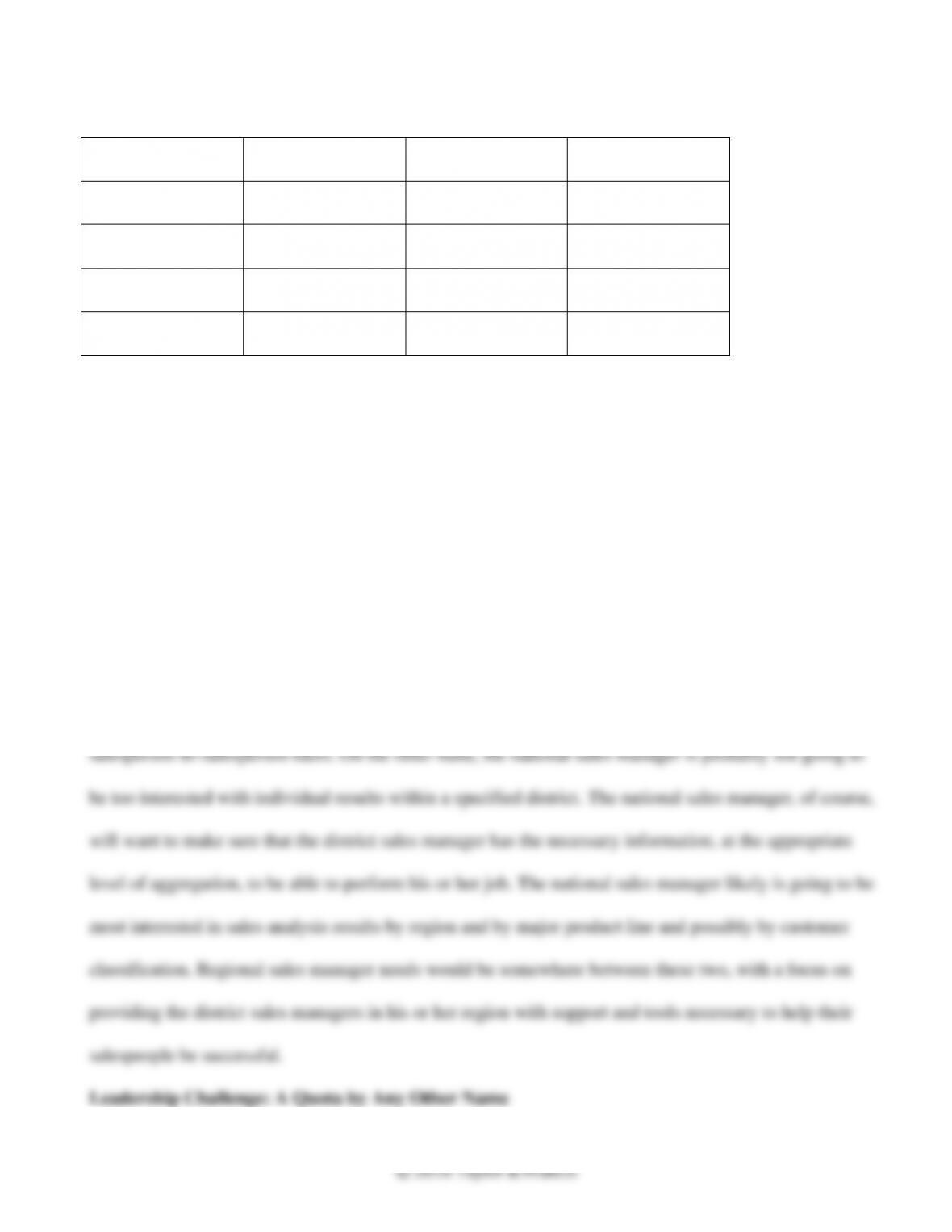
11. The following results for 2010 are based on the information given in the question:
Actual Sales
Expected Sales
Performance Index
Territory 1
$5,425,000
4,995,000
108.6%
Territory 2
3,505,000
2,775,000
126.3%
Territory 3
3,710,000
3,330,000
111.3%
Chapter 5 – The Strategic Role of Information in Sales Management
5-18
Territory 4
2,400,000
2,220,000
108.1%
Territory 5
3,900,000
3,700,000
105.4%
Territory 6
2,000,000
1,480,000
135.1%
Total
$20,940,000
$18,500,000
113.2%
The sales representative from Territory 6 achieved the best results, however all the sales
representatives had a very good year versus expected sales. More information is needed before any
judgments are made about salesperson performance on dimensions other than actual gross sales versus
expected gross sales.
12. District sales managers are not likely to be interested in the same kinds of information as the
national sales manager. A district sales manager is more likely to be interested in a sales analysis that
identifies district problems that for which he or she can provide direct solutions, particularly on a

Chapter 5 – The Strategic Role of Information in Sales Management
Teaching Notes
Determining the nature of sales quotas is critical to the success of a sales force for many reasons. Quotas
1. The most significant advantage is that a sales volume based quota system is directly related to
sales targets (sales revenue, product units, etc.). Management, salespeople, indeed everyone in the
company knows that success in hitting the quota targets means more sales for the company. Ultimately,
5-20
2. In most cases the advantages and disadvantages are the mirror opposite of those identified under a
sales volume-based quota. Specifically, activity-based quota systems encourage all the non-sales related
3. A case can be made for a sales volume-based system. However, given the increased importance of
maintaining good relationships with critical customers like Home Depot and Lowe’s, the company should
consider identifying critical activities/outcomes and then building a quota system that reflects company
expectations in that area. Focusing on these activities in the quota system reinforces their importance in
5-21
Hints for the Instructor
• Students should focus on understanding the importance of using multiple methods of
forecasting so that managers can make better decisions under uncertain conditions.
Chapter 5 – The Strategic Role of Information in Sales Management
5-22
This case illustrates the challenges faced by a manager with the gathering and use of strategic
1. Rajiv’s territory design needs improvement. His goal should have been to make all territories
equal with respect to the amount of sales potential they contain and the amount of work it takes a
salesperson to cover them effectively. Instead, Rajiv simply divided the state in equal geographic parts,
using cities as the basic control unit. This causes problems because some territories contain more business
2. Rajiv performed a sales forecast using both the sales force composite method as well as by taking
a moving average of the previous four years of sales. The sales force composite method is a subjective

Chapter 5 – The Strategic Role of Information in Sales Management
5-23
forecasting method and is good in that it involves the sales personnel who will be responsible for the
results. However, the primary disadvantage with this method is illustrated by Syl underestimating his
3. Rajiv used the sales volume quota, expressed in sales dollars. Quotas, if used correctly, are
wonderful tools to provide incentives for sales representatives and to evaluate sales representatives’
performance. However, Rajiv did not set the appropriate quota level because he set all four

Chapter 5 – The Strategic Role of Information in Sales Management
5-24
personnel to cheat in order to make their quotas. Further, the percentage of compensation (25%) tied to
the quota is too high and puts undue pressure on the sales personnel.