
Chapter 3 – Linking Strategies and the Sales Role in the Era of CRM and Data Analytics
3-1
Chapter 3
Linking Strategies and the Sales Role in the Era of CRM and Data Analytics
Learning Objectives for Chapter 3
• Understand and outline the key components and goals of CRM.
• Explain the importance of a market orientation and how a market orientation is fostered within
a firm.
• Identify the key steps in developing and implementing strategies.
• Describe the role of personal selling in marketing strategy.
• Outline the stages in developing strategic partnership relationships between organizations.
• Discuss the actions salespeople can take to ensure successful long-term buyer–seller
relationships.
Definition of Key Terms in Chapter 3
• Marketing concept
o Turning to consumers themselves for input in making strategic decisions about what
products to market, where to market the products and how to get them to market, at what
price, and how to communicate with consumers about the products.
• Marketing mix
o The four elements of product, distribution, price, and promotion.
• Marketing communication mix (promotion mix)
o The promotional message used by a firm to communicate with customers
▪ Personal selling
▪ Advertising
▪ Sales promotion
Chapter 3 – Linking Strategies and the Sales Role in the Era of CRM and Data Analytics
3-2
• Direct marketing
▪ Public relation/publicity
• Market orientation
Chapter 3 – Linking Strategies and the Sales Role in the Era of CRM and Data Analytics
3-3
• Target marketing
o Applying principles of segmentation to create different strategies and marketing programs
for different consumer groups.
Chapter 3 – Linking Strategies and the Sales Role in the Era of CRM and Data Analytics
3-4
• Data warehouse
o The compilation of information obtained from touchpoints and transformation of that
information into useful information for customer strategy development.
Chapter 3 – Linking Strategies and the Sales Role in the Era of CRM and Data Analytics
3-5
• Sustainable competitive advantage (SCA)
o This is the keystone of a business-level strategy about how a business will compete it its
market based on the set of distinctive competencies exhibited b the firm, the quality or
Chapter 3 – Linking Strategies and the Sales Role in the Era of CRM and Data Analytics
3-6
• Strategic partnerships
o Long-term relationships in which the partners make significant investment to improve
profitability of both companies and jointly achieve strategic objectives.
Chapter 3 – Linking Strategies and the Sales Role in the Era of CRM and Data Analytics
3-7
• Integrated marketing communications (IMC)
o Various ways a firm strategically communicates its message about its products to the
marketplace.
Chapter 3 – Linking Strategies and the Sales Role in the Era of CRM and Data Analytics
3-8
• Selling team
o A group of representatives from various functional departments of the company assigned
to a single customer.
• Top-to-top selling
o Executives at the very top of firms (even CEOs) are directly involved in selling to major
strategic partner customers.
Chapter Outline
I. What Is Customer Relationship Management?

Chapter 3 – Linking Strategies and the Sales Role in the Era of CRM and Data Analytics
3-9
A. How Market Orientation Affects Performance
B. Internal Partnering to Create a Market Orientation
III. The Process of Strategy Development
A. Company Mission and Goals
B. SBU Strategy
a. Step One: Analyze Market Opportunities
b. Step Two: Generate Strategies
c. Step Three: Select the Strategy
d. Step Four: Program the Marketing Mix
e. Step Five: Review and Revise the Strategy
f. Step Six: Audit and Adjust the Strategy
IV. The Importance of Integrating Sales with Other Business Functions
V. Personal Selling’s Role in Marketing Strategy
A. Role of the Relationship
a. Market Exchanges
b. Functional Relationships
c. Strategic Partnerships
VI. Personal Selling in the Relationship Era
A. Exploration Stage
a. Set Proper Expectations
b. Monitor Order Processing and Delivery
c. Ensure Proper Use
d. Assist in Servicing
B. Expansion Stage

Chapter 3 – Linking Strategies and the Sales Role in the Era of CRM and Data Analytics
3-10
a. Generating Repeat Sales and Upgrading
b. Full-Line Selling
c. Cross-Selling
C. Commitment Stage
a. Securing Commitment
VII. Personal Selling’s Role in the Marketing Communication Mix
A. Advantages and Disadvantages of Selling in Marketing Communication
B. Company Resources, Goals, and Marketing Strategy
C. Characteristics of the Target Market
D. Product Characteristics
E. Distribution Practices
F. Pricing Policies
G. Computerized Ordering and Customer Alliances
VIII. Improving Customer Satisfaction and Loyalty Through Feedback
A. Major Account Teams
IX. Summary
X. Key Terms
XI. Breakout Questions
XII. Leadership Challenge: Whose CRM Is It Anyway?
XIII. Role-Play: Serendipity Wireless
XIV. Minicase: TransSprech, A.G.
PowerPoint Program—each chapter of the text has been captured in animated PowerPoint slides.
Chapter Outline with Suggestions
• The Importance of Integrating Sales with Other Business Functions
Chapter 3 – Linking Strategies and the Sales Role in the Era of CRM and Data Analytics
3-11
Suggestion: Using PowerPoint slides 3.1 through 3.3, give an overview of the chapter and then move
into PowerPoint slides 3.4 through 3.6 to begin CRM and customer-centric discussions.
• What Is Customer Relationship Management (CRM)?
o From Mass Marketing to One-to-One Marketing
Suggestion: PowerPoint slide 3.8 illustrates the objectives of CRM. The PowerPoint slides 3.9 through
3.13 present further information on CRM.
o Toward a Relationship-Based Enterprise
Suggestion: A market orientation as compared to a selling focus is important and PowerPoint slides 3.14
and 3.15 illustrate this point. Ask students to name organizations, profit and not-for profit, large and small
and indicate their missions and goals. Ask them to note whether or not objectives and goals are being met.
• The Importance of Market Orientation
o How Market Orientation Affects Performance
Chapter 3 – Linking Strategies and the Sales Role in the Era of CRM and Data Analytics
3-12
Suggestion: PowerPoint slide 3.23 shows the three stages in relationship development.
• Personal Selling in the Relationship Era
o Exploration Stage
o Expansion Stage
o Commitment Stage
Suggestion: Slides 3.25 through 3.27 discuss IMC
Suggestion: Close with PowerPoint slides 3.28, discussing customer satisfaction and leveraging value.
Answers to Breakout Questions
1. In many modern organizations, the CRM initiative was brought to bear through the IT department.
This is because the process was initiated with the sale of CRM software to the firm. In such cases, often
little strategic planning or organizational structure development has taken place prior to investment in
CRM. When this happens, the odds that CRM will deliver its potential benefit to the firm are very low.
Chapter 3 – Linking Strategies and the Sales Role in the Era of CRM and Data Analytics
strategic decisions about what products to market, where to market the products and how to get them to
2. This answer will vary by student. What one should look for to gauge the success of an IMC mix is
how customers respond to the messages such that the image and message surrounding a firm and its
3. This answer also will vary by student. Students should note that a number of the aspects of the
4. Again, this answer will vary by student. The characteristics of strategic partnerships illustrated in

3-14
5. It is becoming more and more common for executives to engage in “top–to-top” selling. For one
thing, CEOs know that their involvement in the selling process can impress the very most important of
customers. They also recognize a major potential disadvantage — their involvement runs the risk of
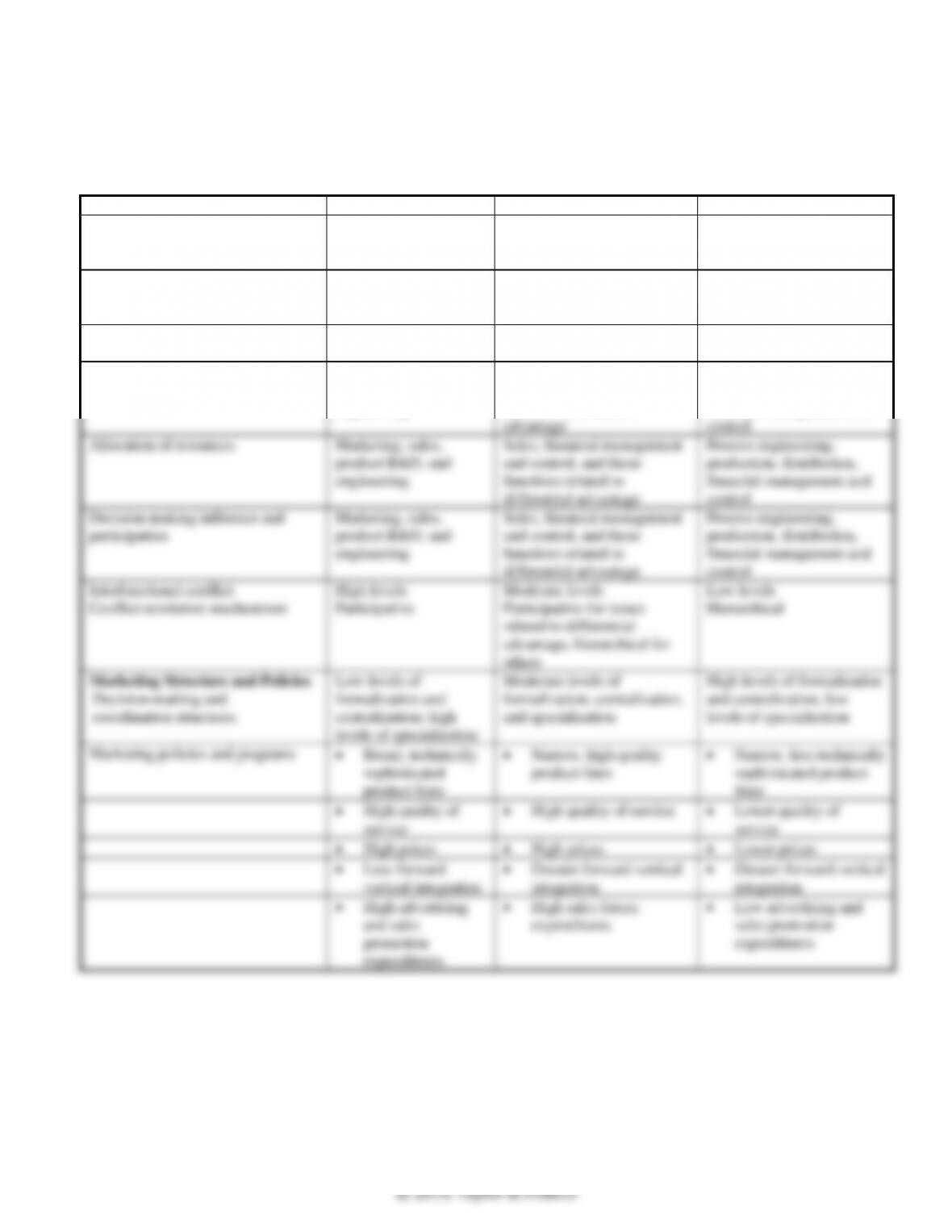
6. The exhibit on the following page identifies the factors that are related to the implementation of
business unit strategies.
Ideally, the best option for a prospector SBU would be to have its own dedicated sales force.
Chapter 3 – Linking Strategies and the Sales Role in the Era of CRM and Data Analytics
Factors Related to the Successful Implementation of Business Unit Strategies
Reprinted from Orville C. Walker, Jr. and Robert W. Ruekert, “Marketing’s Role in the Implementation of
Business Strategies,” Journal of Marketing, 51, July 1987, p. 15, published by the American Marketing
Association. Reprinted with permission.
Organizational Variable
Prospectors
Differentiated Defenders
Low Cost Defenders
Corporate Business Unit
Business unit autonomy
High levels of
autonomy
Moderate levels of autonomy
Low levels of synergy
Shared programs and synergy
Low levels of synergy
Low levels in areas related to
differential advantage; high
levels in other areas
High levels of synergy
Control and reward systems
Sales- or market-share-
based systems
Profitability-based systems
Profitability-based systems
Interfunctional Relationships
Functional competencies
Marketing, sales,
product R&D, and
engineering
Sales, financial management
control, and those functions
related to differential
advantage
Process engineering,
production, distribution,
financial management and
control
Allocation of resources
Marketing, sales,
product R&D, and
engineering
Sales, financial management
and control, and those
functions related to
differential advantage
Process engineering,
production, distribution,
financial management and
control
Decision-making influence and
participation
Marketing, sales,
product R&D, and
engineering
Sales, financial management
and control, and those
functions related to
differential advantage
Process engineering,
production, distribution,
financial management and
control
Interfunctional conflict
Conflict resolution mechanisms
High levels
Participative
Moderate levels
Participative for issues
related to differential
advantage, hierarchical for
others
Low levels
Hierarchical
Marketing Structure and Policies
Decision-making and
coordination structures
Low levels of
formalization and
centralization; high
levels of specialization
Moderate levels of
formalization, centralization,
and specialization
High levels of formalization
and centralization, low
levels of specialization
Marketing policies and programs
• Broad, technically
sophisticated
product lines
• Narrow, high quality
product lines
• Narrow, less technically
sophisticated product
lines
• High quality of
service
• High quality of service
• Lower quality of
service
• High prices
• High prices
• Lower prices
• Less forward
vertical integration
• Greater forward vertical
integration
• Greater forward vertical
integration
• High advertising
and sales
promotion
expenditures
• High sales forces
expenditures
• Low advertising and
sales promotion
expenditures

Chapter 3 – Linking Strategies and the Sales Role in the Era of CRM and Data Analytics
3-16
Leadership Challenge: Whose CRM Is It Anyway?
Teaching Notes
The Challenge is set up to encourage discussion on all the sales issues associated with a CRM system. At
the core of the Challenge is the implementation of a CRM system at New World Manufacturing. Alice
Klein is faced with the same decisions many managers must deal with in implementing such a system.
These issues include; what information is important for the salesperson (management), how do deliver
that information, and what should the salesperson do with it once they have it?
A basic discussion on CRM can begin with identifying the objectives of a CRM system and how
they might apply in this case. Additionally, it is possible to talk about the advantages of CRM and why a
company like New World would want to invest in and implement a CRM system in the company.
Answers to Leadership Challenge Questions
1. Examples of the helpful information would be 1) recent sales, 2) any problems with orders, 3)
feedback from the customer that has been received by other departments in the company such as customer
2. The laptop will most likely dominate the responses and Wi–Fi network cards or Bluetooth
technology permits salespeople to access data easily and remotely. Interestingly, there have been a
3-17
© 2016 Taylor & Francis
the decision making process when, in fact, the real driver should be the salespeople working with their
management team.
3. There are a host of questions and issues that companies face in implementing a CRM system.
What format should the data come to the salesperson (by product or customer, in written or electronic)?
How often should sales people receive the information? Should salespeople be allowed to not receive but
input new data (for example changing product delivery dates) into the system?
Role-Play: Serendipity Wireless
The key “value–added” of this role-play is driving home to students the fact that Customer Relationship
Management is relevant to sales managers and sales people. The characters Leo Leone and Carla
Cadwallader are not using Serendipity’s CRM system to their advantage and are holding back the
performance of their whole sales district. This role-play gives students the opportunity to understand the
value of CRM to the selling effort, and also to understand how a sales manager sometimes must “sell”
using tools like CRM to veteran salespeople.
Hints for the Instructor
• Make sure students stay focused on the industry Serendipity Wireless is in—that is, they
should be looking for ways that CRM and database marketing can help Serendipity reps better
sell to the small- to medium-sized businesses that comprise the company’s key market.
• Before the meeting, the student playing Ellie should develop a short list of key ways CRM can
help the reps be successful. She should then use the meeting time to convince Leo and Carla
that it is in their own best interest (as well as in the interest of their customers) to take
advantage of the company’s CRM system when selling.
• Students playing Leo and Carla should be resistant but should come around if Ellie does a
good job demonstrating the benefits of CRM to their success. Whatever happens, Ellie should

Chapter 3 – Linking Strategies and the Sales Role in the Era of CRM and Data Analytics
3-18
not use a “hammer” approach to “make” the reps use CRM. They need to use it because they
believe in it.
• After the role-play, instructors have a great opportunity to recap the key ways CRM and
database driven selling add value to salespeople and customers.
Minicase: TransSprech, A.G.
Teaching Notes
This case allows students to play the role of consultant and identify the four elements of the marketing
mix based on facts gathered from a fictitious client. The case then illustrates how the strategies for each
element link to Customer Relationship Management (CRM). The case also addresses the issue of whether
personal selling should be used the promotion mix. Students should be encouraged to be creative in
considering the different information they might like to have to be able to further advise Herr Wursching.
Answers to Minicase Questions
1. Marketing Mix: Product, Price, Promotion, and Distribution Product: The current plan is to
provide international cellular phone service over a GSM satellite network to customers worldwide. The
phones themselves are similar to competing cell phone providers, but the satellite service is differentiated
Chapter 3 – Linking Strategies and the Sales Role in the Era of CRM and Data Analytics
3-19
© 2016 Taylor & Francis
Distribution: It sells directly through its company website as well as through licensed retailers. It
does not have its own stores for customer service or retail.
Based on this information about premium pricing and a target market of cell phone customers
wanting global cellular coverage, the generic business strategy appears to be one of Niche, under Porter’s
typology, and one of Prospector under Miles and Snow’s typology.
2. Based on the information given and the stated goals of Herr Wursching, the company’s promotion
mix should be a combination of personal selling and advertising. Several factors lend themselves to
personal selling:
• Relatively few number of customers
3. There is plenty of additional information a consultant could obtain in order to better advise Herr
Chapter 3 – Linking Strategies and the Sales Role in the Era of CRM and Data Analytics
3-20
b. Who is the target customer (size, demographic, geographic distribution)?
c. What other competitors provide this international service?
Herr Wursching’s instincts about customer loyalty and value of existing customers are correct, and
establishing a sales force is a must in order to achieve these goals. Likewise, a CRM system is also must.
However, Herr Wursching is also correct that simply investing in a software package for CRM is not the
ultimate answer. Although technology is key to modern CRM, at its heart it is more than mere software.
The consultant should help TransSprech establish the culture, structure, leadership, and internal expertise
in order to make the initiative successful, and then develop a software system that fits the established
CRM plans.