
Chapter 11 – Salesperson Compensation and Incentives
11-1
Chapter 11
Salesperson Compensation and Incentives
Learning Objectives for Chapter 11
• Discuss the advantages and limitations of straight salary, straight commission, and
combination plans.
• Explain how and why a bonus component to compensation might be used as an
incentive.
• Understand the effective use of sales contests, as well as the potential pitfalls of their
use.
• Identify key nonfinancial rewards, and how and why they might be important.
• Recognize key issues surrounding expense accounts in relationship selling.
• Discuss making decisions on the mix and level of compensation.
Definition of Key Terms in Chapter 11
• Compensation plan
o The method used to implement the reward structure in an organization.
• Salary
o A fixed sum of money paid at regular intervals. The amount of salary paid us
most often a function of the individual’s experience, competence, tenure on the
job as well as the superior’s judgments about the quality of the salesperson’s
performance.
• Incentive payment
Chapter 11 – Salesperson Compensation and Incentives
11-2
o Additional compensation to encourage good performance. These incentives may
take the form of commissions tied to sales volume or profitability, or bonuses for
meeting or exceeding specific performance targets.
Chapter 11 – Salesperson Compensation and Incentives
11-3
• Nonfinancial incentives
o Are incentive in addition to financial compensation such as opportunities for
promotion or various types of recognition for performance like special awards
Chapter 11 – Salesperson Compensation and Incentives
11-4
II. Straight Salary, Straight Commission, and Combination Plans
A. Straight Salary
a. Advantages
b. Limitations
B. Straight Commission
a. Advantages
b. Limitations
C. Combination Plans
a. Proportion of Incentive Pay to Total Compensation
b. Incentive Ceilings
c. When Is a Sale a Sale?
d. Team versus Individual Incentives
e. When Should the Salesperson Receive Incentive Payments?
Chapter 11 – Salesperson Compensation and Incentives
11-5
VI. Expense Accounts
A. Direct Reimbursement Plans
B. Limited Reimbursement Plans
Chapter 11 – Salesperson Compensation and Incentives
11-6
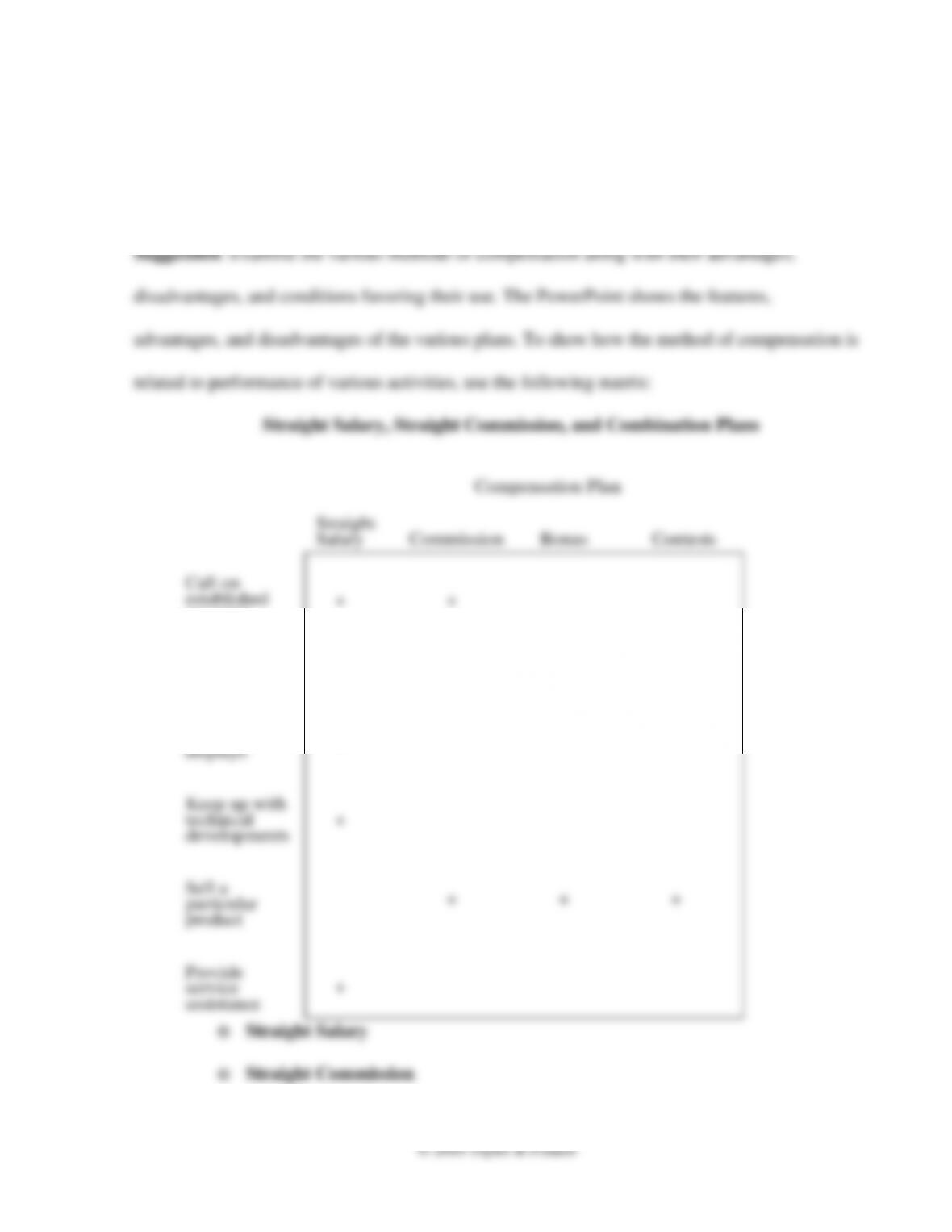
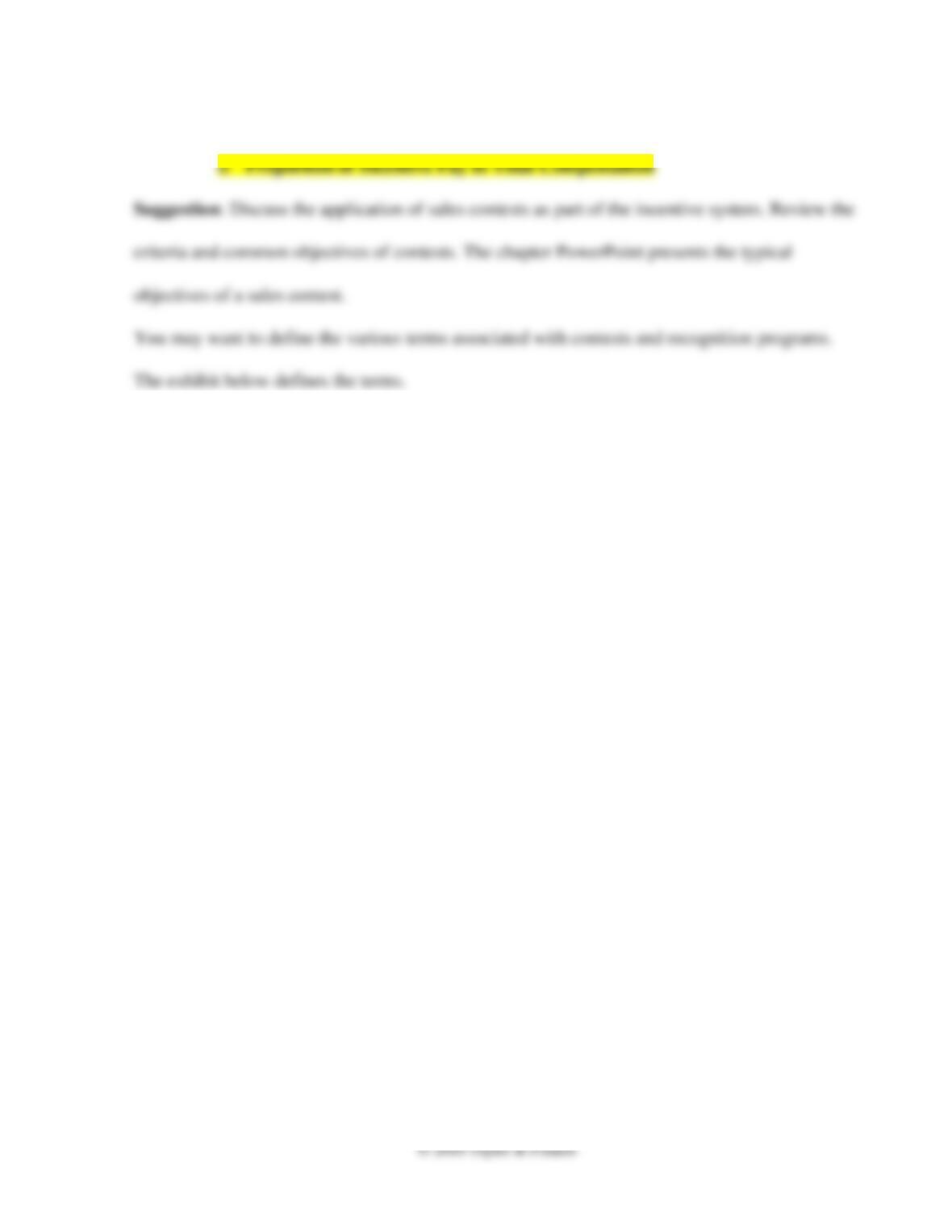
PowerPoint illustrates the key compensation questions and shows the components and objectives
of compensation plans.
• Overview of Compensation and Incentives
technical
developments
Sell a
particular
product
Provide
service
assistance
+
+ + +
+
Chapter 11 – Salesperson Compensation and Incentives
11-7
o Combination Plans
Chapter 11 – Salesperson Compensation and Incentives
11-8
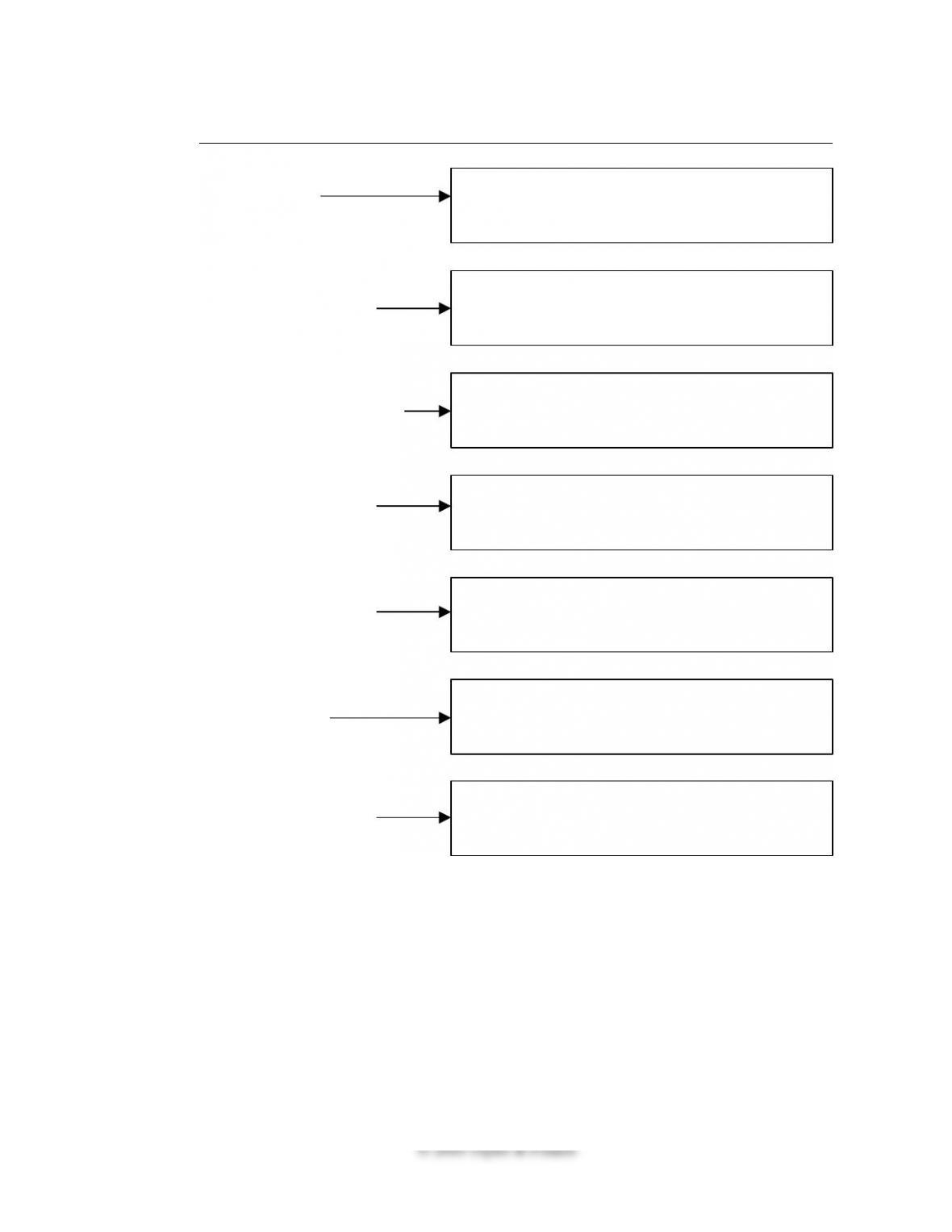
DEFINITIONS
•Sales Contest
•Special Cash Incentives
•Non-Cash Incentives
•Travel Awards
•Recognition Awards
A competitive event to stimulate achievement
of short-term sales objectives
A formal plan designed to encourage and
reward outstanding achievement over the long
term
Dollar awards offered in return for specific
performance during specific period of time
Highly customized to needs/objectives of
organization and announced for a specific
period of time
Pre-selected or earned through the
accumulation of points applied to a catalogue,
generally of some significant financial value
Trips awarded to individual/family or to a
group within the organization; often business
seminar related
Trophies, plaques, rings, publicity given for
symbolic purposes rather than for financial
value
•Merchandise Awards
•Recognition program
Sales representatives frequently criticize contests. A survey of 1,761 salespeople by Roy
W. Walters and Associates showed that their biggest gripe was about “rah-rah” sales contests.
One sales representative said:
I don’t need special contests to make me perform better. I
do a good job all the time—I don’t need a contest to put
out a little extra. All my boss has to tell me is what is the
Chapter 11 – Salesperson Compensation and Incentives
11-9
objective for his unit and then we should agree as to what
my portion should be in meeting that objective. I’ll do it—
not for the prize. The prize becomes more important than
meeting the objective. How silly can you get?
Chapter 11 – Salesperson Compensation and Incentives
11–10
“We have found we could do some things with incentives (sales contests) that were not possible
with a salary plus bonus (based on volume) incentive plan. For example, we’ve been using
incentives to put more emphasis on our new products.”
Chapter 11 – Salesperson Compensation and Incentives
11–11
Suggestion: To provide a balanced perspective use the following exhibit to show a situation
where a sales incentive program produced positive results.
DO SALES INCENTIVES WORK?
Chapter 11 – Salesperson Compensation and Incentives
11–12
Lastly, review the various nonfinancial/recognition rewards used by sales manager to motivate
the sales force. The following exhibits highlight a seminar and a survey sponsored by the
Alexander Group, Inc.:
“a structure plan (i.e., President’s Club
repeated each year) designed to
recognize and reward individuals 100% Club
for high levels of achievement
compared to defined Salesperson of the Year

Chapter 11 – Salesperson Compensation and Incentives
11–13
• Cash, bonds, stock 47%
• Watches, clocks 44%
• Rings 35%
SAMPLE PROGRAM
Sales Ring Club Awards
Objectives: Sales forecast achievement
Attainment of strategic sales goals
Performance criteria: Percent actual sales to forecast
Percent of product mix sales goals
Percent of winners: 20% to 30%
Awards: First year, ring; subsequent years,
additional diamonds
Company stock valued at $1,000
Certificate of achievement
See the PowerPoint for a discussion of nonfinancial rewards as well.
• Nonfinancial Rewards
o Recognition Programs
Suggestion: The control of selling expenses consumes considerable time. Review the dilemma
faced by sales managers from maintaining too tight or too loose control of selling expenses. Ask
students if salespeople should be given selling expense quotas.
• Expense Accounts
o Direct Reimbursement Plans
o Limited Reimbursement Plans
o No Reimbursement Plans

Chapter 11 – Salesperson Compensation and Incentives
Suggestion: Review the procedures for designing a compensation and incentive program. Stress
that most companies should periodically review their compensation and incentive programs. The
dynamic nature of the marketing environment produces changes in all aspects of the marketing
mix: the compensation plan is no exception.
• Making Compensation and Incentive Plans Work
o Assessing the Relationship Selling Objectives
Suggestion: Identify the kinds of activities and performance outcomes to be encouraged by the
compensation and incentive program. Point out that most authorities recommend that
compensation and incentive programs should link rewards to only two or three aspects of job
performance. Ask students what would happen if a company tried to link rewards to a large
number of performance outcomes.
o Determining Which Aspects of Job Performance to Reward
• Deciding on the Most Appropriate Mix and Level of Compensation
Suggestion: The appropriate level of compensation may be discussed next. Discuss the
appropriate mix and level of compensation. Review the dangers of overcompensation and
undercompensation.
Suggestion: Another topic to discuss is the use of ceilings on incentive payments. The issue
usually generates considerable interest among students who feel that incentive caps should not
be used. The windfall sale issue also generates discussion. Windfall sales—IBM calls them a
bluebird over the transom—have the potential to pay very large commissions to the lucky
benefactor. Ask students to consider the impact such an event might have on sales force morale.
o Dangers of Paying Salespeople Too Much
o Dangers of Paying Salespeople Too Little