
A = !” !!!!” !!
!!!!!!
= !” !!/!!
!!!!!!
= !” !.!”#!!” !.!
!.!!!.! =
!” !.!”#
!.!
!.!!!.! = !!.!”#
!.! = -14.34
ln B = ln y1 – Ax1 = ln(4.8) – (-14.34) (1.2) = 18.77
calibrate the instrument. Each measurement was taken three times for replication
purposes. This analysis will help improve the fermentation process to produce the
maximum yield of ethanol as a biofuel.
The table below shows the measurements performed during the fermentation
process,
Ethanol Concentration (g l-1)
Peak Area
4.0
45.55, 52.07, 52.89
13.0
112.65, 113.37, 114.88
19.0
172.05, 174.66, 183.50
25.0
236.48, 236.97, 230.47
33.0
301.80, 303.54, 306.28
a.) Determine the mean and standard deviation for the peak areas for each ethanol
concentration.
Solution
Ethanol Concentration (g l-1)
Mean
Standard Deviation
4.0
50.17
4.022
13.0
113.63
1.138
19.0
176.74
6.001
25.0
234.64
3.620
33.0
303.87
2.259
b.) Plot the data and show the equation for ethanol concentration as a function of
peak area. Show that there is a linear trend with a linear least squares fit of the
data.
Solution

The linear least squares fit line is represented by, y = 0.114x – 0.793, where y
is the ethanol concentration and x is the peak area.
Solution
Substituting x = 125.44 into the linear least squares fit line gives,
y = 0.114x – 0.793 = 0.114 (125.44) – 0.793 = 13.51 g l-1
culture of hybridoma cells is shown below. Liter per day is used for flow rate and micro
grams per milliliter for antibody concentration.
Flow Rate (l d-1)
Concentration of Antibodies (µg ml-1)
0.12
97.3
0.16
92.1
0.20
86.1
0.22
80.0
0.28
73.8
0.31
65.7
0.39
56.2
0.42
50.3
0.46
47.7
0.51
43.6
0.55
39.9
0.59
31.4
0.62
29.5
0.70
23.3
0.76
19.2
0.79
18.1
0.82
16.2
0.85
15.7
0.93
11.2
1.03
9.6
a.) Plot the data points on linear graph paper and determine the ‘best fit’ line
using least-squares analysis.
Solution
The linear least-squares ‘best fit’ line of the data is,
y = -102.64x + 100.31
where y is the concentration of antibodies in µg ml-1 and x is the flow rate
plotted residuals?
Solution
Residuals are calculated as the difference between the measured values
and the predicted y values obtained from the model equation.
Flow Rate (l d-1)
Predicted Y
Residual
0.12
87.991
9.308
0.16
83.886
8.214
0.2
79.780
6.320
0.22
77.728
2.272
0.28
71.569
2.231
0.31
68.490
-2.790
0.39
60.279
-4.079
0.42
57.120
-6.900
0.46
53.094
-5.394
0.51
47.962
-4.362
0.55
43.857
-3.957
0.59
39.751
-8.351
0.62
36.672
-7.172
0.70
28.461
-5.161
0.76
22.302
-3.102
0.79
19.223
-1.123
0.82
16.144
0.056
0.85
13.065
2.635

0.93
4.854
6.346
1.03
-5.410
15.010
If creating a straight line y = 0, the residual values range from being
mainly positive, then negative, then positive again while the flow rate
increases. Therefore the residuals are not randomly distributed.
6. Liquid contents in bioreactors are usually mixed by using sparging rods to deliver air
into the proprietary disposable bag where the liquid velocity is dependent directly on the
gas velocity.
a.) Plot the data points on linear graph paper and determine the ‘best fit’ line
using least-squares analysis. Is the data fitted well with a linear model?
Solution
The linear least-squares ‘best fit’ line of the data is,
Solution
The linear model for the data is in the form of the power equation y = BxA
given as,
Gas superficial velocity, uG (m s-1)
Liquid superficial velocity, uL (m s-1)
0.01
0.065
0.02
0.071
0.03
0.078
0.04
0.085
0.05
0.087
0.06
0.088
0.07
0.091
0.08
0.093
0.09
0.097
0.10
0.099

y = 0.1416x0.1632
The data are also relatively well fitted using the linear model from the
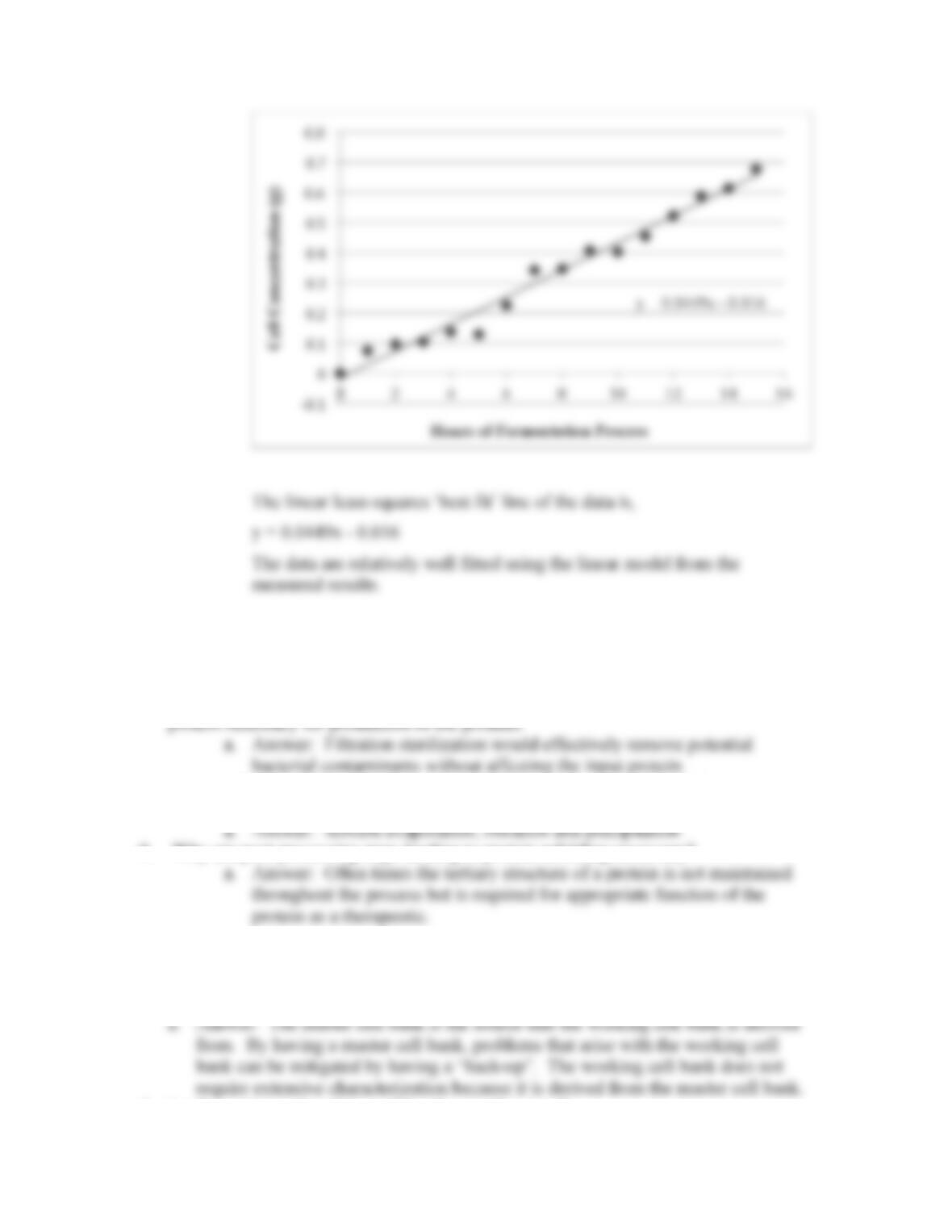
growth rapidly increases due to yeast under anaerobic conditions. Below are the results of
bacterial concentration at each hour of the fermentation process. Plot the data points on
linear graph paper and determine the ‘best fit’ line using least-squares analysis. Is the
data fitted well with a linear model?
Hours
Cell Concentration (g l-1)
0
0
1
0.075
2
0.097
3
0.104
4
0.138
5
0.129
6
0.225
7
0.342
8
0.347
9
0.407
10
0.403
11
0.455
12
0.523
13
0.589
14
0.615
15
0.677
Solution
3. Propose a strategy for sterilization of an input stream containing a heat sensitive
protein necessary for production of the product.
a. Answer: Filtration sterilization would effectively remove potential
bacterial contaminants without affecting the input protein.
a. Answer: Solvent evaporation, filtration and precipitation
9. Why are post-processing steps leading to protein refolding necessary?
a. Answer: Often times the tertiary structure of a protein is not maintained
throughout the process but is required for appropriate function of the
protein as a therapeutic.
3. What are the differences between a master cell bank and a working cell bank?
a. Answer: The master cell bank is the source that the working cell bank is derived
from. By having a master cell bank, problems that arise with the working cell
bank can be mitigated by having a “back-up”. The working cell bank does not
y = 0.0449x – 0.016
!0.1%
0%
0.1%
0.2%
0.3%
0.4%
0.5%
0.6%
0.7%
0.8%
0% 2% 4% 6% 8% 10% 12% 14% 16%
Cell Concentration (g)
Hours of Fermentation Process

a. Answer: Yes, often early production proceeds with a singular cell bank that
serves as both the master and working cell banks.
6. What disadvantages and advantages are present in using mammalian cells for
a. Answer: Advantages are they are often faster than plant and transgenic animals;
Disadvantages is they are often more fragile and require more complicated culture
systems.
other provides positive selection for mammalian cells that have incorporated the
vector.
Chapter 10
1. Name and define the 3 stages of recombinant protein production.
a. Upstream: cell culture process where the protein of interest is produced.
b. Downstream: the process of harvesting the produced protein and purifying
it from host and process related impurities.
c. Formulation: preparing the purified material to be a drug product that can
a. Drawbacks:
i. Post translational modifications are not possible
ii. Possible contamination from endotoxin
b. Advantages:
a. Yeast products are usually secreted into the media.
4. Although insect cells are an attractive model, what is the major hurdle that has yet
a. FDA approval
5. Mammalian cell models have many useful characteristics, name two drawbacks.
a. High cost
b. Long development time
6. Why is it essential to use serum for cell culture that is certified to be free of
a. Because no in vitro assay exists for this contaminate in fetal bovine serum.
7. List the chromatography techniques that are generally compatible with high-ionic
strength solutions and then list those that are generally compatible with organic
solvents.

a. High ionic strength solutions: Hydroxyapatite chromatography,
hydrophobic interaction chromatography, immobilized metal affinity
chromatography, size exclusion chromatography
a. When a timely entry into the market is required.
9. True or false: Reducing the number of steps in a purification procedure for an
unstable protein will ensure that all hurdles to successful production are
overcome.
a. False. An unstable protein will provide difficulties.
a. This can provide some flexibility as the scale-up takes place without
significant loss of product quality.
11. List factors that are in the process optimization stage, only occurring after the
a. Labor vs. automation, lean management, re-using utensils, column life-
time
a. The yield of protein is very high.
13. A team has decided that to be cost effective to use a production facility, the yield
for a low dose protein will need to be 240g/month. Knowing that the facility is
equipped with batch bioreactors that have a volume of 50 L (up to 3 are
available), what expression level in grams per liter of culture medium will be
required? (Assume 4 weeks per month and that a batch uses 1 week of reactor
time.)
a. 240g/month x 1 month/4weeks = 60g/week -> 20g/week per bioreactor
b. 20g/50L = 0.4g/L
a. 3
15. When moving to animal or human studies, list several regulatory groups or
agencies from which approval may be required.
a. NIH, IRB, IBC, IACUC, etc.
16. For open processing steps, work should be done in what kind of environment at a
a. Class 100 hood inside a class 10,000 room.
17. In addition to virus and bacterial contaminates, what other contaminates can
reduce purity of a final product?
a. Proteins, nucleic acids, processing chemicals, etc.
18. What method is useful in determining expiration dates when waiting for the
expiration of a product at “normal” speed is prohibitive to bringing the product to
market?

a. Accelerated methods
19. Describe some of the information that needs to be documented to transfer
information between the stages of development.
a. Rationale for the process design, data about where raw materials were
procured, acceptance criteria, etc.
of patents coming soon?
a. Answer:
i. A move to disposable manufacturing is more likely.
2. Describe the 3 main categories of disposables.
i. Common disposables, petri dishes, flasks, pipets, PPE, test tubes.
ii. Items for the line such as bags, connectors, tri-clamps, tubing, tank
liners, valves.
barriers to using disposables.
a. Answer:
i. Need for capitol investment, learning curve for employees, concern
a. Answer: Melt processing aids that protect the polymer during extrusion
and molding, thermal stabilizers that protect against heat in the final
product, light stabilizers that protect against UV. A major drawback is the
a. Answer: Extractables are used to determine worst case scenarios for
leachables from materials.
6. Describe some factors that may cause a leachable to not show up as an
a. Answer: Products of reactions with the final drug formulation, different
analytical methodologies.
8. Why do many bag manufacturers recommend only partially filling the bags,
especially if they are going to be used on a rocker?
a. Answer: The pressure on the seals can cause them to burst.
9. Name some of the features that differentiate incubating containers from
bioreactors.
a. Answer: Dissolved oxygen and pH sensing

10. When considering the selection of type of bioreactor, which design(s) might be
selected to reduce the formation of foams in the culture media?
a. Answer: Wave bioreactors
Chapter 12
1. Define fed-batch culture and the cell type for which it is best known.
a. Answer: Fresh media is continually or periodically added to attempt to
obtain a quasi-steady state level of nutrients. It is best known for baker’s
yeast culture.
3. What order of magnitude cell density can be expected by using microcarrier cell
culture methods?
a. Answer: Upwards of 10^8 cells/mL
4. Aside from an increase in density, what benefits do microcarriers offer to the cell
microenvironment?
a. Answer: 3D cell culture like environment
5. Using microcarriers can sometimes reduce the need for serum in the media, what
benefit does this have and what quality of the microcarrier is giving this this
effect?
a. Answer:
i. Reduction of cost
ii. No need for serum in the media, because the microcarriers have
a. Answer: Coatings with extracellular matrix proteins, collagen,
fibronectin, etc
7. Why can cost be reduced by in-stream extraction?
the product of interest does not reduce the production and if the media can
be reused there are fewer consumables used.
under staining. They can be a concern for bioprocessing especially as they
can indicate bacterial contamination.
10. Considering that downstream processing often is a major cost in biological
production, what reservation should a bioprocess planner or engineer have when
considering the addition of a component to media?
a. Answer: Removal of that component may make the downstream
processing more costly.

Chapter 13
1. Describe the broad stages in downstream processing.
a. Answers: Cell separation from media or cell disruption and cell debris
removal, product recovery and concentration, column based separation,
other separation operations, purified bulk drug substances.
a. Answers: The physical and chemical properties of the manufactured
protein.
3. Why is the solubility of the protein is an important consideration?
etc.
4. Even though the capture step does not often increase the purity of the substance,
a. Answers: High degrees of capacity, product recovery, chemical and
physical stability.
Questions 5 thru 8 are focused on expanded bed chromatography.
use of this technique.
a. Answers: Interaction of the product with the cells or cell fragments will
occur, but the risk to the product may not prevent it from being a good
through the chromatography media.
7. Will it work if the desired product has no affinity for the bed?
8. Why is it important to monitor the degree of expansion?
a. Answers: A variance in the degree of expansion can indicate problems
with the manifold, and infection, or fouling of the column.
9. Describe ways to inactivate viruses.
quaternary ammonium chloride, radiation
10. What is a limitation of pH treatment when considering inactivation of viruses?
Chapter 14
a. Answers: Adv: high specificity, mild elution conditions, Disadv: hard to
distinguish target from derivatives
2. When selecting elution buffers in an affinity chromatography setup, list some

a. Answers: Polarity, pH, ionic strength
3. What kind of production system is often used for IMAC?
a. Answers: E.coli
4. List some of the pros and cons of AEC, the most used chromatography method.
a. Answers: Pro: scalability, high resolution, Con: usually high ionic
strength in elution buffer
5. If a protein has a pI of 6.75 what pH would be a good starting point in AEC?
6. Should the ionic strength of the solution be low or high for binding on an AEC
column?
a. Answers: Low
7. For gel permeation chromatography, what is the maximum recommended
percentage of the total bed volume that a sample should be?
a. Answers: Approximately 30%
8. When the process requirements indicate that the solution or mobile phase should
be acidic, which chromatograohic technique may be useful?
a. Answers: Reverse phase chromatography
9. Which method can be used to distinguish relatively similar compounds, or even
denatured verses native conformations?
a. Answers: Hydroxyapatite chromatography
10. Describe the parameters that are useful to consider when designing the transition
between lab scale and production scale, or scale-up.
a. Answers: Chromatography medium type, protein load, sample
volumes/concentrations, protein sensitivity to shear forces, washing
procedures, gel life length, buffer consumption, etc.
DNA. What additional step is often required to ensure that the protein will have
the correct tertiary structure?
a. An in vitro folding step.
2. Name some of the benefits of using mammalian cells as the expression system.
a. Extracellular expression of post-translationally modified proteins.
viruses and viral particles of species that it is raised in or will be used in,
etc.
a. Gene regulation tries to increase the number of times a gene is transcribed
and then therefore translated, while gene amplification increases the
number of genes available for transcription.

a. Microinjection, electroporation, calcium phosphate, DEAE-dextran,
DMSO, polybrene, cationic-lipid mediated transfection. Lipid based
transfection is very common and available in many commercial kits.
7. If complexation with nucleic acids during the production of monoclonal
antibodies is suspected, what can be done to reverse this process.
a. Use 0.3-1M NaCl
8. When a process designer is considering the use of yeast as the expression system,
a. Will incorrect glycosylation be detrimental, can incorrect folding be
sensed and corrected, etc
9. Why can yeast be used in many types of bioreactors?
10. Which two purification steps can often be avoided with yeast as compared to
bacterial expression systems?
a. Refolding and cleavage steps
11. While animal systems can offer high yield, what are some of the challenges in this
field?
a. What would be the analogous regulation in an animal system to the cell
bank for mammalian cellular systems?, how are diseases controlled in the
animals?, what steps need to be taken to prevent the presence of pathogens
in the product?
Chapter 16
1. What is the difference between quality control and quality assurance?
a. Answer: Quality control is primarily concerned with testing the product,
while quality assurance has a broader responsibility of oversight of the
process which includes the paperwork required.
production of a quality product.
a. Answer: Manufacturing, r&d, management.
control, change notices for any changes in supplier or supplier process
with adequate personnel to decide if the final product may be affected by
this change.
should be done to prevent inadvertent shipping of the product to consumers?
a. Answer: Mark and separate the batch so that it is held until a decision on
the appropriate action can be be made.
5. Name some sources of information that should be used to develop a corrective
a. Answer: Customer complaints, …

6. Describe steps in developing a robust process. While it may be desirable to test all
combinations of parameters, what is the common practice to establish statistical
bounds on a parameter?
a. Answer: Identify the process steps that are going to affect the quality of
the product to establish ranges for such parameters, … Bounds are often
established using a low and high value.
is performed. Is it required to perform this process in the cGMP environment?
a. Answer: No, in fact it is usually better to do it outside to prevent
inadvertent further contamination.
8. What are the 9 elements of validation?
Range , Accuracy , Precision , Detection limit , Quantification limit ,
Robustness , System suitability testing.
quaternary structure?
a. Answer: NMR, X-ray diffraction, near uv circular dichroism, and for
quaternary structure HP-SEC, Raman scattering, Light scattering useful
for determination of large macromolecular assemblies and scanning
a. Answer: Because of small sample size requirements.
Chapter 17
What benefit does filing a provisional application afford the inventors?
a. Answer: Protection for the idea for 1 year while further preparations are made
to file the patent.
Does having a United States patent protect the right to make the product all over
a. Answer: No, different patents must be filed in other countries.
What three requirements under the European patent law and generally patent law
a. Answer: Novelty, ability to commercialize, and involving an inventive step.
What two trade organizations are heavily considered in patent law in terms of
establishing patentability in the US and other countries?
a. Answer: The world trade organization and North American free trade
agreement.
While a person of ordinary skill in the art might have been considered a worker
for machines, in the biotechnology sector what might be the “person or ordinary skill in
the art”?
a. Answer: A team of highly skilled scientists.

When determining the information available to someone with skill in the art, does
a patent examiner consider the information available at present or at the time of
invention?
a. Answer: At the time of invention.
The Internet makes finding patent information and doing prior literature searches
listed in this chapter.
a. Answer: USPTO, google, medline, etc
Before the claims section of the patent specification, the utility statement is given.
What is not recommended to include here even though it may seem natural to speculate
on?
a. Answer: The hypothesis for the mechanism of action.
Why do some think the patent term for pharmaceuticals should be extended?
a. Answer: Much of the 20 year term of the patent is spent preparing the product
for market, so the window to earn revenue for the company is small.
How can a substance that occurs in nature be the subject of a patent? Consider
the example of adrenaline.
a. Answer: Adrenaline is found naturally as part of the adrenal gland, however
the purified form can be patented.