Managing in Financial Markets
As an investor, you plan to invest your funds in long-term bonds. You have $100,000 to invest. You may
purchase highly rated municipal bonds at par with a coupon rate of 6 percent; you have a choice of a
maturity of 10 years or 20 years. Alternatively, you could purchase highly rated corporate bonds at par
with a coupon rate of 8 percent; these bonds also are offered with maturities of 10 years or 20 years. You
expect that you will not need the funds for five years. At the end of the fifth year, you will definitely sell
the bonds since you will need to make a large purchase at that time.
a. What is the annual interest you would earn (before taxes) on the municipal bond? On the
corporate bond?
b. Assume that you are in the 20 percent tax bracket. If the level of credit risk and the liquidity for
the municipal and corporate bonds are the same, would you invest in the municipal bond or the
corporate bond? Why?
Invest in the corporate bond. The after-tax annual interest earned on the corporate bond is
c. Assume that you expect all yields paid on newly issued notes and bonds (regardless of maturity)
to decrease by a total of 4 percentage points over the next two years, and to increase by a total of
2 percentage points over the following three years. Would you select the 10-year maturity or the
20-year maturity for the type of bond you plan to purchase? Why?
Select the 20-year bond as long as you are confident about your expectations. The general level
of interest rates in five years should be lower than today, which should increase the value of your
Problems
1. Bond Valuation. Assume the following information for an existing bond that provides annual coupon
payments:
Par value = $1,000
Coupon rate = 11%
Maturity = 4 years
Required rate of return by investors = 11%
a. What is the present value of the bond?
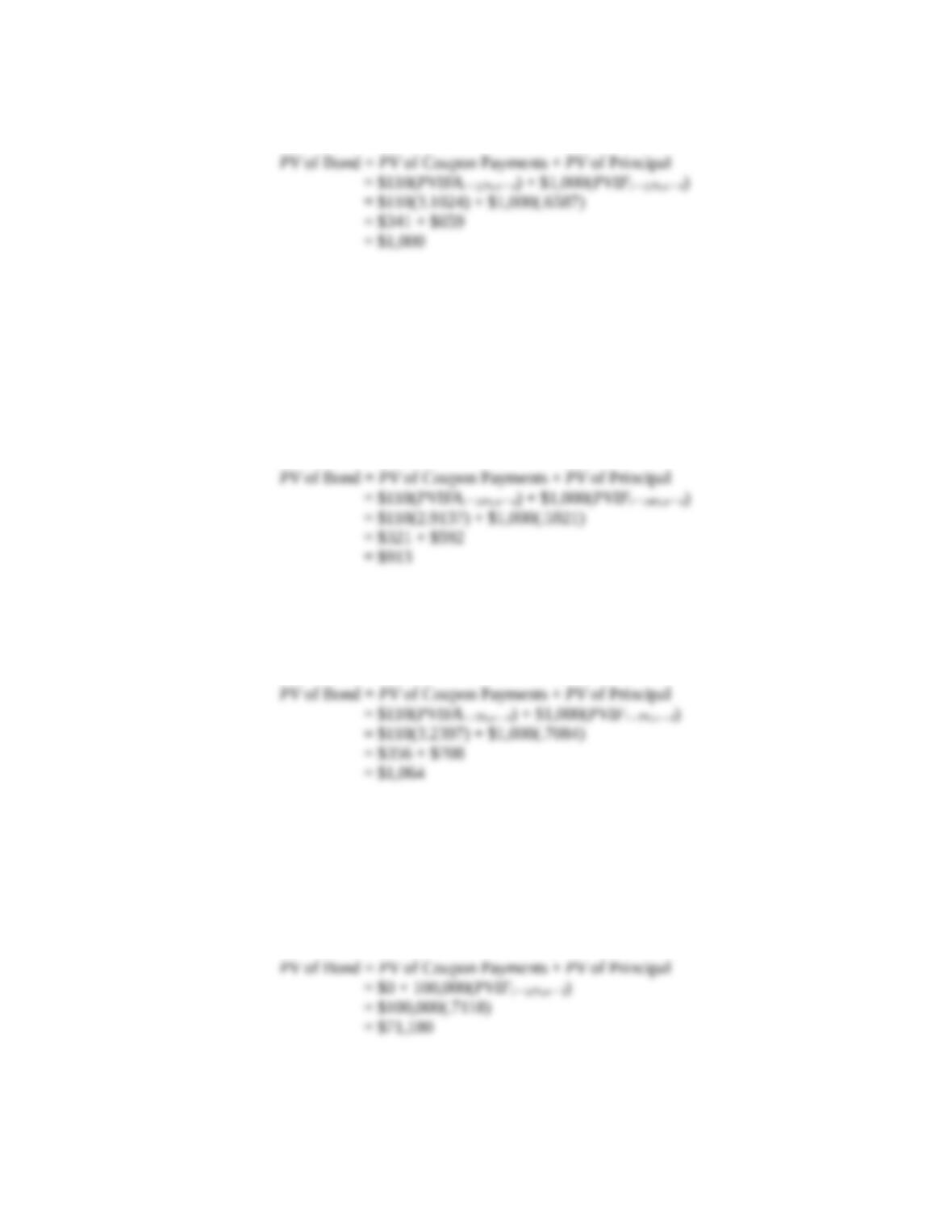
ANSWER:
b. If the required rate of return by investors were 14 percent instead of 11 percent, what would be
the present value of the bond?
ANSWER:
c. If the required rate of return by investors were 9 percent, what would be the present value of the
bond?
ANSWER:
2. Valuing a Zero-Coupon Bond. Assume the following information for existing zero-coupon bonds:
Par value = $100,000
Maturity = 3 years
Required rate of return by investors = 12%
How much should investors be willing to pay for these bonds?
ANSWER:
3. Valuing a Zero-Coupon Bond. Assume that you require a 14 percent return on a zero-coupon bond
with a par value of $1,000 and six years to maturity. What is the price you should be willing to pay
for this bond?
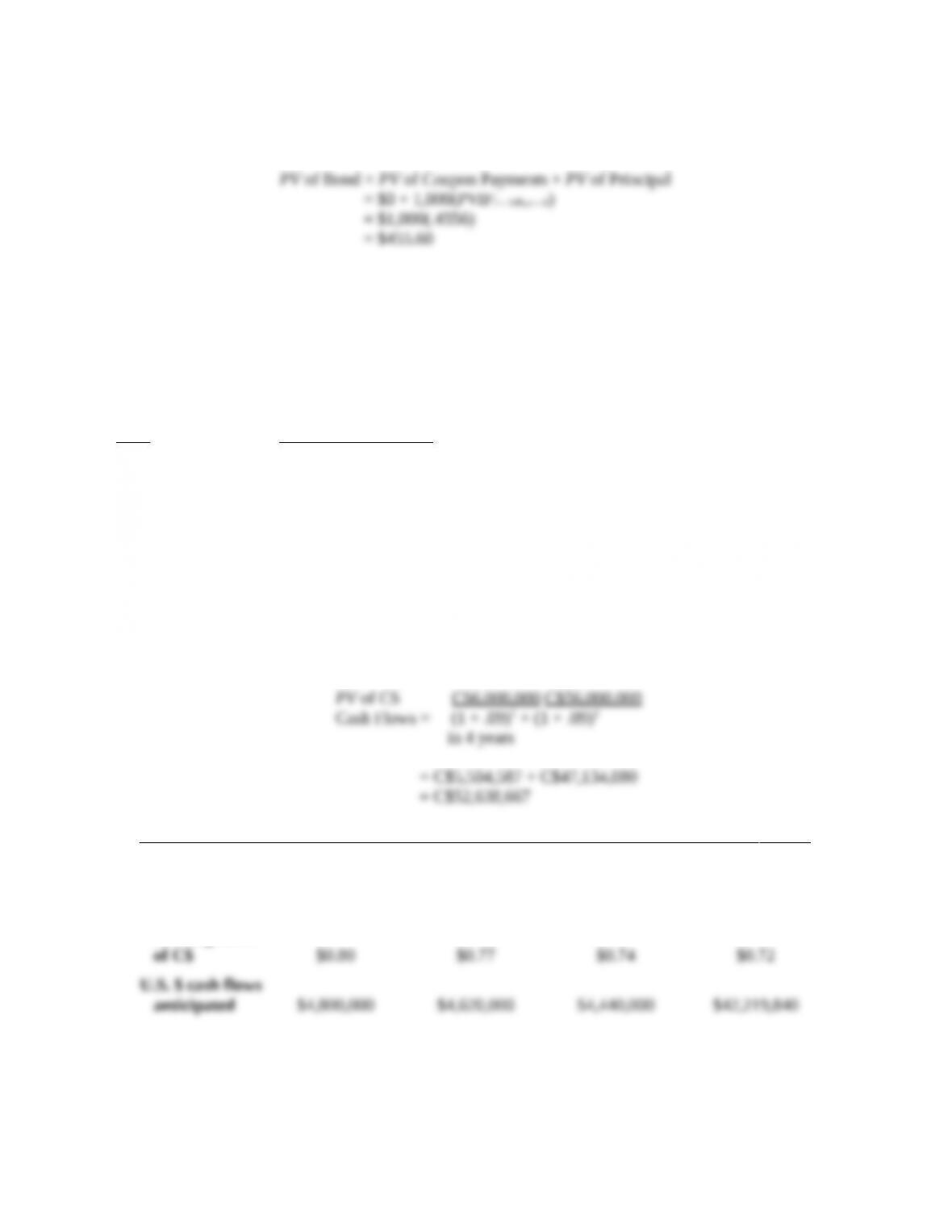
ANSWER:
4. Bond Value Sensitivity to Exchange Rates and Interest Rates. Cardinal Company, a U.S.-based
insurance company, considers purchasing bonds denominated in Canadian dollars, with a maturity of
six years, a par value of C$50 million, and a coupon rate of 12 percent. The bonds can be purchased
at par by Cardinal and would be sold four years from now. The current exchange rate of the Canadian
dollar is $0.80. Cardinal expects that the required return by Canadian investors on these bonds four
years from now will be 9 percent. If Cardinal purchases the bonds, it will sell them in the Canadian
secondary market four years from now. The exchange rates are forecast as follows:
Year Exchange Rate of C$
1 $0.80
2 0.77
3 0.74
4 0.72
5 0.68
6 0.66
a. Refer to earlier examples in this chapter to determine the expected U.S. dollar cash flows to
Cardinal over the next four years. Refer to Chapter 3 to determine the present value of a bond.
ANSWER:
Year 1 2 3 4
C$ cash flows C$6,000,000 C$6,000,000 C$6,000,000 C$6,000,000
anticipated +C$52,638,667
Forecasted
exchange rate
b. Does Cardinal expect to be favorably or adversely affected by the interest rate risk?
Explain.
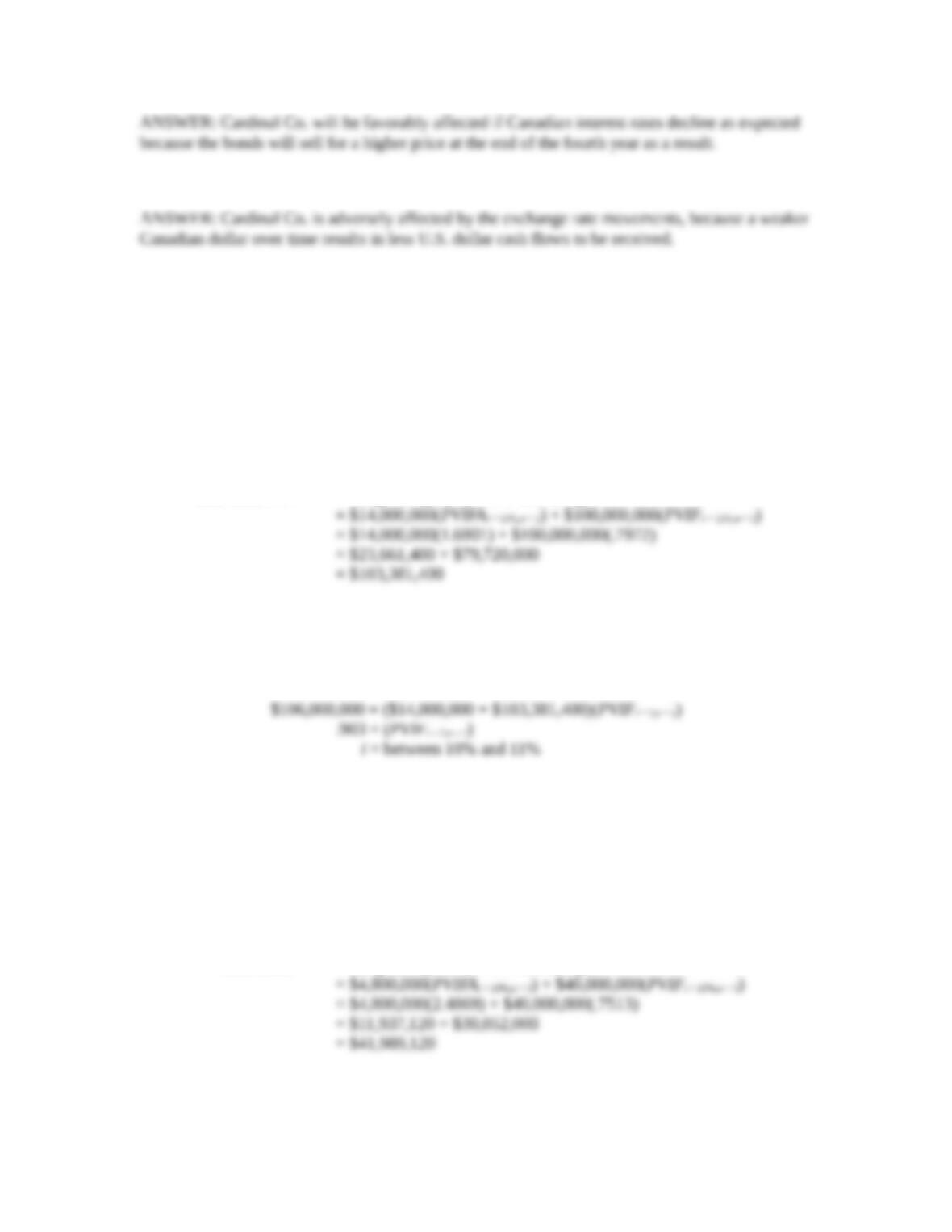
c. Does Cardinal expect to be favorably or adversely affected by exchange rate risk? Explain.
5. Predicting Bond Values. (Use the chapter appendix to answer this problem.) Bulldog Bank has just
purchased bonds for $106 million that have a par value of $100 million, three years remaining to
maturity, and an annual coupon rate of 14 percent. It expects the required rate of return on these
bonds to be 12 percent one year from now.
a. At what price could Bulldog Bank sell these bonds for one year from now?
ANSWER:
PV of Bonds One PV of Remaining
Year from Now = Coupon Payments + PV of Principal
b. What is the expected annualized yield on the bonds over the next year, assuming they are to be
sold in one year?
ANSWER:
6. Predicting Bond Values. (Use the chapter appendix to answer this problem.) Sun Devil Savings has
just purchased bonds for $38 million that have a par value of $40 million, five years remaining to
maturity, and a coupon rate of 12 percent. It expects the required rate of return on these bonds to be
10 percent two years from now.
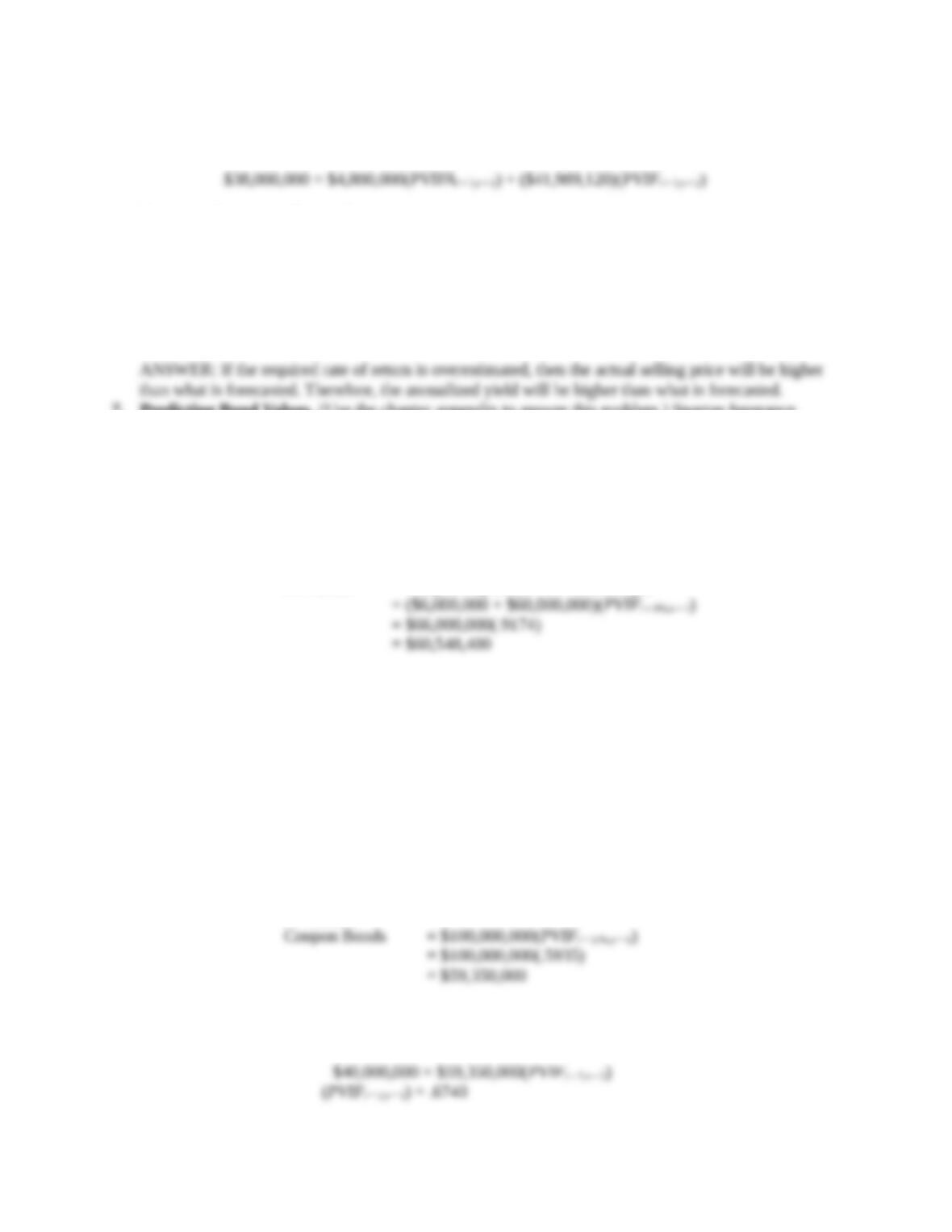
a. At what price could Sun Devil Savings sell these bonds for two years from now?
ANSWER:
PV of Bonds PV of Remaining
in 2 Years = Coupon Payments + PV of Principal
b. What is the expected annualized yield on the bonds over the next two years, assuming they are to
be sold in two years?
ANSWER:
By trial and error, i = about 17%.
This can also be done with some calculators.
c. If the anticipated required rate of return of 10 percent in two years is overestimated, how would
the actual selling price differ from the forecasted price? How would the actual annualized yield
over the next two years differ from the forecasted yield?
7. Predicting Bond Values. (Use the chapter appendix to answer this problem.) Spartan Insurance
Company plans to purchase bonds today that have four years remaining to maturity, a par value of
$60 million, and a coupon rate of 10 percent. Spartan expects that in three years, the required rate of
return on these bonds by investors in the market will be 9 percent. It plans to sell the bonds at that
time. What is the expected price it will sell the bonds for in three years?
ANSWER:
PV of Bonds PV of Remaining
in 3 Years = Coupon Payments + PV of Principal
8. Bond Yields. (Use the chapter appendix to answer this problem.) Hankla Company plans to purchase
either (1) zero-coupon bonds that have ten years to maturity, a par value of $100 million, and a
purchase price of $40 million, or (2) bonds with similar default risk that have five years to maturity, a
9 percent coupon rate, a par value of $40 million, and a purchase price of $40 million.
Hankla can invest $40 million for five years. Assume that the market’s required return in five years is
forecasted to be 11 percent. Which alternative would offer Hankla a higher expected return (or yield)
over the five-year investment horizon?
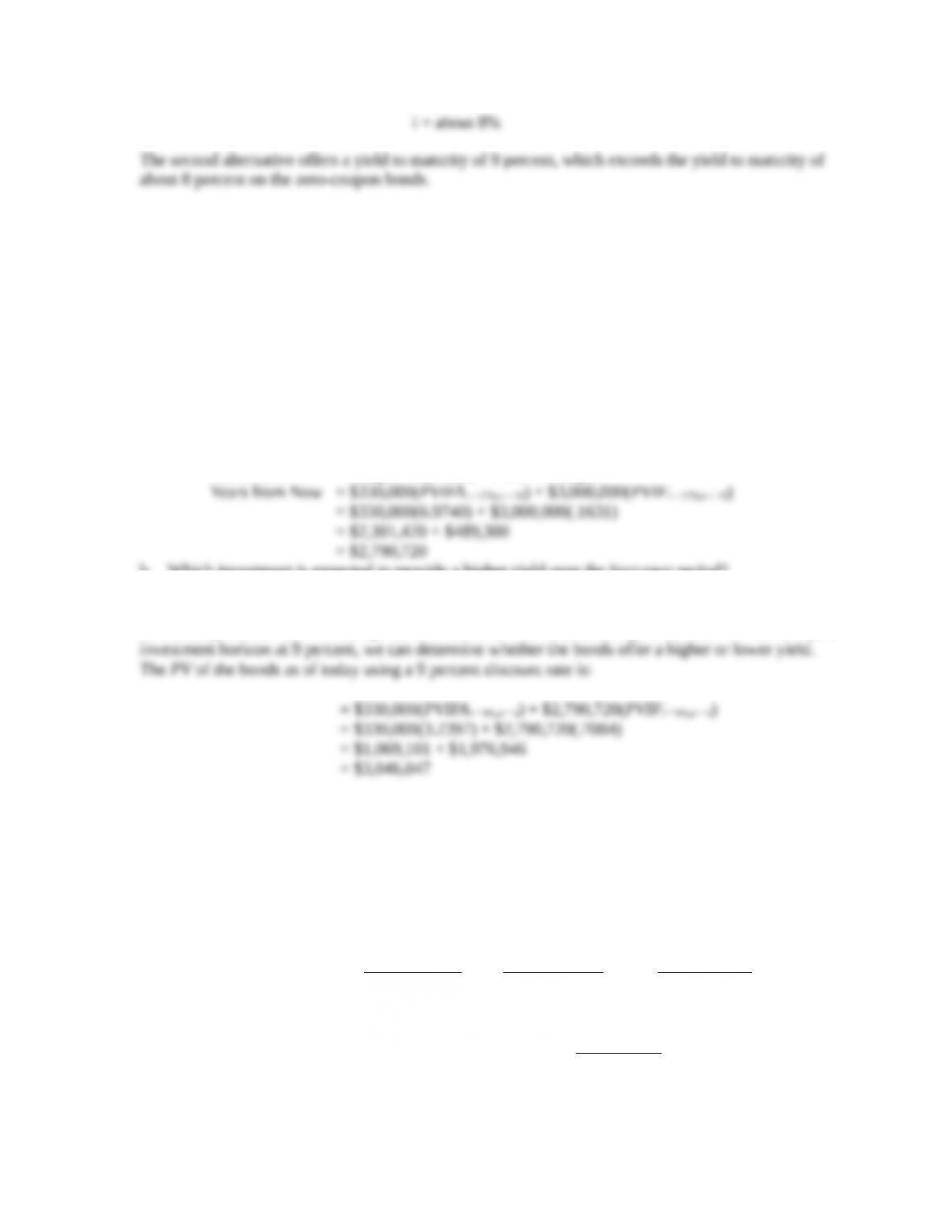
ANSWER: The PV of zero-coupon bonds five years from now is based on the PV of the par value to
be received 5 years after that point in time:
PV of Zero-
The discount rate at which the anticipated cash flows from the zero-coupon bonds will equal today’s
price is:
9. Predicting Bond Values. (Use the chapter appendix to answer this problem.) The portfolio manager
of Ludwig Company has excess cash that is to be invested for four years. He can purchase four-year
Treasury notes that offer a 9 percent yield. Alternatively, he can purchase new 20-year Treasury bonds
for $2.9 million that offer a par value of $3 million and an 11 percent coupon rate with annual
payments. The manager expects that the required return on these same 20-year bonds will be 12
percent four years from now.
a. What is the forecasted market value of the twenty-year bonds in four years?
ANSWER:
PV of 20-Year PV of Remaining
Bonds as of 4 = Coupon Payments + PV of Principal
b. Which investment is expected to provide a higher yield over the four-year period?
ANSWER: Ludwig could achieve a yield of 9 percent on the Treasury notes with certainty. By
discounting the cash flow resulting from the alternative investment (20-year bonds) over the four-year
Since Ludwig would pay less today for these bonds than the present value estimated here, this implies
that the yield to maturity on the bonds exceeds 9 percent. Therefore, the bonds offer a higher yield.
10. Predicting Bond Portfolio Value. (Use the chapter appendix to answer this problem). Ash
Investment Company manages a broad portfolio with this composition:
Years
Present Remaining
Par Value Market Value to Maturity
Zero-coupon bonds $200,000,000
$ 63,720,000 12
8% Treasury bonds 300,000,000 290,000,000 8
11% corporate bonds 400,000,000 380 ,000,000 10
$733,720,000
Ash expects that in four years, investors in the market will require an 8 percent return on the
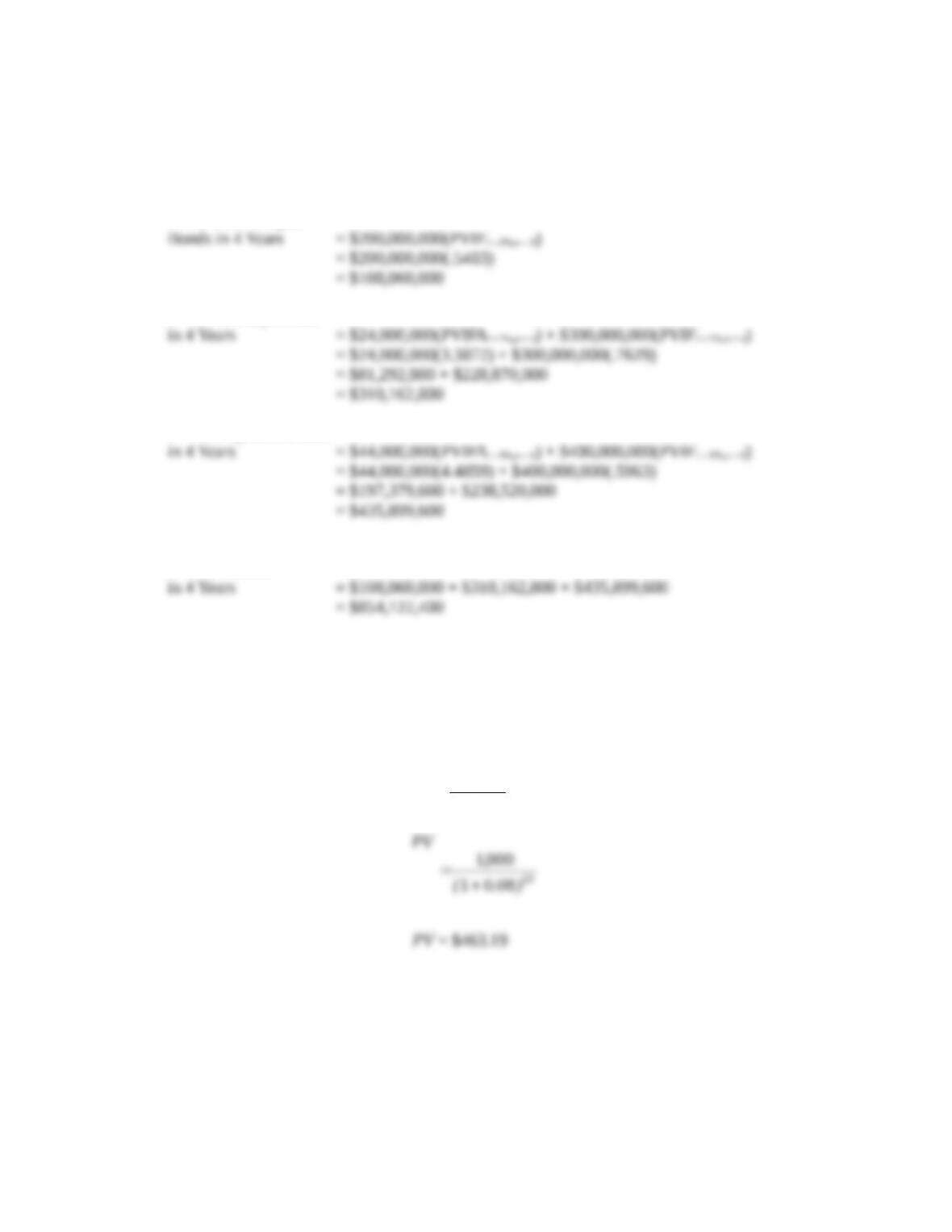
zero-coupon bonds, a 7 percent return on the Treasury bonds, and a 9 percent return on corporate
bonds. Estimate the market value of the bond portfolio four years from now.
ANSWER:
PV of Zero-Coupon
PV of Treasury Bonds
PV of Corporate Bonds
PV of Portfolio
11. Valuing a Zero-Coupon Bond.
a. A zero-coupon bond with a par value of $1,000 matures in 10 years. At what price would this
bond provide a yield to maturity that matches the current market rate of 8 percent?
ANSWER:
PV
1
1)k(
C
b. What happens to the price of this bond if interest rates fall to 6 percent?
ANSWER:

PV
1
1)k(
C
c. Given the above changes in the price of the bond and the interest rate, calculate the bond price
elasticity.
ANSWER:
8220
250
205530
8
86
194 63
194 6339558
in changepercent
in changepercent
.
.
.
%
%%
.$
.$.$
k
P
Pe
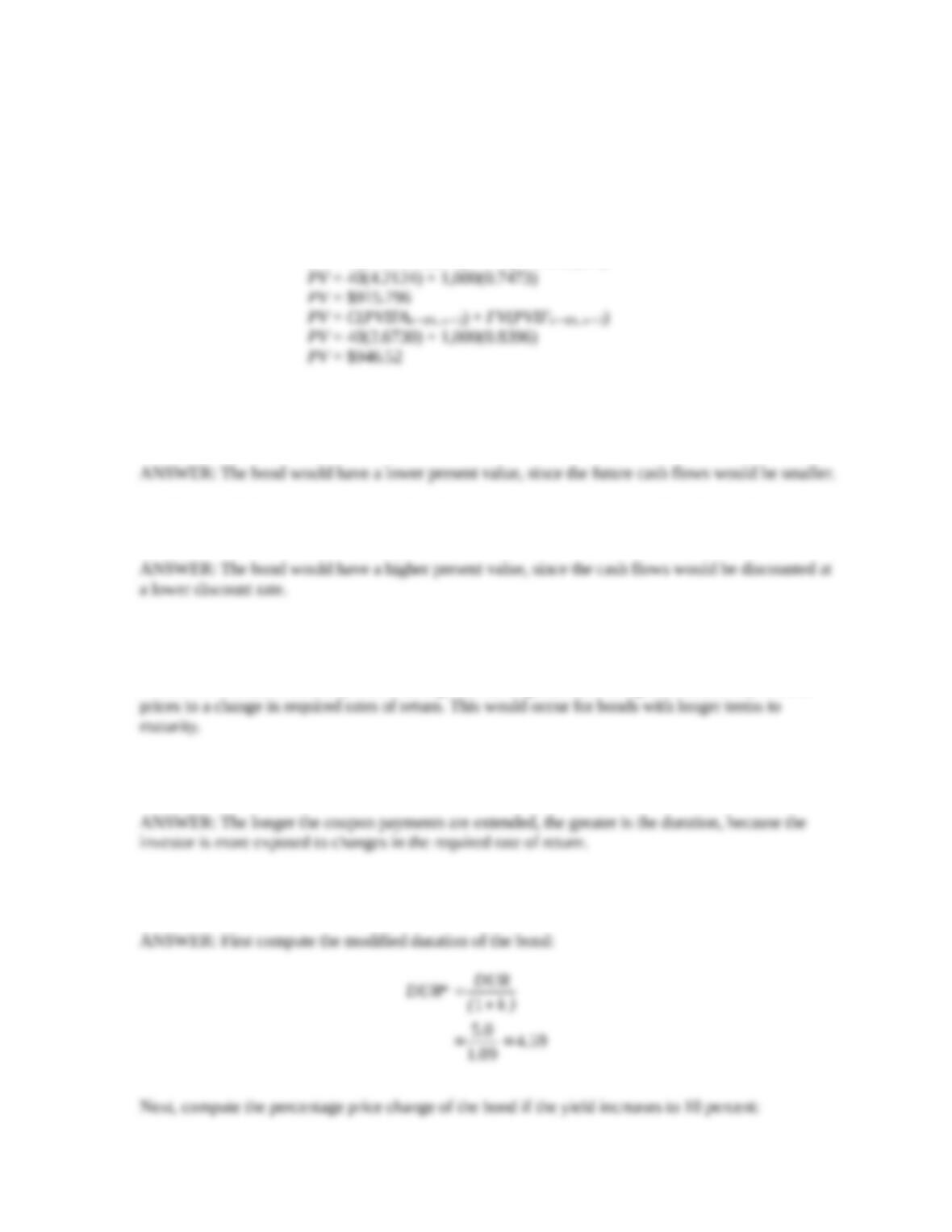
12. Bond Valuation. You are interested in buying a $1,000 par value bond with 10 years to maturity and
an 8 percent coupon rate that is paid semiannually. How much should you be willing to pay for the
bond if the investor’s required rate of return is 10 percent?
ANSWER:
PV = C(PVIFA k = 5%, n = 20) + FV(PVIFk = 5%, n = 20)
13. Predicting Bond Values. A bond you are interested in pays an annual coupon of 4 percent, has a
yield to maturity of 6 percent and has 13 years to maturity. If interest rates remain unchanged, at what
price would you expect this bond to be selling 8 years from now? Ten years from now?
ANSWER:
PV = C(PVIFAk = 6%, n = 5) + FV(PVIFk = 6%, n = 5)
14. Sensitivity of Bond Values.
a. How would the present value (and therefore the market value) of a bond be affected if the coupon
payments are smaller and other factors remain constant?
b. How would the present value (and therefore the market value) of a bond be affected if the
required rate of return is smaller and other factors remain constant?
15. Bond Elasticity. Determine how the bond elasticity would be affected if the bond price changed by a
larger amount, holding the change in the required rate of return constant.
ANSWER: The bond elasticity would be higher, meaning that there is a greater sensitivity of bond
16. Bond Duration. Determine how the duration of a bond be affected if the coupons were extended over
additional time periods.
17. Bond Duration. A bond has a duration of 5 years and a yield to maturity of 9 percent. If the yield to
maturity changes to 10 percent, what should be the percentage price change of the bond?

%.
..
k*DURP%
594
010594
Consequently, the bond should decrease in price by 4.59%.
18. Bond Convexity. Describe how bond convexity affects the theoretical linear price-yield relationship
of bonds. What are the implications of bond convexity for estimating changes in bond prices?
ANSWER: Bond convexity illustrates that the price-yield relationship is not linear, but convex. This
is particularly pronounced for bonds with low coupons and long maturities.
From a bond pricing perspective, bond convexity leads to estimation errors in the price change of a
Flow of Funds Exercise
Interest Rate Expectations, Economic Growth, and Bond Financing
Recall that if the economy continues to be strong, Carson Company may need to increase its production
capacity by about 50 percent over the next few years to satisfy demand. It would need financing to
expand and accommodate the increase in production. Recall that the yield curve is currently upward
sloping. Also recall that Carson is concerned about a possible slowing of the economy because of
potential Fed actions to reduce inflation. It needs funding to cover payments for supplies. It is also
considering the issuance of stock or bonds to raise funds in the next year.
a. At a recent meeting, the Chief Executive Officer (CEO) stated his view that the economy will
remain strong, as the Fed’s monetary policy is not likely to have a major impact on the interest
rates. So he wants to expand the business to benefit from the expected increase in demand for
Carson’s products. The next step would be to determine how to finance the expansion. The Chief
Financial Officer (CFO) stated that if Carson Company needs to obtain long-term funds, the
issuance of fixed-rate bonds would be ideal at this point in time because he expects that the Fed’s
monetary policy to reduce inflation and will cause long-term interest rates to rise. If the CFO is
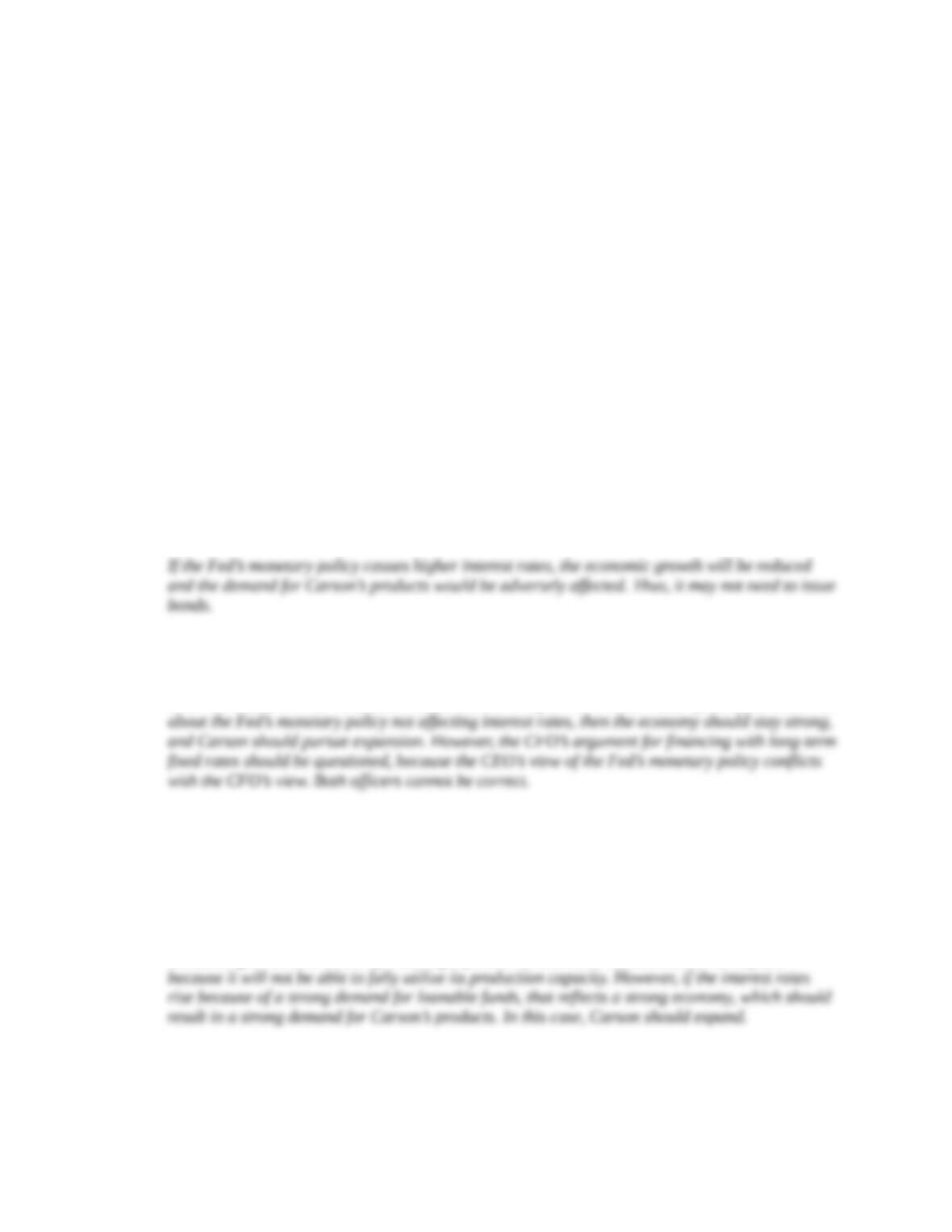
correct about future interest rates, what does this suggest about the future economic growth, the
future demand for Carson’s products, and the need to issue bonds?
b. If you were involved in the meeting described here, what do you think needs to be resolved
before deciding to expand the business?
There should be a clear conclusion about the Fed’s impact on interest rates. If the CEO is correct
c. At the meeting described here, the Chief Executive Officer (CEO) stated the following:
“The decision to expand should not be dictated by whether interest rates are going to increase or
not. Bonds should be issued only if the potential increase in interest rates is attributed to a strong
demand for loanable funds rather than the Fed’s reduction in the supply of loanable funds.” What
does this statement mean?
If interest rates rise as a result of the Fed’s actions, its monetary policy is intended to slow
economic growth as a means of reducing inflation. In this case, Carson should not expand