Questions
1. Bond Indenture. What is a bond indenture? What is the function of a trustee, with respect to the
bond indenture?
ANSWER: The bond indenture is a legal document specifying the rights and obligations of both the
2. Sinking-Fund Provision. Explain the use of a sinking-fund provision. How can it reduce the
investor’s risk?
ANSWER: A sinking-fund provision is a requirement that the firm retire a certain amount of the bond
3. Protective Covenants. What are protective covenants? Why are they needed?
ANSWER: Protective covenants are restrictions placed on the firm issuing bonds, in order to protect
4. Call Provisions. Explain the use of call provisions on bonds. How can a call provision affect the
price of a bond?
ANSWER: A call provision allows the issuing firm to purchase its bonds back prior to maturity at a
5. Bond Collateral. Explain the use of bond collateral, and identify the common types of collateral for
bonds.
ANSWER: Bond collateral may be established by the bond issuer as a means of backing the bond. If
6. Debentures. What are debentures? How do they differ from subordinated debentures?
ANSWER: Debentures are backed only by the general credit of the issuing firm. Subordinated
7. Zero-Coupon Bonds. What are the advantages and disadvantages to a firm that issues low- or
zero-coupon bonds?
ANSWER: From the perspective of the issuing firm, low or zero coupon bonds have the advantage of
requiring low or no cash outflow during the life of the bond. The issuing firm is allowed to deduct the
8. Variable-Rate Bonds. Are variable-rate bonds attractive to investors who expect interest rates to
decrease? Explain. Would a firm that needs to borrow funds consider issuing variable-rate bonds if it
expects that interest rates will decrease? Explain.
ANSWER: If investors expect interest rates to decrease, they would avoid variable-rate bonds
9. Convertible Bonds. Why can convertible bonds be issued by firms at a higher price than other
bonds?
ANSWER: Convertible bonds allow investors to exchange the bonds for a stated number of shares of
10. Global Interaction of Bond Yields. If bond yields in Japan rise, how might U.S. bond yields be
affected? Why?
ANSWER: If bond yields rise in Japan, there may be an increased flow of funds to purchase these
11. Impact of Credit Crisis on Junk Bonds. Explain how the credit crisis affected the default rates
of junk bonds and the risk premiums offered on newly issued junk bonds.
ANSWER: Many junk bonds defaulted during the credit crisis, as economic conditions weakened
12. New Guidelines for Credit Rating Agencies. Explain the new guidelines for credit rating agencies
resulting from the Financial Reform Act of 2010.
ANSWER: Credit rating agencies are subject to new reporting requirements in which they must
disclose their methodology for determining ratings. They must consider credible information from

13. Impact of Greece Crisis. Explain the conditions that led to the debt crisis in Greece.
ANSWER: In spring of 2010, Greece experienced a credit crisis, because of its weak economic
14. Bond Downgrade. Explain how the downgrading of bonds for a particular corporation affects the
prices of those bonds, the return to investors that currently hold these bonds, and the potential return
to other investors who may invest in the bonds in the near future.
ANSWER: If corporate debt is downgraded, the required rate of return by investors would increase,
as the bonds are now perceived to have a higher degree of default risk. Consequently, the price of
Advanced Questions
15. Junk Bonds. Merrito Inc. is a large U.S. firm that issued bonds several years ago. Its bond ratings
declined over time, and about a year ago, the bonds were rated in the junk bond classification. Yet,
investors were buying the bonds in the secondary market because of the attractive yield they offered.
Last week, Merrito defaulted on its bonds, and the prices of most other junk bonds declined abruptly
on the same day. Explain why news of Meritto’s financial problems could cause the prices of junk
bonds issued by other firms to decrease, even when those firms had no business relationships with
Merrito. Explain why the prices of those junk bonds with less liquidity declined more than those with
a high degree of liquidity.
ANSWER: The financial problems of Merrito Inc. signaled that other firms classified in the junk
bond category might also experience cash flow problems. Investors quickly sold their holdings
The impact on the bond prices would be more pronounced for those bonds that have less liquidity,
16. Event Risk. An insurance company purchased bonds issued by Hartnett Company two years ago.
Today, Hartnett Company has begun to issue junk bonds and is using the funds to repurchase most of
its existing stock. Why might the market value of those bonds held by the insurance company be
affected by this action?
ANSWER: This question is related to event risk. The bonds held by the insurance company will now
17. Exchange-traded Notes. Explain what exchange-traded notes are and how they are used.
Why are they risky?
ANSWER: Exchange-traded notes (ETNs) are debt instruments in which the issuer promises to pay a
return based on the performance of a specific debt index after deducting specified fees. Thus, ETNs
18. Auction-Rate Securities. Explain why the market for auction-rate securities suffered in 2008.
ANSWER: Some of the financial institutions that made a market for the securities were unwilling to
19. Role of Bond Market Explain how the bond market facilitates a government’s fiscal policy.
How do you think the bond market could discipline a government and discourage the government
from borrowing (and spending) excessively?
ANSWER: The bond market enables the Treasury to finance government expenditures by issuing
Treasury notes and bonds in exchange for funding that can be spent. The Treasury notes and bonds
Interpreting Financial News
Interpret the following statements made by Wall Street analysts and portfolio managers.
a. “The values of some stocks are dependent on the bond market. When investors are not interested
in junk bonds, the values of stocks ripe for leveraged buyouts decline.”
The likelihood of a firm engaging in an LBO is dependent on whether it can obtain debt
b. “The recent trend in which many firms are using debt to repurchase some of their stock is a good
strategy as long as they can withstand the stagnant economy.”
When firms use debt to repurchase some of their stock, they create a higher degree of financial
c. “Although yields among bonds are related, today’s rumors of a tax cut caused an increase in the
yield on municipal bonds, while the yield on corporate bonds declined.”
If investors expect a tax cut, they recognize that the benefits from tax-free municipal bonds will be
Managing in Financial Markets
As a portfolio manager for an insurance company, you are about to invest funds in one of three possible
investments: (1) 10-year coupon bonds issued by the U.S. Treasury, (2) 20-year zero-coupon bonds issued
by the Treasury, or (3) one-year Treasury securities. Each possible investment is perceived to have no risk
of default. You plan to maintain this investment for a one-year period. The return of each investment over
a one-year horizon would be about the same if interest rates do not change over the next year. However,
you anticipate that the U.S. inflation rate will decline substantially over the next year, while most of the
other portfolio managers in the United States expect inflation to increase slightly.
a. If your expectations are correct, how will the return of each investment be affected over a
one-year horizon?
The U.S. interest rates will decline if the U.S. inflation rate declines. Consequently, bond prices
b. If your expectations are correct, which of the three investments should have the highest return
over the one-year horizon? Why?
The 20-year zero-coupon bond would have the highest expected return for a one-year horizon.
Longer-term bonds are more sensitive to interest rate movements, and zero-coupon bonds are
c. Offer one reason why you might not select the investment that would have the highest expected
return over the one-year investment horizon.
Your expectations about inflation and therefore interest rates could be wrong. If inflation rises
over the one-year period, or other economic conditions (such as economic growth or the budget
Problems
1. Inflation-Indexed Treasury Bond. An inflation-indexed Treasury bond has a par value of $1,000
and a coupon rate of 6 percent. An investor purchases this bond and holds it for one year. During the
year, the consumer price index increases by 1 percent every six months. What are the total interest
payments the investor will receive during the year?
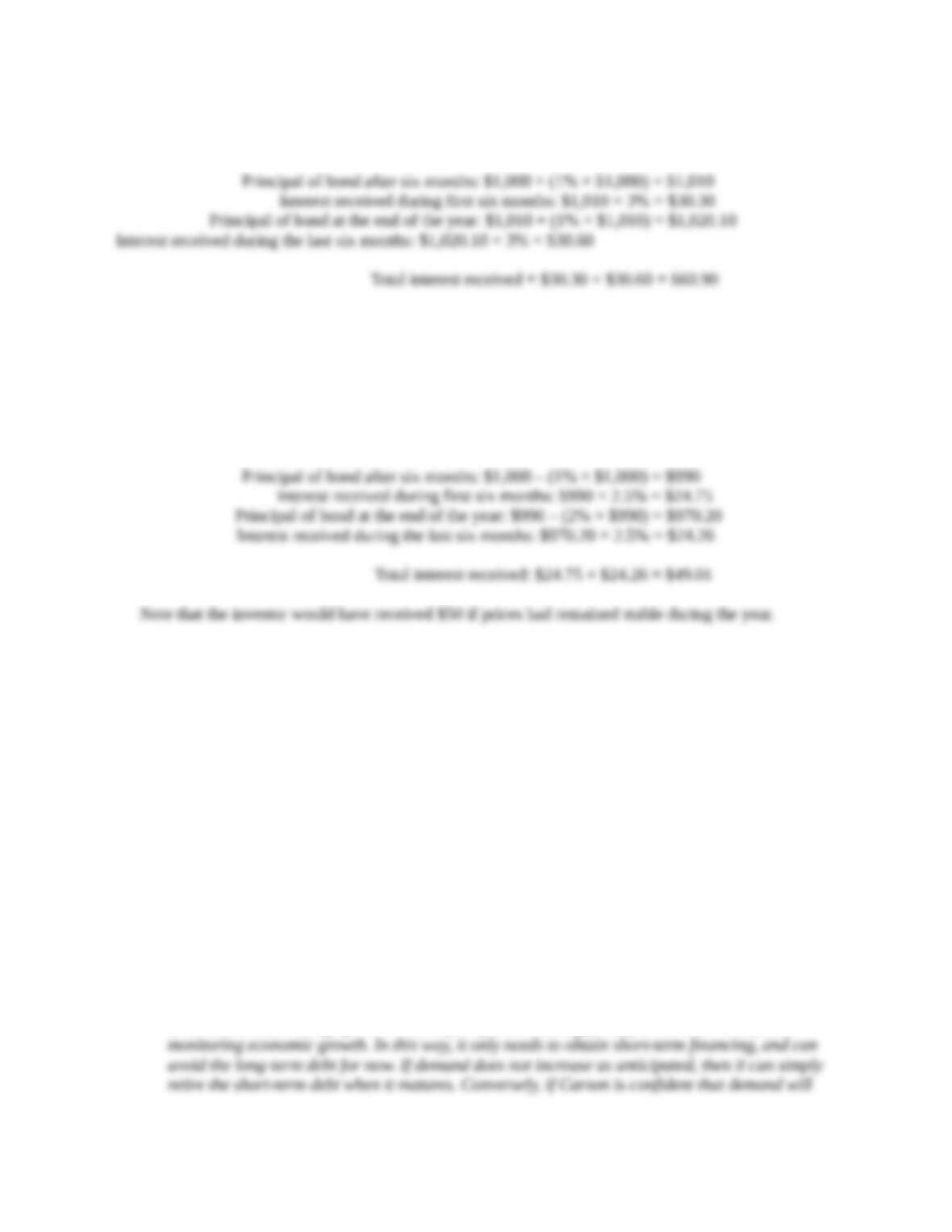
ANSWER:
2. Inflation-Indexed Treasury Bond. Assume that the U.S. economy experienced deflation during the
year, and that the consumer price index decreased by 1 percent in the first six months of the year, and
by 2 percent during the second six months of the year. If an investor had purchased inflation-indexed
Treasury bonds with a par value of $10,000 and a coupon rate of 5 percent, how much would she
have received in interest during the year?
ANSWER:
Flow of Funds Exercise
Financing in the Bond Markets
If the economy continues to be strong, Carson Company may need to increase its production capacity by
about 50 percent over the next few years to satisfy demand. It would need financing to expand and
accommodate the increase in production. Recall that the yield curve is currently upward sloping. Also
recall that Carson is concerned about a possible slowing of the economy because of potential Fed actions
to reduce inflation. It needs funding to cover payments for supplies. It is also considering the issuance of
stock or bonds to raise funds in the next year.
a. Assume that Carson has two choices to satisfy the increased demand for its products.
It could increase production by 10 percent with its existing facilities. In this case, it could obtain
short-term financing to cover the extra production expense and then use a portion of the revenue
received to finance this level of production in the future. Alternatively, it could issue bonds and
use the proceeds to buy a larger facility that would allow for 50 percent more capacity.
Carson should not buy a larger facility unless it feels confident that it can fully utilize the space.
It should consider using up the excess capacity in its existing facility in the short term, and
b. Carson currently has a large amount of debt, and its assets have already been pledged to back up
its existing debt. It does not have additional collateral. At this time, the credit risk premium it
would pay is similar in the short-term and long-term debt markets. Does this imply that the cost
of financing is the same in both markets?
c. Should Carson consider using a call provision if it issues bonds? Why? Why might Carson decide
not to include a call provision on the bonds?
d. If Carson issues bonds, it would be a relatively small bond offering. Should Carson consider a
private placement of bonds? What type of investor might be interested in participating in a private
placement? Do you think Carson could offer the same yield on a private placement as it could on
a public placement? Explain.
Carson could consider a private placement, as it may be able to reduce its transaction costs if it
e. Financial institutions such as insurance companies and pension funds commonly purchase bonds.
Explain the flow of funds that runs through these financial institutions and ultimately reaches
corporations that issue bonds such as Carson Company.
Insurance companies receive funds from policyholders who pay insurance premiums. They invest
Pension funds receive money that they invest for employees until the money is withdrawn after