Questions
1. Futures Contracts. Describe the general characteristics of a futures contract. How does a
clearinghouse facilitate the trading of financial futures contracts?
ANSWER: A futures contract is a standardized agreement to deliver or receive a specified amount of
The clearinghouse records all transactions and guarantees timely payments on futures contracts. This
2. Futures Pricing. How does the price of a financial futures contract change as the market price of the
security it represents changes? Why?
ANSWER: As the market price of the security changes, so does the futures price, in a similar manner.
3. Hedging with Futures. Explain why some futures contracts may be more suitable than others for
hedging exposure to interest rate risk.
4. Treasury Bond Futures. Will speculators buy or sell Treasury bond futures contracts if they expect
interest rates to increase? Explain.
ANSWER: Speculators should sell Treasury bond futures contracts. If they expected interest rates to
5. Gains from Purchasing Futures. Explain how purchasers of financial futures contracts can offset
their position. How is their gain or loss determined? What is the maximum loss to a purchaser of a
futures contract?
ANSWER: Purchasers of financial futures contracts can offset their positions by selling the identical
6. Gains from Selling Futures. Explain how sellers of financial futures contracts can offset their
position. How is their gain or loss determined?
ANSWER: Sellers of financial futures contracts can offset their positions by purchasing identical
7. Hedging with Futures. Assume a financial institution has more rate-sensitive assets than
rate-sensitive liabilities. Would it be more likely to be adversely affected by an increase or decrease in
interest rates? Should it purchase or sell interest rate futures contracts in order to hedge its exposure?
8. Hedging with Futures. Assume a financial institution has more rate-sensitive liabilities than
rate-sensitive assets. Would it be more likely to be adversely affected by an increase or a decrease in
interest rates? Should it purchase or sell interest rate futures contracts in order to hedge its exposure?
9. Hedging Decision. Why do some financial institutions remain exposed to interest rate risk, even
when they believe that the use of interest rate futures could reduce their exposure?
ANSWER: Some financial institutions prefer not to hedge because they wish to capitalize on their
10. Long versus Short Hedge. Explain the difference between a long hedge and a short hedge used by
financial institutions. When is a long hedge more appropriate than a short hedge?
ANSWER: A long hedge represents a purchase of financial futures and is appropriate when assets are
11. Impact of Futures Hedge. Explain how the probability distribution of a financial institution’s returns
is affected when it uses interest rate futures to hedge. What does this imply about its risk?
ANSWER: The probability distribution of returns narrows as a result of using interest rate futures to
12. Cross-Hedging. Describe the act of cross-hedging. What determines the effectiveness of a
cross-hedge?
ANSWER: Cross-hedging represents the use of financial futures on one instrument to hedge a
13. Hedging with Bond Futures. How might a savings and loan association use Treasury bond futures to
hedge its fixed-rate mortgage portfolio (assuming that its main source of funds is short-term
deposits)? Explain how prepayments on mortgages can limit the effectiveness of the hedge.
ANSWER: It may enact a short hedge in which it sells interest rate futures. If interest rates rise, its
If interest rates decline, it will incur a loss on its futures position, which can be offset by an increase
14. Stock Index Futures. Describe stock index futures. How could they be used by a financial institution
that is anticipating a jump in stock prices but does not yet have sufficient funds to purchase large
amounts of stock? Explain why stock index futures may reflect investor expectations about the
market more quickly than stock prices.
ANSWER: The institution could purchase stock index futures. If the stock market experiences
increased prices, the stock index will rise. Thus, the stock index futures position will generate a gain.
15. Selling Stock Index Futures. Why would a pension fund or insurance company consider selling
stock index futures?
16. Systemic Risk. Explain systemic risk as it relates to the futures market. Explain how the Financial
Reform Act of 2010 attempts to monitor systemic risk in the futures market and other markets.
ANSWER: Financial institutions could take excessive risks by speculating in the futures market. If
they have agreements over-the-counter, the failure of one party might prevent payment to another
17. Circuit Breakers. Explain the use of circuit breakers.
ANSWER: Circuit breakers are trading restrictions imposed on specific stocks or stock indices when
Advanced Questions
18. Hedging with Futures. Elon Savings and Loan Association has a large number of 30-year mortgages
with floating interest rates that adjust on an annual basis and obtains most of its funds by issuing
five-year certificates of deposit. It uses the yield curve to assess the market’s anticipation of future
interest rates. It believes that expectations of future interest rates are the major force affecting the
yield curve. Assume that a downward-sloping yield curve with a steep slope exists. Based on this
information, should Elon consider using financial futures as a hedging technique? Explain.
ANSWER: The yield curve reflects expectations of declining interest rates. Since Elon’s assets are
19. Hedging Decision. Blue Devil Savings and Loan Association has a large number of 10-year
fixed-rate mortgages and obtains most of its funds from short-term deposits. It uses the yield curve to
assess the market’s anticipation of future interest rates. It believes that expectations of future interest
rates are the major force in affecting the yield curve. Assume that an upward-sloping yield curve
exists with a steep slope. Based on this information, should Blue Devil consider using financial
futures as a hedging technique? Explain.
ANSWER: Blue Devil should expect interest rates to rise, since the yield curve is upward sloping.
20. How Futures Prices May Respond to Prevailing Conditions. Consider the prevailing conditions
for inflation (including oil prices), the economy, the budget deficit, and other conditions that could
affect the values of futures contracts. Based on these conditions, would you prefer to buy or sell
Treasury bond futures at this time? Would you prefer to buy or sell stock index futures at this time?
Assume that you would close out your position at the end of this semester. Offer some logic to
support your answers. Which factor is most influential on your decision regarding Treasury bond
futures and on your decision regarding stock index futures?
ANSWER: This question is open-ended. It requires students to apply the concepts that were presented
21. Use of Interest Rate Futures When Interest Rates Are Low Short-term and long-term interest
rates are presently very low. You believe that the Fed will use a monetary policy to maintain interest
rates at a very low level. Do you think financial institutions that could be adversely affected by a
decline in interest rates would benefit from hedging their exposure with interest rate futures? Explain.
Interpreting Financial News
Interpret the following comments made by Wall Street analysts and portfolio managers.
a. “The existence of financial futures contracts allows our firm to hedge against temporary market
declines without liquidating our portfolios.”
Investors can protect their portfolios by selling index futures on the underlying investments that
reflect the securities in the investor’s portfolio. By selling futures on indexes, they protect against
b. “Given my confidence in the market, I plan to use stock index futures to increase my exposure to
market movements.”
Stock index futures may be purchased by portfolio managers along with other stocks. The futures
require only a small initial investment, and yet the value can change substantially. There is much
c. “We used currency futures to hedge the exchange rate exposure of our international mutual fund
focused on German stocks.”
A portfolio manager can sell futures contracts on euros to hedge German stock investments. If the
Managing in Financial Markets
As a portfolio manager, you are monitoring previous investments that you made in stocks and bonds of
U.S. firms, and in stocks and bonds of Japanese firms. Though you plan to keep all of these investments
over the long run, you are willing to hedge against adverse effects on your investments that result from
economic conditions. You expect that over the next year, U.S. and Japanese interest rates will decline, the
U.S. stock market will perform poorly, the Japanese stock market will perform well, and the Japanese yen
(the currency) will depreciate against the dollar.
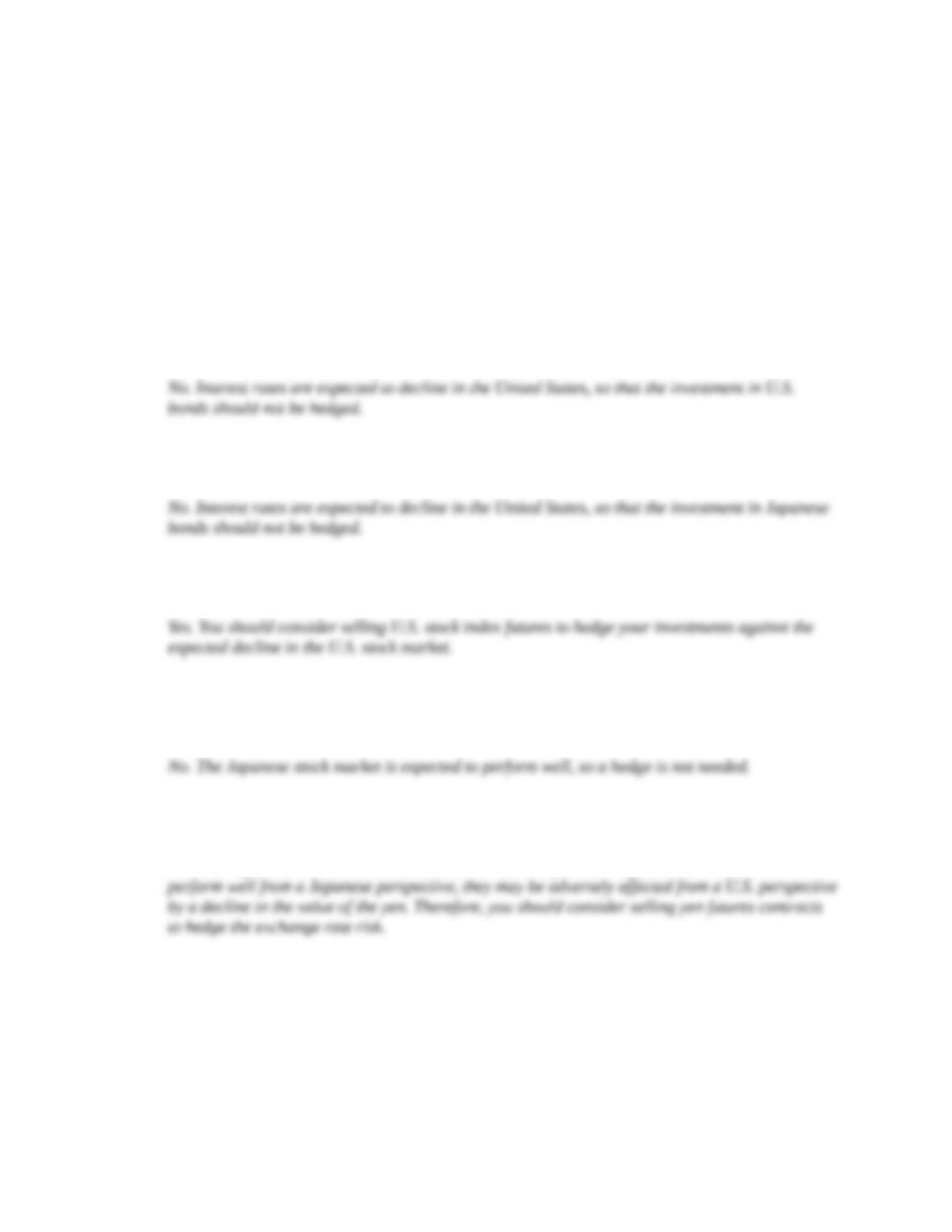
a. Should you consider taking a position in U.S. bond index futures to hedge your investment in
U.S. bonds? Explain.
b. Should you consider taking a position in Japanese bond index futures to hedge your investment in
Japanese bonds? Explain.
c. Should you consider taking a position in U.S. stock index futures to hedge your investment in
U.S. stocks? Explain.
d. Should you consider taking a position in Japanese stock index futures to hedge your investment in
Japanese stocks? (Note: The Japanese stock index is denominated in yen, and therefore is used to
hedge stock movements, not currency movements).
e. Should you consider taking a position in Japanese yen futures to hedge the exchange rate risk of
your investment in Japanese stocks and bonds?
Yes. The Japanese stocks and bonds are denominated in yen. Even if the stocks and bonds
Problems
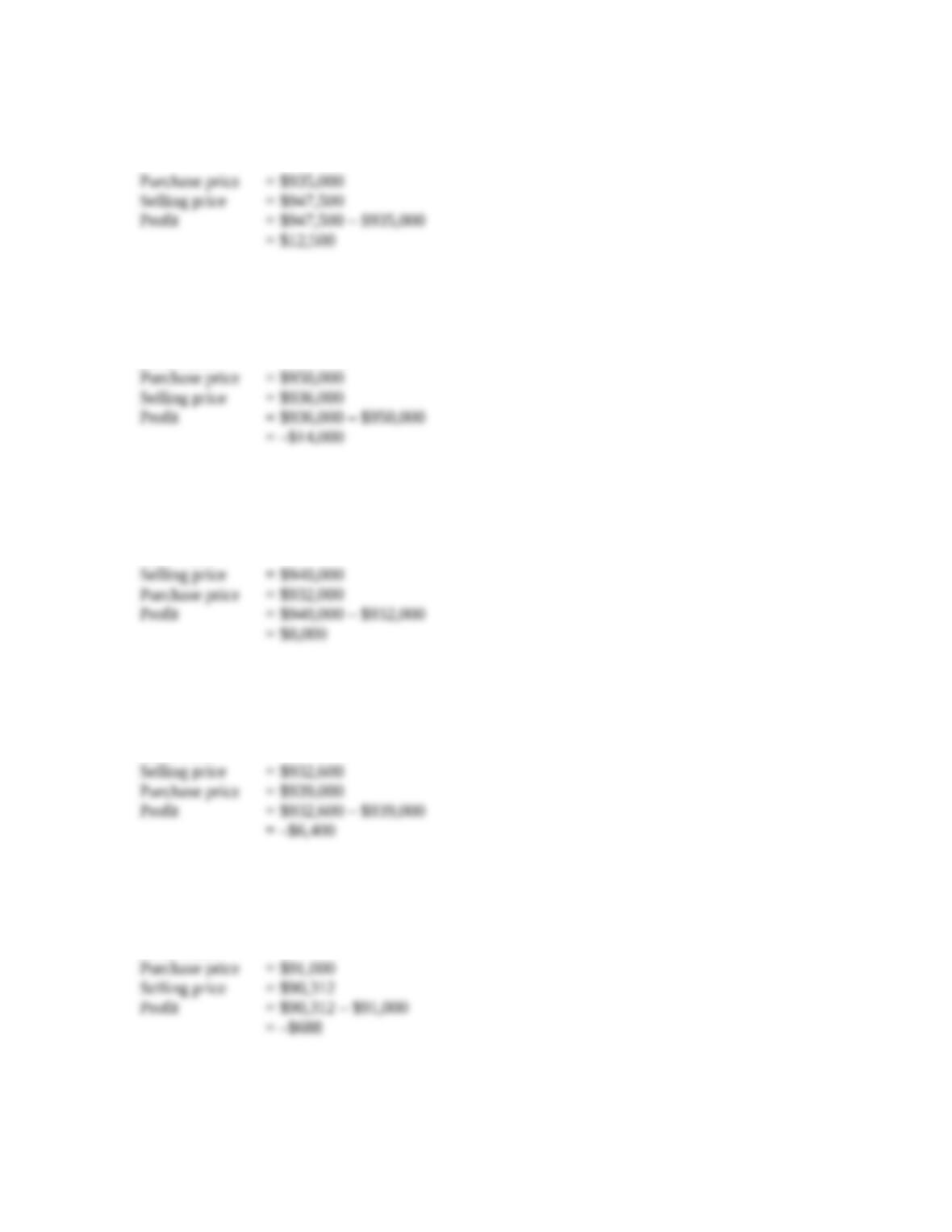
1. Profit from T-bill Futures. Spratt Company purchased Treasury bill futures contracts when the
quoted price was 93-50. When this position was closed out, the quoted price was 94-75. Determine
the profit or loss per contract, ignoring transaction costs.
ANSWER:
2. Profit from T-bill Futures. Suerth Investments Inc. purchased Treasury bill futures contracts when
the quoted price was 95-00. When this position was closed out, the quoted price was 93-60.
Determine the profit or loss per contract, ignoring transaction costs.
ANSWER:
3. Profit from T-bill Futures. Toland Company sold Treasury bill futures contracts when the quoted
price was 94-00. When this position was closed out, the quoted price was 93-20. Determine the profit
or loss per contract, ignoring transaction costs.
ANSWER:
4. Profit from T-bill Futures. Rude Dynamics Inc. sold Treasury bill futures contracts when the quoted
price was 93-26. When this position was closed out, the quoted price was 93-90. Determine the profit
or loss per contract, ignoring transaction costs.
ANSWER:
5. Profit from T-bond Futures. Egan Company purchased a futures contract on Treasury bonds that
specified a price of 91-00. When this position was closed out, the price of the Treasury bond futures
contract was 90-10. Determine the profit or loss, ignoring transaction costs.
ANSWER:
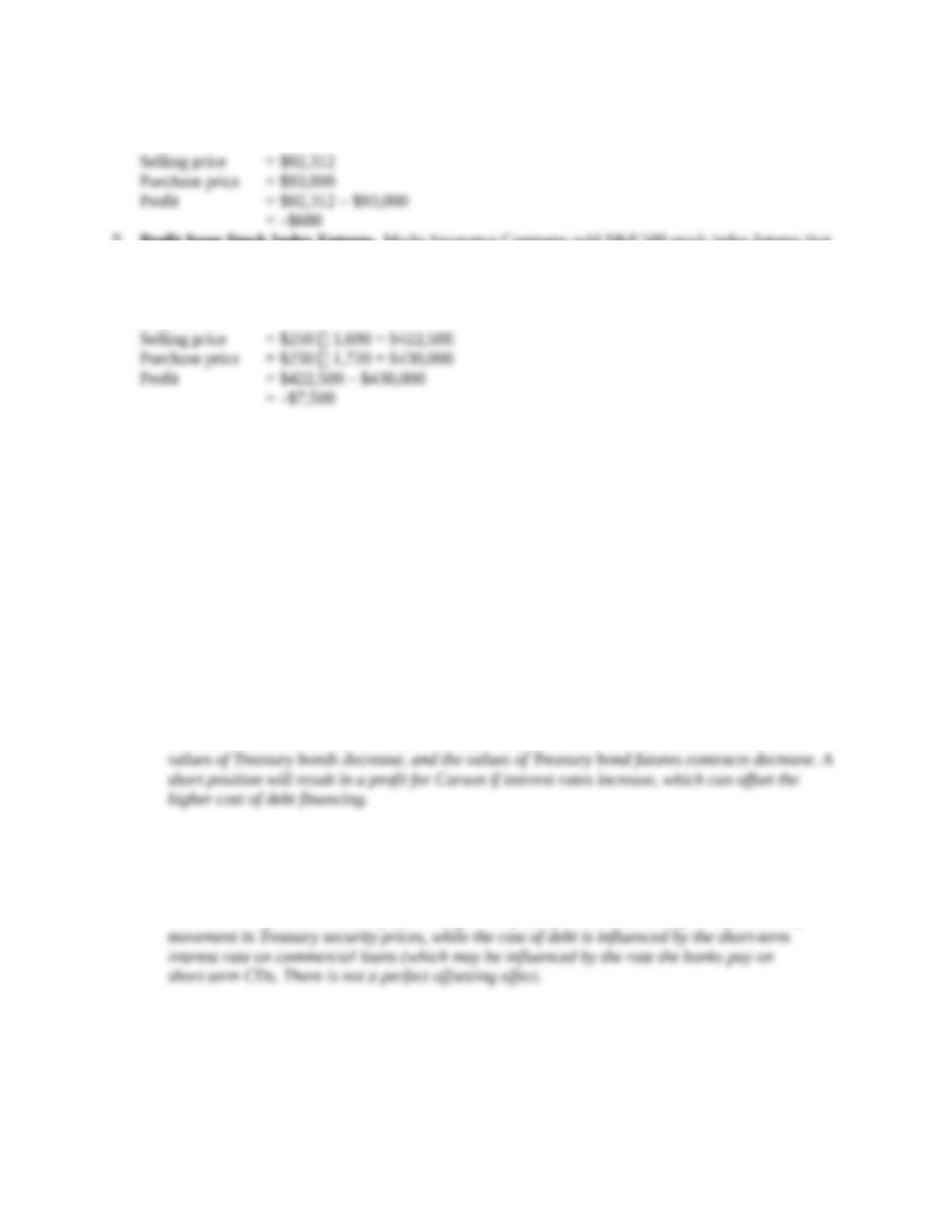
6. Profit from T-bill Futures. R. C. Clark sold a futures contract on Treasury bonds that specified a
price of 92-10. When the position was closed out, the price of Treasury bond futures contract was
93-00. Determine the profit or loss, ignoring transaction costs.
ANSWER:
7. Profit from Stock Index Futures. Marks Insurance Company sold S&P 500 stock index futures that
specified an index of 1690. When the position was closed out, the index specified by the futures
contract was 1,720. Determine the profit or loss, ignoring transaction costs.
ANSWER:
Flow of Funds Exercise
Hedging With Futures Contracts
Recall that if the economy continues to be strong, Carson Company may need to increase its production
capacity by about 50 percent over the next few years to satisfy demand. It would need financing to
expand and accommodate the increase in production. Recall that the yield curve is currently upward
sloping. Also recall that Carson is concerned about a possible slowing of the economy because of
potential Fed actions to reduce inflation. Carson currently relies mostly on commercial loans with floating
interest rates for its debt financing.
a. How could Carson use futures contracts to reduce the exposure of its cost of debt to interest
rate movements? Be specific about whether it would use a short hedge or a long hedge.
Carson could sell Treasury bond (or Treasury bill) futures contracts. If interest rates rise, the
b. Will the hedge that you described in the previous question perfectly offset the increase in debt
costs if interest rates increase? Explain what drives the profit from the short hedge, versus what
drives the higher cost of debt to Carson if interest rates increase.
No. The short position is not a perfect hedge. The profit from the short hedge is influenced by the