Problems
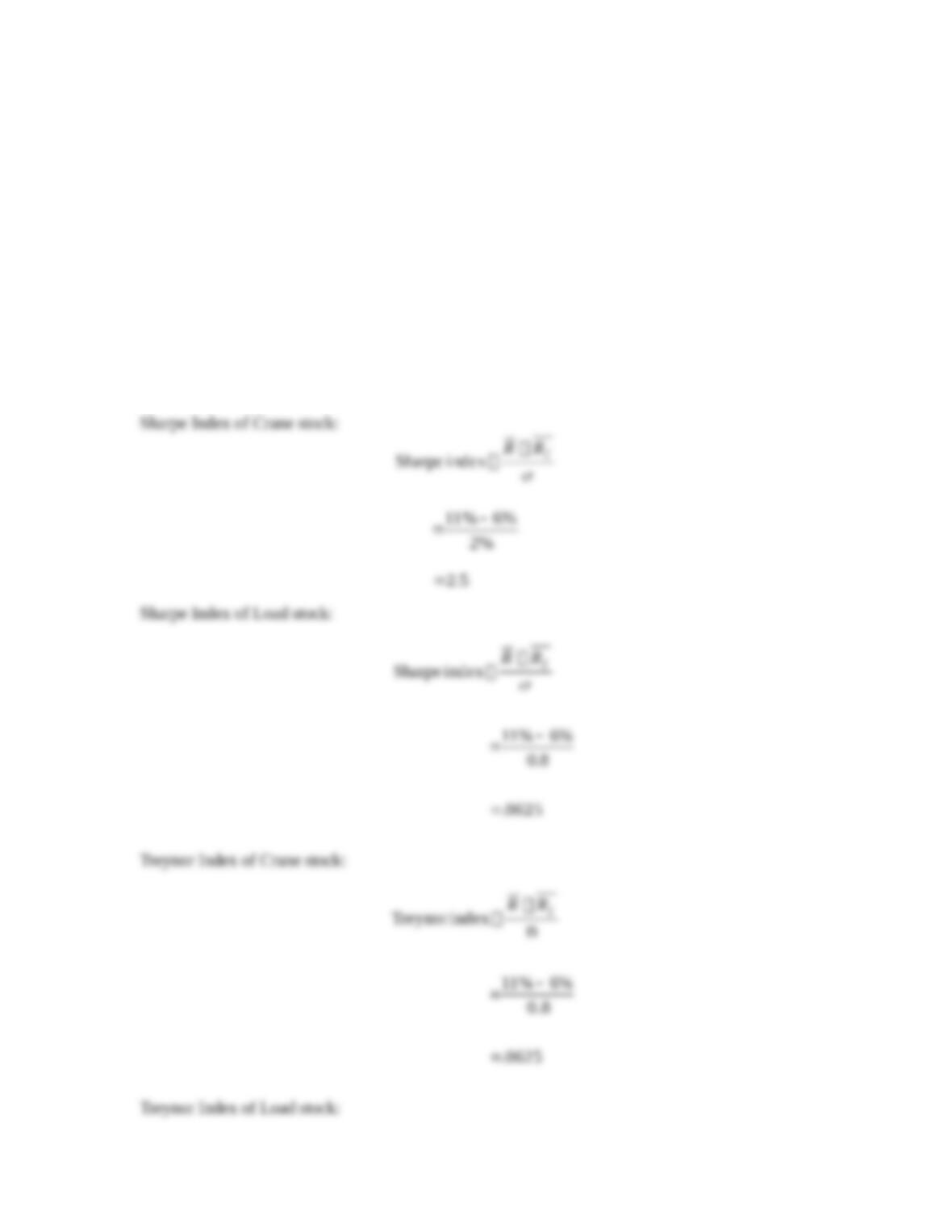
1. Risk-Adjusted Return Measurements. Assume the following information over a five-year period.
Average risk-free rate = 6%
Average return for Crane stock = 11%
Average return for Load stock = 14%
Standard deviation of Crane stock returns = 2%
Standard deviation of Load stock returns = 4%
Beta of Crane stock = 0.8
Beta of Load stock = 1.1
Determine which stock has higher risk-adjusted returns according to the Sharpe Index. Which stock
has higher risk-adjusted returns according to the Treynor Index? Show your work.
ANSWER:
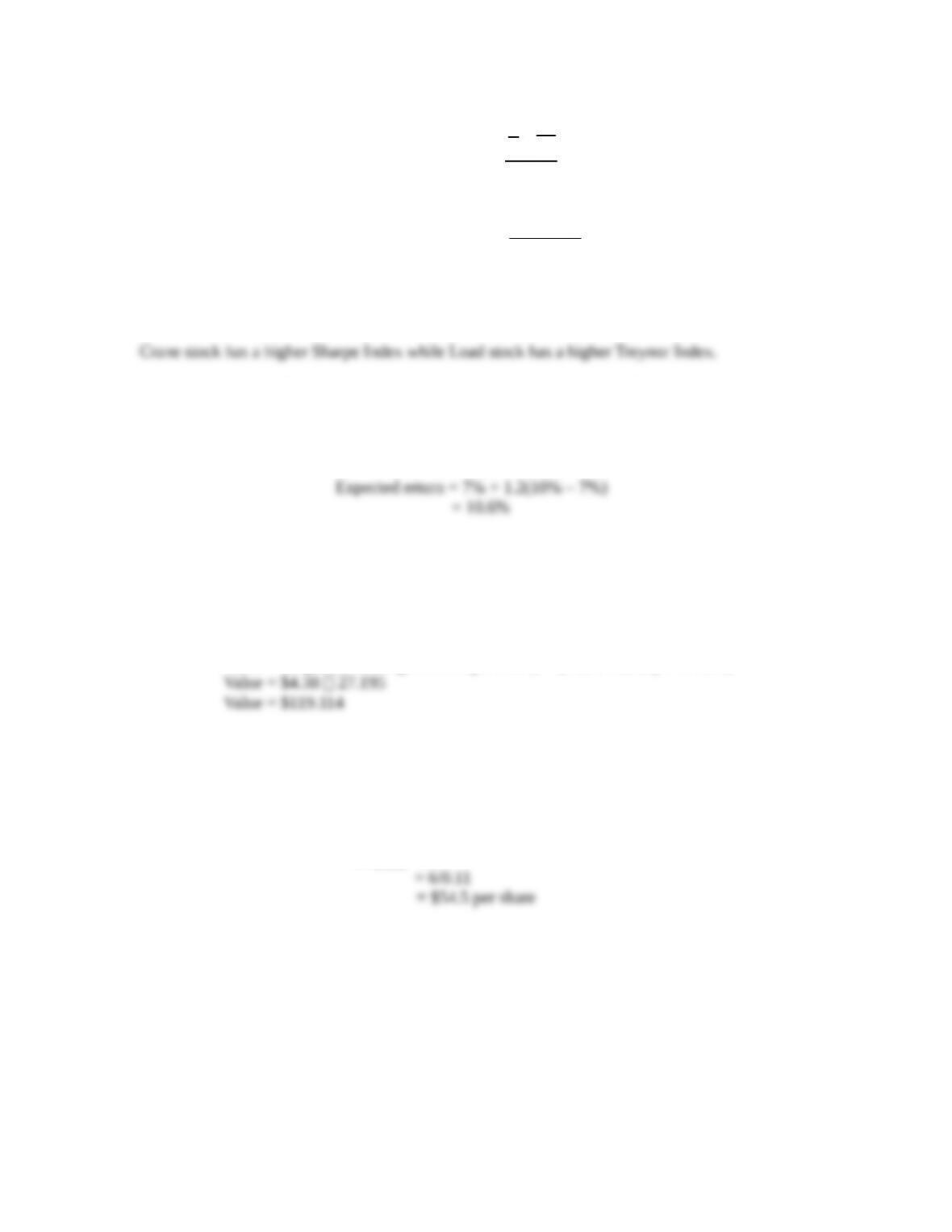
B
indexTreynor f
RR
1.1
%6%14
0727.
Crane stock has a higher Sharpe Index while Load stock has a higher Treynor Index.
2. Measuring Expected Return. Assume Mess stock has a beta of 1.2. If the risk-free rate is 7 percent,
and the market return is 10 percent, what is the expected return on Mess stock?
ANSWER:
3. Using the PE Method. You found that Verto Stock is expected to generate earnings of $4.38 per
share this year, and that the mean PE ratio for its industry is 27.195. Use the PE valuation method to
determine the value of Verto shares.
ANSWER:
Value = (Expected earnings of IBM per share) × (Mean industry P/E ratio)
4. Using the Dividend Discount Model. Suppose that you are interested in buying the stock of a
company that has a policy of paying a $6 per share dividend every year. Assuming no changes in the
firm’s policies, what is the value of a share of stock if the required rate of return is 11 percent?
ANSWER:
PVof stock = D/k
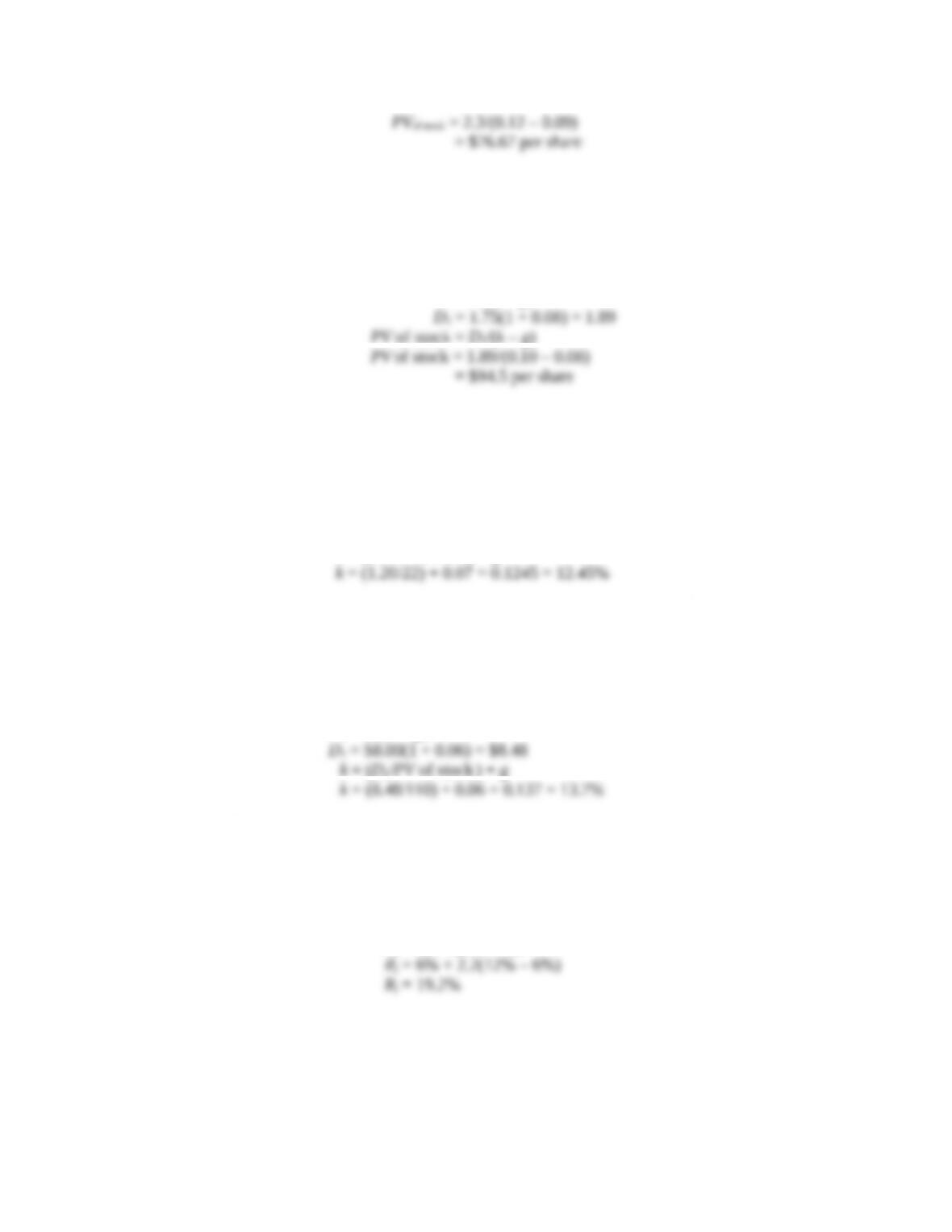
5. Using the Dividend Discount Model. Micro, Inc. will pay a dividend of $2.30 per share next year. If
the company plans to increase its dividend by 9 percent per year indefinitely, and you require a 12
percent return on your investment, what should you pay for the company’s stock?
ANSWER:
PVof stock = D1/(k – g)
6. Using the Dividend Discount Model. Suppose you know that a company just paid a dividend of
$1.75 per share on its stock and that the dividend will continue to grow at a rate of 8 percent per year.
If the required return on this stock is 10 percent, what is the current share price?
ANSWER:
D1 = D0(1 + g)
PV of stock = D1/(k – g)
7. Deriving the Required Rate of Return. The next expected dividend for Sun, Inc., will be $1.20 per
share and analysts expect the dividend to grow at a rate of 7 percent indefinitely. If Sun stock
currently sells for $22 per share, what is the required rate of return?
ANSWER:
PV of stock = D1/(k – g)
k = (D1/PV of stock) + g
8. Deriving the Required Rate of Return. A share of common stock currently sells for $110. Current
dividends are $8 per share, and are expected to grow at 6 percent per year indefinitely. What is the
rate of return required by investors in the stock?
ANSWER:
D1 = D0(1 + g)
k = (D1/PV of stock ) + g
9. Deriving the Required Rate of Return. A stock has a beta of 2.2, the risk-free rate is 6 percent, and
the expected return on the market is 12 percent. Using the CAPM, what would you expect the
required rate of return on this stock to be? What is the market risk premium?
ANSWER:
Rj = Rf + Bj(Rm – Rf )
The market risk premium is 6 percent.
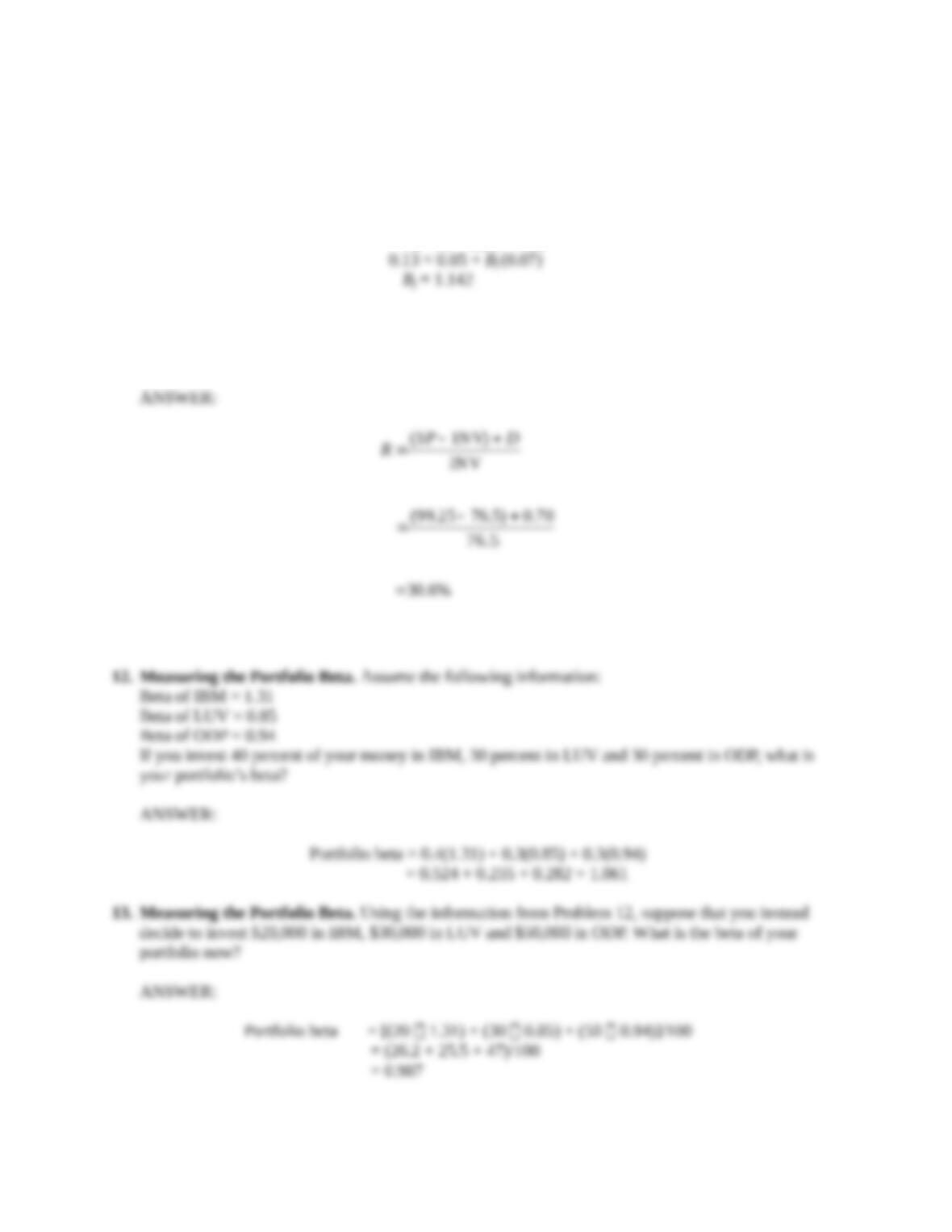
10. Deriving the Stock’s Beta. You are considering investing in a stock that has an expected return of 13
percent. If the risk-free rate is 5 percent and the market risk premium is 7 percent, what must the beta
of this stock be?
ANSWER:
Rj = Rf + Bj(Rm – Rf )
11. Measuring Stock Returns. Suppose you bought a stock at the beginning of the year for $76.50.
During the year, the stock paid a dividend of $0.70 per share and had an ending share price of $99.25.
What is the total percentage return from investing in that stock over the year?
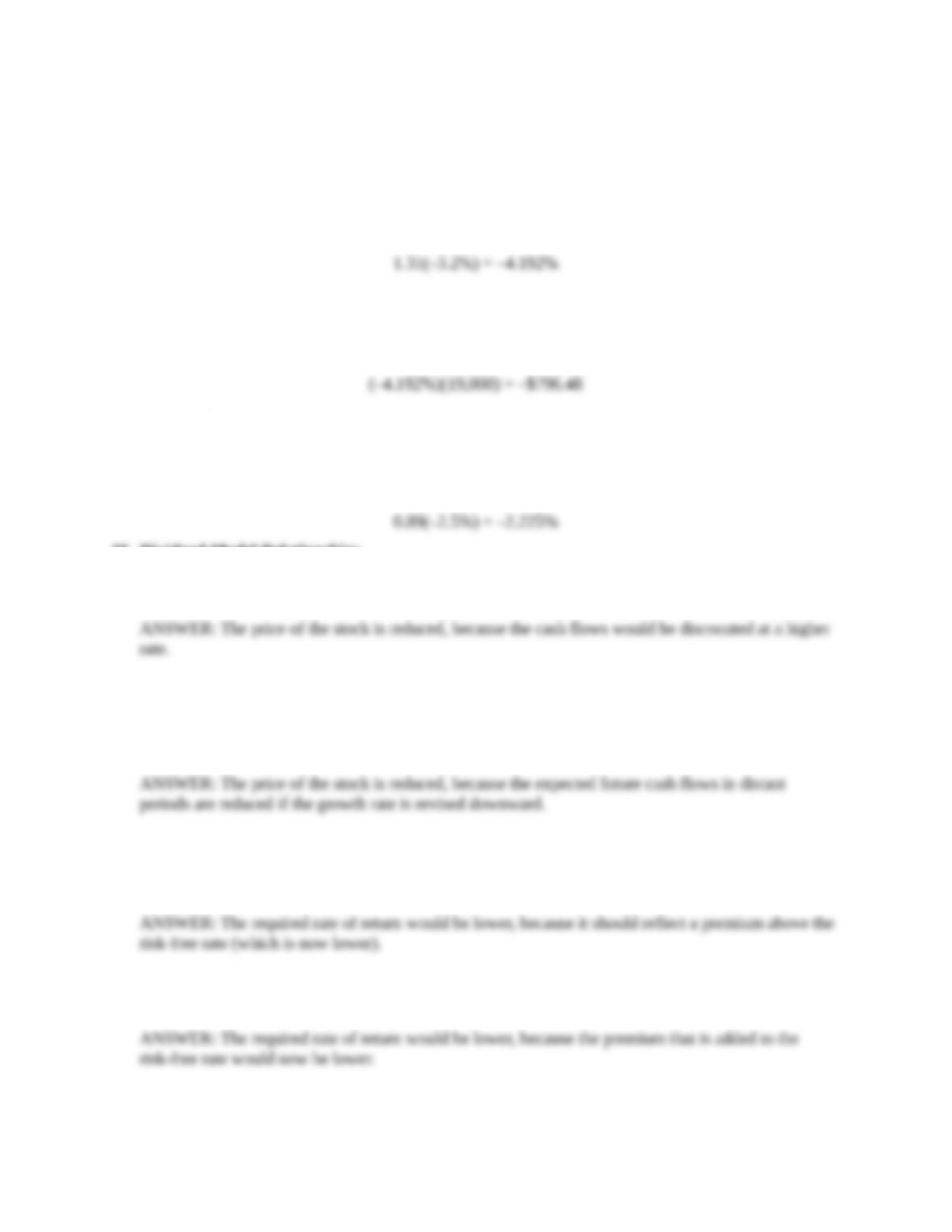
14. Value at Risk. Assume that Quitar Co. has a beta of 1.31.
a. If you assume that the stock market has a maximum expected loss of –3.2 percent on a daily basis
(based on a 95 percent confidence level), what is the maximum daily loss for the Quitar Co.
stock?
ANSWER:
b. If you have $19,000 invested in Quitar Co. stock, what is your maximum daily dollar loss?
ANSWER:
15. Value at Risk. If your portfolio beta is calculated to be 0.89 and the stock market has a maximum
expected loss of –2.5 percent on a daily basis, what is the maximum daily loss to your portfolio?
ANSWER:
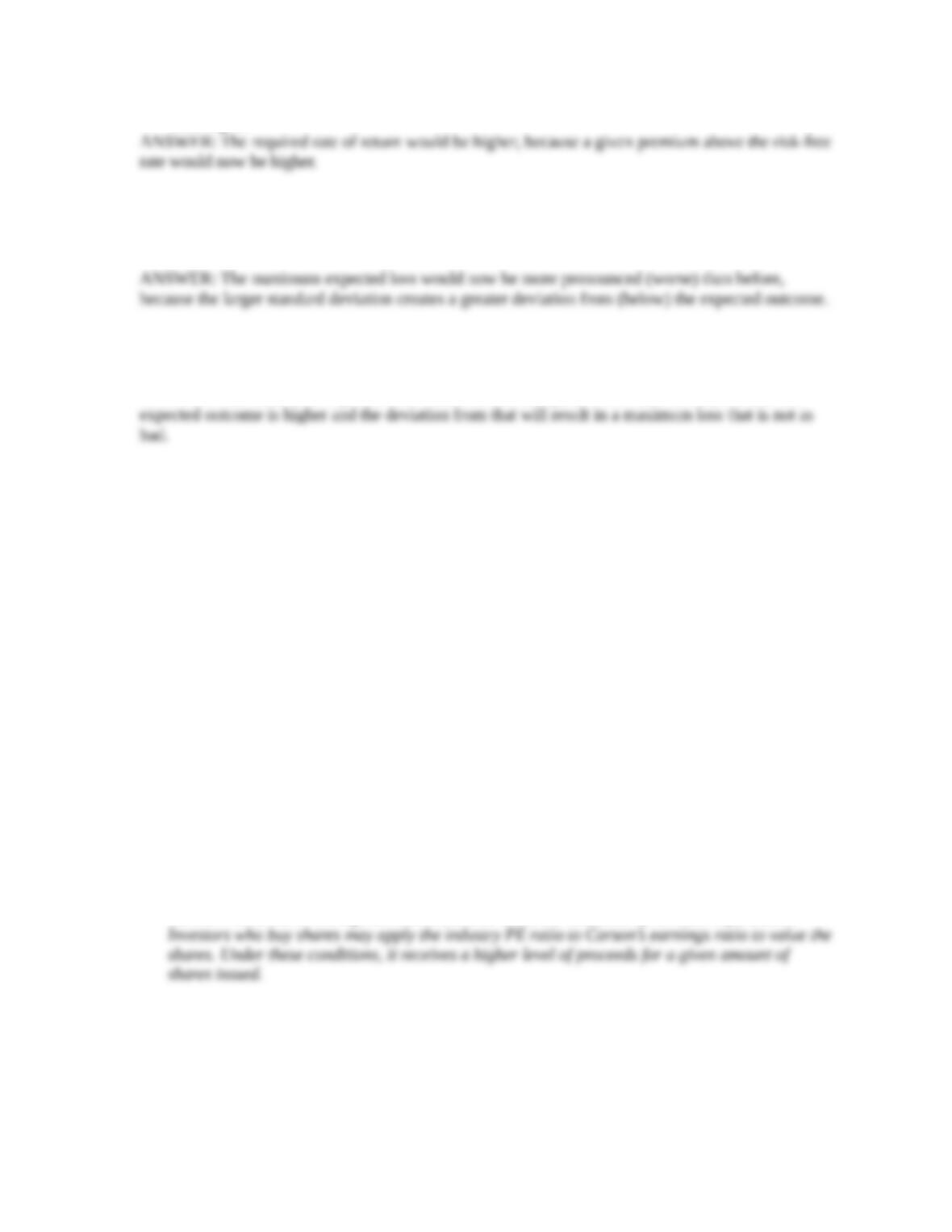
16. Dividend Model Relationships.
a. When computing the price of the stock with the dividend discount model, how would the price of
a stock be affected if the required rate of return is increased. Explain the logic of this relationship.
b. When computing the price of a stock using the constant-growth dividend discount model,
determine how the price of a stock would be affected if the growth rate is reduced. Explain the
logic of this relationship.
17. CAPM Relationships.
a. When using the CAPM, how would the required rate of return on a stock be affected if the
risk-free rate were lower.
b. When using the CAPM, how would the required rate of return on a stock be affected if the market
return were lower.
c. When using the CAPM, how would the required rate of return on a stock be affected if the beta
were higher.
18. Value at Risk.
a. How is the maximum expected loss on a stock affected by an increase in the volatility (standard
deviation), based on a 95 percent confidence interval?
b. Determine how the maximum expected loss on a stock would be affected by an increase in the
expected return of the stock, based on a 95 percent confidence interval.
ANSWER: The maximum expected loss would now be less pronounced than before, because the
Flow of Funds Exercise
Valuing Stocks
Recall that if the economy continues to be strong, Carson Company may need to increase its production
capacity by about 50 percent over the next few years to satisfy demand. It would need financing to
expand and accommodate the increase in production. Recall that the yield curve is currently upward
sloping. Also recall that Carson is concerned about a possible slowing of the economy because of
potential Fed actions to reduce inflation. It is also considering issuing stock or bonds to raise funds in the
next year. If Carson goes public, it might even consider using its stock as a means of acquiring some
target firms. It would also consider engaging in a secondary offering at a future point in time if the IPO is
successful and if its growth continues over time. It would also change its compensation system to
compensate most of its managers with shares of its stock that would represent about 30 percent of their
compensation and would pay the remainder of the compensation as salary.
a. At the present time, the price-earnings (PE) ratio (stock price per share divided by
earnings per share) of other firms in Carson’s industry is relatively low but should rise in the
future. Why might this information affect the time at which Carson issues its stock?
Carson would like to attempt to issue the shares when the valuation of its stock is favorable.
b. Assume that Carson Company believes that issuing of stock is an efficient means of
circumventing the potential for high interest rates. Even if long-term interest rates have increased
by the time it issues stock, Carson thinks that it would be insulated by issuing stock instead of
bonds. Is this view correct?
No. If interest rates increase, the risk-free interest rate that can be earned by investors has
increased. The required rate of return by investors when investing in a new stock contains a risk
c. Carson Company recognizes the importance of a high stock price at the time it
engages in an IPO (if it goes public). But why would its stock price be important to Carson
Company even after the IPO?
First, Carson Company may do a secondary offering someday, and the stock price at the time of
the secondary offering would affect the amount of proceeds it would receive from selling a
d. If Carson Company goes public, it may be able to motivate its managers by granting
them stock as part of their compensation. Explain why the stock may motivate them to perform
well. Then explain why the use of stock as compensation may motivate them to use a very focus
on short-term goals, even though they are supposed to focus on maximizing shareholder wealth
over the long run. How can a firm provide stock as motivation but prevent its managers from
using a very short-term focus?
Stock compensation can motivate managers to make decisions that maximize the stock price,
because the managers benefit directly when they hold shares of the firm’s stock. Yet, some
Answers to Appendix Discussion Questions
1. Should an accounting firm be prohibited from offering both auditing services and consulting services
to the same client? Explain your answer. If an accounting firm offered only one service, could there
still be conflicts of interest due to referrals (and finder’s fees)?
ANSWER: The goal is to allow students to present advantages and disadvantages of the SEC’s
proposal for accounting firms to provide only auditing or consulting services. Even if the accounting
2. Should members of Congress be allowed to set regulations on accounting and financial matters while
receiving donations from related lobbying groups?
3. What alternative sources of information about a firm should investors rely on if they cannot rely on
financial statements?
ANSWER: The alternative sources of information about a firm come from securities firms and other
4. Should investors have confidence in ratings by analysts who are affiliated with securities firms that
provide consulting services to firms? Explain.
ANSWER: If analysts are unwilling to assign a true rating to a firm, then investors cannot rely on
5. Does an analyst employed by a securities firm to rate firms face a conflict of interest? If so, can the
conflict be resolved?
ANSWER: There is a conflict of interests if analysts must appease firms that they rate so that their
6. How might a firm’s board of directors discourage its managers from attempting to manipulate
financial statements to create a temporarily high stock price?
ANSWER: The firm could implement a compensation system that prevents managers from selling
any of their holdings of the firm’s stock in a short period of time. That is, managers would only be
7. How can the compensation of a firm’s board of directors be structured so that the board will not be
tempted to allow accounting or other managerial decisions that could cause a superficially high price
over a short period?
ANSWER: The firm could implement a compensation system that prevents board members from
selling any of their holdings of the firm’s stock in a short period of time. That is, board members