Units Cost Amount
10 60 49
19 (60) 49
47052
15 70 52
120 53
23 (70) 52
(120) 53
25 40 54
30 40 54
100 55
Balance
Ending inventory
Date
Sale
Sale
Balance
P8. Perpetual Inventory System and Inventory Costing Methods (Continued)
2. Perpetual inventory system—FIFO method
Balance
Balance
7-37
© 2014 Cengage Learning. All Rights Reserved. May not be scanned, copied, duplicated, or posted to a publicly accessible website, in whole or in part.
Units Cost Amount
10 60 49
31 60 49
46049
10 52
15 60 49
10 52
120 53
23 (50) 54
(120) 53
(10) 52
25 40 49
30 40 49
100 55
4.
3. Perpetual inventory system—LIFO method
In a long period of rising prices, how realistic the inventory value of the balance
sheet is will depend on the inventory method used by the company. For instance, if
the company uses the average method, the inventory should reflect the average
price paid over the past year. If the LIFO method is used, the inventory prices will
likely reflect lower prices paid many years before. If the FIFO method is used, the in-
Cost of goods sold for March equals the total cost of the sale made on March 19, or $4,680.
Cost of goods sold for April equals the total cost of the sale made on April 23, or $10,560.
Balance
Balance
Balance
P8. Perpetual Inventory System and Inventory Costing Methods (Concluded)
Balance
Ending inventory
Date
Ending inventory
Sale
7-38
© 2014 Cengage Learning. All Rights Reserved. May not be scanned, copied, duplicated, or posted to a publicly accessible website, in whole or in part.
Cost Retail
2.
4.
1. Month-end inventory at cost estimated
October 31 physical inventory
The retail method is an efficient way for companies to operate because sales employees
P9. Retail Method
7-39
© 2014 Cengage Learning. All Rights Reserved. May not be scanned, copied, duplicated, or posted to a publicly accessible website, in whole or in part.
1.
2.
Schedule to Estimate Inventory Destroyed
April 22, 2014
Zubac Company
P10. Gross Profit Method
Management may want to estimate the cost of inventory for interim reports or esti-
7-40
© 2014 Cengage Learning. All Rights Reserved. May not be scanned, copied, duplicated, or posted to a publicly accessible website, in whole or in part.
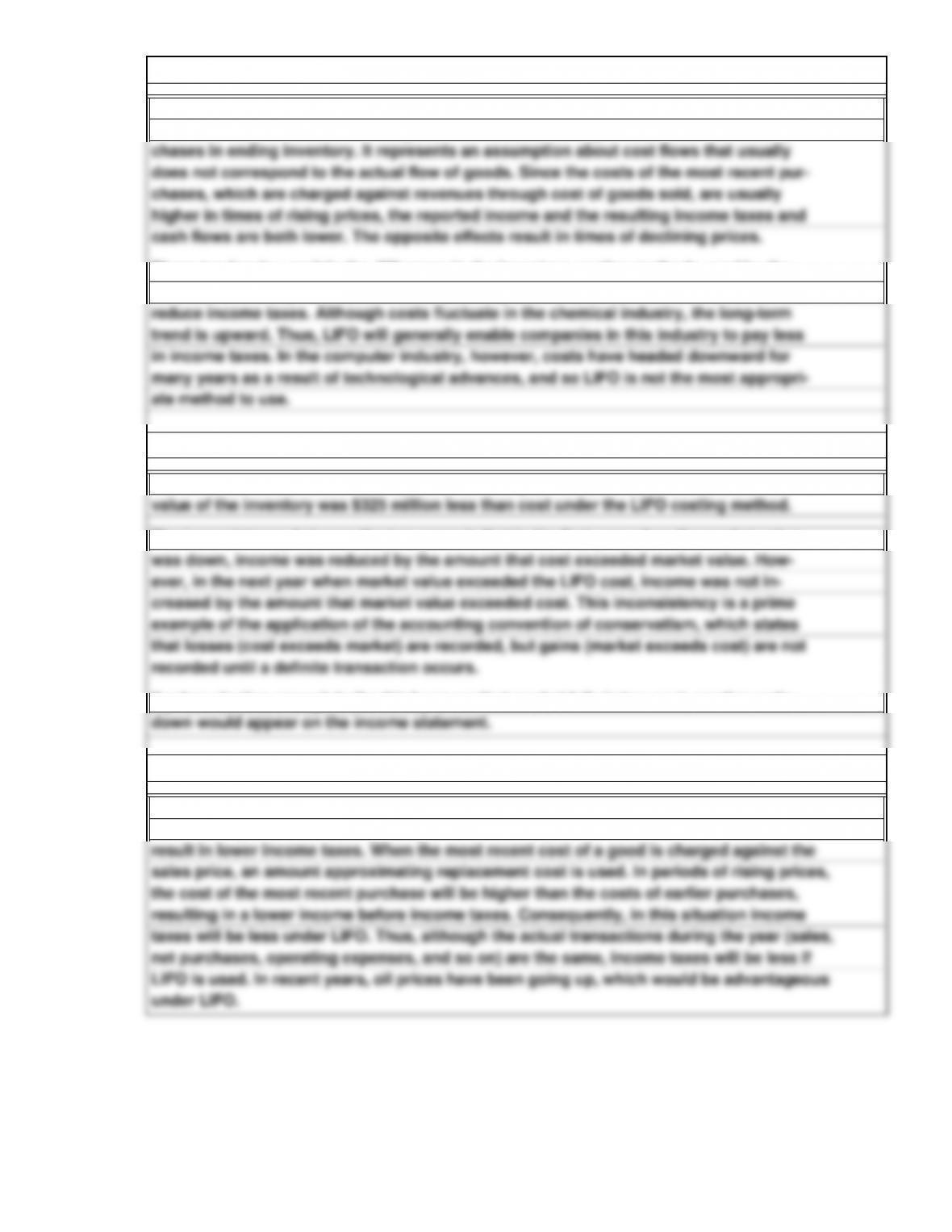
taxes will be less under LIFO. Thus, although the actual transactions during the year (sales,
net purchases, operating expenses, and so on) are the same, income taxes will be less if
LIFO is used. In recent years, oil prices have been going up, which would be advantageous
under LIFO.
result in lower income taxes. When the most recent cost of a good is charged against the
sales price, an amount approximating replacement cost is used. In periods of rising prices,
the cost of the most recent purchase will be higher than the costs of earlier purchases,
resulting in a lower income before income taxes. Consequently, in this situation income
A company like ExxonMobil may choose LIFO because management believes that LIFO is
more closely tied to the reality that goods must be replaced when sold and that LIFO may
down would appear on the income statement.
creased by the amount that market value exceeded cost. This inconsistency is a prime
example of the application of the accounting convention of conservatism, which states
that losses (cost exceeds market) are recorded, but gains (market exceeds cost) are not
recorded until a definite transaction occurs.
was down, income was reduced by the amount that cost exceeded market value. How-
ever, in the next year when market value exceeded the LIFO cost, income was not in-
If prices decline enough in the third year so that market falls below cost, another write-
C2. Interpreting Financial Reports: LCM and Conservatism
C3. Interpreting Financial Reports: FIFO and LIFO
The LCM rule resulted in a write-down in the first year of $325 million because the market
The inconsistency between the two years is that in the first year when the market value
many years as a result of technological advances, and so LIFO is not the most appropri-
ate method to use.
chases, which are charged against revenues through cost of goods sold, are usually
higher in times of rising prices, the reported income and the resulting income taxes and
cash flows are both lower. The opposite effects result in times of declining prices.
These tendencies explain the difference in the inventory costing methods used by the
chemical and computer industries, since an important motivation in both industries is to
C1. Conceptual Understanding: LIFO Inventory Method
LIFO—or last-in, first-out—is an inventory pricing method that transfers the costs of the
most recent purchases to cost of goods sold while retaining the costs of the earliest pur-
7-41
© 2014 Cengage Learning. All Rights Reserved. May not be scanned, copied, duplicated, or posted to a publicly accessible website, in whole or in part.
( + ) / 2
( + ) / 2
times
*Rounded
Days’ Inventory on Hand Number of Days in a Year
7.2
CVS’s Days’ Inventory on Hand:
=
Inventory Turnover
$10,519.0
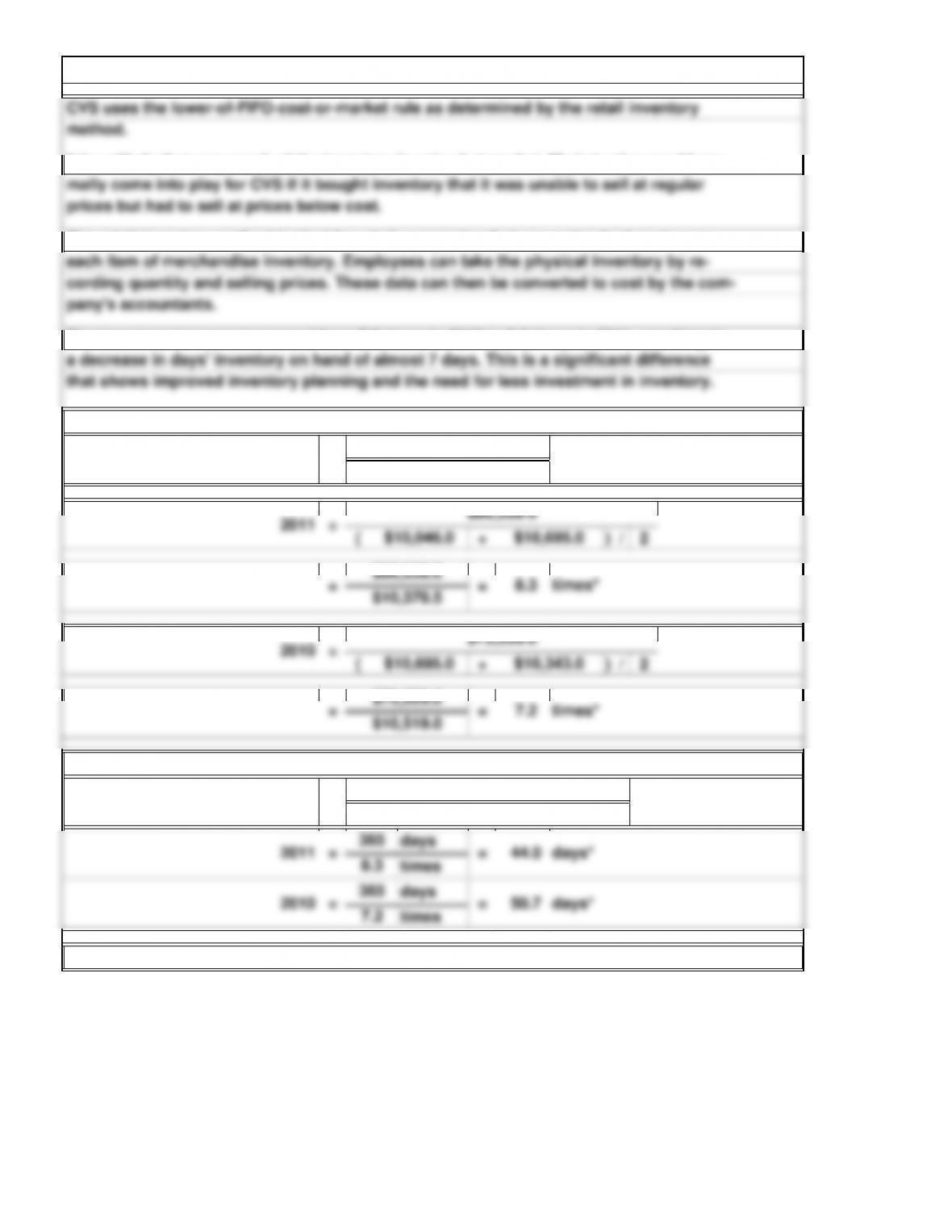
2010 = $75,559.0
$10,343.0$10,695.0
=$86,539.0 = 8.3 times*
$10,370.5
2011 = $86,539.0
$10,695.0$10,046.0
CVS’s Inventory Turnover (in millions):
Inventory Turnover = Cost of Goods Sold
Average Inventory
that shows improved inventory planning and the need for less investment in inventory.
each item of merchandise inventory. Employees can take the physical inventory by re-
cording quantity and selling prices. These data can then be converted to cost by the com-
The inventory turnover increased from 7.2 times in 2010 to 8.3 times in 2011, resulting in
a decrease in days’ inventory on hand of almost 7 days. This is a significant difference
pany’s accountants.
mally come into play for CVS if it bought inventory that it was unable to sell at regular
prices but had to sell at prices below cost.
The retail inventory method is ideal for retail companies that use a standard markup on
C4. Annual Report Case: Inventory Costing Methods and Ratios
It is unlikely that very much of the inventory is valued at market. Market value would nor-
7-42
© 2014 Cengage Learning. All Rights Reserved. May not be scanned, copied, duplicated, or posted to a publicly accessible website, in whole or in part.
days
times
days
times
365
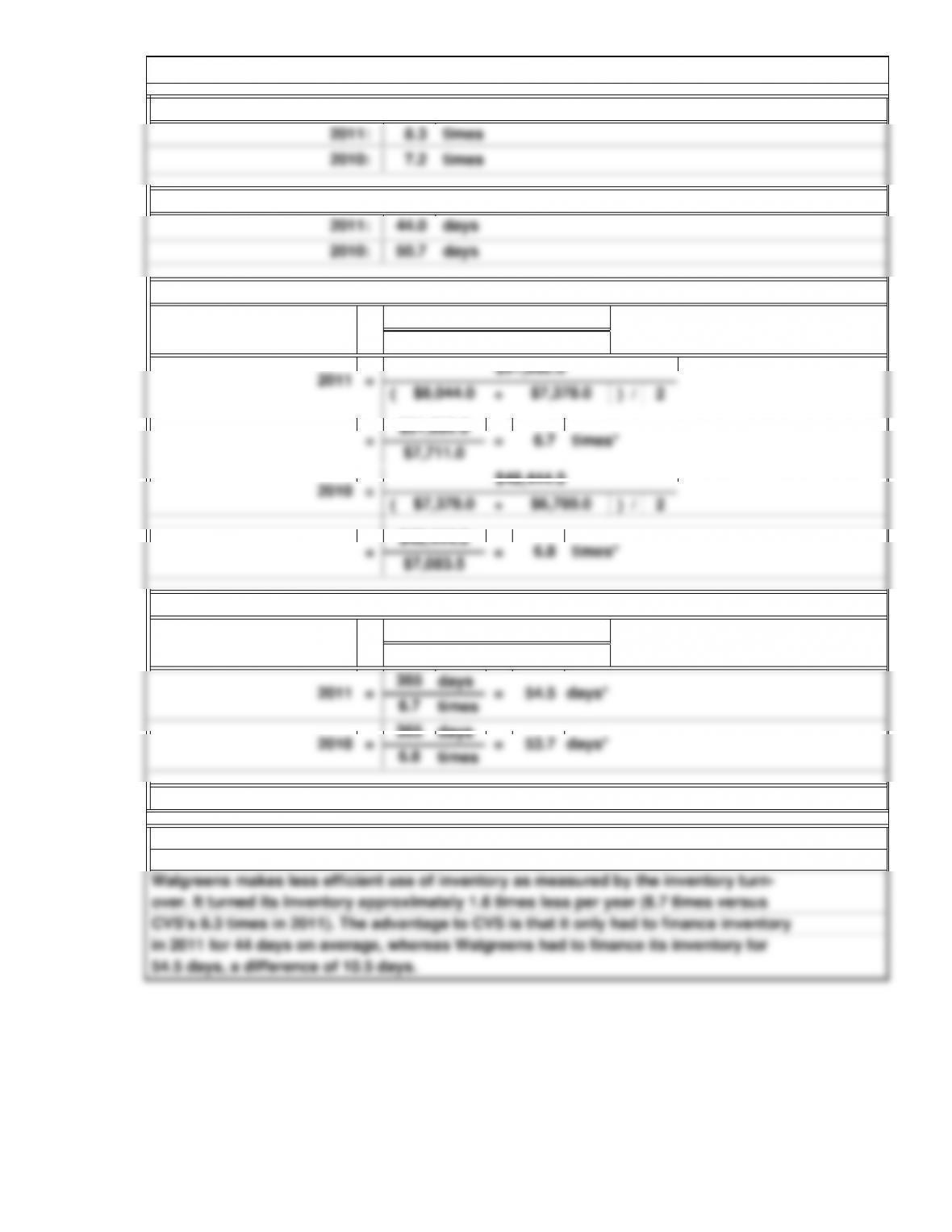
6.7 = 54.5
*Rounded
53.7 days*
days*
While Walgreens remained steady from 2010 to 2011, CVS improved. However, Wal-
greens had a lower inventory turnover. The most important conclusion to draw is that
C5. Comparison Analysis: Inventory Efficiency
Days’ Inventory on Hand Number of Days in a Year
Inventory Turnover
=
Walgreens’ Days’ Inventory on Hand:
=
2011
==2010 365
6.8
8.3
7.2
44.0
50.7 days
2011:
CVS’s Average Days’ Inventory on Hand (from C4):
2011:
2010:
2010:
=$48,444.0 = 6.8 times*
$7,083.5
Inventory Turnover* = Cost of Goods Sold
Average Inventory
CVS’s Inventory Turnover (from C4):
times
days
times
Walgreens’ Inventory Turnover:
7-43
© 2014 Cengage Learning. All Rights Reserved. May not be scanned, copied, duplicated, or posted to a publicly accessible website, in whole or in part.
C8. Continuing Case: Annual Report Project
Note to Instructor: Answers will vary depending on the company selected by the students.
Because the goods ordered by The Executive Woman have not been separated, they will
be included in the inventory count on December 31. If the auditors do not detect this situ-
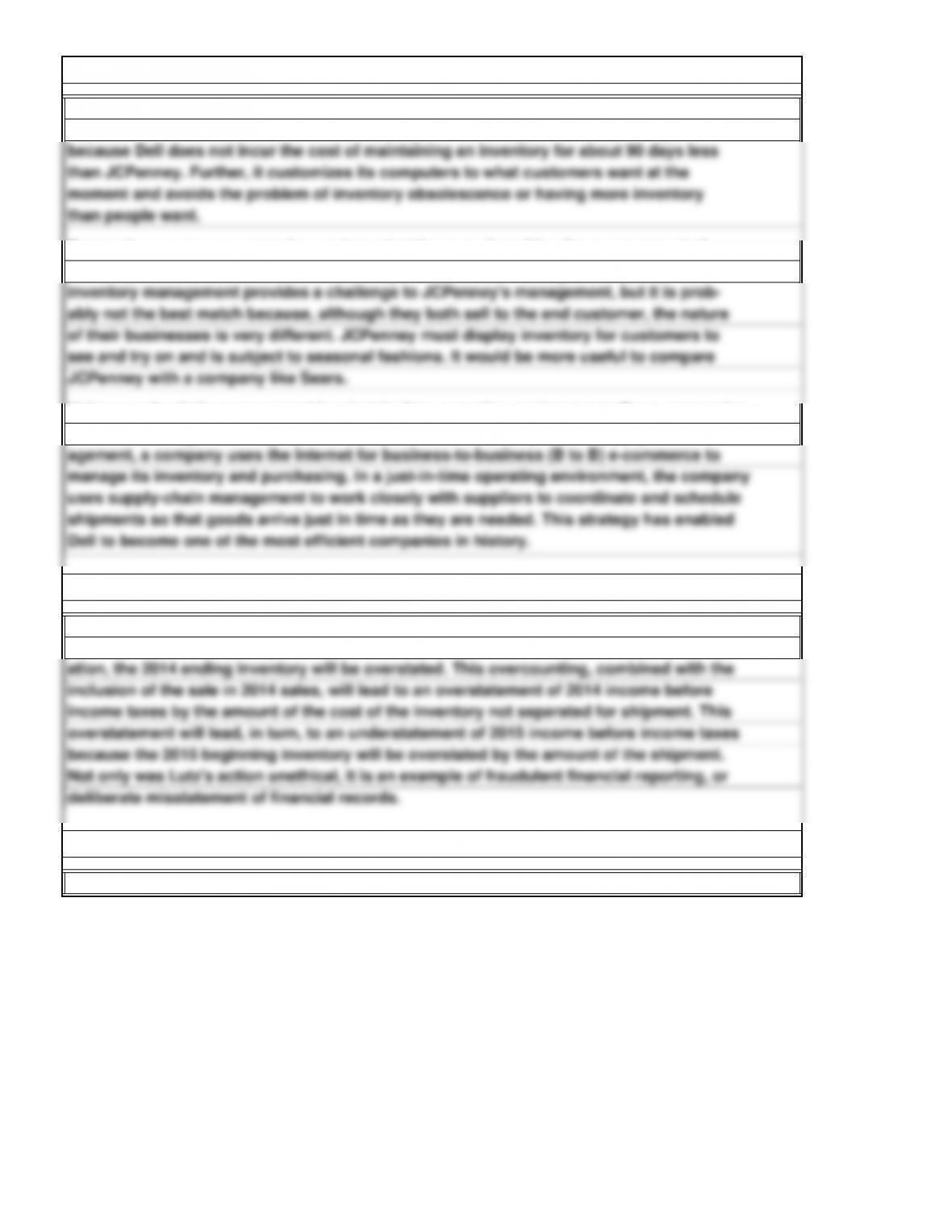
ation, the 2014 ending inventory will be overstated. This overcounting, combined with the
inclusion of the sale in 2014 sales, will lead to an overstatement of 2014 income before
income taxes by the amount of the cost of the inventory not separated for shipment. This
overstatement will lead, in turn, to an understatement of 2015 income before income taxes
Dell to become one of the most efficient companies in history.
C7. Ethical Dilemma: Inventories, Income Determination, and Ethics
Using supply-chain management in a just-in-time operating environment allows companies
to use technology to attempt to reduce their levels of inventory. Under supply-chain man-
agement, a company uses the Internet for business-to-business (B to B) e-commerce to
manage its inventory and purchasing. In a just-in-time operating environment, the company
uses supply-chain management to work closely with suppliers to coordinate and schedule
inventory management provides a challenge to JCPenney’s management, but it is prob-
ably not the best match because, although they both sell to the end customer, the nature
of their businesses is very different. JCPenney must display inventory for customers to
shipments so that goods arrive just in time as they are needed. This strategy has enabled
than people want.
Comparisons among companies are important because it enables the management of
the companies to benchmark themselves against other well-managed companies. Dell’s
C6. Evaluation of Inventory Levels
Since JCPenney’s inventory turnover is 3.8, its average inventory on hand is about 100
days compared to Dell’s, which is about 10 days. This is a big business advantage to Dell
7-44
© 2014 Cengage Learning. All Rights Reserved. May not be scanned, copied, duplicated, or posted to a publicly accessible website, in whole or in part.